
Reports
The Global Renewable Energy Certificate Market was valued at USD 5240 Million in 2025 and is anticipated to reach a value of USD 9541.9 Million by 2033 expanding at a CAGR of 7.78% between 2026 and 2033. Growth is being accelerated by expanding corporate renewable electricity procurement, stricter decarbonization mandates, cross-border clean energy trading frameworks, and digital certificate tracking platforms that improve transparency and compliance efficiency.
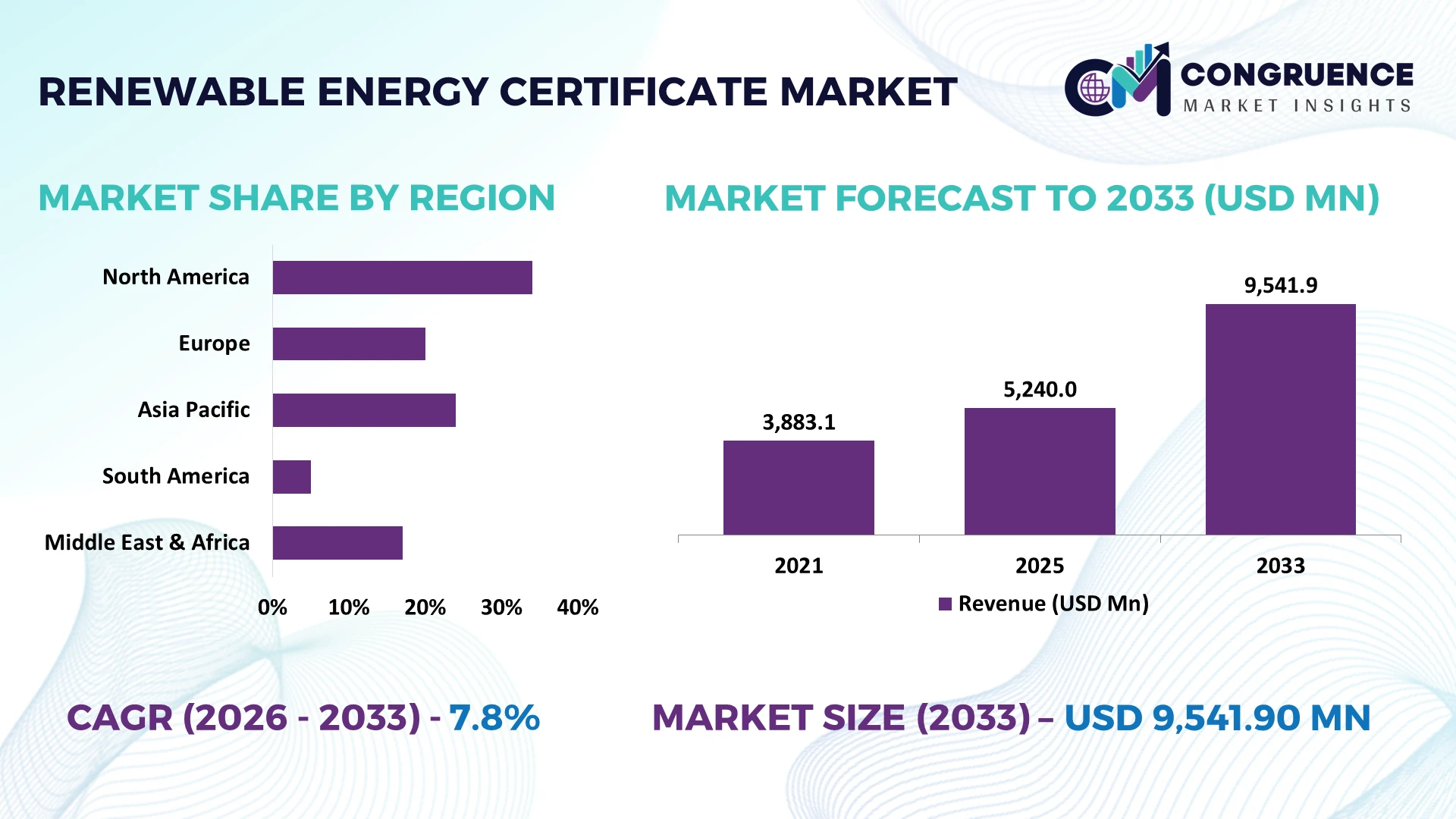
The United States remains the dominant country, accounting for approximately 34% of global Renewable Energy Certificate issuance, supported by utility-scale solar and wind additions, corporate power purchase agreements, and advanced digital registry systems. Following renewed energy security priorities after the Europe-Russia energy transition, Germany continues expanding renewable compliance programs, while the U.S. installed renewable capacity exceeds Germany by more than 2.5 times, strengthening market liquidity and institutional participation across major industries.
Strategic positioning in digitally verified certificate ecosystems and high-liquidity trading regions will define competitive advantage for market participants through 2033.
Market Size & Growth: USD 5240 Million (2025) to USD 9541.9 Million (2033) at 7.78% CAGR, supported by expanding corporate clean-energy procurement and digital certificate verification.
Top Growth Drivers: Corporate renewable procurement (+31%), utility-scale renewable additions (+24%), and mandatory sustainability compliance (+18%) continue strengthening certificate demand.
Short-Term Forecast: By 2028, automated certificate management reduces transaction processing time by nearly 35%, improving operational efficiency across large enterprises.
Emerging Technologies: AI-powered verification, blockchain-based certificate registries, and automated compliance platforms improve transparency by approximately 30% while reducing administrative workloads.
Regional Leaders: North America approaches USD 3.6 Billion, Europe USD 2.8 Billion, and Asia-Pacific USD 2.2 Billion by 2033, driven by regional expansion and accelerated renewable adoption.
Consumer/End-User Trends: More than 62% of multinational enterprises integrate Renewable Energy Certificates into enterprise decarbonization strategies and annual sustainability reporting.
Pilot/Case Example: In 2026, enterprise digital REC trading platforms improved certificate settlement efficiency by nearly 40%, supporting faster cross-market transactions.
Competitive Landscape: The top market participants collectively account for approximately 38% market share, with key companies including APX, Xpansiv, STX Group, Evident, and Ecohz.
Regulatory & ESG Impact: Enhanced climate disclosure requirements increase renewable certificate participation by nearly 22%, strengthening transparent environmental reporting across global industries.
Investment & Funding: More than USD 2.4 Billion supports registry modernization, clean-energy trading infrastructure, and strategic partnerships amid evolving global energy supply-chain priorities.
Innovation & Future Outlook: Advanced digital registries, real-time certificate authentication, and integrated carbon accounting accelerate next-generation renewable compliance and strategic market expansion.
The Renewable Energy Certificate Market is witnessing stronger demand from data centers, manufacturing, technology companies, and commercial utilities seeking verified renewable electricity claims. AI-enabled registry management and blockchain-based certificate authentication are improving transaction accuracy, while digital trading participation has increased by approximately 28%. Evolving environmental disclosure requirements and expanding cross-border renewable procurement frameworks continue reshaping operational strategies, setting the stage for broader strategic market developments.
The Renewable Energy Certificate Market has become a strategic instrument for utilities, multinational corporations, and energy-intensive industries seeking verified renewable electricity claims while strengthening competitive positioning. Regulatory harmonization, expanding voluntary procurement programs, and digital certificate exchanges are reshaping market participation. Supply-chain restructuring following global energy security initiatives has accelerated localized renewable sourcing, encouraging organizations to integrate certificate procurement directly into enterprise sustainability and procurement strategies rather than treating it solely as a compliance activity.
Modern blockchain-enabled certificate registries process transactions approximately 40% faster than conventional manual verification platforms while reducing administrative costs by nearly 25%, improving operational transparency and audit readiness. The United States maintains higher trading liquidity through mature renewable procurement ecosystems, whereas India is rapidly expanding digital certificate deployment alongside utility-scale solar capacity, creating stronger opportunities for industrial consumers. Over the next two to three years, enterprise digital certificate adoption is expected to exceed 60% among large electricity buyers, supported by automated compliance workflows and interoperable registry platforms.
A growing number of hyperscale data center operators now integrate Renewable Energy Certificates with long-term power purchase agreements to optimize sustainability reporting and procurement flexibility. Companies are expanding partnerships with digital trading platforms, renewable generators, and registry providers to improve transaction efficiency, strengthen certificate traceability, and establish long-term competitive differentiation through scalable clean-energy procurement capabilities.
Mandatory climate disclosure frameworks and corporate net-zero commitments continue strengthening Renewable Energy Certificate procurement across electricity-intensive industries. More than 68% of Fortune 500 companies now incorporate renewable electricity sourcing into sustainability strategies, while automated certificate platforms reduce processing time by nearly 35% and improve verification accuracy by approximately 30%. The United States continues expanding voluntary renewable procurement, supported by increasing utility-scale renewable generation and advanced registry infrastructure. This combination improves certificate availability and market transparency. Companies are responding through digital platform investments, long-term renewable procurement agreements, and strategic partnerships with certificate exchanges to streamline compliance while strengthening environmental reporting and operational resilience. An important strategic shift is the integration of certificate procurement into enterprise energy management systems, enabling faster procurement decisions and stronger audit performance.
Differences in certificate standards, registry structures, and cross-border recognition continue limiting seamless Renewable Energy Certificate trading. Cross-market transaction complexity increases administrative workloads by nearly 28%, while inconsistent verification protocols extend settlement periods by approximately 20%. Japan, Australia, and several emerging certificate markets continue operating under distinct regulatory structures, reducing international trading efficiency. These structural limitations affect procurement flexibility, increase compliance costs, and complicate multinational sustainability reporting. Companies are reducing operational exposure through diversified procurement portfolios, localized certificate sourcing, and long-term contractual arrangements with trusted registry operators. Strategic investment in interoperable digital infrastructure has become essential for maintaining transaction reliability and supporting multinational renewable procurement strategies.
Artificial intelligence, blockchain verification, and automated environmental reporting are creating high-value opportunities beyond traditional certificate transactions. Digital trading platforms improve matching efficiency by nearly 32%, while automated compliance systems reduce reporting workloads by approximately 27%. India is rapidly expanding renewable electricity generation alongside digital energy market modernization, creating untapped demand from manufacturing clusters and technology campuses. Companies are increasing investment in cloud-based certificate management, API-enabled trading ecosystems, and integrated carbon accounting platforms to deliver faster settlement and greater transparency. A notable strategic opportunity lies in combining Renewable Energy Certificates with real-time electricity consumption analytics, enabling enterprises to optimize procurement timing while strengthening operational efficiency and sustainability performance.
Long-term market expansion depends on securely integrating certificate registries with evolving digital energy ecosystems. Cybersecurity incidents targeting energy platforms have increased by more than 20% globally, while interoperability implementation projects frequently extend deployment timelines by nearly 18% because of complex legacy infrastructure. Germany and the United States continue investing in digital energy modernization, yet integrating multiple registry platforms, utilities, and enterprise systems remains operationally demanding. These execution challenges directly influence transaction consistency, reporting accuracy, and stakeholder confidence. Companies must strengthen investment in secure cloud infrastructure, workforce capabilities, standardized data architectures, and technology partnerships to ensure scalable certificate management while preserving operational integrity and long-term competitiveness in increasingly digital renewable energy markets.
Digital Registry Modernization Accelerates Enterprise buyers are replacing manual certificate workflows with blockchain-enabled registries and automated validation platforms, reducing processing times by nearly 40% while improving audit accuracy by around 30%. Regulatory digitization in the United States and Europe is driving interoperability upgrades, prompting certificate exchanges and utilities to expand technology partnerships that lower administrative costs and improve transaction speed.
Corporate Procurement Becomes Integrated More than 60% of large multinational companies now integrate Renewable Energy Certificate purchasing directly into enterprise energy management systems, while automated procurement workflows reduce contract execution time by approximately 25%. Growing sustainability disclosure requirements encourage companies to consolidate renewable sourcing, supplier verification, and compliance reporting through unified digital platforms instead of separate procurement processes.
Cross-Border Trading Gains Momentum Cross-border certificate transactions have increased by roughly 22% as multinational manufacturers diversify renewable electricity sourcing following global supply-chain restructuring and energy security initiatives. Standardization efforts improve trading consistency, while certificate providers respond through regional partnerships, localized registry integration, and digital settlement capabilities that simplify multinational procurement without increasing operational complexity.
AI Enhances Certificate Intelligence Artificial intelligence now supports demand forecasting, fraud detection, and procurement optimization, improving trading efficiency by nearly 28% and reducing reporting errors by approximately 20%. Large certificate marketplaces are deploying predictive analytics to optimize inventory management, while technology providers expand cloud-based compliance solutions that strengthen operational transparency and enable faster sustainability decision-making across energy-intensive industries.
Compliance Certificates account for approximately 46% of the Renewable Energy Certificate Market, supported by mandatory renewable portfolio standards and regulated electricity procurement programs. Their dominance stems from standardized verification procedures, broad utility participation, and established registry infrastructure that improves market liquidity and transaction reliability. Utilities and energy suppliers continue prioritizing compliance certificates because they simplify regulatory reporting and provide consistent environmental attribute verification. Market-Based Certificates remain strategically important for enterprises seeking procurement flexibility across multiple electricity markets, while Technology-Based Certificates strengthen traceability by linking certificates to specific renewable generation technologies.
Voluntary Certificates represent the fastest-growing segment, with enterprise adoption increasing by nearly 24% as corporations strengthen decarbonization commitments beyond regulatory obligations. Technology-Based Certificates are gaining momentum through digital tracking platforms that improve transparency by approximately 30%, encouraging higher-value procurement strategies. Companies are expanding certificate portfolios, investing in digital registries, and forming partnerships with renewable developers to diversify product offerings while addressing evolving customer sustainability objectives and strengthening long-term competitive positioning.
Renewable Energy Procurement represents the leading application with an estimated 41% market share, reflecting widespread enterprise investment in verified renewable electricity sourcing. Large data centers, manufacturing facilities, and commercial operations increasingly integrate Renewable Energy Certificates into electricity procurement strategies to improve energy traceability and procurement flexibility. Regulatory Compliance remains a mature application where utilities and obligated organizations continue maintaining stable purchasing volumes through standardized certificate mechanisms that support environmental reporting obligations.
Corporate Sustainability is the fastest-growing application, with enterprise participation increasing by approximately 27% as environmental reporting becomes integrated into business operations. Carbon Offset applications continue expanding through complementary sustainability strategies rather than replacing direct renewable procurement. More than 58% of multinational enterprises now combine certificate procurement with automated ESG reporting systems, encouraging providers to develop integrated digital platforms, scalable compliance tools, and customized certificate solutions that improve operational efficiency while supporting enterprise sustainability programs.
Utilities remain the dominant end-user group, accounting for approximately 44% of total Renewable Energy Certificate demand due to large-scale renewable electricity procurement, regulatory obligations, and extensive grid operations. Their purchasing scale supports consistent certificate liquidity and long-term market stability. Government Organizations continue utilizing certificates for public-sector renewable electricity programs, while the Industrial Sector steadily expands procurement to support manufacturing decarbonization and electricity-intensive production processes requiring verified renewable sourcing.
Commercial Enterprises represent the fastest-growing end-user segment, with certificate adoption increasing by approximately 26% as technology companies, financial institutions, and retail organizations integrate renewable procurement into enterprise energy strategies. Around 63% of large corporate buyers now automate certificate tracking and reporting, encouraging providers to introduce customized procurement services, flexible pricing models, and strategic partnerships with digital registry operators. Companies are increasingly tailoring certificate portfolios for enterprise-specific sustainability objectives, strengthening customer retention while expanding participation across rapidly evolving commercial energy markets.
North America accounted for the largest market share at 39.4% in 2025 however, Asia-Pacific is expected to register the fastest growth, expanding at a 9.6% CAGR between 2026 and 2033.
Advanced Digital Trading and Corporate Procurement Leadership
North America maintains the leading position through mature renewable electricity markets, established certificate registries, and strong participation from utilities and multinational enterprises. The region represents approximately 39.4% of global Renewable Energy Certificate activity, supported by extensive wind and solar deployment and sophisticated digital trading platforms. Corporate power purchase agreements continue integrating certificate procurement into enterprise sustainability strategies, while automated registry systems reduce transaction processing time by nearly 35%. Large technology firms, utilities, and industrial manufacturers increasingly standardize certificate verification across multiple operating locations. Recent investments in cloud-based certificate management platforms and cross-registry interoperability strengthen operational efficiency, improve compliance accuracy, and increase transaction transparency, reinforcing North America's position as the benchmark market for enterprise renewable certificate trading.
United States Market Outlook: The United States remains the largest national market due to extensive renewable generation capacity, advanced certificate registries, and strong voluntary procurement activity from technology companies, manufacturers, and utilities. More than 34% of global certificate issuance originates from the country, supported by expanding corporate clean-energy purchasing and mature electricity markets. Enterprises continue investing in automated certificate management platforms, while utilities strengthen renewable integration through long-term procurement agreements and digital verification infrastructure.
Regulatory Harmonization Strengthens Market Integration
Europe continues strengthening Renewable Energy Certificate deployment through harmonized sustainability regulations, cross-border electricity trading, and expanding renewable infrastructure. The region accounts for nearly 29% of global market participation, with strong adoption among industrial manufacturers and commercial enterprises. Digital certificate platforms improve settlement efficiency by approximately 28%, enabling faster verification across interconnected electricity markets. Modernized transmission infrastructure and standardized environmental reporting frameworks continue improving certificate utilization throughout the region. Strategic partnerships between energy exchanges, renewable developers, and certificate registries support operational transparency while encouraging greater participation from energy-intensive industries seeking verified renewable electricity procurement.
Germany Market Outlook: Germany leads the European market through large-scale renewable electricity deployment, advanced energy transition policies, and strong industrial participation. Industrial exporters increasingly integrate Renewable Energy Certificates into procurement and sustainability reporting, while renewable electricity contributes more than half of national power generation during favorable operating periods. Continued investment in digital registry modernization and industrial decarbonization strengthens Germany's leadership in enterprise renewable certificate adoption.
Rapid Renewable Deployment Reshapes Procurement
Asia-Pacific represents the fastest-evolving Renewable Energy Certificate landscape, driven by accelerating renewable capacity additions, expanding industrial electricity demand, and digital market modernization. The region contributes approximately 24% of global certificate activity while recording the strongest deployment momentum. Digital certificate platforms improve procurement efficiency by nearly 30%, allowing manufacturers and technology companies to streamline renewable electricity verification. Rapid expansion of utility-scale solar and wind infrastructure strengthens certificate availability, while industrial supply-chain localization encourages greater enterprise participation. Companies increasingly establish regional partnerships with renewable developers and digital marketplace providers to improve procurement flexibility and operational transparency.
India Market Outlook: India is emerging as the region's strategic growth engine through rapid renewable energy expansion, electricity market reforms, and increasing enterprise sustainability commitments. Renewable generation capacity continues expanding across solar and wind projects, while certificate demand from commercial and industrial consumers grows steadily. Digital trading platforms, improved transmission infrastructure, and stronger corporate renewable procurement strategies position India as a key market for scalable certificate deployment.
Industrial Renewable Procurement Expands
South America is strengthening its Renewable Energy Certificate ecosystem through abundant renewable resources, growing industrial electricity demand, and expanding sustainability initiatives. The region accounts for approximately 5% of global market activity, with hydropower and wind generation supporting certificate availability. Industrial exporters increasingly adopt renewable certificates to strengthen international supply-chain compliance, while renewable electricity participation continues expanding across mining and manufacturing sectors. Operational progress is supported by new digital registry initiatives and regional energy partnerships, although infrastructure standardization and market interoperability remain ongoing priorities for broader certificate trading.
Brazil Market Outlook: Brazil dominates the regional market through extensive renewable electricity generation, a diversified energy mix, and expanding corporate sustainability initiatives. Hydropower, wind, and solar assets provide a strong foundation for certificate issuance, while industrial exporters increasingly purchase Renewable Energy Certificates to strengthen environmental credentials. Ongoing electricity market modernization and digital registry improvements continue supporting broader enterprise participation and operational efficiency.
Energy Diversification Drives Market Development
The Middle East & Africa market is advancing through renewable infrastructure investment, national energy diversification programs, and expanding commercial renewable procurement. The region contributes approximately 2.6% of global certificate activity but continues strengthening operational capabilities through utility-scale renewable developments and digital market infrastructure. Large industrial facilities increasingly incorporate Renewable Energy Certificates into environmental reporting, while government-backed modernization programs accelerate renewable electricity deployment. Strategic partnerships between utilities, renewable developers, and technology providers improve certificate verification processes and support greater institutional participation.
United Arab Emirates Market Outlook: The United Arab Emirates leads regional adoption through ambitious renewable investment programs, advanced utility infrastructure, and enterprise sustainability initiatives. Large commercial developments and industrial operators increasingly integrate Renewable Energy Certificates into renewable electricity procurement strategies. Expansion of utility-scale solar facilities and digital energy management systems continues strengthening certificate demand while supporting long-term energy diversification objectives.
The Renewable Energy Certificate Market is led by Xpansiv, STX Group, APX, Evident, and Ecohz, competing directly with regional certificate exchanges and specialized environmental trading platforms. The top five participants collectively control approximately 38% of market activity through advanced trading infrastructure, digital verification, and enterprise procurement services. Competition centers on transaction speed, registry interoperability, and automated compliance, with blockchain-enabled platforms reducing processing time by nearly 40% and AI-driven validation improving operational efficiency by around 30%. Global platform operators compete through international expansion and technology integration, while regional specialists emphasize localized regulatory expertise and customized procurement solutions. Strategic partnerships with utilities, renewable generators, and enterprise energy managers strengthen certificate availability and customer retention. Digital platform consolidation is accelerating as buyers demand integrated carbon accounting and renewable procurement capabilities. High regulatory complexity and trusted registry access remain major entry barriers. Winning requires scalable digital infrastructure, cross-market interoperability, transparent verification, and enterprise-focused service innovation.
Xpansiv
STX Group
APX
Evident
Ecohz
3Degrees
South Pole
NativeEnergy
ENGIE Environmental Services
Green-e Energy
Power Ledger
LevelTen Energy
EcoRegistry
Climate Impact Partners
Digital certificate registries, cloud-based trading platforms, and automated compliance software define the current technology landscape of the Renewable Energy Certificate Market. Around 64% of enterprise buyers now use digital certificate management platforms, reducing administrative processing by nearly 32% while improving verification accuracy by approximately 27%. API integration with energy management systems enables real-time certificate tracking, strengthens audit readiness, and shortens procurement workflows, providing utilities and multinational enterprises with greater operational visibility and compliance consistency.
Emerging technologies include blockchain-enabled certificate authentication, artificial intelligence for procurement optimization, and machine learning for demand forecasting. AI-driven trading engines improve certificate matching efficiency by nearly 24%, while blockchain verification reduces reconciliation time by approximately 38%. Compared with legacy manual registry processes, integrated digital platforms deliver nearly 40% faster transaction completion and around 25% lower operational costs. Technology providers, certificate exchanges, and large corporate buyers benefit most by accelerating transaction speed while minimizing reporting complexity across multiple jurisdictions.
Between 2026 and 2028, interoperability standards, tokenized environmental attributes, and predictive procurement analytics will reshape certificate trading ecosystems. More than 70% of large enterprises are expected to prioritize integrated energy and sustainability platforms, encouraging vendors to expand automation capabilities and strategic partnerships. Organizations investing early in intelligent certificate infrastructure will secure stronger operational resilience, faster compliance execution, and a durable competitive advantage as digital renewable procurement becomes the industry standard.
October 2024 Ecohz and LevelTen Energy announced a partnership to streamline global Power Purchase Agreement procurement and renewable certificate management, improving procurement workflow integration across multinational buyers. The collaboration expands enterprise access to verified renewable sourcing. Source: https://www.ecohz.com/news
January 2025 Norway's energy regulator confirmed transmission and distribution operators may use Guarantees of Origin to document renewable electricity consumption, strengthening certificate utilization across grid operations and improving regulatory consistency for energy reporting. Source: https://www.ecohz.com/news
October 2025 Xpansiv and Constellation launched annual Emission-Free Energy Certificates on the CBL exchange, supported by Xpansiv's North American Renewables Registry covering more than 89 GW of renewable capacity, expanding verified clean-energy trading. Source: https://www.publicpower.org
February 2026 India's Ministry of New and Renewable Energy confirmed installed non-fossil capacity reached 283.46 GW, accelerating renewable electricity deployment and strengthening long-term demand for renewable certificate markets and corporate clean-energy procurement. Source: https://www.pib.gov.in
This report provides comprehensive analysis of the Renewable Energy Certificate Market across Compliance Certificates, Voluntary Certificates, Technology-Based Certificates, and Market-Based Certificates, covering Carbon Offset, Renewable Energy Procurement, Corporate Sustainability, and Regulatory Compliance applications. It evaluates demand across Utilities, Commercial Enterprises, Industrial Sector, and Government Organizations while assessing operational trends across North America, Europe, Asia-Pacific, South America, and the Middle East & Africa. More than 60% of enterprise renewable procurement now incorporates digital certificate management, highlighting accelerating technology integration.
The study examines digital registries, blockchain verification, AI-enabled certificate management, cloud-based trading platforms, and interoperability developments shaping market evolution between 2026 and 2033. It delivers strategic assessment of competitive positioning, regional deployment patterns, technology adoption, enterprise procurement behavior, and partnership strategies, enabling stakeholders to identify expansion opportunities, prioritize investment decisions, strengthen operational planning, and respond effectively to evolving regulatory frameworks and renewable electricity procurement models.
| Report Attribute/Metric | Report Details |
|---|---|
Market Revenue in 2025 | USD 5240 Million |
Market Revenue in 2033 | USD 9541.9 Million |
CAGR (2026 - 2033) | 7.78% |
Base Year | 2025 |
Forecast Period | 2026 - 2033 |
Historic Period | 2021 - 2025 |
Segments Covered | By Type
By Application
By End-User
|
Key Report Deliverable | Revenue Forecast, Growth Trends, Market Dynamics, Segmental Overview, Regional and Country-wise Analysis, Competition Landscape |
Region Covered | North America, Europe, Asia-Pacific, South America, Middle East, Africa |
Key Players Analyzed | Xpansiv, STX Group, APX, Evident, Ecohz, 3Degrees, South Pole, NativeEnergy, ENGIE Environmental Services, Green-e Energy, Power Ledger, LevelTen Energy, EcoRegistry, Climate Impact Partners |
Customization & Pricing | Available on Request (10% Customization is Free) |




