
Reports
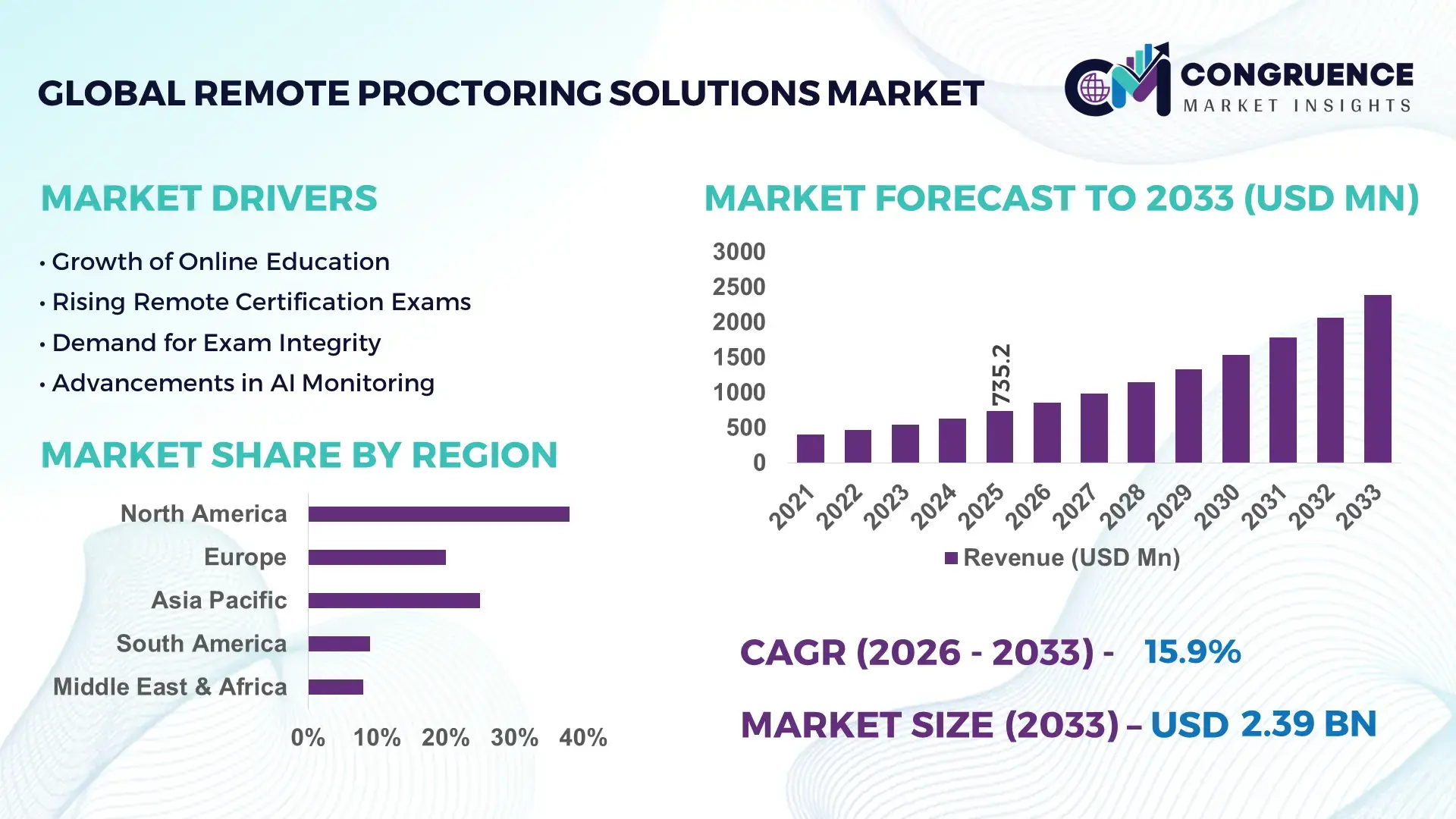
The Global Remote Proctoring Solutions Market was valued at USD 735.17 Million in 2025 and is anticipated to reach a value of USD 2393.64 Million by 2033 expanding at a CAGR of 15.9% between 2026 and 2033. Growth is primarily driven by the rapid digitalization of education and certification ecosystems worldwide.
The United States represents the dominant national landscape for remote proctoring solutions, supported by large-scale digital testing infrastructure, strong EdTech investment, and enterprise certification demand. Over 70% of higher education institutions in the country support fully or partially online assessment models, while professional certification bodies administer millions of remote exams annually. Venture and private equity funding in U.S. digital assessment technologies has exceeded USD 2 billion in recent years, enabling advancements in AI-based identity verification, behavioral analytics, and secure browser technologies. Key applications include higher education entrance testing, IT and cloud certification, healthcare licensure exams, and corporate compliance testing. The country also hosts several leading proctoring technology providers operating global cloud-based exam delivery networks handling peak volumes exceeding 500,000 remote sessions per day.
Market Size & Growth: Valued at USD 735.17 Million in 2025, projected to reach USD 2393.64 Million by 2033 at a CAGR of 15.9%, fueled by expansion of online education and digital credentialing.
Top Growth Drivers: Online exam adoption 62%, certification digitization 48%, AI monitoring efficiency gains 37%.
Short-Term Forecast: By 2028, institutions are expected to achieve up to 28% reduction in exam administration costs through remote proctoring models.
Emerging Technologies: AI-driven facial recognition, keystroke biometrics, and real-time behavioral anomaly detection systems.
Regional Leaders: North America USD 910 Million by 2033 driven by higher education adoption; Europe USD 640 Million supported by regulatory-aligned digital exams; Asia-Pacific USD 590 Million led by large-scale student populations.
Consumer/End-User Trends: Universities, certification bodies, and enterprises increasingly adopt hybrid exam models, with remote sessions accounting for over half of total assessments in digital-first institutions.
Pilot or Case Example: A 2025 university consortium pilot reduced exam logistics time by 35% and increased candidate throughput by 42% using AI proctoring.
Competitive Landscape: Market leader holds approximately 22% share, followed by major providers including Pearson VUE, Prometric, Meazure Learning, Proctorio, and ExamSoft.
Regulatory & ESG Impact: Data protection laws, accessibility mandates, and carbon footprint reduction targets are accelerating adoption of remote testing infrastructure.
Investment & Funding Patterns: Over USD 1.5 Billion invested recently in AI assessment platforms, with strong venture capital participation in identity verification technologies.
Innovation & Future Outlook: Integration with learning management systems, blockchain credential verification, and adaptive risk-based proctoring are shaping next-generation exam ecosystems.
Higher education, professional certification, IT credentialing, and healthcare licensure represent the largest industry sectors contributing to demand, together accounting for the majority of remote proctoring deployments. Rapid innovation in AI surveillance algorithms, multi-factor authentication, and cloud-scalable exam delivery platforms is improving exam integrity and operational efficiency. Regulatory frameworks related to data privacy, digital accessibility, and cross-border credential recognition are influencing procurement decisions, while sustainability initiatives encourage reduced physical test center usage. North America and Europe show mature consumption patterns, whereas Asia-Pacific exhibits accelerated growth driven by expanding online learner populations and government-supported digital education programs. Future outlook indicates broader integration with digital identity systems, predictive risk analytics, and secure decentralized credential verification models.
Remote Proctoring Solutions have become strategically critical to global education, workforce certification, and compliance ecosystems as organizations shift toward scalable, location-independent assessment infrastructures. Enterprises and academic institutions are prioritizing digital exam integrity, with over 65% of large universities integrating remote or hybrid testing frameworks into core assessment strategies. AI-enabled behavioral analytics combined with multi-factor identity authentication now form the backbone of secure online testing architectures, enabling exam delivery continuity across geographies while reducing physical infrastructure dependency.
Advanced AI-based gaze tracking and environment scanning delivers 42% improvement in anomaly detection accuracy compared to rule-based monitoring systems, significantly strengthening fraud prevention. North America dominates in volume of remotely administered certification exams, while Asia-Pacific leads in adoption with over 58% of digital-first institutions deploying AI-based proctoring at scale. By 2028, predictive risk-scoring algorithms are expected to cut manual proctor review time by 35%, improving operational efficiency and candidate throughput.
Compliance alignment is becoming central to procurement strategy. Firms are committing to 30% reduction in physical test center energy usage by 2030, aligning digital assessment with ESG targets and carbon reduction initiatives. In 2025, a European certification authority achieved 38% faster exam processing through AI-driven identity automation and secure browser integration, demonstrating measurable performance gains. As digital credentials, cross-border education mobility, and enterprise compliance programs expand, the Remote Proctoring Solutions Market is positioned as a core pillar of operational resilience, regulatory adherence, and sustainable digital transformation across assessment ecosystems.
The global expansion of online education and remote certification programs is a primary growth catalyst. More than 60% of higher education institutions now offer fully online or hybrid degree pathways, significantly increasing demand for secure remote assessment technologies. Professional certification providers in IT, finance, and healthcare administer millions of digital exams annually, requiring scalable proctoring infrastructures. Enterprises are also embedding remote testing into compliance training, onboarding evaluations, and skill validation programs, reducing dependency on physical centers. Digital exam delivery improves scheduling flexibility, enabling institutions to conduct assessments across time zones without facility constraints. Remote proctoring platforms can support concurrent testing sessions exceeding 100,000 candidates globally, demonstrating scalability. Additionally, AI-driven automation reduces manual monitoring workload by up to 40%, enabling institutions to maintain exam integrity while managing larger candidate pools efficiently.
Stringent data protection regulations and concerns over biometric surveillance present adoption barriers. Remote proctoring systems frequently process facial images, audio recordings, and behavioral data, triggering compliance requirements under regional privacy laws. Institutions must implement consent management, secure data storage, and encryption protocols, increasing operational complexity. Some jurisdictions impose restrictions on biometric data processing, requiring localized hosting and additional compliance audits. User resistance also affects deployment, with candidates expressing concerns over home environment monitoring and algorithmic bias in AI detection systems. Technical disparities, including inconsistent internet bandwidth and hardware compatibility, can lead to false flags or session disruptions, undermining confidence. These factors compel institutions to invest in legal reviews, infrastructure upgrades, and transparent policy frameworks before full-scale implementation.
Integration between remote proctoring platforms and digital credential ecosystems presents significant opportunity. Organizations are linking exam verification directly to blockchain-backed credential issuance, reducing credential fraud and streamlining employer validation processes. Workforce analytics platforms are also incorporating exam performance data into skill-mapping tools, supporting talent mobility and upskilling initiatives. Emerging economies are expanding national digital education strategies, creating demand for scalable testing infrastructure capable of supporting millions of candidates. Government-funded online learning programs and vocational certification initiatives are increasing digital exam volumes. Additionally, AI-powered adaptive assessment models, which adjust question difficulty in real time, are gaining traction, improving assessment precision and candidate experience while strengthening integrity controls.
Reliable remote proctoring requires stable broadband connectivity, high-resolution video capture, and compatible hardware, which are not uniformly available across all regions. Candidates in low-bandwidth environments may experience latency, session interruptions, or video quality degradation, increasing false incident rates. Institutions must invest in pre-exam system checks, candidate support services, and contingency protocols to mitigate disruptions. Platform complexity is another challenge. AI-based monitoring tools generate large volumes of flagged events requiring human review, demanding trained personnel and standardized evaluation frameworks. Integration with institutional IT systems, identity management platforms, and compliance tools further increases implementation timelines. These operational demands raise total cost of ownership and require strategic planning, especially for large-scale, multi-region deployments.
• AI-Driven Behavioral Analytics Expanding Detection Accuracy by 40%+
Advanced AI monitoring engines are becoming standard across enterprise and academic deployments, with over 68% of large digital testing programs now using behavioral analytics such as gaze tracking, voice pattern mapping, and anomaly scoring. These systems have demonstrated more than 40% higher irregularity detection rates compared to earlier rule-based monitoring models, while reducing false-positive flags by nearly 25%. Automated incident classification is also cutting human review workloads by approximately 30%, allowing institutions to manage higher exam volumes without proportional staffing increases.
• Hybrid Exam Models Increasing Candidate Reach by Over 50%
Institutions are adopting hybrid assessment frameworks that combine remote and on-site testing, with more than 57% of universities offering flexible exam modes. This approach has expanded candidate participation by over 50% in cross-border programs and reduced scheduling conflicts by nearly 35%. Professional certification bodies report that remote sessions now account for more than 60% of total test deliveries in digital-first environments, improving accessibility for working professionals and geographically dispersed learners.
• Biometric Multi-Factor Authentication Adoption Surpassing 45%
Identity verification technologies integrating facial recognition, keystroke dynamics, and ID document validation are now deployed in over 45% of enterprise-level remote testing programs. Multi-factor biometric checks have lowered impersonation incidents by approximately 38% and shortened candidate onboarding time by nearly 20%. Real-time ID validation systems can process authentication in under 8 seconds per candidate, enhancing user experience while maintaining compliance with digital identity standards.
• Cloud-Scaled Exam Infrastructure Supporting 3× Peak Volume Growth
Cloud-native proctoring platforms are enabling scalable exam delivery, with leading providers reporting capacity to handle peak concurrent sessions exceeding 300% of pre-2022 levels. Institutions leveraging elastic cloud infrastructure have reduced system downtime by 32% during high-demand periods and improved platform response speeds by 28%. Automated load balancing and distributed server networks are ensuring stable performance across multiple time zones, supporting global certification and education programs.
The Remote Proctoring Solutions market is structured across distinct types, applications, and end-user categories, reflecting the operational diversity of digital examination ecosystems. Solution types vary by automation depth and monitoring methodology, while applications align with academic, professional, enterprise, and public testing frameworks. End-user distribution highlights the scale of institutional testing versus workforce validation programs. Increasing integration of biometric verification, AI-driven risk analytics, and cloud-based exam delivery is influencing adoption patterns across all segments. Institutions are prioritizing flexible deployment models that support large concurrent candidate volumes while maintaining compliance with digital privacy regulations. Segmentation trends indicate a gradual shift from fully human-supervised testing toward AI-assisted and hybrid models, enabling operational efficiency and improved exam integrity across global digital learning and credentialing systems.
Remote Proctoring Solutions are categorized into Live Online Proctoring, AI-Based Automated Proctoring, and Record-and-Review Proctoring. AI-Based Automated Proctoring leads with approximately 46% share due to its scalability and automation efficiency. AI systems analyze facial recognition markers, eye movement, and environmental anomalies, reducing manual oversight requirements by nearly 35% while supporting thousands of simultaneous sessions. Live Online Proctoring represents about 34%, primarily used for high-stakes or regulated exams where real-time human supervision is required.
Record-and-Review Proctoring is the fastest-growing type, expanding at an estimated 18% CAGR, as institutions adopt asynchronous monitoring models that allow flexible scheduling and post-exam review audits. Hybrid AI-human verification systems and mobile-optimized proctoring platforms make up the remaining 20%, serving institutions with accessibility needs and varied bandwidth environments.
Major applications include Higher Education Exams, Professional Certification, Enterprise and Workforce Assessments, and Government and Public Sector Testing. Higher Education accounts for nearly 48% of adoption, as universities conduct semester exams, entrance assessments, and online degree evaluations. Professional Certification holds about 27%, driven by IT, finance, and healthcare credentialing programs transitioning to remote formats.
Enterprise workforce assessments represent the fastest-growing application area, expanding at roughly 17% CAGR, supported by remote hiring, compliance testing, and skill validation programs. Government and public sector testing contributes around 25%, including civil service and licensing exams administered digitally.
Universities and academic institutions lead the end-user landscape with approximately 44% share due to high student volumes and semester-based testing cycles. Certification bodies account for around 29%, administering standardized global professional exams. Enterprises represent the fastest-growing end-user group, expanding at nearly 19% CAGR, as organizations implement proctored testing in onboarding, compliance verification, and workforce development programs.
Government agencies and independent training providers collectively contribute about 27%, supporting national qualification exams and vocational skill certification initiatives. Over 52% of multinational organizations now use remote proctoring in at least one internal assessment process.
North America accounted for the largest market share at 38% in 2025 however, Asia-Pacific is expected to register the fastest growth, expanding at a CAGR of 18.6% between 2026 and 2033.

Europe follows with approximately 27% share, supported by strong regulatory alignment and cross-border digital education frameworks. Asia-Pacific currently contributes about 23%, driven by large student populations exceeding 350 million in online or hybrid learning environments. South America represents nearly 7%, with increasing adoption in national examination programs, while the Middle East & Africa hold close to 5%, supported by digital government transformation initiatives. Over 65% of global remote certification exams originate from developed economies, while emerging markets show annual candidate volume growth above 20%. Cloud-based exam deployments now support more than 500,000 concurrent global sessions daily, demonstrating the scale of digital assessment infrastructure across regions.
How is digital certification transformation accelerating secure online assessments?
North America holds roughly 38% of the global Remote Proctoring Solutions market volume, supported by mature EdTech ecosystems and large certification networks. Higher education, healthcare licensure, financial compliance testing, and IT credentialing are major demand drivers. Over 70% of universities offer hybrid or online assessment options, and enterprise compliance exams account for nearly 45% of corporate training evaluations. Data privacy regulations and accessibility mandates guide procurement, encouraging secure data hosting and inclusive exam interfaces. AI-based monitoring, biometric identity checks, and encrypted browsers are widely deployed, with more than 60% of institutions using automated proctoring tools. Regional behavior shows stronger enterprise adoption in healthcare and finance sectors. A leading assessment provider based in the region expanded its AI review automation, reducing human intervention time by 30% across large-scale certification programs.
What is driving secure digital examination adoption under strict data governance frameworks?
Europe represents approximately 27% of global market share, with strong adoption in Germany, the UK, and France. Regulatory frameworks emphasizing privacy and algorithm transparency shape procurement decisions, increasing demand for explainable AI monitoring systems. More than 55% of higher education institutions in Western Europe deploy hybrid exam models. Professional certification programs in engineering, finance, and language testing account for nearly 40% of digital exam volumes. Accessibility directives have pushed platforms to include multilingual interfaces and adaptive testing features. Regional consumers favor systems with transparent incident reporting and localized data hosting. A regional EdTech firm enhanced biometric authentication workflows, cutting identity verification time by 22% while maintaining compliance with strict digital privacy rules.
How are large student populations accelerating cloud-based exam ecosystems?
Asia-Pacific ranks among the top growth regions, contributing about 23% of global volume. China, India, and Japan lead adoption, with combined digital learner populations exceeding 200 million. National online education initiatives and competitive entrance examinations drive large-scale deployment. Infrastructure upgrades have expanded broadband penetration above 70% in urban centers, supporting stable remote exam delivery. Technology hubs in India and Singapore are advancing AI-driven monitoring innovations. Regional consumer behavior shows strong mobile-first usage patterns, with more than 60% of candidates accessing exam systems via personal devices. A regional testing technology provider introduced AI-based environment scanning, lowering exam irregularity incidents by 26% across national-level assessments.
How are national education reforms supporting remote examination adoption?
South America accounts for nearly 7% of the global market, led by Brazil and Argentina. Government-backed digital education reforms and public university entrance exams are key demand drivers. Internet connectivity improvements have raised broadband access to above 65% in major urban regions, supporting digital exam participation. Language localization and media-based learning trends influence platform design. Trade and digital education policies encourage cross-border certification acceptance. Regional consumer behavior emphasizes mobile accessibility and multilingual interfaces. A regional assessment organization digitized national licensing tests, processing over 300,000 remote candidates in a year and reducing physical testing center dependency by 28%.
How is digital transformation modernizing certification and licensing systems?
The Middle East & Africa represent around 5% of the market, with strong momentum in the UAE and South Africa. Demand stems from professional licensing in engineering, oil and gas, and public administration. Government digital transformation programs have digitized more than 40% of public sector exams in select countries. Technology modernization includes cloud migration and AI-based identity verification systems. Regional trade partnerships and cross-border education initiatives encourage digital credential recognition. Consumer behavior shows growing preference for remote access due to geographic dispersion. A regional digital education authority implemented secure browser testing platforms, improving exam throughput by 31% while maintaining centralized oversight.
United States – 34% share: High digital education penetration, large certification industry, and strong enterprise compliance testing demand support leadership in Remote Proctoring Solutions deployment.
China – 16% share: Massive online learner base, government-supported digital examination programs, and rapid AI technology adoption drive significant Remote Proctoring Solutions usage.
The Remote Proctoring Solutions market exhibits a moderately fragmented structure, with more than 45 active technology vendors operating globally across automated AI proctoring, live monitoring, and hybrid review models. The top five companies collectively account for approximately 48% of overall deployments, indicating competitive intensity balanced between established assessment providers and specialized AI-driven startups. Market positioning centers on technological depth, scalability, regulatory compliance capabilities, and integration with learning management and certification platforms.
Strategic partnerships have increased by nearly 30% in the past two years, primarily between proctoring vendors and digital credentialing platforms to enable end-to-end exam verification workflows. Product innovation cycles average 12–18 months, with vendors enhancing biometric authentication accuracy by over 35% and reducing incident false positives by around 25% through AI model refinement. Cloud-native infrastructure now supports exam concurrency exceeding 300,000 sessions per hour among leading providers, strengthening service reliability during peak demand.
Mergers and technology acquisitions focus on AI analytics, identity verification, and cybersecurity modules, reflecting the importance of secure data handling and automation efficiency. Competitive differentiation increasingly depends on compliance readiness, multilingual support, and adaptive monitoring frameworks tailored to regional regulations.
Pearson VUE
Prometric
Proctorio
Examity
Meazure Learning
PSI Services
Honorlock
Mercer | Mettl
Technology innovation in the Remote Proctoring Solutions market centers on AI automation, biometric verification, secure browser environments, and cloud-based scalability. AI-driven behavioral analytics engines now analyze more than 20 behavioral indicators per candidate session, including gaze deviation, facial movement patterns, background noise levels, and keystroke dynamics. These systems have improved anomaly detection precision by over 40% while lowering false incident flags by nearly 25%, enabling institutions to scale monitoring without proportional staffing increases.
Biometric identity verification has evolved into multi-layer authentication frameworks. More than 45% of large-scale deployments use a combination of facial recognition, government ID matching, and liveness detection. Real-time identity validation processes are completed in under 10 seconds, reducing impersonation risks by approximately 35%. Secure browser technologies restrict unauthorized applications and screen capture, blocking more than 95% of known digital cheating vectors during live exam sessions.
Cloud-native infrastructure supports dynamic scaling, with distributed servers handling peak loads exceeding 300% of baseline traffic. Load balancing algorithms have reduced system downtime during high-demand exam windows by around 30%, improving reliability across time zones. Edge computing is emerging to process video streams locally, cutting latency by nearly 20% in bandwidth-constrained regions.
Encryption standards now include end-to-end video protection and regional data residency controls to meet privacy compliance mandates. Integration APIs connect proctoring platforms with over 70% of mainstream learning management systems, enabling seamless exam scheduling and reporting. Future technology pathways include adaptive risk-scoring models, voice stress analysis, and decentralized credential validation, shaping more automated, scalable, and regulation-ready assessment ecosystems.
• In March 2025, Honorlock announced a strategic partnership with Instructure to integrate its remote proctoring platform directly within the Canvas Learning Management System, enabling seamless identity verification and exam integrity controls across hundreds of institutions. This integration supports automated exam provisioning and real-time proctoring workflows, enhancing user experience and operational efficiency.
• In January 2025, Proctorio launched a significant product update introducing advanced AI-assisted proctoring capabilities designed to enhance anti-cheating detection and automated identity verification for large-scale remote exams, improving monitoring accuracy and system scalability for enterprise and academic clients.
• In early 2025, Pearson announced a global collaboration with Mettl to expand remote proctoring capabilities for higher education and corporate training customers, aiming to scale AI-driven monitoring and identity verification technologies across international assessment programs.
• In May 2024, Respondus unveiled Respondus Monitor 2.0, featuring enhanced AI-based cheating detection, improved exam workflow automation, and strengthened privacy controls for students, which has contributed to broader adoption by universities seeking secure, compliant digital assessment solutions.
The scope of the Remote Proctoring Solutions Market Report encompasses comprehensive analysis across solution types, end-user segments, application areas, and geographic regions to provide decision-makers with a detailed understanding of market composition and deployment patterns. The report evaluates multiple product categories, including live online proctoring, automated AI-driven monitoring, and hybrid models that combine human oversight with machine intelligence. It examines application areas such as higher education exams, professional certification and licensure testing, enterprise compliance assessments, and government examinations, providing insights into deployment trends, institutional preferences, and functional requirements associated with each segment.
Geographic coverage includes North America, Europe, Asia-Pacific, South America, and the Middle East & Africa, each analyzed for adoption maturity, infrastructure readiness, regulatory influences, and consumer behavior differences. The report highlights technology trends impacting market evolution, such as biometric identity verification, secure browser lockdowns, behavioral analytics engines, multi-device detection, and cloud-native scalability frameworks that support peak exam volumes exceeding hundreds of thousands of concurrent sessions.
Industry focus areas extend to integration within learning management systems, mobile proctoring adaptations for bandwidth-constrained environments, accessibility enhancements for diverse learner populations, and compliance-driven features aligned with data privacy and digital credentialing standards. The report also assesses operational metrics such as incident flagging efficiency, manual review workloads, and platform reliability benchmarks, offering stakeholders quantitative insights to support procurement strategies, partnership evaluations, and technology investment decisions. Designed for institutional leaders, technology planners, and certification bodies, the report synthesizes market segmentation with evolving use cases and emerging niches, such as adaptive risk scoring and decentralized credential verification frameworks.
| Report Attribute/Metric | Report Details |
|---|---|
|
Market Revenue in 2025 |
USD V2025 Million |
|
Market Revenue in 2033 |
USD V2033 Million |
|
CAGR (2026 - 2033) |
15.9% |
|
Base Year |
2025 |
|
Forecast Period |
2026 - 2033 |
|
Historic Period |
2021 - 2025 |
|
Segments Covered |
By Types
By Application
By End-User
|
|
Key Report Deliverable |
Revenue Forecast, Growth Trends, Market Dynamics, Segmental Overview, Regional and Country-wise Analysis, Competition Landscape |
|
Region Covered |
North America, Europe, Asia-Pacific, South America, Middle East, Africa |
|
Key Players Analyzed |
Pearson VUE, Prometric, Proctorio, Examity, Meazure Learning, PSI Services, Honorlock, Mercer | Mettl |
|
Customization & Pricing |
Available on Request (10% Customization is Free) |




