
Reports
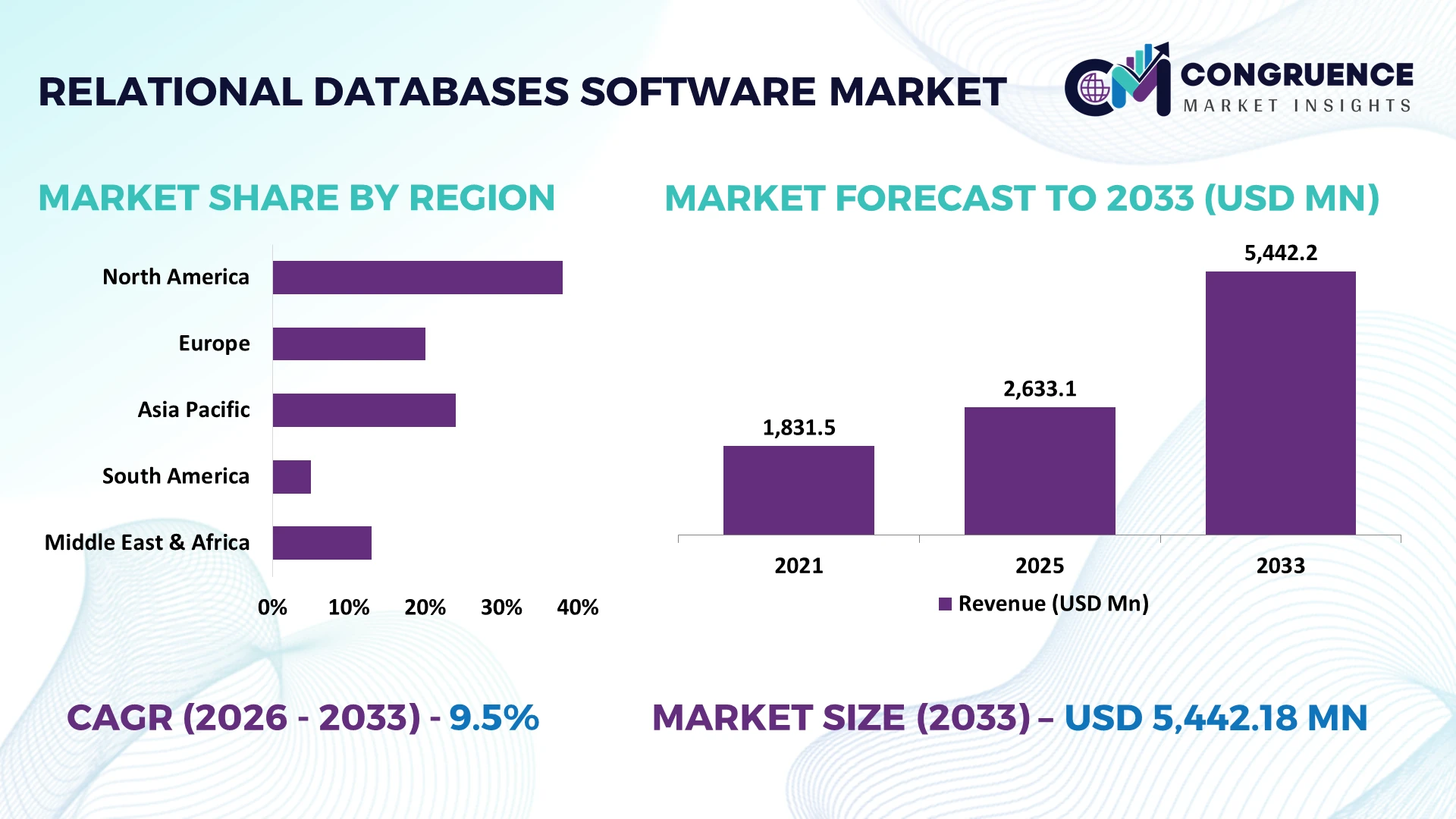
The Global Relational Databases Software Market was valued at USD 2633.05 Million in 2025 and is anticipated to reach a value of USD 5442.18 Million by 2033 expanding at a CAGR of 9.5% between 2026 and 2033. Growth is driven by cloud-native database migration, serverless SQL adoption, AI/vector-search integration, and enterprises replacing infrastructure-managed databases with automated relational Database-as-a-Service platforms.
The United States remains the dominant country, representing approximately 78% of the North American relational database market, supported by hyperscaler infrastructure, federal cloud modernization, and intensive adoption across BFSI, retail, healthcare, software, and telecommunications. Cloud databases reinforce this leadership: relational platforms captured 58.4% of cloud database and DBaaS deployments in 2025, while large enterprises represented 51.8% of adoption. U.S. federal Cloud Smart and FedRAMP requirements continue shifting regulated workloads toward authorized managed database environments, while Asia-Pacific benefits from accelerating data-sovereignty and hyperscale infrastructure investment.
Strategically, database vendors and enterprise buyers should prioritize cloud-native PostgreSQL compatibility, automated scaling, AI-ready SQL architectures, and sovereign deployment options as relational workloads shift from license-centric infrastructure toward managed, distributed platforms.
Market Size & Growth: USD 2,633.05 million in 2025 advances toward USD 5,442.18 million by 2033 at 9.5% CAGR, supported by cloud-native SQL modernization and managed database migration.
Top Growth Drivers: Cloud databases captured 56.4% of database spending, relational platforms held 57.3% by database type, and DBaaS represented 64.2% of service-model spending in 2025.
Short-Term Forecast: By 2028, advanced relational deployments will increasingly target up to 30% infrastructure cost savings through optimized storage, caching, serverless capacity management, and automated scaling.
Emerging Technologies: Serverless SQL, distributed relational architectures, vector search, zero-ETL integration, and AI-assisted database operations are reshaping deployment, with optimized Aurora PostgreSQL reads delivering up to 8× lower query latency.
Regional Leaders: North America, Europe, and Asia-Pacific remain the three principal commercial regions; applying the report's forecast structure indicates approximately USD 2.0 billion, USD 1.4 billion, and USD 1.5 billion potential respectively by 2033, alongside rising cloud adoption.
Consumer/End-User Trends: Large enterprises represented 67.1% of overall database spending in 2025, while transactional workloads accounted for 51.4%, reinforcing SQL's role in mission-critical operational systems.
Pilot/Case Example: 2026-era Amazon Aurora deployments demonstrate up to 5× MySQL and 3× PostgreSQL throughput on comparable hardware, strengthening the operational case for cloud-native relational migration.
Competitive Landscape: Oracle ranks No. 1 among relational DBMS platforms in August 2026 with a 1,123.43 DB-Engines score, followed by MySQL, Microsoft SQL Server, PostgreSQL, and Snowflake.
Regulatory & ESG Impact: U.S. FedRAMP and NIST-aligned security requirements strengthen governed cloud database adoption, while multi-region relational architectures now target up to 99.999% availability for regulated and mission-critical applications.
Investment & Funding: Snowflake's USD 250 million acquisition of Crunchy Data highlights intensifying investment around enterprise PostgreSQL, open-source compatibility, and hybrid-cloud relational infrastructure.
Innovation & Future Outlook: PostgreSQL gained 13.32 DB-Engines ranking points year over year by August 2026 while Snowflake gained 37.00, signaling competitive movement toward open, AI-ready and distributed relational architectures.
Relational Databases Software Market demand is concentrating around cloud-native transaction processing, financial systems, ERP applications, e-commerce, healthcare records, and AI-connected enterprise workloads. Relational systems retain a 57.3% share of database deployments, while innovations in serverless SQL, vector capabilities, automated scaling, and distributed architectures are accelerating modernization. Data-sovereignty requirements are simultaneously encouraging regional and hybrid deployments, setting up a decisive strategic shift in enterprise database architecture.
Relational databases are becoming strategic infrastructure as enterprises consolidate transactional data, AI applications, analytics, and regulated workloads on cloud-native platforms. More than 50% of database spending is now associated with cloud deployment, while large enterprises account for roughly two-thirds of database consumption. Infrastructure modernization is shifting procurement from perpetual, self-managed systems toward managed PostgreSQL, distributed SQL, and database-as-a-service architectures with automated availability, security, and capacity management.
Cloud-native relational engines materially improve operational economics over legacy installations. Amazon Aurora, for example, delivers up to 5× MySQL throughput and 3× PostgreSQL throughput on comparable hardware, reducing infrastructure required for transaction-intensive workloads. The United States leads hyperscale deployment and AI-database integration, while China emphasizes domestic cloud infrastructure and data localization; European deployments place stronger emphasis on sovereignty and regulatory controls under GDPR.
Through 2028, serverless scaling, vector search, zero-ETL pipelines, and AI-assisted database administration will increasingly enter production environments. A retailer can automatically scale SQL capacity during peak transactions rather than permanently provisioning servers for maximum load. Oracle, Microsoft, AWS, Google, Snowflake, and PostgreSQL ecosystem vendors are consequently directing investment toward managed services, AI integration, migration tooling, and multi-cloud partnerships. Competitive advantage will increasingly depend on combining relational reliability with elastic infrastructure and AI-ready data access.
Cloud migration is the strongest structural driver, with cloud deployments representing more than 50% of database spending and DBaaS accounting for over 60% of cloud database service consumption. Large enterprises contribute approximately 67% of database spending as banks, retailers, manufacturers, and digital platforms modernize transaction-processing infrastructure. In the United States, federal Cloud Smart modernization and FedRAMP requirements reinforce migration toward governed managed environments. The non-obvious shift is operational: enterprises increasingly purchase automated availability and scalability rather than database licenses alone. This reduces administrator-intensive provisioning and accelerates application deployment. AWS, Microsoft, Oracle, and Google are responding by expanding serverless SQL, automated patching, migration services, and PostgreSQL-compatible offerings, while independent vendors strengthen multi-cloud integrations and consumption-based deployment models.
Legacy dependency limits modernization because relational databases remain deeply embedded within ERP, payment, billing, and core banking architectures. Large enterprises account for roughly 67% of database spending, while transactional workloads represent more than 50% of database usage, increasing the operational consequences of migration failures. Database modernization projects can require 20–30% additional implementation effort when proprietary stored procedures, extensions, and application dependencies require refactoring. U.S. banks and government agencies face additional validation requirements when transferring sensitive workloads into managed environments. The overlooked constraint is application coupling rather than database technology itself: decades-old business logic can make switching economically unattractive. Vendors are reducing exposure through automated schema conversion, compatibility layers, hybrid deployments, long-term support contracts, and migration partnerships designed to move workloads incrementally without disrupting mission-critical transactions.
AI integration is opening a valuable opportunity beyond conventional transaction processing. Relational databases still support more than 50% of transactional database workloads, creating a substantial installed base that can incorporate vector search, semantic retrieval, automated query optimization, and real-time AI applications without duplicating operational data. Modern cloud relational engines can deliver up to 5× conventional MySQL throughput, while serverless architectures can eliminate substantial idle capacity through usage-based scaling. India represents a particularly attractive deployment environment as digital payments, SaaS platforms, e-commerce, and cloud infrastructure expand transaction-intensive workloads. The non-obvious opportunity lies in combining structured SQL records with vector capabilities inside one governed platform. Vendors are investing in PostgreSQL extensions, AI copilots, zero-ETL integration, distributed architectures, and hyperscaler partnerships to capture workloads previously fragmented across relational, search, and specialized vector databases.
Operating relational databases consistently across cloud, edge, and multi-region environments creates a long-term execution challenge. Mission-critical platforms increasingly target 99.99% or higher availability, while distributed architectures must simultaneously maintain transaction consistency, low latency, encryption, backup integrity, and regulatory controls. Cybersecurity compounds this burden: database systems remain high-value targets because a single compromised credential can expose millions of structured records. European organizations must also align cross-border processing with GDPR requirements, increasing architectural complexity for globally distributed applications. The strategic problem is that greater geographic redundancy can increase synchronization, observability, and governance overhead rather than automatically improving resilience. Database providers are therefore investing in automated failover, confidential computing, AI-assisted threat detection, multi-region replication, and policy-driven access controls. Sustainable differentiation requires making distributed reliability operationally manageable, not simply technically achievable.
Hybrid Database Strategies Strengthen: Database deployment is becoming deliberately hybrid rather than cloud-only. Only 30% of organizations host databases mostly or entirely in cloud environments, while 46% plan hybrid strategies. Cloud cost management affects 63% of teams, pushing enterprises toward workload placement based on latency, governance, utilization, and operating economics instead of uniform migration.
Database Portfolios Rapidly Consolidate: Organizations using one database platform increased from 21% to 26%, while those operating more than five fell from 29% to 9%. Nearly 75% now use three platforms or fewer. Enterprises are consolidating tooling, monitoring, and database skills to reduce integration overhead, while vendors expand cross-platform administration and automation capabilities.
FinOps Enters Database Operations: Cloud economics now directly influence relational database architecture. In 2026, 85% of organizations identify cloud-spend management as a major challenge, 63% have established FinOps teams, and 71% operate Cloud Centers of Excellence. Database teams are adopting rightsizing, serverless capacity controls, workload scheduling, and observability to connect database performance with infrastructure economics.
Security Automation Replaces Manual Processes: Data security and privacy concern around AI increased from 41% to 61%, while 71% of organizations still manually create database test data. Enterprises are responding with synthetic datasets, masking, automated access policies, and DevSecOps controls. The non-obvious shift is that secure test-data automation is becoming as strategically important as production database protection.
Cloud-Based relational database software leads with an estimated 44% market share, supported by elastic compute, managed backups, automated patching, high availability, and integration with cloud application stacks. Scalability and flexibility influence approximately 70% of cloud database decisions, while high availability and reliability influence about 62%. These operating advantages are shifting database procurement toward managed services, although cost scrutiny is producing more selective workload placement. On-Premises platforms retain approximately 27% share because financial institutions, government agencies, manufacturers, and regulated enterprises continue requiring direct infrastructure and data controls.
Distributed relational databases represent approximately 18% and are the fastest-growing type as enterprises require geographically resilient transaction processing, horizontal scaling, and multi-region availability. In-Memory platforms account for around 11%, maintaining strategic relevance in latency-sensitive analytics, telecommunications, financial processing, and real-time applications. Vendors are responding with distributed SQL, PostgreSQL compatibility, serverless scaling, automated failover, and hybrid management. Investment priorities increasingly favor workload portability rather than dependence on a single deployment architecture.
Transaction Processing leads with an estimated 37% share, reflecting relational databases' continued importance across payment authorization, order processing, inventory management, account servicing, reservations, and other ACID-dependent workloads. Enterprise Resource Planning accounts for approximately 23%, supported by persistent SQL deployment across finance, procurement, production planning, and human-resource systems. Companies are improving these established applications through automated indexing, replication, connection management, high-availability configurations, and cloud-managed deployment.
Business Intelligence represents approximately 18% and is the fastest-growing application as enterprises connect governed relational datasets with self-service analytics, AI assistants, and real-time decision systems. Data Warehousing retains an important position for structured historical analysis, while Customer Data Management is strengthening through unified profiles and personalization workflows. Suppliers are responding with zero-ETL connectivity, columnar processing, embedded analytics, vector extensions, and automated query optimization. The strategic boundary between transactional and analytical databases is consequently narrowing, enabling enterprises to extract operational intelligence without maintaining extensive duplicate data pipelines.
Banking & Finance leads with an estimated 29% share because core banking, payment processing, trading, fraud detection, account ledgers, and regulatory reporting require consistent transaction processing and resilient data infrastructure. Retail & E-Commerce represents approximately 22%, supported by expanding order volumes, inventory synchronization, digital payments, customer accounts, and omnichannel operations. Telecommunications maintains substantial relational workloads across subscriber management and billing, while Manufacturing depends on SQL integration across ERP and production systems.
Healthcare is the fastest-growing end-user, representing approximately 19% as electronic health records, claims platforms, digital-care applications, scheduling systems, and clinical workflows generate increasingly interconnected structured datasets. Vendors are targeting these buyers through industry-specific security controls, encryption, automated compliance, managed-cloud packages, and migration partnerships. Competitive investment is shifting toward regulated-workload capabilities rather than database performance alone. Companies capable of combining high availability, auditability, granular access controls, and hybrid deployment gain stronger positioning across mission-critical industries where database downtime carries direct operational consequences.
North America accounted for the largest market share at 43% in 2025 however, Asia-Pacific is expected to register the fastest growth, expanding at a CAGR of 8.6% between 2026 and 2033.
Cloud-Native Enterprise Modernization Leads Deployment
North America accounts for approximately 43% of global relational database software activity, supported by concentrated hyperscale cloud infrastructure, mature enterprise IT spending, and transaction-intensive financial, healthcare, retail, and technology workloads. The United States dominates deployment as enterprises replace self-managed database clusters with managed SQL, serverless capacity, automated replication, and AI-connected data architectures. Relational databases represent approximately 58% of cloud database deployments, demonstrating continued SQL relevance despite expanding non-relational alternatives. Financial institutions increasingly retain sensitive systems in hybrid environments while shifting customer-facing applications toward managed platforms. Database vendors are strengthening PostgreSQL compatibility, zero-ETL integration, automated security, and multi-region availability. Canadian enterprises add demand through regulated banking, telecommunications, government modernization, and expanding domestic cloud infrastructure, reinforcing the region's preference for resilient, governed database architectures.
United States Market Outlook: The United States maintains the strongest country-level position through AWS, Microsoft, Google, Oracle, IBM, and a dense ecosystem of software developers and enterprise users. Large organizations represent more than 50% of cloud database adoption, while financial services, healthcare, e-commerce, SaaS, and government workloads sustain intensive relational transaction processing. AI integration is further shifting database procurement toward platforms combining SQL consistency, vector capabilities, automated administration, and elastic compute.
Data Sovereignty Reshapes Database Architecture
Europe represents approximately 25% of database management activity, with relational platforms remaining deeply embedded across banking, manufacturing, government, telecommunications, and enterprise resource planning. Regulatory requirements under GDPR and growing digital-sovereignty priorities are accelerating controlled cloud, sovereign infrastructure, and hybrid database deployment. In 2025, 52.7% of EU enterprises used paid cloud services, while 45.5% of cloud-using enterprises purchased database hosting services. Germany, France, Italy, and the Nordic economies are increasing cloud adoption while retaining stringent requirements around residency, encryption, access governance, and portability. The competitive structure remains distinctive: European providers hold only about 15% of the regional cloud infrastructure market, encouraging enterprises to pursue multi-provider architectures. Database suppliers are responding with EU-hosted services, customer-managed encryption, PostgreSQL support, and stronger compliance automation.
Germany Market Outlook: Germany combines a large industrial software base with substantial database requirements across automotive manufacturing, engineering, financial services, logistics, and public administration. Enterprises increasingly integrate relational platforms with SAP-centered workflows, industrial IoT systems, and cloud analytics while maintaining controlled environments for sensitive production data. Sovereignty requirements are strengthening demand for interoperable SQL architectures capable of operating consistently across private infrastructure and European cloud environments.
Digital Scale Accelerates Distributed SQL Adoption
Asia-Pacific is emerging as the fastest-moving deployment environment as China, India, Japan, South Korea, Singapore, and Australia expand cloud infrastructure and transaction-intensive digital services. The region represents approximately 22% of database-as-a-service activity, with adoption increasingly driven by digital payments, e-commerce, telecommunications, super-app ecosystems, and government digitization. China emphasizes domestic database technologies and localized infrastructure, while India combines hyperscaler expansion with rapidly scaling fintech and software-service workloads. Distributed SQL is gaining operational importance because high-volume applications require horizontal scalability without abandoning relational consistency. Japan and South Korea add mature enterprise modernization demand across manufacturing, financial services, and telecommunications. Suppliers are increasing local cloud capacity, forming technology partnerships, expanding PostgreSQL-compatible offerings, and developing multi-region architectures designed for high-concurrency applications and jurisdiction-specific data controls.
China Market Outlook: China represents a strategically important relational database ecosystem because domestic cloud platforms and software suppliers increasingly support workloads historically dependent on foreign database technologies. Alibaba Cloud, Huawei, Tencent, and domestic database specialists are expanding distributed and cloud-native SQL capabilities. Large-scale e-commerce, payments, telecommunications, manufacturing, and public-sector systems create particularly demanding requirements for transaction throughput, localization, and resilient multi-node database operations.
Fintech Modernization Drives Cloud Migration
South America represents approximately 6% of database-as-a-service activity, with Brazil providing the largest concentration of enterprise relational workloads. Banking modernization, instant payments, digital commerce, telecommunications, and public-sector digitization are shifting database operations toward managed and hybrid environments. Brazil accounts for approximately 58% of Latin American cloud database activity, supported by hyperscaler infrastructure and a large fintech ecosystem. LGPD compliance has simultaneously increased requirements for database governance, access management, encryption, and auditable data processing. Chile and Colombia are strengthening cloud adoption, although uneven data-center coverage, foreign-currency exposure, and enterprise IT skills constrain deployment consistency. Vendors are responding through localized cloud regions, managed database services, migration partners, and consumption-based pricing that lowers infrastructure requirements for mid-sized enterprises.
Brazil Market Outlook: Brazil leads relational database deployment through its banking, fintech, retail, telecommunications, and government technology ecosystems. PIX-scale digital payment activity places continuous transaction-processing pressure on underlying data infrastructure, while LGPD strengthens governance requirements. AWS, Microsoft, and Google operate local cloud infrastructure, allowing enterprises to combine managed relational services with domestic data residency, lower latency, and increasingly automated availability management.
Sovereign Cloud Investment Accelerates Modernization
Middle East & Africa represents approximately 10% of database-as-a-service activity, with adoption concentrated in the UAE, Saudi Arabia, Israel, South Africa, and increasingly Qatar. Government digital-transformation programs, banking modernization, smart-city platforms, telecommunications investment, and new hyperscale data centers are expanding requirements for enterprise relational infrastructure. Saudi Arabia and the UAE increasingly emphasize sovereign cloud environments that combine managed database economics with local data controls. Financial institutions and government entities remain major buyers because transaction integrity and regulatory auditability favor structured SQL platforms. African adoption is more uneven, with South Africa maintaining the deepest enterprise infrastructure while Kenya benefits from digital-payment ecosystems. Suppliers are establishing local cloud regions, sovereign-service partnerships, migration programs, and managed database offerings to overcome infrastructure and specialist-skills constraints.
Saudi Arabia Market Outlook: Saudi Arabia is becoming a major database modernization hub as Vision 2030 programs digitize government, banking, healthcare, commerce, and industrial operations. Domestic data-center expansion by global and local cloud providers strengthens access to low-latency managed databases. Data-localization requirements further favor locally hosted relational architectures, pushing vendors toward sovereign deployment models, automated security controls, Arabic-enabled enterprise applications, and partnerships with domestic technology providers.
Oracle, Microsoft, AWS, Google, IBM, and SAP compete across enterprise relational workloads, with hyperscalers challenging established database vendors through managed cloud services and consumption-based deployment. The top five players collectively control an estimated 65%–70% of commercial deployments, reflecting strong concentration around installed enterprise ecosystems. Competition increasingly centers on performance, interoperability, automation, and cloud economics rather than database licensing alone. Cloud-native platforms can reduce selected administrative workloads by 30%–50%, while automated scaling can cut idle infrastructure requirements by 20%–30%. Oracle and Microsoft leverage installed enterprise applications; AWS and Google emphasize elastic managed services, PostgreSQL compatibility, and AI integration. IBM and SAP defend regulated and mission-critical enterprise estates through hybrid deployment. Partnerships with hyperscalers, distributed SQL development, vector search, and zero-ETL integration are intensifying competitive pressure. High migration complexity and application lock-in remain formidable entry barriers. Winning requires workload portability, predictable economics, AI-ready functionality, strong governance, and enterprise-grade reliability.
Oracle Corporation
Microsoft Corporation
Amazon Web Services
IBM Corporation
SAP SE
Alibaba Cloud
Snowflake Inc.
Teradata Corporation
Cockroach Labs
MariaDB plc
SingleStore
EDB
PingCAP
Cloud-native relational platforms now combine serverless compute, automated tuning, columnar acceleration, and vector search inside established SQL engines. Managed deployments reduce database administration effort by roughly 30%, while optimized read architectures can cut selected infrastructure costs by about 20%. Adoption is strongest among enterprises modernizing transactional, analytics, and AI workloads without abandoning relational consistency, governance, or application compatibility.
Emerging architectures integrate distributed SQL, zero-ETL replication, natural-language querying, and native vector indexing. Modern optimized PostgreSQL services can deliver roughly 4x faster vector search than standard implementations, while zero-ETL pipelines reduce data-movement latency from batch cycles to seconds. Compared with legacy self-managed databases, automated scaling and failover can improve operational efficiency by 25%, benefiting cloud-native vendors and enterprises managing variable workloads.
Between 2026 and 2028, disruptive differentiation will center on agent-ready databases, multimodel retrieval, sovereign deployment, and AI-assisted administration. Production adoption of vector-capable relational platforms is moving beyond pilots as enterprises consolidate transactional and semantic workloads. Vendors combining PostgreSQL compatibility, automated governance, distributed resilience, and embedded AI will gain competitive leverage because buyers can reduce tool sprawl, shorten deployment cycles, and modernize without rewriting core SQL applications. This shifts investment from standalone database maintenance toward integrated data platforms engineered for intelligent operations.
May 2024 Oracle released Database 23ai with AI Vector Search, enabling vectors to be generated, stored, indexed, and queried alongside business data through SQL. The launch embedded secure semantic retrieval directly into relational workloads, reducing separate vector-database dependency. Source: oracle.com
June 2025 Snowflake agreed to acquire Crunchy Data to introduce enterprise PostgreSQL within its AI Data Cloud. The transaction was reported near USD 250 million, strengthening Snowflake’s position in transactional applications and agentic AI workloads for enterprise customers. Source: techcrunch.com
May 2025 Microsoft launched SQL Server 2025 public preview with native vector search, DiskANN indexing, built-in embedding generation, and model integration through T-SQL. The release connected operational relational data directly with RAG and enterprise AI development at scale. Source: microsoft.com
April 2026 Google Cloud expanded AlloyDB with vector search scaling to 10 billion vectors and performance up to 6× faster than standard PostgreSQL HNSW. The upgrade strengthened AlloyDB’s role in large-scale enterprise retrieval, hybrid search, and AI-agent applications. Source: cloud.google.com
The report evaluates Relational Databases Software across Cloud-Based, On-Premises, Distributed, and In-Memory architectures, alongside Transaction Processing, Data Warehousing, Business Intelligence, Customer Data Management, and Enterprise Resource Planning applications. It also assesses demand from Banking & Finance, Healthcare, Retail & E-Commerce, Manufacturing, and Telecommunications, with deployment patterns compared across North America, Europe, Asia-Pacific, South America, and Middle East & Africa.
Technology coverage includes serverless SQL, distributed relational engines, vector search, zero-ETL integration, automated administration, in-memory acceleration, and AI-assisted querying. The analysis examines shifting cloud and hybrid deployment preferences, PostgreSQL-centered ecosystems, regulated workload requirements, and emerging agent-ready database architectures. Competitive benchmarking and segment positioning support investment planning, geographic expansion, partnership selection, product strategy, and long-term portfolio decisions through 2033, while highlighting where enterprise modernization and workload consolidation are reshaping purchasing priorities.
| Report Attribute/Metric | Report Details |
|---|---|
Market Revenue in 2025 | USD 2633.05 Million |
Market Revenue in 2033 | USD 5442.18 Million |
CAGR (2026 - 2033) | 9.5% |
Base Year | 2025 |
Forecast Period | 2026 - 2033 |
Historic Period | 2021 - 2025 |
Segments Covered | By Type
By Application
By End-User
|
Key Report Deliverable | Revenue Forecast, Growth Trends, Market Dynamics, Segmental Overview, Regional and Country-wise Analysis, Competition Landscape |
Region Covered | North America, Europe, Asia-Pacific, South America, Middle East, Africa |
Key Players Analyzed | Oracle Corporation, Microsoft Corporation, Amazon Web Services, Google, IBM Corporation, SAP SE, Alibaba Cloud, Snowflake Inc., Teradata Corporation, Cockroach Labs, MariaDB plc, SingleStore, EDB, PingCAP |
Customization & Pricing | Available on Request (10% Customization is Free) |




