
Reports
The Global Relational Database Management System Market was valued at USD 76162.32 Million in 2025 and is anticipated to reach a value of USD 132039.74 Million by 2033 expanding at a CAGR of 7.12% between 2026 and 2033. Growth is driven by cloud-native database migration, AI-enabled query optimization, real-time analytics, and modernization of legacy enterprise workloads across financial services, healthcare, retail, and manufacturing.
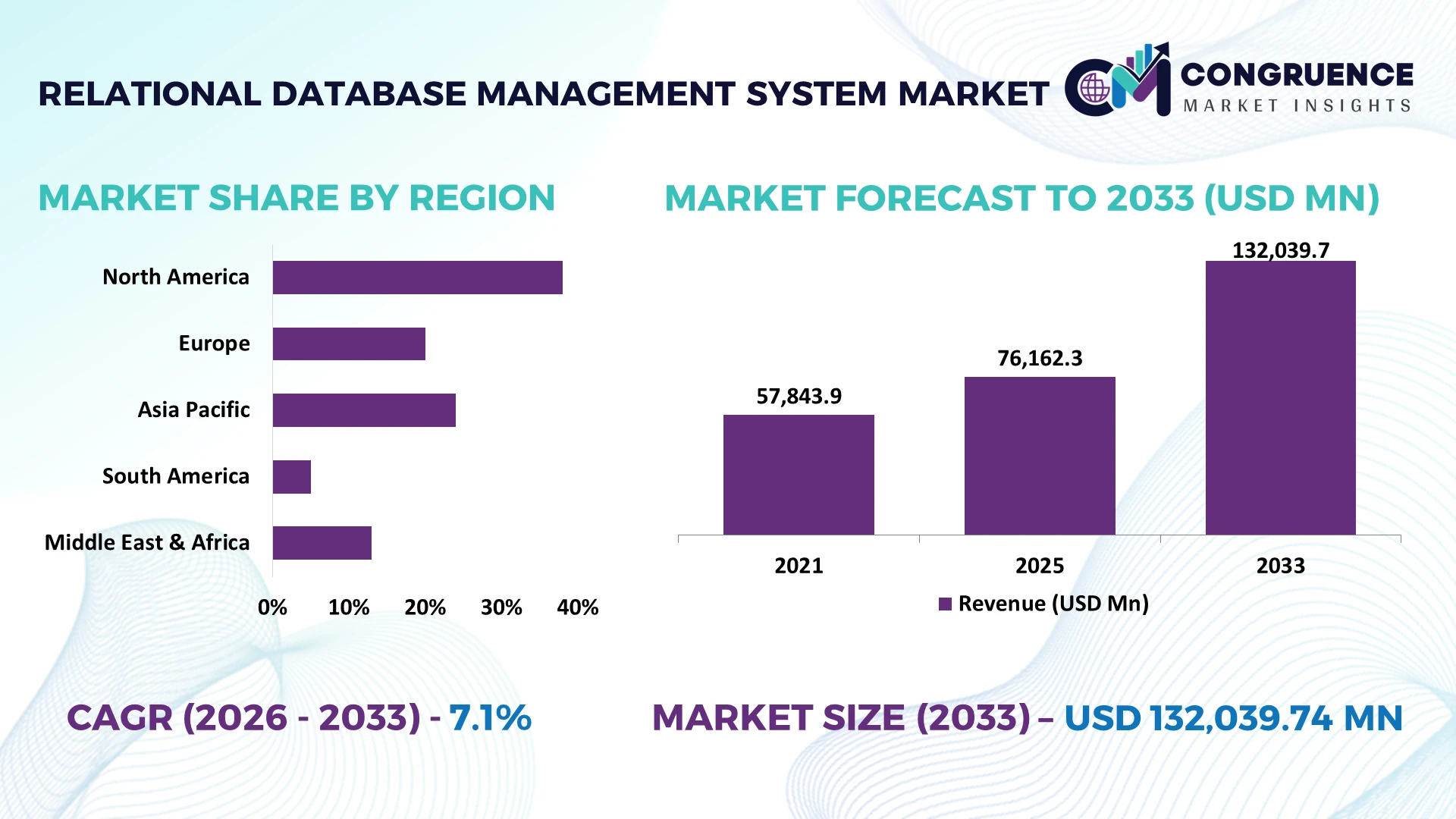
The United States remains the dominant country, accounting for an estimated 38% of advanced enterprise RDBMS deployments, supported by sustained cloud infrastructure investment and high AI workload concentration. China follows with about 19% adoption, accelerated by domestic cloud expansion and data-localization priorities. U.S. enterprise deployments remain roughly 2× China's, while Asia-Pacific continues gaining capacity through regional data-center expansion and technology localization amid ongoing U.S.-China technology restrictions.
Strategic implication: vendors combining cloud scalability, AI-assisted administration, stronger data governance, and cross-region resilience are best positioned to capture enterprise modernization budgets.
Market Size & Growth: USD 76.16 billion in 2025 to USD 132.04 billion by 2033 at 7.12% CAGR, driven by cloud migration and database modernization.
Top Growth Drivers: Cloud migration contributes 31%, AI workloads 24%, and real-time analytics 18% to expansion momentum.
Short-Term Forecast: By 2028, automation-driven administration is positioned to reduce routine database management costs by 15% and improve operational efficiency by 12%.
Emerging Technologies: AI copilots, autonomous tuning, vector extensions, and HTAP architectures are reshaping advanced RDBMS deployment strategies.
Regional Leaders: North America is projected near USD 52 billion, Asia-Pacific near USD 43 billion, and Europe near USD 25 billion, with cloud adoption accelerating across all three.
Consumer/End-User Trends: More than 60% of large enterprises prioritize managed database services for mission-critical workloads, reducing infrastructure-management complexity.
Pilot/Case Example: 2025 enterprise modernization programs using automated database provisioning targeted approximately 20% faster deployment cycles and lower manual administration requirements.
Competitive Landscape: Oracle leads with an estimated 30% enterprise RDBMS share, followed by Microsoft, IBM, SAP, and Amazon Web Services across cloud and hybrid workloads.
Regulatory & ESG Impact: Data-residency controls and sustainability programs are pushing enterprises toward consolidated infrastructure, with workload optimization targeting 10%–15% lower computing consumption.
Investment & Funding: More than USD 20 billion in annual enterprise database and adjacent cloud infrastructure spending is reinforcing partnerships, AI integration, and regional expansion.
Innovation & Future Outlook: Next-generation RDBMS platforms are shifting toward autonomous operations, multimodal analytics, distributed architectures, and tighter AI-data integration as strategic differentiators.
The Relational Database Management System Market is seeing stronger demand for AI-ready SQL platforms, managed cloud databases, vector search, and automated performance tuning. Over 60% of large enterprises are prioritizing managed database architectures, reflecting pressure to simplify operations while supporting real-time workloads. Data-residency requirements and regional cloud expansion are accelerating hybrid deployments, setting the foundation for the market’s strategic evolution.
Relational Database Management System Market platforms are becoming strategic infrastructure as enterprises compete on real-time decision-making, AI readiness, and reliable transaction processing. Database modernization is shifting from isolated IT upgrades toward enterprise-wide infrastructure programs, particularly as data-residency rules and cross-border governance reshape workload placement. This shift is increasing investment in cloud-compatible SQL architectures and distributed data management.
Modern cloud-native RDBMS environments can reduce database provisioning time by 40%–60% versus legacy manual deployments while automated query optimization can lower selected workload processing costs by 15%–25%. The United States leads in advanced enterprise deployment, while India is expanding adoption through fintech, digital commerce, manufacturing, and government-scale digital infrastructure. China emphasizes localized infrastructure and compliance-driven deployment, creating a different technology pathway from the U.S. cloud-led model.
Over the next 2–3 years, enterprises are expected to increase managed-database adoption, automate 30%–40% of routine administration, and prioritize platforms supporting AI and real-time analytics. A practical deployment involves migrating legacy transactional databases to managed cloud RDBMS environments, combining automated backups, scaling, and observability. Companies are redirecting budgets toward modernization, forming hyperscaler partnerships, and consolidating fragmented database estates. Competitive advantage will increasingly depend on delivering secure, interoperable, AI-ready data infrastructure with lower operational overhead.
AI-driven workload optimization is strengthening RDBMS adoption as enterprises seek faster analytics without replacing core transactional systems. Automated tuning and predictive monitoring can improve database administration efficiency by 20%–30%, while cloud-based provisioning can reduce deployment cycles by more than 40%. In the United States, financial institutions and technology companies are integrating AI workloads with SQL environments, accelerating demand for vector capabilities and real-time processing. Data-governance requirements are also pushing firms toward controlled, auditable database architectures. Vendors are responding through AI-assisted administration, managed services, and hyperscaler partnerships. The non-obvious advantage is operational consolidation: companies can extend existing relational workloads into AI environments rather than fund parallel data infrastructures.
Legacy database estates remain a structural constraint because migration involves application dependencies, proprietary schemas, licensing exposure, and extensive validation. Complex enterprise migrations can consume 15%–25% of modernization budgets, while interoperability gaps can increase integration workloads by 20% or more. In Germany, regulated industries face additional requirements for data governance and workload control, limiting unrestricted movement between cloud environments. These constraints directly affect deployment speed and profitability when businesses operate multiple database engines simultaneously. Companies are reducing exposure through phased migration, multi-year vendor contracts, database compatibility layers, and selective workload placement. A key operational insight is that modernization economics improve when firms prioritize high-maintenance workloads rather than attempting full estate replacement.
Autonomous administration creates a high-value opportunity as enterprises automate database operations and integrate AI-ready data services. Automated monitoring, indexing, and resource allocation can reduce routine administrative effort by 30%–40%, while workload optimization can deliver 10%–20% efficiency gains in suitable environments. India presents a notable opportunity as fintech, digital commerce, and industrial platforms expand data-intensive applications. Emerging vector search and hybrid transactional-analytical processing are extending RDBMS relevance beyond conventional transaction management. Vendors are increasing R&D, developing AI-native extensions, and partnering with cloud infrastructure providers. The strongest opportunity lies in enabling organizations to add AI capabilities directly to governed relational data without creating costly duplicate data pipelines.
RDBMS deployment is becoming harder to standardize as enterprises combine on-premises databases, multiple clouds, edge systems, and AI workloads. Distributed architectures can increase configuration and monitoring complexity by 20%–30%, while security teams increasingly allocate substantial resources to identity controls, encryption, and database activity monitoring. U.S. enterprises face persistent pressure to secure interconnected workloads, while organizations operating across jurisdictions must continuously adapt data-access controls to evolving regulations. These pressures can reduce deployment consistency and increase specialist workforce requirements. Companies are responding with zero-trust database access, automated compliance controls, centralized observability, and managed security partnerships. Long-term competitiveness will depend on making distributed database operations secure and repeatable without sacrificing application performance.
Hybrid Database Strategies Expand: Hybrid deployments are gaining traction as 46% of organizations plan a hybrid database future, while 30% have fully migrated or plan full cloud migration. Enterprises are balancing scalability with compliance and cost control, increasing investment in automation and observability.
Multi-Platform Estates Reshape Operations: About 74% of IT teams now operate two or more database platforms, with 25% using more than four. This diversification improves workload matching but raises governance complexity, prompting companies to standardize security controls, monitoring, and database DevOps workflows.
AI Workloads Change Database Design: Cloud-native database adoption has reached 59% among surveyed technology teams, while 13% plan adoption within 12 months. AI-driven applications are pushing enterprises toward vector-enabled SQL, real-time processing, and automated optimization rather than conventional database expansion alone.
Security Investment Takes Priority: Database security concerns are intensifying, with 38% of IT teams citing security and access controls as a major challenge, up 12% year over year. Regulatory pressure and increasingly distributed workloads are driving stronger identity controls, encryption, monitoring, and governance partnerships.
Cloud-Based RDBMS leads the market at approximately 42% share, supported by elastic scaling, managed infrastructure, automated backups, and lower administration requirements. On-Premises RDBMS remains strategically important for regulated workloads and latency-sensitive operations, accounting for roughly 32%. Distributed RDBMS represents about 18%, gaining relevance as enterprises require geographic resilience and high-volume processing, while Embedded RDBMS holds approximately 8% through specialized applications, devices, and industrial software. Companies are increasingly combining deployment models rather than replacing established infrastructure outright.
Cloud-Based RDBMS is the fastest-growing type, with adoption momentum supported by managed services and AI workload integration. Its operational advantage is strongest where capacity fluctuates rapidly, reducing infrastructure planning burdens by an estimated 15%–20%. Distributed RDBMS is attracting investment for resilience, while Embedded RDBMS remains valuable where local processing and low latency are essential. Vendors are expanding cloud compatibility, migration tooling, and hybrid-management capabilities to capture modernization budgets.
Transaction Processing leads with approximately 46% market share because banking, retail, manufacturing, and enterprise applications still depend on consistent, low-latency ACID transactions. Data Warehousing follows at nearly 24%, while Customer Data Management represents about 17% and Enterprise Resource Planning around 13%. Transaction-heavy environments prioritize availability and throughput, keeping mature RDBMS architectures central even as analytics workloads move toward cloud platforms. Companies are extending existing transaction systems with automation and real-time data pipelines rather than abandoning core databases.
Data Warehousing is the fastest-growing application, supported by AI analytics, self-service reporting, and cloud-based data consolidation. Adoption is increasing as enterprises seek 20%–30% faster access to operational insights and reduce duplicated data workflows. Customer Data Management is gaining importance through personalization and unified customer records, while ERP databases remain critical for integrated finance and supply-chain operations. Vendors are strengthening analytics connectors, automation, and workload integration to expand enterprise deployment.
BFSI is the leading end-user at approximately 34% share, reflecting continuous transaction volumes, strict data controls, fraud monitoring, and mission-critical database dependency. IT & Telecom follows at around 25%, supported by high-volume digital services, while Manufacturing accounts for approximately 17%, Retail 14%, and Healthcare 10%. Financial institutions prioritize availability and governance, whereas technology companies emphasize elasticity and deployment speed. Vendors are tailoring database services around sector-specific compliance, performance, and hybrid-cloud requirements.
Healthcare is the fastest-growing end-user, with adoption increasingly tied to electronic records, clinical analytics, AI workloads, and data interoperability. Its deployment momentum is supported by an estimated 15%–20% annual increase in data-intensive workloads across digitally enabled providers. Manufacturing is also expanding database modernization for connected production and supply-chain visibility. Companies are responding through industry-specific cloud partnerships, compliance tooling, and workload migration programs, while BFSI buyers increasingly demand multi-cloud resilience.
North America accounted for the largest market share at 43% in 2025 however, Asia-Pacific is expected to register the fastest growth, expanding at a CAGR of 8.6% between 2026 and 2033.
Cloud modernization is redefining enterprise database operations
North America maintains the strongest RDBMS deployment concentration, supported by large-scale cloud infrastructure, financial-services transaction volumes, healthcare data systems, and technology-sector workloads. The region represents approximately 43% of global market activity, with the United States accounting for the majority of enterprise deployments. Managed database adoption is accelerating as enterprises migrate fragmented workloads into hybrid environments, with automated provisioning reducing selected deployment cycles by 40%–50%. U.S. technology companies are also integrating vector capabilities and AI-assisted database administration into existing SQL environments. Partnerships between database vendors, cloud providers, and enterprise software firms are increasing platform interoperability. The operational priority is shifting from database capacity expansion toward workload optimization, governance, and AI readiness, strengthening demand for scalable managed RDBMS platforms.
United States Market Outlook: The United States remains the primary technology and investment center, supported by hyperscale data centers, financial institutions, software companies, and advanced enterprise IT infrastructure. More than 60% of large enterprises prioritize managed database architectures, creating strong demand for automated administration, multi-cloud compatibility, and AI-ready SQL platforms.
Regulation-driven modernization favors governed database architectures
Europe represents approximately 25% of global RDBMS demand, with Germany, the United Kingdom, and France accounting for significant enterprise deployment activity. Data governance requirements, cybersecurity controls, and sustainability objectives are influencing database architecture decisions, particularly among financial, industrial, and public-sector organizations. European enterprises increasingly favor hybrid deployment to retain sensitive workloads locally while using cloud infrastructure for analytics and scalable applications. Automated workload optimization can reduce computing consumption by around 10%–15% in suitable environments, supporting both operating-cost and sustainability objectives. Germany's industrial base is strengthening demand for reliable databases supporting manufacturing execution, ERP, and supply-chain systems. Vendors are responding with sovereign-cloud capabilities, compliance tooling, and energy-efficient infrastructure partnerships, making governance and interoperability central competitive differentiators.
Germany Market Outlook: Germany benefits from its concentration of automotive, industrial machinery, chemicals, and advanced manufacturing enterprises. Database modernization is increasingly tied to connected production and supply-chain visibility, while strict data governance encourages controlled hybrid architectures. Industrial customers increasingly prioritize low-latency processing and dependable integration with ERP and manufacturing systems.
Scale and digital infrastructure are accelerating database deployment
Asia-Pacific represents approximately 21% of global RDBMS activity and is expanding rapidly through cloud adoption, digital commerce, manufacturing modernization, and public digital infrastructure. China, Japan, South Korea, and India account for substantial deployment capacity, while India's fintech and technology sectors are generating high-volume transactional workloads. Cloud-based database adoption across major enterprise environments is rising by roughly 15%–20% as organizations replace fragmented infrastructure with managed services. China is emphasizing localized technology and data controls, while Japan prioritizes reliability and industrial integration. Vendors are expanding regional data centers, forming local partnerships, and adapting platforms to jurisdiction-specific requirements. The strategic advantage is not simply lower deployment cost; it is the ability to support rapidly scaling digital services while maintaining localized governance and operational resilience.
China Market Outlook: China combines extensive digital-commerce activity, industrial automation, telecom infrastructure, and domestic cloud capacity. Localized database deployment is strategically important because data-governance requirements encourage domestic processing and controlled infrastructure. Large technology and manufacturing enterprises are investing in distributed architectures capable of handling high transaction volumes and geographically dispersed workloads.
Cloud adoption is reducing infrastructure constraints
South America accounts for approximately 6% of global RDBMS demand, with Brazil representing the largest deployment base because of its financial-services, telecommunications, retail, and industrial sectors. Enterprises are shifting from capital-intensive infrastructure toward managed cloud databases, particularly where variable workloads make fixed capacity inefficient. Cloud-enabled deployment can reduce selected infrastructure-management costs by 15%–20%, encouraging modernization among banks, retailers, and digital-service providers. Brazil's expanding data-center ecosystem is improving local processing capacity, while data-protection requirements are increasing demand for controlled access, encryption, and auditability. Vendors are responding through local cloud partnerships, migration programs, and sector-specific database services. Infrastructure availability remains uneven outside major commercial hubs, making localized deployment and managed-service models particularly important for scaling beyond established enterprise centers.
Brazil Market Outlook: Brazil dominates regional database activity through its large banking, retail, telecom, and e-commerce ecosystem. Financial institutions require high-availability transaction processing and strict data controls, while digital-commerce platforms demand elastic capacity. Local infrastructure expansion is strengthening cloud adoption and reducing dependence on distant processing environments.
Digital infrastructure investment is accelerating enterprise modernization
The Middle East & Africa market represents approximately 5% of global RDBMS demand, with the United Arab Emirates, Saudi Arabia, and South Africa serving as key deployment centers. Government digitalization, financial technology, telecom expansion, and smart-city programs are increasing demand for scalable transactional and analytical databases. Large infrastructure programs are encouraging enterprises to modernize legacy systems, while cloud adoption is expanding through hyperscaler data-center investments. Saudi Arabia and the UAE are prioritizing localized data infrastructure, increasing demand for compliant database environments. Managed database services can reduce routine administration requirements by approximately 25%–35%, supporting leaner enterprise IT operations. Vendors are forming cloud partnerships, expanding regional infrastructure, and developing compliance-focused services. The strongest competitive opportunity lies in combining local hosting, cybersecurity, and scalable database management.
Saudi Arabia Market Outlook: Saudi Arabia is emerging as a major enterprise technology investment center through digital transformation programs, financial modernization, telecom expansion, and large-scale infrastructure development. Localized cloud capacity is increasing demand for governed RDBMS platforms, while enterprises increasingly require scalable systems supporting national digital services and data-intensive industrial applications.
Oracle, Microsoft, IBM, SAP, and Amazon Web Services compete primarily as global platform leaders, while regional database specialists and open-source ecosystem providers challenge them on flexibility and cost. The top five players collectively command an estimated 68% share, creating a concentrated structure where enterprise trust and installed-base depth matter. Competition centers on technology, pricing, interoperability, and deployment speed: automated administration can cut operating effort by 20%–30%, while cloud migration programs target 15%–25% lower infrastructure costs. Leaders are expanding managed database services, forming hyperscaler partnerships, adding AI-ready capabilities, and integrating security controls. The competitive shift is moving from conventional SQL performance toward autonomous operations, hybrid-cloud portability, and AI workload support. High switching costs, application dependencies, compliance requirements, and specialized skills remain significant entry barriers, while open-source alternatives pressure licensing economics. Regional providers gain opportunities through localization and sector customization. Winning requires an ecosystem, migration tooling, hybrid deployment, and measurable total-cost advantages.
Oracle Corporation
Microsoft Corporation
IBM Corporation
SAP SE
Amazon Web Services
Google LLC
Teradata Corporation
MariaDB plc
EnterpriseDB Corporation
MongoDB Inc.
PostgreSQL Global Development Group
Redis Ltd.
Cloud-native RDBMS, managed services, and automated tuning now anchor enterprise deployments, with roughly 60% of large organizations prioritizing managed database environments. Compared with manual legacy provisioning, infrastructure-as-code database deployment cuts setup time by 40%–60%, improving release velocity. Hybrid integration preserves regulated workloads while enabling elastic analytics and centralized observability for faster application scaling.
Emerging AI-native databases combine SQL with vector search, retrieval-augmented generation, and autonomous optimization. Adoption is moving from pilots into production as enterprises connect AI applications to governed transactional data. Oracle AI Database 26ai includes more than 300 new features, while automated tuning can reduce routine administration effort by 20%–30%. This benefits vendors integrating AI directly into enterprise database stacks. Competitive advantage shifts toward platforms unifying operational data, AI context, security, and governance.
Disruptive distributed SQL and serverless architectures are changing scalability economics. Aurora DSQL and similar platforms target near-zero infrastructure management, while distributed replication strengthens resilience. From 2026–2028, database teams will prioritize AI integration, multi-cloud portability, and automated operations. Technology leaders gain differentiation through lower latency, faster deployment, and reduced administration. Early adopters can consolidate fragmented workloads and redirect specialist capacity toward data engineering, favoring providers with mature distributed architecture and enterprise reliability across mission-critical global workloads.
May 2025 Microsoft released SQL Server 2025 preview with built-in AI, vector search, Azure, and Fabric integration, enabling SQL estates to support generative-AI workloads without separate databases. The release strengthens modernization economics and accelerates AI application development. Source: microsoft.com
May 2025 AWS made Aurora DSQL generally available as a serverless distributed SQL database, removing infrastructure management and targeting unlimited scale. The launch strengthens AWS positioning for distributed applications requiring resilience, availability, and simplified database operations. Source: aws.amazon.com
October 2025 Oracle introduced AI Database 26ai with more than 300 new features, integrating vector search, agentic AI, and multicloud capabilities. The release strengthens Oracle’s strategy to consolidate relational and AI workloads within one governed platform. Source: oracle.com
November 2025 A team demonstrated an AI-driven SQL governance framework achieving 92.5% query validity and 68% lower model cost versus GPT-3.5 across 2,847 queries. Results strengthen evidence for AI-assisted database operations and enterprise governance. Source: arxiv.org
The Relational Database Management System Market Report covers On-Premises RDBMS, Cloud-Based RDBMS, Distributed RDBMS, and Embedded RDBMS, assessing deployment economics, scalability, interoperability, security, and modernization priorities. Application coverage includes Transaction Processing, Data Warehousing, Customer Data Management, and Enterprise Resource Planning, while end-user analysis spans BFSI, IT & Telecom, Healthcare, Retail, and Manufacturing. Segment comparisons identify leading and fastest-shifting demand areas.
Geographically, the report evaluates North America, Europe, Asia-Pacific, South America, and Middle East & Africa, with country-level analysis of enterprise deployment, cloud infrastructure, regulatory conditions, and technology investment. Coverage also tracks AI-ready databases, vector search, autonomous administration, distributed SQL, serverless architectures, and hybrid-cloud integration. With leading segments representing roughly 42%–46% of deployment activity, the analysis supports investment planning, expansion priorities, competitive positioning, partnership decisions, and technology selection through 2033.
| Report Attribute/Metric | Report Details |
|---|---|
Market Revenue in 2025 | USD 76162.32 Million |
Market Revenue in 2033 | USD 132039.74 Million |
CAGR (2026 - 2033) | 7.12% |
Base Year | 2025 |
Forecast Period | 2026 - 2033 |
Historic Period | 2021 - 2025 |
Segments Covered | By Type
By Application
By End-User
|
Key Report Deliverable | Revenue Forecast, Growth Trends, Market Dynamics, Segmental Overview, Regional and Country-wise Analysis, Competition Landscape |
Region Covered | North America, Europe, Asia-Pacific, South America, Middle East, Africa |
Key Players Analyzed | Oracle Corporation, Microsoft Corporation, IBM Corporation, SAP SE, Amazon Web Services, Google LLC, Teradata Corporation, MariaDB plc, EnterpriseDB Corporation, MongoDB Inc., PostgreSQL Global Development Group, Redis Ltd. |
Customization & Pricing | Available on Request (10% Customization is Free) |




