
Reports
The Global Regulatory Change Management Solutions Market was valued at USD 1,375.8 Million in 2025 and is anticipated to reach a value of USD 2,745.4 Million by 2033 expanding at a CAGR of 9.02% between 2026 and 2033. Growth is propelled by the proliferation of AI-driven compliance tooling that converts regulatory alerts into automated policy updates, with 63% of financial institutions planning to increase RegTech spending in 2026.
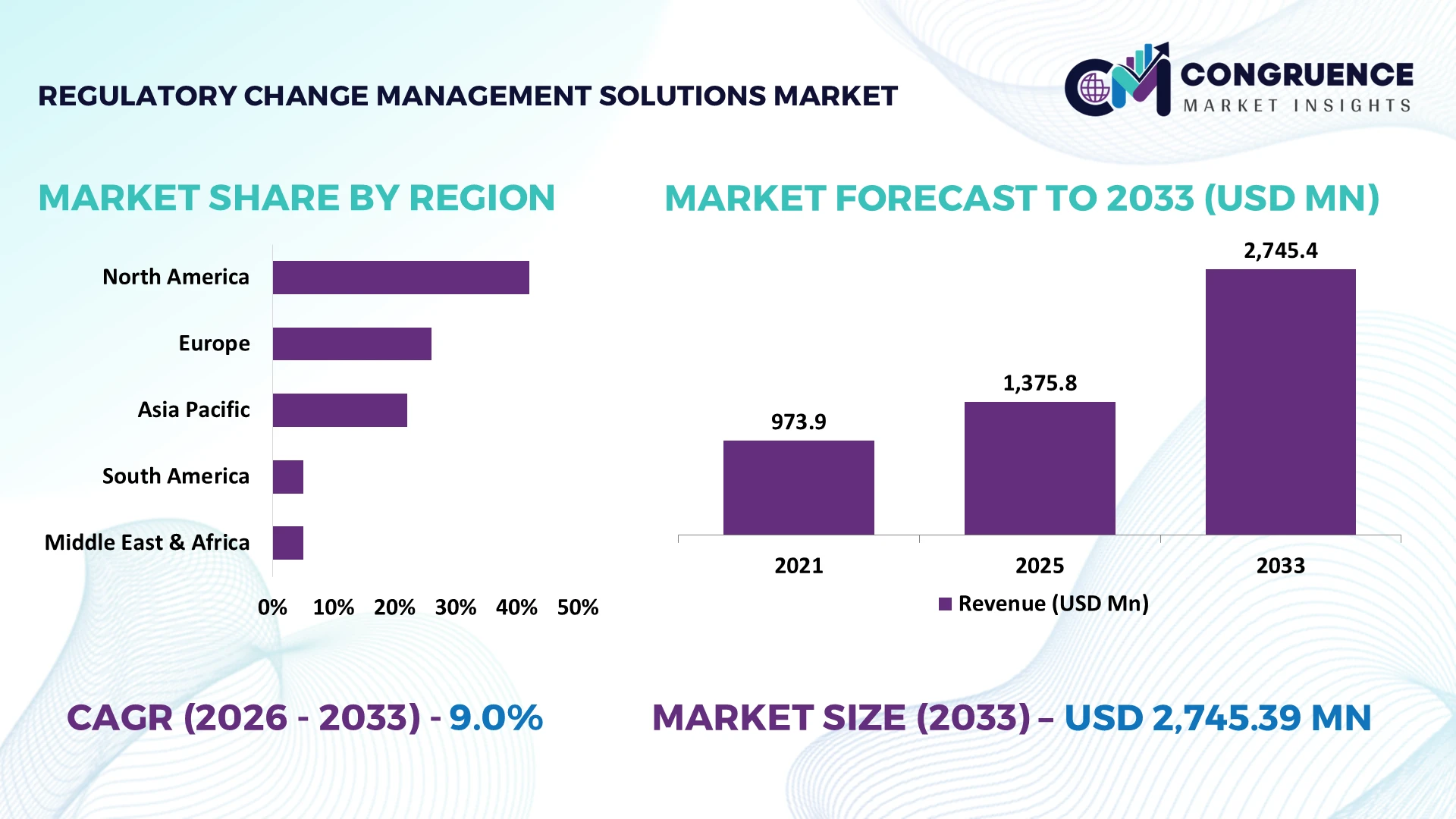
The United States dominates with roughly 56% of global RegTech deal activity in Q2 2025, anchored by deep capital markets, dense regulatory exposure across federal and state regimes, and enterprise adoption spanning banking, insurance, and asset management. The UK follows as Europe's leading hub, capturing 27% of regional deals in 2025, with 45 transactions concentrated in London's financial compliance ecosystem.
This concentration signals that vendors must prioritize US regulatory taxonomy coverage and UK supervisory alignment to capture enterprise procurement cycles, while treating continental Europe as a secondary expansion corridor.
Market Size & Growth: Valued at USD 1,375.8 Million in 2025, forecast to USD 2,745.4 Million by 2033, driven by AI-assisted regulatory mapping that reduces manual obligation tracking across multi-jurisdictional frameworks.
Top Growth Drivers: Regulatory volume expansion (68%), compliance cost pressure (54%), and cloud migration of GRC infrastructure (61%) collectively push enterprise adoption toward integrated platforms.
Short-Term Forecast: By 2028, automated regulatory change detection is expected to cut alert triage time by 40% and lower external compliance advisory spend by 22% across large banking institutions.
Emerging Technologies: AI-driven obligation extraction, real-time regulatory feeds, and zero-touch verification workflows are converging into unified change-management engines, with Vanta's AI agent already saving compliance teams up to 12 hours weekly.
Regional Leaders: North America leads with USD 612 Million projected for 2026; Europe follows at USD 398 Million with UK dominance in deal share; Asia-Pacific reaches USD 287 Million, driven by Singapore and Australia adoption.
Consumer/End-User Trends: Large enterprises account for over 80% of solution deployments, yet SME adoption is rising at 19% annually as modular compliance-as-a-service models lower entry barriers.
Pilot/Case Example: In 2025, Vanta deployed AI questionnaire automation across 12,000 companies in 58 countries, cutting response times by over half and saving teams up to 12 hours per week.
Competitive Landscape: IBM, Thomson Reuters, Wolters Kluwer, and Archer hold over 50% combined share, with Wolters Kluwer solutions supporting 90% of the world's top banks through regulatory-grade fraud and compliance infrastructure.
Regulatory & ESG Impact: DORA compliance in the EU and operational resilience rules in the UK drive 34% of new solution evaluations, with ESG disclosure tracking now embedded in 41% of enterprise procurement criteria.
Investment & Funding: Global RegTech funding reached USD 8.5 Billion in 2025, up 31% year-over-year, with sub-USD 100 Million deals rising 55% as investors favor scalable compliance platforms.
Innovation & Future Outlook: Consolidation toward end-to-end regulatory lifecycle platforms accelerates, with API-first architectures and ISO 42001-certified AI governance becoming baseline requirements for enterprise procurement.
The Regulatory Change Management Solutions market is shifting from alert aggregation toward execution-layer automation, where regulatory feeds directly trigger policy revisions and control testing. Adoption is strongest in banking and insurance, where institutions face an average of 300 regulatory changes daily and cannot sustain manual triage. AI-enabled obligation mapping now reduces false-positive alerts by 37%, while cloud-native deployment models lower total cost of ownership by 28% against on-premises legacy systems. This operational math explains why consolidation and platform-scale investment are accelerating across the vendor landscape.
Regulatory change management has moved from a back-office compliance function to a competitive differentiator as supervisors demand demonstrable control connectivity across the regulatory lifecycle. A typical global bank tracks up to 1,000 regulatory bodies and faces 300 daily alerts, making manual processing untenable and forcing automation into strategic budgets. AI-driven platforms now compress policy-to-control update cycles from months to minutes, while legacy manual workflows still consume over 10% of compliance headcount in large institutions.
The regional contrast is sharp: US firms deploy integrated GRC suites across multi-state and federal obligations, while UK institutions prioritize supervisory alignment with PRA and FCA frameworks, and Asia-Pacific adopters favor modular cloud tools that scale without full platform replacement. Over the next two to three years, operational KPIs will center on alert-to-obligation conversion rates exceeding 85% and external advisory spend reduction of 20% or more. Firms are adjusting by consolidating vendor stacks and prioritizing platforms with native DORA and operational resilience mapping, positioning regulatory change capability as a defensible operational asset rather than a cost center.
Regulatory velocity has outpaced manual processing capacity, with global banks facing up to 300 regulatory changes daily and 68% of compliance leaders reporting alert overload as their primary operational bottleneck. AI-assisted obligation mapping reduces false-positive triage by 37% and compresses policy update cycles from weeks to hours, directly addressing the 10% of staff overhead large institutions allocate to regulatory tracking. In the United States, where federal and state regulatory layers compound complexity, institutions are responding by embedding AI extraction tools into existing GRC stacks rather than replacing core systems. The strategic insight is that obligation-mapping accuracy, not alert volume, becomes the procurement battleground, favoring vendors with jurisdiction-specific training data.
Regulatory change platforms must interface with core banking, policy management, and control-testing systems, yet 54% of financial institutions report integration timelines exceeding 12 months due to legacy data models and non-standard regulatory taxonomies. In Germany and France, where supervisory reporting formats remain fragmented across BaFin and ACPR requirements, deployment delays increase project costs by an average of 28%. The direct business impact is deferred ROI and stalled scalability for mid-tier institutions that cannot absorb prolonged parallel-run costs. Companies are mitigating through pre-built connectors and phased cloud migration, but the restraint is structural: without standardized regulatory data schemas, integration remains the rate-limiting step for enterprise-wide deployment.
Large enterprises control over 80% of current deployments, yet SMEs face the same regulatory velocity with proportionally fewer compliance staff, creating a high-growth underserved segment. Modular, usage-based compliance platforms can capture this demand at 40% lower entry cost than full-suite GRC implementations, with adoption among mid-sized financial firms rising 19% annually. In Singapore and Australia, regulators are actively encouraging streamlined compliance tooling for smaller licensed entities, opening a policy-supported channel for vendor expansion. The non-obvious opportunity lies in bundling regulatory change monitoring with adjacent compliance workflows—sanctions screening updates and licensing renewals—to increase platform stickiness before larger competitors consolidate the segment.
As AI becomes embedded in regulatory interpretation, supervisors increasingly demand explainability and audit trails for automated obligation decisions. Financial institutions deploying AI-driven change management must meet ISO 42001 and SOC 2 Type II standards, with 41% of enterprise procurement criteria now requiring documented AI governance frameworks. In the UK, PRA supervisory statements on model risk management extend to third-party RegTech tools, creating deployment friction for vendors without certified AI operations capabilities. The long-term risk is regulatory rejection of black-box obligation mapping, forcing costly retrofits. Companies must invest in human-in-the-loop verification interfaces and model documentation infrastructure to maintain deployment consistency across jurisdictions with diverging AI oversight regimes.
Cloud-First Deployment Accelerates Cloud-based regulatory change platforms are displacing on-premises installations as financial institutions prioritize scalability and remote accessibility. Enterprise adoption of cloud-native GRC tools rose sharply through 2025, with cloud deployment now capturing the majority of new implementations. The shift reduces infrastructure maintenance overhead and enables continuous regulatory feed updates without manual patching. Vendors are responding by rebuilding obligation-mapping engines as API-first services, allowing integration with existing core banking stacks without full platform replacement.
Workflow Orchestration Closes Execution Gap Banks have largely solved regulatory detection but remain stalled at execution, with manual handoffs between legal, compliance, and technology teams consuming weeks per change. Firms deploying end-to-end workflow orchestration report regulatory response times compressing from multiple weeks to hours. The operational bottleneck has moved from horizon scanning to obligation decomposition and ownership assignment. Enterprises are investing in platforms that convert circular paragraphs directly into testable requirements with named owners and audit trails, rather than standalone alerting tools.
AI Governance Becomes Procurement Gate Supervisory scrutiny of automated regulatory interpretation has intensified, with examiners demanding explainability for AI-generated obligation decisions. Procurement criteria now routinely require documented model governance frameworks alongside functional capability. In the UK, PRA model risk guidance extends to third-party RegTech tools, forcing vendors to expose decision logic and human-in-the-loop checkpoints. Companies are responding by embedding approval gates into automated workflows and maintaining version-controlled audit records that satisfy both internal model risk teams and external supervisors.
SME Modular Adoption Reshapes Buyer Base Mid-sized financial firms and licensed non-bank entities are entering the market through modular, usage-priced compliance tools rather than enterprise suites. This segment faces equivalent regulatory velocity with proportionally thinner compliance staffing, creating demand for pre-configured obligation libraries and managed service wrappers. Vendors are responding with tiered offerings that bundle regulatory monitoring with adjacent workflows—licensing renewals, sanctions list updates—to increase stickiness before larger competitors consolidate the mid-market.
Cloud-based regulatory change management solutions command approximately 68% of deployment share, driven by lower total cost of ownership, continuous regulatory feed updates, and reduced infrastructure burden for compliance teams. The dominance is structural: cloud architectures enable vendors to push jurisdiction-specific taxonomy updates without client-side patching, a critical advantage as regulatory volumes compound across US federal and state layers.
On-premises deployments persist among institutions with data residency constraints, particularly in Germany and France where supervisory reporting formats and local hosting requirements slow cloud migration. Companies are responding by offering hybrid connectors that keep sensitive obligation data on-premises while routing analytics through vendor-managed cloud layers. The fastest-growing sub-segment is modular cloud deployment for mid-sized firms, where entry costs run roughly 40% below full-suite enterprise implementations.
Large enterprises account for more than 80% of regulatory change management solution deployments, reflecting the operational intensity of multi-jurisdictional compliance across global banking, insurance, and asset management operations . These organizations face hundreds of regulatory alerts daily and maintain dedicated compliance technology budgets that support full-suite GRC integration. Demand concentration is highest in US and UK banking institutions, where federal, state, and supervisory layers create obligation volumes that manual triage cannot absorb.
The fastest-growing application segment is SMEs, expanding at a rate exceeding the overall market as modular compliance-as-a-service models lower adoption barriers. Mid-sized firms in Singapore and Australia are particularly active, supported by regulators encouraging streamlined tooling for smaller licensed entities. Companies are adapting by unbundling enterprise platforms into tiered offerings with pre-configured obligation libraries, targeting SMEs through managed service wrappers and usage-based pricing that avoids upfront license commitments.
Banking and financial services institutions represent the dominant end-user group, capturing an estimated 62% of regulatory change management solution spend. Demand concentration stems from the operational intensity of supervisory obligations—global banks track up to 1,000 regulatory bodies and face hundreds of daily alerts—combined with the infrastructure investment capacity required for platform integration. US institutions lead deployment scale, while UK banks prioritize PRA and FCA supervisory alignment.
The fastest-growing end-user segment is insurance, where Solvency II reporting updates and operational resilience requirements are pushing adoption of automated obligation tracking. Healthcare and life sciences follow as regulatory complexity in FDA and EMA frameworks creates parallel demand for change management tooling. Companies are targeting these segments through vertical-specific obligation libraries and partnerships with industry compliance associations. Pricing strategies increasingly emphasize modular functionality—regulatory monitoring as a standalone module with optional policy management add-ons—to accommodate buyers with narrower initial deployment scopes.
North America accounted for the largest market share at 42% in 2025 however, Asia-Pacific is expected to register the fastest growth, expanding at a CAGR of 11.6% between 2026 and 2033.
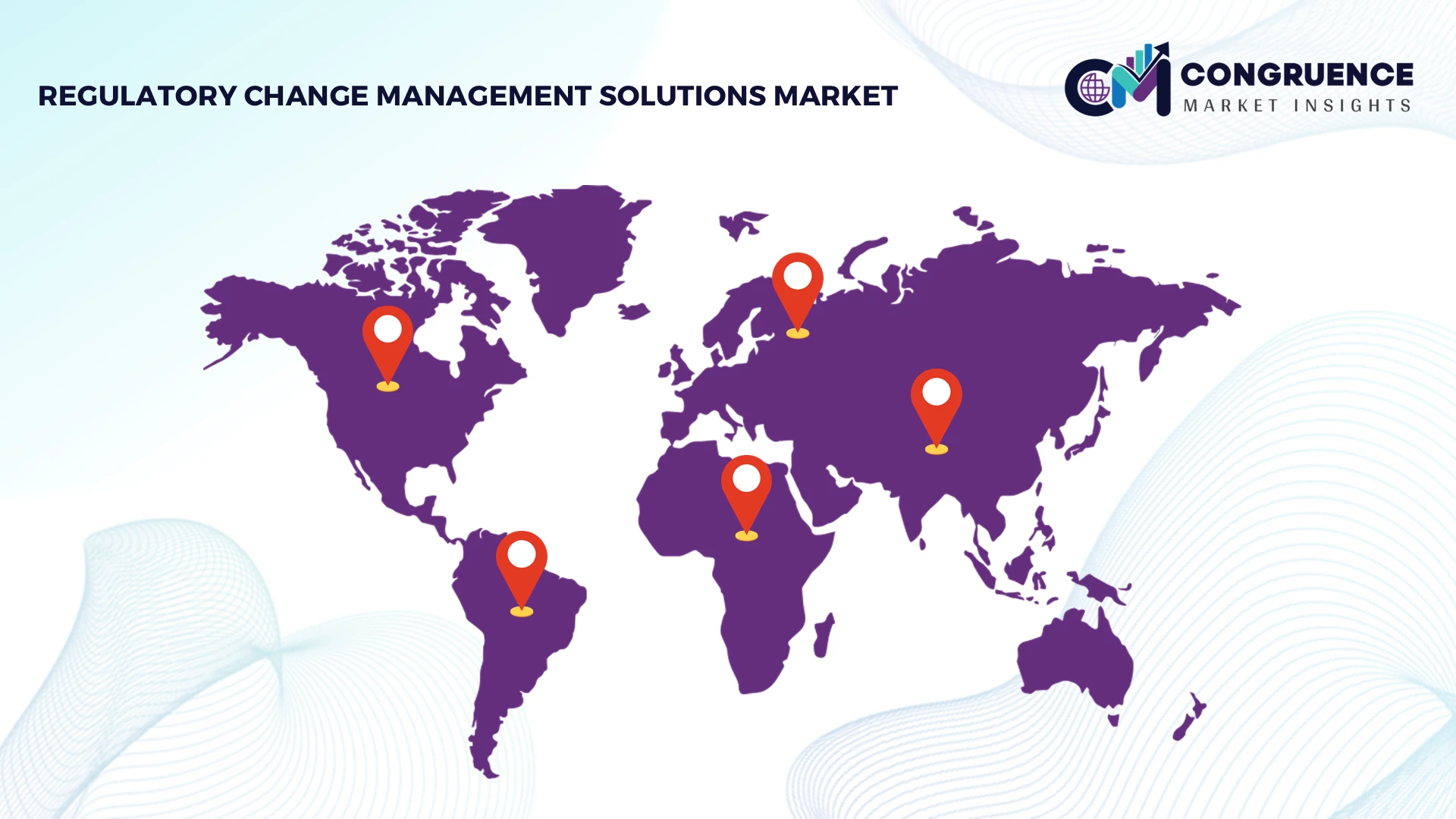
North America anchors global regulatory change management demand through the density of US federal and state supervisory regimes, where financial institutions face compounding obligation volumes across banking, insurance, and capital markets. The region captures 42% of global market share, with deployment concentration highest among US money-center banks and asset managers operating multi-jurisdictional compliance stacks. Cloud-native obligation mapping adoption reached 64% among US financial institutions in 2025, driven by vendor competition and regulatory taxonomy standardization efforts. Canadian institutions follow a more measured deployment cadence, prioritizing data residency and OSFI supervisory alignment over rapid platform migration. Investment momentum remains concentrated in California and New York RegTech ecosystems, where AI-driven compliance automation attracted the majority of regional funding through 2025.
United States Market Outlook: The US market benefits from the world's deepest RegTech capital pool, with California firms securing 37% of all US RegTech deals in Q3 2025 and New York adding 18% share. Federal and state regulatory layering creates obligation volumes that no manual process can absorb, forcing platform adoption. US financial institutions lead globally in AI-assisted regulatory extraction deployment, positioning the country as the benchmark market for obligation-mapping accuracy and audit defensibility.
Europe commands 26% of global market share, shaped by the UK's role as the region's RegTech investment and deployment hub. London's concentration of PRA and FCA-supervised institutions drives demand for supervisory-aligned regulatory change platforms, with UK firms capturing 27% of European RegTech deals in 2025. DORA implementation across EU member states has accelerated obligation-tracking requirements for financial entities operating in Germany, France, and the Netherlands, though fragmentation across BaFin, ACPR, and DNB reporting formats sustains integration friction. The region's distinctive dynamic is regulator-led technology scrutiny: the FCA's five-year strategy explicitly expects firms to demonstrate surveillance effectiveness and governance rigor, pushing vendors toward explainable AI and audit-traceable obligation decomposition.
United Kingdom Market Outlook: The UK leads Europe with 45 RegTech transactions in 2025, supported by FCA supervisory expectations that prioritize demonstrable control connectivity over alert volume. London's concentration of global banking compliance functions creates a procurement environment where regulatory change platforms must satisfy both PRA operational resilience and FCA market integrity requirements, making the UK the region's most demanding and influential deployment market.
Asia-Pacific holds 22% of global market share, with Singapore emerging as the region's regulatory technology standard-setter. The city-state leads globally in AI adoption for compliance surveillance, with 97% of firms using AI and 96% reporting measurable improvements. MAS-driven initiatives, including Project MindForge and the AI Risk Management Handbook, are formalizing governance expectations that will shape vendor requirements across the region. Australia follows with stronger emphasis on record-keeping and regulatory reporting infrastructure, though encrypted communications surveillance gaps persist. China and Japan present distinct dynamics: domestic regulatory frameworks favor localized compliance tooling, while Japanese institutions prioritize integration with existing GRC suites. Regional budget expansion is broad-based, with 84% of APAC firms increasing compliance budgets in 2025.
Singapore Market Outlook: Singapore functions as APAC's regulatory technology testbed, where MAS sandboxes and AI governance frameworks create a structured path from pilot to production. The 97% AI adoption rate in surveillance reflects deliberate regulator-industry collaboration, and the forthcoming operationalisation guidance for Project MindForge will establish compliance automation benchmarks that vendors must meet to access the broader Southeast Asian market.
South America represents 5% of global market share, with Brazil driving nearly all meaningful deployment activity. The Banco Central do Brasil's Pix instant payment rail and Open Finance framework have generated transaction volumes and security requirements that exceed manual compliance capacity, creating structural demand for automated regulatory monitoring and fraud-related obligation tracking. Brazilian financial institutions face rapid regulatory iteration—new Pix features, Open Finance API standards, and DREX digital currency pilots—that require continuous obligation reassessment. The region's constraint is infrastructure unevenness: while Brazil's regulatory sandbox and innovation hub support pilot-to-production pathways, neighboring markets lack comparable supervisory clarity, limiting vendor expansion beyond Portuguese-speaking jurisdictions.
Brazil Market Outlook: Brazil's central bank operates the region's most active regulatory innovation program, combining Pix expansion, Open Finance mandates, and sandbox licensing to create real compliance workloads rather than theoretical demand. Homegrown RegTech vendors specializing in Pix fraud monitoring and consent governance have emerged, though international providers must partner locally to navigate data handling and sandbox participation requirements.
Middle East & Africa captures 5% of global market share, with Saudi Arabia and the UAE driving deployment through state-led financial modernization. Saudi Vision 2030 and SAMA's regulatory sandbox have created a structured pipeline of compliance requirements for banks, fintechs, and payment providers, while the UAE's digital economy strategy generates parallel demand for data protection and AML automation. Large enterprises dominate regional adoption, reflecting the scale of Gulf banking operations and their exposure to multi-jurisdictional regulatory frameworks. The region's distinctive advantage is policy-to-procurement translation: sandbox approvals and open banking mandates create immediate technical compliance needs that RegTech products are designed to address. Infrastructure constraints in African markets limit cloud-native deployment, though mobile money growth creates selective demand for lightweight compliance tooling.
Saudi Arabia Market Outlook: Saudi Arabia leads MEA through explicit state policy linking fintech expansion to compliance infrastructure. SAMA and CMA sandboxes, combined with Fintech Saudi's ecosystem programs, generate a steady pipeline of licensed entities requiring regulatory change management from day one of operation. The Kingdom's cashless payment targets and open banking rollout create obligation volumes that incumbent banks and new entrants cannot manage through manual processes, positioning regulatory technology as a mandated operational layer rather than discretionary investment.
The regulatory change management market is contested by global GRC incumbents—IBM, Thomson Reuters, Wolters Kluwer, and Archer—that collectively hold over 50% of revenue, competing against specialized regulatory intelligence vendors such as CUBE andmCompliance.ai. Competition centers on obligation-mapping accuracy, integration depth, and regulatory taxonomy coverage rather than price alone. CUBE's regulatory agents identify three to four times more essential regulation than frontier AI models in benchmark testing, signaling that domain-specific data depth now outweighs generic platform breadth . Incumbents are responding through acquisitions and ecosystem partnerships—Thomson Reuters embedded CUBE's intelligence into CoCounsel Legal to extend coverage across 150 countries without ingesting regulatory data internally . The competitive shift is toward workflow-embedded regulatory intelligence: standalone alerting tools lose ground to platforms that convert regulatory text into actionable controls. Entry barriers are rising around verified regulatory corpora and audit-traceable AI governance, making proprietary data infrastructure the decisive competitive asset.
IBM
Thomson Reuters
Wolters Kluwer
Archer
Protiviti
ServiceNow
CUBE
MetricStream
SAI360
Resolver (Kroll)
LogicGate
Compliance.ai
PerformLine
LogicManager
AI-assisted obligation extraction is now baseline, with vendors embedding large language models directly into regulatory feeds to convert circular text into testable controls. CUBE's benchmark testing demonstrated its regulatory identification agents surfaced three to four times more essential regulation than general-purpose frontier models, confirming that domain-trained architectures outperform generic AI on supervisory material . Thomson Reuters operationalized this through a partnership embedding CUBE's intelligence into CoCounsel Legal, extending regulatory coverage to users across 150 countries without internal data ingestion overhead .
Runtime governance represents the disruptive frontier. Vanta's acquisition of Pillar Security targets AI agent monitoring and enforcement, with AI Inventory and runtime detection slated for January 2027, followed by red teaming and enforcement later that year . This shifts compliance from periodic documentation to live control enforcement, where unauthorized agent actions are blocked and logged automatically. Organizations relying on static policy repositories will face audit gaps as AI agents operate beyond human review cycles.
The 2026–2028 window favors platforms combining verified regulatory corpora with runtime enforcement capability. Firms acting now to integrate regulatory intelligence feeds with active control testing gain compounding audit defensibility, while laggards face retrofitting costs as supervisory scrutiny of AI-driven compliance decisions intensifies.
March 2026 – Archer Named a Leader in The Forrester Wave™: Third-Party Risk Management Platforms, Q1 2026, cited for integrating third-party risk into the broader enterprise risk ecosystem including regulatory change. Business impact: strengthens competitive positioning for enterprise GRC consolidation. Source: archerirm.com
November 2026 – Thomson Reuters Achieved FedRAMP certification for Legal Research and Risk & Fraud solutions, sponsored by the U.S. Department of Veterans Affairs and HHS, enabling federal agencies to deploy AI-powered regulatory and legal intelligence in secure cloud environments. Source: thomsonreuters.com
November 2026 – CUBE Partnered with Thomson Reuters to power CoCounsel Legal's regulatory intelligence across 150+ countries, with benchmark testing showing its agents identified three to four times more essential regulation than frontier AI models. Source: itbrief.in
November 2026 – Vanta Signed a definitive agreement to acquire Pillar Security, building runtime AI governance with AI Inventory launching January 2027 and enforcement capabilities following, targeting over 20,000 existing customers demanding real-time agent control. Source: vanta.com
The report covers the global regulatory change management solutions market across cloud-based and on-premises deployment types, with applications spanning large enterprises and SMEs. Regional analysis encompasses North America, Europe, Asia-Pacific, South America, and Middle East & Africa, with country-level insights for the United States, United Kingdom, Singapore, Brazil, and Saudi Arabia. Large enterprises account for over 80% of current deployments, while SME adoption accelerates through modular compliance-as-a-service models .
Technology coverage includes AI-assisted obligation mapping, regulatory intelligence feeds, workflow orchestration, and runtime AI governance. The report profiles key competitors including IBM, Thomson Reuters, Wolters Kluwer, Archer, CUBE, and ServiceNow, examining partnership strategies, certification achievements, and acquisition activity shaping competitive positioning. Strategic insights support investment planning around verified regulatory data infrastructure, expansion prioritization in high-velocity jurisdictions, and competitive differentiation through workflow-embedded compliance automation. The analysis maps demand shifts toward execution-layer platforms that convert regulatory alerts into auditable controls, providing decision-ready intelligence for vendor selection, partnership evaluation, and market entry between 2026 and 2033.
| Report Attribute / Metric | Details |
|---|---|
| Market Revenue (2025) | USD 1,375.8 Million |
| Market Revenue (2033) | USD 2,745.4 Million |
| CAGR (2026–2033) | 9.02% |
| Base Year | 2025 |
| Forecast Period | 2026–2033 |
| Historic Period | 2021–2025 |
| Segments Covered |
By Type
By Application
By End-User
|
| Key Report Deliverables | Revenue Forecast; Market Trends; Growth Drivers & Restraints; Technology Insights; Segmentation Analysis; Regional Insights; Competitive Landscape; Regulatory & ESG Overview; Recent Developments |
| Regions Covered | North America; Europe; Asia-Pacific; South America; Middle East & Africa |
| Key Players Analyzed | IBM; Thomson Reuters; Wolters Kluwer; Archer; Protiviti; ServiceNow; CUBE; MetricStream; SAI360; Resolver (Kroll); LogicGate; Compliance.ai; PerformLine; LogicManager |
| Customization & Pricing | Available on Request (10% Customization Free) |




