
Reports
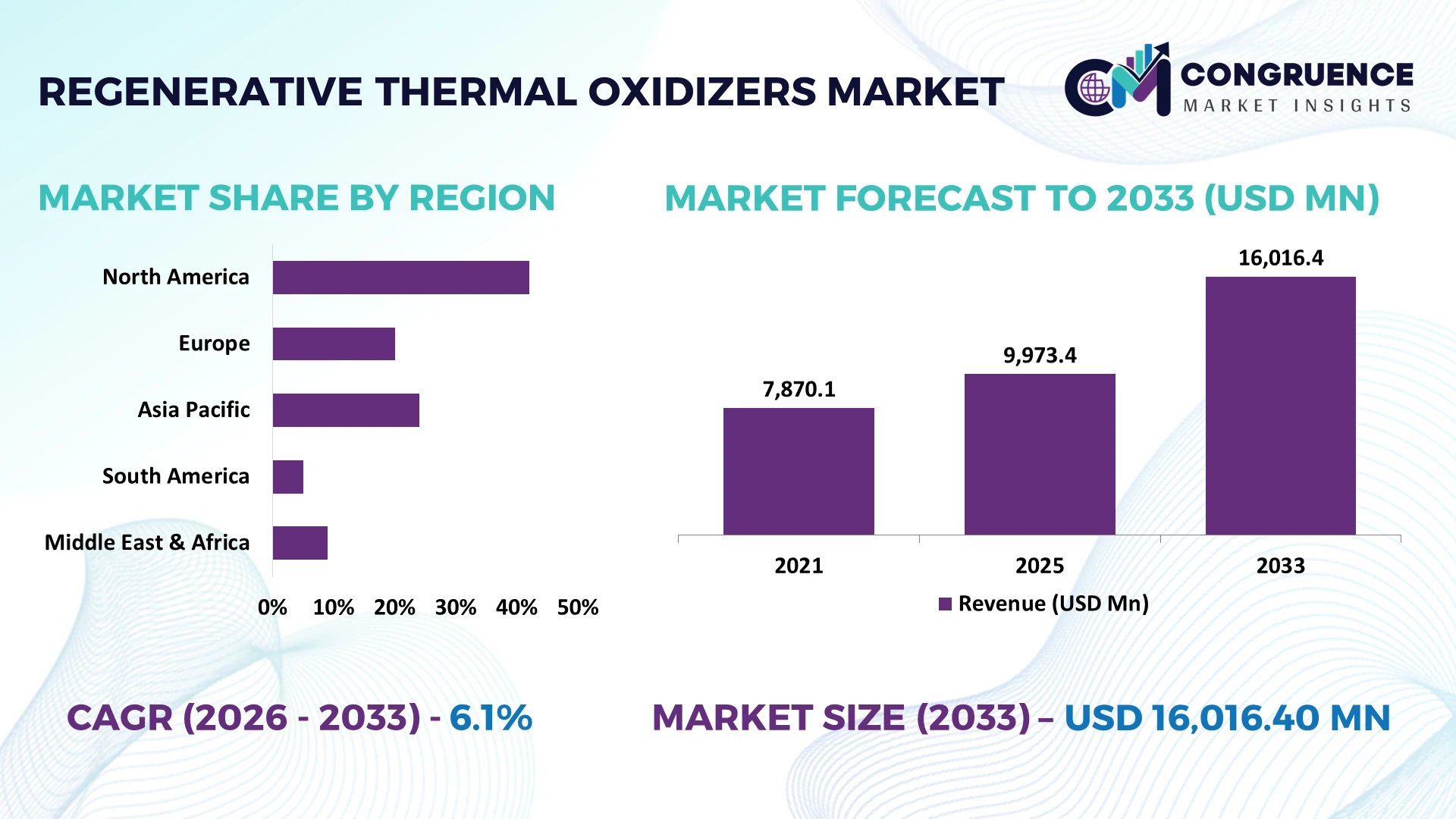
The Global Regenerative Thermal Oxidizers Market was valued at USD 9973.4 Million in 2025 and is anticipated to reach a value of USD 16016.4 Million by 2033 expanding at a CAGR of 6.1% between 2026 and 2033. Growth is driven by stringent volatile organic compound emission standards, expansion of chemical and pharmaceutical manufacturing, industrial coating operations, and adoption of high-efficiency ceramic heat recovery systems.
The United States holds a strategically important position in regenerative thermal oxidizer deployment, supported by chemical processing, automotive coating, pharmaceuticals, and industrial manufacturing. An indicative market model assigns the country 25% of global demand, reflecting its established pollution control infrastructure. Modern regenerative thermal oxidizers achieve 95–99% VOC destruction efficiency and thermal recovery exceeding 95% under optimized conditions. Compared with India, US facilities face more established federal air permitting requirements under the Clean Air Act, encouraging investment in automated emission control systems.
Strategically, suppliers should prioritize US industrial retrofit projects and India's expanding manufacturing clusters, emphasizing 95% thermal recovery and independently validated VOC destruction performance.
Market Size & Growth: USD 9,973.4 million in 2025, reaching USD 16,016.4 million by 2033 at 6.1% CAGR, supported by industrial VOC emission regulations.
Top Growth Drivers: Illustrative demand weighting assigns 40% to emission compliance, 35% to manufacturing expansion, and 25% to energy-efficient equipment replacement.
Short-Term Forecast: By 2028, upgraded RTO installations target 10–15% lower auxiliary fuel consumption through optimized heat recovery and airflow control.
Emerging Technologies: AI-based combustion optimization, ceramic heat exchangers, and digital monitoring target 5–10% improvements in operational efficiency.
Regional Leaders: Indicative 2033 allocations place North America at USD 5,285.4 million, Asia-Pacific at USD 4,965.1 million, and Europe at USD 3,523.6 million, reflecting compliance and industrial modernization.
Consumer/End-User Trends: Chemical, coating, and pharmaceutical facilities prioritize RTO systems delivering 95–99% VOC destruction efficiency.
Pilot/Case Example: A 2025 illustrative industrial retrofit scenario targets 15% lower auxiliary fuel consumption through improved ceramic heat recovery.
Competitive Landscape: Dürr, CECO Environmental, Anguil, and TKS compete in industrial oxidation systems; individual company market shares remain unverified.
Regulatory & ESG Impact: Modern RTO installations achieve up to 99% VOC destruction, supporting compliance with US industrial air pollution regulations.
Investment & Funding: Industrial emission control investments increasingly prioritize modular RTO packages; a verified global market-specific investment total is not established.
Innovation & Future Outlook: By 2033, advanced RTO platforms will integrate predictive maintenance, automated valve control, and heat recovery optimization.
The Regenerative Thermal Oxidizers Market is shaped by industrial air pollution control requirements across chemical manufacturing, automotive painting, pharmaceuticals, printing, and flexible packaging. Regenerative thermal oxidizers use ceramic heat exchange beds to recover combustion energy while destroying volatile organic compounds and hazardous air pollutants. Advanced systems can achieve thermal recovery efficiencies exceeding 95%, reducing supplementary fuel requirements during stable operation. Industrial operators in the United States and Europe are upgrading aging emission control infrastructure, while Asian manufacturers increasingly integrate automated combustion monitoring. Equipment suppliers are emphasizing compact configurations, heat recovery performance, and regulatory compliance, establishing operational efficiency as a central investment consideration.
Regenerative thermal oxidizers are becoming strategically important as chemical producers, automotive manufacturers, and industrial coating facilities modernize emission control infrastructure. The United States Clean Air Act establishes enforceable requirements for controlling volatile organic compounds and hazardous air pollutants, influencing industrial equipment procurement. Modern RTO systems achieve 95–99% VOC destruction efficiency, supporting regulatory compliance while reducing operational exposure. Manufacturers are prioritizing automated combustion controls, ceramic heat recovery systems, and integrated emission monitoring to strengthen equipment performance and reliability.
Compared with conventional direct-fired thermal oxidizers, advanced regenerative systems recover more than 95% of combustion heat under optimized conditions, reducing auxiliary fuel requirements. Germany emphasizes industrial retrofit projects and energy efficiency, while China prioritizes manufacturing-scale emission control deployment. Between 2026 and 2028, equipment suppliers are targeting 10–15% reductions in supplementary fuel consumption through intelligent airflow management and improved valve sequencing. Digital monitoring also supports faster fault detection and more consistent operating temperatures.
Automotive paint shops provide a practical deployment example, where RTO units treat solvent-laden exhaust from coating and drying processes. Dürr and specialized oxidation equipment suppliers are expanding integrated air pollution control solutions and aftermarket services. Competitive advantage increasingly depends on verified destruction efficiency, thermal recovery performance, and dependable lifecycle operating costs.
Industrial VOC emission regulations are accelerating regenerative thermal oxidizer deployment across chemical manufacturing, automotive coating, and pharmaceutical production. The United States Clean Air Act requires regulated facilities to control hazardous air pollutants, encouraging investment in high-efficiency oxidation systems. Modern RTO installations achieve 95–99% VOC destruction efficiency, while advanced ceramic heat exchangers recover more than 95% of combustion energy under suitable operating conditions. Optimized configurations target 10–15% lower auxiliary fuel consumption than less efficient installations. These performance advantages strengthen compliance economics and reduce energy exposure. Dürr, Anguil, and CECO Environmental are developing integrated emission control packages, automated combustion systems, and retrofit services. Suppliers combining regulatory engineering expertise with reliable thermal performance gain stronger positions in industrial modernization projects.
Regenerative thermal oxidizers require substantial initial investment in combustion chambers, ceramic media, valves, ductwork, and control infrastructure. Large industrial installations also depend on reliable natural gas or alternative fuel supplies during startup and low VOC concentration operation. In Germany, industrial energy price volatility increases uncertainty surrounding equipment operating costs. An illustrative 15% increase in installation expenditure extends investment recovery periods, while 10% higher auxiliary fuel costs weaken operating margins. A modeled 5% increase in maintenance expenditure further affects lifecycle economics. Space-constrained facilities face additional challenges integrating large oxidation equipment into existing production layouts. Manufacturers are addressing these limitations through compact modular designs, localized component sourcing, and long-term service agreements. Heat recovery optimization and alternative fuel compatibility support more predictable operating economics.
Advanced heat recovery technologies and automated combustion optimization create opportunities for regenerative thermal oxidizer manufacturers serving aging industrial facilities. Automotive coating plants and chemical processing operations in India are increasingly evaluating equipment modernization alongside environmental compliance requirements. Next-generation ceramic media and optimized airflow configurations target 10–15% lower supplementary fuel consumption, while predictive maintenance systems offer illustrative 8–12% reductions in unplanned downtime. Automated valve sequencing can improve thermal stability and support 5% lower process variability under controlled operating conditions. Between 2026 and 2028, manufacturers are positioned to expand modular retrofit packages, remote monitoring services, and integrated waste heat utilization systems. Partnerships with engineering contractors and industrial automation providers strengthen deployment capabilities. Capturing recovered heat for adjacent production processes creates additional value beyond conventional VOC destruction.
Maintaining consistent oxidation performance across fluctuating exhaust volumes and VOC concentrations presents a major operational challenge. Automotive painting, pharmaceutical production, and chemical processing facilities frequently experience changing process loads, requiring responsive combustion control and reliable valve operation. An illustrative 10% variation in exhaust flow increases control complexity, while 5% deterioration in ceramic heat recovery performance raises supplementary fuel requirements. A modeled 8% reduction in equipment availability also disrupts production continuity. Industrial operators in China face additional pressure to integrate emission monitoring with increasingly automated manufacturing systems. Equipment suppliers must strengthen predictive diagnostics, high-temperature valve durability, and adaptive process controls. Investment in operator training, redundant instrumentation, and maintenance partnerships supports consistent destruction efficiency and long-term equipment reliability.
Continuous Emissions Monitoring Gains Operational Priority: US chemical and coating facilities are strengthening continuous emissions monitoring to demonstrate regulatory compliance. Modern RTO systems typically achieve 95–99% VOC destruction efficiency, while digital monitoring platforms target 5–10% faster deviation detection. Equipment suppliers are integrating temperature sensors, automated reporting, and remote diagnostics, reducing manual inspection requirements and improving audit readiness under Clean Air Act permitting obligations.
Ceramic Media Designs Improve Thermal Performance: German industrial facilities are evaluating structured ceramic heat exchange media to improve airflow distribution and reduce pressure losses. Advanced RTO configurations achieve thermal recovery exceeding 95%, while engineered media arrangements target 5–8% lower pressure drop. Manufacturers are refining ceramic geometries and modular bed configurations, helping operators reduce fan energy consumption without compromising oxidation temperatures or treatment capacity.
Low-Concentration Exhaust Treatment Expands: Pharmaceutical and semiconductor facilities increasingly require treatment of dilute solvent exhaust streams containing variable VOC concentrations. RTO installations operate at oxidation temperatures commonly ranging from 760°C to 870°C, with optimized systems targeting 95–99% destruction efficiency. Equipment suppliers are introducing concentration monitoring and adaptive burner controls, improving treatment stability when solvent loading fluctuates between production batches.
Prefabricated Oxidizer Packages Shorten Installation: Industrial manufacturers in India and Southeast Asia are adopting skid-mounted RTO configurations to reduce onsite construction complexity. Modular equipment designs target 10–20% shorter installation schedules and 5–10% lower onsite labor requirements in illustrative project comparisons. Suppliers are standardizing ductwork interfaces, preassembled valve systems, and factory-tested controls, enabling faster commissioning while reducing disruption to existing manufacturing operations.
Two-Canister Systems Lead Standard Industrial Installations
Two-Canister Systems represent the leading segment, with an indicative 38% market share, supported by relatively straightforward construction, established operating practices, and suitability for moderate industrial exhaust volumes. Their alternating ceramic beds provide effective heat recovery while limiting equipment complexity. Three-Canister Systems account for an estimated 29%, offering improved flow management and purge capabilities that reduce untreated exhaust carryover during valve switching. These configurations serve facilities requiring consistent VOC destruction across variable operating conditions.
Multi-Canister Systems represent the fastest-growing category, holding an indicative 20% share as large chemical and coating facilities seek greater treatment capacity and operating flexibility. Advanced configurations can achieve thermal recovery exceeding 95%, strengthening fuel efficiency in high-volume applications. Rotary Regenerative Systems account for approximately 13%, emphasizing compact equipment arrangements and continuous heat exchange. Manufacturers are refining high-temperature valves, ceramic media, and automated flow controls across all configurations. Dürr, Anguil, and specialized equipment suppliers are developing application-specific designs and modular installation packages. Investment increasingly favors systems balancing destruction efficiency, pressure drop, maintenance accessibility, and lifecycle operating costs.
VOC Abatement Dominates Industrial Oxidation Demand
VOC Abatement represents the leading application, with an indicative 42% market share, supported by solvent-intensive manufacturing and established industrial emission control requirements. Automotive painting, printing, coating, and chemical processing facilities deploy RTO systems to oxidize volatile organic compounds before atmospheric discharge. Modern equipment achieves 95–99% VOC destruction efficiency under properly controlled operating conditions. Industrial Exhaust Treatment accounts for an estimated 28%, reflecting demand for centralized processing of mixed manufacturing exhaust streams and improved facility-wide emission management.
Hazardous Air Pollutant Control represents the fastest-growing application, holding an indicative 19% share as regulated facilities strengthen treatment of specific toxic organic compounds. Odor Control accounts for approximately 11%, serving industrial processes where oxidizable organic contaminants contribute to nuisance emissions. Manufacturers are integrating automated temperature management, advanced ceramic beds, and process-specific monitoring systems. Three-canister and multi-canister designs improve operational flexibility where continuous treatment is essential. Equipment suppliers increasingly differentiate through guaranteed destruction performance, engineered exhaust handling, and regulatory documentation support.
Chemical and Petrochemical Plants Lead Equipment Procurement
Chemical and Petrochemical Plants represent the largest end-user category, accounting for an indicative 34% market share. Continuous processing operations generate solvent-containing exhaust streams requiring dependable emission treatment, supporting investment in high-capacity RTO installations. Printing and Coating Industries account for an estimated 27%, driven by solvent evaporation during coating, drying, and printing processes. Automotive Manufacturers represent approximately 20%, emphasizing reliable VOC abatement across paint shops and surface finishing operations. Equipment suppliers prioritize high thermal recovery, automated combustion controls, and integrated maintenance services.
Semiconductor Manufacturers represent the fastest-growing end-user segment, holding an indicative 11% share as advanced fabrication facilities expand specialized exhaust treatment infrastructure. Pharmaceutical Manufacturers account for approximately 8%, reflecting solvent-intensive production and batch processing requirements. Properly engineered RTO systems achieve 95–99% destruction efficiency, supporting industrial compliance objectives. Manufacturers are developing compact configurations, specialized pretreatment systems, and digital monitoring capabilities. Competitive positioning increasingly depends on application-specific engineering, continuous operating reliability, and documented emission control performance.
North America accounted for the largest market share at an indicative 33% in 2025 however, Asia-Pacific is expected to register the fastest growth, expanding at a projected CAGR of 7.4% between 2026 and 2033.

Industrial Emission Compliance Drives Advanced Oxidizer Modernization
North America represents an indicative 33% of global regenerative thermal oxidizer demand, supported by established industrial emission control infrastructure and stringent air pollution regulations. The United States dominates regional installations, while Canada contributes through chemical processing, automotive manufacturing, and industrial coating operations. The US Clean Air Act establishes enforceable emission requirements for regulated industrial facilities, supporting investment in VOC destruction equipment. Modern regenerative thermal oxidizers achieve 95–99% destruction efficiency, while optimized ceramic heat recovery systems exceed 95% thermal efficiency. Industrial operators increasingly replace aging thermal oxidizers with automated RTO configurations that reduce supplementary fuel requirements. Equipment suppliers including Anguil and CECO Environmental emphasize integrated combustion controls, remote monitoring, and retrofit engineering. Procurement decisions increasingly prioritize verified destruction performance, maintenance accessibility, and long-term energy efficiency across industrial manufacturing facilities.
United States Market Outlook: The United States maintains a strong position through extensive chemical manufacturing, automotive coating, and pharmaceutical production infrastructure. Texas, Louisiana, Michigan, and Ohio concentrate industrial operations requiring reliable VOC control. US Environmental Protection Agency regulations influence equipment specifications and operating requirements. Manufacturers are expanding modular RTO systems, high-temperature valve technologies, and automated compliance monitoring to improve operating reliability.
Energy Efficiency and Industrial Regulation Shape Equipment Replacement
Europe accounts for an indicative 22% of global regenerative thermal oxidizer demand, supported by industrial emissions legislation, energy efficiency requirements, and established manufacturing infrastructure. Germany, France, Italy, and the United Kingdom contribute through automotive production, chemical processing, pharmaceuticals, and industrial coating activities. The European Union's revised Industrial Emissions Directive strengthens environmental performance expectations for covered industrial installations. Manufacturers increasingly prioritize RTO systems combining high VOC destruction efficiency with reduced auxiliary fuel consumption. Advanced ceramic heat exchange configurations recover more than 95% of thermal energy under optimized operating conditions. Dürr and specialized European equipment suppliers develop integrated emission treatment systems, automated process controls, and energy recovery solutions. Industrial operators emphasize reliable compliance performance, equipment modernization, and reduced energy exposure. Retrofit engineering and advanced ceramic media replacement are becoming important procurement considerations.
Germany Market Outlook: Germany benefits from extensive automotive manufacturing, chemical production, and advanced industrial engineering capabilities. Automotive coating facilities and chemical processing plants require dependable VOC abatement systems. Dürr maintains established expertise in industrial environmental technology and paint shop integration. German industrial energy efficiency priorities encourage adoption of regenerative systems that reduce supplementary fuel consumption and support automated emissions monitoring.
Manufacturing Expansion Accelerates Industrial Exhaust Treatment Deployment
Asia-Pacific represents an indicative 31% of global regenerative thermal oxidizer demand, supported by extensive chemical manufacturing, automotive production, electronics processing, and industrial coating activities. China dominates regional equipment requirements, while India, Japan, and South Korea contribute through manufacturing modernization and environmental compliance investments. China's industrial air pollution control framework encourages facilities to adopt effective VOC treatment technologies across chemical and coating operations. Advanced RTO installations achieve 95–99% destruction efficiency, strengthening compliance capabilities for solvent-intensive manufacturing. India is expanding pharmaceutical and chemical manufacturing infrastructure, creating opportunities for modular oxidation equipment. Japan and South Korea emphasize automated combustion control, compact equipment configurations, and reliable treatment of specialized industrial exhaust streams. Equipment suppliers are developing localized manufacturing capabilities, integrated monitoring platforms, and application-specific engineering services. Competitive differentiation increasingly depends on equipment reliability, installation flexibility, and operating efficiency.
China Market Outlook: China benefits from large chemical manufacturing clusters in Jiangsu, Zhejiang, and Shandong, alongside extensive automotive and electronics production. National VOC emission control policies encourage industrial facilities to strengthen exhaust treatment infrastructure. Domestic equipment manufacturers are expanding automated oxidation systems and ceramic heat recovery technologies. Industrial operators prioritize treatment capacity, compliance monitoring, and dependable maintenance support across high-volume manufacturing operations.
Industrial Modernization Strengthens VOC Control Equipment Demand
South America accounts for an indicative 7% of global regenerative thermal oxidizer demand, concentrated in Brazil, Argentina, Chile, and Colombia. Chemical manufacturing, automotive assembly, printing, and industrial coating operations establish the principal equipment applications. Brazil maintains the largest regional industrial base, supporting investment in VOC abatement and exhaust treatment infrastructure. Automotive production facilities require dependable oxidation systems for solvent-containing paint shop emissions, while chemical processors emphasize consistent destruction efficiency. Modern RTO configurations achieve thermal recovery exceeding 95% under suitable operating conditions, reducing supplementary fuel requirements. Equipment suppliers increasingly rely on local engineering contractors and distributor partnerships to support installation and maintenance. Imported components, financing constraints, and specialized technical workforce limitations affect procurement decisions. Modular equipment packages and long-term maintenance agreements improve deployment accessibility across established industrial facilities.
Brazil Market Outlook: Brazil maintains substantial automotive, chemical, and industrial coating operations concentrated in São Paulo, Minas Gerais, and Paraná. Environmental licensing requirements influence industrial emission treatment investments. Automotive paint shops and chemical manufacturers represent important RTO applications. Equipment suppliers emphasize localized engineering support, reliable spare parts availability, and retrofit-compatible systems to reduce installation complexity and operating interruptions.
Petrochemical Investment Supports Industrial Emission Control Infrastructure
The Middle East & Africa represents an indicative 7% of global regenerative thermal oxidizer demand, supported by petrochemical processing, industrial manufacturing, and environmental infrastructure development. Saudi Arabia, the United Arab Emirates, South Africa, and Qatar contribute through chemical production, refining, and industrial diversification initiatives. Saudi Arabia's industrial development programs support expansion of petrochemical and specialty chemical manufacturing, creating requirements for reliable VOC treatment systems. Regenerative thermal oxidizers achieve 95–99% VOC destruction efficiency under properly engineered operating conditions, supporting industrial air quality management. Equipment suppliers emphasize high-temperature durability, modular configurations, and integrated combustion monitoring. Industrial operators evaluate RTO systems for compatibility with variable exhaust compositions and demanding environmental conditions. Regional engineering partnerships strengthen installation capabilities, while imported ceramic media and specialized valves create opportunities for localized maintenance services.
Saudi Arabia Market Outlook: Saudi Arabia benefits from extensive petrochemical infrastructure and industrial diversification under Vision 2030. Jubail and Yanbu concentrate major chemical and industrial manufacturing facilities requiring effective emission management. Saudi environmental compliance requirements encourage investment in industrial pollution control technologies. Equipment suppliers are targeting high-capacity oxidation systems, automated monitoring, and long-term technical service partnerships to support reliable industrial operations.
The regenerative thermal oxidizers market features competition between Dürr, CECO Environmental, Anguil Environmental Systems, TKS Industrial, and specialized regional equipment manufacturers. An indicative concentration scenario assigns the leading five suppliers 48% combined market share, although verified global concentration data remains limited. Dürr competes through integrated automotive paint shop and emission control solutions, while CECO and Anguil emphasize industrial air pollution treatment and customized equipment engineering. Modern RTO systems deliver 95–99% VOC destruction efficiency, with optimized thermal recovery exceeding 95%. Equipment manufacturers differentiate through ceramic media design, high-temperature valve reliability, modular installation, and automated combustion monitoring. Competition increasingly shifts toward lifecycle operating economics, retrofit compatibility, and integrated maintenance services. Specialized engineering requirements, regulatory performance guarantees, and high-temperature component durability create substantial entry barriers. Winning requires independently validated destruction performance, energy-efficient system design, reliable commissioning, and responsive aftermarket technical support across demanding industrial environments.
Dürr AG
CECO Environmental Corp.
Anguil Environmental Systems, Inc.
TKS Industrial Company
The CMM Group, LLC
Ship & Shore Environmental, Inc.
Epcon Industrial Systems, LP
Catalytic Products International, Inc.
Air Clear, LLC
Eisenmann Environmental Technology
Kono Kogs, Inc.
Taikisha Ltd.
John Zink Hamworthy Combustion
Process Combustion Corporation
Regenerative thermal oxidizers increasingly use structured ceramic heat exchangers, programmable logic controllers, and automated switching valves to stabilize VOC destruction. Commercial installations commonly achieve 95–99% destruction efficiency, while optimized ceramic beds recover over 95% of combustion heat. Compared with conventional direct-fired oxidizers lacking regenerative heat recovery, advanced RTO configurations can reduce auxiliary fuel consumption substantially, with 20% savings representing a project-specific engineering target rather than a universal result. Established deployment across automotive paint shops and chemical plants demonstrates commercial maturity and supports predictable maintenance planning.
Emerging technologies combine variable-frequency fans, continuous emissions monitoring, and adaptive burner management. Engineering targets include 5–10% lower fan electricity consumption and 8–12% fewer unplanned shutdown hours, subject to site validation. Digital twins integrate exhaust temperature, pressure differential, and valve-cycle information to identify ceramic fouling before treatment efficiency deteriorates. Equipment suppliers offering integrated controls gain advantages over vendors supplying standalone combustion hardware, particularly where operators require documented compliance performance.
Between 2026 and 2028, electrified oxidation heating, advanced ceramic geometries, and predictive maintenance will shape equipment differentiation. Hybrid heat recovery arrangements enable recovered thermal energy to serve adjacent manufacturing processes. Manufacturers prioritizing verified field performance, cybersecurity, and retrofit compatibility will secure stronger positions in energy-sensitive industrial projects.
May 2026: Dürr CTS expanded its Oxi.X electric regenerative thermal oxidation portfolio, supporting exhaust flows up to 120,000 Nm³/h. Electrification extends burner-free treatment into high-capacity industrial applications, supporting facilities pursuing reduced fossil fuel dependence. Source: worldaerosols.com
April 2025: Dürr announced an Oxi.X RE installation for Orafol's 14,000 m² production hall in Germany. The regenerative system treats solvent-laden coating exhaust, supporting expanded manufacturing capacity while recovering combustion heat to improve energy efficiency. Source: durr-universal.com
April 2025: Catalytic Products International installed a 30,000 SCFM regenerative thermal oxidizer at a US coil-coating facility, replacing an underperforming system. Independent testing recorded 99.4% VOC destruction efficiency, validating improved emission control and equipment replacement economics. Source: cpilink.com
February 2026: CECO Environmental announced a proposed $2.2 billion combination with Thermon Group, integrating environmental equipment and industrial heating capabilities. The transaction expands complementary engineering expertise and creates opportunities for integrated thermal management and emission control solutions. Source: investors.cecoenviro.com
The Regenerative Thermal Oxidizers Market Report evaluates industrial emission control technologies, equipment configurations, application requirements, and competitive developments between 2026 and 2033. Type segmentation includes Two-Canister Systems, Three-Canister Systems, Multi-Canister Systems, and Rotary Regenerative Systems. Application coverage examines VOC Abatement, Hazardous Air Pollutant Control, Industrial Exhaust Treatment, and Odor Control. End-user analysis encompasses Chemical and Petrochemical Plants, Pharmaceutical Manufacturers, Automotive Manufacturers, Printing and Coating Industries, and Semiconductor Manufacturers.
Regional assessment covers North America, Europe, Asia-Pacific, South America, and the Middle East & Africa. Technology evaluation addresses ceramic heat recovery, electric heating, automated combustion management, and predictive maintenance. Operational benchmarks include 95–99% VOC destruction efficiency and thermal recovery exceeding 95% in optimized configurations. The report supports supplier benchmarking, industrial retrofit investment, geographic expansion, equipment procurement, and competitive positioning across established and emerging industrial applications.
| Report Attribute/Metric | Report Details |
|---|---|
Market Revenue in 2025 | USD 9973.4 Million |
Market Revenue in 2033 | USD 16016.4 Million |
CAGR (2026 - 2033) | 6.1% |
Base Year | 2025 |
Forecast Period | 2026 - 2033 |
Historic Period | 2021 - 2025 |
Segments Covered | By Type
By Application
By End-User
|
Key Report Deliverable | Revenue Forecast, Growth Trends, Market Dynamics, Segmental Overview, Regional and Country-wise Analysis, Competition Landscape |
Region Covered | North America, Europe, Asia-Pacific, South America, Middle East, Africa |
Key Players Analyzed | Dürr AG, CECO Environmental Corp., Anguil Environmental Systems, Inc., TKS Industrial Company, The CMM Group, LLC, Ship & Shore Environmental, Inc., Epcon Industrial Systems, LP, Catalytic Products International, Inc., Air Clear, LLC, Eisenmann Environmental Technology, Kono Kogs, Inc., Taikisha Ltd., John Zink Hamworthy Combustion, Process Combustion Corporation |
Customization & Pricing | Available on Request (10% Customization is Free) |




