
Reports
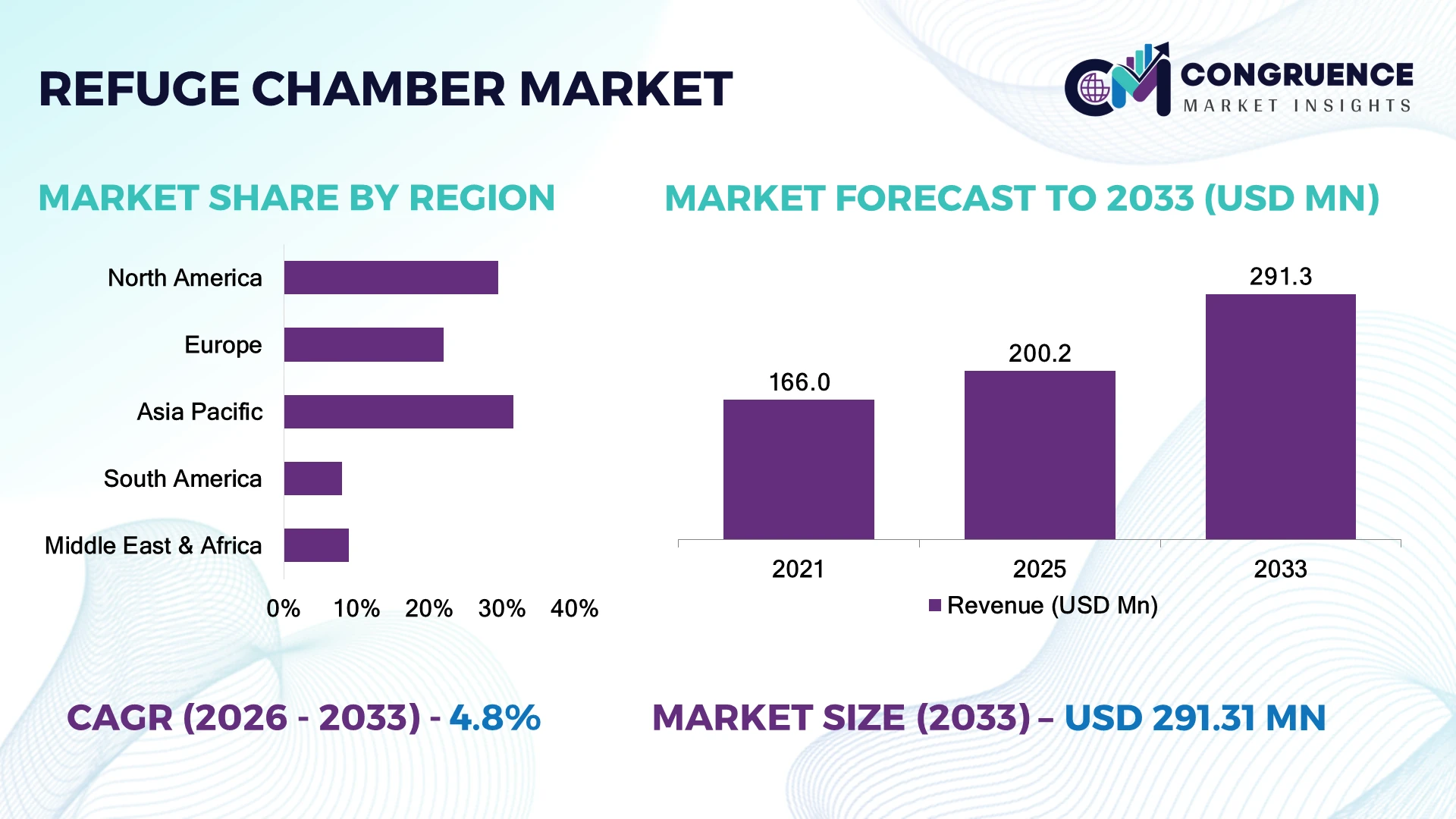
The Global Refuge Chamber Market was valued at USD 200.2 Million in 2025 and is anticipated to reach a value of USD 291.3 Million by 2033 expanding at a CAGR of 4.8% between 2026 and 2033. Growth is driven by underground mine safety requirements, deeper mining operations, emergency preparedness standards, and demand for dependable life-support systems in hazardous underground environments.
China remains an important mining-equipment manufacturing base, while Australia, the United States, and South Africa are established centers for refuge-chamber engineering, deployment, and servicing. MineARC Systems reports operations across more than 80 countries, illustrating the importance of international distribution and technical support. Chamber specifications commonly cover multiple occupancy configurations and survival durations extending to 96 hours, depending on design and applicable requirements. India’s 2026 coal-mining regulatory framework explicitly addresses underground refuge chambers, strengthening the relevance of compliant equipment procurement.
Manufacturers should compete through verified life-support performance, regulatory compliance, local servicing, and chamber configurations matched to mine-specific emergency plans.
Market Size & Growth: The market is estimated at USD 200.2 million in 2025 and projected to reach USD 291.3 million by 2033, supported by underground safety investments and emergency-response requirements.
Top Growth Drivers: Mine-safety compliance, deeper underground operations, and modernization of emergency-response infrastructure underpin procurement; individual driver shares are not consistently disclosed.
Short-Term Forecast: Through 2028, operators are expected to prioritize chamber inspection readiness, spare-part availability, and life-support verification; performance targets should be set against site-specific maintenance baselines.
Emerging Technologies: Remote gas monitoring, digital status alerts, improved carbon-dioxide scrubbing, and integrated communications are strengthening chamber oversight and emergency readiness.
Regional Leaders: Asia-Pacific combines extensive mining activity, North America emphasizes mine-safety compliance, and Australia supports specialized engineering and underground safety expertise.
End-User Trends: Underground coal, hard-rock metal mining, and tunnelling projects require different chamber capacities, mobility, blast resistance, and life-support specifications.
Operational Example: Refuge chambers designed for up to 96 hours of independent life support provide a defined emergency endurance specification, subject to occupancy, equipment configuration, and regulatory requirements.
Competitive Landscape: MineARC Systems, Dräger, and Strata Worldwide compete through chamber engineering, life-support reliability, customization, certifications, and service coverage.
Regulatory Impact: India’s 2026 coal-mining regulations specify refuge chambers with sealed construction, independent breathable air, carbon-dioxide scrubbing, communications, lighting, first aid, and potable water.
Investment Priorities: Procurement focuses on life-support systems, gas monitoring, cooling, emergency communications, inspection programs, and service support rather than chamber purchase price alone.
Innovation & Future Outlook: Modular construction, remote monitoring, and improved thermal management are shifting competition toward maintainable, site-specific emergency systems with verifiable readiness.
The refuge chamber market serves underground coal and metal mines, tunnelling projects, and selected hazardous industrial facilities where immediate evacuation can become impossible. Sealed structures, breathable-air systems, carbon-dioxide scrubbing, thermal management, and communications determine whether a chamber can sustain occupants until rescue. Modular configurations help address restricted mine access and changing workforce requirements, while digital monitoring supports inspection and readiness. As regulators strengthen emergency-planning requirements, buyers increasingly assess lifecycle servicing, compliance documentation, and the reliability of individual life-support components alongside the initial equipment specification.
Refuge chambers are a critical part of underground emergency planning because fires, explosions, roof falls, flooding, or toxic atmospheres can block escape routes. Their strategic value depends on survivable internal conditions, reliable equipment, and accessibility from active work areas. Mining operators increasingly evaluate chamber placement, occupancy, independent air supply, gas scrubbing, cooling, and communications as one integrated safety system rather than as separate equipment purchases.
Technology improvements are shifting attention from basic sealed shelters toward monitored life-support systems. Remote gas sensors and status alerts can improve visibility between inspections, while manual inspection remains essential for confirming physical condition, consumables, and functional readiness. Chamber endurance requirements vary: guidance in Western Australia recommends at least 36 hours of standalone life support, while U.S. underground coal-mine refuge alternatives require breathable air for 96 hours. These differences make local regulatory alignment a core engineering decision.
During 2026–2028, operators are likely to prioritize modular transport, verified maintenance routines, digital monitoring, and heat-management systems. A chamber installed in a remote development heading, for example, must be accessible to the workforce, compatible with the mine’s emergency plan, and serviceable despite difficult underground logistics. Suppliers that provide commissioning, training, inspections, and locally available technical support will be better positioned than vendors competing on equipment price alone.
Mine operators are placing greater emphasis on emergency refuges as underground workings extend farther from surface exits and evacuation routes become more complex. India’s 2026 coal-mining regulatory framework requires strategically located chambers in belowground coal mines, with independent breathable air, carbon-dioxide scrubbing, communications, lighting, first-aid facilities, and potable water. The specification moves procurement beyond a sealed enclosure toward a complete life-support installation. Operators are responding by integrating chamber locations into emergency-response plans, scheduling inspections, and checking occupancy against workforce distribution. Suppliers that provide documented compliance, commissioning, training, and dependable maintenance can compete on operational readiness rather than equipment cost alone.
Refuge chambers require more than a one-time capital purchase: operators must maintain breathable-air systems, carbon-dioxide scrubbers, batteries, cooling, seals, communications, and emergency supplies. Remote underground locations increase the cost and difficulty of inspection, servicing, and component replacement. Western Australian guidance recommends a minimum 36-hour standalone operating duration, while U.S. coal-mine refuge alternatives require breathable air for 96 hours, creating materially different equipment and maintenance requirements across jurisdictions. These obligations can delay procurement at smaller mines with limited safety budgets. Buyers reduce exposure through planned service contracts, standardized spare parts, local technician training, and lifecycle-cost evaluation before selecting a chamber configuration.
Modular refuge chambers offer an opportunity to address restricted shaft dimensions, difficult underground transport, and changing workforce requirements. Strata Worldwide’s modular emergency refuge chamber can be configured for 12 to 36 occupants, allowing capacity to be expanded through additional sections. Remote monitoring adds another opportunity: gas sensors, status alerts, and digital records can improve visibility into chamber condition between physical inspections. Operators can prioritize installations where access is difficult or maintenance teams cover multiple workings. Manufacturers are developing modular layouts, integrated monitoring, and site-specific engineering packages. The strongest commercial proposition combines transport flexibility with verified sealing, life-support performance, and maintainable components rather than treating modularity as a substitute for safety testing.
Refuge chambers must sustain safe internal conditions despite heat, humidity, power loss, contamination, and prolonged occupancy. Carbon-dioxide removal, oxygen supply, cooling, pressure integrity, and communications must operate together; failure in one subsystem can undermine the whole refuge solution. Long-duration specifications of 36 to 96 hours require rigorous validation against occupancy and design assumptions. Underground transport also exposes equipment to vibration, impact, restricted access, and difficult installation conditions. Manufacturers must verify system performance through testing, documented maintenance procedures, and realistic operating scenarios. Operators, meanwhile, need trained personnel, scheduled inspections, and emergency drills. Competitive success depends on demonstrable readiness throughout the equipment lifecycle, not simply meeting the purchase specification.
Regulatory Requirements Become More Explicit: India’s 2026 coal-mining framework specifies sealed refuge chambers, independent breathable air, carbon-dioxide scrubbing, communications, lighting, first aid, and potable water. The detailed requirements reinforce the need for integrated safety systems and documented inspections. Suppliers are adapting product configurations and technical documentation to match local rules rather than relying on a single global specification.
Modular Designs Ease Underground Logistics: Strata Worldwide’s modular chamber accommodates 12–36 occupants through configurable sections. This approach helps address restricted shafts, difficult transport routes, and changing workforce sizes. Standardized modules can also support inventory planning and shorten assembly lead times, while operators retain responsibility for verifying seals, capacity, and compliance after installation.
Remote Monitoring Improves Readiness Visibility: Digital gas monitoring, status alerts, and personnel-tracking integration are helping mines connect refuge equipment with wider emergency-response systems. MineARC’s GuardIAN platform supports gas monitoring and personnel-tracking functions. Operators are integrating these tools into control-room oversight and inspection routines, while retaining physical testing and servicing to confirm that critical life-support components remain operational.
Thermal Management Gains Safety Priority: MineARC highlighted chamber air-conditioning in 2026 as a critical control for heat and humidity during prolonged occupancy. Effective cooling complements oxygen supply and carbon-dioxide scrubbing, helping maintain survivable internal conditions. Manufacturers are focusing on reliable power, cooling performance, and maintenance access, particularly for mines where high ambient temperatures and long rescue times increase operating demands.
Portable refuge chambers are estimated to account for approximately 62% of the market, reflecting their flexibility, independent life-support configurations, and suitability for deployment near active underground workings. Their mobility allows mining operators to reposition safety infrastructure as extraction faces advance, reducing the need for permanently fixed installations throughout a mine’s development cycle. Stationary refuge chambers account for the remaining estimated 38%, supported by established underground operations where dedicated refuge locations, larger occupancy requirements, and permanent infrastructure favor fixed installations. These shares represent directional analyst estimates rather than audited industry figures.
Modular and compact portable configurations are expected to attract stronger incremental demand as mines address restricted shafts, narrow access routes, and changing workforce distribution. This shift could increase the portable segment’s share by approximately 3–5 percentage points over the next several years. Stationary systems remain strategically relevant for established mines and high-capacity refuge areas, while portable units prioritize transportability and deployment flexibility. Manufacturers are responding through configurable occupancy, modular assembly, integrated gas monitoring, and upgraded cooling and scrubbing systems. Procurement priorities are consequently shifting toward installation constraints, maintainability, and verified life-support performance rather than enclosure cost alone.
MineARC Systems specifies standard modular refuge chamber configurations for 12–32 occupants, demonstrating how manufacturers are addressing restricted underground access while maintaining configurable capacity and integrated life-support functionality.
Mining is estimated to represent approximately 82% of refuge chamber demand, driven by underground coal and hard-rock operations where fires, explosions, toxic gases, and blocked escape routes can make immediate evacuation impossible. Coal mines require particular attention to atmospheric hazards and emergency-response readiness, while metal mines often prioritize chamber mobility, blast resistance, and compatibility with changing development headings. Tunnelling and civil infrastructure projects account for an estimated 10%, supported by underground construction activities and the need for designated emergency refuge arrangements. Oil and gas facilities and other hazardous industrial environments together represent approximately 8%, reflecting more specialized requirements and project-specific deployment conditions.
Tunnelling is a potential faster-growing application, with its share potentially increasing by 2–4 percentage points as underground transport links, utility corridors, and complex civil works require more structured emergency planning. Mining nevertheless remains the principal demand center because refuge provisions are closely connected to recurring underground operating risks. Oil and gas applications require solutions tailored to site hazards, access conditions, and applicable safety frameworks rather than direct replication of mine configurations. Manufacturers are adapting through compact footprints, modular transport, customized occupancy, and integrated communications. Investment is likely to favor mining-ready systems in the near term, alongside selective expansion into tunnelling projects where emergency refuge requirements are clearly specified.
MineARC Systems identifies fires, explosions, rockfalls, flooding, and toxic-gas releases as key underground mining emergency scenarios, reinforcing the operational role of refuge chambers when evacuation is no longer safe or practical.
Underground mining companies are estimated to account for approximately 76% of refuge chamber demand, reflecting their extensive underground workforce exposure, recurring safety obligations, and need to position refuge infrastructure near active work areas. Coal mining operators form an important buyer group, while metal and non-metal mining companies require configurations suited to mine geometry, workforce size, and operating conditions. Tunnelling and civil infrastructure contractors account for an estimated 14%, with procurement tied to project-specific emergency plans, construction phases, and underground access constraints. Oil and gas operators and other hazardous industrial organizations represent the remaining estimated 10%, generally purchasing specialized systems for defined high-risk environments. These percentages are indicative analytical estimates, not published procurement statistics.
Tunnelling contractors may represent a faster-growing buyer group, potentially increasing their share by 2–4 percentage points as underground infrastructure projects adopt more formalized emergency-response arrangements. Established mining companies typically emphasize standardized fleets, service contracts, inspections, and replacement planning, whereas construction contractors often prioritize temporary deployment, modular transport, and project-specific capacity. Industrial buyers tend to require more customized engineering and site-level risk assessment. Suppliers are responding with configurable chamber designs, commissioning support, maintenance agreements, and training packages. Competitive positioning will increasingly depend on lifecycle service coverage and documented readiness, with manufacturers building partnerships with local mine-equipment distributors and safety-service providers to improve installation and after-sales support.
MineARC Systems reports a global deployment footprint spanning more than 80 countries and offers refuge solutions ranging from compact 4–8-person chambers to installations accommodating up to 100 personnel, illustrating the diversity of buyer requirements across underground operations.
Asia-Pacific accounted for the largest market share at 31.5% in 2025 moreover, Asia-Pacific is also expected to register the fastest growth, expanding at a CAGR of 5.6% between 2026 and 2033.
Regulatory Compliance and Mine-Safety Modernization Shape Procurement
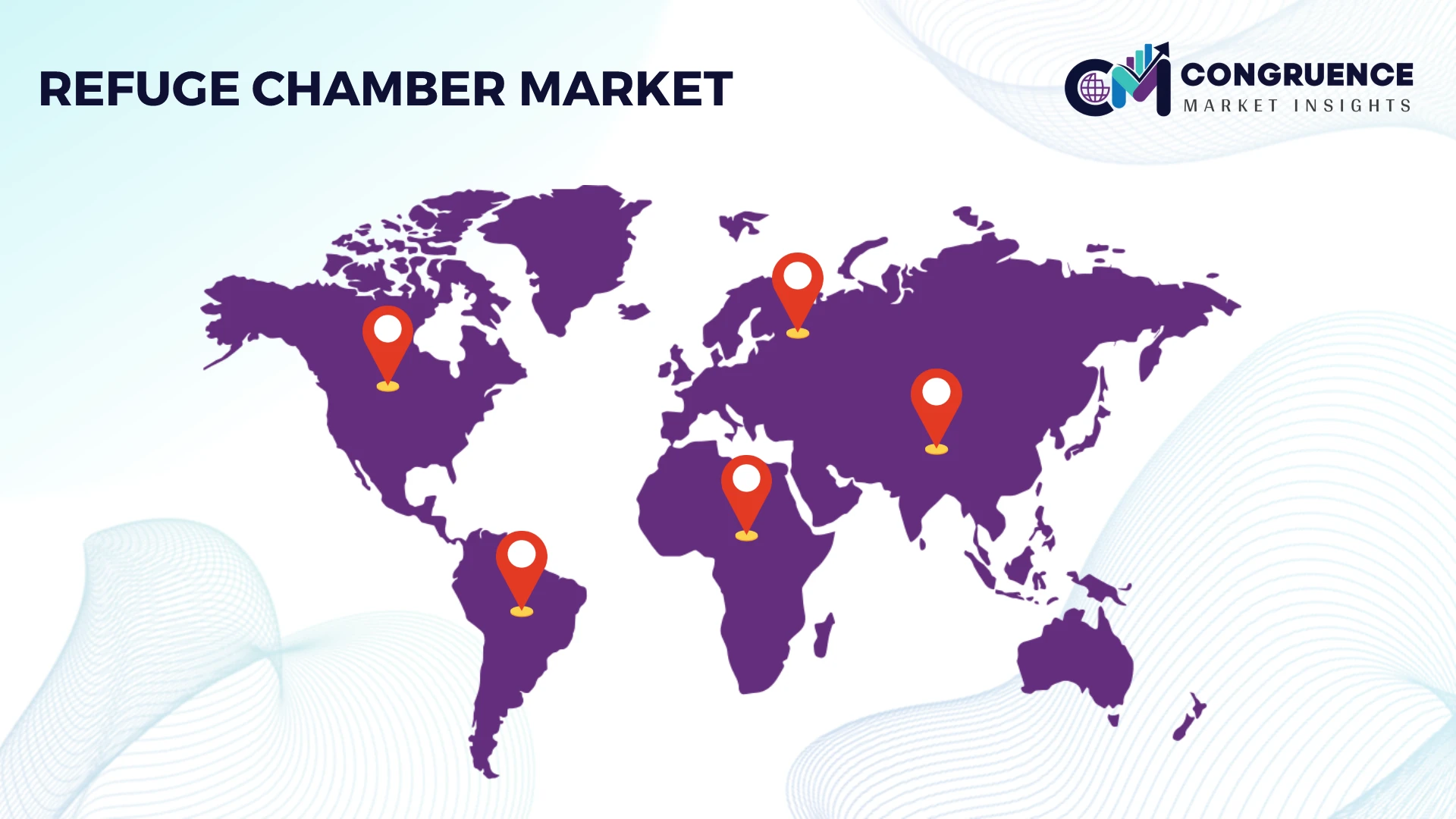
North America is estimated to account for approximately 29.5% of the global refuge chamber market in 2025, supported by established underground coal mining, metal mining, and mine-safety compliance frameworks. The United States represents the region’s principal demand center, where refuge alternatives must address prolonged emergency isolation, breathable-air availability, and underground worker protection. U.S. requirements specify breathable air for up to 96 hours for underground coal-mine refuge alternatives, influencing system sizing, consumables, testing, and maintenance. Canada contributes through underground gold, nickel, copper, and other mineral operations, where chamber placement must reflect mine geometry and evacuation constraints. Suppliers are emphasizing integrated life support, gas monitoring, communication systems, and scheduled maintenance. Buyers increasingly evaluate documented readiness and service coverage alongside acquisition cost, creating opportunities for established safety-equipment providers.
United States Market Outlook: The United States benefits from a defined regulatory framework for refuge alternatives in underground coal mines and an established ecosystem of mine-safety equipment suppliers. The 96-hour breathable-air requirement creates specific engineering and maintenance expectations, particularly for occupancy calculations, oxygen availability, carbon-dioxide removal, and consumable replacement. Mining companies are also prioritizing emergency drills and inspection records. Suppliers with strong technical documentation, component availability, and training capabilities are well positioned to serve operators seeking compliance and dependable emergency preparedness.
Specialized Underground Engineering Supports Safety-Led Modernization
Europe is estimated to represent approximately 22.0% of the global refuge chamber market in 2025. Demand is shaped by underground mining in selected countries, mineral extraction, and complex tunnelling and infrastructure projects. Poland remains relevant through its coal-mining operations, while Sweden and Finland support demand associated with underground metal mining. European procurement places importance on equipment reliability, occupational safety, maintainability, and compatibility with site-specific emergency plans. Infrastructure contractors may require temporary or relocatable refuge solutions during lengthy tunnel construction, creating different purchasing priorities from established mines. Suppliers are responding with compact chamber designs, configurable life-support systems, and service-led offerings. However, the region’s varied mining intensity and project-specific requirements limit the effectiveness of a uniform product strategy across national markets.
Poland Market Outlook: Poland offers a strategically important market through its established underground coal-mining base and industrial experience with complex underground operations. Mine operators must account for workforce distribution, ventilation conditions, emergency escape routes, and the accessibility of refuge locations when planning protective infrastructure. These requirements support demand for durable chambers, dependable breathable-air systems, and maintenance programs suited to demanding operating environments. Suppliers that can tailor installations to individual mine layouts and provide inspection and technical support are positioned to address Poland’s specialized underground safety needs.
Mining Scale and Local Manufacturing Strength Accelerate Adoption
Asia-Pacific is estimated to hold approximately 31.5% of the global refuge chamber market in 2025, making it the largest regional market. China’s extensive coal-mining industry creates substantial potential demand for underground emergency protection, while Australia contributes through sophisticated underground metal mining and established mine-safety engineering. India is becoming increasingly relevant as regulatory attention to underground refuge provisions strengthens. China’s official 2025 statistics recorded coal output of approximately 4.85 billion tonnes, illustrating the scale of its coal industry, although production volume does not directly translate into refuge chamber purchases. Regional suppliers benefit from manufacturing capacity and proximity to mining customers, while international manufacturers compete through advanced life-support engineering, monitoring, and technical servicing. Demand varies significantly with mine type, safety requirements, and investment priorities.
China Market Outlook: China’s extensive coal-mining infrastructure and domestic industrial manufacturing base provide a strong foundation for refuge chamber procurement and localized equipment supply. Official national statistics recorded coal production of approximately 4.85 billion tonnes in 2025, underscoring the scale of the operating environment in which underground safety systems are deployed. Buyers require configurations suited to mine-specific layouts, workforce capacity, and emergency procedures. Domestic manufacturers can compete through cost-efficient production and local servicing, while suppliers offering verified life-support performance, monitoring integration, and specialized engineering can differentiate in technically demanding projects.
Deep-Mine Operations Strengthen Demand for Reliable Emergency Refuge
South America is estimated to account for approximately 8.0% of the global refuge chamber market in 2025, with demand concentrated in Chilean and Peruvian mining operations. Copper extraction in Chile and Peru’s copper, gold, and polymetallic mines create opportunities for refuge systems designed for extensive underground workings and challenging access conditions. Chile produced approximately 5.39 million tonnes of mined copper in 2025, according to national copper-industry statistics, reflecting the scale of its mining ecosystem rather than refuge equipment demand directly. Procurement is influenced by mine depth, workforce location, emergency-response planning, and the availability of technical support. Geographic remoteness and import dependence can extend delivery and maintenance timelines, encouraging suppliers to develop regional distribution and service partnerships.
Chile Market Outlook: Chile is the region’s strategically significant market because of its large copper-mining industry and technically demanding operations. National mined-copper output reached approximately 5.39 million tonnes in 2025, supporting a substantial ecosystem of mining contractors, equipment suppliers, and specialized service providers. As underground operations require carefully coordinated emergency plans, operators must match refuge capacity and life-support endurance to mine layout and risk assessments. Suppliers can strengthen their position through local commissioning, spare-parts availability, maintenance support, and chamber designs tailored to individual copper operations.
Mining Investment and Safety-System Modernization Create Selective Opportunities
The Middle East & Africa region is estimated to represent approximately 9.0% of the global refuge chamber market in 2025. South Africa remains a major demand center because of its established gold, platinum-group metal, and other underground mining operations. In the Middle East, Saudi Arabia’s mineral-sector expansion offers a developing opportunity as new projects and industrial capabilities take shape. Saudi Arabia announced a national objective to increase mining-sector capital from approximately SAR 45 billion in 2024 to nearly SAR 92 billion over 2025–2030. This investment ambition does not represent refuge chamber spending directly, but it indicates a potential expansion of the mining infrastructure base. Suppliers must navigate differences in project maturity, local service availability, procurement requirements, and operating conditions.
South Africa Market Outlook: South Africa is a key market because of its established underground gold and platinum-group metal mines, experienced mining contractors, and specialized mine-safety requirements. The mining sector contributed approximately 6% of national GDP, according to PwC’s 2025 industry assessment, underscoring its economic importance. Deep underground operations require refuge solutions that address heat, restricted access, breathable-air supply, and extended emergency isolation. Suppliers that provide robust chamber construction, cooling, gas scrubbing, inspection programs, and responsive local servicing can address the operational requirements of established mines while supporting modernization initiatives.
MineARC Systems and Strata Worldwide compete directly in engineered refuge chambers, while Dräger brings mine-safety and life-support expertise; Aysan Engineering and regional fabricators compete on customization, delivery, and price. Global OEMs target complex mines requiring integrated systems and international servicing, whereas regional suppliers pursue cost-sensitive projects and localized support. The market remains moderately concentrated; the top five players are estimated to represent 55–65% of sales, an analytical estimate because audited market-share disclosures are unavailable. Competition centers on lifecycle cost, validated life-support performance, modularity, and maintenance coverage. Modular designs may reduce handling and installation costs by an estimated 10–15% at access-constrained sites, while remote monitoring may reduce manual status-check workloads by 10–20%; these are directional estimates, not universal verified results. MineARC expands monitoring and chamber options; Strata promotes configurable modules; regional firms emphasize fit-to-site engineering. Competition is shifting toward monitored, service-backed safety systems. Testing, compliance, and field-service coverage remain entry barriers. Winning requires proven reliability, rapid servicing, and site-specific integration.
Refuge chamber technology is evolving from conventional sealed steel enclosures with manually checked life-support equipment toward modular structures with digital controls, integrated gas detection, and remote diagnostics. MineARC’s GuardIAN system can monitor chamber status and support detection of component faults; its Aura-FX monitor can track up to 11 gases. These capabilities improve visibility between physical inspections, although no independently verified market-wide percentage for adoption or failure reduction is publicly established. Remote monitoring is available as an optional feature and can be retrofitted to existing installations.
Modular construction is another important shift. MineARC offers standard modular configurations for 12–32 occupants, while Strata’s modular design supports capacity changes as workforce and site requirements evolve. Compared with moving a fully assembled chamber through restricted shafts, sectional transport can simplify handling and underground assembly. Any percentage savings in installation time or cost remain site-dependent and should be validated through project-level comparisons rather than treated as universal performance gains.
Thermal management, battery reliability, carbon-dioxide scrubbing, breathable-air supply, and emergency communications remain critical engineering priorities. Between 2026 and 2028, operators are likely to favor integrated systems that combine maintainable life-support components with digital readiness checks. Global OEMs with monitoring platforms and service networks may gain an advantage over suppliers offering only structural enclosures. Buyers should prioritize tested endurance, sensor reliability, backup-power performance, and maintainability; digital systems supplement rather than replace scheduled inspections, emergency drills, and physical verification.
September 2024 — Strata Worldwide introduced the modular ERCM refuge chamber for mining and tunnelling. Its sectional design allows pre-delivery or underground assembly and later capacity expansion, targeting restricted shafts, lower handling complexity, and shorter production lead times. Source: Strata Worldwide
July 2025 — Newmont reported that three workers sheltered safely in a MineARC chamber designed for 16 people after a rockfall blocked access at Red Chris. They remained underground for more than 60 hours, demonstrating the operational value of refuge infrastructure during extended rescue efforts. Source: Newmont
May 2025 — MineARC Systems described its Oyu Tolgoi deployment of GuardIAN monitoring, integrating real-time worker tracking, RFID technology, and emergency-response functions. The project illustrates movement toward connected underground safety systems, improving situational awareness and supporting more coordinated responses across complex mining operations. Source: MineARC Systems
September 2026 — MineARC Systems presented its MineSAFE EXTREME chamber at Electra Mining Africa, where it received the New Product & Innovation Award. The polymer-based design emphasizes transportability, deployment flexibility, and thermal efficiency while retaining refuge functionality. Source: LinkedIn (linkedin.com)
The report examines the refuge chamber market across portable and stationary configurations, mining and tunnelling applications, and principal buyer groups including underground mining operators, infrastructure contractors, and other hazardous-industry users. Regional coverage spans North America, Europe, Asia-Pacific, South America, and the Middle East & Africa, with country-level analysis focused on mining intensity, regulatory requirements, industrial infrastructure, and equipment deployment. Competitive coverage includes global OEMs, modular-system specialists, and regional engineering suppliers.
Technology assessment covers modular construction, breathable-air systems, carbon-dioxide scrubbing, gas detection, remote monitoring, backup power, communications, and thermal management. The report also evaluates lifecycle servicing, underground transport constraints, customization, and supplier positioning. Segment and regional estimates support comparisons of demand concentration and emerging opportunities, while company analysis helps identify differentiation strategies and potential competitive gaps. These findings support investment planning, market-entry assessment, expansion prioritization, product development, and competitive positioning over 2026–2033.
| Report Attribute/Metric | Report Details |
|---|---|
|
Market Revenue in 2025 |
USD 200.2 Million |
|
Market Revenue in 2033 |
USD 291.3 Million |
|
CAGR (2026 - 2033) |
4.8% |
|
Base Year |
2025 |
|
Forecast Period |
2026 - 2033 |
|
Historic Period |
2021 - 2025 |
|
Segments Covered |
By Type
By Application
By End-User
|
|
Key Report Deliverable |
Revenue Forecast, Growth Trends, Market Dynamics, Segmental Overview, Regional and Country-wise Analysis, Competition Landscape |
|
Region Covered |
North America, Europe, Asia-Pacific, South America, Middle East, Africa |
|
Key Players Analyzed |
MineARC Systems, Strata Worldwide, Dräger, Aysan Engineering, Cowan Manufacturing, Shairzal Safety Engineering, DEZEGA, ON2 Solutions, Mine Safety Appliances (MSA Safety), China Coal Technology & Engineering Group, Wattrix, Modern Mine Safety Supply |
|
Customization & Pricing |
Available on Request (10% Customization is Free) |




