
Reports
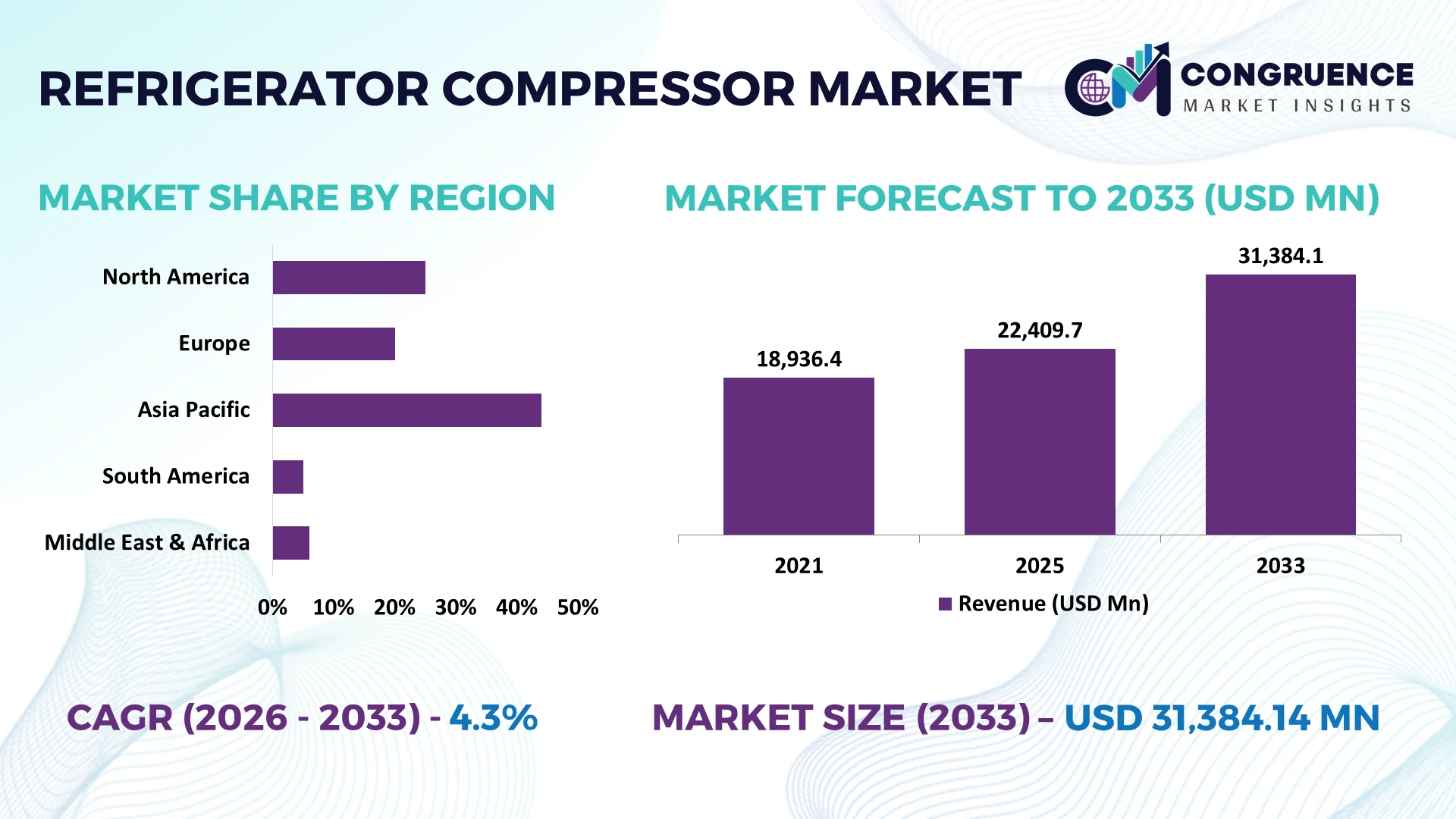
The Global Refrigerator Compressor Market was valued at USD 22409.68 Million in 2025 and is anticipated to reach a value of USD 31384.14 Million by 2033 expanding at a CAGR of 4.3% between 2026 and 2033. Growth is driven by inverter-compressor penetration, R600a and R290 refrigerant transitions, cold-chain capacity additions, commercial refrigeration replacement, and tighter appliance energy-efficiency standards.
China accounts for approximately 40% of global refrigerator-compressor production, supported by an appliance manufacturing base producing more than 100 million household refrigerators annually and integrated motor, electronics, and compressor supply chains. Variable-speed compressors can reduce refrigerator electricity consumption by 20–30% versus fixed-speed configurations. India, by comparison, manufactures roughly 15 million refrigerators annually and is scaling domestic component production. Continuing U.S.–China trade friction strengthens compressor localization across India and Southeast Asia as appliance manufacturers diversify sourcing.
Strategically, compressor manufacturers should prioritize variable-speed platforms, low-GWP refrigerant compatibility, localized electronics supply, and high-volume production near expanding Asian refrigerator and cold-chain manufacturing clusters.
Market Size & Growth: USD 22,409.68 million in 2025 reaches USD 31,384.14 million by 2033 at 4.3% CAGR, driven by inverter-compressor adoption and refrigerant transition.
Top Growth Drivers: Inverter technology delivers 20–30% energy savings, natural refrigerants cut GWP by over 99%, and optimized motors improve efficiency by 5–10%.
Short-Term Forecast: By 2028, advanced variable-speed controls are positioned to reduce refrigerator electricity consumption by approximately 25% versus conventional fixed-speed operation.
Emerging Technologies: BLDC motors, variable-frequency drives, smart diagnostics, and R600a/R290-compatible designs target 10–30% efficiency improvement across residential and commercial platforms.
Regional Leaders: Asia-Pacific approaches USD 18.2 billion, Europe USD 5.1 billion, and North America USD 4.8 billion by 2033 as inverter adoption expands.
Consumer/End-User Trends: Energy-efficient refrigerators increasingly use inverter compressors delivering approximately 20–30% lower electricity consumption under variable cooling loads.
Pilot/Case Example: 2025 variable-speed refrigeration platforms demonstrated approximately 25% lower energy consumption through load-matched compressor operation and optimized electronic controls.
Competitive Landscape: GMCC holds an estimated 20% position, competing with Embraco, Huayi, Secop, and Panasonic across residential and commercial refrigeration.
Regulatory & ESG Impact: Natural refrigerants such as R600a and R290 provide GWP values below 5, versus above 1,000 for several legacy HFC refrigerants.
Investment & Funding: More than USD 5 billion in global appliance manufacturing expansion supports localized compressors, motors, electronics, and low-GWP refrigeration supply chains.
Innovation & Future Outlook: Next-generation compressors target 10–20% additional efficiency gains through BLDC motors, adaptive speed control, lower friction, and connected fault diagnostics.
The Refrigerator Compressor Market is increasingly shaped by household refrigerators, freezers, beverage coolers, supermarket cabinets, heat-sensitive food logistics, and pharmaceutical cold chains. Variable-speed reciprocating and rotary compressors, BLDC motors, electronic controls, and R600a/R290-compatible platforms are replacing fixed-speed architectures as manufacturers pursue lower electricity consumption and quieter operation. Inverter configurations can reduce energy use by approximately 20–30% under variable cooling loads. Refrigerant regulations and appliance supply-chain diversification are simultaneously accelerating localized compressor and electronics manufacturing across China, India, and Southeast Asia, establishing efficiency, refrigerant compatibility, and manufacturing scale as the next strategic priorities.
Refrigerator compressors are becoming strategically important as appliance manufacturers redesign platforms around energy efficiency, natural refrigerants, quieter operation, and localized component sourcing. Regulatory migration away from high-GWP refrigerants is accelerating R600a adoption in household refrigeration and R290 in commercial systems. Simultaneously, manufacturers are restructuring Asian supply chains to reduce dependence on single-country motor, semiconductor, and electronic-control sourcing.
Variable-speed inverter compressors can reduce refrigerator electricity consumption by approximately 20–30% versus fixed-speed units by matching cooling output to actual thermal load. China dominates manufacturing scale with more than 100 million refrigerators produced annually, while Europe leads low-GWP regulatory adoption and India is expanding localized appliance production. Through 2026–2028, inverter penetration should strengthen as efficiency labeling increasingly differentiates mass-market products and compressor electronics become more cost competitive.
A household refrigerator using an R600a inverter compressor can continuously modulate speed instead of cycling repeatedly between full output and shutdown, reducing energy use and temperature fluctuations. GMCC, Embraco, Huayi, Secop, and Panasonic are advancing variable-speed platforms, natural-refrigerant compatibility, and localized manufacturing. Long-term advantage will depend on integrating compressor mechanics, motors, power electronics, and refrigerant engineering into scalable, energy-efficient platforms.
Tighter appliance-efficiency requirements are moving refrigerator manufacturers from fixed-speed compressors toward electronically controlled variable-speed architectures. Inverter compressors typically reduce refrigerator electricity consumption by 20–30%, while optimized BLDC motors can improve motor efficiency by approximately 5–10%. India's revised appliance efficiency labeling and Europe's progressively tighter ecodesign requirements make compressor performance central to product differentiation. Variable-speed operation also reduces start-stop cycling, improving temperature stability and lowering acoustic disturbance. This creates a structural advantage for compressor suppliers that integrate mechanical design with motors and electronic drives rather than selling standardized fixed-speed units. GMCC, Embraco, Huayi, Secop, and Panasonic are expanding inverter platforms, controller integration, and application engineering. The commercial shift is clear: compressor efficiency increasingly determines the refrigerator's achievable energy label and therefore its competitive retail positioning.
Variable-speed compressors require BLDC motors, inverter boards, power semiconductors, sensors, and control software, increasing component complexity compared with conventional fixed-speed architectures. Electronic control systems can add approximately 10–20% to compressor-system component costs, while copper and electrical steel represent significant exposure to commodity-price fluctuations. Semiconductor disruptions demonstrated how a low-cost controller component can interrupt production of an otherwise vertically integrated refrigeration platform. India remains dependent on imported electronic components despite expanding domestic appliance assembly, creating foreign-exchange and lead-time exposure. Manufacturers are responding by qualifying multiple semiconductor suppliers, localizing motors and controllers, redesigning boards around interchangeable components, and negotiating longer procurement contracts. The non-obvious constraint is therefore not compressor machining capacity; increasingly, scalable output depends on maintaining reliable electronics availability across high-volume appliance production cycles.
The transition toward R600a and R290 creates a product-renewal opportunity because compressor displacement, lubrication, motor protection, electrical safety, and system controls must be optimized for different refrigerant characteristics. R600a has a GWP below 5, representing more than a 99% reduction compared with several legacy HFC refrigerants above 1,000 GWP. R290 also delivers strong thermodynamic efficiency and is gaining commercial refrigeration relevance as regulations phase down higher-GWP alternatives. India and Southeast Asia provide additional opportunity as refrigerator manufacturing and cold-chain infrastructure expand. Suppliers are investing in hydrocarbon-compatible compressors, lower-friction mechanisms, compact BLDC motors, and application laboratories. Through 2026–2028, the strategic opportunity extends beyond compressor replacement: manufacturers able to co-engineer complete compressor-electronics-refrigerant platforms can capture appliance programs earlier and secure longer production relationships.
Scaling advanced compressors across household, commercial, and cold-chain equipment requires consistent performance across voltage fluctuations, ambient temperatures, refrigerant charges, speed ranges, and duty cycles. Inverter units can operate across speed ranges exceeding 3:1, creating lubrication, vibration, acoustic, and thermal-management requirements absent from fixed-speed designs. Hydrocarbon refrigerants introduce additional safety engineering because R600a and R290 are classified as flammable, while higher allowable charge limits increase the importance of leak prevention and electrical-component design. India's high ambient temperatures and variable grid conditions create particularly demanding validation environments. Manufacturers must strengthen accelerated-life testing, motor-control software, acoustic engineering, refrigerant laboratories, and appliance-OEM collaboration. The decisive execution challenge is maintaining 20–30% energy savings without sacrificing compressor life, noise performance, or manufacturing consistency across millions of units.
Compact Variable-Speed Platforms Expand: Compressor manufacturers are reducing displacement while widening modulation ranges, enabling one inverter platform to serve multiple refrigerator capacities. Variable-speed operation delivers roughly 20–30% lower electricity consumption and can operate across speed ranges exceeding 3:1. Chinese appliance OEMs are consolidating compressor specifications across product families, reducing component complexity and inventory requirements. Suppliers are responding with common BLDC motor architectures, standardized controllers, and flexible manufacturing lines that shorten appliance-platform development cycles.
Noise Engineering Gains Procurement Weight: Premium refrigerators increasingly compete on acoustic performance alongside efficiency, pushing compressor manufacturers toward optimized suspension systems, smoother speed transitions, and lower mechanical vibration. Inverter operation can reduce repeated start-stop events by more than 50%, while advanced motor control lowers vibration across partial-load operation. Japanese and European appliance brands are tightening acoustic specifications for premium kitchens. Compressor suppliers are increasing NVH simulation, precision machining, and electronically controlled soft-start capabilities.
Electronics Integration Moves In-House: Compressor suppliers are integrating inverter boards, firmware, and motor controls rather than depending entirely on external electronics vendors. Integrated control can improve part-load efficiency by 5–10% and reduce controller-component counts by approximately 10–20%. Semiconductor supply disruptions accelerated this restructuring across China and Southeast Asia. Manufacturers are establishing controller engineering teams, qualifying alternative chipsets, and designing common power-electronics modules to improve procurement resilience and protect production schedules.
High-Ambient Designs Gain Priority: Rising operating temperatures are changing compressor qualification for cold storage and commercial refrigeration. Refrigeration design temperatures have moved from roughly 28°C toward 35°C, while future peaks increasingly exceed 40°C. Indian and Middle Eastern applications therefore require stronger thermal management and stable compression efficiency. Manufacturers are redesigning motors, lubricants, discharge-temperature controls, and condenser coordination to preserve reliability under sustained high-load operation.
Reciprocating compressors account for approximately 52% of refrigerator compressor demand, supported by high-volume household refrigerators, freezers, beverage coolers, and small commercial systems. Their mature manufacturing economics, broad displacement range, and compatibility with hydrocarbon refrigerants preserve leadership. Variable-speed reciprocating designs increasingly offset the traditional efficiency advantage of more complex architectures, delivering roughly 20–30% electricity savings over fixed-speed operation. Rotary compressors represent a smaller but strategically relevant category where compactness, low vibration, and continuous compression support specialized refrigeration platforms.
Scroll compressors are the fastest-growing type as commercial and larger refrigeration installations prioritize lower vibration, fewer moving components, and efficient part-load operation. Screw compressors retain importance in industrial refrigeration where continuous high-capacity duty favors robust compression, while centrifugal compressors address specialized large-capacity applications rather than mainstream refrigerators. Manufacturers are concentrating investment on inverter reciprocating and scroll platforms, integrated drives, precision machining, and low-GWP compatibility, shifting competitive emphasis from compressor architecture alone toward optimized system-level efficiency.
Residential refrigeration represents approximately 55% of compressor demand, reflecting the enormous installed base of household refrigerators and freezers and China's annual production exceeding 100 million refrigerator units. Reciprocating compressors dominate this application because high-volume manufacturing, compact dimensions, and R600a compatibility support cost-sensitive appliance platforms. Inverter penetration is changing product specifications as variable-speed systems deliver approximately 20–30% lower electricity consumption than conventional fixed-speed operation. Commercial refrigeration remains another major application, requiring compressors across display cabinets, beverage coolers, food-service equipment, and convenience stores.
Cold storage is the fastest-growing application as temperature-controlled food, pharmaceutical, and logistics infrastructure expands in India and other emerging economies. Industrial refrigeration emphasizes higher-capacity scroll, screw, and centrifugal configurations, while food processing requires dependable operation across freezing, chilling, and production environments. Manufacturers are responding with wider modulation ranges, high-ambient designs, connected controls, and application-specific compressor packages. Demand is therefore shifting from standardized compression toward platforms engineered around duty cycle and temperature requirements.
Appliance manufacturers represent approximately 58% of compressor purchasing, reflecting concentrated procurement by refrigerator and freezer OEMs operating high-volume production lines. Their buying decisions prioritize unit cost, energy-label performance, acoustic characteristics, refrigerant compatibility, and supply continuity. Large Chinese manufacturers source compressors at million-unit scale, strengthening demand for standardized reciprocating platforms and increasingly variable-speed designs capable of reducing appliance electricity consumption by 20–30%. Food and beverage companies represent a more operationally intensive buyer group, emphasizing uptime across processing and temperature-controlled storage.
Cold storage operators are the fastest-growing end-user group as food logistics and pharmaceutical distribution expand temperature-controlled capacity. Supermarket chains increasingly prioritize efficient compressors across display cabinets and backroom refrigeration, while hospitality companies require quieter, compact equipment for kitchens, minibars, and food-service operations. Compressor manufacturers are responding through OEM co-development, customized electronics, service partnerships, and high-ambient product configurations. Competitive positioning increasingly depends on securing platform-level design approvals rather than individual compressor transactions.
Asia-Pacific accounted for the largest market share at 54% in 2025 however, Asia-Pacific is expected to register the fastest growth, expanding at a CAGR of 5.2% between 2026 and 2033.

Efficiency Regulation Accelerates Platform Replacement
North America represents approximately 18% of refrigerator compressor demand, concentrated across household appliances, supermarkets, foodservice equipment, cold warehouses, and food-processing facilities. The United States dominates regional deployment as refrigerator replacement and commercial refrigeration modernization favor variable-speed compressors and lower-GWP refrigerants. Updated federal refrigerator efficiency requirements taking effect in 2029 target roughly 10–20% energy reductions across covered product categories, already influencing compressor platform development and OEM qualification. Commercial operators are simultaneously moving toward R290-compatible systems for smaller refrigeration equipment. Mexico strengthens the regional supply chain through large-scale refrigerator manufacturing and export-oriented appliance assembly. Compressor suppliers are responding with BLDC motors, integrated inverter electronics, quieter reciprocating designs, and hydrocarbon-compatible platforms. Competitive differentiation increasingly depends on helping appliance OEMs meet future efficiency specifications without materially increasing cabinet size or cooling-system complexity.
United States Market Outlook: The United States combines a large installed refrigerator base with increasingly demanding appliance-efficiency requirements and extensive supermarket and foodservice infrastructure. Residential refrigeration consumes roughly 7% of household electricity, making compressor efficiency commercially significant. OEMs are therefore prioritizing variable-speed operation, optimized heat exchange, low-GWP refrigerants, and integrated electronic controls when redesigning future refrigerator platforms.
Refrigerant Transition Reshapes Compressor Engineering
Europe holds approximately 17% of global demand, with Germany, Italy, France, Poland, and Turkey supporting appliance production and substantial commercial refrigeration infrastructure. Regulation is accelerating the transition away from higher-GWP refrigerants, increasing engineering activity around R600a household compressors and R290 commercial platforms. Variable-speed compressors provide approximately 20–30% lower electricity consumption than conventional fixed-speed configurations under suitable variable-load operation, aligning compressor selection with tighter appliance energy requirements. European supermarkets are also modernizing refrigeration assets as energy expenditure and refrigerant compliance increasingly influence lifecycle economics. Germany and Italy maintain strong refrigeration-engineering ecosystems, while Poland and Turkey provide cost-competitive appliance manufacturing capacity. Compressor suppliers are expanding hydrocarbon-compatible product families, electronic drives, acoustic optimization, and application engineering. The structural shift favors suppliers capable of combining efficiency, refrigerant safety, low noise, and precise capacity modulation within compact architectures.
Germany Market Outlook: Germany provides a high-value compressor market through premium household appliances, food retail, industrial refrigeration, and sophisticated refrigeration engineering. Manufacturing contributes close to one-fifth of national economic output, supporting strong component integration capabilities. German buyers emphasize energy labels, acoustic performance, long service life, and natural-refrigerant compatibility, strengthening demand for precision-engineered inverter and scroll compressor technologies.
Manufacturing Scale Drives Technology Localization
Asia-Pacific controls approximately 54% of global demand, anchored by China's refrigerator, freezer, compressor, motor, and electronics manufacturing ecosystem. China produces more than 100 million household refrigerators annually, providing compressor manufacturers with unmatched production scale and direct access to appliance OEM programs. India adds expanding refrigerator ownership, domestic appliance manufacturing, food processing, and temperature-controlled logistics, while Japan and South Korea contribute advanced inverter-control and high-efficiency technologies. Supply-chain diversification is encouraging additional component localization across India, Thailand, Vietnam, and Indonesia. Variable-speed reciprocating and rotary platforms are gaining production attention as OEMs consolidate compressor families across multiple appliance capacities. Manufacturers are investing in automated machining, BLDC motor production, inverter electronics, and R600a/R290-compatible assembly. Scale remains important, but integrated compressor-controller manufacturing increasingly determines cost, product-development speed, and supply continuity.
China Market Outlook: China combines high-volume appliance manufacturing with vertically integrated compressor, electric-motor, power-electronics, and refrigeration-component supply chains. Annual household refrigerator production exceeds 100 million units, enabling compressor suppliers to amortize automation and tooling across exceptionally large production runs. Domestic OEMs increasingly integrate inverter control, R600a compatibility, quieter operation, and connected appliance functionality into mainstream refrigerator platforms.
Localized Appliance Production Supports Replacement Demand
South America represents approximately 5% of global demand, with Brazil accounting for the strongest concentration through household appliances, supermarkets, beverage refrigeration, food processing, and cold-chain operations. Brazil's large domestic consumer market sustains refrigerator production and replacement, while commercial applications increasingly require energy-efficient compressors capable of operating reliably under elevated ambient temperatures. Argentina, Chile, and Colombia contribute demand through food retail, hospitality, beverage distribution, and temperature-controlled logistics. Imported electronics, currency volatility, and uneven cold-chain infrastructure create procurement pressure, encouraging manufacturers to prioritize proven architectures and serviceable components. Compressor suppliers are balancing premium inverter platforms with cost-optimized fixed and variable-speed configurations. Local technical support and parts availability carry greater procurement weight because long imported-component lead times can extend appliance production interruptions and commercial refrigeration downtime.
Brazil Market Outlook: Brazil combines domestic refrigerator manufacturing with one of Latin America's largest food-processing and supermarket systems. High ambient temperatures increase compressor duty cycles, strengthening the value of efficient motors and robust thermal design. Local manufacturing in established industrial centers also supports compressor assembly, component sourcing, and OEM engineering relationships, reducing dependence on completely built imported refrigeration systems.
Cold-Chain Investment Elevates High-Ambient Designs
Middle East & Africa accounts for approximately 6% of global demand, shaped by high ambient temperatures, food-import dependence, supermarket expansion, hospitality infrastructure, and investment in temperature-controlled logistics. Saudi Arabia and the UAE emphasize modern food distribution and hospitality refrigeration, while South Africa provides a diversified base across household appliances, food processing, retail, and cold storage. Ambient temperatures exceeding 40°C in Gulf markets raise compressor discharge temperatures and increase cooling loads, making thermal robustness and efficient part-load operation critical purchasing criteria. Food-security strategies are strengthening investment in refrigerated warehouses and distribution systems, expanding demand beyond household appliances. Suppliers are adapting with tropicalized compressors, wider operating envelopes, R290-compatible platforms, and stronger distributor networks. Reliable aftermarket service remains decisive where refrigeration failure can rapidly translate into inventory losses.
Saudi Arabia Market Outlook: Saudi Arabia's food-security strategy, expanding hospitality sector, supermarket modernization, and logistics investment create compressor demand across cold rooms, display cabinets, foodservice equipment, and distribution centers. Summer temperatures frequently exceed 40°C, placing unusually high thermal loads on refrigeration systems. Suppliers offering high-ambient compressors, variable-speed controls, dependable service, and natural-refrigerant compatibility gain a clear operational advantage.
GMCC, Huayi, Embraco, Secop, Panasonic, and specialist compressor manufacturers compete across household and commercial refrigeration, with Chinese volume producers challenging technology-focused suppliers on scale and cost. The top five players collectively represent approximately 55% of compressor demand. GMCC and Huayi leverage vertically integrated Asian manufacturing, while Embraco and Secop differentiate through natural-refrigerant engineering, variable-speed control, and commercial applications. Inverter compressors deliver roughly 20–30% energy savings, optimized BLDC motors improve efficiency by 5–10%, and integrated controllers can reduce electronic component counts by 10–20%. Players are expanding automated production, hydrocarbon-compatible platforms, controller development, OEM partnerships, and localized supply chains. Competition is shifting from standalone compressor hardware toward integrated motor-electronics-refrigerant platforms. High-volume precision manufacturing, appliance qualification cycles, patents, reliability validation, and established OEM relationships create substantial entry barriers. Winning requires manufacturing scale, low-GWP engineering, efficient modulation, competitive cost, dependable electronics sourcing, and rapid co-development with refrigerator manufacturers across major appliance and refrigeration programs.
GMCC
Huayi Compressor
Embraco
Secop
Panasonic
Samsung Electronics
LG Electronics
Mitsubishi Electric
Tecumseh Products Company
Highly Group
Donper
Nidec Global Appliance
BITZER
Dorin S.p.A.
Current refrigerator compressor technology centers on variable-speed reciprocating platforms, BLDC motors, R600a/R290 compatibility, optimized valves, and integrated inverter controls. Variable-speed operation cuts refrigerator energy use by more than 25% versus traditional fixed-speed compressors, while compact architectures reduce material, cabinet intrusion, vibration, and logistics requirements. Adoption is expanding from premium appliances into mainstream refrigerators and beverage coolers.
Emerging platforms integrate compressors, fans, controllers, and development software to coordinate refrigeration loads. Advanced electronic control has demonstrated approximately 24% efficiency improvement in optimized commercial systems, while newer compact compressors can be 30% lighter without sacrificing cooling capacity. Scroll architectures and digital modulation are extending precise capacity control into commercial refrigeration, benefiting OEMs seeking faster qualification and fewer component interfaces.
Through 2026–2028, disruptive development will center on integrated control boards, predictive diagnostics, digital capacity modulation, and localized compressor-electronics manufacturing. Digital scroll systems can modulate output from 10% to 100%, improving temperature stability under changing loads. Suppliers controlling motors, inverters, firmware, compressors, and refrigerant engineering gain a competitive advantage through faster system optimization and stronger supply continuity. Manufacturers should act now because efficiency regulation and natural-refrigerant transitions increasingly require compressor, electronics, and appliance design to advance together across residential and commercial refrigeration product development cycles.
April 2025 – Embraco launched Atom at AWE 2025, a variable-speed residential compressor weighing 2.5 kilograms and 30% lighter than FMS. Its compact architecture lowers appliance space requirements while expanding efficient inverter technology into mainstream refrigerator platforms globally. Source: CoolingPost
November 2024 – Secop introduced SCE Plus, expanding its S-Series to 23 and 25 cm³ displacement for R290 refrigeration. Designed for hydrocarbon charges up to 500 grams, the platform strengthens supermarket and walk-in freezer efficiency, safety, capacity, and performance. Source: Secop
June 2025 – Embraco announced compressor manufacturing in Maharashtra, India, establishing annual capacity of 6 million units from 2026. Local production of fixed-speed, variable-speed compressors and electronics strengthens supply-chain localization and supports residential and commercial refrigeration OEMs and production continuity. Source: TCBU
January 2026 – Embraco announced Pulse digital scroll compressors for AHR Expo 2026, providing 10% to 100% capacity modulation across 2–15 HP. The technology improves load matching and temperature control for cold rooms, multideck cabinets, and heating applications efficiently and reliably. Source: Embraco
The report evaluates Reciprocating, Rotary, Scroll, Screw, and Centrifugal Compressors across Residential Refrigeration, Commercial Refrigeration, Industrial Refrigeration, Cold Storage, and Food Processing. End-user coverage includes Appliance Manufacturers, Food and Beverage Companies, Supermarket Chains, Cold Storage Operators, and Hospitality Companies. Reciprocating compressors represent approximately 52% of type demand, while residential refrigeration accounts for about 55% of application deployment.
Regional analysis covers North America, Europe, Asia-Pacific, South America, and Middle East & Africa, including appliance manufacturing hubs, food-retail infrastructure, cold-chain investment, and high-ambient operating environments. Technology coverage examines variable-speed drives, BLDC motors, integrated controllers, digital scroll modulation, R600a/R290 platforms, and predictive diagnostics. The 2026–2033 framework supports manufacturing investment, localization, OEM partnerships, product-platform planning, geographic expansion, and competitive positioning around energy-efficient, electronically controlled, natural-refrigerant compressor systems.
| Report Attribute/Metric | Report Details |
|---|---|
Market Revenue in 2025 | USD 22409.68 Million |
Market Revenue in 2033 | USD 31384.14 Million |
CAGR (2026 - 2033) | 4.3% |
Base Year | 2025 |
Forecast Period | 2026 - 2033 |
Historic Period | 2021 - 2025 |
Segments Covered | By Type
By Application
By End-User
|
Key Report Deliverable | Revenue Forecast, Growth Trends, Market Dynamics, Segmental Overview, Regional and Country-wise Analysis, Competition Landscape |
Region Covered | North America, Europe, Asia-Pacific, South America, Middle East, Africa |
Key Players Analyzed | GMCC, Huayi Compressor, Embraco, Secop, Panasonic, Samsung Electronics, LG Electronics, Mitsubishi Electric, Tecumseh Products Company, Highly Group, Donper, Nidec Global Appliance, BITZER, Dorin S.p.A |
Customization & Pricing | Available on Request (10% Customization is Free) |




