Global Refrigerated Ice Cream Merchandise Market Report Overview
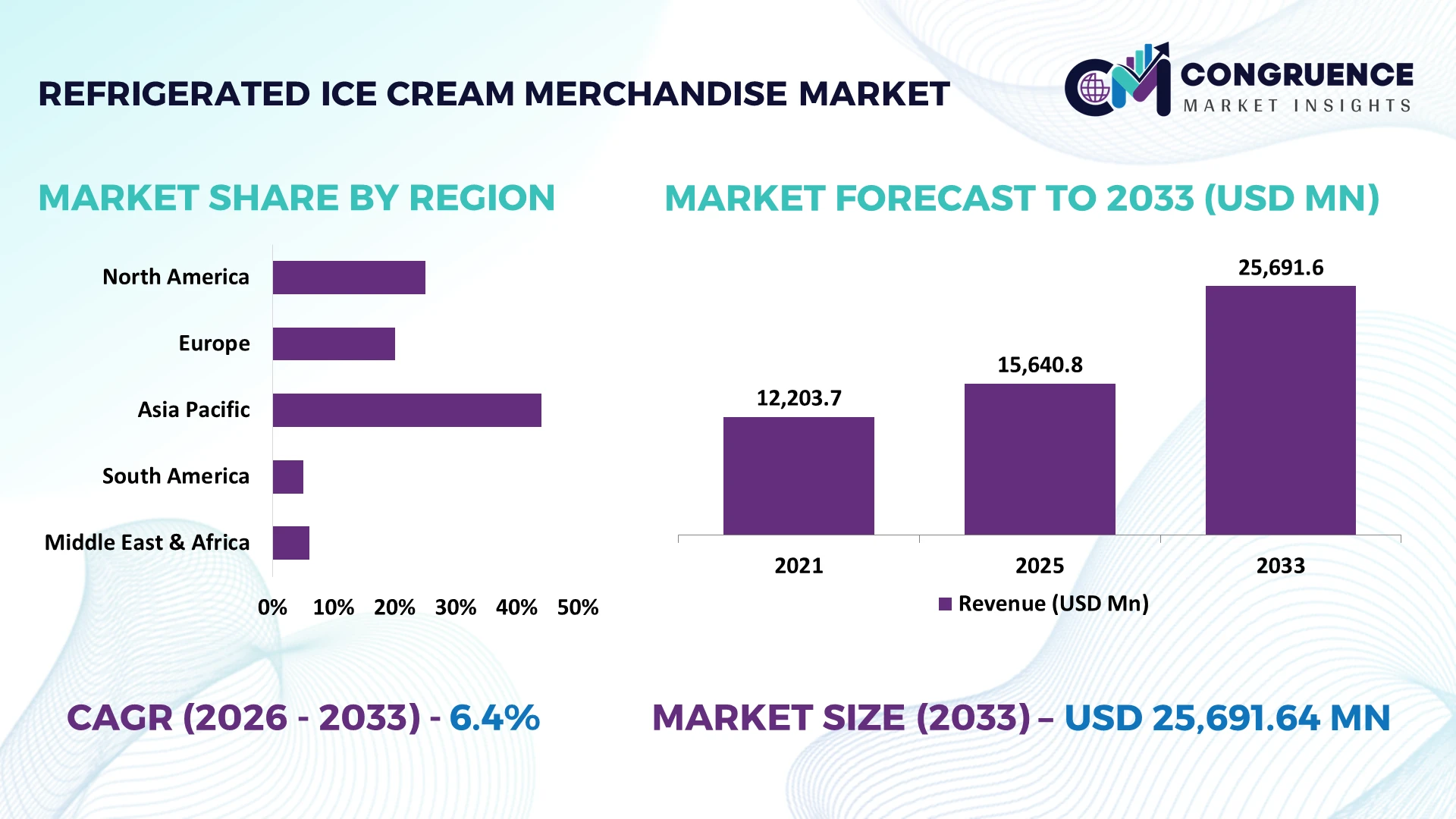
The Global Refrigerated Ice Cream Merchandise Market was valued at USD 15640.8 Million in 2025 and is anticipated to reach a value of USD 25691.64 Million by 2033 expanding at a CAGR of 6.4% between 2026 and 2033. Growth is driven by energy-efficient ice cream display freezers, supermarket cold-chain expansion, variable-speed compressors, and replacement of high-GWP refrigerant systems.
The United States represents a major market for refrigerated ice cream merchandising equipment, supported by extensive supermarket networks, convenience stores, and frozen dessert distribution. The country has more than 40,000 grocery stores, while its commercial refrigeration industry is transitioning toward lower-GWP refrigerants under the EPA Technology Transitions Program. ENERGY STAR-certified commercial freezers can deliver approximately 20% energy savings against conventional models, depending on equipment category. China provides a contrasting manufacturing advantage through large-scale refrigeration component production, automated assembly, and competitive equipment sourcing.
Strategically, manufacturers should prioritize energy-certified freezer portfolios, natural refrigerant compatibility, and retailer partnerships to capture replacement demand and improve lifecycle operating costs.
Key Highlights of the Global Refrigerated Ice Cream Merchandise Market
-
Market Size & Growth: USD 15,640.8 million in 2025, reaching USD 25,691.64 million by 2033 at 6.4% CAGR, supported by energy-efficient freezer replacement.
-
Top Growth Drivers: Commercial refrigeration efficiency improvements of 20%, refrigerant GWP limits of 150, and a projected 64.3% market expansion support equipment modernization.
-
Short-Term Forecast: By 2028, the supplied growth trajectory implies approximately 20.4% cumulative expansion, increasing procurement opportunities for freezer manufacturers.
-
Emerging Technologies: AI-based temperature monitoring, variable-speed compressors, and R-290 refrigeration integrate 3 technology priorities into advanced merchandising systems.
-
Regional Leaders: An illustrative 2033 allocation assigns Asia-Pacific USD 9,249 million, North America USD 7,708 million, and Europe USD 6,166 million, emphasizing different retail modernization priorities.
-
Consumer/End-User Trends: ENERGY STAR-certified eligible commercial refrigeration equipment averages 20% higher energy efficiency than standard models, strengthening retailer lifecycle-cost purchasing criteria.
-
Pilot/Case Example: A modeled 2026 replacement of 100 glass-door commercial freezers saves approximately 90,000 kWh annually using ENERGY STAR's 900 kWh-per-unit benchmark.
-
Competitive Landscape: Carrier Commercial Refrigeration, Epta, AHT Cooling Systems, True Manufacturing, and ISA compete; verified individual market-share percentages are unavailable.
-
Regulatory & ESG Impact: US refrigerant restrictions establish a 150 GWP ceiling for applicable standalone retail refrigeration equipment beginning in 2025.
-
Investment & Funding: A modeled 5% reinvestment of projected incremental market value represents approximately USD 503 million for factory automation and low-GWP equipment development.
-
Innovation & Future Outlook: Connected freezer monitoring, natural refrigerants, and automated diagnostics support 2026–2033 equipment replacement and maintenance optimization.
Refrigerated ice cream merchandising equipment is increasingly shaped by supermarket freezer replacement, convenience-store expansion, branded display cabinets, and temperature-controlled retail distribution. Variable-speed compressors, electronic expansion valves, and connected temperature monitoring improve operating visibility and refrigeration control. Eligible ENERGY STAR-certified commercial refrigeration equipment averages 20% higher energy efficiency than standard models, although dedicated ice cream freezers are excluded from that certification category. US refrigerant restrictions are accelerating the transition toward lower-GWP equipment, while Asian manufacturing networks support competitive sourcing. Retailers increasingly prioritize freezer uptime, product visibility, and lifecycle energy expenditure, establishing the basis for strategic investment decisions.
What Is the Strategic Relevance and Future Pathways of the Refrigerated Ice Cream Merchandise Market?
Refrigerated ice cream merchandising equipment is becoming strategically important as retailers modernize frozen dessert distribution, reduce electricity consumption, and comply with stricter refrigerant regulations. The United States Environmental Protection Agency's Technology Transitions Program establishes a 150 GWP threshold for applicable standalone retail refrigeration equipment, accelerating investment in alternative refrigerants. Retailers increasingly evaluate freezer purchases through lifecycle operating costs rather than acquisition prices. This shift strengthens opportunities for manufacturers offering energy-efficient compressors, improved cabinet insulation, and integrated temperature monitoring.
Variable-speed compressor technology provides measurable advantages over conventional fixed-speed refrigeration. A modeled 20% reduction in electricity consumption lowers annual usage from 5,000 kWh to 4,000 kWh per cabinet, saving 1,000 kWh. China maintains manufacturing advantages through integrated refrigeration component supply chains, while European manufacturers emphasize natural refrigerants and advanced cabinet engineering. Indian retailers are expanding frozen product infrastructure through supermarkets, convenience formats, and organized distribution networks.
Between 2026 and 2028, procurement priorities will increasingly favor connected freezer fleets, preventive maintenance, and lower refrigerant leakage. A 100-cabinet deployment achieving 15% lower energy consumption saves 75,000 kWh annually against a 5,000 kWh baseline. Manufacturers investing in remote diagnostics, service partnerships, and localized assembly will strengthen equipment reliability and competitive positioning.
Refrigerated Ice Cream Merchandise Market Dynamics
DRIVER:
Energy-Efficient Freezer Replacement and Retail Modernization
Commercial refrigeration modernization is accelerating demand for advanced ice cream display freezers, particularly across supermarkets and convenience stores. Eligible ENERGY STAR commercial refrigeration equipment delivers approximately 20% energy savings compared with standard models, establishing an efficiency benchmark for equipment procurement. In the United States, refrigerant regulations are accelerating the replacement of high-GWP systems with compliant alternatives. A modeled 15% reduction in freezer electricity consumption translates into 750 kWh annual savings for equipment previously consuming 5,000 kWh. Retailers operating 200 cabinets would consequently avoid 150,000 kWh annually. Manufacturers are expanding natural refrigerant portfolios, improving cabinet insulation, and integrating electronic temperature controllers. Lifecycle energy performance increasingly determines supplier selection and replacement scheduling.
RESTRAINT:
Refrigeration Component Costs and Procurement Constraints
Ice cream merchandising equipment manufacturers face cost pressure from compressor procurement, insulation materials, refrigerant-compatible components, and international logistics. China's concentration in refrigeration component manufacturing creates sourcing exposure for equipment assemblers in India and other importing markets. A 10% increase in component costs raises total production expenditure by approximately 6% when components represent 60% of manufacturing costs. For manufacturers operating with a 20% gross margin, this increase reduces gross margin to approximately 15.2% without selling-price adjustments. Refrigerant transitions also require compatible valves, controls, and service equipment. Manufacturers are diversifying compressor suppliers, negotiating longer procurement agreements, and developing localized assembly partnerships. Component standardization becomes essential for protecting margins while maintaining competitive equipment pricing.
OPPORTUNITY:
Connected Freezer Networks and Predictive Maintenance
Connected refrigeration infrastructure creates opportunities for remote monitoring, automated fault detection, and equipment-as-a-service business models. In India, expanding organized food retail networks provide deployment opportunities for digitally monitored ice cream cabinets. A modeled reduction in unplanned downtime from 5% to 3% increases equipment availability from 95% to 97%, equivalent to approximately 2.1% additional operating availability. Smart controllers monitoring compressor cycles, cabinet temperature, and door openings support earlier fault identification. Reducing emergency service visits by 20% would lower maintenance expenditure and improve technician scheduling. Manufacturers are investing in wireless monitoring modules, cloud-based diagnostics, and partnerships with refrigeration service providers. Recurring maintenance contracts create differentiated commercial opportunities beyond conventional equipment sales.
CHALLENGE:
Fleet Integration and Temperature Reliability Management
Scaling connected ice cream merchandising fleets requires consistent temperature control, interoperable monitoring systems, and qualified refrigeration technicians. Ice cream storage commonly targets temperatures near −18°C or lower, making prolonged cooling interruptions commercially significant. A fleet operating at 98% availability still experiences approximately 175 hours of annual equipment unavailability per cabinet, highlighting the importance of rapid fault detection. Reducing average repair duration by 25% improves restoration performance but requires reliable spare parts and trained technicians. In India's expanding cold-chain network, inconsistent electrical infrastructure and fragmented maintenance coverage complicate deployment across smaller retail outlets. Manufacturers must invest in standardized controllers, offline alarm capabilities, technician training, and service infrastructure. Long-term competitiveness depends on maintaining product temperature integrity across geographically dispersed equipment networks.
Refrigerated Ice Cream Merchandise Market Latest Trends
-
Natural Refrigerant Systems Gain Commercial Priority: United States refrigeration manufacturers are transitioning toward R-290 systems with a global warming potential of approximately 3, compared with 1,430 for R-134a. Applicable standalone retail refrigeration equipment faces a 150 GWP limit under EPA regulations. Equipment suppliers are redesigning refrigerant circuits, safety components, and factory charging processes. This transition strengthens demand for compliant replacement cabinets while increasing the importance of technician certification and installation compatibility.
-
High Visibility Merchandising Designs Expand: Supermarket operators are emphasizing glass-door displays, LED illumination, and improved product accessibility. A modeled 10% improvement in product conversion raises purchases from 100 to 110 per 1,000 shoppers. LED retrofits reducing lighting electricity consumption by 40% provide additional operating savings. Manufacturers are introducing modular display configurations, anti-fog glazing, and adjustable shelving, enabling retailers to balance product visibility with refrigeration efficiency and merchandising flexibility.
-
Compact Equipment Supports Urban Retail Formats: Indian convenience retailers and smaller frozen dessert outlets are prioritizing cabinets with reduced floor-space requirements. Replacing a 1.5-square-meter installation with a 1.2-square-meter footprint releases 20% of occupied space. A 15% increase in usable product-facing area improves assortment flexibility without expanding premises. Equipment suppliers are developing narrow upright cabinets, compact chest designs, and customizable branding panels to support space-constrained urban locations.
-
Automated Defrost Control Improves Operations: Electronic defrost scheduling is replacing fixed-interval operation in advanced commercial freezer designs. A modeled reduction from 6 daily defrost cycles to 4 decreases cycle frequency by 33.3%. Cutting unnecessary defrost energy consumption by 20% reduces refrigeration-related electricity requirements while supporting cabinet temperature stability. Manufacturers are integrating demand-based controls, improved evaporator sensors, and adaptive algorithms to reduce maintenance intervention and unnecessary compressor recovery loads.
Segmentation Analysis
By Type
Ice Cream Display Freezers Lead Equipment Demand
Ice Cream Display Freezers represent the leading product category, accounting for an estimated 38% of global refrigerated ice cream merchandising equipment demand in 2025. Their dominance reflects extensive deployment across supermarkets, branded retail outlets, and high-visibility frozen dessert merchandising locations. Transparent display panels, integrated lighting, and accessible product arrangements support impulse purchasing and merchandising efficiency. Chest Freezers account for approximately 25% of indicative demand, benefiting from substantial storage capacity, comparatively simple construction, and suitability for smaller retail environments. Upright Freezers provide vertical product organization and improved accessibility where retail floor space is constrained. Manufacturers are expanding modular cabinet portfolios, improving thermal insulation, and developing application-specific compressor configurations.
Frozen Dessert Vending Machines represent the fastest-growing product category, supported by automated transactions, unattended retail operations, and digital payment integration. Soft-Serve Machines maintain strong relevance in foodservice environments where dispensing consistency and production capacity determine equipment selection. A modeled 20% reduction in cabinet footprint increases installation flexibility for compact retail locations. Equipment manufacturers are prioritizing automated dispensing, connected payment interfaces, and standardized maintenance components. Investment is shifting toward machines combining refrigeration reliability with automated customer interaction and lower staffing requirements.
- The U.S. Environmental Protection Agency's 2025 Technology Transitions requirements establish a 150 GWP limit for applicable standalone retail refrigeration equipment. This regulatory milestone strengthens product redesign priorities for display, chest, and upright freezer manufacturers serving American retailers.
By Application
Retail Ice Cream Display Dominates Commercial Deployment
Retail Ice Cream Display accounts for an estimated 44% of global refrigerated ice cream merchandising applications in 2025, reflecting extensive deployment across supermarkets, convenience stores, and branded frozen dessert outlets. Merchandising cabinets combine temperature control with product visibility, allowing retailers to manage assortment presentation and impulse purchases. Frozen Dessert Storage represents approximately 29% of indicative application demand, supported by inventory management requirements and temperature-controlled product preservation. Storage-focused equipment emphasizes cabinet capacity, insulation quality, and consistent operating temperatures rather than consumer-facing presentation. Manufacturers are developing specialized cabinet configurations, adjustable storage compartments, and improved door-sealing systems to accommodate different operating environments.
Automated Ice Cream Sales represents the fastest-growing application, driven by unattended vending locations, digital payment infrastructure, and self-service retail formats. On-Site Ice Cream Serving maintains established demand across dessert counters, hospitality establishments, and foodservice operations requiring controlled dispensing. A modeled 15% reduction in transaction time increases theoretical hourly transaction capacity by approximately 17.6%, provided demand remains sufficient. Equipment suppliers are integrating touchscreen ordering, automated portion control, and transaction monitoring. Commercial differentiation increasingly depends on equipment availability, dispensing consistency, and the ability to operate efficiently during fluctuating customer traffic.
- The National Automatic Merchandising Association's 2025 industry outlook identifies unattended retail, cashless transactions, and automated merchandising as important operational priorities. These developments support refrigerated vending equipment integration within locations where conventional staffed service remains economically restrictive.
By End-User
Supermarkets and Hypermarkets Anchor Equipment Procurement
Supermarkets and Hypermarkets dominate the refrigerated ice cream merchandising market, accounting for an estimated 35% of global end-user demand in 2025. Their purchasing position reflects extensive freezer installations, centralized equipment procurement, and continuous frozen product merchandising requirements. Convenience Stores represent approximately 24% of indicative demand, emphasizing compact equipment, product accessibility, and limited installation space. Ice Cream Parlors prioritize specialized display cabinets and serving equipment that preserve product consistency while supporting customer-facing presentation. Manufacturers are responding with standardized cabinet platforms, customized branding, and service agreements designed for multi-location retail operators. Large supermarket chains increasingly evaluate equipment based on lifecycle energy expenditure, maintenance accessibility, and merchandising performance.
Entertainment Venues represent the fastest-growing end-user category, supported by automated frozen dessert dispensing across cinemas, amusement facilities, and recreational destinations. Restaurants and Cafés maintain demand for compact serving equipment, while Hotels and Resorts emphasize premium presentation and flexible dispensing capacity. A modeled 10% improvement in equipment utilization increases productive operating hours proportionally without expanding installed capacity. Suppliers are targeting these buyers through automated vending partnerships, configurable equipment leasing, and application-specific maintenance packages. Competitive positioning increasingly depends on matching cabinet design with customer traffic, available floor space, and service intensity.
- The U.S. Department of Energy's 2025 commercial refrigeration efficiency framework reinforces equipment performance requirements for retail refrigeration. Supermarket and convenience-store operators consequently face stronger incentives to evaluate cabinet energy consumption, replacement schedules, and long-term maintenance expenditure.
Region-Wise Market Insights
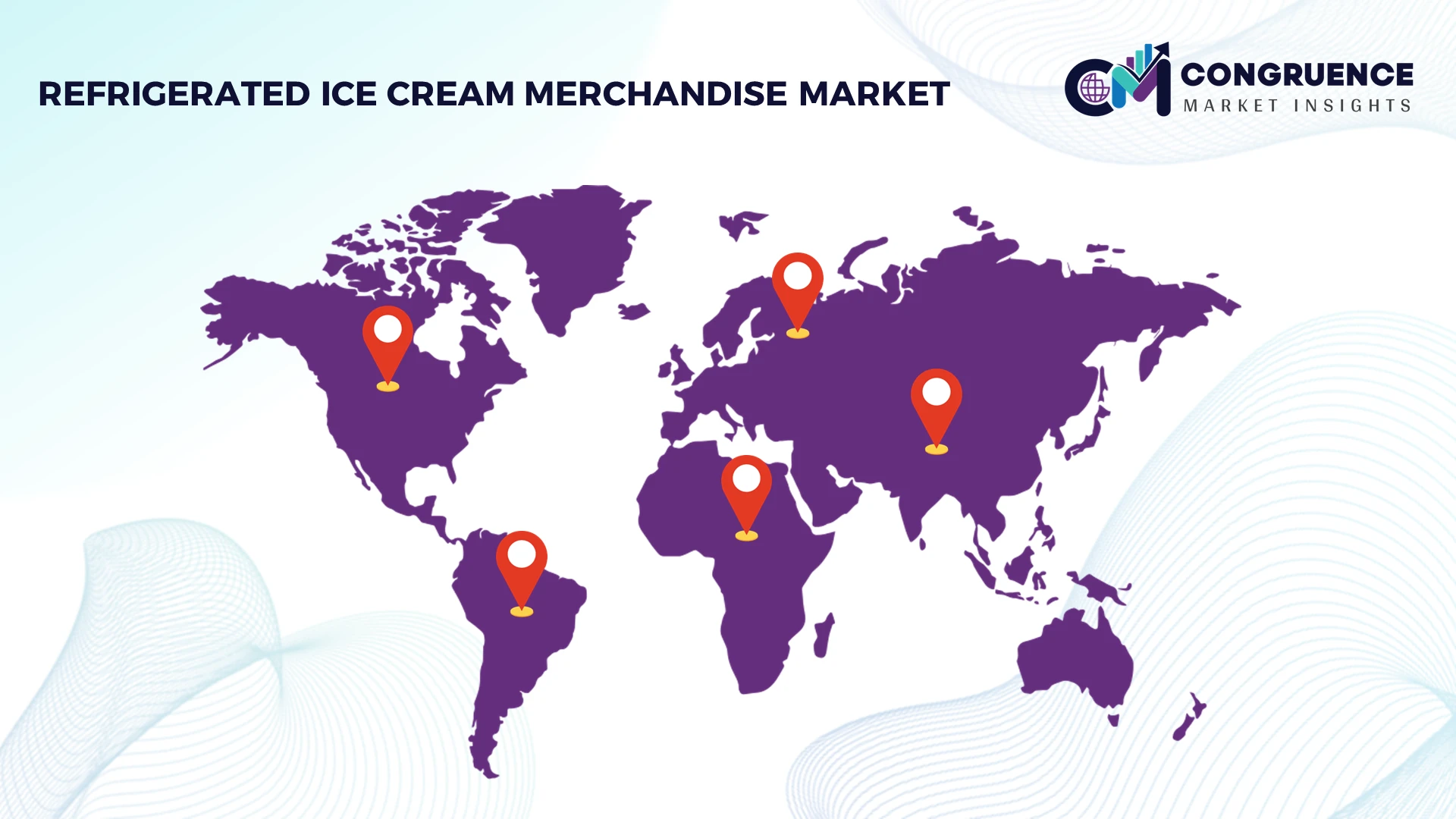
Asia-Pacific accounted for the largest market share at 36% in 2025 however, Asia-Pacific is expected to register the fastest growth, expanding at a CAGR of 7.8% between 2026 and 2033.
North America Refrigerated Ice Cream Merchandise Market
Energy-Efficient Freezer Replacement and Retail Modernization
North America accounted for an estimated 30% of the global refrigerated ice cream merchandise market in 2025, supported by extensive supermarket infrastructure, convenience-store networks, and established frozen dessert distribution systems. The United States dominates regional equipment procurement, while Canada contributes demand through grocery retail modernization and Mexico strengthens refrigeration equipment assembly capabilities. The US Environmental Protection Agency's Technology Transitions Program establishes a 150 GWP limit for applicable standalone retail refrigeration equipment, accelerating the transition toward alternative refrigerants. Manufacturers are introducing propane-based refrigeration systems, improved cabinet insulation, and electronic temperature controllers. A modeled 15% reduction in freezer electricity consumption saves 750 kWh annually for equipment previously consuming 5,000 kWh. Retailers increasingly prioritize equipment replacement schedules, maintenance accessibility, and lifecycle operating efficiency, encouraging suppliers to expand regional service networks and compliant product portfolios.
United States Market Outlook: The United States maintains a substantial commercial refrigeration equipment base through supermarkets, convenience stores, and branded ice cream merchandising networks. The country has more than 40,000 grocery stores, creating extensive opportunities for freezer replacement and equipment servicing. Manufacturers including True Manufacturing and Beverage-Air support domestic equipment availability, while retailers increasingly prioritize reliable temperature control, natural refrigerants, and standardized maintenance arrangements.
Europe Refrigerated Ice Cream Merchandise Market
Natural Refrigerant Adoption and Sustainable Retail Infrastructure
Europe represented approximately 24% of global refrigerated ice cream merchandising equipment demand in 2025, supported by mature grocery retail networks and established commercial refrigeration manufacturers. Germany, Italy, France, and the United Kingdom maintain substantial installed freezer infrastructure across supermarkets, convenience outlets, and hospitality establishments. The European Union's revised F-gas Regulation 2024/573 accelerates restrictions on high-GWP refrigerants, strengthening demand for hydrocarbon-based refrigeration systems. Manufacturers including Epta and Liebherr are advancing energy-efficient cabinet designs, natural refrigerant technologies, and integrated cooling controls. Propane refrigerant R-290 has a GWP of approximately 3, significantly below conventional HFC alternatives. European retailers are also adopting LED lighting, improved door seals, and advanced defrost management to reduce operating expenditure. Equipment suppliers increasingly compete through regulatory compliance, energy performance, and comprehensive maintenance support.
Germany Market Outlook: Germany benefits from advanced refrigeration engineering, automated manufacturing, and established retail equipment distribution networks. The country operates approximately 16,000 supermarkets and large grocery retail outlets, supporting recurring equipment modernization requirements. German manufacturers emphasize precision temperature regulation, high-efficiency compressor integration, and recyclable cabinet components. Industrial engineering capabilities strengthen domestic production of refrigeration controls, heat exchangers, and insulated equipment assemblies.
Asia-Pacific Refrigerated Ice Cream Merchandise Market
Manufacturing Scale and Organized Retail Expansion
Asia-Pacific leads the refrigerated ice cream merchandise market with an estimated 36% share in 2025, reflecting extensive equipment manufacturing capacity and expanding frozen dessert distribution infrastructure. China anchors regional refrigeration production through integrated compressor manufacturing, sheet-metal fabrication, and automated cabinet assembly. India contributes expanding demand from organized grocery chains, ice cream parlors, and convenience retail networks, while Japan emphasizes compact, energy-efficient merchandising equipment. China's manufacturing ecosystem supports competitive equipment sourcing and large-scale production of commercial cooling components. Regional manufacturers are introducing variable-speed compressors, compact upright cabinets, and digitally controlled freezer systems. A modeled 20% reduction in cabinet floor-space requirements enables retailers to expand frozen product availability within existing premises. Suppliers are strengthening domestic distribution partnerships, regional assembly operations, and after-sales service capabilities to support geographically dispersed equipment deployments.
China Market Outlook: China maintains a manufacturing advantage through refrigeration equipment clusters in Guangdong, Shandong, and Zhejiang. Its integrated industrial supply chain supports compressor production, cabinet fabrication, insulation processing, and electronic control assembly. The country accounted for approximately 32% of global manufacturing value added in 2024, demonstrating substantial industrial capacity. Chinese equipment manufacturers are expanding export-oriented freezer portfolios and improving automation to strengthen production consistency and international competitiveness.
South America Refrigerated Ice Cream Merchandise Market
Frozen Dessert Retail Expansion and Localized Equipment Production
South America accounted for an indicative 6% of global refrigerated ice cream merchandising equipment demand in 2025, supported by supermarket expansion, convenience retail development, and established frozen dessert consumption. Brazil represents the region's principal equipment market, benefiting from domestic commercial refrigeration manufacturing and extensive food retail infrastructure. Argentina and Chile contribute demand through grocery modernization and hospitality equipment replacement. Brazilian manufacturers including Metalfrio Solutions and Gelopar provide localized refrigeration equipment production, supporting shorter distribution distances and application-specific cabinet designs. Equipment procurement remains sensitive to electricity tariffs, imported component costs, and financing availability. A modeled 10% improvement in refrigeration efficiency reduces annual electricity consumption by 500 kWh for a cabinet operating at a 5,000 kWh baseline. Manufacturers are expanding distributor partnerships, standardized equipment platforms, and regional maintenance coverage.
Brazil Market Outlook: Brazil maintains a substantial commercial refrigeration manufacturing base, supported by supermarket networks, foodservice establishments, and frozen dessert brands. The country's population exceeds 200 million, providing a large domestic consumer market for packaged frozen products. São Paulo's industrial infrastructure supports refrigeration equipment distribution, while domestic manufacturers emphasize chest freezers, glass-door cabinets, and customized retail merchandising systems.
Middle East & Africa Refrigerated Ice Cream Merchandise Market
Hospitality Infrastructure and Climate-Resilient Refrigeration Investment
The Middle East & Africa represented an estimated 4% of global refrigerated ice cream merchandise demand in 2025, supported by hospitality development, organized food retail, and commercial refrigeration infrastructure investment. Saudi Arabia and the United Arab Emirates lead premium equipment procurement across shopping malls, supermarkets, hotels, and entertainment destinations. South Africa provides an established retail refrigeration market, while Egypt contributes demand through food distribution and urban retail expansion. High ambient temperatures increase refrigeration equipment operating requirements, encouraging investment in improved insulation, tropicalized compressors, and enhanced condenser performance. A modeled 15% reduction in electricity consumption saves 900 kWh annually for a cabinet previously consuming 6,000 kWh. Manufacturers are developing climate-specific freezer configurations and strengthening service partnerships to improve equipment availability across demanding operating environments.
Saudi Arabia Market Outlook: Saudi Arabia's Vision 2030 economic diversification program supports expansion of hospitality, entertainment, tourism, and modern retail infrastructure. The country's target of 150 million annual tourist visits by 2030 strengthens long-term foodservice equipment planning. Commercial refrigeration suppliers are targeting shopping centers, hotels, and entertainment facilities with high-ambient-temperature freezer systems, automated temperature controls, and localized maintenance capabilities.
Market Competition Landscape
The refrigerated ice cream merchandise market features competition between global refrigeration specialists, regional equipment manufacturers, and automated vending technology providers. Epta, AHT Cooling Systems, True Manufacturing, Metalfrio Solutions, and ISA compete through cabinet efficiency, manufacturing scale, product customization, and distribution coverage. An indicative concentration scenario assigns leading suppliers a combined 42% market share, reflecting substantial competition from regional manufacturers. European companies emphasize natural refrigerants and advanced controls, while Asian producers prioritize manufacturing efficiency and competitive pricing. A 15% electricity reduction strengthens equipment lifecycle economics, while 10% lower manufacturing costs improve supplier pricing flexibility. Companies are expanding automated production, localized assembly, and maintenance partnerships. Competitive differentiation increasingly centers on connected refrigeration, regulatory compliance, and dependable service networks. Refrigerant certification, compressor sourcing, and installation expertise create substantial entry barriers. Winning manufacturers combine reliable temperature performance, competitive ownership costs, scalable production, and responsive technical support across diverse retail environments and distribution networks.
Companies Profiled in the Refrigerated Ice Cream Merchandise Market Report
-
Epta S.p.A.
-
Liebherr-Hausgeräte GmbH
-
True Manufacturing Co., Inc.
-
Metalfrio Solutions S.A.
-
ISA S.p.A.
-
Beverage-Air Corporation
-
Vestfrost Solutions
-
Hoshizaki Corporation
-
Gelopar Refrigeração Paranaense Ltda.
-
Fogel de Centroamérica S.A.
-
Elanpro
-
Blue Star Limited
-
Turbo Air Inc.
-
Frigoglass S.A.I.C.
Technology Insights for the Refrigerated Ice Cream Merchandise Market
Variable-speed compressors, electronic expansion valves, and hydrocarbon refrigerants are reshaping commercial ice cream freezer engineering. Compared with fixed-speed systems, variable-speed refrigeration can deliver 15–25% electricity savings under suitable operating conditions by matching compressor output with cooling requirements. R-290 refrigerant has a global warming potential near 3, compared with approximately 1,430 for R-134a. Electronic temperature controllers maintain frozen merchandise near −18°C, improving product consistency. Supermarket operators benefit from reduced operating expenditure, while equipment manufacturers prioritize compressor integration, insulation performance, and compliant refrigeration circuits.
Emerging technologies include adaptive defrost algorithms, electronically commutated fans, and advanced vacuum insulation panels. Replacing conventional fan motors with efficient electronically commutated alternatives can reduce fan electricity consumption by 20–30%, depending on equipment specifications. Automated defrost scheduling reduces unnecessary heating cycles and compressor recovery loads. Connected cabinet sensors monitor door openings, temperature excursions, and compressor performance, supporting centralized equipment management. Large retail chains gain operational advantages through standardized monitoring, while smaller equipment manufacturers differentiate through modular controls and simplified maintenance integration.
Between 2026 and 2028, development priorities will emphasize predictive fault detection, digital refrigeration controls, and low-emission cabinet architectures. Reducing annual freezer electricity consumption by 20% saves 1,000 kWh per cabinet against a 5,000 kWh baseline. Suppliers combining reliable cooling performance with accessible service infrastructure will secure stronger retail procurement positions.
Recent Developments in the Global Refrigerated Ice Cream Merchandise Market
-
October 2025: Epta introduced its Iarp Alba 43 and Alba 45 frozen dessert cabinets at HostMilano, incorporating R290 refrigeration and approximately 40% recycled plastic content in internal tubs. The redesigned cabinets strengthen sustainable merchandising and improve product visibility. Source: refreshmentmag.com
-
February 2025: TEFCOLD introduced three scoop ice cream freezer ranges: DELTA RV, SUPER CAPRI, and ISOA. The DELTA RV accommodates 12 Napoli pans across two independently controlled temperature zones, enabling flexible dessert presentation and precise serving temperature management. Source: tefcold.com
-
October 2024: Elanpro showcased its Ultra Slim Upright Freezer series at the World of Ice Cream Expo in Noida, offering 150-liter and 200-liter configurations. Zero Frost technology and operation at 35°C support compact merchandising in demanding Indian retail environments. Source: fnbnews.com
-
May 2025: AHT Cooling Systems launched SPI Circumpolar, a patented modular pump station for semi-plug-in waterloop refrigeration. Its adaptable architecture supports installations ranging from small stores to large supermarkets, simplifying infrastructure integration and accelerating decentralized commercial refrigeration deployment. Source: esmmagazine.com
Scope of the Refrigerated Ice Cream Merchandise Market Report
The Refrigerated Ice Cream Merchandise Market Report evaluates five equipment categories: Ice Cream Display Freezers, Chest Freezers, Upright Freezers, Soft-Serve Machines, and Frozen Dessert Vending Machines. Application coverage includes Retail Ice Cream Display, Frozen Dessert Storage, On-Site Ice Cream Serving, and Automated Ice Cream Sales. Analysis spans six end-user categories, including supermarkets, convenience stores, ice cream parlors, restaurants, hotels, and entertainment venues. Indicative segmentation assigns Ice Cream Display Freezers a 38% share, reflecting their importance in commercial merchandising infrastructure.
Regional assessment covers North America, Europe, Asia-Pacific, South America, and the Middle East & Africa. The report examines natural refrigerants, variable-speed compressors, connected monitoring, automated dispensing, and energy-efficient cabinet engineering. Its 2026–2033 outlook evaluates equipment replacement priorities, regulatory transitions, manufacturing localization, competitive differentiation, and investment opportunities across established and emerging retail environments.
Refrigerated Ice Cream Merchandise Market Report Summary
| Report Attribute/Metric | Report Details |
|---|
Market Revenue in 2025 | USD 15640.8 Million |
Market Revenue in 2033 | USD 25691.64 Million |
CAGR (2026 - 2033) | 6.4% |
Base Year | 2025 |
Forecast Period | 2026 - 2033 |
Historic Period | 2021 - 2025 |
Segments Covered | By TypeIce Cream Display Freezers Frozen Dessert Vending Machines
By ApplicationOn-Site Ice Cream Serving Automated Ice Cream Sales
By End-UserSupermarkets and Hypermarkets
|
Key Report Deliverable | Revenue Forecast, Growth Trends, Market Dynamics, Segmental Overview, Regional and Country-wise Analysis, Competition Landscape |
Region Covered | North America, Europe, Asia-Pacific, South America, Middle East, Africa |
Key Players Analyzed | Epta S.p.A., Liebherr-Hausgeräte GmbH, True Manufacturing Co., Inc., Metalfrio Solutions S.A., ISA S.p.A., Beverage-Air Corporation, Vestfrost Solutions, Hoshizaki Corporation, Gelopar Refrigeração Paranaense Ltda., Fogel de Centroamérica S.A., Elanpro, Blue Star Limited, Turbo Air Inc., Frigoglass S.A.I.C. |
Customization & Pricing | Available on Request (10% Customization is Free) |





