
Reports
The Global Refinish Paints Market was valued at USD 6,724.1 Million in 2025 and is anticipated to reach a value of USD 10,556.5 Million by 2033 expanding at a CAGR of 5.8% between 2026 and 2033. Growth is driven by collision-repair throughput, waterborne coating adoption, digital color matching, and fast-cure technologies that improve booth productivity while reducing energy intensity.
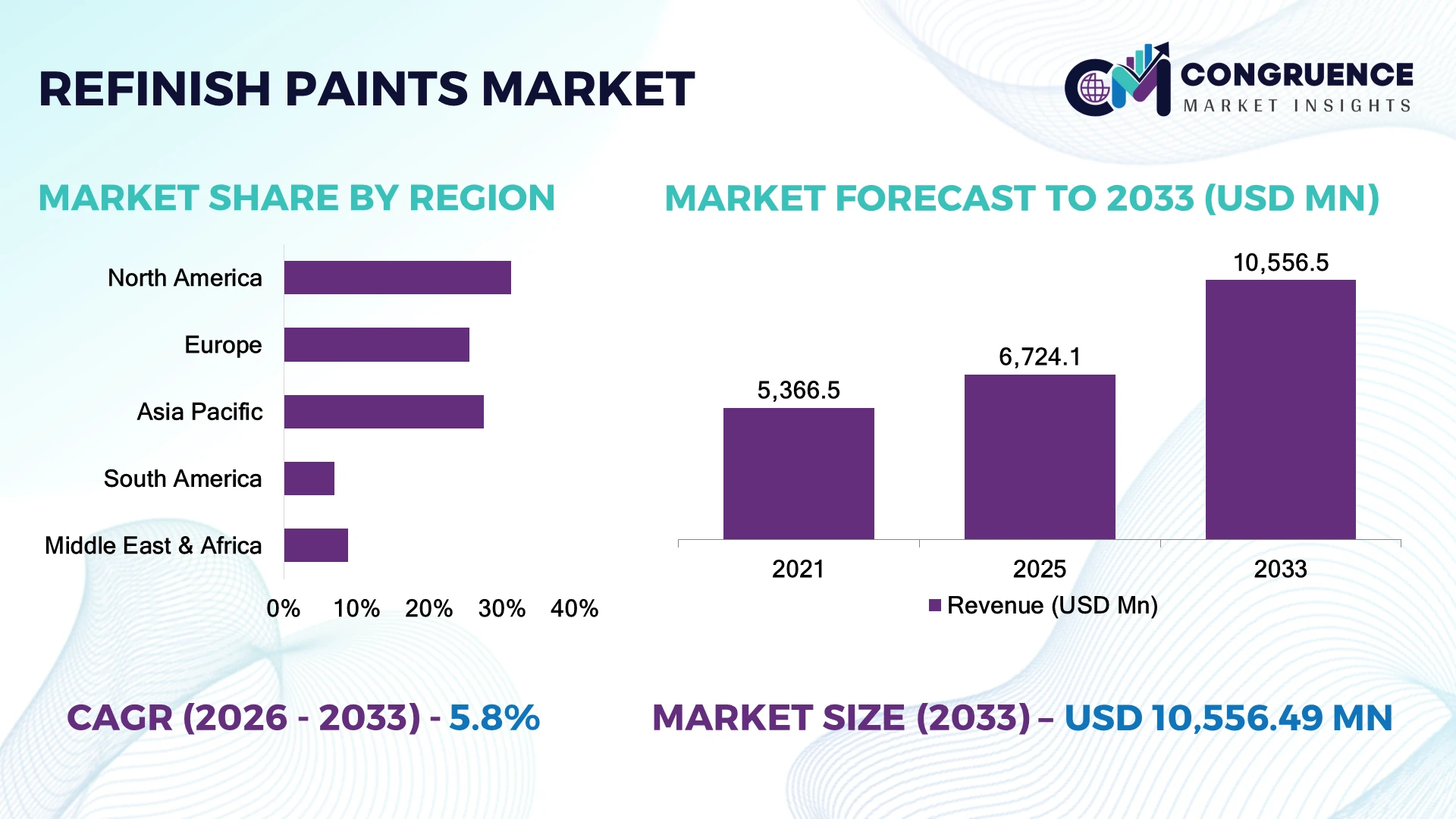
The United States represents roughly 30% of global refinish demand, supported by a large vehicle parc, sophisticated collision networks, and rapid adoption of digital color tools. Europe has stronger low-VOC adoption, while Asia-Pacific combines expanding repair infrastructure with manufacturing scale. Fast-cure technology can reduce energy consumption by up to 49%; 2026 freight volatility is also encouraging regional inventory planning.
Strategically, suppliers should prioritize high-throughput body shops, localized supply resilience, and integrated digital-refinish platforms.
Market Size & Growth: USD 6,724.1 million in 2025 to USD 10,556.5 million by 2033 at 5.8% CAGR, driven by collision repair, waterborne coatings, and digital color matching.
Top Growth Drivers: Collision repair contributes roughly 45% of demand; passenger vehicles represent 68%; commercial fleets prioritize durable finishes and lower downtime.
Short-Term Forecast: By 2028, automated color workflows can reduce material waste 5–10%, while fast-cure systems cut booth cycle times up to 50%.
Emerging Technologies: AI color identification, automated mixing, waterborne basecoats, and low-energy clearcoats improve consistency, throughput, and environmental performance.
Regional Leaders: North America, Asia-Pacific, and Europe remain leading demand centers, with projected 2033 values of approximately USD 3.2 billion, USD 2.9 billion, and USD 2.7 billion, respectively.
Consumer/End-User Trends: Passenger vehicles hold about 68% of demand, while multi-shop operators increasingly standardize premium coatings, digital color tools, and workflow dashboards.
Pilot/Case Example: In 2025, Axalta’s fast-cure system delivered up to 49% lower energy consumption and 50% shorter cycle times versus conventional systems.
Competitive Landscape: Axalta holds an estimated 15% share, competing with PPG, BASF, AkzoNobel, and Sherwin-Williams through color libraries, digital matching, technical service, and distribution.
Regulatory & ESG Impact: Low-VOC systems gain priority; advanced Eco Balance technologies target up to 50% lower CO2, strengthening sustainability-led procurement.
Investment & Funding: BASF’s coatings transaction with Carlyle carries a €7.7 billion enterprise value, signaling strategic restructuring and continued technology investment.
Innovation & Future Outlook: Spectrophotometers, cloud color databases, automated mixing, low-energy curing, and workflow analytics are shifting competition toward integrated productivity platforms.
The Refinish Paints Market is increasingly concentrated around automotive collision repair, commercial fleet maintenance, and high-throughput body-shop networks. Waterborne basecoats, low-VOC clearcoats, automated mixing, and digital color matching are gaining traction, with automated workflows improving productive hours by around 6%. In 2026, tighter emissions requirements and supply-chain volatility are reinforcing demand for efficient, locally supported coating systems.
The Refinish Paints Market is becoming strategically important as collision repair networks prioritize throughput, technician productivity, color accuracy, and energy control. Aging vehicle fleets, increasingly complex finishes, and tighter environmental requirements are shifting procurement from standalone coatings toward integrated systems combining paint, digital matching, mixing, and workflow management. Supply-chain restructuring is also encouraging regional inventories and shorter replenishment cycles.
Technology is widening the performance gap. Fast-cure systems can reduce energy consumption by up to 49% and cycle times by 50% versus conventional processes, while automated mixing can increase productive work hours by about 6%. North America remains highly systemized, Europe emphasizes low-VOC and waterborne compliance, while Asia-Pacific is expanding body-shop capacity and digital adoption from a lower installed base.
During 2026–2028, high-volume collision centers are prioritizing connected spectrophotometers, automated dispensers, low-energy clearcoats, and production dashboards. Companies are responding through product launches, regional partnerships, and technology integration. Competitive advantage will increasingly depend on reducing repair time, material waste, energy intensity, and color-rework risk simultaneously. These investments strengthen margins while making technical service and digital ecosystem integration harder for smaller suppliers to replicate.
Rising vehicle repair complexity is pushing body shops toward faster-curing coatings, digital color matching, and standardized refinish workflows. Collision repair represents roughly 45% of demand, while passenger vehicles account for about 68%, creating strong volume concentration in North America and Western Europe. Fast-cure systems can reduce booth cycle times by up to 50% and energy consumption by approximately 49%. In the United States, labor shortages are further increasing pressure to maximize technician productivity per booth. Manufacturers are responding with integrated paint systems, automated mixing equipment, and digital color platforms that reduce rework and improve throughput. The non-obvious shift is that productivity, rather than coating price alone, is increasingly determining purchasing decisions among multi-site repair operators.
Refinish coatings remain exposed to fluctuations in solvents, resins, pigments, isocyanates, and specialty additives, with raw-material movements capable of changing formulation costs by approximately 5–10%. Imported components can add another 8–15% to landed costs when freight or currency conditions deteriorate. European producers face additional compliance costs from VOC restrictions, while Asian manufacturers remain exposed to shipping disruptions and feedstock volatility. These pressures directly affect distributor margins and body-shop inventory economics, particularly for premium clearcoats and specialty colors. Companies are reducing exposure through dual sourcing, regional warehousing, longer-term supplier contracts, and localized formulation. A key operational advantage is emerging for manufacturers able to maintain consistent color performance despite raw-material substitutions without forcing body shops through repeated product qualification.
Digital color identification and automated paint dispensing are opening a high-value productivity opportunity for large collision networks. Spectrophotometer-led workflows can reduce color-matching labor by approximately 20–30%, while automated dispensing can improve mixing consistency by 5–10% and reduce material waste by roughly 5–10%. U.S. multi-shop operators are increasingly suitable for connected platforms because centralized color libraries can standardize processes across hundreds of repair locations. The next opportunity is integration between estimating, color retrieval, inventory, and mixing systems, creating a closed digital workflow rather than standalone equipment. Manufacturers are investing in cloud databases, software partnerships, and equipment integration. This creates recurring software and consumables opportunities alongside conventional paint sales, particularly for suppliers serving high-throughput repair networks.
Advanced refinish systems increasingly depend on technician calibration, substrate preparation, spray-gun settings, flash times, and controlled booth conditions. Incorrect application can increase rework by 5–10% and extend repair cycle times by 10–20%, offsetting the productivity advantage of premium coatings. The challenge is particularly relevant in the United States, where technician shortages are encouraging shops to employ less-experienced labor, while European repairers manage increasingly stringent environmental requirements. Waterborne systems also require controlled drying and airflow conditions that older facilities cannot consistently provide. Manufacturers must therefore combine product innovation with training platforms, technical-service teams, digital application guidance, and equipment partnerships. The strategic issue is not technology availability but repeatable utilization across technicians, locations, vehicle substrates, and increasingly complex OEM-approved repair procedures.
Fast-Cure Booth Processes: Collision centers are adopting low-energy curing systems that can cut cycle times by up to 50% and energy consumption by approximately 49%. The change increases booth availability without expanding physical capacity, helping high-volume U.S. repair networks process more vehicles per day. Manufacturers are pairing rapid-cure coatings with optimized clearcoats and application systems.
Digital Color Matching Expands: Spectrophotometers and cloud-based color libraries are moving from premium body shops into broader multi-site networks. Digital identification can reduce color-matching labor by 20–30%, while centralized databases improve consistency across locations. Suppliers are integrating scanning, formulation retrieval, inventory management, and automated dispensing to reduce technician dependency and minimize costly color rework.
Waterborne Systems Standardize: European repair operations continue shifting toward waterborne basecoats as VOC controls tighten. Advanced systems can reduce solvent emissions by roughly 30–50% versus conventional solvent-heavy processes while maintaining finish quality. Manufacturers are expanding training, application support, and compatible drying equipment because waterborne performance depends more heavily on booth airflow and humidity control.
Connected Shop Management: Large repair networks are increasingly linking estimating, paint mixing, inventory, and production data. Integrated workflows can reduce administrative handling by 10–15% and improve material visibility by roughly 15–20%. This creates a non-obvious competitive shift: coating suppliers with software and workflow capabilities gain greater influence over recurring consumables procurement than manufacturers competing solely on formulation performance.
Waterborne refinish paints represent approximately 42–46% of global demand, supported by tightening VOC requirements, OEM-compatible color technology, and growing adoption across high-volume collision centers. Solventborne systems retain roughly 30–34% share because of established equipment, technician familiarity, and strong performance in markets with less stringent emissions requirements. High-solids coatings account for approximately 18–22%, occupying an important position where shops prioritize reduced material consumption and faster application. Waterborne formulations are the fastest-shifting category, with adoption expanding as body shops modernize drying infrastructure and seek lower-emission processes.
The competitive gap is increasingly operational rather than purely formulation-based. Waterborne systems can reduce solvent-related emissions while maintaining OEM-level color matching, whereas solventborne products remain commercially relevant through installed-base compatibility. Companies are therefore expanding waterborne portfolios, improving application support, and integrating digital color platforms. PPG's 2026 Quickline launch illustrates this shift toward waterborne systems positioned around affordability, color capability, fast drying, and regulatory compliance.
BASF's 2025 digital-refinish deployment combines ScanR color measurement, cloud-based color management, and automated mixing capable of completing up to six mixes simultaneously, demonstrating the industry's movement toward integrated waterborne and digital workflows.
Automotive collision repair accounts for approximately 58–62% of global refinish paint consumption, reflecting the large installed vehicle base and recurring accident-related repair activity. Commercial vehicle refinishing contributes about 23–27%, supported by fleet maintenance, truck refurbishment, and uptime requirements, while industrial and specialty vehicle applications represent approximately 12–16%. Collision repair remains the mature core application, but commercial fleets are gaining importance as operators prioritize standardized appearance, corrosion protection, and shorter vehicle downtime.
Digital color identification is accelerating the shift toward technology-enabled repair. Connected spectrophotometers can reduce manual color-selection activity by approximately 20–30%, while automated mixing improves formulation consistency and reduces material handling. Large repair networks are increasingly integrating paint systems with workflow software and technical training. The 2026 agreement between PPG and Quality Collision Group covering more than 95 repair centers across 13 states demonstrates how suppliers are using network-wide deployment to secure recurring coatings and digital-tool demand.
CCC reported that 86.9% of U.S. repairable DRP appraisals included a vehicle scan in Q1 2025, highlighting the broader shift toward technology-intensive collision workflows and increasing complexity inside modern repair operations.
Independent body shops and multi-shop collision networks collectively account for approximately 55–60% of global refinish paint consumption, making them the largest purchasing group through recurring repair volumes and broad vehicle coverage. Authorized dealership body shops represent roughly 25–30%, supported by OEM repair standards and certified workflows, while fleet-owned and specialty repair operations contribute approximately 12–16%. Multi-shop networks are the fastest-shifting buyer group because centralized procurement can standardize coatings, equipment, training, and color-management processes across multiple facilities.
Large operators increasingly evaluate paint suppliers on total repair productivity rather than unit price alone. Digital color tools can reduce matching labor by roughly 20–30%, while automated mixing improves repeatability and inventory control. Suppliers are responding with network agreements, technical certification, equipment integration, and bundled software. PPG's 2025 Toyota Motor Europe partnership demonstrates this model, combining approved refinish products with digital color matching, automated mixing, sustainability tools, and technical certification across the European body-shop network.
A 2026 CCC/CREF workforce study surveyed 475 students and recent graduates, finding strong interest in collision repair alongside advanced technology and AI, reinforcing the importance of technology-enabled training as repair networks address workforce constraints.
North America accounted for the largest market share at 31.2% in 2025 however, Asia-Pacific is expected to register the fastest growth, expanding at a CAGR of 6.7% between 2026 and 2033.
High-throughput collision networks accelerate digital and low-energy refinishing
North America represents approximately 31.2% of the global Refinish Paints Market, supported by a mature collision-repair ecosystem, extensive vehicle ownership, and large multi-shop operator networks. The United States generates more than 85% of regional demand, with California, Texas, Florida, and the Midwest serving as major repair and distribution centers. Collision applications account for approximately 58–62% of regional consumption, while waterborne and high-solids systems are gaining share as repairers optimize booth productivity and emissions compliance. Digital color matching is increasingly integrated into enterprise repair workflows, reducing color-selection labor by roughly 20–30%. PPG's 2026 supply agreement with Quality Collision Group covering more than 95 repair centers across 13 states demonstrates the increasing importance of network-wide supplier relationships. Manufacturers are responding with localized inventories, technical training, connected color platforms, and integrated coating systems.
United States Market Outlook: The United States remains the principal market because its collision-repair infrastructure combines high vehicle density, sophisticated insurer-driven repair networks, and strong adoption of digital estimating and scanning technologies. More than 80% of large multi-location repair operators increasingly emphasize standardized processes across facilities. The country's extensive distribution infrastructure also enables rapid replenishment of specialized primers, basecoats, and clearcoats.
Low-VOC compliance drives waterborne system modernization
Europe contributes approximately 25–26% of global Refinish Paints demand, with Germany, France, Italy, the United Kingdom, and Spain forming the principal consumption centers. Regulatory pressure on VOC emissions has accelerated waterborne basecoat adoption and increased demand for compliant clearcoat systems. Germany and France account for a substantial portion of premium refinish consumption because of sophisticated body-shop infrastructure and strong OEM repair standards. European operators increasingly combine spectrophotometers, cloud color databases, and automated mixing to improve repair consistency. Digital color workflows can reduce manual matching activity by approximately 20–30%. Suppliers are investing in technical certification, localized distribution, and lower-emission formulations while strengthening relationships with OEM-certified repair networks.
Germany Market Outlook: Germany represents Europe's strongest industrial refinish market because of its dense automotive manufacturing ecosystem, extensive authorized repair infrastructure, and stringent environmental requirements. Waterborne systems are increasingly integrated into professional collision workflows, while premium body shops prioritize OEM-compatible color accuracy. Germany's large automotive supplier base also provides manufacturers with a strong platform for technical partnerships and early validation of next-generation refinish technologies.
Vehicle expansion and body-shop modernization strengthen regional scale
Asia-Pacific accounts for approximately 27–28% of global Refinish Paints demand and combines China's manufacturing scale with rapidly expanding repair infrastructure in India, Southeast Asia, and South Korea. China contributes roughly 45% of regional consumption, supported by its large vehicle parc, commercial fleet base, and extensive automotive production ecosystem. India is shifting toward organized collision repair and higher-specification coating systems as insurance penetration and dealership service networks expand. Waterborne formulations currently have greater penetration in premium facilities than in smaller independent workshops. Manufacturers are therefore combining localized production, distributor partnerships, technical training, and digital color systems. Automated mixing can improve formulation consistency by approximately 5–10%, making technology deployment increasingly relevant as repair volumes rise.
China Market Outlook: China is the region's largest individual refinish market, supported by extensive automotive manufacturing, a large domestic vehicle fleet, and rapidly expanding professional repair capacity. Major coating suppliers benefit from proximity to resin, pigment, and packaging supply chains. Large collision centers increasingly adopt digital color matching and automated mixing, while domestic manufacturers compete through localized formulations, competitive pricing, and broad distributor coverage.
Brazil's organized repair networks strengthen premium coating adoption
South America represents approximately 7% of global Refinish Paints demand, with Brazil accounting for roughly 70% of regional consumption. São Paulo, Minas Gerais, Paraná, and Rio de Janeiro concentrate automotive repair activity, distribution infrastructure, and organized collision centers. Passenger-vehicle collision repair remains the primary demand base, while commercial fleets create additional requirements for durable coatings and rapid turnaround. Premium body shops are increasingly adopting waterborne basecoats and digital color matching, although independent workshops remain more price-sensitive. Digital color identification can reduce matching-related labor by approximately 20–30%, improving productivity where skilled technicians are limited. Suppliers are strengthening regional distribution, technical training, and localized inventory to reduce replenishment delays and protect margins amid currency and logistics volatility.
Brazil Market Outlook: Brazil dominates South American demand through its large vehicle population, concentrated automotive corridors, and expanding organized collision-repair networks. São Paulo represents a major procurement and distribution hub, linking coating suppliers with body shops, dealerships, and fleet operators. Professional repair facilities increasingly prioritize waterborne systems and digital color tools, while distributors remain critical for serving smaller independent workshops outside metropolitan centers.
Automotive service infrastructure investment supports premium refinishing
Middle East & Africa represents approximately 9% of global Refinish Paints demand, with Saudi Arabia, the UAE, South Africa, Turkey, and Egypt serving as important consumption centers. Gulf markets are benefiting from investment in automotive service facilities, fleet infrastructure, and organized repair networks, while South Africa provides a mature body-shop and distribution base. Saudi Arabia and the UAE together contribute more than 45% of regional demand. Premium repair centers increasingly deploy digital color matching and controlled paint systems, particularly for luxury and commercial vehicles. Manufacturers are strengthening distributor inventories and technical support while targeting fleet-service partnerships. Automated mixing can reduce material-handling requirements by approximately 10–15%, supporting productivity in high-throughput repair facilities.
Saudi Arabia Market Outlook: Saudi Arabia is the region's most strategically significant market due to expanding automotive service infrastructure, commercial fleet activity, and investment in organized vehicle-maintenance facilities. Riyadh, Jeddah, and Dammam are key service and distribution centers. Premium workshops increasingly use digitally supported color matching and higher-specification coatings, creating opportunities for suppliers offering technical training, localized inventories, and integrated refinish systems.
PPG, Axalta, AkzoNobel, BASF, and Sherwin-Williams form the leading competitive group, while Nippon Paint, Kansai Paint, KCC, and regional manufacturers compete aggressively on price and localized distribution. The top five players collectively hold an estimated 45–47% share, creating moderate concentration with substantial regional fragmentation. Competition centers on technology, technical support, supply reliability, and repair speed: fast-cure systems can reduce cycle times by 50%, while automated color workflows improve mixing consistency by 5–10%. PPG and Axalta emphasize digital color ecosystems and high-throughput systems; AkzoNobel competes through waterborne productivity platforms; BASF is integrating robotics and connected workflows; Sherwin-Williams leverages distribution depth. The competitive shift is moving from formulation performance toward integrated productivity solutions and supply-chain control. Entry barriers include formulation expertise, OEM validation, technician training, distribution density, and body-shop qualification. Winning requires validated coatings, digital integration, rapid technical support, dependable regional inventory, and measurable reductions in repair time and operating cost.
PPG Industries, Inc.
Axalta Coating Systems Ltd.
AkzoNobel N.V.
BASF SE
The Sherwin-Williams Company
Nippon Paint Holdings Co., Ltd.
Kansai Paint Co., Ltd.
KCC Corporation
Berger Paints India Limited
NOROO Paint & Coatings Co., Ltd.
KAPCI Coatings
Roberlo S.A.
MIPA SE
HB BODY Automotive Refinish
Current refinish technology is shifting toward waterborne basecoats, fast-cure clearcoats, digital color matching, and automated dispensing. Waterborne systems reduce solvent emissions, while fast-cure chemistry can cut energy consumption by up to 49% and cycle times by 50% versus conventional processes. Digital color platforms are increasingly deployed across multi-site repair networks, improving formula retrieval and reducing technician handling.
Emerging systems connect spectrophotometers, cloud color databases, automated mixers, inventory software, and repair-order platforms. BASF’s automated mixing architecture can complete six mixes simultaneously, while connected inventory tools improve stock visibility and reduce manual administration by roughly 10–15%. These integrations shift suppliers from paint vendors toward workflow partners, strengthening recurring equipment, software, and consumables relationships.
During 2026–2028, robotics-enabled spraying, AI-assisted color prediction, low-temperature curing, and biomass-balanced or recycled-feedstock coatings will gain operational relevance. Robotic application targets repeatability and material efficiency, while low-temperature systems reduce booth energy requirements. Compared with conventional manual application, automation can improve process consistency by approximately 10–20%. Axalta, BASF, PPG, and AkzoNobel benefit from combining formulation expertise with digital ecosystems, technical training, and equipment partnerships across high-throughput collision centers and enterprise repair networks worldwide today.
November 2025 Axalta’s Fast Cure Low Energy system won an R&D 100 Award, cutting energy consumption by 49% and repair cycle times by 50%. The technology strengthens booth throughput while lowering operating energy costs for collision centers globally. Source: rdworldonline.com
August 2026 PPG launched QUICKLINE, a waterborne refinish portfolio for U.S. and Canadian body shops. Its fast-drying system combines basecoats, clearcoats and digital color support, strengthening affordable low-VOC repair capability across diverse shop conditions and reducing workflow complexity. Source: PPG
May 2026 BASF Coatings expanded its refinish strategy into robotics-enabled application, integrating digital color management with automated primer, basecoat and clearcoat processes. The initiative targets repeatable application, higher throughput, and scalable automation as body shops address technician shortages. Source: BASF
March 2025 China’s JT/T 1530-2024 automobile body-painting standard entered force, establishing safety and environmental requirements for repair coating operations. The national framework strengthens process controls and compliance expectations for workshops, accelerating modernization of painting facilities and workflows. Source: samr.gov.cn
The Refinish Paints Market Report covers waterborne, solventborne, high-solids, and specialty systems across primers, basecoats, clearcoats, and related refinishing products. Application coverage includes passenger-vehicle collision repair, commercial vehicles, fleet refurbishment, and specialty vehicle refinishing. End-user analysis encompasses independent body shops, multi-shop operators, dealerships, fleet repair facilities, and authorized collision networks. Regional assessment spans North America, Europe, Asia-Pacific, South America, and Middle East & Africa.
The study evaluates digital color matching, spectrophotometers, automated mixing, fast-cure chemistry, low-temperature curing, robotics, and sustainable coating technologies. Passenger vehicles represent approximately 68% of demand, while collision repair contributes roughly 58–62%, providing a clear view of core purchasing patterns. Analysis of 10–14 major companies supports investment planning, geographic expansion, technology prioritization, partnership development, supply-chain localization, and competitive positioning through 2026–2033, including emerging waterborne and digitally integrated repair ecosystems.
| Report Attribute/Metric | Report Details |
|---|---|
|
Market Revenue in 2025 |
USD 6,724.1 Million |
|
Market Revenue in 2033 |
USD 10,556.5 Million |
|
CAGR (2026 - 2033) |
5.8% |
|
Base Year |
2025 |
|
Forecast Period |
2026 - 2033 |
|
Historic Period |
2021 - 2025 |
|
Segments Covered |
By Type
By Application
By End-User
|
|
Key Report Deliverable |
Revenue Forecast, Growth Trends, Market Dynamics, Segmental Overview, Regional and Country-wise Analysis, Competition Landscape |
|
Region Covered |
North America, Europe, Asia-Pacific, South America, Middle East, Africa |
|
Key Players Analyzed |
PPG Industries, Inc., Axalta Coating Systems Ltd., AkzoNobel N.V., BASF SE, The Sherwin-Williams Company, Nippon Paint Holdings Co., Ltd., Kansai Paint Co., Ltd., KCC Corporation, Berger Paints India Limited, NOROO Paint & Coatings Co., Ltd., KAPCI Coatings, Roberlo S.A., MIPA SE, HB BODY Automotive Refinish |
|
Customization & Pricing |
Available on Request (10% Customization is Free) |




