
Reports
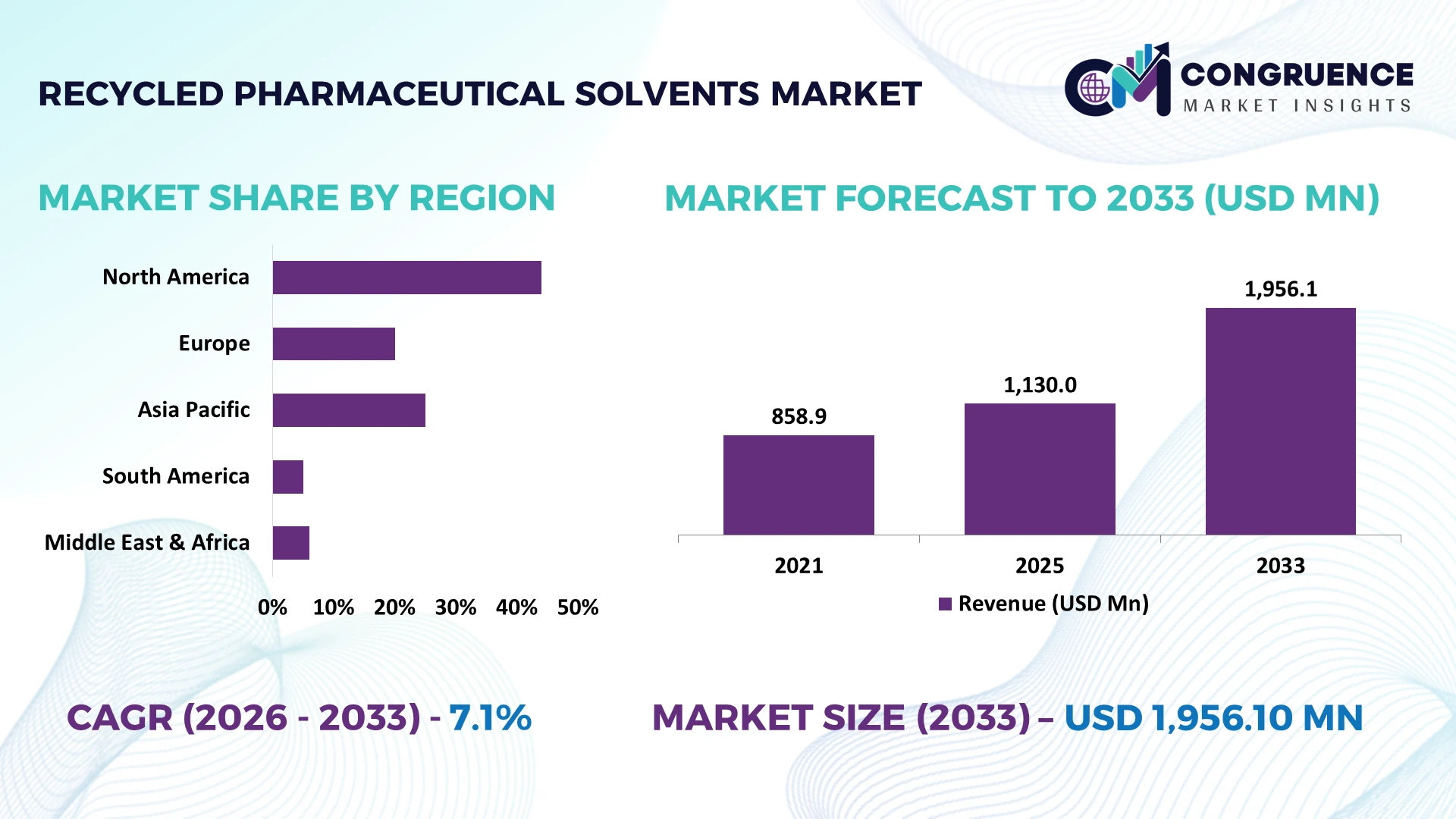
The Global Recycled Pharmaceutical Solvents Market was valued at USD 1130 Million in 2025 and is anticipated to reach a value of USD 1956.1 Million by 2033 expanding at a CAGR of 7.1% between 2026 and 2033. Growth is driven by pharmaceutical solvent recovery mandates, increasing adoption of closed-loop distillation, rising active pharmaceutical ingredient (API) manufacturing, and efforts to reduce hazardous chemical disposal.
India represents a strategically important market for recycled pharmaceutical solvents, supported by its extensive generic drug manufacturing network and API production infrastructure. The country supplies approximately 20% of global generic medicines by volume and operates more than 10,000 pharmaceutical manufacturing facilities. Compared with China, India's pharmaceutical production is particularly concentrated in generic formulations and contract manufacturing, creating substantial opportunities for recovering methanol, acetone, isopropyl alcohol, and ethyl acetate. Gujarat and Telangana remain important pharmaceutical manufacturing clusters, where solvent distillation and purification support chemical reuse and compliance with environmental regulations.
Manufacturers investing in validated solvent purification, traceability, and integrated recovery infrastructure are positioned to strengthen procurement resilience while reducing hazardous waste management costs.
Market Size & Growth: USD 1,130 million in 2025, reaching USD 1,956.1 million by 2033 at 7.1% CAGR, supported by closed-loop pharmaceutical solvent recovery.
Top Growth Drivers: Solvent recovery can reclaim over 90% of selected solvent streams, reduce fresh solvent purchases, and lower hazardous waste generation through controlled purification.
Short-Term Forecast: By 2028, recovery systems targeting 95% solvent reclamation will prioritize improved distillation efficiency, energy integration, and batch consistency.
Emerging Technologies: AI-assisted distillation control, automated solvent segregation, and membrane-assisted purification represent 3 important technology development areas.
Regional Leaders: Asia-Pacific, Europe, and North America anchor global demand through API manufacturing, circular chemical processing, and regulated pharmaceutical production, respectively.
Consumer/End-User Trends: Pharmaceutical manufacturers increasingly evaluate solvent reuse across 2 operating models: internal recycling and outsourced recovery with documented purity verification.
Pilot/Case Example: A 2026 recovery project targeting 90% reclamation would reduce virgin solvent requirements by 900 kilograms per 1,000 kilograms of recoverable solvent feed, before processing losses.
Competitive Landscape: Veolia, Clean Harbors, Tradebe, and Indaver compete through recovery infrastructure, hazardous waste expertise, solvent purification capabilities, and pharmaceutical service contracts.
Regulatory & ESG Impact: European waste hierarchy requirements and pharmaceutical quality standards encourage traceable solvent reuse, with 90% recovery representing a practical high-performance operating benchmark.
Investment & Funding: Capital deployment increasingly targets 3 infrastructure categories: fractional distillation units, solvent purification systems, and centralized pharmaceutical waste recovery facilities.
Innovation & Future Outlook: Hybrid membrane-distillation systems, digital solvent tracking, and continuous recovery processes support the transition from disposal-focused services toward integrated circular chemical supply chains.
The Recycled Pharmaceutical Solvents Market is increasingly shaped by solvent-intensive API synthesis, pharmaceutical intermediate manufacturing, and contract development and manufacturing operations. Advanced fractional distillation, molecular sieve dehydration, and automated composition monitoring enable recovery of high-purity acetone, ethanol, methanol, and isopropyl alcohol for qualified reuse. Properly designed recovery processes can reclaim more than 90% of selected solvent streams, depending on contamination and separation requirements. India's pharmaceutical manufacturing expansion and Europe's circular economy regulations reinforce demand for traceable solvent recovery services. These developments establish solvent recovery efficiency, quality validation, and regional processing capacity as important strategic considerations.
Recycled pharmaceutical solvents are becoming strategically important as drug manufacturers restructure chemical procurement, improve production economics, and strengthen compliance with hazardous waste regulations. Solvents can account for 80–90% of the material mass used in pharmaceutical manufacturing processes, making recovery infrastructure an important determinant of resource efficiency. India's expanding contract development and manufacturing sector is accelerating investment in integrated solvent management, while European pharmaceutical producers increasingly prioritize circular chemical procurement under stricter environmental requirements. This transition is shifting competition from waste disposal services toward validated solvent purification and reuse.
Advanced fractional distillation combined with automated process control can achieve recovery efficiencies exceeding 90% for suitable solvent streams, compared with substantially lower recovery from poorly optimized conventional batch systems. Automated composition monitoring improves separation consistency and reduces off-specification batches. Germany emphasizes high-purity recycling and regulatory traceability, whereas India prioritizes processing capacity and integration with API manufacturing clusters. For example, a facility processing 10 tonnes of recoverable solvent daily at 90% recovery can reclaim 9 tonnes for subsequent qualification and reuse.
During 2026–2028, investment priorities will increasingly include continuous distillation, heat integration, and digital solvent tracking. Manufacturers are strengthening partnerships with specialized recyclers to secure predictable recovery capacity. Competitive advantage will depend on verified purity, reliable throughput, and lower solvent procurement exposure.
Pharmaceutical manufacturing's high solvent consumption is accelerating investment in closed-loop recovery infrastructure. Organic solvents can represent 80–90% of the material mass used in pharmaceutical production, particularly during API synthesis, extraction, and crystallization. Optimized distillation systems can recover more than 90% of suitable solvent streams, while process heat integration reduces thermal energy requirements. India's pharmaceutical manufacturing clusters in Hyderabad, Ankleshwar, and Visakhapatnam are important locations for centralized solvent recycling services. Regulatory oversight of hazardous waste handling further encourages controlled recovery instead of disposal. Pharmaceutical manufacturers are installing dedicated solvent segregation systems, upgrading distillation equipment, and contracting specialized recyclers. Capturing reusable solvent directly at production facilities reduces transportation exposure and improves procurement continuity.
Contaminated pharmaceutical solvent streams create substantial processing cost differences because water content, mixed organic compounds, and residual active ingredients complicate separation. A solvent mixture containing 20% water requires additional dehydration, while a stream with 5% high-boiling impurities can demand more intensive fractionation and residue handling. Even at 90% recovery efficiency, unrecovered material requires replacement or disposal, directly affecting processing economics. India's fragmented pharmaceutical manufacturing network also creates collection and logistics constraints for smaller recovery operators. Recyclers are responding through feedstock classification, minimum-volume supply agreements, and localized processing facilities. The principal commercial limitation is that recovery volume alone does not determine profitability; energy consumption, impurity composition, and validated product specifications establish the economic value of reclaimed solvents.
Hybrid membrane-distillation systems offer opportunities to recover solvents from mixtures that conventional separation equipment processes inefficiently. Pervaporation membranes targeting 95–99% selective component separation under suitable operating conditions can support dehydration before final purification, reducing dependence on repeated thermal processing. Digital composition monitoring and automated batch routing also create opportunities to improve solvent utilization across multiple production lines. In India, pharmaceutical manufacturing clusters in Gujarat provide potential locations for shared recovery infrastructure serving smaller API producers. Companies are evaluating modular purification equipment, membrane research partnerships, and recovery-as-a-service contracts. During 2026–2028, decentralized facilities targeting recovery efficiencies above 90% can expand access without requiring every pharmaceutical manufacturer to invest in standalone distillation infrastructure.
Scaling pharmaceutical solvent recycling requires consistent impurity control, analytical verification, and documented material traceability across successive recovery cycles. Under ICH Q3C guidance, permitted residual solvent concentrations differ substantially: Class 2 methanol has a concentration limit of 3,000 ppm, while acetonitrile has a limit of 410 ppm under Option 1 conditions. These thresholds illustrate why solvent identity and contamination profiles require compound-specific assessment rather than uniform acceptance criteria. Pharmaceutical manufacturers must also address cross-contamination when shared recovery equipment processes solvents from different synthesis routes. Companies are investing in validated cleaning procedures, gas chromatography, batch-level digital records, and qualified analytical personnel. The central execution challenge is maintaining repeatable solvent quality at industrial throughput without compromising pharmaceutical manufacturing compliance or production scheduling.
Expansion of Dedicated Solvent Recovery Streams: Pharmaceutical manufacturers are separating alcohols, ketones, and esters before recovery to preserve solvent quality and simplify downstream purification. Facilities handling 5–10 tonnes of solvent waste daily increasingly benefit from dedicated collection infrastructure. Segregating streams containing less than 5% incompatible impurities reduces separation complexity. Indian API producers are strengthening on-site collection protocols and working with recovery specialists to improve processing economics and material accountability.
Growing Emphasis on Energy Efficient Distillation: Rising industrial energy costs are sharpening attention on thermal efficiency in pharmaceutical solvent regeneration. Heat recovery configurations can reduce heating requirements by 15–30%, depending on feed composition and equipment design. Operators are upgrading condensers, introducing vapor recompression, and monitoring specific energy consumption per kilogram recovered. German chemical processors are emphasizing energy benchmarking, while equipment suppliers are integrating automated utility management into distillation installations.
Increasing Adoption of Digital Quality Traceability: Pharmaceutical recyclers are integrating laboratory information management systems with electronic batch documentation and chromatographic testing. Gas chromatography methods can quantify residual contaminants at parts-per-million levels, while automated records connect individual solvent batches with purification conditions and release decisions. Under pharmaceutical quality requirements, this traceability strengthens audit readiness and reduces manual reconciliation. Specialized service providers are developing customer-specific reporting interfaces and electronically controlled batch release workflows.
Shift Toward Contractual Solvent Circularity: Pharmaceutical companies are restructuring recovery contracts around material ownership, return specifications, and guaranteed processing capacity. A manufacturer generating 1,000 tonnes of suitable solvent waste annually can recover 850 tonnes at an 85% recovery rate, subject to qualification. Dedicated take-back agreements reduce exposure to spot-market solvent procurement. Contract manufacturers and recycling operators are introducing multi-year arrangements linking collection schedules, analytical acceptance criteria, and reclaimed solvent deliveries.
Recycled Alcohols represent a leading category in pharmaceutical solvent recovery, supported by extensive use of methanol, ethanol, and isopropyl alcohol in synthesis, crystallization, and equipment preparation. Their established distillation characteristics enable integration with existing solvent regeneration systems. Recovery efficiencies above 90% are achievable for suitable, well-segregated alcohol streams. Pharmaceutical manufacturers in India and Germany prioritize alcohol recovery because repeated consumption across production campaigns creates opportunities to reduce virgin solvent purchases. Recycled Ketones, particularly acetone, maintain strong relevance in pharmaceutical cleaning and intermediate processing, where volatility supports relatively straightforward recovery under controlled conditions.
Recycled Esters represent an important developing segment, supported by ethyl acetate applications in extraction and purification. Manufacturers are investing in dehydration and separation equipment to improve recovered ester quality. Recycled Hydrocarbons, including toluene and heptane, remain strategically relevant for specialized synthesis routes, although impurity management and solvent compatibility influence reuse decisions. Investment priorities increasingly favor high-volume, chemically consistent solvent streams over mixed-solvent recovery.
Active Pharmaceutical Ingredient Production represents the principal application for recycled pharmaceutical solvents because multistage chemical synthesis requires repeated solvent charging, reaction processing, isolation, and crystallization. Pharmaceutical manufacturing studies indicate that solvents contribute approximately 80–90% of process waste mass, making API operations a priority for solvent recovery investments. Manufacturers in India and China are integrating solvent reclamation into production workflows to reduce raw material requirements and improve chemical inventory control. Extraction and Purification is an increasingly important application as advanced separation processes create opportunities to recover valuable solvents from complex pharmaceutical mixtures.
Drug Formulation requires stringent purity and quality verification, particularly when recovered solvents are considered for regulated manufacturing applications. Pharmaceutical Cleaning uses reclaimed solvents in compatible, validated equipment-cleaning processes, where contamination control determines acceptance. Manufacturers are differentiating recovery strategies by application, with high-volume API operations favoring dedicated distillation systems and purification-intensive facilities evaluating advanced membrane separation. This application-specific approach supports better recovery economics without compromising process quality or regulatory compliance.
Pharmaceutical Manufacturers constitute the dominant end-user category because integrated drug production facilities generate substantial solvent volumes through synthesis, purification, and production support operations. Solvents can represent 80–90% of material inputs in certain pharmaceutical manufacturing processes, creating strong incentives for internal reclamation. Large manufacturers prioritize dedicated recovery infrastructure, validated solvent specifications, and continuous material accounting. Contract Manufacturing Organizations represent an important expanding customer group as outsourced pharmaceutical production increases the need for flexible recovery arrangements across multiple products and solvent compositions.
Contract Research Organizations require smaller, more diverse solvent recovery services because development activities involve frequent changes in chemical formulations and processing requirements. Solvent Recycling Companies occupy a distinct position as specialized service providers, investing in centralized purification facilities, analytical testing, and collection networks. Biotechnology Companies represent an emerging customer category, particularly where solvent-intensive downstream processing and chemical synthesis require controlled material reuse. Suppliers are responding with differentiated service contracts, modular equipment, and customer-specific purification specifications. Competitive positioning increasingly depends on matching recovery infrastructure to each end-user's solvent volumes, quality requirements, and production schedules.
Asia-Pacific accounted for the largest market share in 2025, supported by concentrated pharmaceutical manufacturing and solvent-intensive API production, while the region is also positioned for rapid expansion through investment in industrial solvent recovery infrastructure.
Advanced Solvent Reclamation and Pharmaceutical Quality Compliance
North America represents an established market for recycled pharmaceutical solvents, supported by pharmaceutical research, specialty chemical manufacturing, and regulated hazardous waste management infrastructure. The United States accounts for the region's principal industrial concentration, with pharmaceutical production clusters in New Jersey, Massachusetts, North Carolina, and California. Solvent recovery operators increasingly combine fractional distillation, analytical testing, and hazardous material logistics to serve manufacturers requiring validated reuse pathways. The US Environmental Protection Agency's hazardous waste framework influences solvent collection, treatment, and reclamation practices, while pharmaceutical quality requirements determine suitability for manufacturing applications. Recovery efficiencies exceeding 90% are technically achievable for appropriately segregated solvent streams. Clean Harbors and specialized industrial service providers compete through processing infrastructure, collection networks, and technical capabilities. Operational priorities emphasize traceability, reliable recovery turnaround, and integration with pharmaceutical production schedules.
United States Market Outlook: The United States benefits from established pharmaceutical manufacturing infrastructure and sophisticated industrial waste treatment capabilities. North Carolina's Research Triangle and New Jersey's pharmaceutical corridor support specialized solvent management requirements. FDA manufacturing oversight and EPA hazardous waste regulations reinforce the importance of documented purification processes. Facilities operating continuous production campaigns prioritize solvent quality consistency and reliable processing capacity to minimize procurement interruptions.
Circular Chemical Processing and Regulatory-Driven Modernization
Europe maintains a strategically important position in pharmaceutical solvent recycling through established chemical processing infrastructure, environmental regulation, and industrial resource efficiency initiatives. Germany, Switzerland, Belgium, and Ireland concentrate significant pharmaceutical and specialty chemical manufacturing activities. The European Union's Waste Framework Directive establishes a waste hierarchy prioritizing prevention, reuse, and recycling over disposal, supporting industrial solvent recovery investments. European processors increasingly evaluate heat-integrated distillation, solvent dehydration, and automated analytical verification to improve recovered material specifications. Industrial recovery facilities handling mixed solvent streams require sophisticated fractionation capabilities to separate chemically compatible materials. Veolia, Indaver, and specialized chemical recovery companies compete through integrated waste management, purification services, and cross-border logistics. The region's competitive advantage lies in technical specialization, regulatory compliance infrastructure, and established relationships with pharmaceutical manufacturers requiring documented chemical circularity.
Germany Market Outlook: Germany's extensive chemical manufacturing ecosystem supports advanced pharmaceutical solvent regeneration, particularly around North Rhine-Westphalia and major industrial chemical parks. The country's chemical sector includes more than 2,000 enterprises, providing a substantial industrial foundation for specialized recovery services. German operators emphasize energy-efficient distillation, rigorous analytical verification, and industrial integration to improve recovered solvent quality and reduce processing losses.
Large-Scale API Manufacturing Strengthens Recovery Infrastructure
Asia-Pacific leads the recycled pharmaceutical solvents market through extensive active pharmaceutical ingredient production, generic medicine manufacturing, and integrated chemical processing infrastructure. China and India dominate industrial activity, while Japan and South Korea contribute advanced pharmaceutical manufacturing and high-purity chemical processing capabilities. China's chemical industry provides substantial solvent production and recovery infrastructure, supporting integrated supply chains for pharmaceutical intermediates. India supplies approximately 20% of global generic medicines by volume, establishing a significant foundation for solvent-intensive manufacturing operations. Recovery operators are expanding distillation capacity near pharmaceutical industrial estates to reduce hazardous waste transportation requirements and improve material collection efficiency. Regional competition increasingly centers on processing throughput, solvent segregation, and reliable purification services. Industrial clusters with established chemical logistics offer structural advantages over geographically dispersed recovery operations, particularly where production facilities generate consistent solvent waste streams.
India Market Outlook: India is a strategically important market because of its extensive API manufacturing network and pharmaceutical export orientation. Hyderabad, Ankleshwar, and Visakhapatnam provide concentrated demand for solvent recovery services. The country has more than 10,000 pharmaceutical manufacturing facilities, creating opportunities for centralized treatment infrastructure. Environmental compliance requirements encourage operators to integrate solvent recovery with hazardous waste management and documented industrial reuse practices.
Pharmaceutical Localization Supports Industrial Solvent Recovery
South America's recycled pharmaceutical solvents market is concentrated around Brazil and Argentina, where domestic pharmaceutical production and specialty chemical processing create industrial recovery requirements. Brazil's pharmaceutical manufacturing centers in São Paulo and Goiás provide opportunities for solvent collection, regeneration, and industrial reuse. Local manufacturers increasingly evaluate solvent reclamation to manage imported chemical procurement exposure and hazardous waste treatment obligations. Brazil's National Solid Waste Policy provides a regulatory framework for waste management and resource recovery, encouraging more structured industrial processing practices. Recovery facilities must manage dispersed collection networks, variable solvent compositions, and differences in regional treatment infrastructure. Partnerships between pharmaceutical producers and licensed chemical waste operators provide a practical approach to consolidating recoverable material volumes. The region's principal competitive consideration is achieving sufficient collection density to support efficient purification operations and consistent recovered solvent specifications.
Brazil Market Outlook: Brazil offers the strongest industrial foundation in South America through its pharmaceutical manufacturing base, chemical processing industry, and established waste management regulations. São Paulo concentrates important pharmaceutical production and industrial logistics infrastructure. ANVISA manufacturing requirements influence solvent quality verification, while environmental licensing governs waste treatment operations. Centralized recovery services can improve processing economics for manufacturers lacking dedicated purification equipment.
Pharmaceutical Industrialization Creates Recovery Infrastructure Opportunities
The Middle East & Africa recycled pharmaceutical solvents market is developing alongside pharmaceutical localization, industrial diversification, and investment in chemical processing infrastructure. Saudi Arabia, the United Arab Emirates, South Africa, and Egypt represent important pharmaceutical manufacturing and industrial service locations. Saudi Arabia's Vision 2030 industrial diversification strategy supports domestic pharmaceutical production, creating opportunities to integrate solvent recovery into new manufacturing facilities. Industrial developments in Jubail and Riyadh benefit from established chemical infrastructure and industrial logistics networks. South Africa contributes established pharmaceutical manufacturing capabilities, while Egypt's expanding medicine production infrastructure strengthens demand for compliant chemical waste treatment. Recovery deployment remains influenced by access to specialized distillation equipment, qualified analytical laboratories, and licensed waste handling services. Partnerships with international technology suppliers help local operators establish reliable purification systems and strengthen industrial processing capabilities.
Saudi Arabia Market Outlook: Saudi Arabia is strategically positioned through its pharmaceutical localization programs, industrial investment initiatives, and petrochemical manufacturing infrastructure. Jubail Industrial City provides access to established chemical processing capabilities and industrial utilities. The Kingdom's Vision 2030 framework encourages domestic manufacturing development, creating opportunities for integrated solvent reclamation facilities. Investment priorities include centralized treatment capacity, technical partnerships, and pharmaceutical-grade quality assurance infrastructure.
The recycled pharmaceutical solvents market features competition between integrated environmental service providers, specialized purification companies, and equipment manufacturers. Veolia, Clean Harbors, Tradebe, SUEZ, and Maratek form a leading competitive group, although their combined global market share remains undisclosed. Clean Harbors operates nine solvent recycling centers, while Tradebe's pharmaceutical purification infrastructure includes 30,000 tonnes of annual capacity in Spain and 20,000 tonnes in Italy. These operators compete against Indaver and regional recyclers through collection coverage, regulatory compliance, and customized solvent recovery contracts. Advanced purification systems achieving 99.8% purity strengthen differentiation, while solvent recycling can reduce greenhouse gas emissions by 46–92% compared with virgin production. Companies are expanding processing facilities, introducing automated distillation, and developing closed-loop supply partnerships. Feedstock availability, hazardous waste permits, and pharmaceutical quality validation remain substantial entry barriers. Competitive success requires dependable collection networks, consistent recovered solvent specifications, and efficient processing infrastructure capable of supporting pharmaceutical manufacturing requirements.
Veolia Environnement S.A.
Clean Harbors, Inc.
Tradebe
SUEZ
Indaver
Maratek Environmental Inc.
OFRU Recycling GmbH & Co. KG
CleanPlanet Chemical
CYCLESOLV LLC
Progressive Recovery, Inc.
Nippon Refine Co., Ltd.
Richard Geiss GmbH
Remat Chemie B.V.
Hydrite Chemical Co.
Fractional distillation, vacuum evaporation, and automated solvent segregation remain central to pharmaceutical solvent recovery. Properly configured distillation systems can recover 90–95% of suitable single-solvent streams, while heat integration can reduce thermal energy requirements by 15–30% under favorable operating conditions. Gas chromatography and inline composition sensors support pharmaceutical-grade quality verification, particularly for methanol, acetone, and ethyl acetate. Facilities processing several tonnes daily increasingly combine automated batch records with laboratory information management systems, reducing manual documentation and improving recovered solvent traceability.
Emerging technologies include pervaporation membranes, molecular sieve dehydration, and hybrid membrane-distillation configurations. Compared with conventional energy-intensive separation, optimized hybrid systems can reduce energy consumption by 20–40% for suitable solvent-water mixtures. Automated impurity detection also improves batch routing and minimizes unnecessary reprocessing. Pharmaceutical manufacturers operating multiproduct synthesis facilities benefit from flexible purification, while specialized recyclers gain differentiation through validated high-purity solvent recovery services.
Between 2026 and 2028, modular continuous distillation, digital process twins, and predictive maintenance will influence equipment modernization. AI-assisted monitoring can identify deviations before solvent specifications are breached, improving operational consistency. Companies integrating purification analytics with manufacturing execution systems will strengthen chemical inventory control, reduce production interruptions, and secure competitive advantages through dependable recycled solvent quality.
October 2026: Anuh Pharma inaugurated its Tarapur F-10 manufacturing facility, incorporating advanced solvent recovery and zero-liquid-discharge infrastructure. The plant provides 575 tonnes of annual API capacity, strengthening integrated pharmaceutical production and chemical resource management. Source: anuhpharma.com
September 2026: CBG Biotech introduced MiniSolv, a compact distillation system supporting recovery of five solvent types, including acetone, ethanol, and methanol. The product enables smaller laboratories and industrial operators to establish localized recycling without large processing infrastructure. Source: cbgbiotech.com
March 2025: Indaver announced plans for a solvent recycling facility at Syngenta's Huddersfield manufacturing campus, targeting 15,000 tonnes of annual processing capacity. The proposed closed-loop operation would recover acetonitrile, strengthening industrial solvent circularity and reducing external transport requirements. Source: resourcemedia.eco
July 2024: i3NanoTec installed a ZEOSEP solvent dehydration plant for a Southeast Asian biopharmaceutical facility, providing 23 kilolitres daily capacity. The system reduced water content from 16.2% to 1%, demonstrating advanced membrane-based purification performance for pharmaceutical manufacturing. Source: i3nanotec.com
The Recycled Pharmaceutical Solvents Market Report evaluates industry structure, manufacturing requirements, technology deployment, and competitive developments between 2026 and 2033. Segmentation covers four solvent categories: Recycled Alcohols, Recycled Ketones, Recycled Esters, and Recycled Hydrocarbons. Application analysis examines Active Pharmaceutical Ingredient Production, Drug Formulation, Pharmaceutical Cleaning, and Extraction and Purification. End-user coverage includes Pharmaceutical Manufacturers, Contract Manufacturing Organizations, Contract Research Organizations, Solvent Recycling Companies, and Biotechnology Companies. Regional assessment spans North America, Europe, Asia-Pacific, South America, and the Middle East & Africa.
The report examines fractional distillation, membrane dehydration, automated purification, and digital quality monitoring alongside solvent recovery efficiencies exceeding 90% under suitable processing conditions. Competitive analysis assesses infrastructure capacity, regulatory compliance, processing specialization, and strategic partnerships. These insights support investment allocation, facility expansion, technology selection, and competitive positioning across established pharmaceutical manufacturing hubs and emerging recovery markets.
| Report Attribute/Metric | Report Details |
|---|---|
Market Revenue in 2025 | USD 1130 Million |
Market Revenue in 2033 | USD 1956.1 Million |
CAGR (2026 - 2033) | 7.1% |
Base Year | 2025 |
Forecast Period | 2026 - 2033 |
Historic Period | 2021 - 2025 |
Segments Covered | By Type
By Application
By End-User
|
Key Report Deliverable | Revenue Forecast, Growth Trends, Market Dynamics, Segmental Overview, Regional and Country-wise Analysis, Competition Landscape |
Region Covered | North America, Europe, Asia-Pacific, South America, Middle East, Africa |
Key Players Analyzed | Veolia Environnement S.A., Clean Harbors, Inc., Tradebe, SUEZ, Indaver, Maratek Environmental Inc., OFRU Recycling GmbH & Co. KG, CleanPlanet Chemical, CYCLESOLV LLC, Progressive Recovery, Inc., Nippon Refine Co., Ltd., Richard Geiss GmbH, Remat Chemie B.V., Hydrite Chemical Co. |
Customization & Pricing | Available on Request (10% Customization is Free) |




