
Reports
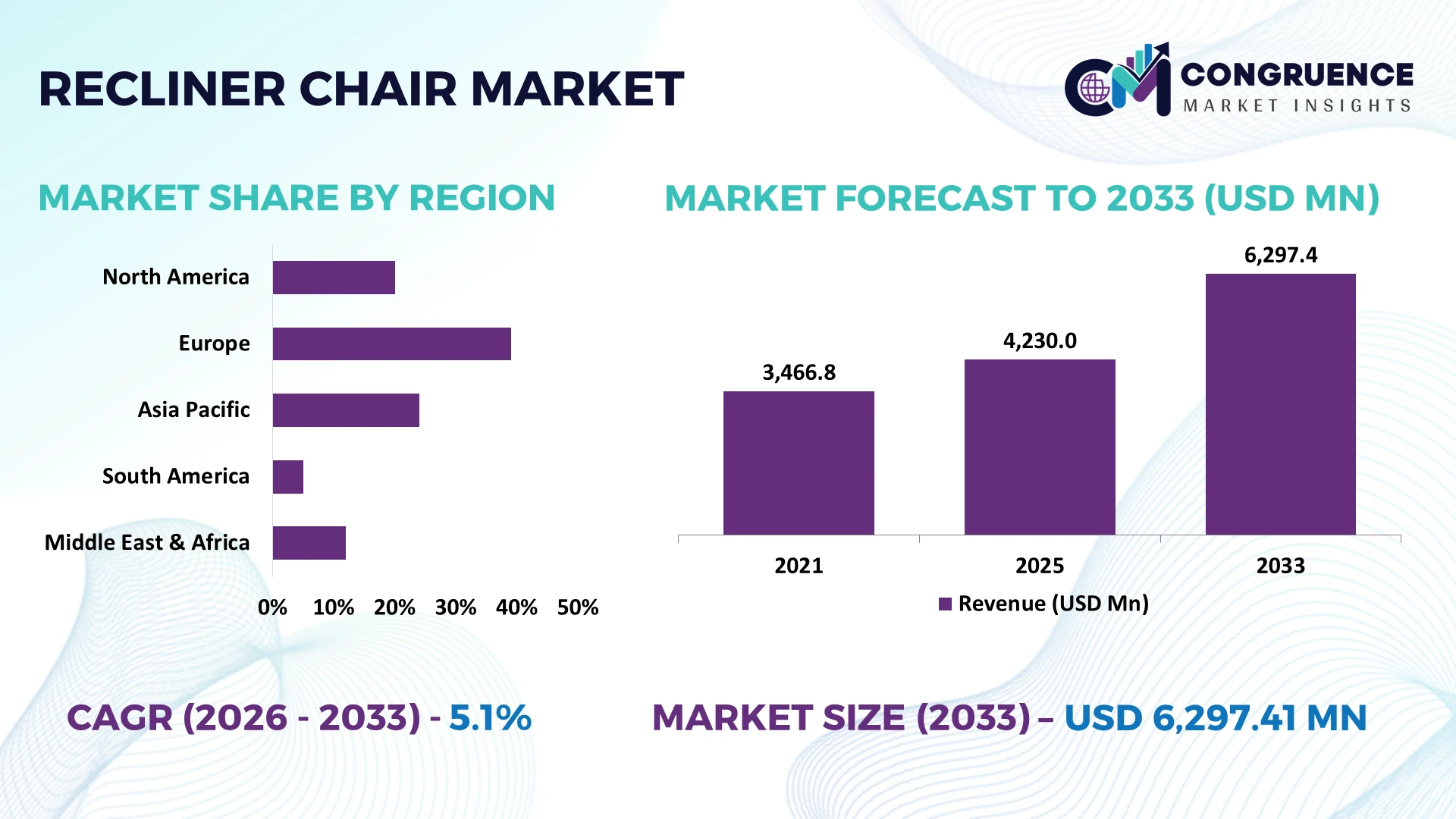
The Global Recliner Chair Market was valued at USD 4230 Million in 2025 and is anticipated to reach a value of USD 6297.41 Million by 2033 expanding at a CAGR of 5.1% between 2026 and 2033. Growth is driven by power-reclining mechanisms, aging-in-place furniture demand, multifunctional home seating, compact motorized designs, and expanding hospitality and premium home-theater installations.
The United States accounts for approximately 31% of global recliner chair demand, supported by 65 million adults aged 65 or older and high penetration of large-format living-room furniture. China remains the principal manufacturing hub, supplying more than 35% of global furniture exports, while Vietnam is gaining upholstered-furniture capacity. U.S.–China tariff pressures continue redirecting sourcing toward Vietnam, Mexico, and other manufacturing alternatives, while motorized recliners expand premium adoption.
Strategically, manufacturers should combine power-recline technology, aging-friendly ergonomics, modular designs, and geographically diversified production to defend margins and capture higher-value replacement demand.
Market Size & Growth: USD 4.23 billion in 2025 is projected to reach USD 6.30 billion by 2033 at 5.1% CAGR, supported by power-reclining technology and multifunctional seating upgrades.
Top Growth Drivers: Power-recliner conversion contributes approximately 32% of growth momentum, aging-friendly seating 27%, and premium home-entertainment furniture upgrades approximately 21%.
Short-Term Forecast: By 2028, standardized motors, modular frames, and automated upholstery workflows are positioned to reduce assembly time by 10–15% and component waste by approximately 8%.
Emerging Technologies: Dual-motor actuation, zero-gravity positioning, USB-C charging, occupancy sensors, and memory controls are moving recliners from mechanical furniture toward connected comfort platforms.
Regional Leaders: North America is projected near USD 2.20 billion, Asia-Pacific USD 1.85 billion, and Europe USD 1.65 billion by 2033, with motorized seating penetration increasing across premium households.
Consumer/End-User Trends: Consumers aged 55+ represent approximately 35–40% of premium recliner demand, strengthening purchases of lift-assist, lumbar-support, adjustable-headrest, and easy-entry seating.
Pilot/Case Example: In 2025, advanced dual-motor recliner platforms enabled independent backrest and footrest adjustment, increasing configurable seating positions by more than 50% versus basic single-motor mechanisms.
Competitive Landscape: La-Z-Boy maintains approximately 15% of organized branded demand, competing with Ashley Furniture, Man Wah Holdings, Ekornes, and Flexsteel through comfort technology, distribution, customization, and pricing.
Regulatory & ESG Impact: Furniture manufacturers increasingly target 20–30% recycled or certified material content across selected products as timber traceability, foam chemistry, packaging, and circular-design requirements tighten.
Investment & Funding: Leading furniture manufacturers are directing hundreds of millions of USD toward upholstery automation, retail modernization, production expansion, digital customization, and supply-chain localization across Mexico and Southeast Asia.
Innovation & Future Outlook: Smart controls, modular actuators, integrated charging, massage functions, and zero-gravity positioning are expanding premium functionality, with advanced powered configurations carrying 20–40% higher selling prices than basic manual recliners.
The Recliner Chair Market is shifting from mechanically operated seating toward power-adjustable, ergonomic, multifunctional comfort systems serving residential, senior-living, hospitality, and home-entertainment applications. Motorized and premium configurations increasingly represent over 40% of organized recliner sales in developed markets, supported by dual-motor controls, adjustable headrests, USB charging, lift assistance, and zero-gravity positioning. Simultaneously, U.S.–China tariff exposure is accelerating upholstered-furniture sourcing toward Vietnam and Mexico, making technology integration, modular engineering, and manufacturing flexibility increasingly important competitive priorities and setting the foundation for strategic market analysis.
The Recliner Chair Market is becoming strategically important as seating shifts from basic mechanical furniture toward powered, ergonomic, and aging-friendly comfort systems. Motorized configurations already account for more than 40% of organized recliner sales in several developed markets, while the U.S. population aged 65+ exceeds 65 million. At the same time, upholstered-furniture supply chains are restructuring toward Vietnam and Mexico as U.S.–China tariff exposure changes sourcing economics.
Dual-motor recliners deliver independent backrest and footrest control, offering over 50% more positioning flexibility than basic single-motor systems, while modular actuator platforms can cut assembly time by roughly 10–15%. North America leads premium adoption and lift-chair demand; China retains manufacturing scale; Europe emphasizes ergonomic refinement, certified materials, and compact urban designs. Through 2028, USB-C integration, memory settings, zero-gravity functions, and smarter actuator controls will expand across mid-premium portfolios.
Senior-living operators provide a practical deployment case, specifying lift-assist recliners to improve seated mobility and reduce caregiver handling. Manufacturers are investing in localized upholstery capacity, actuator partnerships, and modular frame engineering. Long-term advantage will favor brands combining comfort technology, resilient sourcing, serviceability, and segment-specific design.
Power-reclining adoption is the strongest structural driver, supported by aging populations and higher consumer preference for customizable comfort. Adults aged 65+ now represent about 18% of the U.S. population, while powered configurations exceed 40% of organized recliner sales in several mature channels. Dual-motor systems also provide more than 50% greater positioning flexibility than conventional single-motor designs. This shifts demand toward lift assistance, adjustable lumbar support, headrest control, and zero-gravity positioning. U.S. retailers and senior-living operators increasingly prioritize functional seating over purely decorative furniture. Manufacturers are responding with expanded motorized ranges, partnerships with actuator suppliers, and broader lift-chair portfolios. The strategic shift is clear: value creation is moving from upholstery aesthetics toward integrated mobility, ergonomics, and assisted-comfort functionality.
Recliner manufacturing remains exposed to volatile foam, steel, timber, upholstery, actuator, and electronic-component costs, creating pressure on margins and lead times. Frames, cushioning, upholstery, and mechanisms can represent more than 70% of product cost, while powered recliners typically carry 20–40% higher component intensity than manual models. China remains a major source of furniture mechanisms and electrical components, leaving U.S. and European brands vulnerable to tariff changes and logistics disruption. Large recliners also incur high freight costs because low container density limits shipping efficiency. Manufacturers are reducing exposure through Mexico and Vietnam sourcing, standardized actuator platforms, local frame production, and supplier consolidation. The key operational constraint is not demand, but maintaining price competitiveness while preserving comfort specifications, reliability, and warranty performance across multi-country supply networks.
Next-generation recliners create opportunity through connected controls, modular actuation, compact footprints, and aging-in-place functionality. Smart recliner configurations can add memory positioning, USB-C charging, occupancy sensing, heat, massage, and zero-gravity modes, while modular platforms can reduce assembly time by approximately 10–15% and simplify parts inventories by 15–20%. Japan and South Korea present attractive premium opportunities where smaller living spaces favor compact powered seating, while the United States offers scale for lift-assist and home-theater formats. A less obvious opportunity lies in platform reuse: common frames, motors, and controllers can support multiple upholstery and feature variants, improving SKU economics. Manufacturers are investing in actuator R&D, electronics integration, digital customization, and partnerships with senior-living and healthcare channels to expand high-value applications.
The long-term challenge is scaling powered recliners without increasing warranty exposure, repair complexity, and service inconsistency. Advanced models can integrate 2–4 motors, heating elements, control boards, charging ports, sensors, and multiple moving joints, raising failure points compared with purely mechanical seating. Electronics can represent 10–20% of the cost structure in premium powered models, while bulky furniture complicates field servicing and reverse logistics. Regulatory scrutiny around electrical safety, flammability, and chemical content also varies across the United States, Europe, and Asian markets, increasing compliance complexity. Manufacturers must improve modular electronics, tool-free component replacement, diagnostic controls, and technician networks. Competitive sustainability will depend on designing recliners that are not only feature-rich, but also repairable, standardized, and economically serviceable throughout the product lifecycle.
Power Features Move Downmarket: Power-assisted recliners represented about 45% of reclining-chair demand in 2025, while U.S. electric recliner sales increased roughly 23% in early 2025. USB charging, adjustable headrests, lumbar control, and zero-gravity presets are shifting from premium-only features into mid-market collections. Brands are standardizing actuators and control modules to reduce feature costs and accelerate SKU rollout across broader retail channels.
Retail Networks Become More Direct: Large furniture brands are expanding company-owned stores and digital configuration tools to improve conversion and service control. La-Z-Boy reached 230 company-owned North American stores by June 2026, representing 61% of its 378-store network. Direct retail improves product demonstration, warranty handling, and powered-feature education, prompting competitors to strengthen omnichannel selling, showroom formats, and white-glove delivery capabilities.
Compact Motion Furniture Gains Priority: Urban buyers are increasingly favoring wall-hugger mechanisms, narrower frames, and apartment-scaled power seating. In India, sofas and recliners represented 25% of furniture value in FY2025, with recliners accounting for 8% within the category. Manufacturers are redesigning frame geometry and modular components to reduce floor-space requirements while maintaining powered functionality, improving addressability across smaller urban homes and premium apartments.
Supply Chains Shift Geographically: U.S. tariffs and Canadian trade measures on upholstered seating from China and Vietnam are increasing sourcing complexity. Manufacturers are allocating upholstery, frame fabrication, and final assembly across Vietnam, Mexico, and domestic plants while standardizing imported mechanisms. The shift improves tariff flexibility and lead-time control, but raises qualification requirements, making modular component platforms and multi-country supplier relationships increasingly important competitive assets.
Manual Recliners account for approximately 45% of global recliner chair demand, retaining leadership through lower acquisition cost, simpler mechanical construction, broad retail availability, and lower warranty exposure. Their mature supply chain supports mass-market residential deployment and high inventory scalability. Power Recliners represent roughly 32% and are the fastest-growing type as consumers adopt motorized footrests, adjustable headrests, lumbar systems, USB charging, and memory controls. Compared with manual mechanisms, powered systems provide significantly greater positioning flexibility but require higher component and service intensity.
Lift Recliners hold an estimated 10–12% share and remain strategically important for aging consumers and mobility support. Rocker Recliners maintain established family-room demand, while Massage Recliners occupy a smaller premium segment built around heat, vibration, and therapeutic positioning. Manufacturers are shifting investment toward standardized motors, modular electronics, and shared frames that support multiple powered variants, reducing development complexity while preserving differentiated upholstery and feature packages.
Living Rooms account for approximately 56% of recliner chair applications because recliners remain core residential comfort furniture used for television viewing, relaxation, reading, and everyday seating. High placement frequency, broad household compatibility, and replacement-driven purchasing preserve this application’s scale. Home Theaters represent approximately 17% and are the fastest-growing application as consumers adopt multi-seat powered recliners with cupholders, USB charging, storage consoles, adjustable headrests, and zero-gravity positioning.
Home Offices are gaining relevance through ergonomic seating and hybrid-work use, while Healthcare Facilities prioritize lift-assist and mobility-support recliners. Hospitality Spaces remain smaller but strategically valuable for premium suites, lounges, and extended-stay settings. Manufacturers are adapting by developing modular seat widths, compact wall-hugger mechanisms, linked theater configurations, and upholstery packages tailored to residential or commercial durability requirements. Investment is moving toward application-specific configurations rather than one universal recliner platform, improving fit, merchandising precision, and procurement relevance across different use environments.
Residential Consumers represent approximately 70% of recliner chair demand, supported by living-room replacement, home-theater upgrades, aging-in-place purchasing, and growing adoption of powered comfort furniture. Furniture Retailers form the next-largest commercial channel because recliners require demonstration, delivery coordination, financing, and after-sales service. Senior Care Facilities are the fastest-growing end-user group as aging populations increase demand for lift mechanisms, easier ingress and egress, pressure-relieving upholstery, and caregiver-friendly seating.
Hospitals use specialized recliners for patient rooms, recovery spaces, and treatment environments, while Hotels deploy premium recliners selectively in suites and lounge areas. Senior-focused demand is increasingly influencing mainstream design, with lift-assist and ergonomic functions moving into residential collections rather than remaining exclusively clinical. Manufacturers are responding through retailer partnerships, healthcare-grade upholstery, higher weight capacities, modular lift mechanisms, and targeted senior-living sales programs. Competitive positioning increasingly depends on combining residential aesthetics with functional mobility support and serviceable powered components.
North America accounted for the largest market share at 36% in 2025 however, Asia-Pacific is expected to register the fastest growth, expanding at a CAGR of 6.2% between 2026 and 2033.

Power Seating and Direct Retail Expansion
North America represents approximately 36% of global recliner chair demand, supported by high penetration of upholstered living-room furniture, home-theater seating, and aging-friendly residential products. The United States remains the principal demand center, where powered recliners, adjustable headrests, lift mechanisms, and zero-gravity positioning increasingly shape mid-premium assortments. Residential consumers account for the majority of purchases, while senior-care facilities and healthcare environments strengthen demand for mobility-support seating. Direct retail is becoming strategically important because motorized products require demonstration, delivery coordination, and after-sales service. Leading manufacturers are expanding company-controlled showrooms and digital configuration capabilities while increasing localized upholstery and assembly. With powered configurations commanding approximately 20–40% premiums over manual models, retailers are allocating greater floor space to feature-rich seating that improves average transaction value.
United States Market Outlook: The United States combines strong furniture retail infrastructure with more than 65 million residents aged 65 or older, creating substantial demand for power, lift-assist, and ergonomic recliners. Domestic manufacturing and nearby Mexican production also strengthen supply-chain flexibility. Brands are prioritizing modular mechanisms, home-delivery capabilities, financing, customization, and service networks to protect premium positioning.
Ergonomics and Compact Design Reshape Portfolios
Europe accounts for approximately 25% of global recliner chair demand, with Germany, the United Kingdom, France, Italy, and the Nordic countries supporting premium upholstered-seating consumption. Smaller average living spaces favor compact recliners, wall-hugger mechanisms, swivel bases, and Scandinavian-style ergonomic seating rather than oversized theater formats. Aging populations also strengthen demand for lift assistance and easy-entry designs, while regulatory emphasis on timber traceability, chemical safety, durability, and material circularity influences product engineering. European premium manufacturers increasingly differentiate through cold-cure foam, engineered steel mechanisms, certified timber, and replaceable components. Production automation and modular frame design are reducing customization complexity while supporting multiple upholstery combinations. The market therefore rewards suppliers capable of combining sophisticated comfort engineering with space efficiency, documented materials, and repair-oriented product architecture.
Germany Market Outlook: Germany is strategically significant because of its affluent consumer base, large furniture retail network, aging demographics, and high expectations for engineering quality. More than 20% of the population is aged 65 or older, supporting ergonomic and mobility-oriented seating. Suppliers compete through durable mechanisms, compact dimensions, electrical-safety compliance, premium upholstery, and dealer-supported customization.
Manufacturing Scale Meets Premiumization
Asia-Pacific represents approximately 27% of global recliner chair demand and provides the industry's largest manufacturing base for upholstered seating, steel mechanisms, motors, electronics, foam, textiles, and leather components. China remains central to motion-furniture production, while Vietnam and India are gaining manufacturing allocations as international brands diversify supply chains. Rising urban incomes in China, India, South Korea, and Southeast Asia are broadening demand for powered recliners, home-theater seating, and compact multifunctional furniture. Manufacturers are investing in automated cutting, CNC frame processing, standardized actuator modules, and export-oriented upholstery capacity. The critical shift is from cost-focused assembly toward integrated motion-furniture manufacturing, allowing Asian producers to supply higher-feature products while supporting private-label programs and international brands through faster customization and scalable component ecosystems.
China Market Outlook: China retains a decisive production advantage through integrated clusters covering metal mechanisms, actuators, upholstery, foam molding, electronics, packaging, and export logistics. Domestic consumers are simultaneously adopting higher-feature seating, giving manufacturers both production scale and product-testing depth. Competitive factories increasingly automate upholstery cutting, standardize motors, and develop premium zero-gravity and massage configurations for domestic and export channels.
Localized Manufacturing Supports Mid-Market Demand
South America accounts for approximately 6% of global recliner chair demand, led by Brazil's large residential furniture market and established upholstered-furniture manufacturing base. Manual recliners retain strong penetration because of price sensitivity, but motorized models are gaining visibility across major urban retail networks and premium households. Brazil supports local frame, foam, upholstery, and woodworking capabilities, reducing dependence on fully imported finished furniture, although motors and specialized mechanisms remain more import-oriented. Currency volatility and high logistics costs constrain premium imported products, creating incentives for localized assembly and standardized component sourcing. Manufacturers are expanding through domestic retailers, regional distributors, and locally upholstered power-recliner platforms. This structure favors companies capable of combining imported motion technology with lower-cost regional fabrication and strong last-mile delivery infrastructure.
Brazil Market Outlook: Brazil offers the strongest regional scale through a population exceeding 200 million, established furniture clusters, and broad retail distribution. Local upholstery and woodworking capability supports competitively priced recliners, while premium brands increasingly introduce motorized and massage functions. Manufacturers that localize frames and covers while importing standardized mechanisms can improve pricing control and reduce exposure to bulky finished-product imports.
Hospitality Investment Expands Premium Seating
Middle East & Africa accounts for approximately 6% of global recliner chair demand, with commercial opportunity concentrated in Gulf residential developments, hospitality, premium cinemas, healthcare, and luxury furniture retail. Saudi Arabia and the UAE are increasingly important as large tourism, entertainment, hotel, and residential projects expand requirements for high-specification seating. Home-theater and cinema-style recliners also benefit from affluent consumer segments and premium real-estate development. South Africa provides a broader retail market but remains more price sensitive. Because local motion-mechanism manufacturing is limited, distributors depend heavily on imported components and finished furniture. Suppliers are responding through regional warehousing, hospitality partnerships, customized upholstery programs, and assembly localization. Premium demand therefore depends as much on project specification and service capability as on conventional consumer furniture retail.
Saudi Arabia Market Outlook: Saudi Arabia provides the strongest infrastructure-led opportunity as Vision 2030 expands hotels, entertainment venues, cinemas, residential projects, and senior-care infrastructure. The country's target of 150 million annual tourist visits by 2030 strengthens hospitality-furniture procurement. Suppliers are targeting developers and premium retailers with motorized, cinema-style, zero-gravity, and customized recliner platforms backed by regional installation and service capabilities.
The Recliner Chair Market pits La-Z-Boy, Man Wah Holdings, Ashley Furniture, Ekornes, and Flexsteel against regional upholstered-furniture specialists and private-label manufacturers. The top five players collectively control approximately 38–42% of organized branded demand, giving established suppliers meaningful scale without eliminating room for differentiated challengers. Competition centers on comfort technology, pricing, customization, retail reach, and supply resilience; powered configurations carry roughly 20–40% premiums, modular platforms can reduce assembly time by 10–15%, and direct retail improves service control. La-Z-Boy and Ashley leverage broad retail networks, Man Wah emphasizes large-scale motion-furniture manufacturing, while Ekornes competes through premium ergonomics and design. Players are expanding showrooms, localizing upholstery, standardizing actuators, and partnering with component suppliers. The competitive shift favors integrated power features, aging-friendly functionality, and multi-country production. Entry barriers include bulky logistics, warranty servicing, mechanism reliability, and dealer access. Winning requires trusted comfort performance, scalable sourcing, strong after-sales support, and disciplined channel execution at scale.
La-Z-Boy
Man Wah Holdings
Ashley Furniture Industries
Ekornes
Flexsteel Industries
Natuzzi
Haverty Furniture Companies
Hooker Furnishings
Ethan Allen Interiors
Bassett Furniture Industries
Palliser Furniture
Himolla
Southern Motion
American Leather
Current recliner technology centers on dual-motor actuation, powered headrests, adjustable lumbar support, lift assistance, USB-C charging, and zero-gravity positioning. Powered configurations account for approximately 40–45% of organized recliner demand across developed markets. Compared with legacy single-motor recliners, dual-motor systems provide over 50% greater positioning flexibility by independently controlling backrest and footrest movement. Standardized actuator assemblies also reduce manufacturing and installation time by approximately 10–15%, improving production economics and enabling manufacturers to broaden powered seating portfolios.
Emerging technologies include memory presets, wireless controls, occupancy sensors, heating, massage systems, modular electronics, and compact wall-hugger mechanisms. Shared motors and controller architectures can reduce component complexity by 15–20%, while space-saving mechanisms improve installation flexibility by approximately 10–15%. Adoption is expanding from premium collections into mid-market products. Manufacturers controlling actuator integration, electronics engineering, and modular platforms gain faster customization, simpler servicing, lower inventory complexity, and stronger differentiation.
Between 2026 and 2028, sensor-assisted posture adjustment, intelligent comfort personalization, predictive diagnostics, and app-connected controls will reshape premium recliners. Automated upholstery cutting and modular frames can reduce material waste by 8–12%. Companies investing now in serviceable electronics, standardized mechanisms, connected controls, and automated manufacturing will secure faster product cycles, stronger margins, and defensible positioning.
April 2024 La-Z-Boy acquired a 2-store independent La-Z-Boy Furniture Galleries network in Florida, strengthening company-owned retail coverage and direct consumer access. The transaction expanded vertically integrated distribution, improving merchandising control, customer experience, and delivery coordination for reclining furniture. Source: la-z-boy.com
May 2024 Flexsteel Industries advanced its manufacturing restructuring by expanding production capabilities in Mexicali, Mexico, supporting approximately 1 million square feet of manufacturing infrastructure. The shift strengthens nearshore upholstered-furniture production, reduces Asian sourcing dependence, and improves supply responsiveness for motion seating. Source: flexsteel.com
June 2025 La-Z-Boy expanded its company-owned retail footprint to 220 stores, representing approximately 60% of its La-Z-Boy Furniture Galleries network. Greater direct ownership strengthens control over premium recliner merchandising, consumer financing, delivery execution, customization, and after-sales service capabilities. Source: furnituretoday.com
January 2026 Man Wah Holdings continued expanding its Vietnam manufacturing platform, where its production infrastructure exceeds 2 million square feet, strengthening diversified motion-furniture capacity. The Southeast Asian footprint improves sourcing flexibility for powered recliners amid continuing tariff and supply-chain pressures. Source: manwahholdings.com
The report covers Manual Recliners, Power Recliners, Lift Recliners, Rocker Recliners, and Massage Recliners across Living Rooms, Home Theaters, Home Offices, Healthcare Facilities, and Hospitality Spaces. End-user analysis includes Residential Consumers, Hospitals, Senior Care Facilities, Hotels, and Furniture Retailers, with geographic coverage spanning North America, Europe, Asia-Pacific, South America, and Middle East & Africa.
Strategic analysis examines dual-motor actuation, zero-gravity positioning, lift assistance, powered lumbar and headrest systems, smart controls, modular mechanisms, automated upholstery production, and connected comfort technologies. Manual Recliners represent approximately 45% of type demand, while powered configurations are gaining adoption through functionality and premiumization. The report supports 2026–2033 investment planning, manufacturing localization, sourcing diversification, retail expansion, technology partnerships, product positioning, and competitive benchmarking while identifying emerging opportunities in aging-friendly furniture, compact powered seating, home theaters, smart recliners, and institutional mobility-support applications.
| Report Attribute/Metric | Report Details |
|---|---|
Market Revenue in 2025 | USD 4230 Million |
Market Revenue in 2033 | USD 6297.41 Million |
CAGR (2026 - 2033) | 5.1% |
Base Year | 2025 |
Forecast Period | 2026 - 2033 |
Historic Period | 2021 - 2025 |
Segments Covered | By Type
By Application
By End-User
|
Key Report Deliverable | Revenue Forecast, Growth Trends, Market Dynamics, Segmental Overview, Regional and Country-wise Analysis, Competition Landscape |
Region Covered | North America, Europe, Asia-Pacific, South America, Middle East, Africa |
Key Players Analyzed | La-Z-Boy, Man Wah Holdings, Ashley Furniture Industries, Ekornes, Flexsteel Industries, Natuzzi, Haverty Furniture Companies, Hooker Furnishings, Ethan Allen Interiors, Bassett Furniture Industries, Palliser Furniture, Himolla, Southern Motion, American Leather |
Customization & Pricing | Available on Request (10% Customization is Free) |




