
Reports
The Global Recirculation Aquaculture System Market was valued at USD 3,597.4 Million in 2025 and is anticipated to reach a value of USD 7,220.8 Million by 2033 expanding at a CAGR of 9.1% between 2026 and 2033. Growth is driven by land-based fish farming, tighter water-use requirements, biosecurity priorities, and investment in controlled-environment aquaculture.
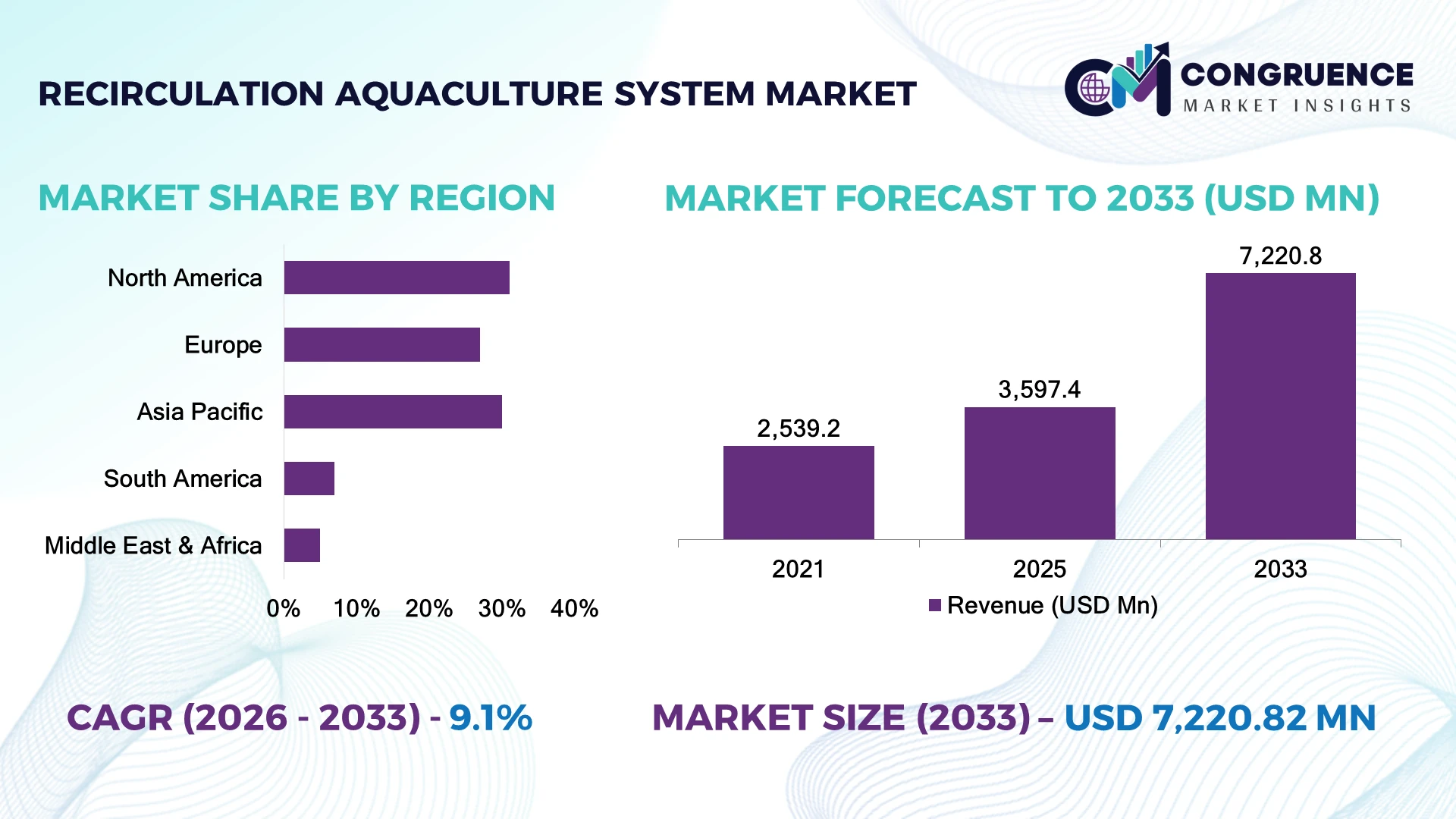
Norway leads deployment with an estimated 24% share, supported by salmon farming, closed-containment investments, and advanced water-treatment integration, while China follows at roughly 18% through high-volume aquaculture modernization. Norway's intensive RAS facilities can recycle more than 95% of process water, strengthening production near consumption markets amid tighter coastal and environmental constraints.
Strategic implication: suppliers combining water efficiency, automation, and reliable biological filtration are best positioned for high-value farm expansion.
Market Size & Growth: USD 3.6 billion in 2025 to USD 7.2 billion by 2033 at 9.1% CAGR, driven by controlled land-based aquaculture and water reuse.
Top Growth Drivers: Water reuse 95%, biosecurity adoption 72%, automated monitoring 61% are accelerating commercial RAS deployment.
Short-Term Forecast: By 2028, advanced RAS facilities target 10–18% lower water-treatment costs and 8–12% higher production consistency.
Emerging Technologies: AI water-quality monitoring, membrane filtration, digital twins, and automated feeding are moving into 35–50% of advanced installations.
Regional Leaders: Europe targets approximately USD 2.4 billion, Asia-Pacific USD 2.1 billion, and North America USD 1.6 billion by 2033, supported by expanding land-based production.
Consumer/End-User Trends: Commercial fish farms represent nearly 60% of system demand, with biosecurity-led adoption strongest among intensive salmon and shrimp producers.
Pilot/Case Example: In 2025, commercial RAS optimization programs delivered 15% lower freshwater consumption while improving dissolved-oxygen stability by approximately 10%.
Competitive Landscape: Leading suppliers including AKVA group, Pentair, Veolia, Aquacare Environment, and Billund Aquaculture compete through system integration, filtration performance, automation, and lifecycle support.
Regulatory & ESG Impact: Closed-loop systems can reduce freshwater intake by more than 90%, strengthening compliance positioning where discharge and water-abstraction controls tighten.
Investment & Funding: Land-based aquaculture projects attracted more than USD 1 billion in announced investment commitments, shifting supplier focus toward modular systems and integrated engineering.
Innovation & Future Outlook: Next-generation RAS combines sensors, predictive controls, energy optimization, and biological filtration, shifting competition toward uptime, resource intensity, and digitally managed production.
The Recirculation Aquaculture System Market is strengthening around salmon, trout, shrimp, and high-value finfish production where water scarcity, biosecurity, and proximity to consumers influence farm economics. Advanced filtration, oxygenation, UV treatment, automated feeding, and real-time water monitoring are increasing system integration. More than 70% of sophisticated installations increasingly prioritize continuous water-quality monitoring, while energy optimization is becoming a procurement criterion as electricity-intensive operations expand.
Recirculation aquaculture systems are becoming strategically important because producers can decouple fish farming from coastal geography, freshwater availability, and conventional pond infrastructure. Controlled production environments improve biosecurity while enabling farms to locate closer to processing and consumption centers. Norway's land-based salmon investments illustrate this shift, while China is emphasizing higher-density aquaculture modernization and domestic production resilience.
Technology selection increasingly determines operating economics. Modern RAS configurations can recycle more than 95% of process water, while automated oxygenation and sensor-based control can improve operational consistency by roughly 10–15% versus manually managed systems. Europe emphasizes environmental compliance and premium species, whereas Asia-Pacific prioritizes production scale and cost-efficient system deployment. By 2028, digitally monitored facilities are positioned to capture a larger share of new installations.
Commercial operators are therefore prioritizing modular expansion, predictive water-quality management, energy-efficient pumps, and long-term equipment partnerships. The strategic advantage is shifting from simply installing filtration equipment to delivering dependable biological stability, resource efficiency, and production uptime.
Land-based aquaculture is shifting toward controlled recirculation as producers address water scarcity, biosecurity, and proximity to consumption markets. Advanced RAS facilities routinely recycle more than 95% of process water, while automated monitoring can reduce critical water-quality deviations by 20–30%. In Norway, investment in closed-containment salmon production is reinforcing this transition, particularly as producers seek tighter biological control and predictable stocking conditions. The operational advantage is not simply water conservation; stable temperature, oxygen, and ammonia management support higher production consistency. Companies are responding by integrating oxygenation, biological filtration, UV treatment, sensors, and automated feeding into modular systems, with strategic investment increasingly favoring integrated suppliers capable of delivering complete farm infrastructure rather than standalone filtration equipment.
Electricity consumption remains a material constraint because pumps, oxygenation, temperature control, filtration, and water treatment operate continuously. Energy can represent roughly 15–25% of operating expenditure in intensive RAS facilities, while heating and cooling requirements can raise utility loads by another 10–20% in climate-sensitive locations. Norway's colder operating environment illustrates the importance of thermal management, whereas facilities in warmer markets face substantial cooling requirements. Higher power costs directly pressure production margins and complicate expansion economics when farms scale rapidly. Operators are reducing exposure through variable-speed pumps, heat recovery, renewable-power contracts, and higher-efficiency oxygenation systems. The strategic pressure point is system architecture: reducing energy intensity without compromising dissolved-oxygen stability is becoming more valuable than simply maximizing water-recirculation rates.
Digital RAS management is creating an opportunity to improve productivity without proportional infrastructure expansion. Sensor networks, predictive analytics, machine learning, and automated dosing can potentially reduce manual intervention by 30–40% while improving response speed to water-quality deviations by more than 20%. In Japan and Singapore, space-constrained aquaculture models favor compact, digitally controlled systems that maximize output from limited footprints. The next opportunity lies in integrating digital twins with biological models to forecast ammonia accumulation, oxygen demand, and filtration performance before operational thresholds are breached. Equipment suppliers are therefore expanding software capabilities, forming technology partnerships, and developing remote-monitoring platforms. This shifts competitive value toward recurring optimization services and performance guarantees, giving integrated RAS providers a stronger position than hardware-only vendors.
Large-scale RAS projects face integration complexity across hydraulics, biological filtration, oxygenation, automation, sensors, feed systems, and species-specific production protocols. Commissioning errors can create 15–25% efficiency losses during early operations, while insufficient operator expertise can increase corrective interventions by 10–20%. High-density salmon and shrimp facilities are particularly sensitive because small deviations in oxygen, temperature, or ammonia can rapidly affect stocking performance. Digital connectivity also introduces cybersecurity and interoperability requirements as farms connect equipment from multiple vendors. Companies must address these execution barriers through standardized interfaces, operator training, predictive maintenance, and long-term technical partnerships. The non-obvious competitive issue is commissioning capability: suppliers that combine equipment with biological engineering and operational support can protect customer uptime more effectively than low-cost component vendors.
Automated Water Quality Control: RAS operators are shifting from periodic sampling toward continuous sensor-based monitoring, with advanced facilities deploying automated controls across 60–70% of critical water-quality parameters. Real-time oxygen, ammonia, temperature, and pH management improves intervention speed by approximately 20% and reduces dependence on manual checks. Companies are integrating sensors with centralized farm-control platforms to strengthen production consistency.
Energy Optimization Becomes Strategic: Electricity management is moving into equipment-selection decisions as energy represents roughly 15–25% of operating costs in intensive facilities. Variable-speed pumping, heat recovery, and optimized oxygenation can reduce system energy consumption by 10–15%. European operators facing elevated power costs are prioritizing high-efficiency components and renewable-power integration rather than expanding capacity with conventional energy-intensive configurations.
Modular Farms Gain Traction: Modular RAS architecture is increasingly used to shorten installation cycles by approximately 15–20% and enable phased production expansion. Standardized filtration skids, oxygenation modules, and monitoring packages allow operators to replicate proven configurations across facilities. Suppliers are responding with prefabricated systems and integrated commissioning services, creating a less obvious advantage: faster capacity replication without redesigning the entire biological process.
Biosecurity Shapes Farm Design: Disease-control requirements are increasing separation between intake, treatment, grow-out, and discharge pathways, with advanced facilities allocating approximately 10–15% more design attention to containment and disinfection infrastructure. UV treatment, ozone, filtration barriers, and controlled personnel flows are becoming integrated rather than optional features. Producers are redesigning facility layouts to reduce contamination exposure while protecting high-value stocks and improving operational resilience.
Recirculating aquaculture systems with conventional biological filtration account for an estimated 58% of the market, supported by established engineering practices, scalable water-treatment configurations, and compatibility with salmon, trout, tilapia, and shrimp production. Their mature supplier ecosystem lowers commissioning complexity and makes them the preferred architecture for large commercial farms. Modular and hybrid RAS configurations represent roughly 27%, gaining traction as producers seek phased capacity additions and lower upfront infrastructure exposure. Companies are increasingly standardizing filtration, oxygenation, UV, and pumping modules to shorten installation cycles by approximately 15%.
Advanced automated RAS represents the fastest-growing type, with adoption expanding as AI-enabled monitoring and predictive controls reduce manual intervention by an estimated 30%. Compared with conventional configurations, digitally integrated systems can improve process consistency by approximately 10–15%. Basic recirculation and specialized compact systems retain relevance for smaller facilities and niche species. Suppliers are therefore prioritizing modular engineering, automation partnerships, and integrated service packages, shifting investment toward systems that combine biological stability with measurable operating-cost and labor-efficiency gains.
In 2025, the Global Aquaculture Alliance highlighted increasing industry emphasis on recirculating systems, biosecurity, and controlled production as commercial aquaculture intensifies.
Commercial fish farming represents an estimated 62% market share, reflecting the high water-treatment requirements and continuous production cycles of salmon, trout, tilapia, and other intensively farmed species. Demand is concentrated among large facilities where stable temperature, oxygenation, ammonia control, and biosecurity directly influence stocking density and survival. Hatchery and nursery applications account for approximately 21%, supported by the need for precise environmental control during sensitive early-life stages. Companies are expanding modular installations and integrating automated monitoring to increase production reliability without proportionally increasing water consumption.
Aquaculture research and specialty production represent the fastest-growing application group, supported by controlled breeding, species diversification, and land-based farming initiatives. Adoption of automated water-quality monitoring in advanced facilities is approaching 60%, improving response times and reducing manual sampling requirements. Conventional commercial systems remain more standardized, while research-oriented installations demand greater customization and sensor integration. Suppliers are responding with configurable filtration modules, remote diagnostics, and application-specific engineering. The business implication is clear: vendors capable of adapting RAS architecture to species, stocking density, and facility footprint are gaining stronger positioning than standardized equipment providers.
The Food and Agriculture Organization reported in 2025 that aquaculture continues to account for more than half of aquatic animal production for human consumption, reinforcing the need for controlled production infrastructure.
Large commercial aquaculture farms represent approximately 64% of RAS demand because their production intensity, water-treatment loads, and biosecurity requirements justify sophisticated closed-loop infrastructure. These operators typically prioritize uptime, automation, lifecycle support, and energy efficiency over the lowest equipment price. Hatcheries and nursery operators account for roughly 20%, where precise control of temperature, dissolved oxygen, and solids removal is critical to juvenile survival. Smaller farms and specialty producers remain important for modular systems but generally favor compact configurations and staged capital deployment.
Hatcheries and specialty producers form the fastest-growing buyer group as species diversification and localized production increase demand for flexible RAS architectures. Their adoption of automated monitoring is estimated at 45–55%, compared with approximately 35–40% among smaller conventional facilities. Large farms are responding through long-term technology contracts, integrated engineering, and capacity expansion, while smaller operators increasingly seek leasing, modular procurement, and service-based models. Suppliers are consequently segmenting product portfolios around facility scale, stocking intensity, and automation requirements. Future demand is shifting toward buyers that value configurable infrastructure and technical support rather than standalone filtration hardware.
In 2026, the Aquaculture Stewardship Council continued strengthening responsible-aquaculture requirements, increasing emphasis on traceability, environmental management, and operational controls across certified production.
North America accounted for the largest market share at 31% in 2025 however, Asia-Pacific is expected to register the fastest growth, expanding at a CAGR of 10.2% between 2026 and 2033.
Land-based salmon investment is reshaping production economics
North America remains the largest RAS market, supported by intensive salmon, trout, and specialty aquaculture projects. The United States holds the strongest deployment position, with large closed-containment facilities using RAS to control water quality, biosecurity, and production location. USDA research launched in 2025 specifically targets technological and operational efficiency improvements for land-based RAS, reflecting increasing institutional support for domestic aquaculture infrastructure. Advanced facilities can recycle more than 95% of process water, strengthening the technology's positioning where freshwater availability and environmental controls constrain conventional production. Operators are increasingly combining biological filtration, oxygenation, automation, and waste recovery rather than purchasing isolated equipment. This favors integrated suppliers capable of engineering complete production environments and supporting commissioning, optimization, and lifecycle maintenance.
United States Market Outlook: The United States is the region's most strategically significant market because of large-scale land-based salmon investment and strong RAS research infrastructure. USDA's Leetown program began a 2025–2027 project focused on improving RAS efficiency, fish performance, biomonitoring, and computing integration. Atlantic Sapphire's Florida operation further demonstrates commercial-scale deployment, strengthening domestic technical expertise and supplier demand.
Regulatory intensity is accelerating closed-containment adoption
Europe maintains a strong RAS position through Norway, Denmark, Iceland, and the United Kingdom, where salmon production, environmental controls, and land-based farming investment reinforce adoption. Norway remains the principal technology and engineering hub, while European suppliers increasingly emphasize modular systems, energy efficiency, and biological process control. Nofitech recorded 13% top-line growth in 2025 and reported an approximately NOK 4 billion backlog, demonstrating sustained investment in land-based salmon infrastructure. Operators are also integrating waste recovery and digital monitoring to improve resource productivity. The competitive shift is toward complete production packages that reduce commissioning risk and improve operational predictability rather than standalone filtration equipment.
Norway Market Outlook: Norway leads European RAS innovation through its mature salmon industry, specialized engineering base, and substantial land-based farming investment. Norwegian suppliers are increasingly exporting modular RAS expertise to international salmon producers. The country's strong aquaculture research ecosystem also supports improvements in biological filtration, smolt production, automation, and energy management, strengthening its position as a technology and equipment-development center.
High-density aquaculture is driving modular RAS deployment
Asia-Pacific is shifting rapidly toward controlled aquaculture as China, Japan, and other high-production markets address water constraints, disease management, and land-use pressure. China has developed RAS through multiple stages of system integration, with more than 110 enterprises reported to have established RAS infrastructure exceeding 1.4 million cubic meters by 2012. Current development is moving toward compact, automated, and species-specific configurations. Japan is emphasizing smaller energy-efficient systems that reduce the traditional capital and technical barriers to land-based farming. Companies are responding through modular engineering, localized manufacturing, sensor integration, and partnerships linking equipment with farm-management technology. The strategic advantage increasingly rests on reducing system complexity while maintaining high stocking-density performance.
China Market Outlook: China combines extensive aquaculture production with a rapidly developing RAS engineering ecosystem. Its RAS infrastructure has expanded beyond conventional finfish applications into high-value shrimp and specialty species. Recent research is also examining carbon intensity and resource efficiency, encouraging operators to integrate renewable energy, nutrient recovery, and automated water treatment. This creates a large addressable base for standardized, cost-efficient RAS equipment and digital controls.
Precision farming is opening new production locations
South America is emerging as a specialized RAS market, led by Chile's salmon industry and growing interest in controlled production for trout and other species. Chilean operators are using RAS to improve early-stage fish management, reduce environmental exposure, and diversify production infrastructure. In 2025, Invermar presented its first Coho salmon cultivation under RAS, signaling increasing commercial interest in controlled production. Research in northern Chile has also demonstrated rainbow-trout reproduction at 3,000 meters above sea level, showing that RAS can overcome geographic constraints that limit conventional aquaculture. Companies are therefore targeting hatcheries, smolt production, and specialized inland farms before pursuing broader grow-out deployment. Infrastructure costs and technical expertise remain key adoption filters, favoring suppliers with localized engineering and service capabilities.
Chile Market Outlook: Chile is the region's strongest RAS opportunity because of its globally significant salmon industry, established aquaculture workforce, and need to manage production across geographically diverse environments. A 2025 high-altitude RAS study successfully produced 8,570 trout eggs with 6,569 hatchlings, demonstrating the technology's ability to support controlled production beyond conventional coastal locations.
Water scarcity is turning RAS into strategic infrastructure
Middle East & Africa adoption is being shaped primarily by freshwater scarcity, food-security programs, and investment in domestic aquaculture. Saudi Arabia, the United Arab Emirates, and Egypt are the most relevant deployment markets, with RAS enabling intensive production where conventional freshwater and coastal farming face geographic constraints. Compact systems are particularly attractive because they support controlled production close to urban consumption centers while minimizing water exchange. Japan's 2026 development of compact RAS technology with a minimum footprint of 60 square meters illustrates the type of modular architecture increasingly relevant to space-constrained markets. Suppliers are positioning through turnkey projects, localized technical support, and energy-efficient filtration. The key investment priority is reducing power and cooling requirements while maintaining high biosecurity and production density.
Saudi Arabia Market Outlook: Saudi Arabia has the strongest strategic position in the region because national food-security priorities align with controlled aquaculture and water-efficient production. RAS offers a practical route to intensive fish farming despite limited freshwater resources and harsh climatic conditions. Investment is increasingly focused on integrated systems combining filtration, oxygenation, temperature management, automation, and renewable-energy compatibility, creating opportunities for suppliers able to deliver complete operating solutions.
The market pits RAS technology specialists AquaMaof, Innovasea, AKVA group and Nofitech against vertically integrated salmon producers such as Atlantic Sapphire and Nordic Aqua Partners, with regional engineering suppliers competing on installed cost and service depth. The top five leading players collectively control an estimated 25% of the fragmented market, leaving substantial share to specialized integrators and local contractors. Competition centers on system efficiency, biosecurity, modularity, commissioning speed and lifecycle support: energy optimization can lower operating intensity by 10–20%, while advanced water treatment can reduce freshwater requirements by 30–50%. Players are expanding through turnkey projects, technology partnerships, modular manufacturing and software-enabled monitoring. The competitive shift is moving from equipment sales toward integrated production platforms combining RAS, automation, analytics and waste recovery. High engineering complexity, biological know-how and proven commercial-scale references raise entry barriers. Winning requires validated uptime, scalable designs, low operating intensity and dependable commissioning support.
AquaMaof Aquaculture Technologies
Innovasea Systems
AKVA group
Nofitech
Pure Salmon Technology
Billund Aquaculture
Veolia Water Technologies
Pentair Aquatic Eco-Systems
Krüger Kaldnes
Aquacare Environment
Atlantic Sapphire
Nordic Aqua Partners
RAS technology is shifting from filtration equipment toward integrated, sensor-rich production platforms. Advanced moving-bed biofilters, ozone, UV and membrane treatment improve water-quality stability, with optimized systems targeting 5–10% higher operational efficiency and 10–15% lower water-handling intensity. Digital dissolved-oxygen, ammonia and carbon-dioxide monitoring is moving into large-scale facilities, where telemetry improves intervention speed and reduces sampling. Operators with integrated controls gain tighter biomass consistency and biosecurity.
Emerging systems combine AI-assisted feeding, machine-vision biomass estimation, automated dosing and predictive maintenance. These tools can improve feeding precision by 3–8% and reduce equipment downtime by roughly 5%. Modular RAS architecture is gaining traction because standardized skids shorten installation cycles and allow capacity additions without redesigning facilities. The competitive advantage increasingly favors suppliers able to integrate mechanical, biological and software layers rather than sell standalone components.
Disruptive development through 2026–2028 will center on digital twins, biomonitors, low-energy treatment and waste-to-value integration. Compared with legacy manually adjusted systems, automated control architectures can deliver 10–20% faster response to water-quality deviations. Adoption will benefit large salmon and trout operators first, while modular platforms broaden access for smaller producers. Companies investing now in interoperable controls, remote diagnostics and energy-aware treatment designs will secure stronger operating economics and technology differentiation as commercial RAS scales.
September 2025 Innovasea partnered with the Andrew J. Young Foundation to equip two fully recirculating aquaponic facilities in Colorado and Georgia. The deployment expands regenerative land-based production models and demonstrates integrated RAS applications beyond conventional fish farming commercially at scale. Source: innovasea.com (Innovasea)
May 2025 Innovasea, Grieg Seafood and Canada’s Ocean Supercluster launched a CAD $6 million, three-year fish-welfare project covering six Grieg sites. The program integrates precision aquaculture technology, software and equipment to improve production control and sustainability across operations at scale. Source: innovasea.com (Innovasea Newsroom)
September 2025 Pure Salmon Technology secured Huon Aquaculture’s contract for a new Tasmania land-based smolt facility. The advanced RAS project will more than double Huon’s land-based farming capacity, strengthening biosecurity, water efficiency and larger-smolt production while reducing marine grow-out exposure. Source: puresalmontech.com (Pure Salmon Tech)
October 2025 Nofitech completed its fourth RAS module for Bakkafrost Scotland’s Applecross development, reaching 3,620 tonnes of annual post-smolt capacity. The four-module system adds 30,100 cubic metres of production water volume, strengthening scalable hatchery-to-post-smolt operations and local technical capability further. Source: aquafeed.co.uk (Aquafeed)
The Recirculation Aquaculture System Market Report covers technology configurations, filtration and water-treatment architectures, automation layers, and production systems used across land-based aquaculture. Segmentation evaluates major system types, applications across hatchery, nursery, grow-out and specialized production, and end-users including commercial aquaculture operators, research institutions and integrated seafood producers. The scope captures adoption patterns for salmon, trout, shrimp and other high-value species, including emerging modular and closed-containment deployments.
Geographic coverage spans North America, Europe, Asia-Pacific, South America, and Middle East & Africa, with country-level analysis of manufacturing capacity, infrastructure, investment activity and regulatory support. The report assesses AI-enabled monitoring, digital controls, advanced biofiltration, waste recovery and energy-efficiency technologies, supporting investment planning, market-entry decisions, capacity expansion, partnership strategy and competitive positioning through 2033. India’s government-supported RAS deployment alone reached 12,000 approved systems during 2020–21 to 2024–25, illustrating the importance of policy-backed adoption channels.
| Report Attribute/Metric | Report Details |
|---|---|
|
Market Revenue in 2025 |
USD 3,597.4 Million |
|
Market Revenue in 2033 |
USD 7,220.8 Million |
|
CAGR (2026 - 2033) |
9.1% |
|
Base Year |
2025 |
|
Forecast Period |
2026 - 2033 |
|
Historic Period |
2021 - 2025 |
|
Segments Covered |
By Type
By Application
By End-User
|
|
Key Report Deliverable |
Revenue Forecast, Growth Trends, Market Dynamics, Segmental Overview, Regional and Country-wise Analysis, Competition Landscape |
|
Region Covered |
North America, Europe, Asia-Pacific, South America, Middle East, Africa |
|
Key Players Analyzed |
AquaMaof Aquaculture Technologies, Innovasea Systems, AKVA group, Nofitech, Pure Salmon Technology, Billund Aquaculture, Veolia Water Technologies, Pentair Aquatic Eco-Systems, Krüger Kaldnes, Aquacare Environment, Atlantic Sapphire, Nordic Aqua Partners |
|
Customization & Pricing |
Available on Request (10% Customization is Free) |




