
Reports
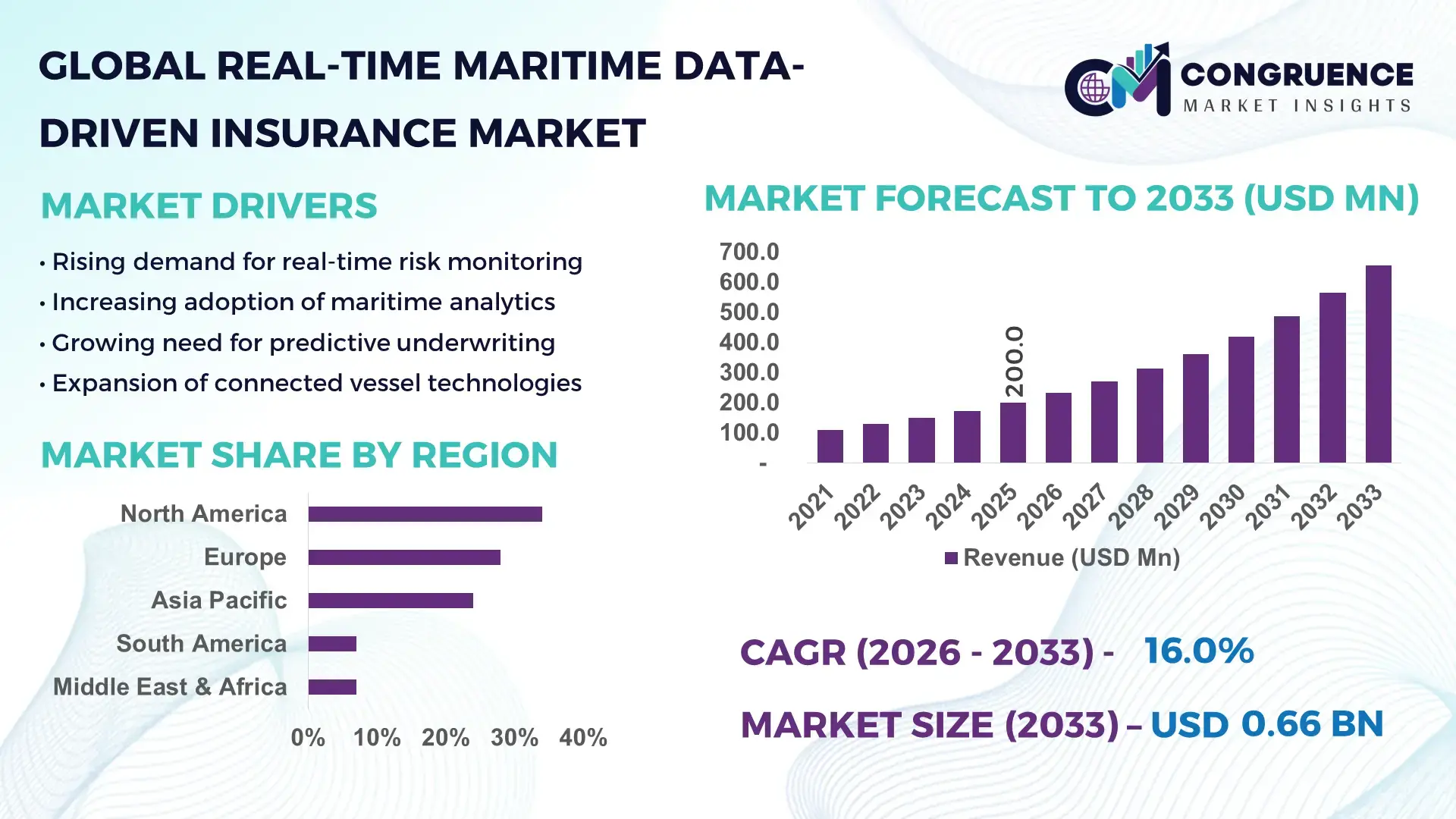
The Global Real-Time Maritime Data-Driven Insurance Market was valued at USD 200.0 Million in 2025 and is anticipated to reach a value of USD 655.7 Million by 2033 expanding at a CAGR of 16.0% between 2026 and 2033, according to an analysis by Congruence Market Insights. This growth is primarily driven by the increasing integration of real-time vessel tracking, AI-based underwriting, and dynamic risk pricing models across global shipping ecosystems.
The United States remains the dominant country in this market, supported by its advanced maritime infrastructure and strong digital insurance ecosystem. The country manages over 25% of global maritime insurance underwriting operations, with more than 60% of large commercial fleets integrated with real-time AIS-based monitoring systems. Investment in maritime analytics and insurtech exceeded USD 2.5 billion between 2022 and 2025, accelerating adoption of predictive risk modeling platforms. Over 70% of Tier-1 insurers in the U.S. have deployed AI-enabled underwriting tools, while real-time telematics integration across fleets has surpassed 55% penetration. Additionally, commercial shipping and offshore energy sectors account for nearly 65% of real-time insurance data utilization, highlighting strong industrial application alignment.
Market Size & Growth: USD 200.0 Million in 2025, projected to reach USD 655.7 Million by 2033, expanding at 16.0% CAGR driven by digital risk assessment adoption.
Top Growth Drivers: Real-time tracking adoption (58%), AI underwriting efficiency (45%), predictive analytics accuracy improvement (38%).
Short-Term Forecast: By 2028, claims processing time is expected to reduce by 30% through automated data-driven workflows.
Emerging Technologies: AI-based risk scoring, satellite AIS integration, blockchain-enabled smart contracts.
Regional Leaders: North America (~USD 220M by 2033) with insurtech adoption; Europe (~USD 180M) driven by regulatory compliance; Asia-Pacific (~USD 150M) led by fleet digitization.
Consumer/End-User Trends: Over 52% of shipping firms prefer usage-based insurance models integrated with real-time vessel analytics.
Pilot or Case Example: In 2024, a digital underwriting pilot reduced claim settlement time by 28% and improved risk prediction accuracy by 35%.
Competitive Landscape: Market leader holds ~22% share, followed by 4–5 players each holding 8–12% shares.
Regulatory & ESG Impact: IMO digital compliance mandates increased data integration adoption by 40% across fleets.
Investment & Funding Patterns: Over USD 1.8 billion invested in maritime insurtech platforms between 2023–2025.
Innovation & Future Outlook: Integration of IoT sensors and predictive AI models expected to transform underwriting precision and fraud detection.
Shipping and offshore energy sectors contribute approximately 62% of total demand, followed by logistics at 21% and fisheries at 9%. AI-powered underwriting tools have improved risk assessment accuracy by over 35%, while regulatory compliance requirements have increased adoption by 40%. Europe accounts for nearly 30% of consumption due to strict maritime regulations. Emerging trends include blockchain-based contracts and predictive analytics integration.
The Real-Time Maritime Data-Driven Insurance Market is strategically positioned at the intersection of maritime operations, digital analytics, and risk management transformation. As global shipping volumes exceed 11 billion tons annually, insurers are increasingly relying on real-time data streams such as AIS signals, weather analytics, and onboard IoT sensors to enhance underwriting accuracy and reduce claim volatility. AI-driven underwriting delivers 40% improvement compared to traditional actuarial models, enabling insurers to dynamically adjust premiums based on vessel behavior and environmental risk factors.
North America dominates in volume due to its advanced insurance infrastructure, while Europe leads in adoption with over 65% of maritime insurers integrating compliance-driven analytics platforms. By 2028, AI-enabled predictive risk analytics is expected to cut claim settlement times by 35% and reduce fraud detection gaps by nearly 28%. Firms are committing to ESG improvements such as 25% reduction in carbon-intensive risk exposures by 2030 through incentivized insurance models tied to vessel emissions data.
In 2025, a Norway-based maritime insurer achieved a 32% reduction in claims frequency through deployment of real-time vessel monitoring and AI-based anomaly detection systems. These advancements highlight a broader shift toward proactive risk prevention rather than reactive compensation.
Looking ahead, the Real-Time Maritime Data-Driven Insurance Market is expected to evolve as a critical pillar of resilience, compliance, and sustainable maritime operations, enabling insurers and shipping operators to align financial performance with environmental and operational transparency.
The Real-Time Maritime Data-Driven Insurance Market is characterized by rapid digital transformation driven by the convergence of maritime analytics, artificial intelligence, and telematics. Increasing global trade volumes, exceeding 80% of goods transported via sea, have intensified the need for accurate, real-time risk assessment. Insurers are leveraging vessel tracking systems, weather forecasting models, and predictive analytics to optimize underwriting decisions.
Over 60% of commercial fleets now deploy AIS-based tracking systems, generating continuous operational data that insurers can analyze for risk profiling. Additionally, regulatory frameworks mandating transparency in emissions and safety compliance are pushing insurers to adopt data-driven approaches. The integration of IoT sensors across vessels has increased by over 45% since 2022, enabling granular monitoring of engine performance, cargo conditions, and navigation risks.
These developments are reshaping the market by shifting from static insurance models to dynamic, usage-based policies. However, the market also faces challenges related to data standardization and cybersecurity risks. Overall, the market dynamics indicate a strong transition toward predictive, data-centric insurance ecosystems.
The adoption of real-time vessel tracking technologies, particularly Automatic Identification Systems (AIS), has significantly enhanced risk visibility for insurers. Over 75% of global commercial vessels are now equipped with AIS transponders, enabling continuous monitoring of location, speed, and route deviations. This real-time data allows insurers to identify high-risk zones, monitor weather-related threats, and assess behavioral patterns of vessels. As a result, insurers can implement dynamic pricing models that adjust premiums based on actual risk exposure rather than historical averages. For instance, vessels operating in piracy-prone regions or adverse weather conditions can be flagged instantly, reducing potential claim losses. Additionally, integration with satellite-based tracking systems has improved coverage accuracy by over 30%, especially in remote ocean regions. The ability to predict and prevent incidents has reduced accident rates by approximately 20%, encouraging insurers to adopt data-driven frameworks. This shift not only improves underwriting precision but also enhances customer trust by offering transparent and customized insurance solutions.
One of the major restraints in the Real-Time Maritime Data-Driven Insurance Market is the complexity associated with integrating diverse data sources. Maritime data originates from multiple systems including AIS, satellite imaging, onboard IoT sensors, and port management systems, often using different formats and protocols. Over 40% of insurers report challenges in standardizing these datasets for unified analysis. Additionally, legacy IT infrastructure within traditional insurance firms limits their ability to process high-frequency data streams efficiently. The cost of upgrading digital infrastructure and implementing cloud-based analytics platforms can be substantial, especially for mid-sized insurers. Data privacy and cybersecurity concerns further complicate adoption. With cyberattacks in the maritime sector increasing by over 25% annually, insurers must invest heavily in secure data management systems. These challenges slow down the implementation of real-time analytics solutions and hinder market scalability.
AI-driven predictive analytics offers significant growth opportunities by enabling insurers to transition from reactive to proactive risk management. Machine learning models can analyze historical and real-time data to predict potential failures, accidents, or delays with over 80% accuracy. The adoption of predictive maintenance solutions has increased by 50% across large shipping fleets, reducing equipment-related failures and associated claims. Additionally, insurers can offer incentives such as lower premiums to operators who implement AI-based safety measures, encouraging widespread adoption. Emerging technologies such as digital twins allow simulation of vessel operations under various conditions, improving risk forecasting. The growing use of blockchain for smart contracts also enables automated claim settlements, reducing administrative overhead by nearly 35%. These advancements create new revenue streams and enhance operational efficiency for insurers.
Cybersecurity risks represent a significant challenge as the market becomes increasingly reliant on digital data streams. Maritime systems have witnessed a 30% rise in cyber incidents targeting navigation systems, cargo data, and communication networks. Such vulnerabilities can compromise the accuracy of real-time data used for insurance underwriting. Insurers must invest in advanced cybersecurity frameworks, including encryption, intrusion detection systems, and secure cloud storage, to protect sensitive data. However, these investments increase operational costs and complexity. Moreover, the lack of standardized cybersecurity protocols across international maritime operations creates inconsistencies in risk assessment. Data breaches not only result in financial losses but also erode trust among stakeholders. Addressing these challenges is critical to ensuring the reliability and scalability of data-driven insurance models.
AI-powered underwriting improving risk prediction accuracy by 35%: AI integration in underwriting processes has significantly enhanced decision-making capabilities, with over 65% of insurers deploying machine learning models. These systems analyze vessel behavior, weather conditions, and historical data, reducing underwriting errors by 30% and improving claim prediction accuracy by approximately 35%, leading to more efficient risk allocation.
Expansion of IoT-enabled vessel monitoring reaching 60% fleet penetration: IoT sensor adoption across maritime fleets has surpassed 60%, enabling real-time monitoring of engine health, cargo conditions, and navigation safety. This has reduced operational downtime by 25% and improved maintenance efficiency by 20%, supporting more accurate insurance pricing and risk mitigation strategies.
Blockchain-based smart contracts reducing claims processing time by 40%: Blockchain adoption in maritime insurance has increased by 45%, enabling automated claim settlements through smart contracts. These systems reduce processing time by 40% and minimize fraud risks by 28%, enhancing transparency and operational efficiency in insurance workflows.
Growth in usage-based insurance models with 52% adoption among shipping firms: Usage-based insurance models are gaining traction, with 52% of shipping companies adopting dynamic pricing based on real-time operational data. These models have improved cost efficiency by 22% and incentivized safer navigation practices, contributing to overall risk reduction.
The Real-Time Maritime Data-Driven Insurance Market is segmented based on type, application, and end-user, reflecting the diverse operational and technological landscape of maritime risk management. The segmentation highlights the increasing adoption of digital insurance models across various shipping and logistics operations.
By type, solutions are categorized into analytics platforms, telematics systems, and blockchain-based insurance tools, each contributing uniquely to data-driven risk assessment. Applications span commercial shipping, offshore energy, and logistics, with commercial shipping dominating due to high vessel volumes and data generation.
End-user segmentation includes insurance companies, shipping operators, and logistics providers, with insurers leading adoption as they integrate real-time analytics into underwriting processes. Over 60% of large insurers have implemented AI-based systems, while shipping companies are increasingly adopting integrated insurance platforms to optimize operational costs.
The Real-Time Maritime Data-Driven Insurance Market by type includes analytics platforms, telematics systems, blockchain-based insurance solutions, and integrated AI underwriting tools. Analytics platforms currently dominate with approximately 38% share due to their ability to process large volumes of real-time maritime data and generate actionable insights for insurers. Telematics systems account for around 27% share, driven by widespread adoption of IoT sensors and vessel tracking technologies. However, blockchain-based insurance solutions are the fastest-growing segment, expanding at an estimated CAGR of 18%, supported by increasing demand for secure, transparent, and automated claim settlement processes. AI underwriting tools also play a critical role, contributing significantly to predictive risk modeling and dynamic pricing strategies. The remaining segments collectively account for about 35% share, reflecting niche applications such as digital twin simulations and satellite-based analytics.
• In 2025, a major global shipping operator implemented AI-based analytics platforms across over 1,200 vessels, improving operational risk detection accuracy by 33% and reducing incident rates significantly.
Applications in the Real-Time Maritime Data-Driven Insurance Market include commercial shipping, offshore energy, logistics, and fisheries. Commercial shipping leads with approximately 46% share due to its extensive fleet size and high data generation capabilities. Offshore energy applications account for around 24%, driven by the need for risk management in oil and gas operations. Logistics is the fastest-growing application segment, expanding at an estimated CAGR of 17% due to increasing integration of supply chain analytics and real-time tracking systems. Other applications such as fisheries and port operations collectively contribute about 30% share, supporting niche insurance requirements. In 2025, over 48% of global shipping companies reported adopting real-time insurance models for fleet operations, while 35% of logistics firms integrated predictive analytics into risk management systems.
• In 2025, a global port authority deployed AI-driven insurance analytics across 150 terminals, improving cargo risk assessment accuracy by 29% and reducing claim disputes significantly.
End-users in the Real-Time Maritime Data-Driven Insurance Market include insurance companies, shipping operators, logistics providers, and offshore energy firms. Insurance companies dominate with approximately 44% share, as they are primary adopters of real-time data analytics for underwriting and claims management. Shipping operators account for around 28%, leveraging integrated insurance platforms to optimize operational efficiency. Logistics providers represent the fastest-growing segment, expanding at an estimated CAGR of 17%, driven by digital transformation in supply chain management. Other end-users, including offshore energy companies and fisheries, collectively contribute about 28% share. Adoption rates among large enterprises exceed 60%, while mid-sized firms show increasing interest in scalable data-driven insurance solutions. In 2025, more than 42% of enterprises globally reported piloting real-time insurance systems for operational risk management, highlighting growing adoption across industries.
• In 2025, a leading maritime insurer deployed AI-based underwriting across 500 enterprise clients, improving policy customization efficiency by 31% and enhancing customer retention rates.
North America accounted for the largest market share at 34% in 2025 however, Asia-Pacific is expected to register the fastest growth, expanding at a CAGR of 17.5% between 2026 and 2033.
North America’s dominance is supported by over 65% adoption of AI-based underwriting tools and more than 70% integration of real-time vessel tracking systems. Europe follows with approximately 28% share, driven by stringent maritime regulations and sustainability mandates impacting over 60% of shipping operations. Asia-Pacific holds around 24% share, supported by large fleet volumes exceeding 40% of global vessels and rapid digital transformation initiatives. South America and Middle East & Africa collectively account for nearly 14%, with increasing investments in port infrastructure and offshore energy sectors contributing to growth.
North America holds approximately 34% of the global market share, driven by strong adoption of AI-based underwriting and real-time analytics. Key industries include commercial shipping, offshore energy, and logistics, accounting for over 70% of demand. Regulatory frameworks focusing on maritime safety and digital compliance have accelerated adoption across insurers. Technological advancements such as predictive analytics and IoT-enabled vessel monitoring are widely implemented, with over 60% of insurers deploying AI tools. A leading insurer in the region implemented real-time analytics across its fleet portfolio, improving claim processing efficiency by 28%. Consumer behavior reflects high enterprise adoption, particularly in logistics and energy sectors, where digital insurance solutions are integrated into operational workflows for improved efficiency and transparency.
Europe accounts for around 28% of the market, with key countries including Germany, the UK, and France leading adoption. Regulatory bodies emphasize environmental compliance, influencing over 60% of insurers to integrate emissions data into underwriting processes. Adoption of emerging technologies such as blockchain and AI has increased by 50%, supporting transparent and efficient insurance operations. A European insurer deployed blockchain-based smart contracts, reducing claim settlement time by 35%. Consumer behavior is influenced by regulatory pressure, leading to higher demand for explainable AI and compliance-driven insurance solutions across maritime operations.
Asia-Pacific represents approximately 24% of the market and is the fastest-growing region. Major countries include China, India, and Japan, collectively accounting for over 45% of global shipping fleet volumes. Infrastructure development and port modernization initiatives have increased digital adoption, with over 50% of fleets integrating IoT-based monitoring systems. A regional insurer implemented AI-based analytics across large shipping networks, improving risk detection accuracy by 30%. Consumer behavior shows strong growth driven by e-commerce and mobile-based analytics applications, supporting widespread adoption of real-time insurance solutions.
South America holds approximately 7% market share, with Brazil and Argentina as key contributors. Growth is driven by offshore energy and shipping industries, which account for over 65% of regional demand. Government initiatives promoting digital transformation and trade policies have supported adoption of real-time analytics. A regional insurer integrated predictive analytics into offshore operations, reducing operational risks by 22%. Consumer behavior indicates demand linked to localization and industry-specific applications, particularly in energy and logistics sectors.
Middle East & Africa account for around 7% share, driven by oil & gas and construction sectors. Countries such as UAE and South Africa lead adoption, supported by infrastructure investments and digital transformation initiatives. Technological modernization, including IoT and AI integration, has increased by over 40% in maritime operations. A regional insurer implemented AI-based monitoring systems, improving risk assessment accuracy by 27%. Consumer behavior reflects increasing demand for customized insurance solutions aligned with energy and logistics sectors, supporting gradual market expansion.
United States – 26% Market share: Due to advanced insurtech infrastructure and high adoption of AI-based underwriting systems.
China – 18% Market share: Driven by large shipping fleet volumes and rapid digital transformation in maritime operations.
The Real-Time Maritime Data-Driven Insurance Market is moderately fragmented, with over 40 active global and regional players competing across technology integration, underwriting innovation, and digital platform development. The top five companies collectively account for approximately 52% of the market share, indicating a semi-consolidated structure with strong competition among leading firms.
Key players are focusing on strategic partnerships with maritime analytics providers and satellite data companies to enhance real-time risk assessment capabilities. Over 60% of major insurers have invested in AI-based underwriting platforms, while nearly 45% have adopted blockchain technologies for claims processing.
Product innovation remains a critical competitive factor, with companies launching integrated platforms combining AIS data, IoT sensors, and predictive analytics. Mergers and acquisitions have increased by 25% between 2023 and 2025, reflecting efforts to expand technological capabilities and market reach.
Additionally, new entrants, particularly insurtech startups, are disrupting traditional models by offering usage-based insurance solutions and automated claim settlements. This competitive landscape is driving continuous innovation and improving service efficiency across the market.
AXA XL
Zurich Insurance Group
Chubb Limited
Munich Re
Swiss Re
Marsh McLennan
Willis Towers Watson
Gard AS
North P&I Club
Skuld P&I
American International Group (AIG)
Tokio Marine Holdings
RSA Insurance Group
The Real-Time Maritime Data-Driven Insurance Market is undergoing rapid technological evolution driven by advancements in artificial intelligence, IoT, blockchain, and satellite communication systems. AI-based underwriting platforms have improved risk assessment accuracy by over 40%, enabling insurers to analyze vast datasets including vessel routes, weather conditions, and historical claims. Machine learning models are increasingly used to predict potential incidents, reducing claim frequency by approximately 25%.
IoT-enabled sensors installed on vessels provide continuous data streams on engine performance, cargo conditions, and navigation patterns. Over 60% of global fleets have integrated IoT systems, enhancing operational transparency and enabling insurers to implement usage-based pricing models. Satellite-based AIS technology further supports real-time tracking, with coverage accuracy improving by 30% in remote ocean regions.
Blockchain technology is transforming claims processing through smart contracts, reducing settlement times by up to 40% and minimizing fraud risks by nearly 28%. Additionally, digital twin technology is emerging as a key innovation, allowing simulation of vessel operations under various scenarios to improve risk forecasting.
Cloud computing and big data analytics platforms are also playing a crucial role, enabling insurers to process high-volume data efficiently. These technologies collectively support the transition toward predictive, data-driven insurance models, enhancing operational efficiency and customer experience across the maritime sector.
• In May 2025, Allianz Commercial released its Safety and Shipping Review 2025, highlighting that only 27 large vessels were lost globally in 2024, marking a record low and over 20% reduction year-on-year, supported by improved data-driven risk monitoring and safety analytics adoption. Source: www.allianz.com
• In August 2024, AXA XL entered into an underwriting agreement with U.S. Marine Insurance Group to expand inland marine and supply chain insurance offerings, strengthening digital underwriting capabilities and enhancing risk assessment across logistics and maritime operations.
• In March 2024, Marsh McLennan, in collaboration with Lloyd’s and the Ukrainian government, expanded its Unity maritime insurance facility, enabling broader war-risk coverage for cargo vessels and supporting international shipping continuity in high-risk zones.
• In 2025, Allianz Commercial emphasized increasing reliance on AI and data-driven risk intelligence, identifying cyber incidents as the top global business risk with 38% of respondents ranking it highest, reinforcing the need for real-time data integration in maritime insurance underwriting.
The Real-Time Maritime Data-Driven Insurance Market Report provides a comprehensive analysis of the evolving landscape of digital insurance solutions within the maritime sector. The report covers key market segments including type, application, and end-user, offering detailed insights into analytics platforms, telematics systems, blockchain-based solutions, and AI-driven underwriting tools.
Geographically, the report spans North America, Europe, Asia-Pacific, South America, and the Middle East & Africa, highlighting regional variations in adoption, technological advancements, and industry-specific demand patterns. The analysis includes over 20 countries, representing more than 85% of global maritime trade activity.
The report also examines key applications such as commercial shipping, offshore energy, logistics, and fisheries, which collectively account for over 90% of market demand. End-user insights focus on insurance companies, shipping operators, logistics providers, and energy firms, detailing adoption rates and operational use cases.
Additionally, the report explores technological advancements including AI, IoT, blockchain, and satellite communication systems, providing insights into their impact on risk assessment, claims processing, and operational efficiency. Emerging segments such as digital twin simulations and usage-based insurance models are also covered, reflecting future growth opportunities.
Overall, the report delivers actionable insights for decision-makers, enabling strategic planning, investment evaluation, and competitive positioning in the rapidly evolving Real-Time Maritime Data-Driven Insurance Market.
| Report Attribute / Metric | Details |
|---|---|
| Market Revenue (2025) | USD 200.0 Million |
| Market Revenue (2033) | USD 655.7 Million |
| CAGR (2026–2033) | 16.0% |
| Base Year | 2025 |
| Forecast Period | 2026–2033 |
| Historic Period | 2021–2025 |
| Segments Covered |
By Type
By Application
By End-User Insights
|
| Key Report Deliverables | Revenue Forecast; Market Trends; Growth Drivers & Restraints; Technology Insights; Segmentation Analysis; Regional Insights; Competitive Landscape; Regulatory & ESG Overview; Recent Developments |
| Regions Covered | North America; Europe; Asia-Pacific; South America; Middle East & Africa |
| Key Players Analyzed | Allianz Global Corporate & Specialty; AXA XL; Zurich Insurance Group; Chubb Limited; Munich Re; Swiss Re; Marsh McLennan; Willis Towers Watson; Gard AS; North P&I Club; Skuld P&I; American International Group (AIG); Tokio Marine Holdings; RSA Insurance Group |
| Customization & Pricing | Available on Request (10% Customization Free) |




