
Reports
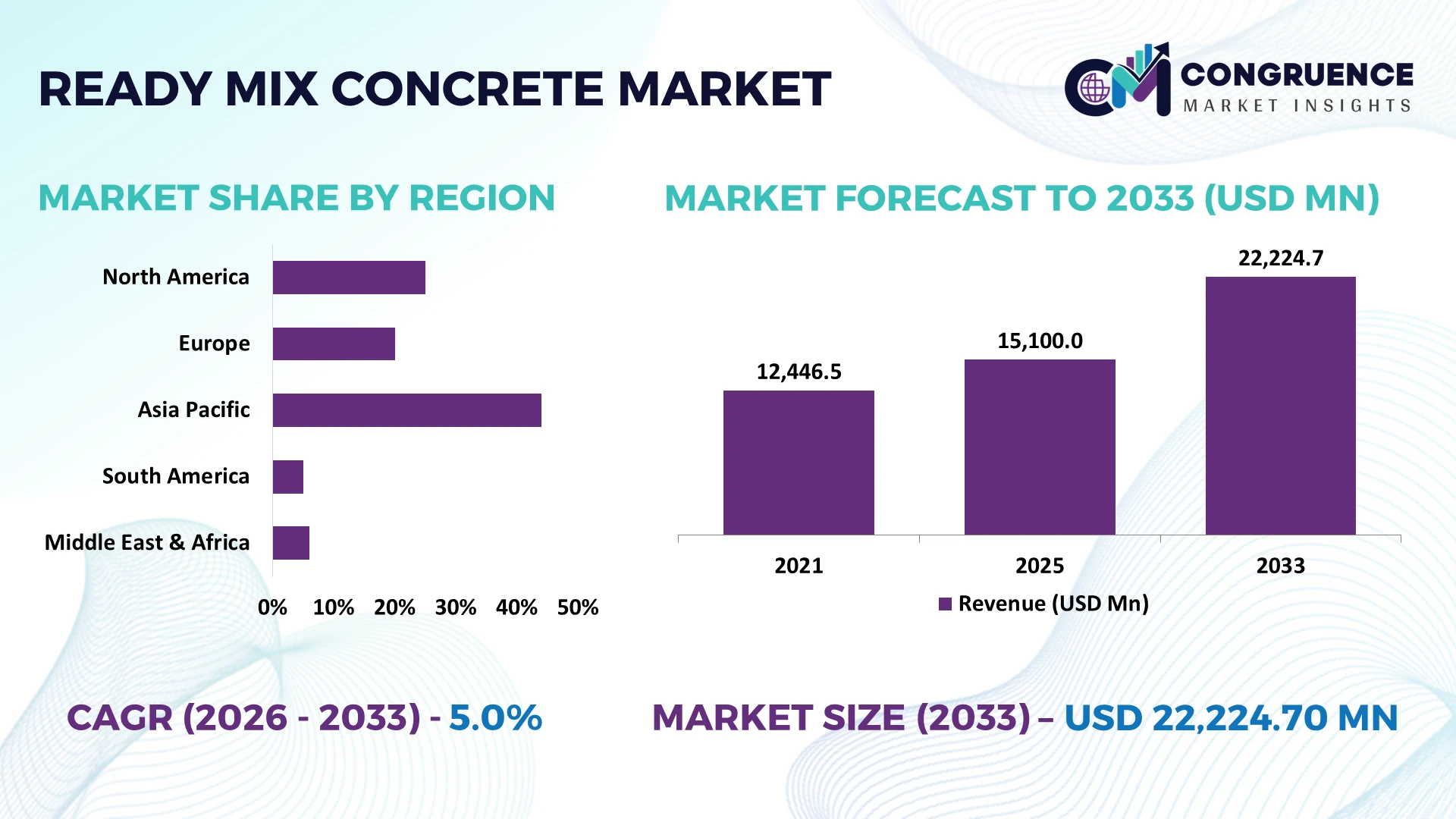
The Global Ready Mix Concrete Market was valued at USD 15100 Million in 2025 and is anticipated to reach a value of USD 22224.7 Million by 2033 expanding at a CAGR of 4.95% between 2026 and 2033. Growth is driven by urban infrastructure construction, expansion of metro rail and highway networks, automated concrete batching, and increasing adoption of low-carbon cementitious materials.
China dominates global concrete production through extensive construction infrastructure, integrated cement manufacturing, and large-scale batching operations. The country produced approximately 1.8 billion metric tons of cement in 2024, representing more than 45% of global output, compared with India's approximately 450 million metric tons. China's infrastructure priorities include high-speed rail, urban redevelopment, and industrial construction. Automated batching plants, high-capacity transit mixers, and supplementary cementitious materials support large-volume ready mix concrete supply. India's National Infrastructure Pipeline reinforces regional opportunities for organized concrete producers.
Strategically, China's production scale and India's infrastructure expansion favor producers investing in automated batching, localized aggregate supply, and lower-carbon concrete formulations.
Market Size & Growth: USD 15,100 million in 2025, reaching USD 22,224.7 million by 2033 at 4.95% CAGR, supported by infrastructure construction and automated batching.
Top Growth Drivers: Urbanization exceeds 57% globally, cement contributes approximately 7%–8% of global CO₂ emissions, and infrastructure investment reinforces concrete consumption.
Short-Term Forecast: By 2028, optimized batching operations target 5%–10% lower material waste through automated moisture correction and accurate cement dosing.
Emerging Technologies: Three innovations include AI-assisted mix optimization, IoT-enabled batching equipment, and carbon mineralization technologies for lower-emission concrete.
Regional Leaders: Indicative 2033 allocations place Asia-Pacific at USD 11,112 million, North America at USD 4,000 million, and Europe at USD 3,778 million, reflecting infrastructure modernization.
Consumer/End-User Trends: Commercial concrete mixtures increasingly incorporate 20%–40% supplementary cementitious materials where performance specifications and material availability permit.
Pilot/Case Example: CarbonCure technology demonstrates concrete production with injected captured CO₂, supporting cement reductions of approximately 3%–5% in suitable formulations.
Competitive Landscape: Holcim, Heidelberg Materials, CRH, CEMEX, and UltraTech Cement compete through plant networks, aggregates integration, and specialized concrete products.
Regulatory & ESG Impact: Cement production contributes approximately 7%–8% of global CO₂ emissions, accelerating procurement requirements for lower-carbon construction materials.
Investment & Funding: India's National Infrastructure Pipeline identified approximately USD 1.4 trillion in planned infrastructure investment, strengthening long-term construction material requirements.
Innovation & Future Outlook: Advanced concrete producers are integrating 24/7 batching analytics, digital delivery tracking, and low-clinker binders to improve production consistency.
The Ready Mix Concrete Market is evolving through automated production, specialized construction applications, and increasing demand for verified material performance. Infrastructure contractors prioritize consistent compressive strength, predictable setting characteristics, and dependable delivery schedules for high-volume construction. Advanced batching plants integrate aggregate moisture sensors, computerized proportioning, and fleet management systems to improve operational control. Supplementary cementitious materials can replace 20%–40% of Portland cement in suitable formulations, reducing clinker consumption while maintaining specified performance. Construction material suppliers are expanding technical services around low-carbon concrete, high-performance admixtures, and project-specific mix designs. These developments are reshaping procurement priorities and competitive differentiation across organized concrete supply networks.
Ready mix concrete is becoming strategically important as infrastructure contractors prioritize reliable material supply, faster construction schedules, and verified environmental performance. Global urbanization exceeds 57%, intensifying requirements for industrialized concrete production near expanding metropolitan areas. Procurement is shifting toward integrated batching networks, digital delivery coordination, and project-specific material specifications. Producers controlling aggregates, cement supply, and transport fleets gain advantages in delivery reliability and production scheduling, particularly for large infrastructure contracts requiring uninterrupted concrete placement.
Automated batching systems with moisture correction and computerized proportioning can target 5%–10% lower material waste compared with poorly controlled manual operations. China benefits from extensive construction material manufacturing, while India emphasizes organized batching capacity for metro rail, highways, and urban development. European producers increasingly prioritize lower-clinker formulations and environmental product declarations. These differences influence plant investment, supplier qualification, and concrete mix development across major construction markets.
During 2026–2028, producers will prioritize digital dispatch, recycled aggregate processing, and performance-based concrete formulations. India's metro rail construction demonstrates the importance of scheduled concrete delivery and consistent quality across multiple construction sites. Holcim, Heidelberg Materials, and UltraTech Cement are strengthening specialized concrete portfolios and production capabilities. Competitive advantage will depend on localized supply networks, reliable fleet utilization, and documented concrete performance.
Large infrastructure construction programs are strengthening demand for consistent, high-volume ready mix concrete supply. India's urban population represents approximately 36% of its total population, supporting continuing investment in transportation networks, housing, and industrial facilities. China's urbanization exceeds 66%, reinforcing requirements for organized concrete production near metropolitan construction clusters. Ready mix concrete offers controlled proportioning and centralized quality management compared with variable on-site mixing practices. Large batching facilities commonly produce 60–120 cubic meters per hour, supporting demanding construction schedules. Producers including UltraTech Cement and Heidelberg Materials are expanding integrated concrete supply networks and technical services. The strategic advantage lies in securing construction contracts requiring dependable delivery, standardized compressive strength, and coordinated material placement across multiple project locations.
Ready mix concrete production faces structural constraints from aggregate transportation costs, cement price fluctuations, and limited batching plant proximity to construction sites. Aggregates commonly account for 60%–75% of concrete volume, making local quarry availability essential to cost competitiveness. A 10% increase in aggregate procurement costs raises direct material expenditure proportionately to the aggregate cost contribution, pressuring margins where contract prices remain fixed. India's urban construction markets face restrictions on quarry operations, truck movement, and material transport routes, increasing supply complexity. Concrete's limited workable delivery window further restricts economical distribution distances. Producers are responding through local aggregate sourcing, long-term supply contracts, optimized plant locations, and fleet scheduling systems. Operational profitability increasingly depends on controlling delivered material costs rather than maximizing batching capacity alone.
Low-carbon ready mix concrete formulations create opportunities through supplementary cementitious materials, carbon mineralization, and performance-based construction specifications. Suitable mixtures can replace 20%–40% of Portland cement with fly ash, slag, or other approved materials while maintaining required engineering performance. Carbon mineralization technologies enable permanent incorporation of captured CO₂ into concrete, with selected formulations supporting approximately 3%–5% cement reductions. India's expanding infrastructure construction offers opportunities for lower-clinker concrete where technical specifications permit alternative binders. Producers are developing specialized mix designs, conducting laboratory validation, and partnering with carbon technology providers. The non-obvious advantage is improved material efficiency alongside environmental differentiation, particularly where procurement increasingly evaluates embodied carbon and verified structural performance.
Scaling ready mix concrete operations requires consistent material quality, reliable equipment calibration, and effective coordination between batching plants and construction sites. Concrete compressive strength is commonly assessed at 7 and 28 days, requiring production traceability and dependable laboratory testing. Water-to-cementitious material ratios often range from 0.35 to 0.55 for structural applications, making uncontrolled moisture variation a significant performance risk. A 5% deviation in aggregate moisture correction can materially affect batch water calculations, depending on aggregate proportions and mix design. Indian producers operating multiple urban plants face additional challenges integrating laboratory results, dispatch platforms, and equipment controls. Companies must invest in automated moisture sensors, standardized quality procedures, operator training, and connected production systems. Long-term competitiveness depends on reproducible concrete performance across geographically dispersed batching networks.
Digital Dispatch Reshapes Delivery Operations: Concrete producers are connecting batching schedules, truck locations, and site unloading status through fleet management platforms. Transit mixers typically carry 6–10 cubic meters, making turnaround time critical to daily delivery capacity. A reduction from 90 to 75 minutes per delivery cycle increases theoretical trip capacity by 20%. Producers are adopting GPS tracking and electronic delivery tickets to reduce idle time and improve coordination with construction contractors.
Self-Compacting Concrete Gains Specification Preference: High-rise and heavily reinforced structures increasingly require concrete that flows without mechanical vibration. Self-compacting mixtures commonly achieve slump flow values of 650–800 millimeters, compared with conventional slump measurements around 75–150 millimeters. Contractors reduce dependence on vibration equipment and associated placement labor. Suppliers are expanding admixture expertise and laboratory testing capabilities to serve complex structural applications.
Recycled Aggregate Processing Becomes More Selective: Construction waste management requirements are encouraging producers to qualify processed recycled aggregates for suitable concrete applications. Replacement levels of 10%–30% are evaluated according to aggregate quality and project specifications. Crushing, grading, and contamination removal determine material consistency. Producers are partnering with recycling operators to secure traceable aggregate streams, reducing dependence on virgin materials where technical and regulatory conditions permit.
Temperature-Controlled Deliveries Protect Concrete Performance: Hot-weather construction is increasing attention to concrete temperature during transportation and placement. Specifications commonly restrict delivery temperatures to approximately 30–35°C, depending on project requirements. Producers are using chilled mixing water, shaded aggregate storage, and temperature monitoring to control hydration behavior. In Saudi Arabia, these measures support more reliable placement schedules and reduce risks associated with rapid slump loss.
Transit-Mixed Concrete represents the leading type, with an indicative 45%–50% market share, supported by flexible delivery scheduling and relatively low dependence on centralized mixing infrastructure. Materials are proportioned at batching facilities and mixed during transportation, allowing producers to serve geographically dispersed construction sites. Typical transit mixers carry 6–10 cubic meters, making fleet utilization and delivery distances central to operational profitability. The segment remains particularly relevant in India, where urban construction projects require frequent deliveries across congested metropolitan networks. Producers are investing in dispatch optimization, mixer maintenance, and decentralized batching locations.
High-Strength Concrete represents the fastest advancing type, driven by high-rise buildings, industrial structures, and infrastructure projects requiring enhanced load-bearing performance. High-strength formulations commonly exceed 60 MPa compressive strength, compared with conventional structural mixtures frequently specified around 25–40 MPa. Central-Mixed Concrete supports consistent mixing quality and high-volume project supply, while Shrink-Mixed Concrete combines partial plant mixing with final transit mixing. Companies including Holcim and UltraTech Cement are strengthening specialized concrete portfolios and technical support capabilities, shifting investment toward performance differentiation and project-specific material engineering.
Residential Construction represents the leading application, with an indicative 35%–40% share of ready mix concrete demand. Multistory housing, apartment developments, and large residential projects require standardized concrete supply for foundations, columns, slabs, and structural frameworks. India's urban population represents approximately 36% of its total population, supporting organized construction activity across major metropolitan centers. Developers increasingly specify factory-controlled concrete to improve consistency and coordinate sequential structural pours. Suppliers respond through neighborhood batching facilities, scheduled deliveries, and standardized structural concrete grades.
Roads and Bridges represent the fastest advancing application, supported by transportation infrastructure modernization and increasingly demanding durability specifications. Highway pavements and bridge structures frequently require compressive strengths of 30–50 MPa, depending on design and exposure conditions. Commercial Construction generates demand for high-rise offices, retail developments, and institutional facilities, while Industrial Construction supports factories, warehouses, and logistics infrastructure. Producers are expanding high-capacity supply arrangements, technical testing services, and specialized mixtures for infrastructure contractors. Competitive positioning increasingly depends on meeting project-specific strength, workability, and delivery requirements.
Construction Contractors represent the leading end-user category, with an indicative 45%–50% share of the ready mix concrete market. Their purchasing concentration reflects responsibility for structural execution, construction scheduling, and material quality across residential, commercial, and infrastructure projects. Large contractors typically coordinate multiple concrete placements daily, making dependable dispatch and consistent batch properties commercially important. A batching facility producing 90 cubic meters per hour can theoretically supply fifteen 6-cubic-meter mixer loads hourly, excluding loading and logistical constraints. Producers are strengthening contractor relationships through dedicated account management, technical assistance, and coordinated delivery scheduling.
Infrastructure Developers represent the fastest advancing end-user category as transportation and urban utility projects require larger, more consistent concrete supply arrangements. Government Agencies influence procurement through public infrastructure specifications and contractor qualification requirements, while Industrial Companies purchase specialized concrete for manufacturing facilities and heavy-duty floors. Companies including Heidelberg Materials and CEMEX are developing project-specific supply contracts, technical service packages, and integrated logistics capabilities. The purchasing shift favors suppliers capable of maintaining quality and delivery reliability throughout complex construction schedules.
Asia-Pacific accounted for the largest indicative market share at 50% in 2025 however, Asia-Pacific is expected to register the fastest growth, expanding at an indicative CAGR of 6.2% between 2026 and 2033.
Infrastructure Renewal and Automated Concrete Production Leadership
North America represents an indicative 18% share of the global ready mix concrete market, supported by established construction material supply networks, infrastructure rehabilitation, and advanced batching technologies. The United States dominates regional production through extensive concrete manufacturing facilities, integrated aggregate operations, and large construction contractor networks. The Infrastructure Investment and Jobs Act allocated approximately USD 1.2 trillion toward transportation, utilities, and infrastructure modernization. This investment environment supports concrete consumption across highway reconstruction, bridges, industrial facilities, and public infrastructure. Producers increasingly deploy computerized batching, GPS-enabled transit mixers, and automated quality control systems to improve delivery reliability. Companies including CRH, CEMEX, and Heidelberg Materials maintain substantial production and distribution operations. Regional competition increasingly emphasizes plant proximity, aggregate ownership, specialized concrete formulations, and dependable delivery performance across geographically dispersed construction markets.
United States Market Outlook: The United States maintains a leading position through extensive concrete production infrastructure, established engineering standards, and advanced construction logistics. The country operates thousands of ready mix concrete plants supplying residential, commercial, and public infrastructure projects. The American Concrete Institute's technical standards influence mix design, structural performance, and quality assurance. Producers are expanding digital dispatch capabilities, automated moisture correction, and specialized concrete offerings to strengthen operational efficiency and contractor relationships.
Low-Carbon Construction Standards Reshape Concrete Procurement
Europe represents an indicative 17% share of the global ready mix concrete market, supported by established infrastructure networks, building renovation programs, and increasingly stringent environmental requirements. Germany, France, the United Kingdom, and Italy maintain significant concrete production capacity and organized construction material distribution systems. The European Union's emissions trading framework and construction sustainability policies encourage lower-carbon cementitious materials and improved production efficiency. Cement manufacturing contributes approximately 7%–8% of global carbon dioxide emissions, increasing attention to embodied carbon throughout construction supply chains. Producers are expanding environmental product declarations, alternative binder formulations, and recycled aggregate applications. Companies including Holcim, Heidelberg Materials, and CRH are strengthening low-carbon concrete portfolios and technical certification capabilities. Regional competitive advantage increasingly depends on documented environmental performance, consistent material quality, and compliance with evolving construction procurement standards.
Germany Market Outlook: Germany is a strategically important European market through its extensive construction materials industry, established engineering capabilities, and infrastructure modernization requirements. The country maintains a substantial network of concrete batching facilities serving transportation, commercial, and industrial projects. Heidelberg Materials has a strong domestic operating presence, supporting integrated cement, aggregates, and concrete supply. German producers prioritize environmental product declarations, standardized quality management, and specialized mixtures for technically demanding construction applications.
Large-Scale Infrastructure Construction Drives Production Concentration
Asia-Pacific represents an indicative 50% share of the global ready mix concrete market, supported by extensive infrastructure construction, industrial development, and urban residential projects. China dominates regional production through large cement manufacturing capacity, integrated construction material networks, and extensive batching infrastructure. India contributes expanding demand from metro rail, highways, industrial corridors, and urban redevelopment. China produced approximately 1.8 billion metric tons of cement in 2024, representing more than 45% of global production. Regional concrete producers increasingly adopt automated batching, digital fleet coordination, and specialized structural concrete formulations. Companies including China National Building Material Group, UltraTech Cement, and regional construction material suppliers maintain extensive distribution networks. Competitive positioning depends on localized aggregate sourcing, efficient transit mixer operations, and dependable high-volume delivery across major construction corridors.
China Market Outlook: China maintains the region's strongest production position through extensive construction material manufacturing, large infrastructure contractors, and established urban batching networks. The country's high-speed railway network exceeds 48,000 kilometers, demonstrating the scale of transportation infrastructure development. Domestic concrete suppliers support railway construction, industrial facilities, and metropolitan redevelopment through integrated cement and aggregate supply. Automated production controls and high-capacity mixing equipment strengthen operational consistency across major construction markets.
Urban Construction and Logistics Infrastructure Support Concrete Demand
South America represents an indicative 7% share of the global ready mix concrete market, supported by urban construction activity, transportation infrastructure development, and industrial investment. Brazil dominates regional production through established cement manufacturing, aggregate extraction, and organized concrete supply networks. Chile, Colombia, and Argentina contribute additional demand from commercial buildings, mining infrastructure, and transportation projects. Brazil's population exceeds 200 million, supporting substantial requirements for residential development and urban infrastructure. Regional producers increasingly focus on batching plant proximity, aggregate procurement, and reliable concrete transportation. Companies including Votorantim Cimentos and CEMEX maintain relevant regional construction material operations. High transportation costs, uneven infrastructure quality, and financing constraints influence project execution. Producers are strengthening local distribution networks, contractor partnerships, and operational planning to improve supply reliability across geographically diverse construction markets.
Brazil Market Outlook: Brazil maintains the leading regional position through its established construction materials industry, large domestic market, and extensive infrastructure requirements. Votorantim Cimentos operates integrated cement and concrete businesses supporting construction activity. The country's transportation and sanitation infrastructure programs reinforce demand for durable concrete applications. Producers are investing in regional batching operations, specialized mixtures, and improved fleet utilization to serve major metropolitan areas and industrial development corridors.
Megaproject Construction Accelerates High-Capacity Batching Investment
The Middle East & Africa region represents an indicative 8% share of the global ready mix concrete market, supported by major construction projects, industrial diversification, and transportation infrastructure investment. Saudi Arabia and the United Arab Emirates dominate advanced concrete procurement through large urban developments, transport infrastructure, and industrial construction programs. Saudi Arabia's Vision 2030 initiative supports extensive construction activity associated with economic diversification and infrastructure modernization. Regional producers deploy high-capacity batching plants, temperature-controlled concrete production, and specialized admixtures to address demanding climatic conditions. South Africa contributes established cement and concrete manufacturing infrastructure, while Egypt maintains significant urban construction activity. Producers are expanding project-specific batching facilities, logistics partnerships, and technical testing capabilities. Competitive differentiation increasingly depends on continuous concrete supply, high-temperature performance, and dependable execution for complex construction schedules.
Saudi Arabia Market Outlook: Saudi Arabia maintains a strategically important position through large infrastructure programs, urban development projects, and industrial construction investment. NEOM and associated national development initiatives require extensive concrete supply and specialized material engineering. Ready mix producers deploy centralized batching facilities, transit mixer fleets, and temperature management systems to support construction in demanding desert environments. Equipment reliability, consistent compressive strength, and coordinated project delivery remain central to supplier competitiveness.
Holcim, Heidelberg Materials, CRH, CEMEX, and UltraTech Cement compete through integrated cement, aggregates, and ready mix concrete networks, while regional producers emphasize localized pricing and delivery flexibility. Their combined global ready mix concrete share is indicatively estimated below 20%, reflecting fragmented production and geographically constrained distribution. Aggregates typically constitute 60%–75% of concrete volume, making quarry access and transport efficiency decisive competitive advantages. Automated batching systems target 5%–10% reductions in material waste compared with poorly controlled manual operations. Leading producers are expanding specialized concrete portfolios, acquiring local batching facilities, and integrating digital dispatch platforms. Competition increasingly shifts toward low-carbon formulations, performance certification, and dependable project delivery. High capital requirements, environmental permits, aggregate availability, and limited economical delivery distances restrict market entry.
Holcim Ltd.
Heidelberg Materials AG
CRH plc
CEMEX, S.A.B. de C.V.
UltraTech Cement Limited
China National Building Material Group Co., Ltd.
Votorantim Cimentos S.A.
Buzzi S.p.A.
Taiheiyo Cement Corporation
Martin Marietta Materials, Inc.
Vulcan Materials Company
Breedon Group plc
Vicat S.A.
TITAN Cement International S.A.
Current ready mix concrete production relies on computerized batching, aggregate moisture sensors, automated admixture dosing, and GPS-enabled fleet management. These systems improve proportioning accuracy and coordinate delivery schedules across construction sites. Compared with manually adjusted batching, automated moisture correction targets 5%–10% lower material waste under controlled operating conditions. High-capacity plants commonly produce 60–120 cubic meters hourly, supporting continuous infrastructure construction. Integrated laboratory testing and digital batch records strengthen quality assurance while reducing costly material inconsistencies.
Emerging technologies include artificial intelligence for mix optimization, predictive equipment maintenance, and digital concrete delivery tickets. Producers use real-time aggregate measurements and historical strength results to refine cementitious material consumption. Replacing 20%–40% of Portland cement with suitable supplementary materials reduces clinker dependence while preserving specified structural performance. Digital dispatch systems improve mixer utilization by connecting plant schedules with site readiness. Vertically integrated suppliers benefit through coordinated procurement, production, and transportation.
Disruptive technologies include carbon mineralization, advanced recycled aggregate processing, and sensor-enabled concrete performance monitoring. During 2026–2028, manufacturers will prioritize verified low-carbon formulations, automated quality documentation, and integrated production analytics. Companies combining secure aggregate supply with specialized materials and dependable delivery infrastructure gain stronger positioning in performance-driven construction procurement.
February 2024: CRH completed its $2.1 billion acquisition of cement and ready mixed concrete assets in Texas. The transaction strengthened integrated material supply and expanded the company's production footprint, improving access to construction projects across the state. Source: crh.com
August 2025: CEMEX collaborated with the University of Manchester and industry partners to deploy 15 cubic meters of graphene-enhanced concrete. The formulation achieved up to 49% lower embodied carbon, demonstrating commercially relevant potential for alternative cementitious technologies. Source: iom3.org
December 2025: Heidelberg Materials began CarbonCure trials at its Greenwich ready mixed concrete plant in England. The technology demonstrated potential carbon dioxide reductions of 7–11 kilograms per cubic meter, supporting differentiated low-carbon concrete offerings for construction customers. Source: spglobal.com
July 2025: Holcim reported that ECOPact low-carbon concrete reached 31% of ready mix sales during the first half, compared with 25% previously. This shift demonstrated stronger customer adoption and reinforced investment priorities in sustainable concrete products. Source: holcim.com
The Ready Mix Concrete Market Report evaluates production technologies, construction applications, procurement patterns, and competitive strategies between 2026 and 2033. Type coverage includes Transit-Mixed Concrete, Shrink-Mixed Concrete, Central-Mixed Concrete, and High-Strength Concrete. Application analysis examines Residential Construction, Commercial Construction, Roads and Bridges, and Industrial Construction. End-user assessment covers Construction Contractors, Infrastructure Developers, Government Agencies, and Industrial Companies. Operational benchmarking considers batching capacities of 60–120 cubic meters per hour and concrete strength requirements across structural applications.
Regional analysis encompasses North America, Europe, Asia-Pacific, South America, and the Middle East & Africa. Technology coverage includes automated proportioning, digital dispatch, carbon mineralization, and advanced admixtures. Competitive assessment evaluates aggregate sourcing, plant utilization, contractor partnerships, and specialized concrete portfolios, supporting investment allocation, capacity expansion, and differentiated market positioning.
| Report Attribute/Metric | Report Details |
|---|---|
Market Revenue in 2025 | USD 15100 Million |
Market Revenue in 2033 | USD 22224.7 Million |
CAGR (2026 - 2033) | 4.95% |
Base Year | 2025 |
Forecast Period | 2026 - 2033 |
Historic Period | 2021 - 2025 |
Segments Covered | By Type
By Application
By End-User
|
Key Report Deliverable | Revenue Forecast, Growth Trends, Market Dynamics, Segmental Overview, Regional and Country-wise Analysis, Competition Landscape |
Region Covered | North America, Europe, Asia-Pacific, South America, Middle East, Africa |
Key Players Analyzed | Holcim Ltd., Heidelberg Materials AG, CRH plc, CEMEX, S.A.B. de C.V., UltraTech Cement Limited, China National Building Material Group Co., Ltd., Votorantim Cimentos S.A., Buzzi S.p.A., Taiheiyo Cement Corporation, Martin Marietta Materials, Inc., Vulcan Materials Company, Breedon Group plc, Vicat S.A., TITAN Cement International S.A. |
Customization & Pricing | Available on Request (10% Customization is Free) |




