
Reports
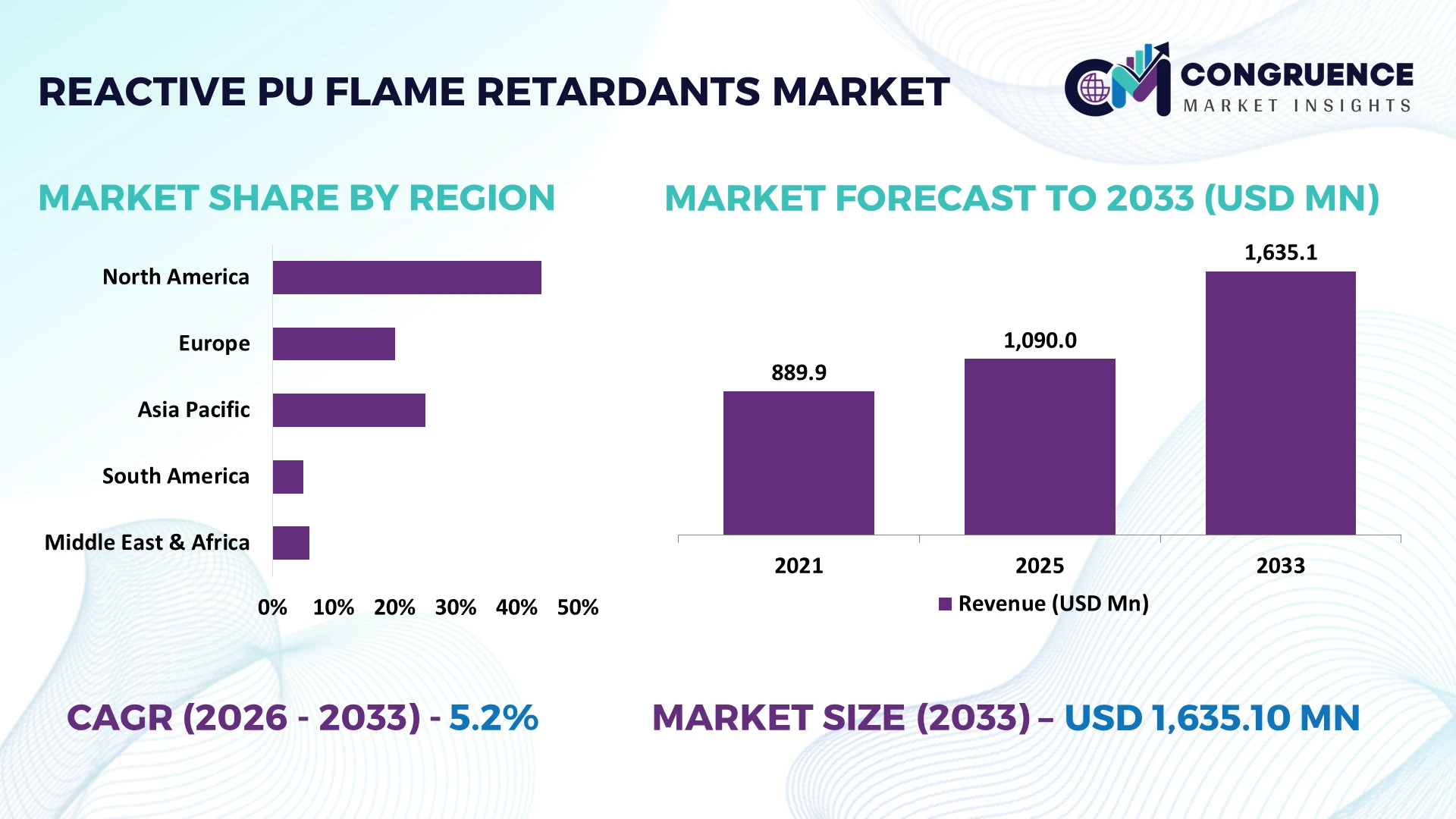
The Global Reactive PU Flame Retardants Market was valued at USD 1090 Million in 2025 and is anticipated to reach a value of USD 1635.1 Million by 2033 expanding at a CAGR of 5.2% between 2026 and 2033. Growth is driven by stricter building fire safety requirements, replacement of additive halogenated flame retardants, expansion of polyurethane insulation manufacturing, and increasing adoption of chemically bonded phosphorus-based reactive polyols.
China holds a strategically dominant position in polyurethane manufacturing, supported by large-scale chemical production, construction insulation, automotive components, and appliance manufacturing. Wanhua Chemical operates a 1.1 million tonne annual MDI facility in Yantai, demonstrating domestic feedstock integration. China's polyurethane industry benefits from extensive polyol manufacturing and downstream foam processing, while Germany emphasizes high-performance insulation and automotive fire safety formulations. European REACH restrictions on selected hazardous chemicals accelerate development of halogen-free reactive systems, strengthening China's manufacturing scale advantage and Europe's specialty formulation leadership.
Strategically, suppliers should prioritize integrated Chinese polyurethane production capacity and European regulatory-driven formulation upgrades, combining scalable phosphorus chemistry with certified fire performance and dependable raw material sourcing.
Market Size & Growth: USD 1,090 million in 2025, reaching USD 1,635.1 million by 2033 at 5.2% CAGR, supported by chemically bonded phosphorus flame retardants.
Top Growth Drivers: Research demonstrates 55.9% lower total heat release, 65.8% lower smoke production, and improved flame resistance through phosphorus-nitrogen reactive polyols.
Short-Term Forecast: By 2028, the market reaches an estimated USD 1,269.2 million, representing 16.4% cumulative expansion from 2025.
Emerging Technologies: Phosphorus-nitrogen synergists, bio-based reactive polyols, and low-migration chemistry target 2 critical properties: flame resistance and emissions control.
Regional Leaders: Indicative 2033 scenarios allocate USD 654 million to Asia-Pacific, USD 441.5 million to Europe, and USD 359.7 million to North America, reflecting manufacturing concentration and specialty formulation adoption.
Consumer/End-User Trends: Four US commercial roofing manufacturers have introduced products incorporating ICL's reactive VeriQuel R100 technology, with 6 additional manufacturers evaluating formulations.
Pilot/Case Example: In 2025, researchers demonstrated 55.9% lower heat release and 65.8% lower smoke production using reactive phosphorus-nitrogen polyols in rigid polyurethane foam.
Competitive Landscape: LANXESS, Clariant, ICL, BASF, and ADEKA compete in flame retardant technologies; a verified leading supplier's market share remains unavailable.
Regulatory & ESG Impact: EU Construction Products Regulation 2024/3110 became applicable in 2026, strengthening product documentation and environmental performance requirements.
Investment & Funding: ICL invested more than USD 2 million in VeriQuel R100 research and development, supporting reactive phosphorus chemistry commercialization.
Innovation & Future Outlook: LANXESS introduced Purventis Core in 2026, targeting 2 insulation categories, PU and PIR, with chemically bonded halogen-free flame retardancy.
The Reactive PU Flame Retardants Market is advancing through chemically integrated phosphorus polyols, low-emission automotive foams, and fire-resistant building insulation. Unlike conventional additive systems, reactive flame retardants become incorporated into polyurethane networks, reducing migration and supporting sustained material performance. Research published in 2025 demonstrated reductions of 55.9% in total heat release and 65.8% in smoke production using phosphorus-nitrogen reactive formulations. European construction product requirements and automotive volatile organic compound specifications are encouraging manufacturers to reformulate insulation panels, seating foams, and specialty polyurethane products, establishing regulatory compliance and material compatibility as central strategic priorities.
Reactive PU flame retardants are becoming strategically important as polyurethane manufacturers prioritize permanent flame resistance, reduced chemical migration, and compliance with tightening product safety requirements. The European Union's Construction Products Regulation 2024/3110 strengthens product performance documentation, encouraging reformulation of insulation materials. China's integrated polyurethane manufacturing infrastructure provides production scale, while European specialty chemical companies emphasize advanced phosphorus chemistry. This structural transition favors suppliers capable of combining chemical compatibility, consistent flame performance, and scalable reactive polyol manufacturing.
Compared with conventional additive flame retardants, reactive phosphorus-nitrogen formulations demonstrate measurable performance improvements. Experimental polyurethane foam systems achieved 55.9% lower total heat release and 65.8% lower smoke production, although results depend on formulation and testing conditions. Germany prioritizes certified insulation and automotive applications, while China emphasizes manufacturing integration and domestic chemical supply. During 2026–2028, manufacturers are expected to expand halogen-free formulations, optimize phosphorus incorporation, and strengthen compatibility testing across rigid and flexible polyurethane systems.
Commercial deployment is advancing through ICL's VeriQuel R100 technology, adopted in product development by four American roofing manufacturers, with six additional manufacturers evaluating formulations. Chemical suppliers are strengthening partnerships with foam producers and investing in reactive phosphorus research. Competitive positioning increasingly depends on verified fire performance, low migration, and efficient industrial processing.
Stricter fire safety requirements and chemical migration concerns are accelerating demand for reactive polyurethane flame retardants. Research involving phosphorus-nitrogen reactive polyols demonstrated 55.9% lower total heat release and 65.8% lower smoke production compared with reference polyurethane formulations. These measurable improvements support insulation manufacturers seeking stronger fire performance without relying exclusively on conventional additive systems. In Germany, construction product compliance requirements are increasing emphasis on documented material performance and formulation consistency. Chemical manufacturers are responding through phosphorus-functional polyol development, expanded fire testing, and partnerships with insulation producers. Reactive incorporation also reduces dependence on physically blended additives, improving formulation stability. Suppliers offering certified fire resistance alongside consistent polyurethane processing characteristics gain stronger positions in specification-driven construction applications.
Reactive flame retardant production faces constraints from specialized phosphorus intermediates, chemical synthesis complexity, and polyurethane formulation compatibility. China's dominant phosphorus chemical supply chain creates procurement exposure for European and American specialty chemical manufacturers. Research demonstrating 55.9% lower heat release and 65.8% lower smoke production also highlights the performance benchmarks suppliers must reproduce under commercial processing conditions. Reactive phosphorus incorporation requires careful control of hydroxyl functionality, viscosity, and isocyanate reaction balance, increasing qualification expenditure. In Germany, specialty chemical producers face additional energy and feedstock procurement pressures. Manufacturers are diversifying phosphorus intermediate sourcing, establishing long-term supplier agreements, and optimizing reactive polyol synthesis. Companies capable of maintaining consistent flame performance without excessive formulation modification achieve stronger manufacturing economics and customer retention.
Bio-based phosphorus-functional polyols create opportunities for manufacturers developing lower-migration, halogen-free polyurethane insulation and specialty foams. Experimental reactive formulations have demonstrated 55.9% lower heat release and 65.8% lower smoke production, establishing performance targets for next-generation material development. In the United States, four commercial roofing manufacturers have incorporated ICL's VeriQuel R100 into product development, while six additional manufacturers are evaluating the technology. This adoption activity highlights opportunities for formulation-specific partnerships and commercially scalable reactive chemistry. Suppliers are investing in renewable polyol feedstocks, phosphorus-nitrogen molecular design, and improved processing compatibility. Integrating flame retardancy directly into polyurethane networks offers differentiation through reduced additive migration and more durable material functionality, particularly in insulation products requiring consistent long-term performance.
Scaling reactive polyurethane flame retardants from laboratory formulations to commercial production requires consistent fire performance, processing stability, and mechanical property retention. Experimental systems demonstrating 55.9% lower heat release and 65.8% lower smoke production must maintain comparable results across industrial foam densities and manufacturing conditions. Reactive phosphorus incorporation changes hydroxyl functionality and polymer network formation, potentially affecting curing behavior, dimensional stability, and compressive strength. In the United States, roofing insulation manufacturers must satisfy demanding fire testing and building product qualification requirements. Suppliers face challenges reproducing laboratory performance across continuous production lines and diverse polyurethane formulations. Companies must strengthen pilot-scale validation, standardized testing, and technical collaboration with foam manufacturers. Long-term competitiveness depends on achieving reproducible fire resistance without compromising insulation efficiency or manufacturing throughput.
Commercial Roofing Formulations Enter Qualification: ICL's VeriQuel R100 technology has entered product development with 4 United States commercial roofing manufacturers, while 6 additional producers are evaluating formulations. Suppliers are coordinating pilot foam production, fire testing, and processing adjustments. This qualification-led commercialization approach strengthens customer integration and reduces the risk of production disruption during reactive flame retardant substitution.
Halogen-Free Product Portfolios Expand: LANXESS introduced Purventis Core in 2026 for 2 insulation categories, polyurethane and polyisocyanurate. Manufacturers are incorporating phosphorus functionality directly into polymer formulations while optimizing hydroxyl values and reaction profiles. European chemical suppliers are strengthening technical service capabilities to support formulation conversion, improve material consistency, and differentiate specialty products from conventional additive flame retardants.
Construction Product Traceability Becomes Digital: European Regulation 2024/3110 strengthens construction product documentation requirements, with provisions applying from 2026. Manufacturers are integrating 3 datasets into qualification workflows: chemical composition, fire classification, and manufacturing traceability. Digital formulation records improve audit preparation and change control, while chemical suppliers coordinate with insulation producers to maintain consistent specifications across production batches.
Fire Testing Shifts Toward Smoke Performance: Polyurethane research increasingly evaluates heat release, smoke generation, and char formation rather than ignition resistance alone. A 2025 experimental phosphorus-nitrogen formulation demonstrated 55.9% lower total heat release and 65.8% lower smoke production under reported laboratory conditions. Material developers are expanding cone calorimetry and thermal analysis workflows, improving formulation screening before expensive industrial-scale validation.
Reactive Phosphorus-Based Chemistry Leads Market Adoption
Reactive Phosphorus-Based flame retardants represent the leading segment, with an indicative 46% market share in 2025, supported by chemically bonded phosphorus functionality, established polyol synthesis routes, and compatibility with polyurethane processing. This share is an analyst estimate rather than a published market measurement. Reactive Halogen-Based systems account for an estimated 24%, maintaining applications where established formulations and specific fire performance requirements support continued use. However, regulatory scrutiny and customer preferences for alternative chemistries are influencing supplier portfolios.
Intumescent Reactive systems are positioned as the fastest-growing type, representing an indicative 17% share, supported by expanding interest in protective char formation and reduced heat transfer. Reactive Nitrogen-Based products contribute approximately 13%, offering opportunities for synergistic flame retardancy and tailored polymer network formation. Manufacturers are investing in phosphorus-nitrogen molecular engineering, improved hydroxyl functionality control, and formulation-specific technical support. Competitive differentiation increasingly depends on balancing fire performance, mechanical properties, and processing stability. Suppliers offering commercially qualified reactive systems gain advantages over technologies requiring extensive customer reformulation.
Rigid PU Foam Leads Reactive Flame Retardant Consumption
Rigid PU Foam represents the largest application segment, with an indicative 39% market share in 2025, reflecting extensive use in building insulation, commercial roofing, refrigeration equipment, and industrial thermal management. This allocation is an analyst estimate based on application requirements rather than verified segment sales. Flexible PU Foam accounts for approximately 27%, supported by furniture cushioning, automotive seating, and specialized foam products requiring controlled flammability. Manufacturers are optimizing reactive polyol compatibility to maintain foam structure, processing consistency, and fire performance.
PU Coatings are positioned as the fastest-growing application, representing an indicative 15% share, supported by demand for durable protective finishes and specialized industrial surfaces. PU Elastomers contribute approximately 11%, serving applications requiring mechanical strength and controlled ignition behavior. PU Adhesives and Sealants represent around 8%, reflecting specialized construction and industrial bonding requirements. Chemical suppliers are expanding formulation development, automated dosing compatibility, and application-specific qualification programs. Investment priorities increasingly favor reactive technologies that preserve mechanical performance while meeting demanding fire classification and processing requirements.
Construction Industry Dominates Reactive Flame Retardant Demand
Construction represents the leading end-user segment, with an indicative 38% market share in 2025, supported by rigid polyurethane insulation, roofing systems, and fire-resistant building materials. This estimated distribution reflects application exposure rather than independently verified end-user expenditure. Furniture and Bedding accounts for approximately 24%, driven by flexible polyurethane foam requirements and product fire safety specifications. Automotive represents an estimated 19%, supported by seating, interior components, and specialty polyurethane materials. Manufacturers are developing tailored reactive polyols that maintain foam processing characteristics while improving flame resistance.
Electronics is positioned as the fastest-growing end-user segment, representing an indicative 11% share, supported by expanding requirements for protective polyurethane encapsulation, electrical insulation, and specialized component coatings. Transportation contributes approximately 8%, reflecting fire performance requirements in rail, aviation, and industrial mobility applications. Suppliers are strengthening application-specific testing, technical partnerships, and low-migration formulation development. Competitive advantages increasingly depend on meeting sector-specific fire standards while maintaining mechanical durability, production efficiency, and chemical compatibility across diverse polyurethane manufacturing processes.
Asia-Pacific accounted for the largest market share at an estimated 40% in 2025 however, Asia-Pacific is expected to register the fastest growth, expanding at an estimated CAGR of 6.4% between 2026 and 2033.
Commercial Roofing Innovation Drives Reactive Chemistry Adoption
North America accounts for an estimated 22% of global Reactive PU Flame Retardants Market demand, supported by commercial roofing insulation, automotive interiors, and specialized polyurethane manufacturing. The United States leads regional adoption through established rigid foam producers and chemical formulation capabilities. ICL's VeriQuel R100 technology has entered commercial product development with 4 American roofing manufacturers, while 6 additional producers are evaluating formulations. This activity demonstrates growing industrial interest in chemically incorporated phosphorus flame retardants rather than conventional additive systems. Canadian manufacturers contribute demand through insulation panels, transportation components, and industrial polyurethane products. Regional suppliers emphasize application-specific fire testing, formulation compatibility, and technical collaboration with foam manufacturers. Increasing qualification requirements favor producers capable of maintaining consistent hydroxyl functionality, processing stability, and flame performance across commercial production lines. Technical service capabilities remain decisive in converting development projects into recurring supply agreements.
United States Market Outlook: The United States maintains a strong position through commercial roofing manufacturers, advanced polyurethane chemistry, and established building material certification infrastructure. ICL has invested more than USD 2 million in VeriQuel R100 research and development, supporting reactive phosphorus technology commercialization. American manufacturers prioritize formulation stability, insulation performance, and compatibility with existing foam production equipment. Suppliers offering technical assistance during fire testing and manufacturing trials gain advantages in qualification-driven procurement.
Regulatory Reform Accelerates Specialty Formulation Development
Europe represents an estimated 27% of global demand, supported by advanced chemical manufacturing, building insulation requirements, and specialized automotive polyurethane applications. Germany leads regional formulation development through established chemical producers, engineering expertise, and demanding product qualification practices. The European Union's Construction Products Regulation 2024/3110 strengthens documentation and performance requirements for construction materials, with major provisions applying from January 2026. This regulatory transition increases attention to chemical composition, product traceability, and consistent fire classification. European manufacturers are expanding phosphorus-functional polyol development and technical testing capabilities to support halogen-free insulation formulations. France and Italy contribute demand through construction materials, industrial coatings, and automotive components. Suppliers increasingly differentiate through validated fire performance, reduced additive migration, and compatibility with established polyurethane processing systems. Regulatory expertise and reliable material documentation strengthen access to specification-driven customers.
Germany Market Outlook: Germany benefits from established specialty chemical manufacturing, polyurethane engineering expertise, and extensive automotive and construction supply chains. LANXESS introduced Purventis Core in 2026 for polyurethane and polyisocyanurate insulation applications, reinforcing domestic innovation in chemically bonded flame retardancy. German manufacturers prioritize processing consistency, mechanical performance, and documented fire resistance. Close collaboration between chemical suppliers, insulation producers, and testing institutions supports faster technical qualification and commercialization.
Integrated Chemical Manufacturing Strengthens Regional Supply Advantages
Asia-Pacific holds an estimated 40% market share, supported by extensive polyurethane manufacturing, integrated chemical supply chains, and large-scale construction material production. China dominates regional industrial capacity through established isocyanate manufacturing, phosphorus chemical processing, and downstream foam fabrication. Wanhua Chemical's Yantai industrial complex includes MDI manufacturing capacity of approximately 1.1 million tonnes annually, demonstrating the scale of domestic polyurethane feedstock integration. Japan and South Korea contribute advanced material formulation capabilities, particularly for automotive components, electronics, and specialty coatings. India supports additional demand through insulation manufacturing, industrial construction, and expanding polyurethane processing infrastructure. Regional manufacturers are strengthening phosphorus intermediate sourcing, automated polyol production, and formulation development to improve supply reliability. Integrated chemical operations provide procurement advantages, while specialty suppliers compete through product consistency, fire testing expertise, and application-specific technical support.
China Market Outlook: China maintains a manufacturing advantage through established phosphorus chemistry, large-scale polyurethane production, and integrated industrial infrastructure. The country accounts for a substantial proportion of global polyurethane raw material capacity, supporting domestic development of reactive flame retardant formulations. Chinese producers are investing in phosphorus-functional polyols, improved chemical synthesis efficiency, and specialized insulation applications. Local feedstock availability strengthens supply flexibility, while export-oriented manufacturers increasingly prioritize compliance with international fire performance specifications.
Construction Modernization Supports Specialty Polyurethane Formulations
South America represents an estimated 6% of global demand, supported by polyurethane insulation, furniture manufacturing, automotive components, and industrial construction materials. Brazil dominates regional consumption through established chemical processing infrastructure and extensive downstream polyurethane manufacturing. São Paulo's industrial corridor supports foam conversion, automotive component production, and specialty chemical distribution. Argentina and Chile contribute additional demand through construction insulation and industrial applications requiring improved fire performance. Regional suppliers face dependence on imported specialty phosphorus intermediates and advanced reactive formulations, creating exposure to international logistics and exchange rate fluctuations. Manufacturers are strengthening relationships with chemical distributors and polyurethane formulators to improve technical support and procurement continuity. Local blending capabilities and application-specific testing offer practical advantages for suppliers seeking to reduce qualification delays and support customers transitioning toward chemically incorporated flame retardants.
Brazil Market Outlook: Brazil leads regional opportunities through its automotive manufacturing base, construction material production, and established polyurethane processing capabilities. National vehicle production exceeded 2.5 million units in 2024, supporting demand for automotive polyurethane components and specialized interior materials. São Paulo-based manufacturers benefit from industrial supplier networks and chemical distribution infrastructure. Reactive flame retardant suppliers are prioritizing formulation compatibility, technical assistance, and reliable access to imported phosphorus-based intermediates.
Industrial Diversification Expands Advanced Insulation Requirements
Middle East & Africa accounts for an estimated 5% of global demand, supported by industrial construction, petrochemical development, and expanding insulation manufacturing capabilities. Saudi Arabia and the United Arab Emirates lead regional industrial activity through petrochemical integration, commercial construction, and specialized building material production. Saudi Arabia's industrial diversification initiatives support investment in downstream chemical manufacturing and polyurethane processing infrastructure. The region's high cooling requirements reinforce the importance of thermal insulation performance, while commercial and industrial buildings require appropriate fire classification. South Africa contributes demand through automotive components, industrial coatings, and specialized polyurethane products. Regional suppliers are strengthening technical distribution networks, formulation support, and partnerships with insulation manufacturers. Dependence on imported specialty flame retardants creates opportunities for localized blending and chemical distribution, particularly where project schedules require consistent material availability.
Saudi Arabia Market Outlook: Saudi Arabia benefits from established petrochemical infrastructure, industrial localization initiatives, and large-scale construction activity. Saudi Aramco's integrated chemical operations and domestic polyurethane supply networks provide a foundation for downstream material development. Vision 2030 industrial diversification priorities encourage local manufacturing and specialized chemical processing. Suppliers offering certified reactive flame retardants, dependable logistics, and technical collaboration with insulation producers are positioned to serve increasingly sophisticated construction material requirements.
The Reactive PU Flame Retardants Market features competition between specialty chemical suppliers LANXESS, Clariant, ICL, BASF, and ADEKA, alongside regional phosphorus chemistry manufacturers. The leading five suppliers represent an indicative combined 42% market share, although independently verified concentration data remains unavailable. ICL differentiates through VeriQuel R100 commercialization, while LANXESS targets polyurethane insulation with chemically bonded phosphorus technologies. BASF competes through integrated polyurethane formulation expertise, whereas Clariant emphasizes specialized flame retardant chemistry. Experimental phosphorus-nitrogen formulations have demonstrated 55.9% lower total heat release and 65.8% lower smoke production, establishing measurable performance benchmarks. Suppliers compete through formulation compatibility, technical qualification, chemical sourcing, and manufacturing reliability. Partnerships with insulation producers accelerate commercialization, while integrated phosphorus supply chains strengthen procurement resilience. The competitive shift favors reactive systems with documented processing stability over conventional additive approaches. Entry barriers include specialized synthesis expertise and demanding fire testing requirements. Winning requires verified performance, dependable supply, and application-specific formulation support.
LANXESS AG
Clariant AG
ICL Group Ltd.
BASF SE
ADEKA Corporation
Wanhua Chemical Group Co., Ltd.
Italmatch Chemicals S.p.A.
Albemarle Corporation
Daihachi Chemical Industry Co., Ltd.
Jiangsu Yoke Technology Co., Ltd.
Zhejiang Wansheng Co., Ltd.
Shandong Brother Sci. & Tech. Co., Ltd.
Shandong Moris Tech Co., Ltd.
PCC Rokita SA
Current technologies center on phosphorus-functional polyols, reactive phosphate esters, and chemically bonded flame retardant structures. Unlike conventional additives, these compounds become integrated into polyurethane networks, limiting migration while preserving processing compatibility. Experimental phosphorus-nitrogen formulations have demonstrated 55.9% lower total heat release and 65.8% lower smoke production against reference foams. Industrial adoption is advancing through commercial roofing qualification, where four American manufacturers have incorporated ICL's VeriQuel R100 into product development. Suppliers benefit from differentiated fire performance and stronger formulation control.
Emerging technologies combine phosphorus-nitrogen synergists, bio-based polyol chemistry, and precision molecular design. Reactive incorporation improves durability by reducing dependence on physically dispersed flame retardants, although quantified migration improvements remain formulation-specific. Automated hydroxyl-value monitoring and controlled dosing support consistent foam cell structure and predictable curing. Compared with conventional formulations, experimentally optimized reactive systems achieved 55.9% lower heat release under reported testing conditions. Specialty chemical manufacturers benefit from application-specific formulations, while insulation producers gain improved material qualification pathways.
Disruptive innovation focuses on recyclable polyurethane networks, digital formulation optimization, and advanced intumescent chemistry. Between 2026 and 2028, manufacturers are prioritizing phosphorus incorporation efficiency, automated fire testing, and industrial validation. These developments strengthen processing reliability, reduce reformulation risk, and support competitive differentiation through verified performance across demanding applications.
December 2024: ICL launched VeriQuel R100 for rigid polyurethane insulation after investing over $2 million in product development. Four American roofing manufacturers had introduced products using the reactive technology, demonstrating commercial adoption and improved resistance to flame-retardant migration. Source: Global Insulation
September 2026: LANXESS launched Purventis Core, a reactive halogen-free phosphorus flame retardant targeting two insulation chemistries, PU and PIR. Chemically bonding into foam matrices, the product supports lower emissions and stronger stiffness, extending the company's specialty-material positioning globally. Source: lanxess.com
February 2026: Clariant published updated technical specifications for Exolit OP 552, a reactive phosphorus polyol containing 16–18% phosphorus. Recommended dosages of 2–8 parts per hundred polyol support automotive foam fire classification, enabling low-migration formulations and controlled industrial processing. Source: clariant.com
June 2025: Researchers published phosphorus-nitrogen reactive polyol results in Reactive and Functional Polymers. Optimized rigid polyurethane foam reduced total heat release 55.9% and smoke production 65.8%, demonstrating an experimental route to improved insulation fire safety and durability. Source: sciencedirect.com
The Reactive PU Flame Retardants Market Report evaluates industry developments from 2026 to 2033, covering Reactive Phosphorus-Based, Reactive Halogen-Based, Reactive Nitrogen-Based, and Intumescent Reactive technologies. Application analysis includes Flexible PU Foam, Rigid PU Foam, PU Coatings, PU Elastomers, and PU Adhesives and Sealants. End-user coverage examines Construction, Automotive, Furniture and Bedding, Electronics, and Transportation, assessing formulation compatibility, fire safety requirements, and industrial procurement priorities.
Regional analysis covers North America, Europe, Asia-Pacific, South America, and Middle East & Africa, emphasizing manufacturing concentration, regulatory developments, and commercialization. The report examines phosphorus-functional polyols, bio-based reactive chemistry, and low-migration technologies. With an indicative 46% share for phosphorus-based systems, competitive assessment supports supplier selection, investment planning, geographic expansion, and technology positioning across emerging polyurethane applications.
| Report Attribute/Metric | Report Details |
|---|---|
Market Revenue in 2025 | USD 1090 Million |
Market Revenue in 2033 | USD 1635.1 Million |
CAGR (2026 - 2033) | 5.2% |
Base Year | 2025 |
Forecast Period | 2026 - 2033 |
Historic Period | 2021 - 2025 |
Segments Covered | By Type
By Application
By End-User
|
Key Report Deliverable | Revenue Forecast, Growth Trends, Market Dynamics, Segmental Overview, Regional and Country-wise Analysis, Competition Landscape |
Region Covered | North America, Europe, Asia-Pacific, South America, Middle East, Africa |
Key Players Analyzed | LANXESS AG, Clariant AG, ICL Group Ltd., BASF SE, ADEKA Corporation, Wanhua Chemical Group Co., Ltd., Italmatch Chemicals S.p.A., Albemarle Corporation, Daihachi Chemical Industry Co., Ltd., Jiangsu Yoke Technology Co., Ltd., Zhejiang Wansheng Co., Ltd., Shandong Brother Sci. & Tech. Co., Ltd., Shandong Moris Tech Co., Ltd., PCC Rokita SA |
Customization & Pricing | Available on Request (10% Customization is Free) |




