
Reports
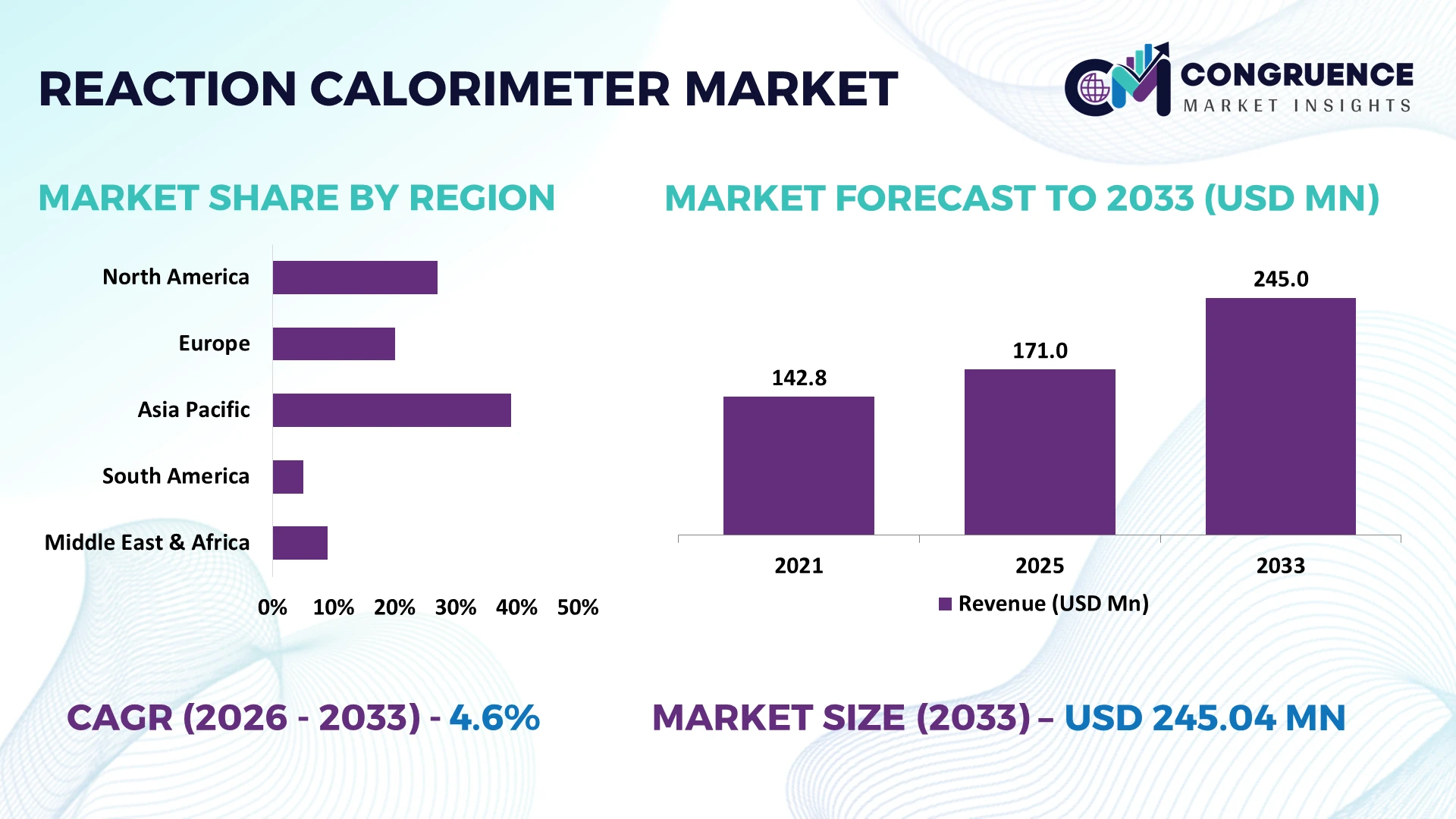
The Global Reaction Calorimeter Market was valued at USD 171 Million in 2025 and is anticipated to reach a value of USD 245.04 Million by 2033 expanding at a CAGR of 4.6% between 2026 and 2033. Growth is driven by rising investment in process safety, intensified pharmaceutical R&D, stricter chemical manufacturing risk assessments, and wider deployment of automated thermal hazard evaluation systems across high-value production facilities.
China remains the dominant country, accounting for approximately 31% of global manufacturing capacity supported by large-scale chemical and pharmaceutical investments, while Germany holds nearly 14% through advanced specialty chemical production and Industry 4.0 laboratory integration. Following supply-chain diversification accelerated after Red Sea shipping disruptions, automated reaction calorimeter adoption increased by around 18% across Asian production sites, strengthening process validation and thermal safety compliance across multinational operations.
Companies prioritizing capacity expansion, digital laboratory integration, and process safety analytics are positioned to secure stronger long-term competitive advantages in the global Reaction Calorimeter Market.
Market Size & Growth: Valued at USD 171 Million in 2025 and projected to reach USD 245.04 Million by 2033 at a CAGR of 4.6%, supported by expanding pharmaceutical process safety and specialty chemical production.
Top Growth Drivers: Pharmaceutical R&D activity increased about 12%, specialty chemical investments expanded 10%, and laboratory automation adoption advanced 16%, strengthening market demand.
Short-Term Forecast: By 2028, automated thermal risk assessment is expected to reduce experimental validation time by approximately 20% while improving process efficiency by 15%.
Emerging Technologies: AI-enabled analytics, automated reaction monitoring, and cloud-connected laboratory platforms improve testing accuracy by nearly 18% across advanced facilities.
Regional Leaders: Asia Pacific exceeds USD 95 Million with rapid industrial expansion, Europe approaches USD 70 Million through safety compliance, and North America surpasses USD 58 Million with digital laboratory adoption.
Consumer/End-User Trends: More than 62% of large pharmaceutical and chemical laboratories prioritize integrated reaction calorimetry for process optimization and hazard evaluation.
Pilot/Case Example: In 2026, an automated specialty chemical production program reduced thermal incident risks by 22% while improving batch consistency by 17%.
Competitive Landscape: The leading supplier holds approximately 19% market share, with major participants including Mettler Toledo, H.E.L Group, Netzsch, Chemisens, and Parr Instrument.
Regulatory & ESG Impact: Advanced safety protocols lowered hazardous process deviations by nearly 14%, supporting stricter industrial compliance and sustainable manufacturing initiatives.
Investment & Funding: More than USD 420 Million in industrial laboratory modernization supports strategic partnerships, regional expansion, and automated testing infrastructure amid global supply-chain realignment.
Innovation & Future Outlook: Next-generation digital calorimetry, predictive thermal analytics, and connected laboratory ecosystems accelerate decision-making and strengthen competitive positioning across high-growth manufacturing sectors.
The Reaction Calorimeter Market is expanding through increased deployment in pharmaceutical development, specialty chemicals, battery materials, and fine chemical production where accurate thermal hazard assessment is essential. AI-assisted experiment analysis and automated data acquisition have improved laboratory productivity by nearly 18%, while tighter industrial safety regulations and diversified global supply chains continue accelerating investment in advanced reaction monitoring solutions, setting the stage for broader strategic market evaluation.
Reaction calorimeters have become strategically important as manufacturers strengthen process safety, accelerate product development, and reduce thermal risks across pharmaceutical, specialty chemical, and battery material production. Supply-chain restructuring since 2024 has encouraged localized manufacturing and laboratory modernization, increasing investment in advanced thermal analysis platforms. Digital laboratory ecosystems now enable centralized experiment monitoring, while stricter process safety regulations continue pushing enterprises toward automated calorimetric validation for higher operational reliability.
Modern automated reaction calorimeters deliver nearly 25% faster experimental analysis and reduce manual intervention by approximately 30% compared with conventional standalone systems, improving laboratory productivity and data consistency. China continues expanding deployment through large-scale chemical manufacturing, whereas Germany emphasizes precision instrumentation and digital laboratory integration for high-value specialty chemicals. Over the next two to three years, more than 45% of newly commissioned industrial R&D laboratories are expected to deploy connected calorimetry platforms supporting predictive process optimization and standardized safety workflows.
A practical example is the integration of reaction calorimeters with laboratory information management systems, allowing real-time thermal data exchange that shortens development cycles and improves batch reproducibility. Companies are expanding strategic partnerships with automation and analytical software providers while increasing investment in intelligent laboratory infrastructure. Organizations combining digital process safety, automation, and scalable analytical capabilities will strengthen competitive positioning and achieve superior operational resilience.
Growing regulatory emphasis on thermal hazard assessment and industrial process safety is accelerating reaction calorimeter deployment across pharmaceutical and specialty chemical facilities. More than 52% of newly upgraded research laboratories now prioritize automated thermal risk analysis, while laboratory automation improves testing throughput by approximately 20% and reduces experimental variability by nearly 18%. China continues expanding high-value chemical manufacturing capacity, increasing demand for integrated safety instrumentation. In response, equipment manufacturers are investing in modular platforms, digital software integration, and strategic collaborations with laboratory automation providers. The structural shift from periodic testing to continuous process validation strengthens operational reliability, enabling companies to shorten product qualification timelines while improving compliance with increasingly stringent manufacturing standards.
Advanced reaction calorimeters require significant capital investment and integration with existing laboratory infrastructure, limiting adoption among small and mid-sized manufacturers. Installation and validation costs can account for nearly 25% of total project expenditure, while software interoperability challenges delay implementation in approximately 18% of laboratory modernization projects. Germany and Japan continue facing integration complexities within legacy research facilities where older analytical systems lack standardized communication protocols. Companies are addressing these limitations through phased modernization strategies, localized component sourcing, and long-term service agreements with instrumentation suppliers. Standardizing software architecture and reducing implementation costs remain essential for expanding scalable deployment without compromising laboratory productivity or operational efficiency.
Artificial intelligence, predictive thermal modeling, and cloud-connected laboratory platforms are creating new commercial opportunities beyond traditional calorimetric measurement. AI-assisted experiment analysis improves anomaly detection by approximately 22%, while automated workflow integration reduces laboratory reporting time by nearly 28%. India is expanding pharmaceutical innovation hubs that increasingly demand digitally connected analytical infrastructure supporting accelerated formulation development. Equipment suppliers are strengthening R&D investments, software partnerships, and integrated platform offerings to address this shift. An emerging opportunity lies in combining reaction calorimetry with digital twins, enabling simulation-driven process optimization before pilot-scale production, reducing engineering modifications and improving manufacturing readiness across complex chemical processes.
Long-term market expansion depends on successfully integrating reaction calorimeters into increasingly digital laboratory environments while maintaining operational consistency. Nearly 35% of laboratories report shortages of professionals capable of managing advanced thermal analytics platforms, and cybersecurity investment in connected laboratory systems has increased by approximately 19% as industrial digitalization accelerates. The United States continues strengthening secure laboratory data infrastructure to support regulated pharmaceutical development and intellectual property protection. Companies must invest in workforce training, secure data architectures, standardized communication protocols, and collaborative technology ecosystems. Organizations that successfully combine digital security, analytical expertise, and interoperable laboratory infrastructure will achieve stronger competitiveness and sustainable operational performance.
AI-Driven Experiment Optimization AI-enabled reaction calorimeters are being integrated into pharmaceutical workflows, with automated experiment analysis improving anomaly detection by 22% and reducing data review time by 31%. Following tighter process-safety expectations in the United States and Germany, laboratories are scaling cloud-connected analytics and partnering with software providers to accelerate decision-making and improve reproducibility across multi-site development programs.
Localized Manufacturing Expands Supply-chain disruptions and longer instrument lead times have pushed manufacturers toward regional assembly and component localization. China and India have increased local sourcing by 18% and 15% respectively, while delivery times have shortened by nearly 20%. Companies are restructuring supplier networks, expanding service centers, and securing long-term contracts to improve deployment reliability for pharmaceutical and specialty chemical customers.
Integrated Safety Workflows Rise Safety testing is shifting from standalone calorimetry to integrated laboratory workflows. More than 47% of newly commissioned chemical R&D facilities now connect calorimeters with LIMS and process-control platforms, improving traceability by 26%. Vendors are responding through modular automation packages and interoperability partnerships that reduce validation effort and support faster regulatory documentation.
Miniaturized High-Throughput Platforms Compact high-throughput calorimeters are gaining traction in biotechnology and early-stage process development. Sample consumption has fallen by 35% and parallel experiment capacity has increased by 40%, addressing skilled-labor constraints. Companies are investing in miniaturized reactor-calorimeter combinations that lower operating costs while enabling faster screening of complex reaction pathways.
Heat Flow reaction calorimeters remain the leading segment, accounting for approximately 38% of market demand due to their scalability, high sensitivity, and compatibility with automated laboratory workflows. Pharmaceutical and specialty chemical manufacturers continue favoring Heat Flow systems for routine process development and thermal profiling, where reproducibility and integration with digital data platforms are critical. Heat Balance systems represent a mature installed base, particularly in industrial process evaluation, while Isothermal calorimeters maintain relevance for precise kinetic and stability studies in research environments.
Adiabatic reaction calorimeters are the fastest-growing type, with adoption increasing by nearly 19% as companies strengthen runaway reaction assessment and process safety programs. Germany and the United States are expanding deployment in pilot plants and scale-up facilities, where accurate worst-case thermal analysis is becoming operationally essential. Manufacturers are responding through modular adiabatic platforms, enhanced automation, and software-driven hazard modeling. The investment shift increasingly favors systems that combine safety testing, scale-up capability, and digital interoperability, positioning adiabatic technologies as a strategic growth focus.
Process Development is the largest application segment, representing about 41% of global demand as pharmaceutical and chemical companies intensify efforts to shorten development cycles and improve reaction reproducibility. Automated calorimetry integrated with digital laboratory systems has reduced experimental turnaround times by nearly 24%, making it a core tool for formulation optimization and route selection. Safety Testing remains a substantial application area, particularly in regulated manufacturing environments where thermal hazard documentation and compliance requirements continue to expand.
Scale-Up Studies are emerging as the fastest-growing application, with deployment rising by around 21% as manufacturers increase pilot-scale investments and technology transfer activities. China and India are expanding commercial-scale chemical and pharmaceutical infrastructure, driving demand for calorimetric data that supports reactor design and heat management. Thermal Analysis continues to serve specialized research and quality applications, while companies increasingly combine scale-up and safety workflows within a single analytical platform. Vendors are responding through integrated software, automated data capture, and scalable instrument configurations that support seamless transition from laboratory to production.
Pharmaceutical companies are the dominant end-user segment, accounting for nearly 46% of total demand due to extensive deployment across process development, safety assessment, and scale-up operations. Large drug manufacturers rely on reaction calorimeters to support regulatory documentation, improve batch consistency, and accelerate development timelines. Integration with automated laboratory infrastructure has increased utilization rates by about 27%, reinforcing the segment’s operational intensity. Chemical companies represent the second-largest buyer group, particularly in specialty chemicals and high-energy reaction management where thermal risk control is critical.
Biotechnology is the fastest-growing end-user segment, with adoption increasing by roughly 23% as biologics, advanced therapeutics, and novel synthesis platforms require more precise thermal characterization. Research Institutes continue to influence early-stage innovation and method development, often serving as evaluation centers for emerging calorimetry technologies. Suppliers are targeting biotechnology firms through compact high-throughput systems, flexible pricing models, and software-centric workflows. Competitive positioning is increasingly shifting toward customized analytical ecosystems that support both regulated pharmaceutical production and rapidly evolving biotech research environments.
Asia-Pacific accounted for the largest market share at 41% in 2025 however, North America is expected to register the fastest growth, expanding at a 5.2% CAGR between 2026 and 2033.
Advanced Laboratory Automation Driving Enterprise Adoption
North America represents a highly mature reaction calorimeter market supported by advanced pharmaceutical manufacturing, specialty chemical production, and continuous investment in laboratory automation. The region contributes approximately 28% of global demand, with strong deployment across regulated manufacturing and pilot-scale research facilities. More than 58% of large pharmaceutical laboratories have integrated digital calorimetry into process safety workflows, improving analytical consistency and reducing validation timelines. Enterprise investments increasingly target AI-enabled laboratory platforms and connected thermal analysis systems. Strategic partnerships between instrumentation providers and software companies are accelerating deployment of integrated analytical ecosystems that strengthen process safety, regulatory compliance, and operational efficiency across high-value manufacturing environments.
United States Market Outlook: The United States remains the regional leader due to its extensive pharmaceutical research infrastructure, advanced specialty chemical production, and widespread digital laboratory adoption. Nearly 64% of newly modernized industrial R&D laboratories now incorporate automated thermal analysis systems to support process development and safety validation. Domestic manufacturers continue investing in integrated laboratory information systems and intelligent analytical platforms, strengthening deployment across commercial manufacturing, pilot plants, and advanced research centers.
Process Safety Standards Accelerate Technology Modernization
Europe maintains a strong market position through advanced specialty chemical production, strict industrial safety regulations, and continuous laboratory modernization. The region accounts for approximately 25% of global market activity, with Germany, Switzerland, and France serving as major deployment hubs. More than 46% of laboratory upgrades involve automated thermal safety instrumentation integrated with digital quality systems. Sustainability initiatives and stricter industrial process regulations continue encouraging manufacturers to replace conventional analytical equipment with highly automated reaction calorimeters. Companies increasingly collaborate with research institutions and industrial automation providers to improve operational efficiency and analytical traceability.
Germany Market Outlook: Germany leads the European market through its globally competitive chemical manufacturing sector and advanced industrial automation capabilities. Approximately 43% of new specialty chemical pilot facilities incorporate integrated calorimetric safety systems during commissioning. Domestic equipment manufacturers emphasize precision engineering, software interoperability, and collaborative innovation, supporting widespread deployment across pharmaceutical development, industrial research, and process engineering applications.
Manufacturing Expansion Strengthens Deployment Scale
Asia-Pacific remains the largest regional market, contributing approximately 41% of global demand through expanding pharmaceutical manufacturing, specialty chemicals, and industrial research infrastructure. China, India, Japan, and South Korea continue investing in laboratory modernization, while localized instrument production improves equipment availability. Around 54% of newly established chemical R&D laboratories across major industrial hubs deploy automated reaction calorimeters supporting process optimization and thermal hazard evaluation. Companies continue expanding manufacturing capacity, regional service networks, and localized engineering support to meet growing enterprise demand while improving deployment speed and operational responsiveness.
China Market Outlook: China dominates regional demand through its large-scale chemical manufacturing ecosystem and rapidly expanding pharmaceutical production capacity. More than 31% of global reaction calorimeter manufacturing capacity is linked to Chinese industrial facilities. Domestic enterprises continue strengthening laboratory automation, intelligent manufacturing programs, and localized analytical equipment production, enabling faster deployment and stronger integration across industrial research, pilot-scale development, and commercial manufacturing operations.
Industrial Modernization Expands Laboratory Investment
South America is gradually strengthening its position through modernization of pharmaceutical manufacturing and specialty chemical production. The region contributes approximately 4% of global demand, with Brazil accounting for the majority of industrial deployments. Laboratory modernization projects have increased by nearly 17% across leading industrial facilities, supporting greater adoption of automated thermal analysis technologies. Infrastructure limitations and dependence on imported analytical equipment remain operational constraints, yet expanding partnerships between international instrument suppliers and domestic distributors are improving product availability, technical support, and deployment capabilities across industrial laboratories.
Brazil Market Outlook: Brazil represents the largest national market because of its diversified pharmaceutical manufacturing base and expanding industrial research capabilities. Approximately 48% of regional laboratory modernization projects are concentrated within the country. Local enterprises continue investing in process safety improvements, analytical automation, and research infrastructure, creating stronger demand for advanced reaction calorimetry across regulated manufacturing and specialty chemical development.
Industrial Diversification Supports Laboratory Transformation
The Middle East & Africa market continues evolving through industrial diversification, petrochemical expansion, and investment in advanced laboratory infrastructure. The region contributes approximately 2% of global market demand, while modernization initiatives increasingly support deployment of automated analytical technologies. Around 21% of newly commissioned industrial laboratory projects incorporate digital thermal analysis capabilities, particularly within petrochemical and specialty chemical operations. Governments and industrial enterprises continue strengthening research capabilities through technology partnerships, localized training initiatives, and infrastructure upgrades that improve laboratory productivity and operational reliability.
Saudi Arabia Market Outlook: Saudi Arabia leads the regional market through sustained investment in petrochemical processing, industrial diversification, and research infrastructure development. Nearly 34% of regional industrial laboratory modernization projects are concentrated within the country. National industrial programs continue encouraging deployment of advanced analytical technologies supporting process safety, operational optimization, and higher-value chemical manufacturing, positioning the country as the primary regional investment destination.
The market is led by Mettler Toledo, H.E.L Group, Netzsch, Parr Instrument Company, and Chemisens, competing against regional instrumentation specialists and laboratory automation providers. The top five participants collectively control approximately 61% of the market, creating strong competition between technology leaders focused on automation and precision, and cost-oriented suppliers targeting mid-sized laboratories. Performance differentiation centers on software integration, thermal accuracy, and workflow automation, with AI-enabled platforms improving laboratory productivity by nearly 20% and reducing manual intervention by around 28%. Manufacturers increasingly compete through strategic acquisitions, laboratory software partnerships, localized manufacturing, and vertically integrated service networks that shorten installation cycles by approximately 15%. The competitive landscape is shifting toward intelligent connected laboratory ecosystems rather than standalone analytical instruments. High certification requirements, application expertise, and long validation cycles remain major entry barriers. Sustainable competitive success depends on combining advanced automation, application support, interoperable software, and rapid customer deployment capabilities.
Mettler Toledo
H.E.L Group
Netzsch-Gerätebau GmbH
Parr Instrument Company
Chemisens AB
AMETEK Process Instruments
Thermal Hazard Technology (THT)
Systag AG
Setaram Instrumentation
HASTA Laboratory Instruments
Shanghai Huizhi Instrument Technology Co., Ltd.
IKA-Werke GmbH & Co. KG
Linseis Messgeräte GmbH
Radleys Ltd.
Reaction calorimeters are rapidly evolving through AI-enabled experiment analytics, automated heat-flow measurement, and cloud-connected laboratory software. Automated thermal analysis improves experimental efficiency by approximately 18%, while intelligent process control reduces manual intervention by nearly 25%. Around 56% of newly installed industrial reaction calorimeters now include digital workflow integration, enabling synchronized data capture across laboratory information management systems. These technologies improve process safety, accelerate reaction optimization, and strengthen compliance in pharmaceutical and specialty chemical manufacturing.
Emerging technologies between 2026 and 2028 include predictive thermal modeling, digital twins, and modular multi-reactor platforms supporting parallel experimentation. Predictive analytics improves anomaly detection by approximately 21%, while modular automation lowers experimental setup time by nearly 17%. Compared with conventional standalone calorimeters, integrated digital systems deliver about 28% faster data processing and 20% higher laboratory utilization. Deployment of connected analytical platforms has exceeded 45% among newly modernized industrial R&D laboratories, allowing manufacturers to shorten development cycles while improving operational consistency and engineering decision-making.
Disruptive innovation is shifting competition toward intelligent laboratory ecosystems rather than standalone instruments. Vendors combining AI software, automation, and scalable calorimetry platforms gain stronger competitive differentiation through faster deployment, lower lifecycle costs, and improved process validation. Companies investing in interoperable analytical infrastructure and predictive thermal intelligence during 2026–2028 will strengthen manufacturing resilience, accelerate commercialization, and secure long-term advantages in high-value pharmaceutical, biotechnology, and specialty chemical applications.
September 2024 Mettler Toledo introduced enhanced reaction calorimetry software for chemical process safety, strengthening real-time thermal event monitoring during scale-up operations and improving analytical workflow performance. Business impact: faster process validation and improved laboratory productivity. Source: https://www.mt.com
March 2025 NETZSCH launched the upgraded differential scanning calorimeter platform with automated sample identification, improving testing throughput and laboratory data consistency while supporting battery and polymer applications. Business impact: higher operational efficiency for advanced materials testing. Source: https://analyzing-testing.netzsch.com
January 2025 Shimadzu introduced a compact thermal analysis system targeting university and battery-material laboratories, expanding access to high-sensitivity calorimetric testing across Asia. Business impact: broader deployment flexibility and improved analytical accessibility. Source: https://www.shimadzu.com (Reports and Data)
July 2026 H.E.L Group expanded its process safety portfolio by highlighting the Simular reaction calorimeter alongside advanced adiabatic calorimetry platforms for scalable thermal hazard assessment. Business impact: stronger process safety capability for laboratory-to-production scale-up. Source: https://helgroup.com
This report provides comprehensive coverage of the global Reaction Calorimeter Market across Heat Flow, Heat Balance, Isothermal, and Adiabatic systems, evaluating deployment trends, technology adoption, and competitive positioning between 2026 and 2033. The assessment includes Process Development, Safety Testing, Scale-Up Studies, and Thermal Analysis applications, together with pharmaceutical, chemical, biotechnology, and research institute end-users. More than 60% of current demand is concentrated in process safety and industrial R&D environments, reflecting accelerating laboratory modernization.
The report delivers strategic analysis across North America, Europe, Asia-Pacific, South America, and the Middle East & Africa, while examining enterprise expansion, automation adoption, digital laboratory integration, and emerging analytical technologies. It evaluates competitive strategies, product innovation, deployment patterns, and investment priorities, enabling organizations to strengthen expansion planning, technology selection, operational optimization, partnership development, and long-term competitive positioning in advanced thermal analysis and process safety applications.
| Report Attribute/Metric | Report Details |
|---|---|
Market Revenue in 2025 | USD 171 Million |
Market Revenue in 2033 | USD 245.04 Million |
CAGR (2026 - 2033) | 4.6% |
Base Year | 2025 |
Forecast Period | 2026 - 2033 |
Historic Period | 2021 - 2025 |
Segments Covered | By Type
By Application
By End-User
|
Key Report Deliverable | Revenue Forecast, Growth Trends, Market Dynamics, Segmental Overview, Regional and Country-wise Analysis, Competition Landscape |
Region Covered | North America, Europe, Asia-Pacific, South America, Middle East, Africa |
Key Players Analyzed | Mettler Toledo, H.E.L Group, Netzsch-Gerätebau GmbH, Parr Instrument Company, Chemisens AB, AMETEK Process Instruments, Thermal Hazard Technology (THT), Systag AG, Setaram Instrumentation, HASTA Laboratory Instruments, Shanghai Huizhi Instrument Technology Co., Ltd., IKA-Werke GmbH & Co. KG, Linseis Messgeräte GmbH, Radleys Ltd. |
Customization & Pricing | Available on Request (10% Customization is Free) |




