
Reports
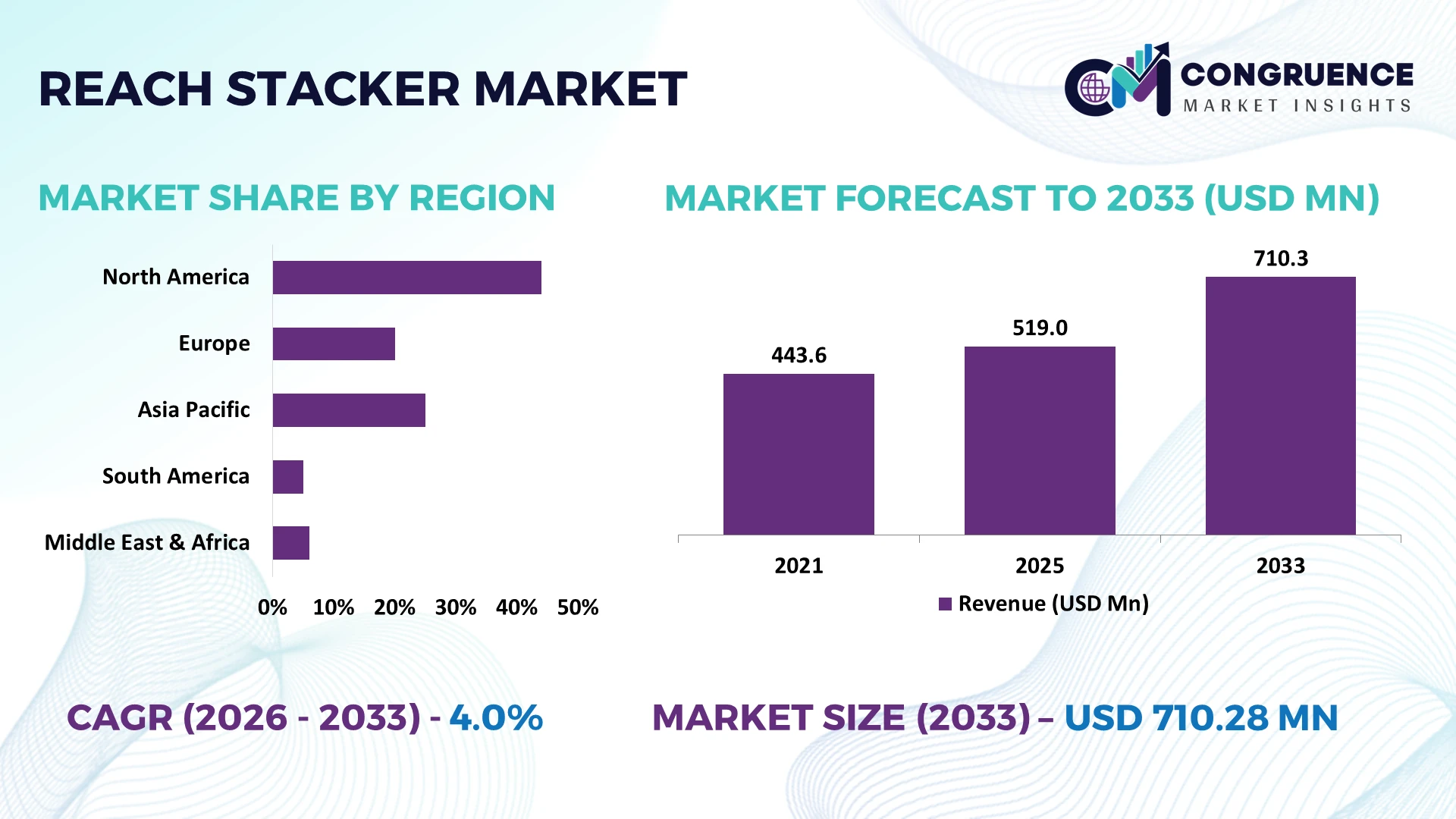
The Global Reach Stacker Market was valued at USD 519 Million in 2025 and is anticipated to reach a value of USD 710.28 Million by 2033 expanding at a CAGR of 4% between 2026 and 2033. Growth is driven by container-terminal capacity expansion, inland logistics hubs, heavier intermodal freight flows, fleet electrification, and replacement of aging diesel container-handling equipment.
China anchors global reach stacker demand through the world’s largest container-port system, which handled more than 330 million TEUs in 2024, with Shanghai alone exceeding 51 million TEUs. Domestic manufacturers including SANY and XCMG benefit from localized heavy-equipment supply chains and accelerating electric-port machinery deployment. By comparison, India handled roughly 22 million TEUs across major and non-major ports, but port modernization under Sagarmala is expanding equipment requirements. Red Sea shipping disruptions and rerouted Asia-Europe services have further increased terminal productivity and equipment-availability priorities.
Manufacturers should prioritize high-throughput Asian ports, electric powertrains, localized service networks, and telematics-enabled fleet productivity to secure long-term terminal contracts.
Market Size & Growth: USD 519 million in 2025 reaches USD 710.28 million by 2033 at 4% CAGR, supported by container-terminal modernization and fleet electrification.
Top Growth Drivers: Port modernization 38%, intermodal capacity expansion 34%, and fleet replacement 28% define procurement priorities.
Short-Term Forecast: By 2028, advanced telematics and predictive maintenance can reduce unplanned equipment downtime by approximately 15–20%.
Emerging Technologies: Lithium-ion powertrains, regenerative braking, AI-assisted diagnostics, and 360-degree vision systems are reshaping high-utilization container handling.
Regional Leaders: Asia-Pacific approaches USD 320 million, Europe USD 170 million, and North America USD 125 million by 2033 as electrification expands.
End-User Trends: Container terminals represent approximately 55% of deployment, while intermodal rail and inland depots strengthen fleet utilization.
Pilot/Case Example: In 2024, electric reach stacker deployments demonstrated up to 80% lower operational CO₂ emissions when powered by low-carbon electricity.
Competitive Landscape: Kalmar holds approximately 20% share, competing with Konecranes, SANY, Hyster-Yale, and CVS Ferrari across ports and logistics terminals.
Regulatory & ESG Impact: EU climate policy targets at least 55% net greenhouse-gas reduction by 2030, accelerating zero-emission cargo-handling procurement.
Investment & Funding: India’s Sagarmala framework encompasses USD 100+ billion equivalent infrastructure investment, expanding port-linked equipment and logistics opportunities.
Innovation & Future Outlook: 45-tonne electric platforms, automated positioning, and connected diagnostics are shifting competition toward lower lifecycle cost and measurable fleet productivity.
The Reach Stacker Market is increasingly concentrated around container terminals, inland container depots, intermodal rail yards, steel logistics, and high-throughput distribution hubs requiring flexible heavy-load handling. Standard container machines commonly provide approximately 45-tonne first-row lifting capacity, while lithium-ion powertrains, regenerative braking, telematics, camera systems, and automated diagnostics are reducing dependence on conventional diesel fleets. Port decarbonization requirements in Europe and rapid terminal expansion across India and Southeast Asia are reshaping procurement. At the same time, Red Sea shipping disruptions reinforce the value of equipment availability and flexible container-yard operations, setting up the market’s strategic priorities.
Reach stackers are becoming strategically important as ports and inland terminals pursue higher container density, lower equipment emissions, and flexible yard operations without fixed crane infrastructure. China’s ports handle more than 330 million TEUs annually, while India’s container throughput exceeds 20 million TEUs, directing equipment investment toward expanding logistics corridors. Simultaneously, European decarbonization policy is accelerating replacement of diesel-powered cargo-handling fleets with electric platforms.
Technology economics increasingly influence procurement. Battery-electric reach stackers can reduce operational CO₂ emissions by more than 70% under low-carbon electricity and eliminate diesel-engine idling, while regenerative braking recovers energy during repetitive lowering and deceleration. China combines high-volume terminal deployment with domestic equipment manufacturing; Europe leads zero-emission fleet conversion, while India prioritizes capacity additions around ports and inland container depots. Standard machines retain approximately 45-tonne first-row lifting capability despite powertrain electrification.
Through 2026–2028, lithium-ion systems, telematics, predictive maintenance, camera-based safety, and automated positioning will gain deployment. A terminal replacing diesel units with electric reach stackers can consolidate charging around scheduled operating breaks while reducing engine maintenance. Kalmar, Konecranes, SANY, and Hyster are expanding electric platforms and service ecosystems. Competitive advantage will increasingly depend on uptime, energy economics, charging integration, and lifecycle support.
Rising container volumes are increasing equipment intensity at ports and inland logistics hubs where reach stackers provide flexible stacking without fixed crane infrastructure. Chinese ports process more than 330 million TEUs annually, while Shanghai surpassed 50 million TEUs, increasing pressure on yard productivity and equipment availability. India’s container throughput has exceeded 20 million TEUs as port modernization and freight-corridor investment expand inland container movement. Reach stackers typically handle 45-tonne containers in first-row operations, supporting loaded-container transfers between trucks, rail, and storage blocks. Red Sea shipping disruptions have reinforced the operational value of flexible terminal capacity when vessel schedules become uneven. Kalmar, Konecranes, SANY, and Hyster are responding with higher-efficiency drivetrains, telematics, service expansion, and equipment packages optimized for intensive container cycles.
Battery-electric reach stackers reduce fuel dependence but require materially different terminal infrastructure from established diesel fleets. A loaded-container machine typically operates around the 45-tonne lifting class, demanding high-capacity batteries and industrial charging systems rather than conventional warehouse charging equipment. Lithium-ion platforms can carry battery packs exceeding 500 kWh, while high-power chargers require substantial grid capacity and planned charging windows. This creates deployment friction at older ports where electrical connections were designed before large mobile equipment electrification. Battery-cell supply also remains geographically concentrated in Asia, exposing OEMs to sourcing and logistics volatility. Operators are mitigating constraints through opportunity charging, phased fleet replacement, energy-management software, and charging-infrastructure partnerships. The critical restraint is therefore not vehicle capability but whether terminal electrical infrastructure can support simultaneous fleet operation without disrupting container throughput.
Zero-emission cargo handling creates an opportunity extending beyond regulatory compliance because reach stackers operate repetitive, energy-intensive duty cycles suited to regenerative electric drivetrains. Battery-electric machines can cut operational CO₂ emissions by more than 70% when charged with low-carbon electricity, while regenerative braking recovers energy during lowering and deceleration. European policy targets at least a 55% net greenhouse-gas reduction by 2030, strengthening procurement incentives for electrified port equipment. The less obvious opportunity is energy orchestration: terminals can coordinate charging with renewable generation, off-peak tariffs, and scheduled operator breaks, turning charging infrastructure into a controllable operating-cost asset. Kalmar, Konecranes, Hyster, and SANY are expanding lithium-ion portfolios, charging partnerships, telemetry, and energy-management capabilities. Suppliers integrating machine, charger, software, and service packages can capture substantially more lifecycle value than equipment-only vendors.
Reach stacker automation must function inside mixed-traffic yards containing trucks, pedestrians, manually operated equipment, container stacks, and changing pickup locations. Unlike fixed automated stacking cranes, reach stackers operate dynamically across multiple yard zones, making localization, obstacle detection, connectivity, and task orchestration substantially harder. Loaded machines routinely handle approximately 45 tonnes, meaning perception or positioning errors carry significant safety and asset consequences. Connected fleets also introduce cybersecurity exposure as telematics, remote diagnostics, and fleet-management interfaces become operationally critical. Ports moving toward 24-hour operations cannot tolerate extended commissioning or network interruptions. OEMs must integrate 360-degree cameras, proximity detection, geofencing, redundant communications, and operator-assistance systems before higher automation scales. The decisive challenge is achieving automation without sacrificing flexibility—the operational characteristic that makes reach stackers valuable compared with fixed container-handling infrastructure.
High-Voltage Platforms Enter Operations: Reach stacker engineering is moving toward 600–800V electrical architectures that support 45-tonne container handling without sacrificing lifting performance. Large battery packs exceeding 500 kWh are increasingly paired with high-power opportunity charging. Kalmar, Konecranes, and Hyster are redesigning platforms around integrated battery management and thermal control, enabling terminals to schedule charging during operator breaks rather than creating dedicated refueling downtime.
Operator Assistance Becomes Standardized: Camera arrays, load monitoring, tire-pressure systems, collision warnings, and automated spreader positioning are moving from optional features toward fleet specifications. 360-degree visibility can cover four principal machine zones, while digital load systems continuously track containers approaching 45 tonnes. Labor availability and safety requirements are accelerating adoption. OEMs are integrating assistance technologies at factory level, reducing dependence on aftermarket safety retrofits.
Telematics Reshapes Maintenance Planning: Connected fleets increasingly transmit operating hours, fuel or energy consumption, fault codes, and utilization data continuously. Terminals running 20–24-hour schedules are using condition-based servicing to target approximately 10–20% lower unplanned downtime. Manufacturers are expanding remote diagnostics and service portals, shifting maintenance from fixed intervals toward component-condition triggers and creating stronger aftermarket relationships.
Modular Platforms Simplify Fleet Configuration: Manufacturers are standardizing chassis, cabins, spreaders, powertrains, and control architectures across multiple reach stacker configurations. Typical machines retain approximately 45-tonne first-row capacity while supporting container, intermodal, and heavy-load attachments. Component commonality can reduce spare-parts complexity by 10–15% across mixed fleets. OEMs are consolidating platforms and regional parts inventories, improving service speed while allowing terminals to configure equipment around specific duty cycles.
Loaded Container Handlers account for approximately 50–55% of reach stacker demand because seaports, container terminals, and intermodal facilities require machines capable of repeatedly moving laden ISO containers between trucks, rail wagons, and storage blocks. Standard configurations commonly provide around 45 tonnes of first-row lifting capacity, giving operators substantially greater operational flexibility than equipment designed primarily for empty boxes. Empty Container Handlers remain important at depots where lower payload requirements permit faster stacking cycles and higher stacking density.
Heavy-Duty Container Handlers represent the fastest-expanding type as steel, wind-energy, industrial logistics, and project-cargo operators require greater lifting moments and specialized attachments. Telescopic Handlers occupy a narrower role where variable reach and attachment flexibility outweigh dedicated container throughput. Manufacturers are responding with reinforced chassis, intelligent load-moment monitoring, modular spreaders, and electric drivetrains. Investment is therefore separating into high-utilization loaded-container platforms and specialized heavy-duty machines, while empty-container equipment remains optimized around stacking speed and lower operating cost.
Container Handling represents approximately 35–40% of application demand because reach stackers perform multiple horizontal and vertical movements without requiring fixed lifting infrastructure. Container Stacking remains closely linked, with machines typically working across several container rows while maintaining approximately 45-tonne first-row capacity. Port Operations combine handling and stacking at high utilization rates, making equipment uptime, spreader reliability, and rapid maneuvering decisive purchasing factors. Empty Container Depots prioritize faster cycles and lower energy consumption because payload requirements are materially lighter.
Intermodal Transfer is the fastest-strengthening application as ports connect more container flows directly with rail and inland logistics corridors. Rail Terminal Operations benefit particularly from reach stackers because telescopic booms can transfer containers between road vehicles and rail wagons without rail-mounted cranes. Manufacturers are adapting through longer wheelbases, improved visibility, automated spreader functions, telematics, and rail-specific configurations. Procurement is increasingly based on moves per operating hour and availability rather than nominal lifting capacity alone.
Container Terminals represent the leading end-user group with approximately 40–45% of reach stacker demand because they combine high container throughput, multi-shift operation, constrained yard space, and frequent equipment replacement. Seaports form another substantial buyer group, particularly at smaller and medium-sized facilities where reach stackers provide lower-infrastructure flexibility compared with fixed stacking cranes. Shipping Companies deploy equipment selectively around owned depots and logistics facilities, while Logistics Companies emphasize multipurpose machines capable of supporting varied container flows.
Rail Freight Terminals are the fastest-strengthening end-user segment as intermodal freight corridors expand and operators transfer containers directly between trucks, storage areas, and trains. Standard 45-tonne machines can handle loaded ISO containers while avoiding permanent crane infrastructure, improving terminal configuration flexibility. OEMs are targeting these buyers with rail-oriented boom geometries, cameras, telematics, customized spreaders, and maintenance agreements. Competitive positioning increasingly depends on guaranteed uptime and local service coverage because equipment availability directly determines terminal throughput.
Asia-Pacific accounted for the largest market share at 45% in 2025 however, Asia-Pacific is expected to register the fastest growth, expanding at a CAGR of 5.2% between 2026 and 2033.
Intermodal Freight Drives Fleet Modernization
North America accounts for approximately 22% of global reach stacker demand, concentrated across U.S. container ports, inland terminals, rail intermodal yards, and Canadian logistics gateways. U.S. containerized trade increasingly moves through integrated port-rail networks, strengthening requirements for flexible 45-tonne machines that transfer loaded boxes without fixed crane infrastructure. Los Angeles and Long Beach together handled more than 19 million TEUs during 2024, creating intensive equipment-utilization requirements across Southern California logistics operations. Terminal operators are prioritizing telematics, automated spreader positioning, 360-degree visibility, and lower-emission drivetrains as California tightens cargo-handling emissions requirements. Kalmar, Hyster, Konecranes, and dealer networks are consequently expanding service coverage and electrified equipment offerings. Fleet purchasing increasingly emphasizes uptime guarantees and parts availability because container surges can rapidly increase yard equipment utilization.
United States Market Outlook: The United States combines high container throughput with one of the world’s largest intermodal rail systems. Southern California, Savannah, New York-New Jersey, Houston, and inland logistics hubs provide concentrated reach stacker deployment opportunities. California’s transition toward zero-emission cargo-handling equipment strengthens the business case for battery-electric machines, while rail yards continue prioritizing flexible container transfer and rapid field service.
Decarbonization Reshapes Terminal Equipment Procurement
Europe represents approximately 25% of global reach stacker demand, supported by dense container-port, short-sea, rail-freight, and inland-terminal infrastructure. Rotterdam, Antwerp-Bruges, Hamburg, Valencia, and major inland logistics hubs create substantial requirements for loaded-container and intermodal handling. Rotterdam handled approximately 13.8 million TEUs in 2024, demonstrating the operating scale behind equipment modernization. EU policy targeting at least 55% net greenhouse-gas emission reduction by 2030 is accelerating procurement scrutiny around diesel-powered cargo-handling equipment. Operators increasingly evaluate lithium-ion reach stackers alongside renewable electricity, high-power charging, telemetry, and energy-management systems. Kalmar, Konecranes, Hyster, and CVS Ferrari are competing through electrified platforms and lifecycle services. Europe’s strategic distinction is procurement based increasingly on total energy consumption, emissions performance, machine availability, and integration with terminal decarbonization programs rather than acquisition price alone.
Netherlands Market Outlook: The Netherlands provides a strategically concentrated equipment market around Rotterdam and its connected inland logistics network. Rotterdam’s extensive container, barge, road, and rail interfaces create demanding multi-modal duty cycles. Terminal electrification and shore-power investments also provide a stronger infrastructure foundation for battery-powered cargo equipment, making the country an important proving ground for electric reach stacker economics.
Container Scale Reinforces Manufacturing Advantage
Asia-Pacific accounts for approximately 45% of global reach stacker demand, combining the world’s highest container throughput with substantial domestic equipment manufacturing. Chinese ports processed more than 330 million TEUs in 2024, while Shanghai exceeded 51 million TEUs, creating exceptional demand for container-yard productivity and fleet availability. China also provides vertically integrated manufacturing for engines, batteries, hydraulics, steel structures, electronics, and heavy machinery, strengthening SANY and XCMG in both domestic and export markets. India is expanding ports, dedicated freight corridors, and inland container depots, while Vietnam and Southeast Asian manufacturing hubs are generating additional containerized trade. Suppliers are increasing electric reach stacker production, localized components, remote diagnostics, and export-oriented service networks. Scale gives Asian manufacturers an important cost advantage while high terminal utilization provides a large operational environment for validating new powertrains and automation technologies.
China Market Outlook: China combines exceptional equipment demand with localized heavy-machinery and battery supply chains. Shanghai alone processes more than 50 million TEUs annually, while Ningbo-Zhoushan, Shenzhen, Qingdao, and Guangzhou add substantial deployment density. Domestic OEMs increasingly integrate lithium-ion batteries, intelligent control systems, camera-based safety, and telematics, supporting faster commercialization of electric container-handling platforms and competitive exports.
Port Concessions Drive Equipment Renewal
South America accounts for approximately 4% of global reach stacker demand, with Brazil, Chile, Colombia, Peru, and Argentina supporting the principal container-handling installations. Brazil dominates regional deployment through Santos and other export gateways serving agricultural, manufacturing, mining, and consumer-goods supply chains. Port of Santos handled more than 5 million TEUs in 2024, generating sustained requirements for container stacking, truck transfer, and inland logistics equipment. Private terminal concessions are encouraging yard modernization, while reach stackers remain attractive where traffic volumes do not justify extensive fixed-crane infrastructure. Currency volatility and imported-component dependence increase equipment and spare-parts costs, making service availability strategically important. OEMs and distributors are responding with regional inventories, maintenance contracts, refurbished equipment, and modular machines. Electrification remains selective because charging infrastructure and capital availability vary substantially between terminals.
Brazil Market Outlook: Brazil provides the strongest regional deployment opportunity through Santos, Paranaguá, Itapoá, Rio Grande, and expanding inland logistics facilities. Export-intensive container flows require reliable loaded-container handling, while terminal concessions support equipment renewal. Buyers increasingly evaluate fuel consumption, tire life, parts availability, and maintenance response alongside purchase price, favoring suppliers with established Brazilian service networks.
Trade Corridors Accelerate Terminal Modernization
Middle East & Africa represents approximately 4% of global reach stacker demand, with the UAE, Saudi Arabia, South Africa, Morocco, and Egypt concentrating major equipment requirements. Jebel Ali, Tanger Med, Durban, Port Said, and expanding Saudi logistics hubs connect high-volume maritime routes with inland distribution. Tanger Med handled more than 10 million containers in 2024, demonstrating the scale emerging at strategically positioned transshipment gateways. Gulf logistics investment is increasing demand for high-capacity, telematics-enabled cargo equipment, while African inland terminals favor reach stackers because they require less fixed infrastructure than automated stacking cranes. Harsh temperatures, dust, service distances, and parts availability influence equipment specification. Manufacturers are strengthening regional distributors, cooling systems, preventive-maintenance packages, and spare-parts inventories to protect uptime under demanding operating conditions.
United Arab Emirates Market Outlook: The UAE combines Jebel Ali’s large container operation with sophisticated logistics parks, free zones, warehouses, and multimodal infrastructure. Operators prioritize high equipment availability, digital fleet monitoring, and rapid technical support. Growing sustainability requirements are also strengthening interest in electric cargo-handling equipment, particularly where terminals can integrate charging with established industrial power infrastructure.
Kalmar, Konecranes, SANY, Hyster, and CVS Ferrari compete across ports, intermodal yards, and industrial terminals, while Chinese OEMs pressure established European and American suppliers on acquisition cost. The top five players control approximately 60–65% of global demand, supported by installed fleets, dealer coverage, engineering depth, and aftermarket service. Premium suppliers differentiate through telematics, electrification, uptime, and customization; Chinese manufacturers can offer comparable 45-tonne lifting configurations at roughly 10–20% lower acquisition prices in selected markets. Electric platforms can reduce operational emissions by over 70% with low-carbon power, shifting lifecycle economics away from diesel. Manufacturers are expanding lithium-ion portfolios, charging partnerships, regional parts inventories, and predictive-maintenance services. Competition is moving from machine specifications toward integrated energy and fleet-management ecosystems. Certification, service infrastructure, battery expertise, and spare-parts availability remain substantial entry barriers. Winning requires competitive lifecycle cost, dependable uptime, localized support, and proven electrified-platform performance globally.
Kalmar
Konecranes
SANY
Hyster-Yale
CVS Ferrari
XCMG
Liebherr
Cargotec
Taylor Machine Works
Hoist Material Handling
Anhui Heli
SOCMA
Hangcha Group
LiuGong
Current reach stacker technology centers on diesel optimization, lithium-ion electrification, telematics, regenerative braking, cameras and load monitoring. Electric models preserve 45-tonne container capacity while eliminating tailpipe emissions. Power Drive optimization can reduce diesel consumption 10–15%, while connected diagnostics improve maintenance planning. Adoption is strongest at high-utilization ports where predictable duty cycles justify charging infrastructure and fleet management.
Emerging systems combine high-energy batteries, fast charging, remote monitoring, automated spreader functions, and modular control architectures. Konecranes electric platforms deliver up to 16 operating hours and recharge within 1–3 hours, enabling multi-shift deployment. Compared with legacy diesel machines, battery-electric reach stackers remove engine idling and mechanical drivetrain servicing, reducing direct operating emissions by 100% at the machine. Ports with strong grid infrastructure gain the clearest lifecycle advantage.
Disruptive development is moving toward dynamic charging, hydrogen fuel cells, remote software upgrades, cybersecurity-ready controls, and increasingly automated container positioning. Conductive-road charging can reduce dependence on oversized onboard batteries by supplying energy during movement or stationary operations. Between 2026 and 2028, modular electric platforms and predictive service ecosystems will expand across intermodal terminals. OEMs combining machines, charging, software, and service will gain competitive advantage; operators investing early secure lower energy exposure, higher uptime, and easier decarbonization.
September 2024 Hyster confirmed its hydrogen fuel-cell ReachStacker was being tested at MSC Terminal Valencia, delivering zero tailpipe emissions while targeting diesel-equivalent performance. The validation advances hydrogen as an alternative for intensive container-handling duty cycles for port operators. Source: Hyster
November 2025 Konecranes launched its first electric reach stacker at TOC Asia, offering up to 16 operating hours and 1–3-hour full charging. Global Remote Services simultaneously expanded, strengthening uptime management and electrified fleet support across demanding terminal operations. Source: PortTechnology
November 2025 Kalmar and Elonroad advanced dynamic charging trials using a 200-metre electrified road in Sweden, after testing a retrofitted electric reachstacker. Conductive charging targets smaller onboard batteries, reduced grid pressure, and higher equipment uptime for industrial fleets. Source: Kalmar
February 2026 Konecranes announced the United Kingdom’s first barge-configured reach stacker order, engineered to reach four metres below quay level and lift 37 tonnes. The machine enables 24/7 Thames waste-container handling despite tidal variation and recycling logistics operations. Source: Konecranes
The Reach Stacker Market Report evaluates Empty Container Handlers, Loaded Container Handlers, Heavy-Duty Container Handlers, and Telescopic Handlers across Container Handling, Container Stacking, Intermodal Transfer, Port Operations, Rail Terminal Operations, and Empty Container Depots. End-user coverage includes Seaports, Container Terminals, Logistics Companies, Rail Freight Terminals, and Shipping Companies. Regional analysis spans North America, Europe, Asia-Pacific, South America, and Middle East & Africa, with Asia-Pacific representing approximately 45% of 2025 demand.
Technology coverage examines lithium-ion drivetrains, regenerative braking, 1–3-hour fast charging, telematics, predictive maintenance, dynamic charging, hydrogen fuel cells, automated spreader positioning, and remote software management. The 2026–2033 assessment evaluates electrification readiness, terminal infrastructure, fleet utilization, service ecosystems, and specialized heavy-load applications, supporting investment prioritization, geographic expansion, equipment procurement, competitive positioning, partnership strategy, and long-term fleet modernization.
| Report Attribute/Metric | Report Details |
|---|---|
Market Revenue in 2025 | USD 519 Million |
Market Revenue in 2033 | USD 710.28 Million |
CAGR (2026 - 2033) | 4% |
Base Year | 2025 |
Forecast Period | 2026 - 2033 |
Historic Period | 2021 - 2025 |
Segments Covered | By Type
By Application
By End-User
|
Key Report Deliverable | Revenue Forecast, Growth Trends, Market Dynamics, Segmental Overview, Regional and Country-wise Analysis, Competition Landscape |
Region Covered | North America, Europe, Asia-Pacific, South America, Middle East, Africa |
Key Players Analyzed | Kalmar, Konecranes, SANY, Hyster-Yale, CVS Ferrari, XCMG, Liebherr, Cargotec, Taylor Machine Works, Hoist Material Handling, Anhui Heli, SOCMA, Hangcha Group, LiuGong |
Customization & Pricing | Available on Request (10% Customization is Free) |




