
Reports
The Global Rayon Fibers Market was valued at USD 2,100.0 Million in 2025 and is anticipated to reach a value of USD 3,423.6 Million by 2033 expanding at a CAGR of 6.3% between 2026 and 2033. Growth is being driven by the shift from conventional viscose toward lyocell, modal, recycled-cellulose feedstocks, and closed-loop processing, with regenerated cellulose fiber production rising about 4% to 8.7 million tons in 2025.
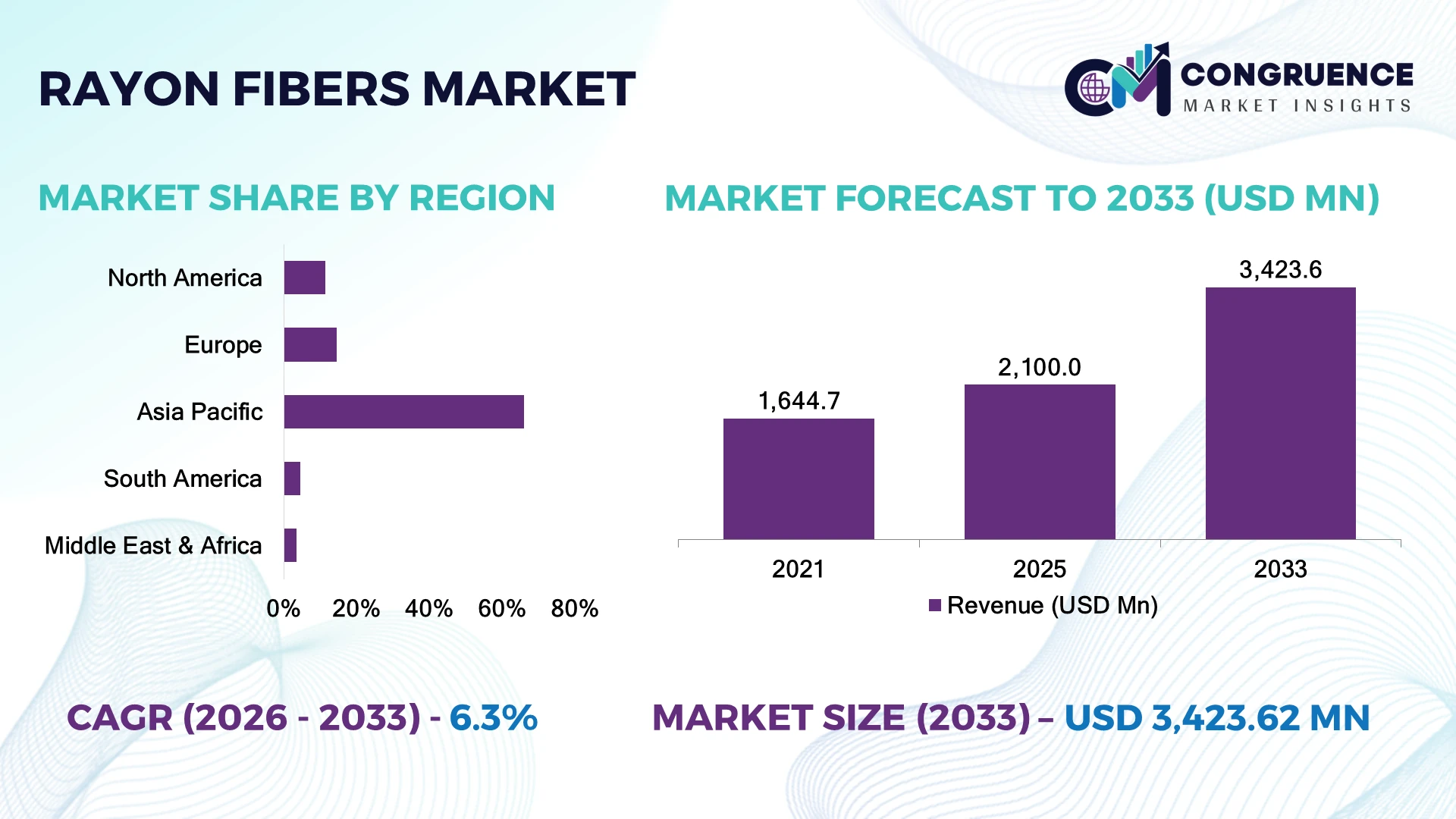
China remains the dominant manufacturing hub, accounting for roughly 63% of global rayon-fiber production, while Asia Pacific represented about 66% of market activity in 2025. India is strengthening its position through large-scale viscose investments, including nearly INR 9,000 crore invested across viscose operations during 2015–2025. China’s production scale remains substantially larger, while India is accelerating technology modernization and sustainable fiber capacity. The U.S. and European markets increasingly favor traceable, certified cellulosic fibers, creating premium opportunities.
Strategically, producers with integrated pulp sourcing, closed-loop recovery, and certified fiber portfolios are best positioned to capture high-value textile demand.
Market Size & Growth: USD 2,100.0 million in 2025 is projected to reach USD 3,423.6 million by 2033 at 6.3% CAGR, supported by increasing lyocell and modal output.
Top Growth Drivers: Lyocell adoption 8.52%; medical textiles 7.83%; filament fibers 7.11%.
Short-Term Forecast: By 2028, automated quality control and process optimization are positioned to deliver 5–8% efficiency gains across advanced production lines.
Emerging Technologies: Closed-loop solvent recovery, AI-enabled quality monitoring, recycled textile pulp, and advanced lyocell processing are reshaping production economics.
Regional Leaders: Asia Pacific is projected toward USD 17.7 billion by 2030; Europe benefits from certified fibers; North America is advancing at 7.13% growth through traceable sourcing.
Consumer/End-User Trends: Apparel represented 54.61% of the market in 2025, while sustainability-led premium textile adoption continues expanding across fashion supply chains.
Pilot/Case Example: In 2025, regenerated cellulose production increased about 4% to 8.7 million tons, while lyocell and modal output advanced at double-digit rates.
Competitive Landscape: Aditya Birla leads with approximately 16.8% share, followed by Lenzing at 12.3%, Sateri at 8.7%, and Tangshan Sanyou at 7.2%.
Regulatory & ESG Impact: Closed-loop systems achieving above 99% solvent recovery are strengthening environmental performance while tightening textile traceability requirements favor certified fibers.
Investment & Funding: India’s viscose industry recorded nearly INR 9,000 crore in investment during 2015–2025, emphasizing modernization, capacity expansion, and environmentally responsible manufacturing.
Innovation & Future Outlook: Recycled cellulose feedstocks, specialty modal, next-generation lyocell, and digital production controls are shifting competition from volume toward traceability, efficiency, and differentiated fiber performance.
Rayon fibers are gaining traction in apparel, home textiles, hygiene, medical materials, and specialty nonwovens, with apparel accounting for 54.61% of market activity. Product innovation is moving toward recycled cellulose, low-impact processing, and high-performance regenerated fibers, while tighter textile traceability requirements and supply-chain restructuring are accelerating investment in certified production systems and integrated sourcing.
The rayon fibers market is becoming strategically important as textile manufacturers balance cost, fiber performance, sustainability compliance, and supply-chain resilience. Regenerated cellulose production reached approximately 8.7 million tons in 2025, while lyocell and modal output recorded double-digit growth. This shift is redirecting investment toward specialty fibers rather than commodity-only capacity.
Technology is becoming a decisive differentiator. Closed-loop lyocell production can recover more than 99% of process solvent, creating a measurable environmental and material-efficiency advantage over conventional chemically intensive processing. China retains the strongest production scale, while India is expanding manufacturing depth and Europe is emphasizing certified, traceable fiber platforms. Over the next 2–3 years, automated process monitoring, recycled feedstock integration, and specialty-fiber capacity are expected to become increasingly important operational indicators.
A practical deployment pathway is the integration of recycled textile pulp into viscose production, with technology already demonstrating blends containing up to 50% recycled textile pulp. Companies are responding through capacity modernization, vertical pulp-to-fiber integration, technology partnerships, and premium branded-fiber development. Competitive advantage will increasingly depend on combining manufacturing scale with traceability, resource efficiency, and differentiated fiber performance.
The strongest growth driver is the substitution of conventional textile inputs with regenerated cellulose fibers offering improved biodegradability and performance credentials. Regenerated cellulose production increased about 4% to 8.7 million tons in 2025, while lyocell and modal production advanced at double-digit rates. European brands are tightening fiber traceability, while Indian and Chinese producers are expanding advanced viscose and lyocell capabilities. This demand shift is pushing manufacturers toward closed-loop processing, recycled pulp, and certified forestry inputs. Companies are responding through modernization and integrated sourcing rather than simply adding commodity capacity. The strategic advantage is clear: specialty-cellulose investment improves product differentiation while reducing exposure to increasingly stringent sustainability requirements.
Rayon production remains exposed to dissolving-pulp availability, chemical-input costs, energy intensity, and environmental-compliance expenditure. Viscose accounted for 67.38% of the market in 2025, leaving producers highly exposed to cost movements within the dominant processing pathway. China’s large manufacturing base also creates intense price competition, while tighter effluent and emissions requirements increase operating costs for older facilities. Supply-chain disruption involving pulp, chemicals, or energy can directly compress margins and interrupt production schedules. Manufacturers are reducing exposure through integrated pulp sourcing, longer-term procurement contracts, geographical diversification, and higher-efficiency recovery systems. The operational priority is shifting from maximum volume utilization toward cost-controlled, compliant production with greater feedstock security.
Recycled textile feedstocks create a differentiated opportunity beyond conventional viscose expansion. Production technologies can incorporate up to 50% recycled textile pulp into viscose fiber, opening a route toward textile-to-textile circularity while reducing dependence on virgin dissolving pulp. Lyocell is also expanding at 8.52%, reinforcing demand for higher-value regenerated cellulose technologies. India, China, and Southeast Asian textile clusters offer strong opportunities for localized recycling ecosystems linking garment waste, pulp processing, fiber manufacturing, and yarn production. Companies are investing in feedstock trials, advanced sorting, closed-loop systems, and partnerships across textile value chains. The non-obvious advantage is greater control over future raw-material availability while creating premium fiber propositions for brands facing traceability and circularity targets.
Scaling next-generation rayon technologies requires consistent feedstock quality, specialized process engineering, skilled operators, and reliable recovery infrastructure. Lyocell’s projected 8.52% growth is increasing pressure to commercialize advanced capacity without compromising quality or cost competitiveness. Recycled textile pulp adds another execution layer because sorting and contamination control must achieve consistent input specifications. Meanwhile, global textile supply chains remain fragmented across spinning, weaving, dyeing, and garment production, complicating end-to-end traceability. Companies must therefore invest in automated quality inspection, digital material tracking, workforce training, and supplier partnerships. The strategic challenge is not simply building capacity; it is maintaining consistent fiber specifications and environmental performance across scaled production while meeting increasingly demanding brand and regulatory requirements.
Lyocell Capacity Moves Closer: Asian producers are expanding lyocell capacity as its price gap with conventional viscose narrows, while lyocell represented about 5% of global manmade cellulosic fiber output in 2024. Companies are prioritizing closed-loop lines, specialty grades, and shorter regional supply chains to improve resource efficiency and reduce logistics exposure.
Recycled Feedstock Enters Production: Recycled and alternative feedstocks accounted for only about 1.1% of manmade cellulosic fiber production, creating a clear transition opportunity. Textile manufacturers are moving from pilot recycling toward controlled pulp integration, while brands are forming offtake partnerships. The operational shift is significant because feedstock localization can reduce dependence on virgin wood pulp.
Nonwoven Applications Gain Scale: Lyocell is moving beyond apparel into wipes, hygiene, and medical nonwovens, where biodegradable fiber specifications are gaining importance. In 2026, a 100,000-ton-capacity Thai facility began producing nonwoven-grade lyocell, shortening supply routes for Asian customers. Producers are reallocating capacity toward application-specific grades and direct enterprise supply models.
Traceability Reshapes Procurement: European textile policy is accelerating material transparency, with less than 1% of textiles currently recycled and EU-wide textile EPR requirements targeted for 2028. Companies are responding with certified cellulose sourcing, digital traceability, and supplier restructuring. The non-obvious shift is that compliance is increasingly becoming a procurement qualification, not merely an ESG reporting exercise.
Viscose rayon remains the dominant type, accounting for approximately 67.38% of the rayon fibers market in 2025. Its scale advantage comes from established wet-spinning infrastructure, broad compatibility with conventional textile machinery, and lower production economics across China, India, and Southeast Asia. Modal occupies a premium middle position, supported by softness, moisture management, and durability, while lyocell is the fastest-growing type at approximately 8.52%, driven by closed-loop processing and stronger brand preference for traceable cellulosics.
The market is therefore dividing between high-volume viscose and higher-value specialty fibers. Lyocell's share of global manmade cellulosic production was about 5% in 2024, compared with roughly 80% for viscose, showing the scale gap that producers are attempting to close. Cuprammonium rayon remains niche, particularly in premium Japanese textiles. Companies are directing new investment toward lyocell capacity, modal differentiation, and lower-impact viscose rather than abandoning the established viscose base.
Apparel is the leading application, representing approximately 54.61% of rayon fiber demand in 2025. Its dominance reflects rayon's drape, dye affinity, breathability, and compatibility with cotton and synthetic blends across dresses, shirts, denim, intimate apparel, and casualwear. Home textiles remain an important mature application, while healthcare and hygiene are emerging faster, with medical textiles expanding at approximately 7.83% as manufacturers seek soft, absorbent, and high-purity cellulose materials.
The application mix is becoming more diversified. Apparel retains volume leadership, but hygiene wipes, medical nonwovens, and specialized healthcare products are increasing the importance of application-specific fiber engineering. Companies are responding through customized denier profiles, controlled absorbency, biodegradable grades, and direct partnerships with converters. The shift is particularly relevant in China, Japan, and the United States, where healthcare standards and premium hygiene products demand tighter fiber specifications. This diversification reduces dependence on fashion cycles and strengthens the operational role of rayon in performance-oriented applications.
Textile and apparel manufacturers represent the dominant rayon-fiber buyer group, accounting for approximately 63.05% of viscose staple fiber demand in 2025. Their purchasing concentration reflects high-volume spinning requirements, established Asian manufacturing clusters, and rayon's compatibility with ring, rotor, and other conventional yarn-processing systems. Home-furnishing producers form another established customer base, while healthcare and medical users are becoming the fastest-expanding specialized buyers as demand for high-purity absorbent fibers increases.
Healthcare and hygiene applications are shifting purchasing behavior from price-led procurement toward specification-led sourcing. Medical and healthcare demand for viscose staple fiber is advancing at approximately 6.79%, supported by wound-care materials, gauze, wipes, and disposable medical products. Automotive and industrial users remain smaller but strategically relevant because high-tenacity rayon provides reinforcement performance. Companies are responding with application-specific grades, technical partnerships, long-term contracts, and differentiated fiber portfolios. The competitive implication is that textile mills continue to provide scale, while healthcare and technical buyers increasingly support higher-value product development.
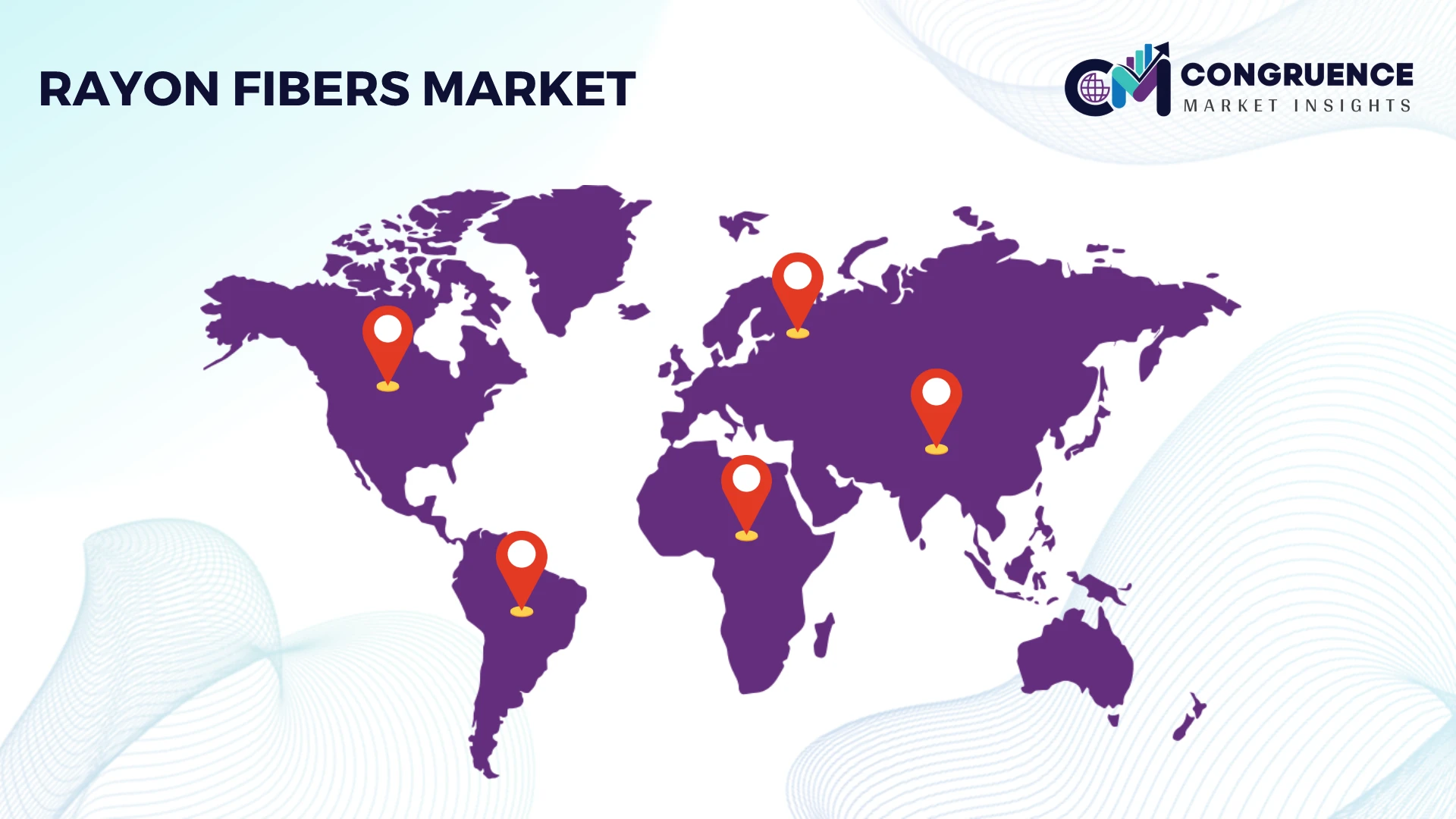
Asia Pacific accounted for the largest market share at 66.0% in 2025 however, North America is expected to register the fastest growth, expanding at a CAGR of 7.13% between 2026 and 2033.
North America accounted for approximately 11.5% of the global rayon fibers market in 2025, led by the United States, which represented nearly 8.2% of global demand. The region is primarily consumption-driven, with apparel, hygiene, healthcare, and premium home textiles absorbing specialty viscose, modal, and lyocell. Certified-cellulosic procurement is expanding as major U.S. brands strengthen fiber traceability and sustainability requirements. Companies are responding through longer-term contracts, supplier diversification, and partnerships with Asian and European fiber manufacturers. The region's operational advantage lies in premium product specifications rather than commodity-scale production, supporting greater adoption of specialty grades and traceable fibers.
U.S. Market Outlook: The United States held approximately 8.2% of the global rayon fibers market in 2025 and accounted for roughly 71% of North American demand. Its large apparel, hygiene, healthcare, and home-textile industries create substantial downstream consumption. Import-oriented supply chains give U.S. buyers strong influence over fiber certification, product specifications, and supplier qualification, accelerating adoption of premium rayon and lyocell grades.
Europe represented approximately 14.5% of the global rayon fibers market in 2025, making it the second-largest regional market after Asia Pacific. Germany, Italy, France, Spain, and the United Kingdom account for a substantial proportion of European consumption, supported by advanced apparel, fashion, technical-textile, and home-furnishing industries. Approximately 1% of clothing material is currently recycled into new clothing, strengthening pressure for circular textile systems and recycled-cellulose inputs. European manufacturers are increasing certified viscose procurement, recycled-fiber partnerships, digital traceability, and supplier audits. Companies are increasingly treating fiber provenance as a procurement criterion, shifting competition toward verified environmental performance and supply-chain transparency.
Germany Market Outlook: Germany accounted for approximately 3.2% of the global rayon fibers market in 2025 and nearly 22% of European demand. Its advanced technical-textile industry, sophisticated manufacturing base, and stringent sustainability requirements support premium rayon and specialty-cellulose adoption. German buyers increasingly prioritize certified inputs, lifecycle performance, and traceability, encouraging suppliers to develop differentiated fiber grades rather than compete solely on price.
Asia Pacific dominated the global rayon fibers market with approximately 66.0% share in 2025. China contributed nearly 39.0% of global market activity, followed by India at approximately 9.5%, while Indonesia, Japan, South Korea, and Southeast Asian textile hubs supplied the remaining regional demand. China's integrated pulp-to-fiber-to-textile infrastructure provides substantial scale and cost advantages, while India is expanding advanced cellulosic capacity. Approximately 890,000 tons per annum of cellulosic staple-fiber capacity was operated by a leading Indian producer at around 97% utilization in fiscal 2026. Companies are directing capital toward lyocell, modal, specialty viscose, and closed-loop technologies while strengthening vertical integration.
China Market Outlook: China held approximately 39.0% of the global rayon fibers market in 2025 and nearly 59% of Asia-Pacific demand. Its extensive rayon manufacturing base connects pulp processing with spinning, weaving, dyeing, and garment production across major industrial clusters. This integration lowers conversion and logistics friction, enabling Chinese producers to supply both domestic manufacturers and export-oriented textile companies while rapidly scaling specialty-fiber production.
South America accounted for approximately 4.5% of the global rayon fibers market in 2025, with Brazil representing nearly 2.8% of global demand and more than 60% of regional consumption. The region remains primarily downstream-oriented, with apparel, home textiles, and blended fabrics generating most rayon requirements. Brazil's established spinning, weaving, garment, and retail infrastructure provides the strongest demand base, although large-scale local rayon production remains limited. Imported fibers therefore play an important role in supply continuity. Companies are responding through diversified sourcing, regional warehousing, direct supplier agreements, and greater procurement of certified viscose. The key operational constraint is logistics exposure, making inventory positioning increasingly important for Brazilian textile manufacturers.
Brazil Market Outlook: Brazil accounted for approximately 2.8% of the global rayon fibers market in 2025 and nearly 62% of South American consumption. Its large domestic apparel industry and established textile-processing infrastructure create the region's strongest downstream platform. Manufacturers increasingly use rayon in lightweight garments, blended fabrics, bedding, and fashion textiles, while sustainability-focused retailers are strengthening demand for certified and traceable cellulose fibers.
The Middle East & Africa accounted for approximately 3.5% of the global rayon fibers market in 2025. Türkiye, Egypt, South Africa, and Ethiopia represent the principal consumption and textile-manufacturing centers, with Türkiye contributing approximately 1.1% of global demand. Egypt and Ethiopia are expanding export-oriented textile and apparel capabilities, creating additional demand for imported viscose and specialty fibers. Regional manufacturers are increasingly integrating spinning, garment production, and textile finishing into industrial clusters. Companies are responding through distributor partnerships, localized inventory, and direct procurement agreements with Asian fiber producers. The most important opportunity lies in connecting imported rayon supplies with expanding downstream textile capacity rather than developing standalone fiber production.
Türkiye Market Outlook: Türkiye accounted for approximately 1.1% of the global rayon fibers market in 2025 and around 31% of Middle East & Africa demand. Its integrated textile manufacturing base, proximity to European fashion markets, strong spinning capacity, and established export infrastructure make it the region's most strategically significant rayon consumer. Manufacturers increasingly favor specialty and certified fibers to satisfy European buyer requirements and improve product differentiation.
The rayon fibers market pits Birla Cellulose, Sateri, and Lenzing against Chinese scale producers such as Tangshan Sanyou and Fulida, with specialty innovators competing on sustainability, performance, and customization. The top five players collectively control approximately 45% of the market, indicating moderate concentration. Price remains decisive in commodity viscose, while 8–12% premium positioning is increasingly supported by specialty lyocell, modal, and certified fibers. Closed-loop technologies can deliver more than 99% solvent recovery, strengthening environmental differentiation. Players are expanding lyocell capacity, integrating pulp supply, partnering with textile mills, and developing recycled-cellulose grades. The competitive shift is moving from volume leadership toward feedstock control, specialty-fiber innovation, traceability, and application engineering. Entry barriers remain high because new producers require large-scale infrastructure, qualified pulp supply, environmental controls, and downstream customer validation. Chinese producers retain cost advantages, while European and Indian leaders emphasize premiumization. Winning requires integrated sourcing, efficient production, differentiated fibers, and customer partnerships.
Grasim Industries Limited (Birla Cellulose)
Lenzing AG
Sateri
Asia Pacific Rayon
Tangshan Sanyou Chemical Industries
Fulida Group
Kelheim Fibres GmbH
Nanjing Chemical Fibre Co., Ltd.
Xinxiang Chemical Fiber Co., Ltd. (Xinxiang Bailu)
Jilin Chemical Fiber Co., Ltd.
Thai Rayon Public Company Limited
Indo Rama Synthetics
Rayon-fiber technology is shifting from conventional viscose chemistry toward closed-loop lyocell, low-impact viscose, recycled-cellulose feedstocks, and application-specific fiber engineering. Closed-loop lyocell recovers more than 99% of process solvent, while advanced viscose systems increasingly combine chemical recovery with tighter emissions controls. Recycled feedstock remains early-stage: only about 1.1% of global manmade cellulosic fibers used recycled or alternative feedstocks in 2024, leaving substantial room for deployment through 2028.
Waterless dyeing is another disruptive layer. ECOHUES technology demonstrated up to 95% lower water use and 40% lower dye consumption versus conventional dyeing, improving mill-level resource efficiency without changing the underlying fiber. Fine lyocell dry fibers can also deliver up to 30% more cellulosic fiber in the same nonwoven space, supporting higher-density hygiene products. These improvements favor producers able to integrate fiber development with downstream processing partnerships.
From 2026–2028, the strongest competitive gains will come from combining recycling, digital quality control, closed-loop processing, and localized specialty-fiber capacity. Lenzing, Sateri, Birla Cellulose, and other integrated producers benefit because they can connect pulp, fiber, application development, and brand qualification. Companies acting now can secure customer validation earlier, reduce process-resource intensity, differentiate premium rayon grades, and shorten customer qualification cycles materially before circular feedstock becomes mainstream globally.
June 2026 Grasim Industries approved ₹3,094 crore for 110,000 tonnes annually of new lyocell capacity at Harihar, Karnataka. Combined lyocell capacity is targeted near 210,000 tonnes. The expansion strengthens premium-fiber scale and supports India’s sustainable textile competitiveness globally. Source: Fibre2Fashion
March 2026 Lenzing began nonwoven-grade VEOCEL™ lyocell production in Thailand, using a 100,000-ton annual-capacity site. The localized output shortens Asian supply routes and lead times while reducing transport exposure, strengthening regional hygiene-fiber availability for fast-growing Asian hygiene markets. Source: Lenzing
April 2025 Asia Pacific Rayon introduced viscose and lyocell products to Vietnam through SaigonTex, its largest presence there. The rollout expanded customer engagement in a fast-growing textile hub and reinforced regional adoption of sustainable fibers and supply-chain resilience. Source: Asia Pacific Rayon
November 2025 India rescinded its Quality Control Order for viscose staple fiber, addressing supply constraints and higher raw-material costs. The policy change improves accessibility for textile manufacturers and exporters, supporting smoother procurement and stronger downstream competitiveness and mills. Source: Press Information Bureau
The Rayon Fibers Market Report covers the industry across viscose, modal, lyocell, cuprammonium rayon, and other relevant fiber categories, evaluating their use across apparel, home textiles, healthcare, hygiene, and technical applications. End-user analysis examines textile manufacturers, healthcare producers, home-furnishing companies, automotive and industrial users, and other specialized buyers.
Geographic coverage spans North America, Europe, Asia-Pacific, South America, and the Middle East & Africa, with country-level assessment of manufacturing concentration, imports, capacity, technology adoption, and supply-chain positioning. The report also evaluates closed-loop processing, recycled-cellulose feedstocks, advanced lyocell, specialty viscose, and digital quality systems. With viscose representing about 80% of global manmade cellulosic fiber production in 2024, the analysis distinguishes mature volume markets from higher-value specialty segments. Strategic findings support investment planning, capacity expansion, supplier selection, competitive positioning, partnership decisions, and market-entry priorities through 2033.
| Report Attribute / Metric Details | Details |
|---|---|
| Market Revenue (2025) | USD 2,100.0 Million |
| Market Revenue (2033) | USD 3,423.6 Million |
| CAGR (2026–2033) | 6.3% |
| Base Year | 2025 |
| Forecast Period | 2026–2033 |
| Historic Period | 2021–2025 |
| Segments Covered |
By Type
By Application
By End-User
|
| Key Deliverables | Revenue Forecast; Market Trends; Growth Drivers & Restraints; Technology Insights; Segmentation Analysis; Regional Insights; Competitive Landscape; Regulatory & ESG Overview; Recent Developments |
| Regions Covered | North America; Europe; Asia-Pacific; South America; Middle East & Africa |
| Companies Profiled | Grasim Industries Limited (Birla Cellulose); Lenzing AG; Sateri; Asia Pacific Rayon; Tangshan Sanyou Chemical Industries; Fulida Group; Kelheim Fibres GmbH; Nanjing Chemical Fibre Co., Ltd.; Xinxiang Chemical Fiber Co., Ltd. (Xinxiang Bailu); Jilin Chemical Fiber Co., Ltd.; Thai Rayon Public Company Limited; Indo Rama Synthetics |
| Customization & Pricing | Available on Request (10% Customization Free) |




