
Reports
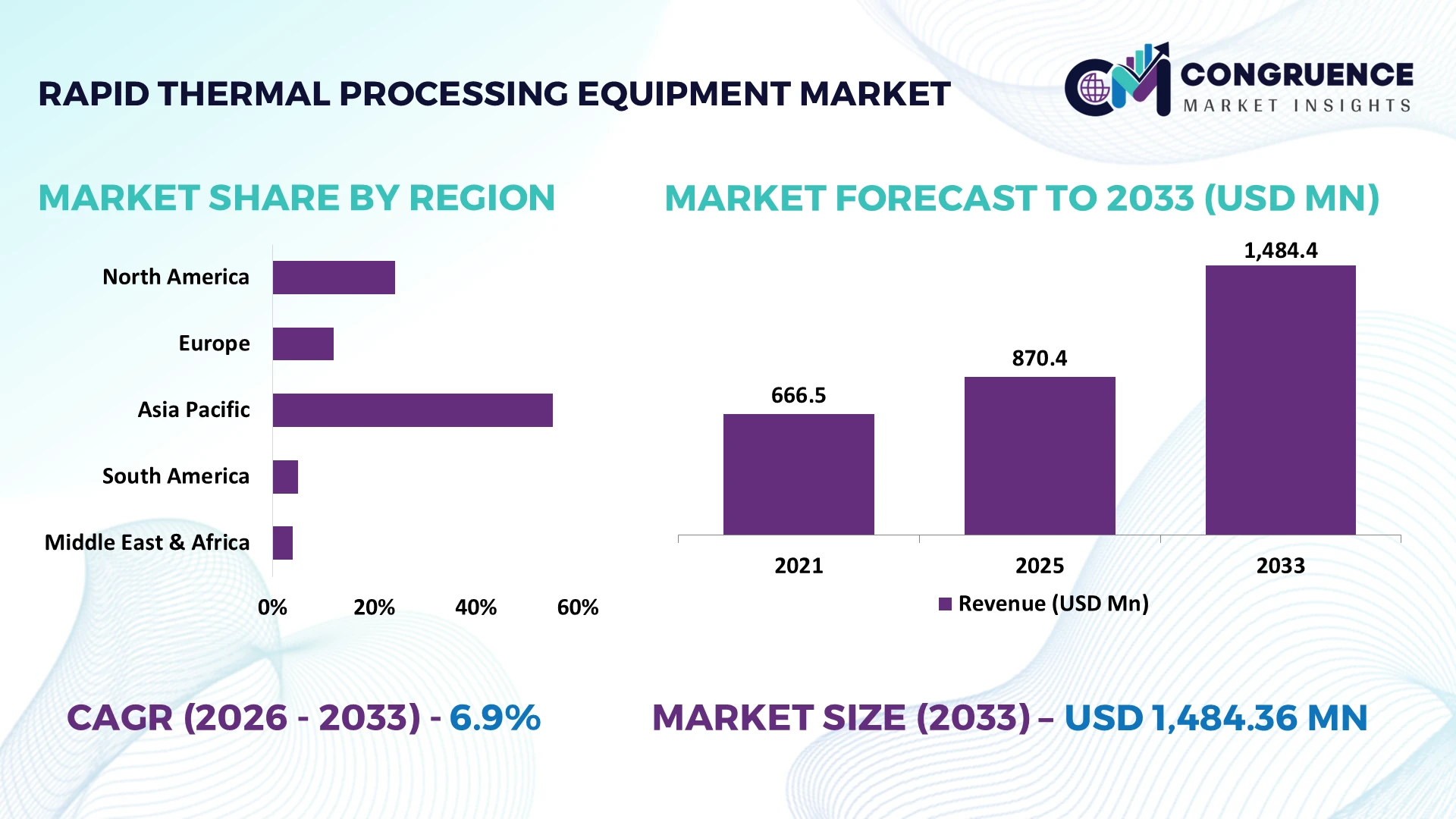
The Global Rapid Thermal Processing Equipment Market was valued at USD 870.4 Million in 2025 and is anticipated to reach a value of USD 1,484.4 Million by 2033 expanding at a CAGR of 6.9% between 2026 and 2033. Growth is driven by advanced semiconductor node transitions, increased adoption of rapid thermal annealing in transistor fabrication, and tighter thermal-budget requirements for high-performance logic and memory devices.
China represents a major demand center for rapid thermal processing equipment, supported by semiconductor localization and expanding domestic wafer fabrication capacity. The country accounted for approximately 28% of global semiconductor manufacturing capacity in 2025, compared with Taiwan's approximately 17%, based on industry capacity estimates. China's semiconductor equipment localization initiatives, reinforced by U.S. export restrictions, are accelerating domestic thermal processing technology development and qualification across 200 mm and 300 mm fabrication lines.
Strategically, equipment manufacturers must prioritize process uniformity, localized technical support, and compatibility with advanced semiconductor architectures to secure long-term fabrication equipment contracts.
Market Size & Growth: The market reached USD 870.4 Million in 2025 and is projected to attain USD 1,484.4 Million by 2033, registering 6.9% CAGR as advanced semiconductor manufacturing expands thermal annealing requirements.
Top Growth Drivers: Advanced logic fabrication, 3D NAND manufacturing, and power semiconductor production represent three major demand drivers, supported by estimated application growth indicators of 8%, 7%, and 9%, respectively.
Short-Term Forecast: By 2028, advanced temperature-control upgrades are expected to improve thermal uniformity by approximately 10–15% in qualified production applications.
Emerging Technologies: AI-assisted process control, multizone lamp heating, and millisecond annealing technologies are advancing thermal precision for sub-5 nm semiconductor manufacturing.
Regional Leaders: Indicative 2033 market allocations place Asia Pacific at USD 816.4 Million, North America at USD 356.3 Million, and Europe at USD 207.8 Million, reflecting foundry expansion, advanced logic investment, and power semiconductor adoption, respectively.
Consumer/End-User Trends: Semiconductor foundries and integrated device manufacturers increasingly prioritize 300 mm wafer processing, with advanced fabrication facilities targeting thermal uniformity deviations below 1%.
Pilot/Case Example: In 2025, advanced millisecond annealing development programs targeted approximately 10% improvements in process-window control for high-density semiconductor devices.
Competitive Landscape: Applied Materials is a leading thermal processing equipment supplier; estimated segment leadership exceeds 20%, alongside competition from Tokyo Electron, Kokusai Electric, Mattson Technology, and SCREEN Holdings.
Regulatory & ESG Impact: U.S. CHIPS Act incentives and European semiconductor policies encourage domestic manufacturing, while optimized thermal cycles target 10–20% energy savings in selected process configurations.
Investment & Funding: The U.S. CHIPS Act allocated approximately USD 52.7 Billion for semiconductor manufacturing and research initiatives, supporting equipment localization and fabrication infrastructure.
Innovation & Future Outlook: Sub-2 nm transistor development, gate-all-around architectures, and advanced silicon carbide processing are shifting equipment competition toward precise thermal-budget management.
The rapid thermal processing equipment market is increasingly shaped by semiconductor foundry modernization, advanced memory manufacturing, and silicon carbide power electronics. AI-enabled thermal monitoring and sophisticated multizone heating architectures are improving wafer-level process consistency, with selected optimized processes targeting approximately 15% lower thermal energy consumption. Semiconductor supply-chain localization is also changing equipment qualification strategies, creating distinct competitive priorities across major manufacturing hubs.
Rapid thermal processing equipment is becoming strategically important because advanced semiconductor manufacturing increasingly depends on precise dopant activation, thin-film modification, and defect control without excessive thermal exposure. The transition toward gate-all-around transistors, advanced DRAM, and silicon carbide devices is strengthening demand for tightly controlled annealing processes. Semiconductor supply-chain restructuring in the United States, Japan, and China is simultaneously influencing equipment procurement, supplier qualification, and manufacturing localization.
Compared with conventional furnace processing, rapid thermal processing delivers significantly shorter thermal cycles, often measured in seconds rather than extended batch-processing periods. Optimized systems can reduce selected process heating durations by more than 90%, although throughput advantages depend on wafer handling and process architecture. Taiwan and South Korea emphasize high-volume advanced-node integration, while Germany and Japan prioritize power semiconductor reliability and specialized process development.
Between 2027 and 2029, equipment manufacturers are expected to expand AI-assisted temperature control, multizone heating, and advanced process monitoring, targeting approximately 10–15% improvements in selected uniformity and process-control indicators. Silicon carbide annealing applications provide a practical deployment pathway as electric vehicle power electronics manufacturers increase production capacity. Suppliers are strengthening foundry partnerships, regional service networks, and application engineering capabilities. Competitive advantage will increasingly depend on reproducible process performance, integration flexibility, and reduced manufacturing variability.
The transition toward gate-all-around transistors, advanced DRAM, and high-density semiconductor structures is increasing the importance of precise thermal-budget management. Sub-3 nm logic manufacturing requires tighter dopant activation control and reduced diffusion variability, while next-generation memory architectures demand consistent wafer-level thermal performance. Advanced fabrication applications increasingly target temperature uniformity within approximately ±1%, alongside potential 10–15% improvements in process stability through optimized control algorithms. Taiwan's advanced foundry investments and South Korea's memory technology upgrades reinforce this transition. Equipment manufacturers are expanding multizone lamp heating capabilities, integrating predictive temperature monitoring, and strengthening process-development partnerships. The decisive advantage lies in improving electrical yield without extending fabrication cycle times or compromising device reliability.
Rapid thermal processing equipment deployment faces structural constraints associated with specialized heating assemblies, precision pyrometry, vacuum-compatible components, and extensive semiconductor qualification requirements. Advanced thermal systems can require approximately 15–25% higher initial investment than simpler legacy configurations, depending on automation and process specifications. Equipment installation and qualification can consume 10–20% of implementation budgets in complex fabrication environments, while specialized component procurement increases exposure to supplier concentration. U.S. semiconductor technology export restrictions further complicate equipment sourcing for Chinese manufacturers. Suppliers are responding through component standardization, alternative sourcing, localized service inventories, and multiyear procurement agreements. The principal commercial constraint is the cost of achieving production-qualified repeatability rather than equipment acquisition alone.
Silicon carbide power semiconductor expansion is creating opportunities for specialized rapid thermal processing platforms capable of managing demanding activation and contact-formation conditions. Advanced SiC fabrication requires temperatures that can exceed 1,500°C for selected processes, creating demand for high-temperature-compatible chambers and precise thermal control. Optimized annealing technologies offer potential 10–15% improvements in selected process consistency indicators, while automated recipe management can target approximately 8–12% reductions in process-development time. Japan's power electronics ecosystem and India's emerging semiconductor manufacturing initiatives offer opportunities for specialized equipment suppliers. Companies are investing in high-temperature process modules, collaborative application development, and localized engineering support. The strategic opportunity extends beyond equipment sales into process optimization, specialized maintenance, and recurring technical services.
Scaling rapid thermal processing across advanced semiconductor production lines requires precise coordination between thermal recipes, wafer handling, metrology systems, and manufacturing execution software. Temperature variations approaching 1% can materially affect sensitive semiconductor processes, while recipe-transfer differences between equipment platforms create additional yield-management challenges. Advanced fabs increasingly target equipment availability above 95%, placing substantial pressure on preventive maintenance and automated fault detection. Japan's semiconductor manufacturing expansion highlights the importance of experienced process engineers and equipment integration specialists. Manufacturers must strengthen digital-twin validation, real-time diagnostics, standardized process interfaces, and technical workforce development. Long-term competitiveness depends on transferring laboratory-qualified thermal processes into high-volume manufacturing without sacrificing wafer uniformity, equipment uptime, or production reproducibility.
AI-Enabled Thermal Recipe Optimization: Semiconductor manufacturers are integrating machine learning into thermal recipe tuning, temperature monitoring, and equipment fault classification. Advanced process-control systems target approximately 10–15% reductions in recipe adjustment cycles and 8–12% improvements in process consistency. Equipment suppliers are expanding software integration partnerships and predictive analytics capabilities, enabling fabrication plants to reduce engineering intervention and stabilize wafer processing across production shifts.
Automated Wafer Handling Gains Momentum: Semiconductor fabrication facilities are upgrading robotic wafer transfer, chamber scheduling, and automated equipment interfaces to reduce handling-related contamination. Modern 300 mm processing lines target equipment availability above 95%, while automated transfer systems can reduce selected handling intervals by 15–20%. Manufacturers are integrating advanced robotics and factory automation protocols to improve throughput predictability and reduce operator-dependent process variability.
Localized Equipment Servicing Reshapes Operations: U.S. semiconductor manufacturing incentives and technology export restrictions are accelerating regional service-network restructuring. Equipment suppliers are targeting 15–25% reductions in critical spare-part delivery times through localized inventories, while remote diagnostic systems aim to reduce troubleshooting cycles by approximately 20%. Companies are expanding technical support operations in Arizona, Texas, and Japan, making service responsiveness an increasingly important equipment procurement criterion.
Thermal Energy Monitoring Becomes Standardized: Semiconductor manufacturers are implementing chamber-level energy monitoring and idle-state power management to control operating expenses. Optimized standby configurations target approximately 10–18% reductions in nonproductive energy consumption, while integrated monitoring platforms improve energy-use visibility across 100% of connected processing chambers. Equipment providers are incorporating automated power-state management and digital performance dashboards, helping fabs distinguish productive heating energy from avoidable standby losses.
Lamp-based equipment represents the leading segment of the rapid thermal processing equipment market, accounting for approximately 65% of the market in 2025. Its dominance reflects established deployment across semiconductor fabrication facilities, compatibility with 200 mm and 300 mm wafers, and reliable temperature control for annealing, oxidation, and dopant activation. Infrared lamp arrays provide rapid heating and cooling, supporting repeatable thermal profiles in high-volume production. Equipment manufacturers are strengthening multizone temperature control, chamber automation, and process monitoring to improve wafer uniformity and reduce production variability.
Laser-based equipment represents approximately 35% of the market and is the fastest-growing type, supported by increasing adoption of localized thermal processing and ultrashort heating cycles. Laser systems deliver millisecond-scale thermal exposure, enabling selective surface modification while limiting heat penetration into underlying structures. Compared with established lamp-based platforms, laser processing offers greater spatial selectivity for specialized semiconductor applications. Suppliers are expanding laser annealing capabilities, developing integrated metrology solutions, and collaborating with advanced fabrication customers to strengthen process qualification and equipment differentiation.
Industrial applications dominate the rapid thermal processing equipment market, accounting for approximately 82% of equipment demand in 2025. Semiconductor manufacturing facilities represent the primary deployment environment, where thermal processing supports dopant activation, oxidation, contact formation, and wafer surface modification. High-volume fabrication operations require repeatable temperature profiles, automated wafer handling, and compatibility with existing production infrastructure. Industrial customers increasingly prioritize equipment availability above 95%, making chamber reliability and process stability important purchasing criteria. Manufacturers are expanding production-qualified platforms and integrating advanced temperature monitoring to improve operating consistency.
Research and development applications represent approximately 18% of the market and are gaining importance through semiconductor materials experimentation and process qualification. Universities, technology institutes, and corporate research laboratories require flexible equipment supporting multiple wafer sizes, programmable heating profiles, and specialized processing atmospheres. Compared with industrial installations, research systems emphasize configuration flexibility and experimental repeatability rather than maximum throughput. Equipment suppliers are developing compact platforms, modular gas-control systems, and customizable process software to strengthen laboratory adoption and accelerate technology transfer into commercial manufacturing.
Semiconductor manufacturing represents the dominant end-user segment, accounting for approximately 75% of rapid thermal processing equipment demand in 2025. Integrated device manufacturers and semiconductor foundries maintain the largest installed equipment bases because thermal processing is essential to wafer fabrication and device performance optimization. Large fabrication facilities prioritize 300 mm wafer compatibility, automated process control, and consistent equipment availability. Established semiconductor manufacturers in Taiwan, South Korea, and the United States emphasize production-qualified thermal systems, encouraging suppliers to strengthen equipment integration, maintenance capabilities, and long-term technical support partnerships.
Microelectronics and MEMS manufacturers represent an important specialized customer group, while research and academic institutions require configurable systems for materials characterization and experimental process development. Photovoltaic manufacturers are gaining attention as advanced solar cell architectures introduce more demanding thermal treatment requirements. These emerging end-user categories collectively represent approximately 25% of demand, with photovoltaic applications showing particularly strong development potential. Equipment manufacturers are responding through modular system designs, specialized heating configurations, and partnerships with research institutions and industrial technology developers to address differentiated operating requirements.
Asia Pacific accounted for the largest market share at 55.0% in 2025 however, North America is expected to register the fastest growth, expanding at a CAGR of 7.8% between 2026 and 2033.
North America accounted for approximately 24.0% of the global rapid thermal processing equipment market in 2025, supported by semiconductor fabrication investments, advanced logic manufacturing, and domestic supply-chain restructuring. The United States dominates regional demand through semiconductor manufacturing clusters in Arizona, Texas, Oregon, and New York. Federal semiconductor incentives are encouraging domestic wafer fabrication and strengthening procurement opportunities for precision annealing equipment. Intel, TSMC, and Samsung are expanding manufacturing capabilities, creating requirements for advanced temperature control, wafer processing automation, and equipment integration. The U.S. CHIPS and Science Act established approximately USD 52.7 billion in semiconductor manufacturing and research support, reinforcing long-term equipment infrastructure development. Suppliers are strengthening domestic service networks, application engineering teams, and partnerships with fabrication operators to reduce qualification delays and improve production continuity.
United States Market Outlook: The United States leads regional equipment adoption through advanced semiconductor manufacturing, process technology innovation, and strong research infrastructure. TSMC's Arizona manufacturing expansion includes three initial fabrication facilities, with additional facilities planned, supporting demand for production-qualified thermal processing systems. Intel's Oregon operations further strengthen advanced transistor development and process integration. Domestic equipment manufacturers benefit from proximity to leading semiconductor customers, specialized engineering capabilities, and established technical service networks.
Europe represented approximately 12.0% of the global rapid thermal processing equipment market in 2025, supported by automotive semiconductor manufacturing, industrial electronics, and specialized power device fabrication. Germany, France, Italy, and the Netherlands anchor regional semiconductor equipment demand through established manufacturing facilities and technology research networks. European semiconductor producers increasingly prioritize silicon carbide processing, thermal treatment precision, and equipment compatibility with automotive-grade reliability requirements. The European Chips Act aims to strengthen the region's semiconductor manufacturing capabilities and increase its global semiconductor market participation toward 20% by 2030. Companies including Infineon Technologies, STMicroelectronics, and Bosch are advancing semiconductor production infrastructure, encouraging investment in specialized thermal processing equipment. Equipment suppliers are emphasizing process customization, energy-efficient heating systems, and collaborative development with semiconductor research institutions to strengthen regional manufacturing competitiveness.
Germany Market Outlook: Germany represents Europe's strategically important rapid thermal processing equipment market, supported by semiconductor manufacturing clusters in Dresden, Munich, and Reutlingen. Infineon Technologies' Dresden Smart Power Fab investment of approximately EUR 5 billion strengthens domestic power semiconductor production infrastructure. Bosch's semiconductor operations reinforce demand for automotive-grade manufacturing equipment. German manufacturers prioritize equipment reliability, process traceability, and precise thermal treatment for silicon carbide and industrial semiconductor applications.
Asia Pacific dominated the global rapid thermal processing equipment market with approximately 55.0% share in 2025, reflecting extensive semiconductor fabrication capacity across China, Taiwan, South Korea, and Japan. Taiwan maintains leadership in advanced foundry manufacturing, while South Korea specializes in high-density memory production and advanced semiconductor processing. China continues expanding domestic fabrication infrastructure through industrial investment and semiconductor equipment localization programs. Japan contributes specialized equipment technologies, semiconductor materials expertise, and power electronics manufacturing capabilities. The region accounts for well over 70% of global semiconductor wafer fabrication capacity, creating substantial demand for thermal annealing, oxidation, and precision temperature-control systems. Equipment manufacturers are expanding regional application engineering capabilities, strengthening foundry relationships, and developing advanced process-control technologies. High manufacturing concentration also encourages suppliers to prioritize equipment availability, rapid maintenance response, and wafer-level process repeatability.
China Market Outlook: China represents a major rapid thermal processing equipment demand center through semiconductor fabrication expansion in Shanghai, Beijing, Shenzhen, and Wuhan. Domestic manufacturers including SMIC and Hua Hong Semiconductor are strengthening mature-node and specialty semiconductor manufacturing capabilities. China's estimated share of global semiconductor fabrication capacity approaches 28%, reinforcing its importance for equipment procurement. Technology export restrictions are accelerating domestic equipment qualification, localized component sourcing, and partnerships between semiconductor manufacturers and Chinese equipment developers.
South America accounted for approximately 5.0% of the global rapid thermal processing equipment market in 2025, reflecting a comparatively limited semiconductor fabrication base and concentrated demand from research institutions, electronics manufacturers, and specialized industrial facilities. Brazil represents the primary regional market, supported by semiconductor research infrastructure, microelectronics development, and industrial technology initiatives. Argentina and Chile contribute smaller demand volumes through academic research and specialized materials processing. Brazil's semiconductor development policies and industrial modernization initiatives are encouraging investment in domestic electronics capabilities. Regional procurement remains constrained by imported equipment dependence, specialized maintenance requirements, and limited advanced wafer fabrication capacity. Equipment suppliers are focusing on compact processing platforms, research-oriented configurations, and distributor partnerships. Technical training, equipment servicing, and access to specialized components remain important considerations for sustainable deployment.
Brazil Market Outlook: Brazil leads South America's rapid thermal processing equipment demand through semiconductor research institutions and electronics manufacturing clusters in São Paulo, Campinas, and Porto Alegre. The federal Brasil Semicon program, introduced in 2024, targets approximately BRL 7 billion annually in semiconductor industry support through 2026. Research organizations such as the Renato Archer Information Technology Center strengthen domestic microelectronics development. Equipment suppliers are prioritizing laboratory-scale thermal systems, technical training, and partnerships with specialized research facilities.
The Middle East & Africa represented approximately 4.0% of the global rapid thermal processing equipment market in 2025, supported by semiconductor research initiatives, industrial diversification, and emerging advanced manufacturing investments. Israel maintains an established semiconductor technology ecosystem, while Saudi Arabia and the United Arab Emirates are strengthening research infrastructure and industrial technology capabilities. South Africa contributes specialized demand through university laboratories, materials science research, and electronics development institutions. Regional equipment procurement primarily involves research-scale thermal processing systems and specialized semiconductor development facilities rather than extensive commercial wafer fabrication networks. Saudi Arabia's Vision 2030 industrial diversification agenda encourages technology localization and advanced manufacturing partnerships. Equipment manufacturers are developing regional distribution arrangements, application support capabilities, and collaborative research relationships to address technical infrastructure requirements and improve equipment accessibility.
Israel Market Outlook: Israel represents a strategically important semiconductor technology market within the Middle East & Africa, supported by advanced chip design, semiconductor manufacturing expertise, and established international technology partnerships. Intel's Kiryat Gat manufacturing operations provide an industrial foundation for semiconductor processing technologies. Israel's research institutions and semiconductor engineering workforce strengthen demand for specialized thermal treatment and process-development equipment. Equipment suppliers benefit from partnerships with technology developers, semiconductor research organizations, and advanced manufacturing enterprises.
The global rapid thermal processing equipment market features established semiconductor equipment manufacturers competing against specialized thermal processing innovators. Applied Materials, Tokyo Electron, Kokusai Electric, Mattson Technology, and Centrotherm compete through process precision, equipment reliability, and fabrication compatibility. The leading five suppliers collectively represent an estimated 65% of market activity, reflecting concentrated technology ownership and customer qualification requirements. Advanced thermal platforms target 10–15% improvements in temperature uniformity, while automated process control delivers approximately 8–12% reductions in selected operating inefficiencies. Applied Materials emphasizes integrated semiconductor processing, whereas specialized suppliers differentiate through configurable annealing systems and application engineering. Competition is shifting toward AI-assisted process optimization, localized service infrastructure, and tighter integration with advanced wafer fabrication workflows. Manufacturers are expanding technical partnerships, strengthening component sourcing, and investing in proprietary heating architectures. High qualification costs and stringent process repeatability requirements restrict entry. Competitive success depends on validated performance, responsive technical support, and manufacturing integration expertise.
Applied Materials, Inc.
Tokyo Electron Limited
Kokusai Electric Corporation
Mattson Technology, Inc.
centrotherm international AG
Annealsys
JTEKT Thermo Systems Corporation
ULVAC, Inc.
SCREEN Holdings Co., Ltd.
ASM International N.V.
CVD Equipment Corporation
Advanced Energy Industries, Inc.
Allwin21 Corporation
Lamp-based rapid thermal processing remains fundamental to semiconductor fabrication, delivering precise temperature control for dopant activation, oxidation, and contact formation. Multizone infrared heating, advanced pyrometry, and closed-loop temperature regulation improve wafer-level thermal uniformity. Modern configurations target approximately 10–15% better process consistency than older single-zone systems. Automated wafer handling and recipe management strengthen deployment across 300 mm fabrication facilities, where repeatability and equipment availability directly influence manufacturing yields.
Emerging technologies include laser spike annealing, millisecond thermal processing, and AI-assisted temperature control. Compared with conventional furnace annealing, advanced rapid thermal systems reduce selected heating cycles by more than 90%, limiting unwanted dopant diffusion and thermal exposure. Predictive analytics can improve process adjustment efficiency by approximately 10–12%, while integrated metrology supports faster deviation detection. Semiconductor foundries and equipment manufacturers benefit through tighter process windows, reduced engineering intervention, and improved production stability.
Between 2026 and 2028, technology development will increasingly emphasize advanced transistor architectures, selective thermal processing, and intelligent equipment integration. Digital twins, automated fault classification, and energy-aware chamber controls are expected to improve operational efficiency by approximately 8–15% in optimized applications. Suppliers investing in proprietary heating technologies, software integration, and collaborative process development will strengthen differentiation as semiconductor manufacturers prioritize qualified performance over equipment acquisition costs.
December 2025, Tokyo Electron launched EVAROS, a thermal processing system supporting 300 mm semiconductor wafers and batches of up to 200 wafers. Its multizone heater and faster wafer transfer improve manufacturing productivity and thermal control for advanced semiconductor fabrication. Source: tel.com.
February 2025, SCREEN Holdings announced an overseas semiconductor equipment research facility involving approximately JPY 11 billion in planned investment. The expansion targets faster development of annealing, cleaning, and advanced packaging technologies, strengthening customer collaboration and equipment competitiveness. Source: screen.co.jp.
June 2025, Kokusai Electric and Yokohama National University demonstrated ALD-Al₂O₃ bonding material deposition on 300 mm wafers. The collaboration addressed thermal resistance in next-generation 3D semiconductor integration, supporting improved heat management and advanced device manufacturing process development. Source: kokusai-electric.com.
August 2025, ULVAC presented its advanced packaging technology roadmap, including plasma surface activation for hybrid bonding and next-generation wafer processing. The company reported approximately 2.2 times targeted order expansion by fiscal 2031, strengthening its semiconductor equipment positioning. Source: ulvac.co.jp.
The Rapid Thermal Processing Equipment Market Report provides comprehensive analysis of semiconductor thermal processing technologies, competitive developments, and manufacturing investment priorities between 2026 and 2033. The study covers lamp-based and laser-based equipment, industrial and research applications, and end-users including semiconductor manufacturers, microelectronics and MEMS producers, photovoltaic manufacturers, and research institutions. It evaluates equipment performance, temperature uniformity, wafer compatibility, process automation, and advanced annealing technologies.
Geographical coverage includes North America, Europe, Asia Pacific, South America, and the Middle East & Africa, with Asia Pacific representing an estimated 55.0% of global demand in 2025. The report examines competitive positioning, semiconductor fabrication expansion, equipment localization, and emerging applications in advanced logic and power electronics. Strategic insights support supplier benchmarking, investment planning, technology selection, manufacturing expansion, and long-term equipment procurement decisions.
| Report Attribute / Metric | Details |
|---|---|
| Market Revenue (2025) | USD 870.4 Million |
| Market Revenue (2033) | USD 1,484.4 Million |
| CAGR (2026–2033) | 6.9% |
| Base Year | 2025 |
| Forecast Period | 2026–2033 |
| Historic Period | 2021–2025 |
| Segments Covered |
By Type
By Application
By End-User
|
| Key Report Deliverables | Revenue Forecast; Market Trends; Growth Drivers & Restraints; Technology Insights; Segmentation Analysis; Regional Insights; Competitive Landscape; Regulatory & ESG Overview; Recent Developments |
| Regions Covered | North America; Europe; Asia-Pacific; South America; Middle East & Africa |
| Key Players Analyzed | Applied Materials, Inc.; Tokyo Electron Limited; Kokusai Electric Corporation; Mattson Technology, Inc.; centrotherm international AG; Annealsys; JTEKT Thermo Systems Corporation; ULVAC, Inc.; SCREEN Holdings Co., Ltd.; ASM International N.V.; CVD Equipment Corporation; Advanced Energy Industries, Inc.; Allwin21 Corporation |
| Customization & Pricing | Available on Request (10% Customization Free) |




