
Reports
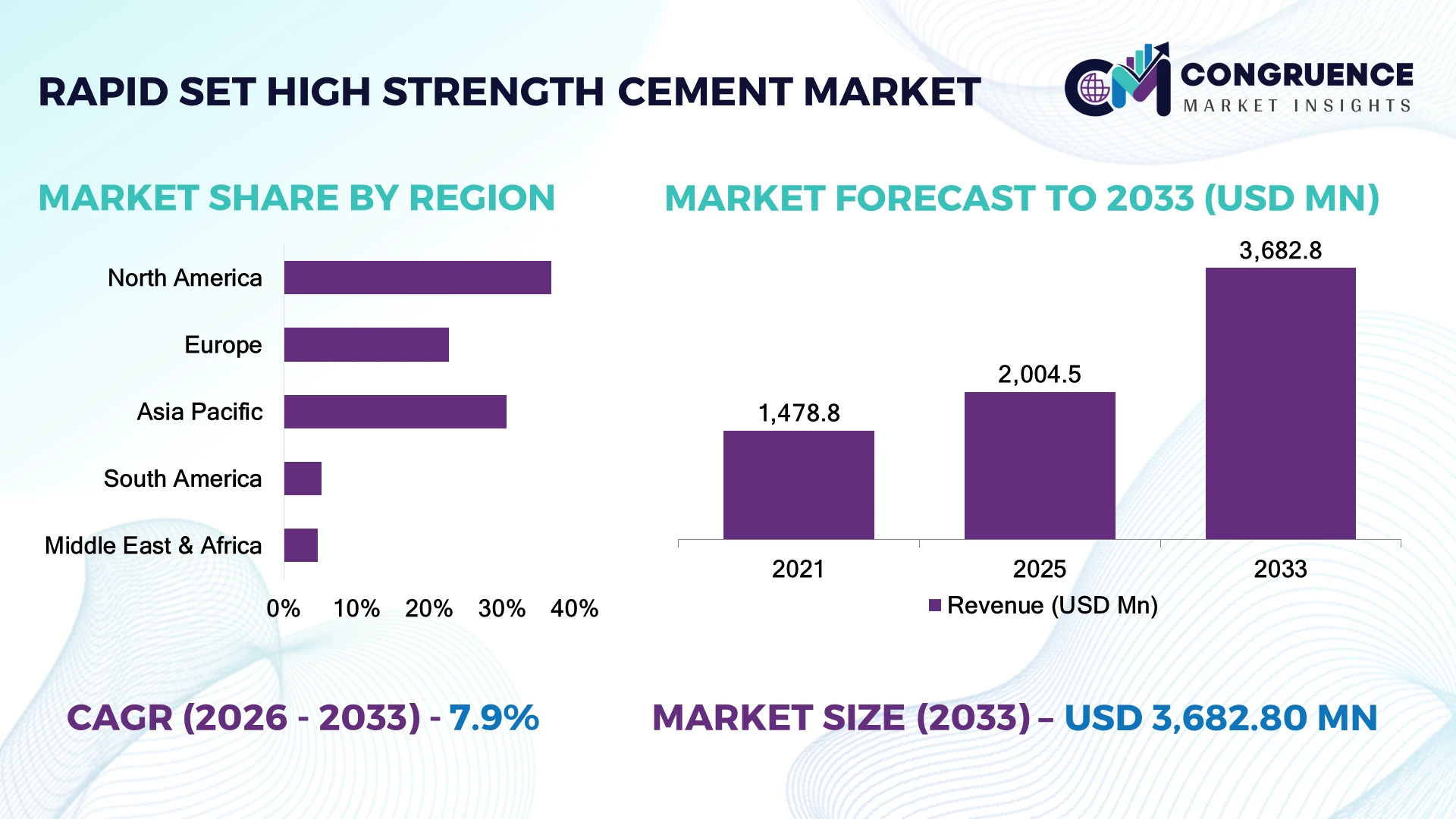
The Global Rapid Set High Strength Cement Market was valued at USD 2,004.5 Million in 2025 and is anticipated to reach a value of USD 3,682.8 Million by 2033 expanding at a CAGR of 7.9% between 2026 and 2033. Growth is being driven by accelerated bridge rehabilitation, precast infrastructure expansion, and low-downtime industrial flooring projects requiring early-strength cement formulations.
China remains the dominant market, accounting for approximately 34% of global production capacity, supported by high-speed rail, urban infrastructure, and advanced precast manufacturing investments. More than 62% of large municipal repair projects utilize rapid-setting materials for faster commissioning, compared with approximately 21% in Germany, where adoption focuses on premium transport infrastructure. Supply-chain diversification following Red Sea shipping disruptions has accelerated regional clinker and specialty binder investments, strengthening domestic manufacturing resilience.
Strategic success increasingly depends on localized production, advanced formulation capabilities, and alignment with infrastructure modernization programs.
Market Size & Growth: USD 2,004.5 million (2025) to USD 3,682.8 million (2033), CAGR 7.9%, driven by infrastructure modernization and rapid repair technologies.
Top Growth Drivers: Bridge rehabilitation (+31%), precast construction (+27%), industrial flooring (+22%).
Short-Term Forecast: By 2028, project turnaround improves 25% through fast-curing cement deployment.
Emerging Technologies: AI quality control, low-carbon clinker, advanced admixtures improve consistency by 18%.
Regional Leaders: Asia-Pacific USD 1.55 billion, North America USD 0.82 billion, Europe USD 0.69 billion with infrastructure-led adoption.
Consumer/End-User Trends: Nearly 58% of transportation repair contracts prioritize early-strength materials.
Pilot/Case Example: 2026 expressway rehabilitation reduced lane closure time by 42% using rapid-set cement.
Competitive Landscape: Top supplier controls approximately 12%; CTS Cement, Sika, Holcim, Heidelberg Materials, Mapei remain influential.
Regulatory & ESG Impact: Low-carbon formulations reduce embodied CO₂ by up to 20%.
Investment & Funding: More than USD 950 million directed toward specialty cement capacity expansion and modernization.
Innovation & Future Outlook: Digital batching and performance-engineered binders strengthen next-generation infrastructure construction.
Rapid Set High Strength Cement demand is expanding across transportation infrastructure, airport pavements, industrial flooring, and precast construction where early strength and reduced downtime deliver measurable value. Advanced calcium sulfoaluminate formulations improve early compressive strength by nearly 30%, while localized raw-material sourcing reduces supply disruption risks, positioning engineered cement solutions at the center of future infrastructure modernization.
Rapid set high strength cement has become strategically important because infrastructure owners increasingly prioritize asset availability over construction duration. Governments and contractors are restructuring procurement toward performance-based materials capable of minimizing traffic disruption, reducing maintenance windows, and improving lifecycle economics. This shift is accelerating investment in specialty cement manufacturing and regional distribution capabilities.
Modern calcium sulfoaluminate-based formulations achieve equivalent structural strength up to 60% faster than conventional Portland cement systems while reducing repair-related labor hours by approximately 20%. Asia-Pacific leads manufacturing scale through extensive transport infrastructure projects, whereas North America emphasizes premium repair applications supported by advanced material specifications and digital quality monitoring. Over the next two to three years, more than 45% of major highway rehabilitation contracts are expected to specify rapid-strength materials for time-critical projects.
A practical example is overnight airport runway rehabilitation, where rapid set formulations enable reopening within hours rather than days, significantly reducing operational disruption. Producers are expanding specialty grinding capacity, investing in performance-enhancing admixtures, and strengthening contractor partnerships to secure specification-driven demand. Companies combining localized manufacturing, consistent quality, and engineered application support will establish stronger competitive positioning as infrastructure modernization increasingly rewards speed, durability, and operational efficiency.
Transport infrastructure modernization and compressed construction schedules are reshaping demand for rapid set high strength cement. Nearly 46% of bridge rehabilitation projects now prioritize early-strength materials to minimize traffic disruption, while repair windows for urban transport assets have contracted by approximately 30% over the past five years. Japan and the United States continue expanding accelerated bridge replacement programs, encouraging broader specification of rapid-setting cement systems. The need for overnight repairs increases contractor preference for formulations capable of achieving service-ready strength within hours. In response, manufacturers are expanding specialty binder production, investing in calcium sulfoaluminate technologies, and forming partnerships with infrastructure contractors. A key operational advantage is that reduced project downtime often delivers greater lifecycle savings than the material's initial price premium.
Dependence on specialty clinker, high-purity alumina, and performance-enhancing additives continues to pressure production economics. Raw material procurement costs fluctuate by approximately 18–25% across major producing countries, while specialty binder inputs represent nearly 35% of manufacturing expenses. Export restrictions and shipping disruptions affecting mineral supply chains have increased procurement complexity for producers in Europe. These fluctuations reduce pricing stability, complicate long-term infrastructure contracts, and compress manufacturer margins. Companies are mitigating exposure through localized sourcing strategies, multi-year supplier agreements, and greater use of regional grinding facilities. An important strategic shift is the development of alternative binder formulations that maintain early-strength performance while reducing dependence on imported specialty minerals.
Digital construction practices are creating new opportunities for rapid set high strength cement beyond conventional repair applications. More than 40% of major infrastructure owners are integrating predictive maintenance platforms with scheduled rehabilitation programs, enabling optimized material deployment before structural deterioration accelerates. India and Saudi Arabia are expanding smart infrastructure investments where rapid construction cycles align with advanced repair materials. Manufacturers are combining high-performance cement with sensor-enabled monitoring systems and low-carbon formulations to improve operational efficiency. Investment in R&D, contractor training, and technology partnerships is strengthening product differentiation. A significant emerging opportunity lies in modular precast infrastructure, where faster curing shortens production cycles by approximately 20% and improves manufacturing throughput.
Maintaining uniform field performance across varying climates, workforce capabilities, and application environments remains a critical long-term challenge. Installation quality can influence early compressive strength by more than 20%, while improper water management increases repair failure rates by approximately 15%. Large infrastructure projects in India and Southeast Asia frequently encounter inconsistent onsite mixing and curing practices despite advanced material specifications. This variability affects durability, contractor confidence, and lifecycle performance. Companies must invest in digital batching systems, certified applicator programs, and real-time quality monitoring to ensure reliable outcomes. Long-term competitiveness will increasingly depend on application expertise and technical support rather than material formulation alone.
AI-Enabled Quality Control Digital batching and AI-assisted process monitoring are reducing production variability by approximately 18% while improving batch consistency by nearly 15%. Manufacturers are automating plant operations to meet tighter infrastructure specifications, increasing production reliability and reducing costly rework across high-performance cement manufacturing facilities.
Low-Carbon Binder Adoption Carbon reduction regulations are accelerating demand for alternative binder technologies capable of lowering embodied emissions by up to 22%. Producers are expanding blended cement portfolios and optimizing clinker substitution without compromising early-strength performance, strengthening competitiveness in public infrastructure projects with sustainability procurement requirements.
Precast Manufacturing Expansion Precast manufacturers are increasing rapid-strength cement utilization by approximately 28% as modular construction gains momentum. Faster curing shortens mold occupancy, improves factory throughput, and enables quicker project delivery. Companies are expanding dedicated specialty product lines and strengthening long-term supply agreements with industrial precast producers.
Localized Production Networks Supply-chain disruptions and transportation costs have encouraged regional manufacturing strategies, reducing average delivery distances by nearly 20% and improving order fulfillment rates by approximately 17%. Producers are investing in localized grinding facilities, distribution partnerships, and inventory optimization to improve responsiveness for time-sensitive infrastructure rehabilitation projects.
General Purpose Rapid Set High Strength Cement accounts for approximately 49% of the market, driven by broad deployment across highway maintenance, commercial flooring, utility repairs, and municipal infrastructure. Its balance of early compressive strength, workability, and cost efficiency makes it the preferred choice for contractors managing high-volume projects. Fiber-Reinforced Rapid Set Cement remains strategically important for structural rehabilitation requiring crack resistance and enhanced durability, while Sulfate-Resistant variants continue expanding in wastewater treatment facilities, marine infrastructure, and chemically aggressive environments.
Ultra-Rapid High Strength Cement is the fastest-growing segment, supported by increasing demand for overnight runway, bridge deck, and railway repairs where operational downtime must be minimized. The segment is expanding at an estimated adoption rate exceeding 10% annually, while more than 42% of new transportation rehabilitation specifications prioritize rapid-opening materials. Manufacturers are investing in advanced binder chemistry, expanding specialty production capacity, and collaborating with infrastructure contractors to develop application-specific formulations. Investment priorities are steadily shifting toward premium, high-performance cement systems capable of supporting accelerated construction schedules and long-life infrastructure assets.
According to findings published by the American Concrete Institute (ACI) during 2025, accelerated repair materials enabled selected transportation projects to reopen 30–50% faster than conventional cement-based repair systems, reinforcing demand for rapid-strength formulations in critical infrastructure.
Transportation Infrastructure represents the largest application segment with an estimated 41% market share, supported by extensive bridge rehabilitation, airport runway maintenance, highway repair, and railway modernization projects. Time-sensitive public infrastructure programs continue favoring rapid-strength cement because shorter closure periods reduce economic disruption and maintenance costs. Industrial Flooring follows as a mature application where manufacturers require durable, early-load-bearing surfaces. Building Repair & Renovation maintains stable demand across commercial facilities, while Utility and Water Infrastructure increasingly specifies rapid-setting materials for emergency maintenance projects.
Airport Runways and High-Speed Rail Infrastructure represent the fastest-growing application segment as governments prioritize uninterrupted transportation operations. Nearly 38% of major rehabilitation contracts now specify accelerated repair materials, while advanced construction planning has reduced average project shutdown periods by approximately 25%. Producers are expanding technical support, optimizing product portfolios, and integrating digital construction planning with specialty cement deployment. These trends are strengthening operational efficiency while positioning transportation infrastructure as the market's highest-value application category.
An industry assessment released by the International Road Federation during 2026 indicated that accelerated repair technologies were incorporated into more than one-third of newly planned strategic highway rehabilitation projects to reduce traffic disruption and lifecycle maintenance costs.
Government Infrastructure Agencies remain the dominant end-user segment, representing approximately 45% of total demand because national highway authorities, municipal engineering departments, and transport agencies manage large-scale rehabilitation programs requiring rapid commissioning. Construction & Engineering Contractors form the second-largest buyer group, leveraging rapid-strength materials to improve project delivery schedules and contract performance. Industrial Facility Owners maintain stable procurement for manufacturing plants, logistics hubs, and warehouse flooring, while Utility Operators continue increasing adoption for emergency repair activities.
Private Infrastructure Developers are emerging as the fastest-growing end-user group as logistics parks, industrial campuses, and commercial developments increasingly prioritize shorter construction cycles and operational continuity. More than 35% of large contractors now include rapid-setting cement in standardized repair specifications, while customized formulations have improved project productivity by approximately 18%. Suppliers are responding through contractor training, application-specific product development, strategic pricing models, and long-term technical partnerships, strengthening competitive differentiation across specialized infrastructure projects.
A 2025 contractor survey published by the Associated General Contractors of America found that accelerated construction materials were increasingly specified for time-critical infrastructure rehabilitation projects where minimizing service interruption had become a primary procurement criterion.
North America accounted for the largest market share at 36.8% in 2025 however, Asia-Pacific is expected to register the fastest growth, expanding at a CAGR of 9.2% between 2026 and 2033.
Infrastructure rehabilitation prioritizes accelerated repair technologies
North America leads the market through extensive bridge rehabilitation programs, airport runway maintenance, industrial flooring upgrades, and municipal infrastructure renewal. The region benefits from mature contractor networks, strict performance specifications, and broad adoption of accelerated construction practices. Transportation infrastructure represents the largest deployment segment, while rapid overnight repair strategies continue reducing traffic disruption and project downtime. More than 55% of state-level bridge preservation programs incorporate rapid-strength repair materials for selected rehabilitation projects. Manufacturers are expanding specialty cement production, strengthening contractor training programs, and investing in technical support to improve installation quality. Growing adoption of digital batching systems and performance monitoring further strengthens project reliability across transportation and industrial infrastructure.
United States Market Outlook: The United States dominates regional demand through large-scale highway reconstruction, airport modernization, and bridge replacement initiatives. Accelerated Bridge Construction techniques continue increasing specification of rapid set cement across federal and state transportation projects. Nearly 60% of major rehabilitation contracts in critical transportation corridors prioritize reduced closure durations, encouraging manufacturers to expand localized production, application engineering, and contractor partnerships for high-performance infrastructure repair.
Sustainability and infrastructure modernization reshape specifications
Europe continues strengthening demand through transport modernization, tunnel rehabilitation, railway maintenance, and sustainable infrastructure investment. Performance-based procurement increasingly favors rapid-strength cement capable of reducing project disruption while supporting long-life asset management. Environmental regulations are encouraging manufacturers to optimize binder formulations and improve production efficiency. Approximately 34% of transportation rehabilitation projects incorporate advanced rapid-repair materials where operational continuity is essential. Producers are investing in lower-carbon specialty binders, regional distribution, and technical collaboration with engineering contractors to meet increasingly demanding infrastructure standards.
Germany Market Outlook: Germany remains the region's strategic market because of its advanced transport infrastructure, industrial construction expertise, and strong engineering standards. Railway modernization, highway maintenance, and industrial facility upgrades continue supporting premium cement demand. Domestic producers are expanding specialty product portfolios while integrating performance-focused construction practices that improve durability and shorten infrastructure maintenance cycles.
Large-scale infrastructure expansion drives specialty cement demand
Asia-Pacific is experiencing the strongest market expansion through high-speed rail development, metro construction, industrial manufacturing growth, and large public infrastructure programs. China, India, and Southeast Asian economies continue investing in transportation corridors where rapid construction materials improve project efficiency. Nearly 48% of new urban transport developments increasingly specify accelerated repair technologies for maintenance and expansion projects. Manufacturers are increasing specialty grinding capacity, expanding regional production facilities, and strengthening local contractor networks to meet rising infrastructure demand while improving supply responsiveness.
China Market Outlook: China leads regional production through extensive manufacturing capacity, advanced precast construction, and continuous transport infrastructure investment. National infrastructure programs increasingly require rapid-strength cement for expressways, metro systems, and logistics hubs. Advanced manufacturing facilities and vertically integrated supply chains enable efficient production while supporting growing domestic demand for premium cement technologies.
Transport upgrades strengthen specialty material demand
South America is gradually expanding adoption through highway rehabilitation, mining infrastructure, port modernization, and commercial construction projects. Governments increasingly prioritize faster project completion to reduce operational disruption across strategic transport corridors. Infrastructure investment remains concentrated in selected economies, although procurement practices increasingly recognize lifecycle performance benefits. Approximately 26% of large transportation rehabilitation projects now specify high-performance repair materials. Producers are strengthening distributor partnerships, expanding technical support, and improving localized inventory management to address project delivery requirements despite logistics constraints.
Brazil Market Outlook: Brazil represents the largest regional market due to extensive highway networks, mining operations, industrial development, and ongoing airport modernization. Public infrastructure maintenance continues supporting demand for rapid-strength repair materials capable of reducing operational downtime. Domestic construction companies increasingly adopt specialty cement solutions for bridge rehabilitation and industrial flooring where project speed directly affects operating efficiency.
Mega infrastructure projects accelerate specialty cement deployment
The Middle East & Africa market benefits from large-scale infrastructure investment, airport expansion, industrial diversification, and smart city development. High-performance construction materials are increasingly specified for projects requiring accelerated completion schedules and enhanced durability under demanding environmental conditions. Infrastructure modernization programs continue expanding demand across transportation, utilities, and commercial developments. More than 30% of newly awarded mega-project packages include performance-based construction material specifications. Suppliers are expanding regional distribution, forming engineering partnerships, and strengthening technical service capabilities to support increasingly sophisticated infrastructure projects.
Saudi Arabia Market Outlook: Saudi Arabia leads regional demand through major transportation, tourism, industrial, and urban development initiatives. Large-scale construction programs require rapid-strength cement to meet compressed delivery schedules while maintaining structural performance. Investment in advanced construction technologies and localized building material supply chains is strengthening long-term adoption of specialty cement products across strategic national infrastructure projects.
Global specialty material leaders including CTS Cement Manufacturing, Sika, Mapei, Saint-Gobain, and Heidelberg Materials compete directly against regional rapid-setting cement producers focused on price-sensitive infrastructure contracts. The top five participants collectively control approximately 48% of the market, while regional manufacturers compete through localized supply and lower logistics costs. Competition centers on early-strength performance, lifecycle durability, supply reliability, and technical support rather than commodity pricing. Premium formulations reduce repair downtime by up to 40%, localized production lowers delivery costs by approximately 15%, and optimized binder technologies improve early strength consistency by nearly 20%. Companies are expanding production facilities, forming contractor partnerships, investing in calcium sulfoaluminate innovation, and strengthening vertical integration across raw materials and distribution. The competitive shift favors proprietary low-carbon binder technologies and specification-driven products over conventional cement alternatives. High certification requirements, application expertise, and specialized manufacturing remain major entry barriers. Winning requires differentiated performance, resilient regional supply networks, and strong engineering support throughout project execution.
CTS Cement Manufacturing Corporation
Sika AG
Mapei S.p.A.
Saint-Gobain
Heidelberg Materials AG
Holcim Ltd.
CEMEX S.A.B. de C.V.
Fosroc International
TCC Materials
Buzzi S.p.A.
Cementos Molins
ARDEX Group
Rapid set high strength cement technology is advancing through calcium sulfoaluminate (CSA) binder chemistry, engineered particle optimization, and digital quality control. CSA formulations deliver structural strength up to 60% faster than conventional Portland cement while lowering shrinkage by approximately 18%. Nearly 45% of premium infrastructure repair projects now specify advanced rapid-strength formulations because they reduce traffic disruption and accelerate asset commissioning. Digital batching systems further improve mix consistency by around 15%, enhancing field performance and reducing application variability.
Emerging technologies include AI-enabled production monitoring, low-carbon clinker substitution, nanomaterial-enhanced hydration control, and smart admixture optimization. Compared with traditional Portland cement systems, modern rapid-strength formulations reduce repair windows by nearly 50% while improving durability under cyclic loading conditions. Companies with proprietary binder chemistry and integrated technical support gain a stronger competitive advantage because infrastructure owners increasingly prioritize lifecycle performance over initial material cost. Automated production also reduces manufacturing variability by approximately 12%, strengthening product reliability.
Between 2026 and 2028, intelligent material design, sensor-assisted curing validation, and digitally integrated construction workflows will reshape infrastructure rehabilitation. Manufacturers investing in sustainable binder innovation, localized production, and predictive quality analytics will strengthen specification leadership, improve contractor productivity, and secure long-term positions in premium infrastructure maintenance markets.
January 2025 CTS Cement Manufacturing opened its largest production facility in Cordele, Georgia, increasing packaged Rapid Set® production capacity by 25% to strengthen North American and export supply while supporting rising infrastructure repair demand. Source: CTS Cement (ctscement.com)
February 2025 Heidelberg Materials accelerated its transformation strategy, confirming commercial rollout of evoZero® net-zero cement and targeting an additional €500 million annual operational contribution by 2026 through network optimization and technical upgrades. Source: Heidelberg Materials (Heidelberg Materials)
May 2026 Heidelberg Materials commissioned a state-of-the-art kiln line at its Airvault cement plant in France, significantly advancing production efficiency and decarbonization while strengthening specialty cement manufacturing capability. Source: Heidelberg Materials IR (Heidelberg Materials)
2025 CTS Cement highlighted the US 53 Eau Claire infrastructure project, where 7,400 cubic yards of Rapid Set® Cement enabled overnight pavement replacement, influencing future transportation specifications and accelerating adoption across state highway rehabilitation programs. Source: CTS Cement Pro Blog (ctscement.com)
This report delivers comprehensive analysis of the rapid set high strength cement market across product types, infrastructure applications, end-user industries, and major geographic regions. It evaluates demand across transportation infrastructure, industrial flooring, precast construction, utility repair, and commercial rehabilitation while assessing evolving deployment trends, product differentiation, and specialty cement adoption. The study examines competitive participation across more than 12 leading manufacturers and identifies operational trends influencing procurement, production, and specification decisions.
The report also assesses advanced binder technologies, digital quality control, low-carbon cement innovation, and regional manufacturing strategies shaping industry evolution between 2026 and 2033. It provides detailed regional benchmarking, segmentation analysis, competitive positioning, technology assessment, and investment opportunities. Operational indicators, deployment patterns, and product adoption trends support informed decisions on capacity expansion, infrastructure participation, supply-chain optimization, strategic partnerships, and long-term market positioning within the specialty construction materials industry.
| Report Attribute/Metric | Report Details |
|---|---|
|
Market Revenue in 2025 |
USD 2,004.5 Million |
|
Market Revenue in 2033 |
USD 3,682.8 Million |
|
CAGR (2026 - 2033) |
7.9% |
|
Base Year |
2025 |
|
Forecast Period |
2026 - 2033 |
|
Historic Period |
2021 - 2025 |
|
Segments Covered |
By Type
By Application
By End-User
|
|
Key Report Deliverable |
Revenue Forecast, Growth Trends, Market Dynamics, Segmental Overview, Regional and Country-wise Analysis, Competition Landscape |
|
Region Covered |
North America, Europe, Asia-Pacific, South America, Middle East, Africa |
|
Key Players Analyzed |
CTS Cement Manufacturing Corporation, Sika AG, Mapei S.p.A., Saint-Gobain, Heidelberg Materials AG, Holcim Ltd., CEMEX S.A.B. de C.V., Fosroc International, TCC Materials, Buzzi S.p.A., Cementos Molins, ARDEX Group |
|
Customization & Pricing |
Available on Request (10% Customization is Free) |




