
Reports
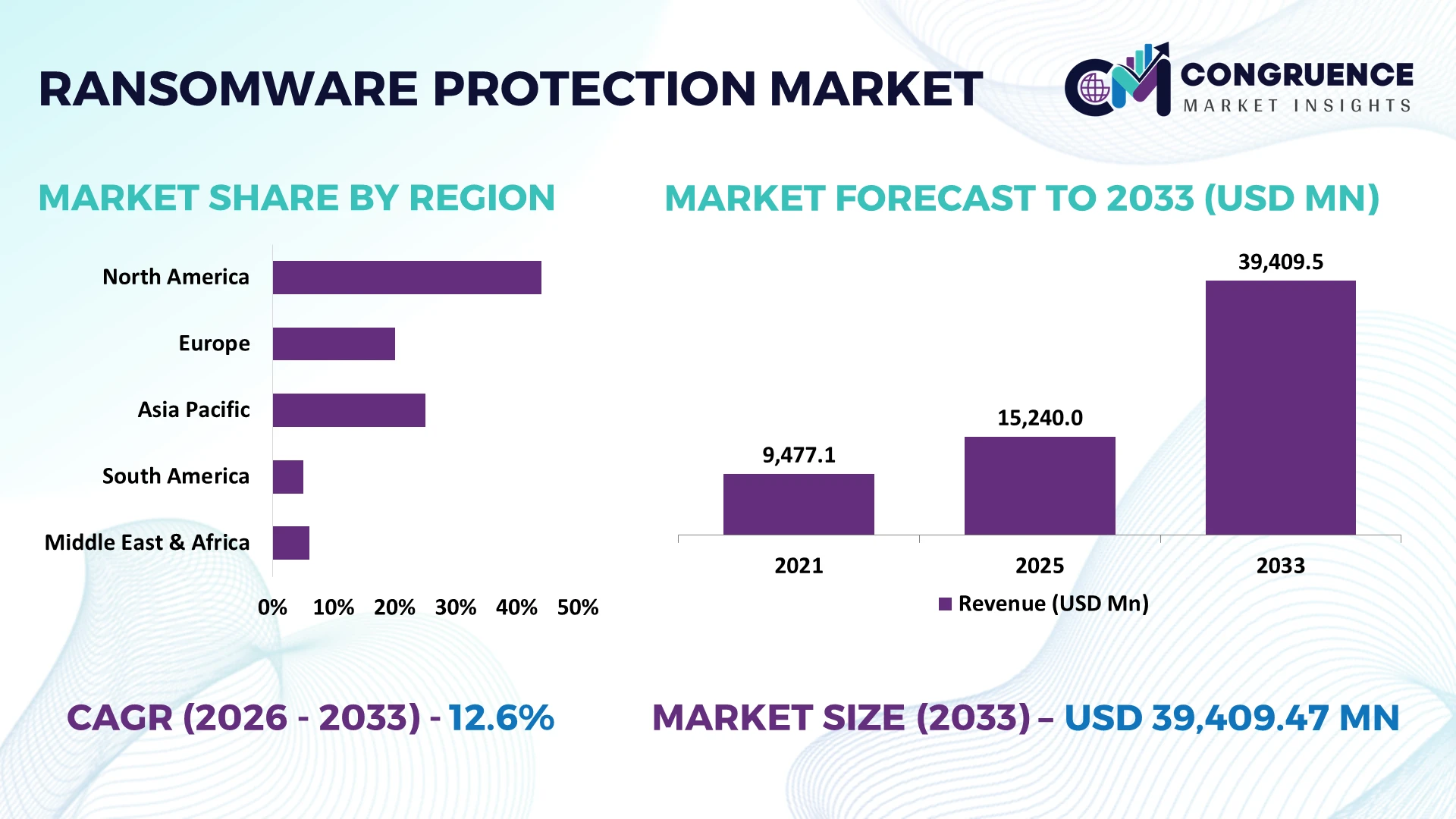
The Global Ransomware Protection Market was valued at USD 15240 Million in 2025 and is anticipated to reach a value of USD 39409.47 Million by 2033 expanding at a CAGR of 12.61% between 2026 and 2033. Growth is driven by double-extortion attacks, identity-based compromise, immutable backup adoption, zero-trust security architectures, and AI-enabled endpoint detection across cloud and hybrid enterprise environments.
The United States represents the dominant country market, accounting for approximately 36% of global ransomware protection demand, supported by extensive cybersecurity spending across banking, healthcare, government, technology, and critical infrastructure. About 68% of ransomware incidents begin with compromised credentials or exploited vulnerabilities, strengthening investment in identity protection, endpoint detection, and zero-trust controls. U.S. federal zero-trust mandates accelerate adoption, while Germany’s expanding NIS2-aligned security requirements strengthen European deployments. Compared with Germany, U.S. enterprises maintain materially higher security-software spending and incident-response capacity.
Strategically, vendors combining identity security, behavioral detection, immutable recovery, and cloud workload protection will capture the strongest enterprise consolidation opportunities.
Market Size & Growth: USD 15,240 million in 2025 advances to USD 39,409.47 million by 2033 at 12.61% CAGR, driven by identity-centric and AI-enabled defense.
Top Growth Drivers: Credential compromise affects roughly 22% of breaches, vulnerability exploitation 20%, and ransomware remains involved in approximately 44% of breaches.
Short-Term Forecast: By 2028, AI-assisted security operations can reduce investigation and remediation workloads by approximately 30%, strengthening enterprise response efficiency.
Emerging Technologies: AI behavioral analytics, automated isolation, and immutable cloud backup increasingly converge; approximately 70% of organizations already use AI-enabled cybersecurity capabilities.
Regional Leaders: North America approaches USD 14.7 billion, Europe USD 10.2 billion, and Asia-Pacific USD 9.6 billion by 2033 as zero-trust and cloud-security deployments deepen.
Consumer/End-User Trends: Approximately 88% of organizations experienced at least one ransomware attack during a recent 12-month assessment period, pushing protection into board-level risk management.
Pilot/Case Example: In 2025, Google reported AI-assisted vulnerability discovery identified 20 security vulnerabilities, demonstrating measurable expansion of automated threat-discovery capacity.
Competitive Landscape: Microsoft holds an estimated low-double-digit share, competing with CrowdStrike, Palo Alto Networks, Sophos, and SentinelOne across endpoint, identity, cloud, and automated response.
Regulatory & ESG Impact: NIS2 introduces cybersecurity obligations across 18 critical sectors, accelerating incident reporting, resilience controls, and ransomware preparedness throughout EU enterprises.
Investment & Funding: Global cybersecurity venture funding exceeded USD 9 billion during 2024, with capital concentrating on AI security, cloud protection, identity controls, and automated detection.
Innovation & Future Outlook: AI-driven SOC automation and autonomous containment are reshaping protection; machine-speed response can cut selected detection-to-containment workflows by more than 50%.
Ransomware Protection Market demand is concentrating around endpoint detection and response, identity threat detection, zero-trust access, immutable backups, cloud workload security, and automated incident containment. Advanced platforms increasingly correlate endpoint, network, identity, and cloud telemetry rather than operating as isolated security tools. Ransomware involvement in approximately 44% of breaches underscores the operational requirement for layered prevention and rapid recovery. NIS2 implementation across Europe is simultaneously tightening resilience and incident-reporting expectations, accelerating platform consolidation among regulated enterprises and setting the foundation for deeper strategic analysis.
Ransomware protection is becoming core enterprise resilience infrastructure as attacks shift from endpoint encryption toward credential theft, data exfiltration, cloud compromise, and extortion. Ransomware appears in approximately 44% of breaches, forcing boards to connect cybersecurity investment with operational continuity. Regulatory restructuring reinforces this shift: Europe’s NIS2 framework covers 18 critical sectors, while U.S. critical-infrastructure operators are strengthening zero-trust, identity, and recovery architectures.
AI-assisted detection now correlates endpoint, identity, network, and cloud telemetry at machine speed; automated investigation can reduce selected security-operations workloads by roughly 30% versus legacy rule-based triage. U.S. enterprises lead deployment of integrated XDR and identity protection, while European organizations place greater procurement emphasis on reporting, resilience, and data-governance controls. Through 2026–2028, automated containment, immutable recovery, and identity threat detection will become increasingly integrated.
A practical deployment links EDR alerts with compromised-account suspension, device isolation, backup validation, and SOC escalation, compressing response from multiple manual steps into one orchestrated workflow. Vendors are expanding AI security platforms, cloud integrations, managed detection partnerships, and recovery capabilities. Competitive advantage will increasingly depend on preventing lateral movement while restoring critical operations rapidly.
Credential compromise and vulnerability exploitation are pushing ransomware defense beyond conventional antivirus toward identity-centric, behavior-based protection. Ransomware is involved in approximately 44% of breaches, while exploitation of vulnerabilities accounts for roughly 20% of initial access and credential abuse remains a major intrusion pathway. In the United States, zero-trust modernization across federal agencies and critical infrastructure is accelerating identity verification, endpoint detection, and privileged-access controls. Enterprises are consequently consolidating EDR, XDR, identity threat detection, and immutable recovery rather than purchasing isolated defenses. Security vendors are expanding AI analytics, privileged-account monitoring, and automated containment through platform investment and technology partnerships. The operational insight is decisive: blocking lateral movement after credential compromise increasingly matters as much as preventing the initial intrusion, shifting budgets toward continuous identity telemetry.
Enterprise security stacks remain fragmented across endpoint, identity, network, cloud, email, and backup environments, limiting the economics of comprehensive ransomware protection. Large organizations commonly operate dozens of security products, while approximately 70% of security teams report skills shortages affecting operational effectiveness and nearly 60% identify tool complexity as a material concern. Germany’s regulated enterprises face additional integration requirements as NIS2-aligned controls intersect with existing GDPR, cloud, and sector-specific governance. Multiple consoles generate duplicated alerts, integration expenditure, and slower incident triage, reducing returns from individual security investments. Vendors are responding through platform consolidation, open APIs, managed detection services, and unified telemetry architectures. The structural restraint is therefore not protection availability but integration cost: adding another disconnected product can increase operational burden without proportionately reducing ransomware exposure.
AI-driven security operations create a significant opportunity to automate ransomware investigation, prioritization, containment, and recovery while compensating for persistent cybersecurity workforce constraints. Approximately 70% of organizations already use AI-enabled cybersecurity capabilities, and automated investigation can reduce selected analyst workloads by around 30%; machine-assisted containment can compress response workflows by more than 50% in suitable environments. India presents a notable opportunity as expanding cloud infrastructure, digital payments, and enterprise digitization enlarge the attack surface while security talent remains constrained. Through 2026–2028, agentic security systems will increasingly correlate identity anomalies, malicious processes, lateral movement, and backup integrity before initiating controlled responses. Vendors are investing in security copilots, autonomous SOC functions, cloud partnerships, and managed services. The non-obvious opportunity lies in mid-market automation, where limited internal SOC staffing makes measurable labor substitution particularly valuable.
Maintaining detection accuracy as ransomware tactics evolve remains a long-term execution challenge. Attackers increasingly combine legitimate credentials, living-off-the-land tools, cloud services, and data theft, reducing dependence on easily identifiable malware. Ransomware appears in approximately 44% of breaches, while human involvement remains present in roughly 60% of breaches and vulnerability exploitation represents about 20% of initial access. U.S. organizations operating hybrid infrastructure face particular complexity because security engines must correlate identities, endpoints, SaaS applications, cloud workloads, and legacy systems without excessive false positives. Vendors must strengthen behavioral models, threat intelligence, continuous validation, and human-in-the-loop response while expanding integrations. The strategic challenge is maintaining automation quality at scale: inaccurate containment can disrupt legitimate operations, whereas delayed intervention gives attackers time to move laterally and compromise recovery infrastructure.
Recovery Architecture Becomes Attack-Aware: Enterprises are redesigning backup workflows around immutable storage, isolated recovery environments, and continuous restoration testing as ransomware increasingly targets backup infrastructure. Approximately 94% of ransomware-hit organizations report attackers attempting to compromise backups, while 57% of successful backup compromises result in ransom payments. Vendors are integrating anomaly detection, clean-room recovery, and automated validation, reducing restoration uncertainty and making recoverability a measurable security-control requirement.
Cyber Insurance Tightens Security Controls: Insurers are increasingly requiring MFA, endpoint detection, privileged-access controls, and tested backups before underwriting ransomware exposure. Roughly 97% of organizations with cyber insurance report security investments directly supporting coverage, while 67% indicate improved defenses after obtaining policies. Enterprises are aligning protection architectures with underwriting requirements, and security providers are packaging controls around insurability, converting insurance compliance into a direct technology-procurement trigger.
Platform Consolidation Reshapes SOC Operations: Security teams are reducing disconnected tools as alert volumes and integration overhead undermine analyst productivity. Nearly 60% of security leaders identify tool complexity as an operational concern, while around 70% report cybersecurity skills shortages. Enterprises are consolidating endpoint, network, cloud, identity, and response telemetry into unified platforms. Vendors are responding through acquisitions, native integrations, and common data architectures that shorten investigation workflows and reduce duplicated security administration.
Regulation Elevates Recovery Accountability: NIS2 implementation across 18 critical EU sectors is shifting ransomware preparation from technical discretion toward executive-governed resilience. Incident notification can require an early warning within 24 hours and formal notification within 72 hours. Companies are restructuring escalation procedures, evidence collection, recovery testing, and executive reporting. The non-obvious impact is stronger demand for protection platforms that document response actions automatically, reducing compliance workload during active incidents.
Endpoint Protection accounts for approximately 32% of ransomware protection demand, reflecting its position at the intersection of user activity, credential abuse, malicious processes, and device-level containment. Mature EDR platforms increasingly combine behavioral detection with automated isolation, giving enterprises scalable protection across distributed workforces. Network Protection remains important for lateral-movement detection, while Data Protection concentrates on encryption, access governance, and sensitive-data monitoring. Backup Protection has shifted from passive retention toward immutable copies and orchestrated recovery as attackers increasingly target restoration infrastructure.
Cloud Protection is the fastest-growing type as enterprise workloads migrate across SaaS, public cloud, and hybrid environments. More than 90% of enterprises use cloud services, while multi-cloud adoption exceeds 75% among large organizations, expanding ransomware exposure beyond traditional endpoints. Vendors are responding with cloud-native workload protection, unified telemetry, identity integrations, and API-based threat detection. Investment priorities are consequently moving toward platforms that coordinate Endpoint, Network, Cloud, Data, and Backup Protection rather than managing each layer independently.
Threat Detection represents approximately 31% of application demand because identifying malicious behavior before encryption or exfiltration directly determines containment effectiveness. Enterprises increasingly correlate endpoint processes, network traffic, identity anomalies, and cloud activity rather than relying on signature-based alerts. Endpoint Security remains a mature application centered on device isolation and behavioral analysis, while Network Security monitors command-and-control traffic and lateral movement. Data Recovery has gained strategic importance as organizations measure ransomware preparedness through restoration speed rather than prevention alone.
Disaster Recovery is the fastest-growing application as ransomware transforms continuity planning into an active cybersecurity function. Approximately 94% of attacked organizations have reported adversaries attempting to compromise backups, demonstrating why isolated recovery infrastructure is operationally critical. Companies are automating backup validation, clean-room restoration, incident orchestration, and recovery sequencing. Security vendors are simultaneously connecting Threat Detection with Data Recovery workflows so confirmed compromise can trigger isolation and protected restoration, reducing dependence on manually coordinated incident-response processes.
Banking and Finance accounts for approximately 29% of end-user demand, reflecting extensive digital transaction infrastructure, sensitive customer data, stringent continuity requirements, and high consequences from operational disruption. Banks deploy layered Endpoint Security, Network Security, threat intelligence, privileged-access controls, and isolated recovery across complex hybrid estates. Government follows with substantial requirements around critical services and national infrastructure, while Retail prioritizes payment environments and distributed endpoints. Manufacturing increasingly protects operational technology alongside conventional enterprise IT as connected production systems broaden ransomware exposure.
Healthcare is the fastest-growing end-user segment because interconnected clinical systems, medical devices, electronic records, and time-critical services sharply increase disruption costs. Healthcare organizations remain heavily targeted, with ransomware recovery frequently requiring weeks rather than days. Vendors are responding with healthcare-specific managed detection, network segmentation, immutable backup, identity controls, and rapid-recovery services. Manufacturing providers are similarly expanding OT-aware protection. Competitive positioning increasingly depends on adapting ransomware controls to sector-specific workflows rather than offering identical protection architectures across Banking, Healthcare, Government, Manufacturing, and Retail.
North America accounted for the largest market share at 39.2% in 2025 however, Asia-Pacific is expected to register the fastest growth, expanding at a CAGR of 15.4% between 2026 and 2033.
Zero-Trust Modernization Reshapes Enterprise Defense
North America represents approximately 39.2% of global ransomware protection demand, reflecting dense cloud infrastructure, extensive digital financial systems, high cybersecurity expenditure, and concentrated deployment of EDR, XDR, identity security, and immutable recovery platforms. U.S. enterprises are shifting from isolated endpoint products toward integrated security operations capable of correlating identity, network, endpoint, and cloud telemetry. Federal zero-trust modernization requirements reinforce this architecture across government agencies and contractors. Ransomware remains involved in approximately 44% of reported breaches, strengthening investment in automated containment and tested recovery. Canada is advancing similar controls across banking, healthcare, and government environments, although deployment scale remains smaller. Security providers are expanding managed detection, AI-assisted investigation, cloud partnerships, and integrated recovery capabilities as customers prioritize faster containment and fewer disconnected security tools.
United States Market Outlook: The United States combines the world’s largest concentration of cybersecurity vendors, hyperscale cloud infrastructure, regulated enterprises, and critical digital assets. Federal agencies continue implementing zero-trust architecture across identity, devices, networks, applications, and data. This procurement environment favors platforms combining behavioral detection, privileged-access monitoring, automated isolation, and resilient backup rather than narrowly focused ransomware tools.
NIS2 Converts Resilience Into Compliance
Europe accounts for approximately 26.8% of global demand, with Germany, the United Kingdom, France, Italy, and the Netherlands concentrating enterprise security deployment. NIS2 materially changes ransomware procurement by extending cybersecurity obligations across 18 critical sectors and requiring an early incident warning within 24 hours, followed by formal notification within 72 hours. Enterprises are therefore integrating detection, evidence retention, recovery orchestration, and compliance reporting instead of treating ransomware defense solely as endpoint security. GDPR simultaneously increases requirements around compromised personal data, making breach containment and forensic visibility operational priorities. Financial institutions and manufacturers are investing heavily in identity protection, network segmentation, immutable backup, and managed detection. Vendors are responding with EU-hosted cloud services, localized security operations, compliance automation, and partnerships capable of supporting cross-border enterprises without fragmenting incident-response processes.
Germany Market Outlook: Germany provides a strategically important deployment base because its banking, automotive, chemicals, manufacturing, and public-sector infrastructure creates substantial ransomware exposure across both IT and operational technology. NIS2 implementation strengthens board-level accountability, while industrial operators increasingly require network segmentation and OT-aware detection. Vendors offering locally compliant cloud processing and integrated IT/OT protection gain a procurement advantage.
Cloud Expansion Accelerates Security Consolidation
Asia-Pacific represents approximately 23.6% of global ransomware protection demand, with India, Japan, Australia, Singapore, and South Korea accelerating deployment as cloud migration and digital-service infrastructure expand. Large enterprises increasingly require protection across distributed endpoints, SaaS environments, public clouds, identity systems, and interconnected supply chains. Australia’s critical-infrastructure reforms have increased executive accountability for cyber resilience, while India’s expanding digital payments and cloud footprint create greater demand for automated detection and recovery. Multi-cloud usage among large enterprises exceeds 75%, increasing the operational value of security platforms that consolidate telemetry across heterogeneous environments. Providers are scaling regional security operations centers, managed detection services, cloud-native protection, and local technology partnerships. Demand is shifting toward platforms that provide centralized visibility without forcing enterprises to replace established cloud and endpoint infrastructure.
India Market Outlook: India combines rapid cloud adoption, large IT-services operations, expanding digital banking, and extensive enterprise outsourcing infrastructure. CERT-In requires specified cyber incidents to be reported within six hours, increasing demand for rapid detection and incident visibility. Banks, technology providers, and digital businesses increasingly deploy automated endpoint containment, identity monitoring, and managed security operations to meet compressed response requirements.
Digital Banking Raises Resilience Requirements
South America contributes approximately 5.8% of global demand, led by Brazil and supported by Colombia, Argentina, and Chile. Digital banking, instant payments, e-commerce, government modernization, and cloud adoption are widening the attack surface faster than many organizations can expand internal security teams. Brazil’s Pix ecosystem processes billions of transactions monthly, making uninterrupted financial infrastructure strategically important and increasing demand for endpoint detection, identity controls, network monitoring, and resilient recovery. Large banks and telecommunications companies maintain sophisticated security operations, while smaller organizations rely more heavily on managed security providers because specialist staffing and integration budgets remain constrained. Vendors are adapting through cloud-delivered protection, Portuguese and Spanish interfaces, managed detection partnerships, and subscription-based platforms. This delivery model lowers deployment complexity while helping enterprises consolidate previously fragmented security controls.
Brazil Market Outlook: Brazil offers the region’s strongest ransomware protection deployment environment through its large banking system, digital-payment infrastructure, cloud adoption, and mature cybersecurity services sector. Pix has embedded real-time payments deeply into everyday commerce, increasing the operational cost of downtime. Financial institutions consequently emphasize behavioral detection, privileged-access security, threat intelligence, and rapid recovery across always-on transaction infrastructure.
Digital Infrastructure Investment Elevates Cyber Resilience
Middle East & Africa represents approximately 4.6% of global ransomware protection demand, with the UAE, Saudi Arabia, Israel, and South Africa concentrating advanced deployments. Gulf governments are expanding cloud infrastructure, smart-city platforms, digital public services, healthcare systems, and financial technology, increasing the number of business-critical workloads requiring ransomware resilience. Saudi Arabia’s cybersecurity framework and national digital transformation programs are pushing enterprises toward stronger identity controls, continuous monitoring, incident response, and protected backups. UAE organizations similarly prioritize cloud security and managed detection across government, aviation, banking, and energy operations. African deployment remains less uniform because security budgets and specialist availability vary substantially by country. Vendors are expanding regional SOC capacity, managed security services, cloud partnerships, and Arabic-language capabilities to support organizations lacking sufficiently large internal cybersecurity teams.
Saudi Arabia Market Outlook: Saudi Arabia combines rapid cloud modernization with extensive investment in government platforms, banking, energy, healthcare, and smart infrastructure. National cybersecurity requirements embed resilience into major digital projects, strengthening demand for continuous monitoring and incident management. Enterprises increasingly procure integrated platforms and managed services that protect cloud workloads while maintaining visibility across legacy and critical infrastructure.
Microsoft, Palo Alto Networks, CrowdStrike, Sophos, and SentinelOne compete across endpoint, identity, cloud, network, and automated ransomware response, while backup specialists challenge platform leaders through recovery-centric differentiation. The top five vendors collectively represent approximately 42% of market demand, creating scale advantages in telemetry, channel reach, and threat intelligence. Competition increasingly centers on detection speed, platform consolidation, and recovery performance: AI-assisted investigation can reduce selected analyst workloads by 30%, automated containment can shorten response workflows by over 50%, and consolidated security platforms can reduce tool-management overhead by approximately 20%. Microsoft leverages enterprise integration, while CrowdStrike and SentinelOne emphasize cloud-native endpoint intelligence; Palo Alto Networks expands through platformization, and Sophos combines protection with managed detection. Partnerships with hyperscalers, acquisitions, AI investment, and integrated backup capabilities are accelerating consolidation. Entry barriers include telemetry scale, trusted threat intelligence, integration depth, and enterprise switching costs. Winning requires proven detection accuracy, automated containment, interoperable architecture, and rapid recovery at enterprise scale.
Microsoft
Palo Alto Networks
CrowdStrike
Sophos
SentinelOne
Fortinet
Check Point Software Technologies
Trend Micro
Broadcom
Cisco
Veeam Software
Rubrik
Zscaler
Cloudflare
Current ransomware protection combines EDR, XDR, identity security, immutable backup, and behavioral analytics within unified platforms. AI-assisted triage can reduce investigation workloads by approximately 30%, while automated endpoint isolation can shorten containment workflows by over 50%. With AI-enabled cybersecurity deployed by roughly 70% of organizations, enterprises increasingly integrate endpoint, cloud, identity, and network telemetry to eliminate detection gaps and accelerate incident decisions.
Emerging technologies center on agentic AI, deception technology, attack-path analytics, and clean-room recovery. Compared with legacy signature-based tools requiring sequential analyst validation, AI-native detection can process correlated telemetry roughly 60% faster and automatically prioritize suspicious identity or lateral-movement activity. Immutable recovery architectures further reduce operational exposure by validating clean restoration points. Large banks, healthcare networks, governments, and managed security providers benefit most because automation expands monitoring capacity without proportional analyst headcount increases.
Disruptive development through 2026–2028 will center on autonomous security operations capable of detecting intrusion chains, isolating compromised assets, disabling identities, validating backups, and initiating controlled recovery. AI-enabled malicious breaches have increased 56% year over year, intensifying machine-speed defense requirements. Vendors integrating security telemetry with automated recovery will gain competitive advantage because ransomware resilience increasingly depends on coordinated detection, containment, and restoration rather than standalone prevention tools.
January 2024 Veeam launched Cyber Secure, combining ransomware preparedness, response, quarterly assessments, and recovery support with up to USD 5 million reimbursement for verified attacks, strengthening enterprise confidence in clean backup restoration and operational resilience. Source: Veeam
May 2025 Broadcom’s Carbon Black Cloud achieved 100% total accuracy in SE Labs ransomware testing covering 15 ransomware groups and 556 payload files, validating protection against known and unknown variants and strengthening enterprise endpoint-security procurement confidence. Source: SE Labs
March 2026 Tech Mahindra partnered with Rubrik to launch AI-powered Cyber Recovery as a Service, extending protection through Rubrik’s platform trusted by 6,600+ customers and enabling faster clean restoration across hybrid and multi-cloud enterprise environments. Source: Tech Mahindra
September 2026 Palo Alto Networks reported Cortex XDR achieved 100% protection in SE Labs’ 2026 ransomware test as AI-enabled malicious breaches increased 56% year over year, reinforcing demand for machine-speed detection against increasingly automated attacks. Source: Palo Alto Networks
The report evaluates ransomware protection across Endpoint Protection, Network Protection, Cloud Protection, Data Protection, and Backup Protection, alongside Threat Detection, Data Recovery, Endpoint Security, Network Security, and Disaster Recovery applications. End-user analysis covers Banking and Finance, Healthcare, Government, Manufacturing, and Retail. Regional assessment spans North America, Europe, Asia-Pacific, South America, and Middle East & Africa, with North America representing approximately 39.2% of 2025 market activity.
Technology coverage includes EDR, XDR, zero-trust architecture, AI behavioral analytics, agentic security, immutable backups, identity threat detection, automated containment, attack-path analysis, and clean-room recovery. The report evaluates deployment consolidation, cloud migration, regulatory requirements, managed security adoption, and enterprise recovery strategies. Competitive benchmarking and country-level deployment analysis support investment planning, technology partnerships, geographic expansion, product positioning, and ransomware-resilience strategies between 2026 and 2033.
| Report Attribute/Metric | Report Details |
|---|---|
Market Revenue in 2025 | USD 15240 Million |
Market Revenue in 2033 | USD 39409.47 Million |
CAGR (2026 - 2033) | 12.61% |
Base Year | 2025 |
Forecast Period | 2026 - 2033 |
Historic Period | 2021 - 2025 |
Segments Covered | By Type
By Application
By End-User
|
Key Report Deliverable | Revenue Forecast, Growth Trends, Market Dynamics, Segmental Overview, Regional and Country-wise Analysis, Competition Landscape |
Region Covered | North America, Europe, Asia-Pacific, South America, Middle East, Africa |
Key Players Analyzed | Microsoft, Palo Alto Networks, CrowdStrike, Sophos, SentinelOne, Fortinet, Check Point Software Technologies, Trend Micro, Broadcom, Cisco, Veeam Software, Rubrik, Zscaler, Cloudflare |
Customization & Pricing | Available on Request (10% Customization is Free) |




