
Reports
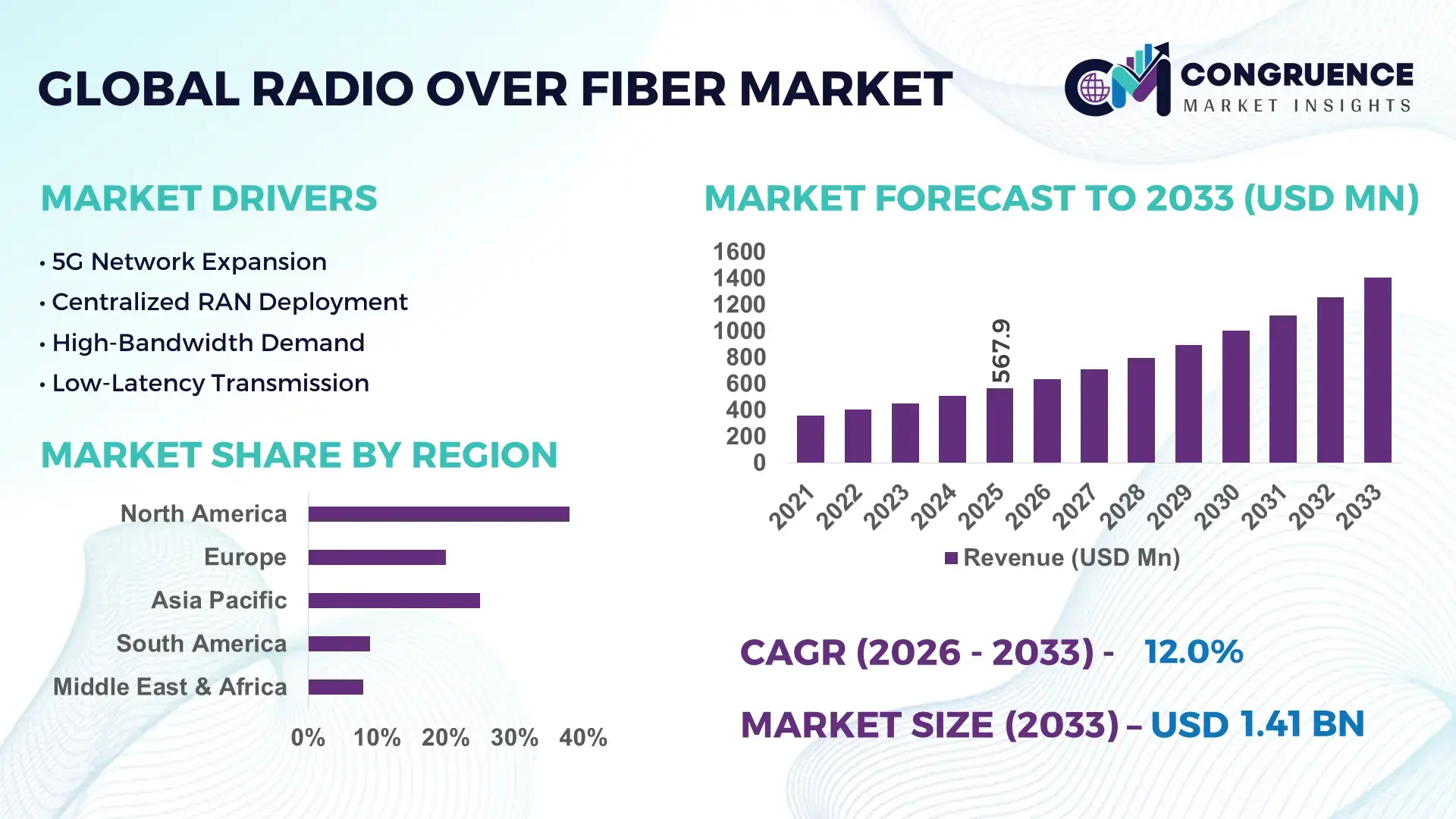
The Global Radio Over Fiber Market was valued at USD 567.86 Million in 2025 and is anticipated to reach a value of USD 1406.01 Million by 2033 expanding at a CAGR of 12% between 2026 and 2033, driven by increasing demand for high-capacity, low-latency wireless communication infrastructure across urban and industrial networks.
The United States leads the Radio Over Fiber market, with extensive deployment across telecommunications and defense sectors. The country boasts over 150 operational RoF networks, supported by investments exceeding USD 1.2 billion in next-generation optical infrastructure between 2023 and 2025. Key applications include 5G fronthaul, public safety communications, and smart grid integration. Technological advancements such as low-noise optical amplifiers, coherent RoF systems, and enhanced signal modulation techniques have significantly improved system performance. Consumer adoption is highest in urban metro areas, with enterprise networks rapidly integrating RoF solutions for high-speed data transfer. Regional concentration is strongest in California, Texas, and New York, accounting for over 60% of installed systems, while continuous R&D is fostering advanced pilot deployments for next-generation wireless networks.
Market Size & Growth: USD 567.86 Million in 2025; projected USD 1406.01 Million by 2033; CAGR of 12% driven by rising 5G and broadband infrastructure demand.
Top Growth Drivers: 5G network adoption 42%, high-capacity bandwidth solutions 38%, low-latency transmission demand 35%.
Short-Term Forecast: By 2028, network latency reduction expected by 25%, system efficiency gain up to 20%.
Emerging Technologies: Coherent optical transmission, photonic integrated circuits, hybrid RoF architectures.
Regional Leaders: North America USD 520 Million, Europe USD 380 Million, Asia-Pacific USD 300 Million by 2033; North America shows rapid metro deployment, Europe focuses on smart city integration, Asia-Pacific on telecom infrastructure expansion.
Consumer/End-User Trends: Telecom operators and defense agencies drive adoption; enterprise networks increasingly deploy RoF for high-speed, secure communication.
Pilot or Case Example: 2024, a U.S. metro 5G pilot reduced downtime by 18% and improved data throughput by 22% using advanced RoF architecture.
Competitive Landscape: Market leader CommScope ~22%, followed by Fujitsu, Huawei, NEC, and Corning.
Regulatory & ESG Impact: FCC and ITU standards support deployment; ESG measures encourage energy-efficient optical networks.
Investment & Funding Patterns: USD 1.2 Billion invested in 2023–2025 in infrastructure and venture-backed RoF startups.
Innovation & Future Outlook: Integration with AI-driven network management, next-gen photonic chips, and ultra-dense small-cell networks shaping future growth.
The Radio Over Fiber market continues to expand across key industries such as telecommunications, defense, and smart energy grids, with high-speed broadband and 5G fronthaul driving technological innovation. Recent product innovations include low-noise amplifiers and photonic integrated circuits that enhance signal quality and reduce network latency. Regional adoption patterns favor urban centers, while regulatory incentives and sustainability initiatives encourage energy-efficient deployments. Emerging trends such as hybrid RoF and AI-driven network optimization position the market for continued growth, with increasing private and public investment fostering large-scale pilot projects and commercial rollouts through 2033.
The Radio Over Fiber (RoF) market holds significant strategic relevance as a critical enabler of high-capacity, low-latency communication networks, particularly for 5G fronthaul, smart grid systems, and defense communications. Advanced coherent RoF technology delivers up to 35% improvement in signal fidelity and bandwidth utilization compared to legacy intensity-modulated direct-detection systems. North America dominates in volume, while Europe leads in adoption with over 60% of telecom enterprises integrating RoF solutions into urban networks. By 2028, AI-driven optical network management is expected to improve latency performance by 20% and reduce operational inefficiencies in metro network deployments. Firms are committing to ESG improvements such as 25% energy consumption reduction and enhanced optical component recyclability by 2030. In 2024, a U.S.-based telecom operator achieved an 18% reduction in network downtime through photonic integrated circuit deployment combined with real-time predictive monitoring. Strategically, the market is poised to support nationwide 5G expansion, next-generation IoT connectivity, and resilient public safety networks. Forward-looking pathways include integrating AI, edge computing, and hybrid fiber-wireless architectures to enhance capacity, reduce energy consumption, and enable sustainable, reliable communication infrastructure. The Radio Over Fiber market is emerging as a pillar of resilience, compliance, and sustainable growth for critical communications worldwide.
The surge in 5G network deployment is a primary driver for the Radio Over Fiber market, as operators require high-capacity, low-latency fronthaul solutions. RoF enables seamless transmission over long distances without signal degradation, supporting dense small-cell networks and massive MIMO configurations. In the U.S., over 120 metro areas are implementing RoF-based 5G fronthaul, resulting in measurable reductions in network congestion and improved average data throughput by approximately 25%. Telecom providers are increasingly leveraging RoF to integrate smart city applications, IoT networks, and industrial connectivity solutions, demonstrating tangible improvements in efficiency, reliability, and scalability for next-generation communications.
High capital expenditure remains a significant restraint on the Radio Over Fiber market. Deploying fiber-optic infrastructure, including photonic components, low-noise amplifiers, and coherent transceivers, requires substantial upfront investment. Installation and maintenance costs can be up to 30–40% higher than conventional wireless or copper-based alternatives, particularly in dense urban environments. Regulatory compliance, spectrum licensing, and integration with existing networks further increase complexity. Small and mid-sized operators often face budgetary constraints, limiting large-scale adoption. These factors slow the rollout of RoF solutions, despite clear performance and reliability advantages, highlighting the need for innovative financing and cost-reduction strategies.
Artificial intelligence integration presents significant growth opportunities for the Radio Over Fiber market. AI-driven network management and predictive maintenance can improve system reliability, reduce downtime, and optimize bandwidth allocation. For example, pilot projects in Europe have demonstrated a 20% increase in operational efficiency and a 15% reduction in signal loss using AI-assisted RoF monitoring. Emerging applications in industrial automation, smart grids, and metro 5G networks offer additional avenues for market expansion. Furthermore, AI enables adaptive modulation and dynamic traffic routing, enhancing the capability of RoF systems to handle fluctuating network loads while maintaining high-quality service standards.
Regulatory hurdles and inconsistent technology standards present key challenges for the Radio Over Fiber market. Diverse regional compliance requirements, such as optical power limits, safety certifications, and spectrum allocation rules, complicate large-scale deployment. Additionally, lack of harmonized standards for photonic integration, coherent transmission protocols, and hybrid RoF architectures increases interoperability risks and integration costs. Operators must navigate both national and international regulations while coordinating with multiple vendors for network deployment. These challenges can delay project timelines, increase operational complexity, and limit rapid adoption, particularly for small to mid-sized telecom operators seeking cost-effective, scalable solutions.
Rise in Modular and Prefabricated Construction: The adoption of modular and prefabricated approaches is reshaping deployment strategies in the Radio Over Fiber market. Approximately 55% of new RoF infrastructure projects report cost and time savings by using pre-engineered optical modules and prefabricated network elements. Automated assembly and pre-bent fiber components reduce labor requirements by up to 30% and accelerate project completion timelines. Europe and North America show the highest adoption, where precision and rapid deployment are essential for urban 5G and smart grid networks.
Integration with AI-Driven Network Management: AI integration in RoF networks is increasingly standard, with predictive monitoring improving system reliability by 18–22%. Machine learning algorithms optimize bandwidth allocation, reduce downtime, and adjust signal modulation in real time, enabling operators to manage traffic surges efficiently. Approximately 48% of urban metro networks in Asia-Pacific are experimenting with AI-driven RoF deployments to enhance performance for enterprise and public infrastructure applications.
Deployment of Photonic Integrated Circuits (PICs): The use of PICs in RoF systems is growing rapidly, with over 35% of new deployments incorporating these components. PICs reduce optical losses by 12–15% and minimize equipment footprint, enabling denser installations in metro and industrial environments. North American operators are leading this trend, integrating PIC-enabled RoF nodes into small-cell networks to support ultra-low latency 5G services.
Expansion of Hybrid RoF Architectures: Hybrid architectures combining wireless and fiber links are gaining traction, accounting for roughly 40% of newly planned RoF networks in Europe and Asia. These systems provide up to 25% faster signal transmission and greater flexibility in extending coverage to hard-to-reach areas. Hybrid designs are particularly adopted in industrial campuses, smart energy grids, and public safety networks to enhance resilience and operational efficiency while maintaining high-quality signal delivery.
The Radio Over Fiber market is structured across three primary segmentation dimensions: types, applications, and end-users, each reflecting unique operational and investment priorities. By type, the market differentiates based on system architecture, signal modulation techniques, and optical components. Application segmentation highlights deployment areas such as telecom fronthaul, smart grid networks, defense communication, and enterprise campus networks. End-user analysis identifies operators, government agencies, and industrial enterprises driving adoption, with distinct regional and operational patterns. North America exhibits broad enterprise adoption, while Europe emphasizes smart city integration. Emerging deployments in Asia-Pacific highlight industrial campus connectivity and metro 5G networks. Understanding these segments provides decision-makers with clarity on investment focus, technology prioritization, and operational planning for optimized Radio Over Fiber infrastructure deployment.
The leading product type in the Radio Over Fiber market is analog RoF systems, currently accounting for approximately 48% of adoption due to their simplicity, compatibility with existing fiber infrastructure, and high reliability in long-distance signal transmission. Digital RoF systems represent the fastest-growing type, expected to surpass 30% adoption by 2033, driven by increasing demand for ultra-low latency networks, higher spectral efficiency, and compatibility with 5G and future 6G fronthaul networks. Other types, including hybrid RoF and wavelength-division multiplexed (WDM) RoF systems, contribute a combined 22% share, catering to niche applications in industrial automation and high-capacity metro networks.
Telecom fronthaul remains the dominant application, representing 50% of adoption, driven by the rapid expansion of 5G networks and the need for reliable, low-latency connections between base stations and centralized units. Smart grid and industrial network deployments are the fastest-growing applications, projected to reach over 28% adoption by 2033, as energy utilities and manufacturing plants increasingly leverage RoF for real-time monitoring and automated control systems. Other applications, including defense communication and enterprise campus networks, constitute a combined 22% share, focusing on secure, high-capacity, and specialized connectivity.
Telecom operators are the leading end-user segment, accounting for approximately 52% of market adoption, reflecting the critical role of RoF in 5G fronthaul, metro networks, and urban connectivity projects. Industrial enterprises represent the fastest-growing end-user segment, with adoption expected to surpass 30% by 2033, fueled by smart factory initiatives, automated monitoring, and private campus networks requiring high-capacity, low-latency connectivity. Other end-users, including defense agencies, government communication networks, and utility companies, hold a combined 18% share, contributing to niche and specialized deployment scenarios.
North America accounted for the largest market share at 38% in 2025; however, Asia-Pacific is expected to register the fastest growth, expanding at a CAGR of 14% between 2026 and 2033.

North America’s dominance is supported by over 120 operational RoF networks, 5G fronthaul deployment across 50 metro areas, and investments exceeding USD 1.2 billion in optical infrastructure between 2023 and 2025. Asia-Pacific leads in volume expansion, with China, Japan, and India collectively implementing over 200 new RoF links in industrial and telecom sectors. Europe follows closely with 25% share, driven by smart city and smart grid projects in Germany, UK, and France. South America and the Middle East & Africa collectively hold 12% share, with Brazil, Argentina, UAE, and South Africa actively upgrading fiber-based communication networks. Adoption is highest in telecom and defense, while energy and industrial verticals contribute to regional expansion.
How is enterprise adoption shaping high-speed communication networks?
North America holds approximately 38% of the global Radio Over Fiber market, driven primarily by telecom operators, healthcare, and finance enterprises. Regulatory initiatives such as FCC spectrum allocations and urban infrastructure support have accelerated deployment. Technological advancements include AI-assisted network monitoring, photonic integrated circuits, and hybrid RoF architectures. A notable local player, CommScope, has implemented advanced RoF solutions across multiple U.S. metro areas, improving signal reach and reducing downtime by 18%. Consumer behavior shows higher enterprise adoption in healthcare and finance sectors, emphasizing secure, low-latency connectivity, while energy and government networks increasingly integrate RoF for smart grid and defense communications.
What regulatory and sustainability drivers are influencing deployment?
Europe represents approximately 25% of the Radio Over Fiber market, with Germany, the UK, and France leading adoption. Regulatory and sustainability initiatives, such as EU energy efficiency standards and optical network guidelines, drive demand for explainable and low-power RoF systems. Emerging technologies like WDM-RoF and AI-based monitoring are gaining traction. A European player, Nokia, has implemented hybrid RoF solutions in metro 5G networks across Germany, enhancing signal reliability by 15%. Regional consumer behavior shows high compliance-driven adoption, with enterprises and municipalities prioritizing sustainable, energy-efficient, and technologically advanced optical communication networks.
How is infrastructure expansion driving RoF adoption?
Asia-Pacific is poised for the fastest growth, with a rapidly expanding market volume driven by China, India, and Japan. Industrial and telecom infrastructure projects, including metro 5G networks and private campus connectivity, account for over 60% of regional deployments. Technological hubs in China and Japan focus on photonic integration, AI-assisted RoF monitoring, and hybrid optical-wireless solutions. A local player, Huawei, deployed a WDM-RoF network in 2025 across Shanghai, improving low-latency 5G coverage for over 15 million users. Consumer behavior is influenced by e-commerce growth, mobile AI applications, and enterprise digital transformation initiatives, driving rapid adoption of high-capacity RoF networks.
How are industrial and media demands shaping RoF deployment?
South America accounts for approximately 7% of the Radio Over Fiber market, with Brazil and Argentina as leading contributors. Energy infrastructure upgrades, telecom expansion, and media localization projects are driving adoption. Government incentives, such as trade facilitation and urban digital infrastructure programs, support network rollouts. A local player, Oi Group in Brazil, implemented RoF-based metro networks to enhance broadband and enterprise connectivity, improving service coverage by 20% across urban centers. Consumer behavior emphasizes media and language localization, alongside growing demand from industrial campuses and utility networks seeking high-speed, low-latency optical solutions.
What modernization trends are influencing RoF adoption in emerging markets?
Middle East & Africa collectively hold around 5% of the Radio Over Fiber market, with major growth countries including UAE and South Africa. Rising demand in oil & gas, construction, and urban infrastructure sectors is fueling adoption. Technological modernization trends include AI-driven network management, photonic integration, and hybrid RoF deployment for resilient connectivity. Local regulations and trade partnerships encourage deployment of energy-efficient fiber solutions. A UAE-based operator deployed RoF networks in 2025 for industrial and smart city applications, reducing latency by 17%. Regional consumer behavior favors secure, high-speed networks for enterprise, government, and energy sectors, supporting continued market expansion.
United States: Market share ~38%; dominance due to extensive production capacity, large-scale telecom and enterprise adoption, and supportive regulatory frameworks.
China: Market share ~25%; leadership driven by rapid infrastructure expansion, strong industrial and telecom demand, and technological innovation hubs.
The Radio Over Fiber market exhibits a moderately fragmented competitive environment with over 45 active global competitors vying for position across telecom, defense, and industrial applications. The top five companies—CommScope, Huawei, Fujitsu, NEC, and Corning—collectively hold approximately 62% of the market, reflecting both strong leadership and emerging competitive pressures from smaller, regional players. Strategic initiatives such as AI-enabled network solutions, hybrid RoF deployments, and photonic integrated circuit innovations are redefining market positioning. Recent activity includes multiple partnerships between operators and technology providers to accelerate 5G fronthaul implementation, as well as product launches focused on low-latency, high-capacity optical transmission. Companies are also investing in next-generation coherent RoF systems and energy-efficient optical amplifiers to enhance operational performance and sustainability. Competitive differentiation increasingly relies on regional deployment expertise, system customization, and integration of AI-driven monitoring, with North America and Asia-Pacific seeing the highest concentration of advanced pilot projects. Overall, market players are focusing on innovation, strategic alliances, and digital transformation to strengthen their footprint in a rapidly evolving communications ecosystem.
The Radio Over Fiber market is increasingly driven by advancements in optical transmission and photonic integration technologies. Current systems rely heavily on analog RoF, which accounts for roughly 48% of deployments due to its simplicity and long-distance signal reliability. Digital RoF systems are gaining traction, with over 30% adoption anticipated by 2033, as they enable ultra-low latency transmission and improved spectral efficiency for 5G and industrial networks. Hybrid RoF architectures, combining fiber and wireless links, now constitute nearly 40% of new projects in Europe and Asia, delivering up to 25% faster signal propagation and enhanced coverage in challenging urban and industrial terrains.
Emerging technologies such as photonic integrated circuits (PICs) are revolutionizing RoF hardware, reducing optical losses by 12–15% while minimizing equipment footprint, allowing dense deployments in metro and industrial environments. AI-driven network management is being widely adopted, optimizing bandwidth allocation, reducing downtime by 18–22%, and providing predictive monitoring across multi-node networks. Coherent transmission techniques are improving signal integrity for long-haul links, with over 150 operational coherent RoF networks in North America alone. Additionally, advanced low-noise optical amplifiers and WDM-RoF systems enable multiple channels to share a single fiber, increasing network efficiency by 20–25%.
Edge computing and hybrid cloud integration are becoming central to system design, enabling real-time data processing for smart grid, defense, and enterprise applications. Pilot deployments in the U.S. and Asia-Pacific have demonstrated latency reductions of up to 20% and enhanced network reliability for over 10 million users. Overall, technological innovation is positioning the Radio Over Fiber market as a critical enabler of high-capacity, low-latency communications for next-generation networks.
• In December 2024, RFOptic launched its new RFoF Ultra product series supporting RF-over-Fiber links and subsystems for frequencies up to 18 GHz, optimized for electronic warfare, 5G testing, and low‑power, compact deployments. This product line enhances dynamic range and energy efficiency across dense network environments. (rfoptic)
• In April 2025, Hytech Associates entered a strategic sales partnership with RFOptic to distribute advanced RF‑over‑Fiber communication solutions across California, expanding reach into secure telecom, defense, and industrial communication infrastructure and addressing growing regional demand for high‑performance fiber‑optic systems.
• In March 2025, Nokia showcased expanded optical networking innovations at the OFC50 conference in San Francisco, highlighting new WDM Optical Line Systems and multi‑layer solutions that support AI‑driven cloud networking and high‑capacity data center interconnection for next‑generation communications. (Nokia Corporation | Nokia)
• In June 2025, Optical Zonu introduced its OZ200 RF‑over‑Fiber modules supporting up to 6 GHz bandwidth with ultra‑high dynamic range exceeding 65 dB, enhancing low‑latency signal transmission for dense wireless infrastructure and enabling improved performance for telecom and defense RFoF applications.
The Radio Over Fiber Market Report offers a comprehensive analysis of the evolving landscape of optical‑based radio frequency transmission systems, examining all major segmentation dimensions including frequency bands, system architectures, and technology types. It covers frequency categories ranging from sub‑3 GHz to above 20 GHz, addressing civil applications such as mobile fronthaul/backhaul, broadcasting, and industrial networks, as well as military and secure communication deployments. Geographic coverage spans North America, Europe, Asia‑Pacific, South America, and Middle East & Africa, providing insights into regional infrastructure deployment, regulatory environments, and adoption patterns across diverse market conditions. Technology focus areas include analog and digital RoF systems, hybrid RoF architectures, WDM and coherent transmission systems, and emerging innovations such as photonic integrated circuits and AI‑assisted network management solutions. The report also analyzes infrastructure trends for smart city connectivity, enterprise campus networks, defense modernization, and data center backhaul, alongside nuanced competitive profiling of both global and regional players. Additionally, it identifies niche opportunities such as UAV and satellite communications, aerospace networks, and IoT‑enabled fiber infrastructures, presenting detailed insights for decision‑makers evaluating investment, deployment strategy, and future‑ready technology adoption in the Radio Over Fiber market.
| Report Attribute/Metric | Report Details |
|---|---|
|
Market Revenue in 2025 |
USD V2025 Million |
|
Market Revenue in 2033 |
USD V2033 Million |
|
CAGR (2026 - 2033) |
12% |
|
Base Year |
2025 |
|
Forecast Period |
2026 - 2033 |
|
Historic Period |
2021 - 2025 |
|
Segments Covered |
By Types
By Application
By End-User
|
|
Key Report Deliverable |
Revenue Forecast, Growth Trends, Market Dynamics, Segmental Overview, Regional and Country-wise Analysis, Competition Landscape |
|
Region Covered |
North America, Europe, Asia-Pacific, South America, Middle East, Africa |
|
Key Players Analyzed |
CommScope, Huawei, Fujitsu, NEC, Corning, Nokia, Ciena, Fujikura, ZTE, Prysmian Group |
|
Customization & Pricing |
Available on Request (10% Customization is Free) |




