
Reports
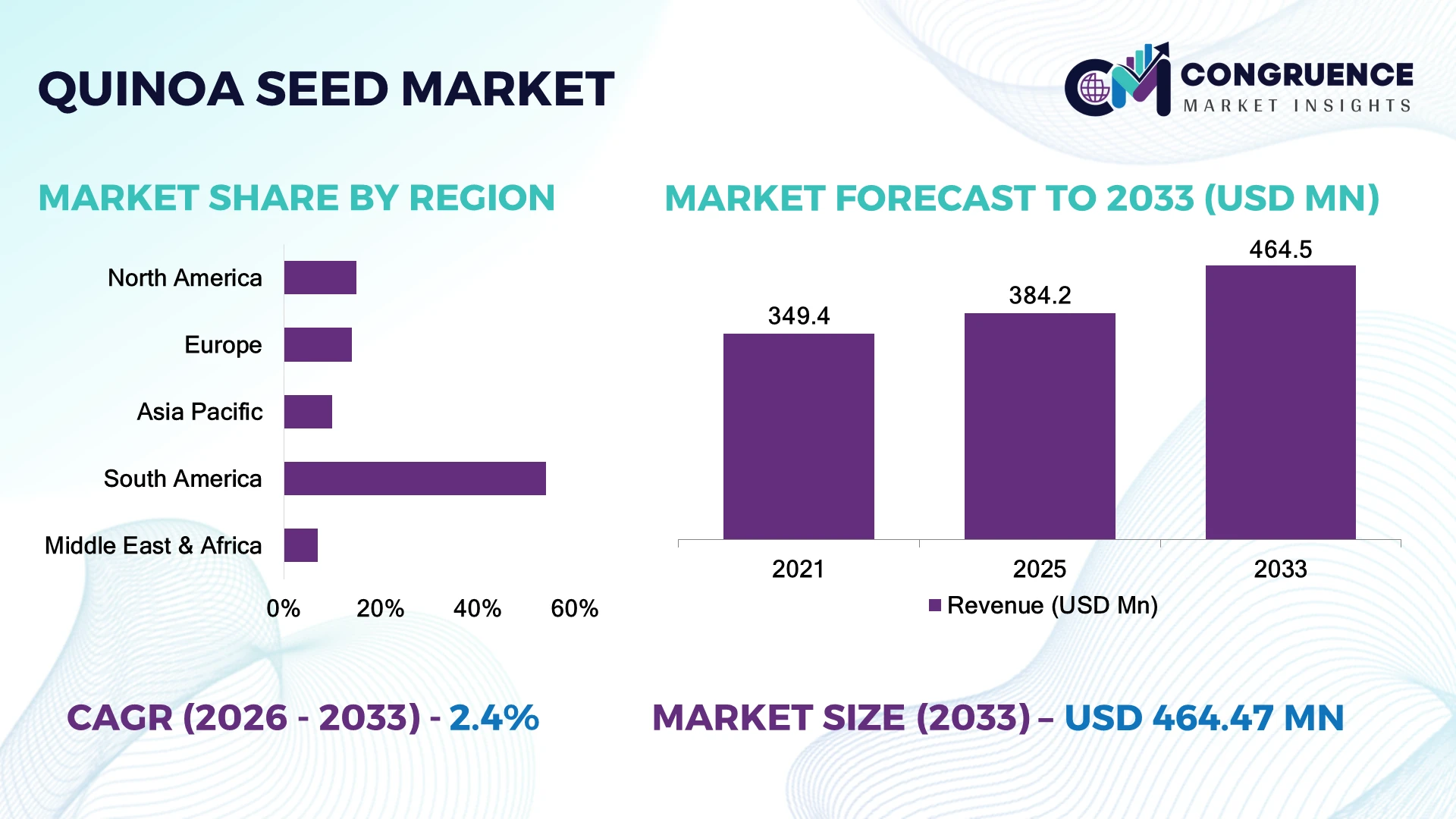
The Global Quinoa Seed Market was valued at USD 384.2 Million in 2025 and is anticipated to reach a value of USD 464.5 Million by 2033 expanding at a CAGR of 2.4% between 2026 and 2033. Growth is primarily driven by the expansion of certified organic quinoa cultivation, increasing climate-resilient seed breeding programs, and wider adoption across functional food and health-focused product manufacturing.
Bolivia remains the dominant country, contributing approximately 42% of global quinoa seed production through large-scale cultivation in the Altiplano region, supported by export-oriented farming and government-backed agricultural initiatives. Peru follows with nearly 36% production share while accelerating mechanized harvesting and certified seed adoption by over 28%. Rising demand from European food processors after EU organic farming expansion further strengthens international trade flows.
Growing investment in premium seed quality, resilient production systems, and export-oriented supply chains is reshaping long-term competitive positioning across the global quinoa seed industry.
Market Size & Growth: USD 384.2 Million in 2025 reaching USD 464.5 Million by 2033 at 2.4% growth, supported by certified seed development and premium food applications.
Top Growth Drivers: Organic cultivation +31%, certified seed adoption +28%, functional food consumption +22%.
Short-Term Forecast: By 2028, certified seed utilization is expected to improve crop consistency by nearly 18%.
Emerging Technologies: AI-assisted crop monitoring, precision irrigation, and genomic seed breeding improve cultivation efficiency.
Regional Leaders: South America (~USD 225 Million), Europe (~USD 98 Million), North America (~USD 71 Million), supported by organic food expansion and sustainable farming.
Consumer/End-User Trends: More than 46% of health-focused food manufacturers increasingly incorporate quinoa-based ingredients.
Pilot/Case Example: In 2024, precision irrigation projects in Peru reduced water consumption by approximately 20% while improving seed quality.
Competitive Landscape: Approximate market leader holds 17% share, alongside Quinoa Foods Company, Irupana Andean Organic Food, Adaptive Seeds, and Hancock Seed Company.
Regulatory & ESG Impact: Organic certification programs increased certified cultivation acreage by over 24% across key exporting nations.
Investment & Funding: More than USD 85 Million has been directed toward processing expansion, seed improvement, and export infrastructure.
Innovation & Future Outlook: Climate-resilient seed varieties and digital farm management platforms continue strengthening global supply resilience.
Quinoa Seed Market demand is expanding across functional foods, nutritional supplements, plant-based formulations, and premium bakery ingredients as manufacturers prioritize ingredient traceability and certified sourcing. Advanced genomic breeding and precision agriculture are improving seed performance, while organic-certified cultivation has surpassed 30% in several producing regions. Supply-chain diversification beyond traditional Andean producers is strengthening procurement flexibility and supporting broader commercial adoption, setting the stage for deeper strategic market development.
The quinoa seed market has become strategically important as food manufacturers strengthen resilient ingredient sourcing and governments promote sustainable agricultural diversification. Certified production systems, improved seed genetics, and traceable supply chains are enhancing competitiveness while reducing dependence on conventional grain crops. Export-oriented farming clusters are attracting greater investment through coordinated production and processing infrastructure.
Modern genomic breeding programs deliver approximately 15% higher yield consistency than conventional seed selection while reducing field losses through improved disease resistance. Bolivia continues to lead global production scale, whereas Peru has accelerated mechanized cultivation and certified seed deployment, enabling faster productivity improvements. Over the next two to three years, digital crop monitoring adoption is expected to exceed 35% among commercial producers, improving quality control and operational planning.
Major producers are expanding partnerships with food processors, strengthening contract farming networks, and investing in premium certified seed portfolios to secure long-term supply agreements. These initiatives improve production stability, enhance export competitiveness, and reinforce strategic positioning as global demand increasingly favors sustainable, high-quality agricultural ingredients.
Certified organic cultivation continues transforming the quinoa seed industry as food manufacturers increasingly require traceable, high-quality raw materials. Organic-certified cultivation has expanded by approximately 31%, while certified seed adoption has increased nearly 28% across major producing countries. European organic food regulations continue encouraging higher-quality imports, strengthening demand for standardized seed production. Companies are expanding contract farming, investing in seed breeding programs, and improving processing infrastructure to enhance product consistency. Peru has accelerated mechanized harvesting to improve operational efficiency, while Bolivian producers continue strengthening export-oriented production systems. The combination of certified production, improved genetics, and stronger supply-chain integration provides a durable competitive advantage for commercial seed suppliers.
Production remains heavily concentrated within Andean countries, exposing the industry to weather variability and export disruptions. Approximately 78% of global production originates from Bolivia and Peru, increasing dependence on localized harvest conditions. Seasonal droughts have reduced yields by nearly 12% in certain cultivation zones, while transportation costs remain elevated following global logistics disruptions. Companies are responding through supplier diversification, localized storage infrastructure, and long-term procurement contracts to reduce operational uncertainty. Expanding certified production outside traditional growing regions remains technically challenging because seed adaptation requires location-specific agronomic expertise and substantial field validation.
Precision farming technologies and climate-resilient seed development are creating new commercial opportunities beyond traditional cultivation regions. Digital field monitoring has improved resource efficiency by approximately 18%, while advanced breeding programs have increased seed resilience by nearly 15%. Countries including Canada and the United States continue expanding commercial quinoa cultivation through research partnerships and precision agriculture initiatives. Companies are increasing R&D investment, collaborating with agricultural research institutions, and developing specialized seed portfolios suited for diverse climatic conditions. These innovations enable production expansion while improving operational consistency and reducing cultivation risk across emerging farming regions.
Maintaining consistent seed quality across expanding cultivation areas remains a significant operational challenge. Germination performance can vary by over 14% between production regions due to environmental differences and inconsistent post-harvest handling. Limited availability of specialized agronomic expertise continues slowing commercial expansion in new producing countries. Companies are investing in standardized seed testing, advanced storage infrastructure, and digital quality monitoring systems to improve production reliability. Strengthening certification protocols, expanding technical training, and improving research collaboration will be essential to maintaining competitiveness and ensuring consistent global supply as commercial cultivation continues expanding.
Certified Organic Seed Expansion Organic-certified quinoa seed cultivation continues expanding as food manufacturers prioritize traceable ingredient sourcing. Certified acreage has increased by approximately 24%, while processor demand for identity-preserved seed lots has grown by nearly 19%. New organic compliance requirements in European markets are accelerating farm-level certification and documentation workflows. Companies are strengthening contract farming networks, expanding seed multiplication programs, and integrating digital traceability platforms to reduce procurement risks and improve export consistency.
Precision Farming Integration Precision agriculture technologies are becoming standard across commercial quinoa cultivation. GPS-guided field operations have improved planting accuracy by around 16%, while sensor-based irrigation has lowered water consumption by nearly 20%. Labor shortages in Peru and Bolivia are encouraging mechanized harvesting and automated crop monitoring. Seed suppliers are partnering with agricultural technology firms to deploy digital field analytics, improving production planning, reducing operational variability, and strengthening quality assurance across commercial supply chains.
Diversified Production Footprint Commercial cultivation is expanding beyond traditional Andean producers as climate resilience becomes a strategic priority. Trial cultivation areas have increased by approximately 18% in Canada and by nearly 15% in Spain through localized seed adaptation programs. Supply-chain diversification is reducing dependence on single-origin procurement while improving seasonal availability. Companies are restructuring sourcing strategies, investing in regional seed testing, and establishing partnerships with local growers to build geographically balanced production networks.
Functional Food Product Innovation Food manufacturers are accelerating quinoa-based product development to address premium nutrition demand. More than 34% of new grain-based product launches now incorporate ancient grains, while clean-label ingredient usage has expanded by nearly 21%. Retailers increasingly require standardized seed quality and stable supply performance. Companies are scaling processing capacity, introducing specialized seed varieties for targeted food applications, and expanding strategic partnerships with ingredient manufacturers to strengthen product differentiation and operational reliability.
The market is segmented into White Quinoa Seed, Red Quinoa Seed, and Black Quinoa Seed. White Quinoa Seed remains the leading segment with an estimated market share of approximately 63% because of its consistent grain quality, mild flavor profile, high processing compatibility, and broad acceptance across food manufacturing. It remains the preferred option for cereals, bakery products, infant nutrition, and packaged health foods. Red Quinoa Seed represents the fastest-growing segment as manufacturers increasingly target premium retail products and functional food formulations with higher nutritional positioning. Companies continue expanding certified seed production while investing in improved varieties that deliver stronger germination performance and better climate resilience. Black Quinoa Seed maintains strategic importance within specialty food markets where premium positioning and differentiated nutritional characteristics support higher-value applications. Commercial producers are expanding breeding programs, strengthening certified multiplication networks, and improving seed quality through advanced selection methods. Approximately 32% of newly certified cultivation fields now include premium colored quinoa varieties, reflecting changing purchasing priorities among food processors and export buyers.
The market is segmented into Food Processing, Retail Consumption, Animal Feed, and Nutraceutical Products. Food Processing accounts for approximately 58% of overall demand as manufacturers increasingly utilize quinoa seeds in bakery products, cereals, snacks, beverages, and plant-based foods. Standardized seed quality, reliable supply, and efficient processing characteristics continue driving commercial procurement. Nutraceutical Products represent the fastest-growing application as protein-rich and functional ingredient formulations gain wider acceptance. Nearly 29% of newly introduced wellness food products now incorporate quinoa-derived ingredients to strengthen nutritional value. Retail Consumption continues expanding through organic grocery channels and premium packaged food offerings, while Animal Feed remains a relatively small but emerging application supported by research into alternative plant-based feed ingredients. Companies are increasing production capacity, strengthening processing partnerships, and developing application-specific seed varieties that improve manufacturing consistency while supporting diversified product portfolios.
The market is segmented into Food Manufacturers, Retail Consumers, Nutraceutical Companies, and Animal Feed Producers. Food Manufacturers remain the dominant end-user group with approximately 61% market share because of large-volume procurement for packaged foods, functional beverages, breakfast cereals, and plant-based product lines. Their purchasing decisions emphasize supply stability, certification, and consistent seed quality. Nutraceutical Companies represent the fastest-growing end-user segment as demand for plant-derived protein and wellness ingredients continues expanding. More than 27% of new functional nutrition formulations now include quinoa-based ingredients within diversified product portfolios. Retail Consumers continue supporting premium packaged seed sales through health-focused purchasing behavior, while Animal Feed Producers remain a developing customer segment exploring specialized feed formulations. Companies are responding by expanding customized seed offerings, strengthening long-term procurement agreements, enhancing certification standards, and building strategic partnerships with ingredient processors to improve customer retention and operational efficiency.
South America accounted for the largest market share at 54% in 2025 however, Asia-Pacific is expected to register the fastest growth, expanding at a CAGR of 3.2% between 2026 and 2033.

North America represents approximately 15% of the global quinoa seed market, supported by increasing domestic cultivation, advanced seed research, and expanding demand from food processors. Commercial farming in the United States and Canada is reducing dependence on imported seed through localized production and climate-adapted varieties. Precision agriculture technologies have been adopted across nearly 35% of commercial quinoa farms, improving planting consistency and input efficiency. Food manufacturers continue expanding procurement partnerships with regional growers to strengthen supply resilience. Investments in certified seed multiplication and processing infrastructure are improving quality assurance while enabling stable production for premium food applications.
United States Market Outlook: The United States leads regional commercialization through advanced agricultural research, large-scale food manufacturing, and growing consumer demand for functional grains. Commercial quinoa cultivation continues expanding across Colorado, Washington, and California, supported by university breeding programs and precision farming technologies. More than 40% of domestic quinoa processing facilities have increased sourcing from local producers, improving supply-chain flexibility and supporting higher adoption of certified seed varieties.
Europe accounts for approximately 14% of global market demand, driven by strong organic food consumption, rigorous quality standards, and expanding retail distribution. Food processors increasingly require certified quinoa seed with full traceability, encouraging closer collaboration with international producers. Organic-certified cultivation linked to European supply agreements has increased by nearly 24%, while processing investments continue strengthening premium grain production. Companies are expanding long-term sourcing partnerships and adopting digital traceability systems to improve compliance, procurement transparency, and operational efficiency throughout the supply chain.
Germany Market Outlook: Germany serves as the region's largest quinoa consumption and processing hub because of its advanced organic food industry and extensive retail network. Food manufacturers continue expanding quinoa use across bakery, breakfast cereal, and plant-based product categories. More than 32% of premium grain product launches include certified ancient grain ingredients, while distributors continue strengthening supplier qualification programs to improve long-term sourcing reliability.
Asia-Pacific represents approximately 10% of the global market and continues strengthening its position through expanding commercial cultivation and rising health-focused food manufacturing. Countries including China, India, and Australia are increasing quinoa acreage to improve domestic supply and reduce import dependence. Experimental cultivation programs have expanded by nearly 20%, supported by improved irrigation techniques and locally adapted seed varieties. Companies are investing in contract farming, seed multiplication, and processing facilities while strengthening partnerships with agricultural research organizations to improve production performance and supply consistency.
China Market Outlook: China leads regional expansion through significant agricultural research capacity, large-scale food manufacturing, and government-supported crop diversification initiatives. Commercial cultivation continues increasing across northern production zones where climate conditions support improved yields. Approximately 18% of newly established specialty grain cultivation projects now include quinoa, while domestic processors continue expanding investment in premium health-food production.
South America contributes approximately 54% of global quinoa seed production, supported by established cultivation expertise, favorable growing conditions, and strong export infrastructure. Bolivia and Peru remain the industry's operational backbone through extensive certified cultivation, advanced seed selection, and experienced farming networks. Certified production acreage has expanded by nearly 26%, while mechanized harvesting continues improving operational efficiency across commercial farms. Export-focused companies are strengthening logistics partnerships, investing in processing capacity, and improving seed quality standards to maintain competitiveness despite periodic weather-related production variability.
Bolivia Market Outlook: Bolivia remains the world's largest quinoa seed producer, supported by extensive Altiplano cultivation and decades of commercial production expertise. Approximately 42% of global quinoa production originates from the country, supported by established producer cooperatives, certified organic farming, and export-oriented processing facilities. Continued investment in improved seed multiplication and sustainable farming practices strengthens product quality while supporting long-term international market leadership.
Middle East & Africa account for approximately 7% of the global market as governments increasingly promote climate-resilient crops and sustainable agricultural diversification. Controlled-environment farming, efficient irrigation systems, and research partnerships are supporting commercial quinoa cultivation in selected countries. Pilot cultivation projects have improved water-use efficiency by approximately 18%, encouraging broader deployment in arid agricultural regions. Companies continue investing in localized seed evaluation, research collaborations, and precision farming technologies to establish commercially viable production systems while reducing dependence on imported specialty grains.
United Arab Emirates Market Outlook: The United Arab Emirates leads regional innovation through controlled-environment agriculture, precision irrigation, and government-backed food security initiatives. Commercial pilot farms continue evaluating climate-adapted quinoa varieties suitable for desert cultivation. More than 25% of advanced agricultural research projects targeting alternative grains now include quinoa, reinforcing the country's position as a regional center for sustainable agricultural technology deployment and innovation.
The competitive landscape is led by Quinoa Foods Company, Irupana Andean Organic Food, Andean Valley, Hancock Seed Company, and Adaptive Seeds, with global exporters competing against regional seed specialists and certified organic suppliers challenging conventional seed distributors. The top five participants collectively account for approximately 46% of the market, leaving significant room for specialized producers. Competition centers on certified seed quality, export reliability, genetic performance, and supply-chain integration rather than price alone. Certified organic seed portfolios command nearly 18% higher average selling prices, while advanced seed cleaning achieves purity levels above 99.9% and precision seed multiplication improves germination consistency by around 12%. Companies are expanding contract farming, strengthening grower partnerships, investing in seed breeding, and integrating processing operations to secure dependable supply. The market is shifting toward traceable, vertically integrated production as buyers prioritize compliance and origin transparency. Strict certification requirements and established grower networks remain major entry barriers. Winning requires superior seed genetics, dependable certification, resilient sourcing, and long-term customer partnerships.
Irupana Andean Organic Food
Andean Valley
Hancock Seed Company
Adaptive Seeds
Territorial Seed Company
Victory Seeds
Heritage Harvest Seed
The Real Seed Collection
Northern Quinoa Production Corporation
Quinoabol
The British Quinoa Company
Precision agriculture is becoming the operational foundation of commercial quinoa seed production. GPS-guided planting, satellite imagery, and sensor-based irrigation are now deployed across approximately 35% of commercial cultivation areas, reducing water consumption by nearly 20% while improving planting precision by around 16%. Digital field monitoring enables earlier identification of crop stress, allowing producers to optimize input application and improve harvest consistency.
Advanced genomic breeding and digital seed phenotyping are replacing traditional selection methods for commercial seed development. Modern breeding programs improve yield stability by approximately 15% compared with conventional breeding cycles while accelerating variety selection through data-driven evaluation. Certified seed producers benefit most from these technologies because stronger varietal consistency improves export acceptance and long-term customer retention. Automated optical seed sorting further increases purity beyond 99.9%, strengthening quality assurance for premium food manufacturers.
Between 2026 and 2028, AI-assisted agronomic decision support, blockchain-enabled traceability, and climate-adapted breeding platforms are expected to become standard across leading exporters. More than 40% of export-oriented producers are projected to integrate digital traceability into procurement and quality management workflows. Early adopters will strengthen operational resilience, improve certification compliance, reduce supply-chain risk, and secure competitive advantage through higher product consistency and stronger international buyer confidence.
February 2025 Irupana Andean Organic Food confirmed its participation at BIOFACH 2025, targeting more than 100 strategic business contacts and over USD 20 million in export opportunities, reinforcing its international organic quinoa expansion strategy. Source: www.irupanabio.com
March 2025 Irupana Andean Organic Food showcased its certified organic quinoa portfolio during BIOFACH 2025, highlighting 99.99% product purity and strengthening long-term relationships with international buyers seeking reliable certified suppliers. Source: www.irupanabio.com
June 2025 KWS SAAT collaborated with Universidad Nacional del Altiplano and the University of Hohenheim to introduce three climate-resilient quinoa varieties for Peru's Altiplano, improving adaptation to extreme conditions and strengthening sustainable seed development. Source: www.presseportal.de
March 2025 Quinoa Foods Company continued expanding its certified export-oriented seed portfolio through enhanced quality assurance and international customer programs, strengthening supply consistency for premium food manufacturers and supporting broader commercial procurement.
This report provides comprehensive coverage of the global quinoa seed market across White Quinoa Seed, Red Quinoa Seed, and Black Quinoa Seed, while assessing applications in food processing, retail consumption, nutraceutical products, and animal feed. The study evaluates demand across food manufacturers, retail consumers, nutraceutical companies, and feed producers, with regional analysis covering North America, Europe, Asia-Pacific, South America, and the Middle East & Africa. It also examines precision agriculture, genomic breeding, digital traceability, certified seed production, and climate-resilient cultivation technologies shaping commercial development.
The report analyzes market positioning through competitive benchmarking, technology adoption, operational trends, supply-chain transformation, and investment priorities between 2026 and 2033. It incorporates deployment patterns, certified cultivation expansion, enterprise strategies, and evolving purchasing behavior to support business planning, market entry, capacity expansion, partnership evaluation, and long-term competitive positioning across established and emerging quinoa-producing regions.
| Report Attribute / Metric | Details |
|---|---|
| Market Revenue (2025) | USD 384.2 Million |
| Market Revenue (2033) | USD 464.5 Million |
| CAGR (2026–2033) | 2.4% |
| Base Year | 2025 |
| Forecast Period | 2026–2033 |
| Historic Period | 2021–2025 |
| Segments Covered |
By Type
By Application
By End-User
|
| Key Deliverables | Revenue Forecast; Market Trends; Growth Drivers & Restraints; Technology Insights; Segmentation Analysis; Regional Insights; Competitive Landscape; Regulatory & ESG Overview; Recent Developments |
| Regions Covered | North America; Europe; Asia-Pacific; South America; Middle East & Africa |
| Companies Profiled | Quinoa Foods Company; Irupana Andean Organic Food; Andean Valley; Hancock Seed Company; Adaptive Seeds; Territorial Seed Company; Victory Seeds; Heritage Harvest Seed; The Real Seed Collection; Northern Quinoa Production Corporation; Quinoabol; The British Quinoa Company |
| Customization & Pricing | Available on Request (10% Customization Free) |




