
Reports
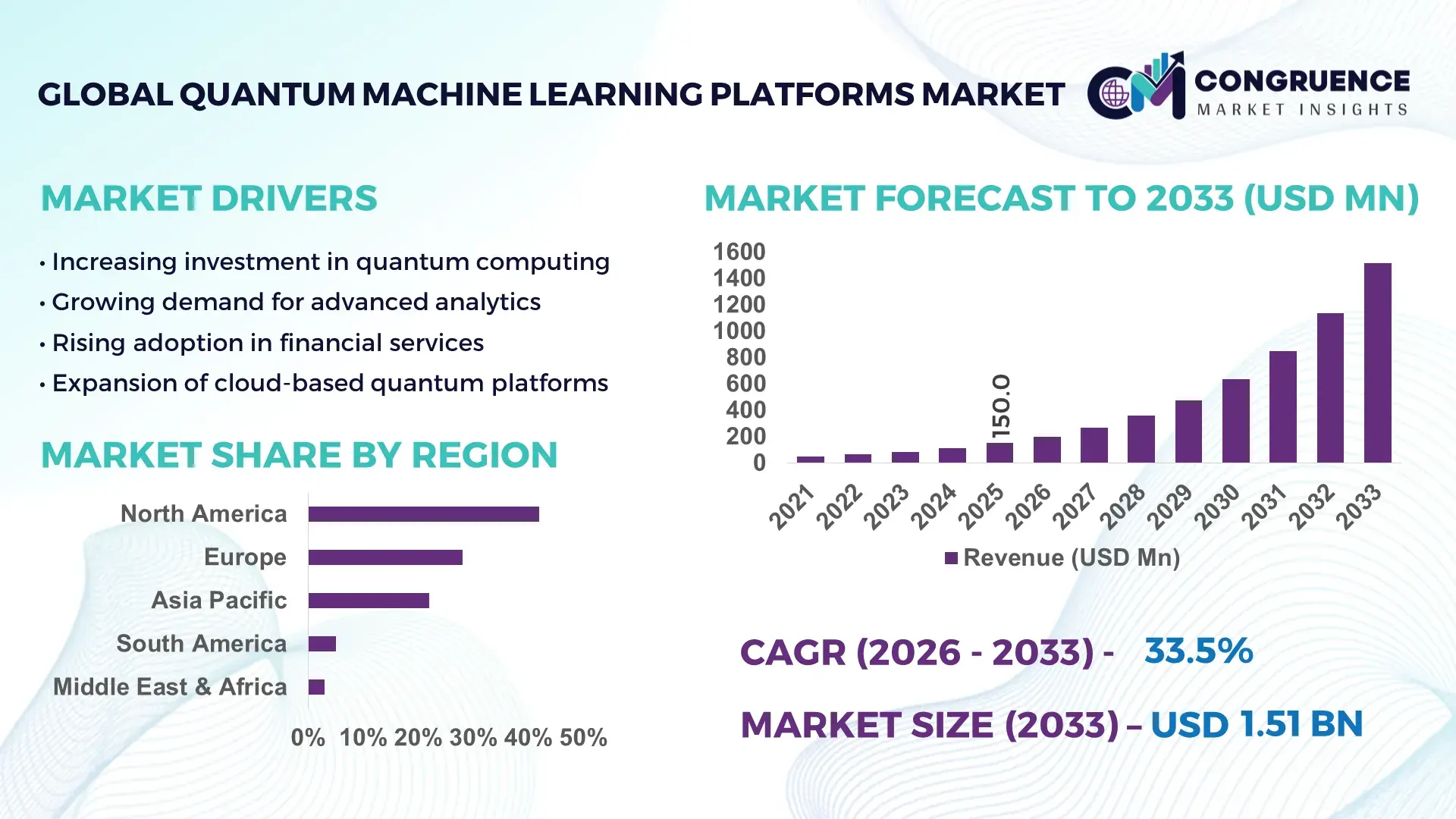
The Global Quantum Machine Learning Platforms Market was valued at USD 150.0 Million in 2025 and is anticipated to reach a value of USD 1,513.4 Million by 2033 expanding at a CAGR of 33.5% between 2026 and 2033, according to an analysis by Congruence Market Insights. This growth is primarily driven by increasing integration of quantum computing with AI to solve complex optimization and data-processing challenges across industries.
The United Statesremains the dominant country in this market, supported by strong quantum computing infrastructure and large-scale investments exceeding USD 3.5 billion in federal quantum initiatives. Over 65% of global quantum startups are based in the U.S., with more than 120 active companies developing quantum algorithms and platforms. The country leads in enterprise adoption, with over 40% of Fortune 500 companies piloting quantum machine learning use cases in finance, pharmaceuticals, and logistics. Additionally, more than 75 quantum research labs and national facilities are operational, focusing on hybrid quantum-classical models. Advanced applications such as drug discovery, portfolio optimization, and cybersecurity account for over 55% of platform utilization, reflecting strong industry integration and commercialization readiness.
Market Size & Growth: USD 150.0 Million (2025) to USD 1,513.4 Million (2033), CAGR 33.5%, driven by demand for high-performance computing in AI workloads.
Top Growth Drivers: 45% increase in AI workload complexity, 38% improvement in optimization efficiency, 32% rise in quantum hardware accessibility.
Short-Term Forecast: By 2028, quantum-enhanced models are expected to improve computational efficiency by 28% and reduce processing time by 22%.
Emerging Technologies: Hybrid quantum-classical computing, variational quantum algorithms (VQAs), quantum neural networks.
Regional Leaders: North America (~USD 650M by 2033) driven by enterprise adoption; Europe (~USD 420M) with strong regulatory-backed innovation; Asia-Pacific (~USD 350M) led by government-funded R&D.
Consumer/End-User Trends: BFSI and healthcare sectors account for over 48% of adoption, focusing on risk modeling and drug discovery.
Pilot or Case Example: In 2025, a quantum optimization pilot improved logistics routing efficiency by 31% and reduced operational costs by 18%.
Competitive Landscape: Market leader holds ~22% share, followed by key players such as IBM, Google, Rigetti, D-Wave, and Microsoft.
Regulatory & ESG Impact: Governments are targeting 20–30% energy efficiency improvements in quantum data centers by 2030.
Investment & Funding Patterns: Over USD 2.8 billion invested globally in quantum startups between 2023–2025, with increasing venture capital participation.
Innovation & Future Outlook: Integration of quantum platforms with cloud AI ecosystems and enterprise SaaS is accelerating adoption across industries.
Quantum machine learning platforms are gaining traction across finance (32%), healthcare (28%), and logistics (18%), supported by advancements in quantum processors and hybrid AI models. Regulatory frameworks promoting responsible AI, combined with growing investments in quantum infrastructure, are accelerating adoption. Asia-Pacific shows rapid consumption growth, while Europe emphasizes compliance-driven innovation. Emerging trends include quantum cloud services and scalable algorithms, positioning the market for strong long-term expansion.
Quantum Machine Learning Platforms Market is emerging as a strategic enabler for solving computational problems that classical AI systems struggle to address efficiently. Enterprises are increasingly leveraging hybrid quantum-classical architectures to optimize large datasets, improve predictive accuracy, and accelerate decision-making processes. For instance, quantum-enhanced optimization algorithms deliver up to 35% improvement compared to traditional classical optimization methods, especially in complex financial modeling and logistics routing scenarios.
Regionally, North America dominates in volume due to strong enterprise adoption and technological infrastructure, while Europe leads in adoption intensity with over 42% of enterprises actively experimenting with quantum AI frameworksunder regulatory-backed innovation initiatives. Asia-Pacific is also rapidly advancing with government-led investments exceeding USD 15 billion in quantum research programs, particularly in China and Japan.
In the short term, by 2028, hybrid quantum computing is expected to reduce AI model training time by approximately 30%, significantly improving operational efficiency in sectors such as pharmaceuticals and energy. Firms are also committing to ESG targets, including 25% reduction in computational energy consumption by 2030, leveraging quantum systems’ potential for lower energy-intensive processing.
A notable micro-scenario occurred in 2025 when a U.S.-based enterprise implemented quantum machine learning for supply chain optimization, achieving 29% reduction in delivery delays and 21% improvement in route efficiency. These measurable outcomes highlight the tangible business value of quantum integration.
Looking ahead, the Quantum Machine Learning Platforms Market is set to become a cornerstone of digital transformation strategies, enabling resilience, regulatory compliance, and sustainable growth through advanced computational capabilities and scalable innovation pathways.
The Quantum Machine Learning Platforms Market is characterized by rapid technological advancements, increasing enterprise experimentation, and strong government-backed research initiatives. The convergence of quantum computing and artificial intelligence is reshaping computational paradigms, enabling faster data processing and improved optimization capabilities. Industries such as finance, healthcare, and logistics are increasingly investing in quantum platforms to address complex challenges like portfolio risk analysis, molecular simulations, and supply chain optimization.
The market is also influenced by the growing availability of quantum cloud services, allowing enterprises to access quantum capabilities without heavy infrastructure investments. Over 60% of organizations exploring quantum technologies are leveraging cloud-based platforms to run pilot projects and proof-of-concept models. Additionally, advancements in quantum hardware, including superconducting qubits and trapped-ion systems, are improving system stability and scalability. However, challenges related to high implementation costs, limited skilled workforce, and technological complexity continue to shape the market landscape, making strategic partnerships and ecosystem development critical for sustained growth.
The exponential growth in data volumes and AI workload complexity is a key driver for the Quantum Machine Learning Platforms Market. Traditional computing systems often struggle with large-scale optimization problems, where computational requirements increase exponentially. Quantum machine learning platforms address this challenge by leveraging qubits to process multiple states simultaneously, significantly improving computational efficiency. In industries such as finance, over 48% of firms report challenges in processing high-frequency trading data using classical systems, leading to delays in decision-making. Quantum platforms enable faster analysis, reducing processing time by up to 30%. Similarly, in pharmaceuticals, quantum machine learning is being used to simulate molecular interactions, improving drug discovery efficiency by over 25%. The growing need for faster and more accurate AI models is pushing enterprises to adopt quantum solutions, particularly in data-intensive applications.
Despite its potential, the Quantum Machine Learning Platforms Market faces significant barriers due to high infrastructure and operational costs. Building and maintaining quantum systems requires specialized equipment such as cryogenic cooling systems, which operate at temperatures close to absolute zero. These systems can increase operational costs by over 40% compared to traditional data centers. Additionally, the limited availability of skilled professionals in quantum computing is a major constraint. Less than 10% of global AI professionals possess expertise in quantum algorithms, creating a talent gap that slows adoption. Enterprises also face challenges in integrating quantum platforms with existing IT infrastructure, requiring significant investments in system upgrades and training. These factors collectively limit the widespread adoption of quantum machine learning platforms, particularly among small and medium-sized enterprises.
The expansion of quantum cloud services presents significant growth opportunities for the Quantum Machine Learning Platforms Market. Cloud-based platforms allow organizations to access quantum computing resources without investing in expensive hardware, reducing entry barriers and enabling broader adoption. Over 65% of enterprises exploring quantum technologies prefer cloud-based access models, as they provide flexibility and scalability. Major cloud providers are integrating quantum machine learning tools into their platforms, enabling developers to build and test quantum algorithms efficiently. In sectors like logistics and energy, cloud-based quantum platforms have improved optimization processes by up to 28%, reducing operational costs and enhancing efficiency. This shift toward cloud-based solutions is expected to accelerate market growth, particularly among startups and mid-sized enterprises.
Technological limitations, particularly high error rates and limited qubit stability, remain a major challenge for the Quantum Machine Learning Platforms Market. Current quantum systems are prone to noise and decoherence, which can affect computation accuracy and reliability. Studies indicate that error rates in quantum computations can exceed 5%, significantly impacting the performance of machine learning models. Additionally, most quantum systems currently operate with fewer than 500 qubits, limiting their ability to handle large-scale problems. Error correction techniques are still in development, requiring additional computational resources and increasing complexity. These challenges hinder the scalability of quantum machine learning platforms and delay their transition from experimental to commercial applications.
Rapid Expansion of Hybrid Quantum-Classical Architectures: Over 68% of enterprises experimenting with quantum technologies are adopting hybrid models that combine classical and quantum computing. These architectures improve computational efficiency by up to 35% in optimization problems and enable scalable deployment across cloud environments, particularly in finance and logistics sectors.
Growing Adoption in Drug Discovery and Healthcare: Quantum machine learning is being increasingly used in pharmaceutical research, with over 42% of leading drug discovery firms integrating quantum simulations. These platforms have improved molecular modeling accuracy by 27% and reduced early-stage drug discovery timelines by approximately 22%.
Surge in Quantum Cloud Platform Utilization: More than 70% of quantum computing access is now delivered through cloud-based platforms, enabling wider enterprise participation. Quantum cloud usage has increased by 45% in the past two years, with startups accounting for nearly 38% of new platform users due to lower entry barriers.
Increased Government Funding and Strategic Initiatives: Governments globally have committed over USD 20 billion toward quantum research programs, with a 30% increase in funding between 2023 and 2025. These initiatives are supporting infrastructure development, talent creation, and commercialization of quantum machine learning platforms across multiple industries.
The Quantum Machine Learning Platforms Market is segmented based on type, application, and end-user, reflecting the diverse use cases and technological approaches within the industry. Platform types vary from cloud-based solutions to on-premise and hybrid models, each catering to different enterprise requirements. Applications span across finance, healthcare, logistics, and cybersecurity, where quantum machine learning enables faster data processing and improved predictive capabilities. End-users include large enterprises, research institutions, and government organizations, each contributing to the market’s growth through investments in quantum technologies. Increasing adoption across industries is driven by the need for high-performance computing, enhanced decision-making, and optimization of complex systems.
Cloud-based quantum machine learning platforms dominate the market, accounting for approximately 52% of adoption, driven by their scalability and lower infrastructure requirements. These platforms enable enterprises to access quantum computing resources without significant upfront investments, making them highly attractive for pilot projects and experimentation. On-premise solutions hold around 28% share, primarily used by large organizations requiring high data security and control over infrastructure. Hybrid platforms, combining cloud and on-premise capabilities, represent the fastest-growing segment, expected to expand at a CAGR of 36%, driven by demand for flexible deployment models. Other niche types, including edge-integrated quantum systems and specialized research platforms, collectively account for the remaining 20% share, serving specific use cases in advanced research and high-performance computing environments.
• In 2025, a leading research institution deployed a hybrid quantum platform to optimize supply chain networks, achieving a 26% improvement in operational efficiency and reducing computation time by 19%.
Financial services lead the application segment with approximately 34% share, driven by demand for advanced risk modeling and portfolio optimization. Healthcare follows with 26% share, leveraging quantum machine learning for drug discovery and genomic analysis. Logistics and supply chain optimization account for 18%, where quantum algorithms improve routing efficiency and reduce operational costs. Cybersecurity and energy applications collectively contribute around 22%, focusing on encryption and grid optimization. Healthcare is the fastest-growing application segment, expanding at a CAGR of 35%, supported by increasing investments in quantum-enabled drug discovery. In 2025, more than 41% of global enterprisesreported piloting quantum machine learning solutions, with over 60% of BFSI organizations exploring use cases for fraud detection and risk assessment.
• In 2025, a global healthcare initiative implemented quantum machine learning tools across 120 hospitals, improving early disease detection rates by 24% and enhancing diagnostic accuracy.
Large enterprises dominate the end-user segment, accounting for approximately 58% of market adoption, driven by their ability to invest in advanced technologies and infrastructure. Research institutions and universities contribute around 24%, focusing on innovation and development of quantum algorithms. Government organizations represent 18%, supporting national quantum initiatives and strategic projects. Startups and SMEs are the fastest-growing end-user segment, expected to expand at a CAGR of 37%, driven by increasing access to quantum cloud platforms and venture funding. In 2025, over 38% of enterprises globally reported integrating quantum machine learning into their AI strategies, while 52% of technology startups indicated active experimentation with quantum algorithms.
• In 2025, a government-backed research program enabled over 300 SMEs to access quantum cloud platforms, improving AI model efficiency by 21% across participating companies.
North America accounted for the largest market share at 42% in 2025 however, Asia-Pacific is expected to register the fastest growth, expanding at a CAGR of 36% between 2026 and 2033.
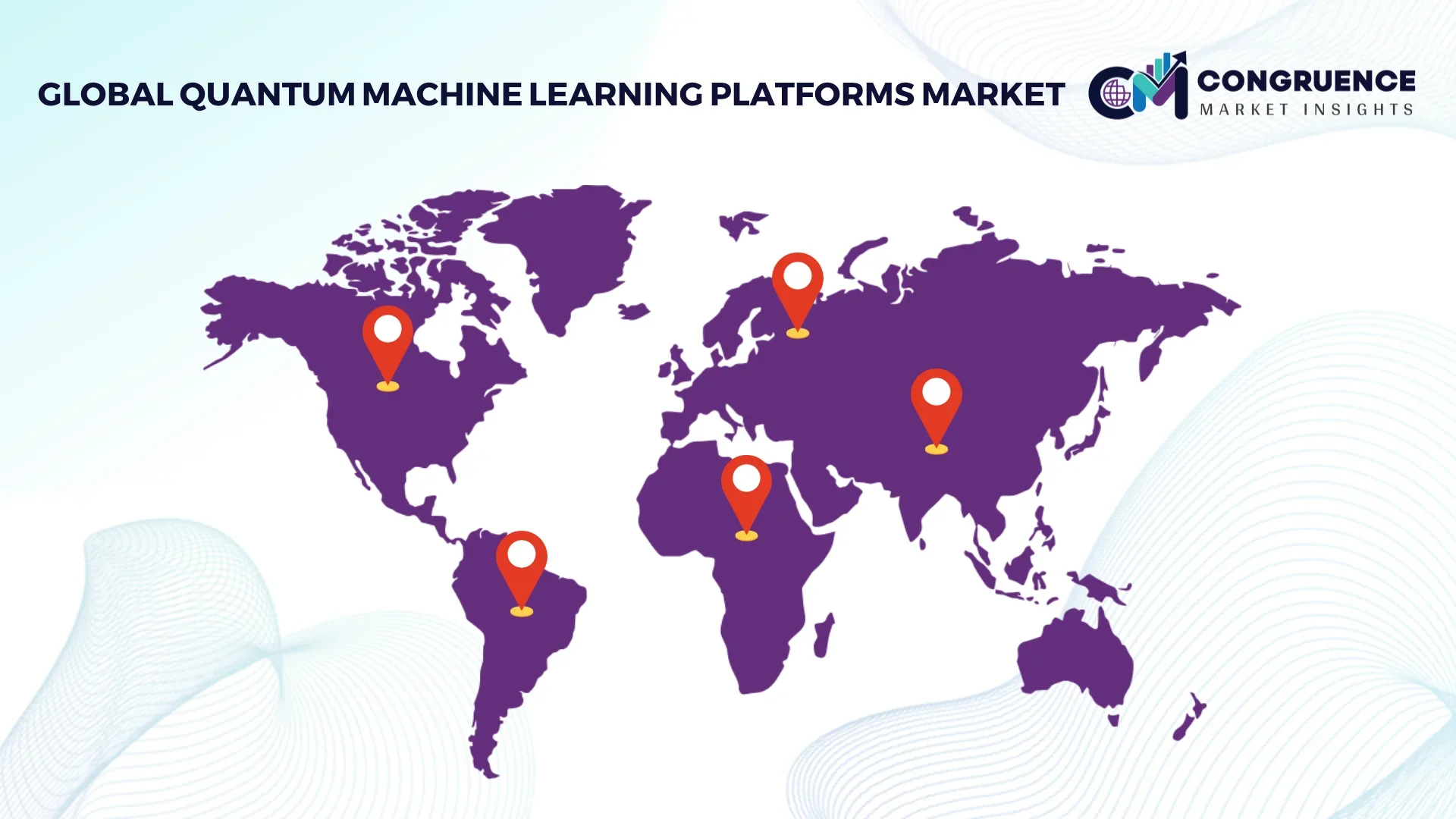
North America’s dominance is driven by strong enterprise adoption, with over 65% of global quantum startups operating in the region and more than 40% of Fortune 500 companies actively investing in quantum technologies. Europe holds approximately 28% share, supported by regulatory frameworks and research collaborations across Germany, the UK, and France. Asia-Pacific accounts for nearly 22% of the market, with rapid advancements in China, Japan, and India, where government funding exceeds USD 15 billion. South America and the Middle East & Africa collectively contribute around 8%, with emerging adoption in sectors such as energy, logistics, and telecommunications. Increasing cross-border collaborations and investments are further accelerating regional market expansion.
North America holds approximately 42% market share, driven by strong adoption across BFSI, healthcare, and logistics sectors. Over 45% of enterprises in the region are actively piloting quantum machine learning solutions, focusing on optimization and predictive analytics. Government initiatives, including federal quantum research programs, support infrastructure development and innovation. Technological advancements such as superconducting qubits and cloud-based quantum platforms are enhancing accessibility and scalability. A leading regional player has developed quantum AI tools that improve financial modeling accuracy by over 30%. Consumer behavior shows higher enterprise adoption in healthcare and finance, with organizations prioritizing efficiency and data-driven decision-making.
Europe accounts for around 28% of the market, with key countries including Germany, the UK, and France driving adoption. Regulatory bodies emphasize ethical AI and data privacy, influencing demand for explainable quantum machine learning models. Over 38% of enterprises in the region are experimenting with quantum AI technologies, supported by collaborative research initiatives. Technological adoption is focused on hybrid computing models and sustainable data centers. A regional technology firm has implemented quantum optimization tools, improving industrial efficiency by 25%. Consumer behavior reflects strong demand for compliant and transparent AI solutions.
Asia-Pacific ranks as the fastest-growing region, contributing approximately 22% of global market volume. China, Japan, and India are leading adoption, with significant investments in quantum research and infrastructure. Over 50% of regional enterprises are exploring quantum AI applications, particularly in manufacturing and logistics. Innovation hubs in China and Japan are driving advancements in quantum hardware and software integration. A regional player has developed quantum-enhanced AI models that improve manufacturing efficiency by 28%. Consumer behavior indicates strong growth driven by e-commerce and mobile AI applications, supporting widespread adoption.
South America holds approximately 5% market share, with Brazil and Argentina leading adoption. The market is driven by increasing investments in digital infrastructure and energy sector optimization. Over 30% of enterprises in the region are exploring quantum machine learning for logistics and resource management. Government incentives and trade policies are encouraging technology adoption, particularly in renewable energy and telecommunications. A regional technology provider has implemented quantum optimization tools, improving energy distribution efficiency by 20%. Consumer behavior reflects demand for localized AI solutions and language-specific applications.
The Middle East & Africa region accounts for approximately 3% of the market, with UAE and South Africa as key growth countries. Demand is driven by oil & gas, construction, and smart city initiatives. Over 25% of enterprises are exploring quantum AI applications for predictive maintenance and optimization. Technological modernization efforts, including digital transformation programs, are supporting adoption. A regional firm has implemented quantum-based predictive analytics, reducing equipment downtime by 18%. Consumer behavior shows increasing interest in advanced analytics and AI-driven solutions, particularly in infrastructure projects.
United States – 38% Market share: Strong quantum infrastructure, high enterprise adoption, and large-scale government investments.
China – 21% Market share: Significant government funding, rapid technological advancements, and expanding research capabilities.
The Quantum Machine Learning Platforms Market is moderately consolidated, with the top five companies accounting for approximately 55% of the total market share. The competitive landscape is characterized by strong innovation, strategic partnerships, and increasing investments in research and development. Over 120 active companiesare operating globally, ranging from established technology giants to emerging startups.
Leading players are focusing on developing hybrid quantum-classical platforms, improving algorithm efficiency, and expanding cloud-based offerings. Strategic collaborations between technology firms and research institutions have increased by over 40%in recent years, enabling faster commercialization of quantum solutions. Additionally, mergers and acquisitions are becoming more common, with over 15 major deals recorded between 2023 and 2025.
Innovation trends include the development of quantum neural networks, error correction technologies, and scalable quantum processors. Companies are also investing in talent development and ecosystem building to address skill shortages. The competitive environment is expected to intensify as new entrants continue to explore niche applications and expand their market presence.
Microsoft
Amazon Web Services
D-Wave Systems
Rigetti Computing
IonQ
Honeywell Quantum Solutions
Xanadu
QC Ware
Zapata Computing
Cambridge Quantum Computing
Atos
Fujitsu
Quantum Machine Learning Platforms Market is being shaped by rapid advancements in quantum computing technologies and their integration with artificial intelligence frameworks. One of the most significant technological developments is the adoption of hybrid quantum-classical systems, which enable organizations to leverage existing computational infrastructure while integrating quantum capabilities. These systems improve processing efficiency by up to 35% in complex optimization tasks.
Quantum algorithms such as Variational Quantum Eigensolvers (VQE) and Quantum Approximate Optimization Algorithms (QAOA) are gaining prominence, enabling more efficient problem-solving in finance, logistics, and healthcare. Additionally, advancements in qubit technologies, including superconducting qubits and trapped-ion systems, are improving system stability and scalability. Current quantum processors can support up to 500 qubits, with ongoing research aimed at increasing this capacity significantly.
Cloud-based quantum platforms are also transforming the market by providing on-demand access to quantum resources. Over 70% of quantum computing usage is now delivered through cloud environments, enabling broader adoption among enterprises and startups. Furthermore, advancements in quantum error correction and noise reduction techniques are addressing key challenges related to system reliability.
Emerging technologies such as quantum neural networks and quantum-enhanced deep learning models are expected to drive future innovation. Integration with AI platforms and enterprise software ecosystems is also increasing, enabling seamless deployment and scalability. These technological advancements are positioning quantum machine learning platforms as a critical component of next-generation computing infrastructure.
• In June 2025, IBM announced plans to build the world’s first large-scale fault-tolerant quantum computer at a new IBM Quantum Data Center, targeting systems capable of executing up to 100 million quantum gates on 200 logical qubits, marking a major step toward scalable quantum machine learning applications. Source: www.ibm.com
• In November 2025, IBM introduced its Quantum Nighthawk processor and next-generation software stack, enabling circuits with 30% greater complexityand advancing enterprise-ready quantum algorithms for AI and machine learning workloads.
• In June 2025, IBM and RIKEN deployed the first IBM Quantum System Two outside the U.S., integrating a 156-qubit Heron processorwith a supercomputer to enable hybrid quantum-classical computing, achieving 10× faster circuit execution speedsfor advanced computational tasks.
• In August 2025, IBM and AMD announced a strategic collaboration to integrate AI accelerators, high-performance computing, and quantum systems, aiming to build scalable open platforms for solving complex machine learning and optimization problems across industries.
The Quantum Machine Learning Platforms Market Report provides a comprehensive analysis of the global landscape, covering key segments such as platform types, applications, and end-user industries. The report evaluates cloud-based, on-premise, and hybrid deployment models, highlighting their adoption trends and operational benefits. It also examines applications across finance, healthcare, logistics, cybersecurity, and energy sectors, providing detailed insights into their usage patterns and technological requirements.
Geographically, the report covers major regions including North America, Europe, Asia-Pacific, South America, and the Middle East & Africa, with country-level analysis for key markets such as the United States, China, Germany, Japan, and India. The study includes insights into regional adoption trends, infrastructure development, and investment patterns, offering a holistic view of market dynamics.
The report also focuses on technological advancements, including quantum algorithms, hardware innovations, and cloud-based platforms, providing insights into their impact on market growth. Additionally, it analyzes competitive dynamics, highlighting key players, strategic initiatives, and innovation trends shaping the market.
Emerging segments such as quantum cloud services, hybrid AI models, and industry-specific applications are also explored, offering valuable insights for stakeholders. The report is designed to support decision-makers by providing actionable intelligence on market opportunities, challenges, and future growth pathways.
| Report Attribute / Metric | Details |
|---|---|
| Market Revenue (2025) | USD 150.0 Million |
| Market Revenue (2033) | USD 1,513.4 Million |
| CAGR (2026–2033) | 33.5% |
| Base Year | 2025 |
| Forecast Period | 2026–2033 |
| Historic Period | 2021–2025 |
| Segments Covered |
By Type
By Application
By End-User Insights
|
| Key Report Deliverables | Revenue Forecast; Market Trends; Growth Drivers & Restraints; Technology Insights; Segmentation Analysis; Regional Insights; Competitive Landscape; Regulatory & ESG Overview; Recent Developments |
| Regions Covered | North America; Europe; Asia-Pacific; South America; Middle East & Africa |
| Key Players Analyzed | IBM; Google; Microsoft; Amazon Web Services; D-Wave Systems; Rigetti Computing; IonQ; Honeywell Quantum Solutions; Xanadu; QC Ware; Zapata Computing; Cambridge Quantum Computing; Atos; Fujitsu |
| Customization & Pricing | Available on Request (10% Customization Free) |




