
Reports
The Global Quantum Computing Infrastructure Access Platforms Market was valued at USD 180.0 Million in 2025 and is anticipated to reach a value of USD 1,354.9 Million by 2033 expanding at a CAGR of 28.7% between 2026 and 2033, according to an analysis by Congruence Market Insights. The growth is primarily supported by rising enterprise demand for cloud-based quantum resources, enabling organizations to access advanced quantum processors and simulators without building costly on-premise infrastructure.
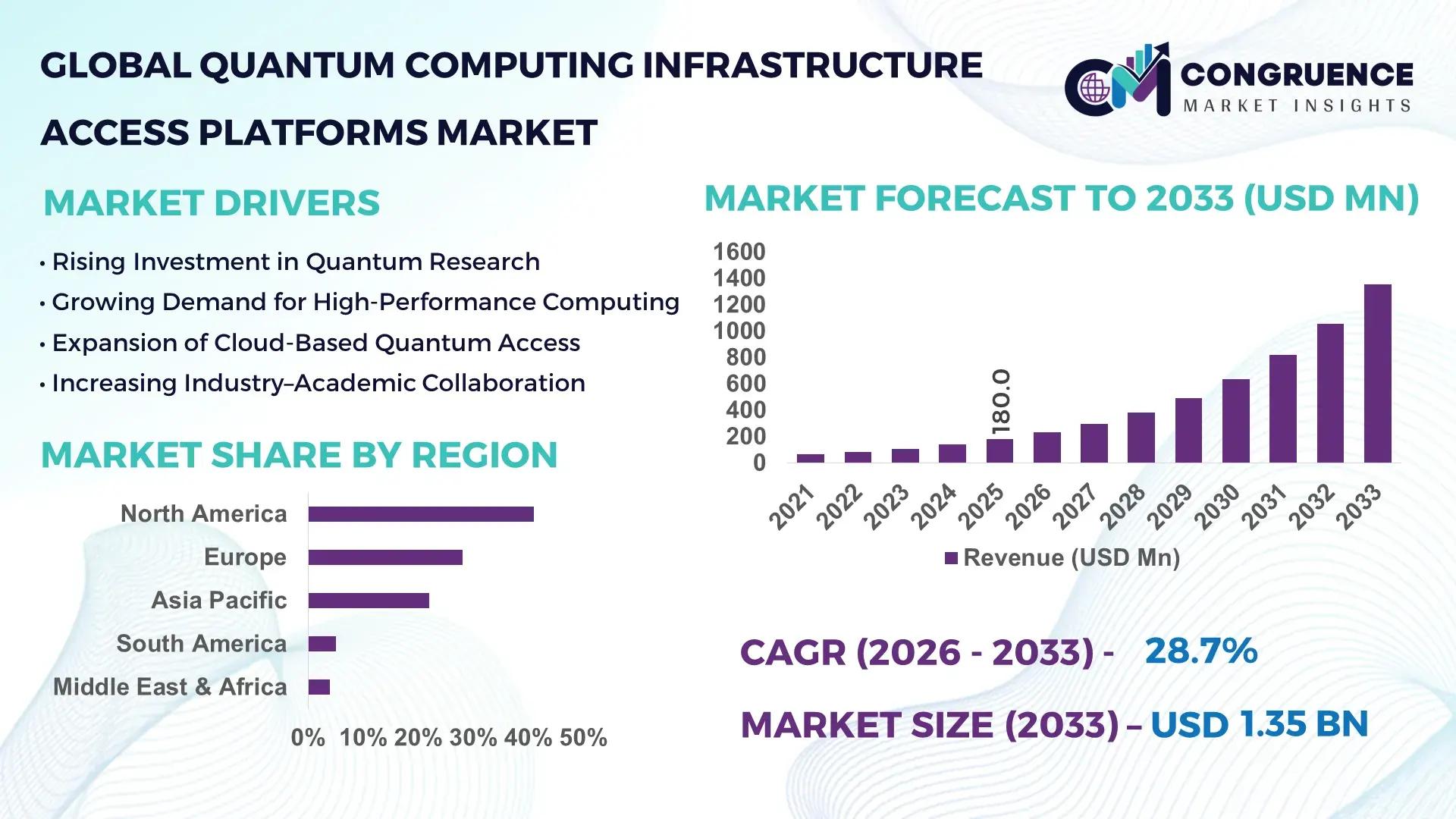
The United States plays a pivotal role in the Quantum Computing Infrastructure Access Platforms Market with extensive investment, infrastructure development, and enterprise adoption. More than 70 operational quantum processors are currently accessible through cloud platforms hosted in U.S. research centers and data facilities. Federal funding for quantum research exceeded USD 3.7 billion under the National Quantum Initiative, supporting infrastructure development and cloud-accessible quantum hardware. Major industry applications include pharmaceutical research, financial risk modeling, logistics optimization, and cybersecurity, with over 45% of Fortune 500 technology firms experimenting with quantum cloud access platforms. In addition, the country hosts over 50% of global quantum computing startups, while partnerships between national laboratories and private technology providers have expanded remote access to superconducting and trapped-ion quantum processors for universities and enterprises worldwide.
Market Size & Growth: The market stood at USD 180.0 Million in 2025 and is projected to reach USD 1,354.9 Million by 2033, expanding at 28.7% CAGR, supported by enterprise adoption of cloud-accessible quantum processors and hybrid computing workflows.
Top Growth Drivers: Approximately 62% enterprise interest in quantum experimentation, 48% improvement in optimization efficiency, and 35% faster simulation capability are accelerating infrastructure access platform demand.
Short-Term Forecast: By 2028, quantum infrastructure access platforms are expected to deliver 25% reduction in computational simulation time for complex optimization problems across logistics and pharmaceutical sectors.
Emerging Technologies: Integration of hybrid quantum-classical computing frameworks, error-mitigation algorithms, and quantum virtualization layers is expanding practical enterprise deployment.
Regional Leaders: North America is projected to approach USD 540 Million by 2033 with strong enterprise experimentation; Europe may exceed USD 350 Million driven by public research networks; Asia-Pacific is expected to cross USD 300 Million supported by national quantum innovation programs.
Consumer/End-User Trends: Financial institutions and pharmaceutical companies represent over 40% of experimental deployments, with increased usage for risk modeling, drug discovery simulations, and cryptographic testing.
Pilot or Case Example: In 2024, a pharmaceutical research consortium deployed a cloud-based quantum simulation platform that improved molecular interaction modeling efficiency by 32%, accelerating candidate drug screening.
Competitive Landscape: IBM holds an estimated 35% platform ecosystem presence, followed by Google Quantum AI, Amazon Web Services (Braket), Microsoft Azure Quantum, and Rigetti Computing.
Regulatory & ESG Impact: Governments are introducing national quantum strategies in over 25 countries, promoting secure computing infrastructure and energy-efficient supercomputing facilities.
Investment & Funding Patterns: Global quantum infrastructure investment exceeded USD 8 billion between 2022–2025, with venture funding focusing on cloud-based quantum access and hardware-software integration startups.
Innovation & Future Outlook: Advancements in quantum error correction, scalable qubit architectures, and hybrid AI-quantum optimization frameworks are expected to reshape enterprise computing strategies over the next decade.
Quantum Computing Infrastructure Access Platforms are gaining traction across pharmaceutical research, financial modeling, aerospace design, and cybersecurity, collectively accounting for nearly 65% of experimental deployments. Recent innovations include hybrid quantum-classical workflow orchestration tools and cloud-based qubit virtualization environments that allow developers to run simulations without specialized hardware. Regulatory support through national quantum strategies and academic-industry collaborations is accelerating infrastructure expansion, particularly in North America and Europe, while Asia-Pacific research hubs continue scaling adoption in semiconductor design and advanced materials modeling.
Quantum Computing Infrastructure Access Platforms are becoming strategically significant as enterprises seek scalable access to emerging quantum processors without investing in complex in-house infrastructure. These platforms enable organizations to experiment with quantum algorithms through cloud interfaces, development kits, and hybrid quantum-classical workflows. Research institutions and corporations increasingly rely on shared quantum infrastructure to accelerate innovation in areas such as drug discovery, financial modeling, and cryptographic security testing.
Recent advancements in hybrid quantum-classical processing frameworks demonstrate measurable improvements in computational efficiency. For instance, hybrid quantum optimization algorithms deliver up to 40% faster problem-solving capability compared to classical heuristic optimization methods, particularly in logistics and portfolio optimization use cases. These improvements are encouraging technology firms to integrate quantum infrastructure access layers into their broader cloud computing ecosystems.
From a regional perspective, North America dominates in volume of operational quantum hardware installations, while Europe leads in institutional adoption, with nearly 38% of research universities participating in quantum cloud experimentation programs. Governments and technology firms are investing heavily in quantum infrastructure to strengthen digital sovereignty and scientific competitiveness.
In the short term, the market outlook is shaped by advances in quantum hardware accessibility and error-mitigation techniques. By 2028, hybrid AI-quantum computing workflows are expected to reduce complex simulation times by approximately 30%, enabling more efficient experimentation in chemistry, materials science, and financial analytics. At the same time, organizations are incorporating sustainability principles in high-performance computing infrastructure. Many operators are committing to energy efficiency targets such as 20% reduction in data center energy consumption by 2030 through optimized quantum simulation workloads.
A practical example of technological progress occurred in 2024, when a leading technology provider in the United States deployed a cloud-based superconducting quantum processor integrated with AI-assisted optimization tools, achieving 28% improvement in algorithm execution efficiency during financial risk modeling experiments. Such initiatives demonstrate how infrastructure access platforms accelerate real-world experimentation.
Looking forward, the Quantum Computing Infrastructure Access Platforms Market will continue to evolve as a foundational component of next-generation computing ecosystems. Through strategic collaboration between technology firms, research institutions, and governments, these platforms are expected to become a critical pillar for digital resilience, regulatory compliance, and sustainable technological growth.
The Quantum Computing Infrastructure Access Platforms Market is influenced by accelerating investments in advanced computing infrastructure, increasing collaboration between research institutions and technology companies, and the rising need for high-performance simulation environments. Enterprises across pharmaceuticals, finance, aerospace, and logistics are exploring quantum algorithms to solve complex optimization and modeling challenges that exceed classical computing capabilities. Cloud-based quantum infrastructure access has emerged as a practical approach for organizations seeking experimental access to quantum processors without building expensive hardware facilities.
Advancements in quantum programming frameworks, hybrid computing models, and error mitigation techniques are expanding the usability of quantum platforms for developers and researchers. Several governments have introduced national quantum strategies supporting research laboratories, startups, and academic networks that rely on remote access to quantum processors. At the same time, global cloud providers are integrating quantum computing access platforms into broader AI and high-performance computing ecosystems. However, the market remains influenced by technical challenges such as limited qubit stability, high operational costs, and the need for specialized quantum algorithm expertise.
Enterprise experimentation with quantum computing has accelerated significantly as organizations explore new ways to solve computationally complex problems. Financial institutions, logistics companies, and pharmaceutical firms are increasingly using cloud-accessible quantum infrastructure to test algorithms related to portfolio optimization, route planning, and molecular simulations. Studies indicate that over 45% of large global enterprises have initiated pilot programs involving quantum algorithms, many of which rely on remote infrastructure access platforms. These platforms provide developers with tools such as quantum software development kits, simulators, and direct connections to quantum processors. Hybrid quantum-classical frameworks have demonstrated up to 35% improvements in solving combinatorial optimization problems compared to conventional heuristics, making them attractive for industries requiring high computational performance. The availability of shared quantum infrastructure also allows universities and startups to conduct research without investing millions in specialized hardware, accelerating innovation and expanding the ecosystem of quantum software developers. As industry experimentation continues to grow, demand for scalable, cloud-based quantum access environments is expected to expand significantly across research and enterprise sectors.
Despite strong interest in quantum computing, technical limitations related to hardware stability and error rates remain a major restraint in the Quantum Computing Infrastructure Access Platforms Market. Current quantum processors operate with limited numbers of qubits and are highly sensitive to environmental noise, which affects computational accuracy. Studies show that many experimental quantum devices experience error rates ranging between 1% and 3% per gate operation, significantly higher than classical computing standards. These limitations require extensive error-mitigation techniques and repeated simulations, increasing operational complexity for organizations accessing quantum infrastructure platforms. Additionally, maintaining quantum processors requires specialized cryogenic systems operating at temperatures near 10–20 millikelvin, making infrastructure deployment expensive and technically demanding. Limited availability of quantum-ready software developers also slows enterprise adoption, as programming quantum algorithms requires expertise in specialized frameworks and quantum mechanics principles. These technical barriers restrict immediate large-scale commercial deployment, forcing many enterprises to treat quantum computing infrastructure access primarily as an experimental research environment rather than a fully operational computing alternative.
Hybrid quantum-classical computing architectures present a significant opportunity for the Quantum Computing Infrastructure Access Platforms Market by enabling practical integration of quantum processors with traditional high-performance computing systems. In these frameworks, classical computers manage large data preprocessing tasks while quantum processors handle specific optimization or simulation calculations. Research programs demonstrate that hybrid algorithms can improve computational performance for certain optimization problems by 25–40% compared with purely classical methods. Cloud-based quantum infrastructure access platforms are particularly well suited for hybrid architectures because they can dynamically allocate quantum and classical resources within a single environment. Industries such as pharmaceuticals and materials science are exploring hybrid workflows to simulate molecular structures and chemical reactions more efficiently. Additionally, global cloud providers are building development environments that allow engineers to test quantum algorithms alongside artificial intelligence and machine learning models. As hybrid computing architectures mature and quantum hardware improves, infrastructure access platforms are expected to become central hubs for cross-disciplinary experimentation and next-generation computational research.
Developing and operating quantum computing infrastructure remains extremely resource intensive, presenting a major challenge for organizations entering the Quantum Computing Infrastructure Access Platforms Market. Quantum processors require highly specialized components such as superconducting circuits, ultra-stable laser systems, and cryogenic refrigeration units capable of maintaining extremely low temperatures. Establishing a functional quantum research facility can require hundreds of millions of dollars in capital investment, limiting participation to well-funded technology companies, governments, and large research institutions. In addition, the global talent pool of quantum engineers and algorithm developers remains limited, with fewer than 20,000 professionals worldwide estimated to have advanced expertise in quantum programming or hardware engineering. This shortage increases competition for specialized skills and slows enterprise adoption of quantum infrastructure platforms. Organizations must also invest in workforce training programs and research collaborations to build internal expertise. These financial and human resource constraints make it challenging for smaller companies to fully leverage quantum computing infrastructure despite growing interest in the technology.
Rapid Expansion of Cloud-Based Quantum Processor Access: More than 65 operational quantum processors are now accessible via cloud-based infrastructure platforms, enabling global research institutions and enterprises to run experiments without installing physical hardware. Around 52% of new quantum computing experiments conducted in 2025 used remote infrastructure access environments, highlighting the shift toward cloud-delivered quantum resources. This trend is strengthening collaborations between technology firms and universities.
Increasing Integration of Hybrid Quantum-AI Workflows: Hybrid computing architectures that combine artificial intelligence with quantum processors are gaining traction across enterprise environments. Studies indicate that approximately 48% of quantum experiments involve hybrid AI-quantum algorithms, particularly in optimization and materials simulation tasks. Early deployments show up to 30% improvement in simulation accuracy when quantum algorithms are integrated with machine learning models.
Growth of National Quantum Infrastructure Programs: Over 25 countries have launched national quantum technology initiatives, with government funding exceeding USD 35 billion globally for research laboratories, academic partnerships, and infrastructure expansion. Around 60% of these programs emphasize cloud-accessible quantum computing platforms, ensuring that research institutions and startups can experiment with advanced computing systems without owning expensive hardware.
Rising Enterprise Participation in Quantum Pilot Projects: Enterprise participation in quantum pilot projects has expanded significantly, with more than 40% of Fortune 500 technology and financial firms testing quantum algorithms through infrastructure access platforms. Logistics optimization experiments have reported 22% improvements in route planning efficiency, while pharmaceutical research teams have achieved 18% faster molecular simulation cycles using quantum-assisted modeling frameworks.
The Quantum Computing Infrastructure Access Platforms Market is segmented based on type, application, and end-user, reflecting how organizations access and utilize quantum computing resources through cloud environments and shared infrastructure systems. Different platform types provide varying levels of functionality, including access to real quantum processors, simulation environments, and hybrid computing frameworks that integrate classical and quantum workloads.
Applications of these platforms span several high-value industries such as pharmaceuticals, finance, logistics, and materials science, where quantum algorithms can address complex optimization and modeling problems. Adoption patterns also vary by end-user group, with research institutions and technology companies representing early adopters due to their technical expertise and access to research funding. Meanwhile, large enterprises across financial services and aerospace sectors are increasingly experimenting with quantum platforms through pilot programs and innovation labs. As platform ecosystems expand and quantum development tools become more accessible, broader enterprise adoption is expected across multiple industries seeking advanced computational capabilities.
Quantum Computing Infrastructure Access Platforms are generally categorized into Quantum Hardware Access Platforms, Quantum Simulation Platforms, and Hybrid Quantum-Classical Platforms. Among these, Quantum Hardware Access Platforms hold the leading position with approximately 46% of total platform utilization, primarily because they provide direct access to physical quantum processors hosted in specialized laboratories and data centers. These platforms allow developers and researchers to run algorithms on superconducting, trapped-ion, or photonic quantum systems, enabling experimentation with real hardware environments. Quantum Simulation Platforms account for roughly 32% adoption, offering virtual quantum environments that mimic the behavior of quantum processors. These simulators are widely used by developers testing algorithms before deploying them on actual hardware. They are particularly useful in educational and research settings where hardware access is limited. The fastest-growing segment is Hybrid Quantum-Classical Platforms, which combine classical high-performance computing resources with quantum processors to execute complex algorithms more efficiently. This segment is expanding rapidly with an estimated 31% adoption growth rate due to its ability to improve optimization and machine learning workflows. The remaining specialized platform types, including quantum algorithm development environments and quantum workflow orchestration tools, collectively represent around 22% of deployments, supporting niche use cases such as algorithm design and hardware benchmarking.
In 2025, a leading research university deployed a hybrid quantum-classical infrastructure platform enabling researchers to run optimization experiments on a superconducting quantum processor integrated with classical GPU clusters, improving algorithm testing throughput for more than 3,000 research users.
Applications of Quantum Computing Infrastructure Access Platforms span multiple industries, including pharmaceutical research, financial modeling, logistics optimization, materials science, and cybersecurity testing. Among these, pharmaceutical and life-science research represents the largest application segment with nearly 38% adoption, as quantum simulation platforms enable scientists to model molecular interactions and complex chemical reactions more efficiently than classical computing methods. Financial modeling accounts for approximately 24% of platform usage, with banks and investment firms exploring quantum algorithms for portfolio optimization, fraud detection, and derivative pricing. Logistics and supply chain optimization is another growing application area, where companies use quantum algorithms to improve route planning and inventory management. The fastest-growing application segment is materials science and energy research, supported by an estimated 29% adoption growth rate, as companies explore quantum simulations to design advanced batteries, semiconductors, and sustainable materials. Other applications, including cybersecurity experimentation and aerospace system design, collectively contribute about 38% of platform experimentation, reflecting the expanding scope of quantum algorithm research. In 2025, more than 38% of enterprises globally reported piloting quantum computing platforms for advanced analytics and optimization tasks, demonstrating rising enterprise experimentation.
In 2025, a global pharmaceutical research consortium deployed quantum simulation platforms to analyze complex molecular structures, enabling early-stage drug discovery experiments across more than 120 laboratories worldwide.
End-users of Quantum Computing Infrastructure Access Platforms include research institutions, technology companies, financial services organizations, pharmaceutical companies, and government laboratories. Research institutions and universities represent the leading end-user segment with around 41% of total platform utilization, as academic organizations conduct experimental quantum research and algorithm development across physics, chemistry, and computer science fields. Technology companies account for roughly 27% of adoption, leveraging these platforms to develop new quantum software frameworks, hardware integration solutions, and hybrid computing tools. These companies often collaborate with academic institutions and cloud providers to expand the quantum ecosystem. The fastest-growing end-user segment is financial services organizations, where adoption is expanding at approximately 30% growth annually due to increasing interest in quantum optimization models for portfolio management and risk analysis. Other sectors—including pharmaceutical companies, aerospace manufacturers, and government research laboratories—collectively contribute about 32% of platform utilization, focusing on applications such as molecular simulation, defense research, and advanced materials development. In 2025, over 40% of global technology enterprises reported testing quantum algorithms through shared infrastructure access platforms, highlighting growing commercial interest in quantum experimentation.
In 2025, a national research laboratory launched a quantum cloud access program that enabled more than 500 research teams and startups to run experimental algorithms on shared quantum processors.
North America accounted for the largest market share at 41% in 2025 however, Asia-Pacific is expected to register the fastest growth, expanding at a CAGR of 30.2% between 2026 and 2033.
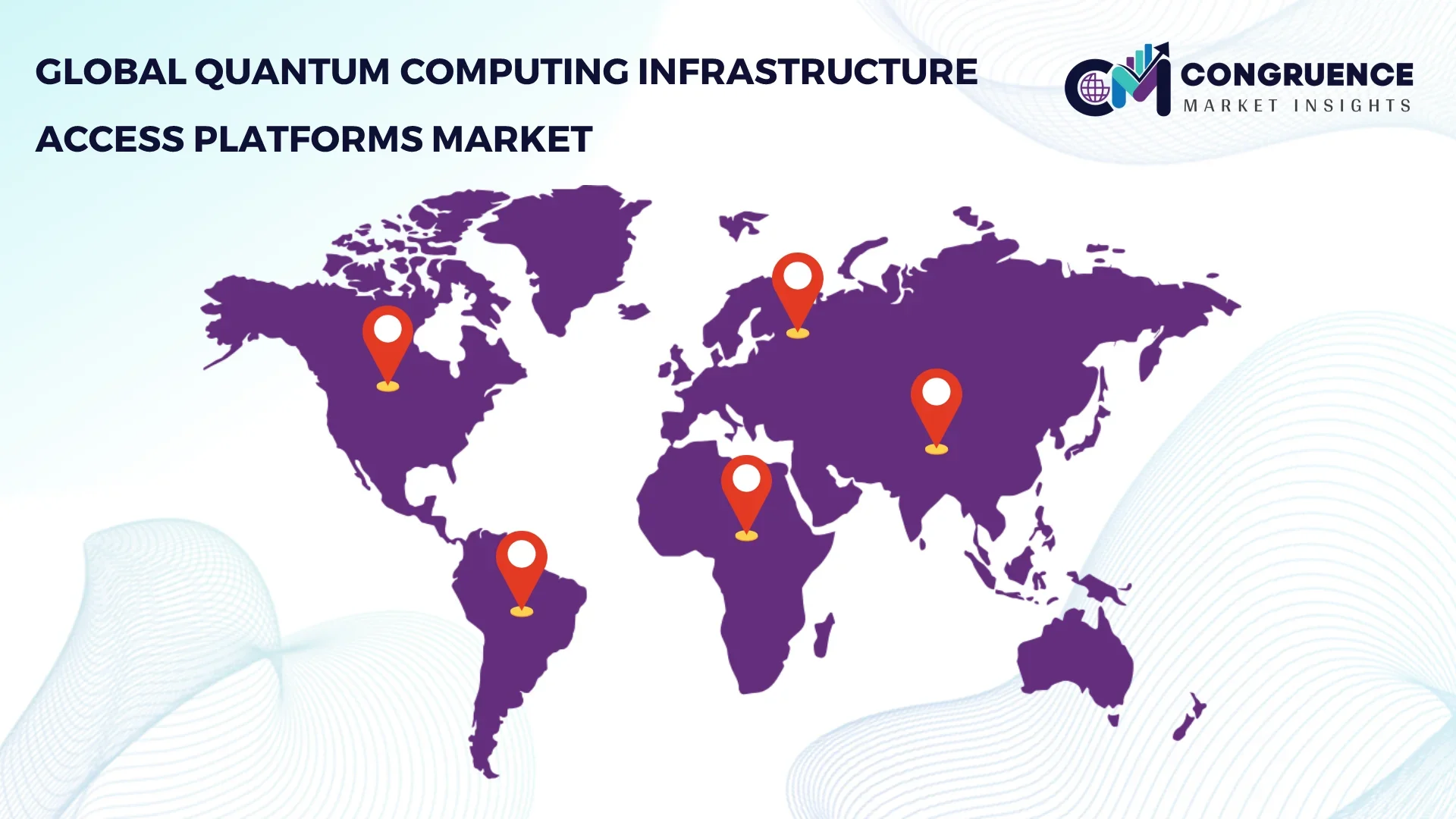
The global Quantum Computing Infrastructure Access Platforms Market shows clear geographic concentration driven by technology investment levels, research ecosystems, and enterprise experimentation with quantum algorithms. North America leads the market with strong cloud quantum infrastructure, hosting over 60 operational quantum processors accessible through remote platforms and more than 120 research institutions actively connected to quantum cloud systems. Europe follows with approximately 28% market share, supported by government-funded quantum innovation networks and collaborative research programs linking over 150 universities and laboratories. Asia-Pacific represents nearly 22% of global deployments, with rapid infrastructure expansion across China, Japan, South Korea, and India, where national quantum initiatives collectively support more than 80 research centers and pilot computing facilities. South America and the Middle East & Africa together account for about 9% of global adoption, but both regions are increasing quantum experimentation programs, particularly in energy modeling, logistics optimization, and financial analytics. Across all regions, enterprise experimentation has accelerated, with over 45% of multinational corporations running at least one quantum pilot project through remote infrastructure access platforms.
North America represents the largest regional ecosystem for the Quantum Computing Infrastructure Access Platforms Market, accounting for around 41% of global platform deployments. The region hosts a dense network of quantum research laboratories, cloud computing providers, and enterprise innovation hubs. Key industries driving demand include financial services, pharmaceutical research, aerospace engineering, and advanced manufacturing, which collectively represent nearly 65% of enterprise quantum experimentation projects. Government initiatives such as the U.S. National Quantum Initiative have allocated more than USD 3.7 billion toward quantum research infrastructure, supporting collaboration among universities, national laboratories, and private technology companies. The region also leads in quantum cloud accessibility, with over 70 quantum processors integrated into remote access environments. A prominent example is IBM, which has deployed multiple cloud-accessible superconducting quantum systems enabling thousands of developers and research teams to run experiments through its quantum infrastructure platform. Consumer behavior patterns show strong enterprise-led adoption, particularly among technology companies and financial institutions; nearly 48% of Fortune 500 technology firms in the region conduct experimental quantum algorithm testing. These developments reinforce North America’s position as a global hub for quantum computing experimentation and infrastructure innovation.
Europe accounts for approximately 28% of global Quantum Computing Infrastructure Access Platforms Market adoption, driven by strong public-sector investment and collaborative research networks. Leading markets include Germany, the United Kingdom, France, and the Netherlands, which together represent nearly 70% of the region’s quantum research capacity. The European Union has allocated more than €7 billion through various quantum technology programs, supporting infrastructure development, quantum software innovation, and cross-border academic partnerships. Regulatory frameworks emphasizing data protection, explainable computing systems, and digital sovereignty are also shaping platform development. Quantum infrastructure in the region is increasingly integrated with high-performance computing centers, with more than 40 supercomputing facilities experimenting with hybrid quantum-classical workflows. A notable example is Pasqal, a European quantum technology company that has expanded cloud-accessible neutral-atom quantum processors for research institutions and industrial partners. Regional consumer behavior trends reveal strong academic participation, with over 35% of European universities conducting experiments on shared quantum infrastructure platforms, while large industrial enterprises are exploring optimization algorithms for automotive design, logistics, and energy systems.
Asia-Pacific ranks among the fastest expanding regions in the Quantum Computing Infrastructure Access Platforms Market and currently represents about 22% of global platform deployments. Key countries driving adoption include China, Japan, South Korea, and India, which collectively operate over 80 quantum research laboratories and pilot computing centers. China alone has invested more than USD 10 billion in national quantum technology initiatives, supporting quantum communication networks and experimental computing platforms. Japan and South Korea are focusing on integrating quantum infrastructure with semiconductor research and advanced manufacturing sectors. Regional innovation hubs in Beijing, Tokyo, and Bangalore are building ecosystems combining quantum computing, artificial intelligence, and high-performance computing infrastructure. One example is Origin Quantum in China, which provides cloud-based access to superconducting quantum processors and development tools for academic and enterprise users. Consumer behavior trends in the region highlight strong participation from technology startups and research institutes, with more than 45% of new quantum pilot projects originating from university-industry collaborations. Asia-Pacific’s rapid digital transformation and government-led technology programs continue to accelerate adoption.
South America currently represents around 5% of global Quantum Computing Infrastructure Access Platforms Market activity, with Brazil and Argentina emerging as the primary contributors to regional research and pilot experimentation. Brazil hosts several academic research programs exploring quantum algorithms for energy grid optimization, financial risk modeling, and climate simulations, while Argentina is expanding collaborations between universities and international technology partners. Regional infrastructure development remains limited compared with North America and Europe, but governments are increasing investments in advanced computing capabilities to support digital transformation. Brazil has introduced national research programs that fund high-performance computing laboratories capable of integrating quantum simulation platforms. A regional example includes QuantaLab, a collaborative quantum research initiative that provides access to experimental quantum computing environments for academic researchers and industry partners. Consumer adoption patterns in the region show strong alignment with media analytics, financial technology, and language-processing research, where local developers are exploring quantum algorithms to improve data processing efficiency. Increasing cross-border collaboration and academic partnerships are gradually expanding the region’s quantum experimentation ecosystem.
The Middle East & Africa accounts for roughly 4% of global Quantum Computing Infrastructure Access Platforms Market deployments, but technological modernization programs are gradually increasing regional experimentation with quantum systems. Key countries contributing to growth include the United Arab Emirates, Saudi Arabia, Israel, and South Africa, where advanced research institutions and technology parks are exploring quantum computing applications. Demand is particularly linked to oil and gas optimization, smart city infrastructure, logistics planning, and financial modeling, sectors that rely on high-performance computing capabilities. Governments in the region are establishing digital innovation programs and research partnerships with international technology providers. Israel hosts several quantum research startups developing software frameworks and cloud-accessible quantum experimentation environments. For example, Classiq Technologies, headquartered in Israel, provides quantum algorithm design platforms that enable enterprises to access and test quantum circuits through remote infrastructure environments. Consumer behavior patterns in the region show increasing interest among research universities and technology accelerators, with more than 20 innovation hubs participating in quantum research collaborations across the Middle East and Africa.
United States – 37% Market Share: It leads globally due to extensive quantum research infrastructure, over 70 cloud-accessible quantum processors, and strong enterprise adoption in finance, pharmaceuticals, and defense computing.
China – 16% Market Share: It's position is driven by large-scale national quantum technology programs, advanced research facilities, and over 30 experimental quantum laboratories supporting quantum algorithm development and cloud-access experimentation.
The competitive landscape of the Quantum Computing Infrastructure Access Platforms Market is characterized by a moderately consolidated structure, where leading cloud computing providers and specialized quantum technology firms dominate infrastructure development and platform ecosystems. Currently, the market includes over 60 active technology companies and research-driven startups working on quantum hardware, software frameworks, and cloud-accessible computing environments.
Large technology companies hold a significant advantage due to their ability to integrate quantum infrastructure with existing cloud platforms and high-performance computing services. The top five companies collectively account for nearly 58% of global platform ecosystem activity, driven by extensive research budgets, partnerships with universities, and early access to quantum hardware technologies. These firms are focusing on expanding remote access capabilities for quantum processors, building developer ecosystems, and launching open quantum programming frameworks to encourage experimentation.
Strategic collaborations are a key competitive strategy in the market. Technology companies are partnering with over 200 research institutions worldwide to expand algorithm development and platform accessibility. Mergers and acquisitions are also shaping competition as established cloud providers acquire startups specializing in quantum software development and hardware integration.
Innovation trends are centered on hybrid quantum-classical computing architectures, quantum error correction techniques, and scalable qubit development. Companies are also investing heavily in developer platforms and quantum programming toolkits to attract enterprise experimentation. As enterprise demand for quantum simulation and optimization grows, competition will increasingly revolve around platform usability, processor performance, and ecosystem partnerships.
Google Quantum AI
Amazon Web Services
Microsoft Azure Quantum
Rigetti Computing
IonQ
D-Wave Systems
Quantinuum
Pasqal
Xanadu
PsiQuantum
Classiq Technologies
Origin Quantum
QC Ware
Zapata AI
Strangeworks
Technological advancements are central to the development of the Quantum Computing Infrastructure Access Platforms Market, as organizations seek scalable and reliable environments for quantum experimentation and algorithm testing. One of the most important technological developments is the integration of hybrid quantum-classical computing architectures, which combine classical high-performance computing systems with quantum processors. These hybrid systems allow organizations to perform data preprocessing and optimization tasks using classical systems while delegating complex calculations to quantum processors. In many experimental cases, hybrid frameworks have improved optimization problem-solving efficiency by 25–40% compared with purely classical algorithms.
Another key technology shaping the market is quantum virtualization, which allows developers to access virtual quantum environments without needing direct hardware access. Quantum simulators can emulate systems containing more than 30–40 qubits, enabling algorithm development and testing before deployment on real quantum processors. These virtualization environments are particularly valuable for universities, startups, and enterprise research teams exploring quantum algorithms.
Advancements in quantum error mitigation and correction techniques are also expanding the usability of quantum platforms. Early quantum processors suffer from noise and instability, but new error-mitigation algorithms are reducing computation inaccuracies by nearly 15–20% during experimental runs. This improvement allows developers to run more reliable quantum experiments through remote infrastructure platforms.
Quantum programming frameworks are another important technological component. Platforms now provide integrated development environments supporting languages such as Qiskit, Cirq, and Q#, enabling developers to design, simulate, and execute quantum circuits within a unified ecosystem. These tools are often combined with artificial intelligence and machine learning frameworks, allowing enterprises to test quantum algorithms for optimization, pattern recognition, and data analysis tasks.
In addition, advancements in scalable qubit architectures—including superconducting qubits, trapped-ion systems, and photonic quantum processors—are improving hardware stability and computational capacity. Some experimental processors now support more than 100 qubits, enabling increasingly complex quantum computations. As these technologies mature, infrastructure access platforms will continue to evolve into comprehensive ecosystems supporting research, enterprise innovation, and cross-disciplinary computational experimentation.
• In November 2024, IBM introduced major upgrades to its quantum computing infrastructure during the IBM Quantum Developer Conference, highlighting the IBM Quantum Heron processor integrated with the modular IBM Quantum System Two architecture. The Heron processor demonstrated the capability to run quantum circuits with up to 5,000 two-qubit gate operations, enabling more complex algorithm experimentation through cloud-accessible quantum systems.
• In April 2025, IonQ announced the global availability of its flagship quantum computer, IonQ Forte Enterprise, through Amazon Braket and the IonQ Quantum Cloud. The system provides #AQ36 algorithmic qubit performance and enables enterprises and researchers worldwide to develop applications in life sciences, financial services, manufacturing, and pharmaceutical research using cloud-accessible quantum infrastructure.
• In June 2025, IBM and Japan’s RIKEN research institute unveiled the first IBM Quantum System Two installed outside the United States. The system, powered by a 156-qubit Heron processor, was deployed alongside the Fugaku supercomputer to support hybrid quantum-classical computing research and provide cloud-accessible quantum computing capabilities for scientific and industrial applications.
• In May 2025, IBM announced plans to deploy a 156-qubit IBM Heron quantum processing unit within the IBM Quantum System One operated by the University of Tokyo’s Quantum Innovation Initiative consortium. The system will provide cloud-accessible quantum computing resources for academic institutions and industrial partners conducting advanced algorithm and materials research. Source: www.ibm.com
The Quantum Computing Infrastructure Access Platforms Market Report provides a comprehensive assessment of the technologies, infrastructure systems, and ecosystem participants enabling remote access to quantum computing resources. The report covers a wide range of platform architectures, including cloud-based quantum hardware access systems, hybrid quantum-classical computing frameworks, and quantum simulation environments used by research institutions, enterprises, and technology developers.
The scope of the report includes detailed analysis across three primary market segments—type, application, and end-user—covering major platform categories such as quantum hardware access environments, quantum simulation platforms, and hybrid computing infrastructures. Application areas evaluated in the report include pharmaceutical and life sciences research, financial modeling, logistics optimization, materials science, cybersecurity testing, aerospace engineering, and energy system simulation. These sectors collectively represent the majority of enterprise quantum experimentation projects globally.
Geographically, the report evaluates market activity across five major regions: North America, Europe, Asia-Pacific, South America, and the Middle East & Africa. Within these regions, the study highlights key national ecosystems including the United States, China, Germany, the United Kingdom, Japan, South Korea, India, Brazil, and the United Arab Emirates, where quantum research facilities, innovation hubs, and cloud computing providers are expanding infrastructure access programs.
The report also examines technological developments shaping the market landscape, including quantum processor architectures, hybrid computing models, error mitigation techniques, quantum software development kits, and cloud orchestration tools. More than 60 active technology vendors and research organizations are assessed to understand competitive dynamics, innovation strategies, and platform ecosystem development.
In addition, the study explores emerging niche segments such as quantum algorithm development environments, quantum-as-a-service ecosystems, and enterprise quantum experimentation platforms, which are gaining importance as businesses increasingly explore next-generation computational capabilities. The report ultimately provides strategic insights designed to help technology providers, investors, research institutions, and enterprise decision-makers understand the evolving opportunities and technological trajectory of the Quantum Computing Infrastructure Access Platforms Market.
| Report Attribute / Metric | Details |
|---|---|
| Market Revenue (2025) | USD 180.0 Million |
| Market Revenue (2033) | USD 1,354.9 Million |
| CAGR (2026–2033) | 28.7% |
| Base Year | 2025 |
| Forecast Period | 2026–2033 |
| Historic Period | 2021–2025 |
| Segments Covered |
By Type
By Application
By End-User
|
| Key Report Deliverables | Revenue Forecast; Market Trends; Growth Drivers & Restraints; Technology Insights; Segmentation Analysis; Regional Insights; Competitive Landscape; Regulatory & ESG Overview; Recent Developments |
| Regions Covered | North America; Europe; Asia-Pacific; South America; Middle East & Africa |
| Key Players Analyzed | IBM Corporation; Google Quantum AI; Amazon Web Services; Microsoft Corporation; Rigetti Computing; IonQ Inc.; D-Wave Systems Inc.; Quantinuum Ltd.; Pasqal SAS; Xanadu Quantum Technologies Inc.; PsiQuantum Corp.; Classiq Technologies Ltd.; Origin Quantum; QC Ware Corp.; Zapata AI; Strangeworks Inc. |
| Customization & Pricing | Available on Request (10% Customization Free) |




