
Reports
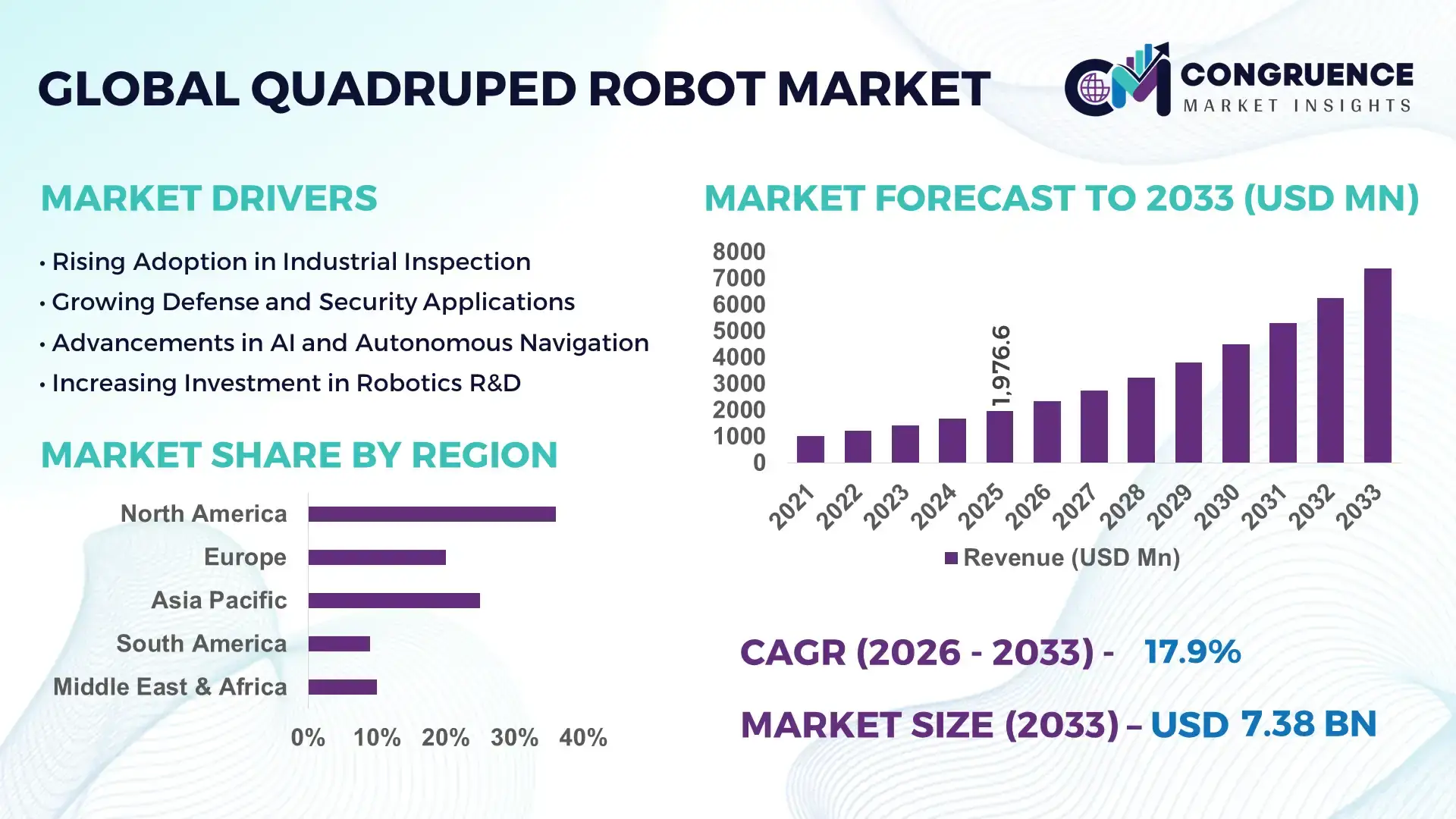
The Global Quadruped Robot Market was valued at USD 1976.63 Million in 2025 and is anticipated to reach a value of USD 7379.68 Million by 2033 expanding at a CAGR of 17.9% between 2026 and 2033. Rapid integration of autonomous robotics across industrial inspection, defense mobility, and hazardous environment operations is accelerating enterprise adoption and long-term demand.
The United States remains a leading production and deployment hub for quadruped robotic systems, supported by strong robotics manufacturing capacity, defense procurement programs, and industrial automation investments exceeding USD 3 billion annually in advanced robotics development initiatives. Multiple robotics laboratories and private manufacturers collectively test thousands of robotic mobility units annually for logistics monitoring, security patrol, and infrastructure inspection. Industrial users across energy, construction, and defense sectors account for more than 40% of operational deployments in pilot and commercial programs. Continuous improvements in AI navigation, sensor fusion, and payload integration have enabled field endurance improvements of over 30%, while enterprise trials in inspection robotics increased by nearly 25% during the past two years.
Market Size & Growth: Valued at USD 1976.63 Million in 2025 and projected to reach USD 7379.68 Million by 2033 at a CAGR of 17.9%, driven by increasing automation in inspection, defense mobility, and smart industrial operations.
Top Growth Drivers: Industrial automation adoption 42%, AI-enabled navigation efficiency improvement 35%, demand for hazardous-site robotics 38%.
Short-Term Forecast: By 2028, enterprise robotics deployments are expected to reduce inspection costs by nearly 28% and improve operational uptime by about 31%.
Emerging Technologies: AI-driven perception systems, edge computing for real-time navigation, and advanced LiDAR-based terrain mapping integrated into quadruped robotic platforms.
Regional Leaders: North America projected to exceed USD 2.8 Billion by 2033 with strong defense robotics programs; Asia-Pacific nearing USD 2.4 Billion with rapid industrial automation; Europe approaching USD 1.7 Billion driven by smart infrastructure monitoring.
Consumer/End-User Trends: Energy utilities, defense agencies, manufacturing plants, and mining operations increasingly deploy autonomous inspection robots to improve safety and reduce manual intervention.
Pilot or Case Example: In 2024, a large industrial inspection project using quadruped robots reported a 34% reduction in maintenance downtime and a 29% improvement in inspection coverage.
Competitive Landscape: The market leader holds approximately 24% share, followed by several established robotics developers and emerging AI robotics startups expanding global deployments.
Regulatory & ESG Impact: Safety standards for autonomous robots and government incentives for smart manufacturing are accelerating compliant deployment across industrial facilities.
Investment & Funding Patterns: Recent investments in legged robotics research and commercialization exceed USD 1.2 Billion, with venture capital and defense technology funding driving innovation.
Innovation & Future Outlook: Advancements in modular payload systems, extended battery endurance, and collaborative robot-human workflows are shaping next-generation quadruped robot adoption.
Quadruped robots are gaining traction across multiple industry verticals including energy inspection, defense reconnaissance, smart city surveillance, and large-scale industrial maintenance. Energy and utilities contribute roughly 30% of operational deployments, followed by defense and public safety programs accounting for about 27%. Recent innovations include improved actuator efficiency, hybrid battery systems extending operational runtime beyond four hours, and integrated AI analytics for predictive maintenance tasks. Environmental and safety regulations encouraging remote inspection in hazardous sites are also supporting adoption. Asia-Pacific manufacturing hubs are rapidly increasing robotics consumption, while Europe is focusing on infrastructure inspection automation. Over the coming years, integration with autonomous drones, digital twin systems, and real-time data analytics platforms is expected to further expand commercial use cases and operational scalability in the quadruped robot ecosystem.
The strategic relevance of the Quadruped Robot Market is expanding as industries prioritize resilient automation, remote inspection, and intelligent mobility systems. Industrial operators are integrating legged robotics into asset monitoring, hazardous site surveillance, and infrastructure diagnostics where terrain limitations restrict wheeled systems. Advanced AI-based perception combined with adaptive locomotion algorithms now allows robots to operate in complex environments such as refineries, power plants, and disaster zones. In operational benchmarking, AI-enabled terrain mapping delivers nearly 32% improvement compared to traditional teleoperated inspection robots that rely on manual navigation.
From a regional perspective, China dominates in volume manufacturing of robotic hardware, while United States leads in enterprise adoption with about 46% of large industrial facilities piloting autonomous robotic inspection programs. By 2028, edge-AI autonomy integrated into quadruped robotic platforms is expected to improve inspection accuracy by nearly 30% and reduce manual inspection cycles by around 27%.
Compliance and ESG commitments are also shaping deployment strategies. Firms are committing to operational sustainability targets such as 20% reduction in hazardous human exposure by 2030 through robotic inspection programs. In 2024, Boston Dynamics reported a 35% improvement in industrial site inspection efficiency through AI-assisted robotic mobility initiatives deployed across energy facilities. Looking ahead, the Quadruped Robot Market is positioned as a foundational pillar supporting operational resilience, regulatory compliance, and sustainable industrial transformation.
The rising demand for automated inspection across high-risk industries such as oil and gas, mining, and power generation is significantly accelerating the Quadruped Robot Market. Industrial facilities are deploying robotic inspection systems to monitor pipelines, equipment corridors, and remote infrastructure where human access is limited or hazardous. Studies indicate that robotic inspection systems can reduce manual inspection exposure by nearly 40% in hazardous environments. Additionally, quadruped robots equipped with thermal cameras, gas detection sensors, and AI-based anomaly detection can inspect large facilities up to 25% faster than traditional inspection teams. Defense and public safety organizations are also expanding robotic patrol and reconnaissance programs, with several national security agencies increasing autonomous robotics trials across border monitoring and surveillance operations.
Despite strong technological progress, the Quadruped Robot Market faces restraints related to integration complexity, hardware costs, and enterprise readiness. Deploying quadruped robots requires compatible digital infrastructure, including AI processing systems, wireless connectivity, and facility mapping platforms. Many industrial operators must upgrade network coverage and operational data systems before deploying autonomous robots at scale. Additionally, robotic platforms equipped with advanced sensors, actuators, and AI computing modules can involve significant upfront capital expenditure. Workforce training is another limiting factor, as organizations must train operators and technicians in robotics management, system calibration, and maintenance. Surveys across manufacturing facilities indicate that nearly 35% of companies delay robotics deployment due to concerns related to operational integration and workforce transition planning.
Smart infrastructure development and digital transformation across industrial ecosystems are creating substantial opportunities for the Quadruped Robot Market. Governments and enterprises are investing heavily in automated asset monitoring, predictive maintenance, and real-time infrastructure management. Quadruped robots integrated with IoT sensors and AI analytics can collect large volumes of environmental and operational data, enabling faster diagnostics and infrastructure monitoring. Smart city programs and energy grid modernization initiatives are expanding the use of robotics in tunnel inspections, rail network monitoring, and power distribution systems. In several infrastructure automation pilots, robotic monitoring systems improved inspection coverage by nearly 33% compared to manual operations. Integration with digital twin platforms and autonomous drones is also unlocking new operational efficiencies and collaborative robotics capabilities.
One of the key challenges affecting the Quadruped Robot Market is meeting regulatory, safety, and reliability standards required for large-scale industrial deployment. Autonomous robotic systems operating in public or industrial environments must comply with strict safety certifications, cybersecurity requirements, and operational risk protocols. In sectors such as energy and transportation infrastructure, robotic systems must maintain consistent performance across extreme temperatures, uneven terrain, and continuous operational cycles. Reliability expectations are particularly high, with many industrial buyers requiring uptime levels exceeding 95% for mission-critical operations. Scaling deployment across multiple sites also requires standardized software platforms, data integration capabilities, and centralized fleet management systems, which can slow adoption for organizations lacking advanced digital infrastructure.
• Expansion of Industrial Inspection Deployments: Industrial asset monitoring using quadruped robots has increased significantly, with nearly 48% of large manufacturing and energy facilities testing robotic inspection systems in 2025. Facilities deploying autonomous inspection reported up to 32% faster anomaly detection and approximately 27% reduction in manual inspection hours. Robotics-enabled inspections now cover pipelines, refinery zones, and high-temperature industrial environments across more than 60 major industrial complexes globally.
• Integration of AI Navigation and Sensor Fusion: Advanced AI navigation combined with LiDAR, thermal imaging, and multi-sensor fusion is improving robotic operational accuracy. Field tests show terrain navigation success rates exceeding 92%, compared to around 70% in earlier robotic mobility systems. In complex environments such as mining sites and power plants, AI-enabled quadruped robots improved route mapping efficiency by nearly 35% and reduced inspection errors by 24%.
• Growth in Defense and Security Robotics Programs: Defense and homeland security agencies are expanding robotic mobility units for reconnaissance and patrol missions. Approximately 41% of ongoing robotics trials in security operations involve legged robotic systems capable of operating in rugged terrains. Several national programs reported patrol coverage improvements of nearly 30% while reducing human exposure to hazardous conditions by about 33%.
• Rise in Modular and Prefabricated Construction Monitoring: The adoption of modular construction is reshaping demand dynamics in the Quadruped Robot market. Research suggests that 55% of the new projects witnessed cost benefits while using modular and prefabricated practices in their projects. Pre-bent and cut elements are prefabricated off-site using automated machines, reducing labor needs and speeding project timelines. Demand for high-precision machines is rising, especially in Europe and North America, where construction efficiency is critical.
The Quadruped Robot Market is segmented by type, application, and end-user industries, each reflecting varying adoption patterns across industrial and public sector environments. Mobility configuration, payload capability, and autonomy level define product types, while applications range from industrial inspection to defense operations and infrastructure monitoring. Industrial inspection remains a primary deployment area due to the need for safer asset monitoring, accounting for a substantial portion of robotic trials worldwide. Regional adoption patterns show strong uptake in technologically advanced manufacturing economies and growing implementation in energy and utilities sectors. End-user demand is also influenced by automation strategies, safety compliance requirements, and operational efficiency goals. Organizations prioritizing predictive maintenance and digital infrastructure management are increasingly integrating quadruped robotic platforms into operational workflows, contributing to expanding deployment footprints across industrial ecosystems.
Product types in the Quadruped Robot Market primarily include electrically powered quadruped robots, hydraulically actuated quadruped robots, and hybrid locomotion robotic systems with modular payload integration. Electrically powered quadruped robots currently account for about 46% of adoption due to their energy efficiency, lower maintenance complexity, and suitability for indoor and semi-structured industrial environments. Hydraulically actuated quadruped robots represent roughly 29% of deployments and are commonly used in rugged terrains such as mining sites, disaster response zones, and defense mobility missions because of their higher load-bearing capability and terrain stability. However, hybrid quadruped robotic platforms are the fastest-growing type with an estimated growth rate of around 21% annually, driven by advancements in battery density, AI-based locomotion algorithms, and improved actuator efficiency.
Other specialized configurations such as research-grade quadruped robots and lightweight reconnaissance units collectively contribute nearly 25% of installations, particularly in academic robotics labs and early-stage commercial pilots. These systems are often used to test advanced mobility, machine learning-based navigation, and collaborative robotics features.
Applications in the Quadruped Robot Market include industrial inspection, defense and security operations, research and development, infrastructure monitoring, and logistics automation. Industrial inspection leads the segment with approximately 38% adoption as companies increasingly deploy robots to inspect pipelines, equipment corridors, and hazardous zones where manual inspection is risky or inefficient. Defense and security applications account for around 27% of usage, with quadruped robots deployed for reconnaissance, surveillance, and patrol missions in difficult terrain environments. However, infrastructure monitoring is the fastest-growing application area with an estimated annual growth rate of nearly 23%, supported by smart city programs and automated bridge, tunnel, and rail inspection initiatives.
Other applications such as academic research, disaster response operations, and logistics facility monitoring collectively contribute about 35% of deployments. These sectors benefit from robotic mobility, real-time data collection, and remote operation capabilities that enhance operational awareness.
End-user adoption in the Quadruped Robot Market is led by the energy and utilities sector, which accounts for approximately 34% of deployments due to the need for continuous monitoring of pipelines, power plants, and remote industrial assets. Defense and public safety agencies follow with around 26% usage, leveraging quadruped robots for reconnaissance, patrol, and hazardous environment assessment. However, manufacturing facilities represent the fastest-growing end-user segment with an estimated annual growth rate of about 24%, driven by the adoption of smart factories, automated safety inspections, and predictive maintenance strategies.
Other end-users including research institutions, construction companies, and transportation infrastructure operators together contribute nearly 40% of deployments. Adoption rates within these industries are increasing as robotics platforms become more autonomous and capable of integrating with digital monitoring systems and AI analytics tools.
Region North America accounted for the largest market share at 36% in 2025 however, Asia-Pacific is expected to register the fastest growth, expanding at a CAGR of 20.6% between 2026 and 2033.

The Quadruped Robot Market demonstrates strong regional concentration driven by industrial automation, defense robotics programs, and smart infrastructure deployment. North America recorded more than 1,800 active industrial robotic inspection units operating across energy facilities, manufacturing plants, and logistics hubs. Europe represented approximately 24% of the global deployments in 2025, supported by over 120 smart infrastructure robotics pilot programs and advanced manufacturing automation initiatives. Asia-Pacific accounted for around 30% of installations with more than 2,500 robotics research and testing projects underway across industrial and academic laboratories. South America maintained about 6% of operational deployments, primarily in mining and energy sectors. The Middle East & Africa represented close to 4% of market activity, with increasing robotic inspection programs across oil, gas, and large-scale infrastructure projects.
How are advanced industrial automation strategies accelerating enterprise robotics adoption across large-scale facilities?
The North America Quadruped Robot Market holds nearly 36% share of global deployments, supported by strong adoption across manufacturing, defense, and energy sectors. More than 45% of large industrial facilities in the region have initiated robotic inspection trials to improve operational safety and asset monitoring. Government-supported robotics innovation programs and safety regulations encouraging remote inspection technologies are further accelerating adoption. Technological trends include AI-based navigation, predictive maintenance analytics, and real-time industrial monitoring systems integrated with enterprise software platforms. A key regional robotics developer, Boston Dynamics, continues expanding enterprise deployments of quadruped robotic inspection systems across industrial plants. Consumer behavior trends indicate higher enterprise adoption in infrastructure monitoring, logistics facilities, and large industrial campuses requiring automated surveillance solutions.
What operational and compliance factors are driving robotics integration into industrial and infrastructure management systems?
The Europe Quadruped Robot Market represents approximately 24% of global adoption, with strong demand emerging from countries such as Germany, the United Kingdom, and France. These markets collectively account for more than 60% of regional deployments due to their advanced manufacturing bases and infrastructure modernization programs. Regulatory frameworks emphasizing workplace safety, environmental monitoring, and digital industrial transformation are influencing enterprise investment in robotic inspection technologies. Sustainability initiatives across industrial operations are encouraging companies to deploy robots capable of reducing hazardous exposure by nearly 30%. Technological advancements include integration of AI-based mobility systems, automated infrastructure diagnostics, and robotics-enabled facility monitoring. Regional consumer behavior shows that regulatory pressure and compliance requirements are increasing demand for explainable and auditable robotics solutions within industrial environments.
Which innovation ecosystems and industrial automation initiatives are accelerating robotics deployment across manufacturing economies?
The Asia-Pacific Quadruped Robot Market ranks second globally in deployment volume and is rapidly expanding due to strong robotics manufacturing ecosystems and infrastructure development projects. Countries including China, India, and Japan represent over 70% of regional robotics adoption, supported by large-scale industrial automation and smart manufacturing initiatives. More than 2,500 robotics research projects and pilot deployments have been reported across universities, technology labs, and industrial facilities. Innovation hubs focusing on AI robotics, mobility engineering, and sensor integration are strengthening regional technological leadership. A major robotics manufacturer, Unitree Robotics, is actively expanding production of cost-efficient quadruped robotic platforms for industrial inspection and research applications. Consumer adoption trends show strong growth driven by expanding e-commerce infrastructure, manufacturing automation, and digital transformation initiatives.
How are energy and mining sector modernization projects shaping robotic inspection adoption across industrial operations?
The South America Quadruped Robot Market accounts for approximately 6% of global adoption, with Brazil and Argentina leading regional demand. The mining, oil, and energy sectors are key drivers, as companies seek advanced robotic inspection systems capable of operating in hazardous environments and remote industrial zones. Infrastructure modernization projects across energy facilities and transportation networks are contributing to growing interest in robotic mobility solutions. Government initiatives encouraging industrial automation and technology partnerships are supporting pilot deployments in large-scale infrastructure projects. Robotics integration in industrial inspection has improved operational monitoring coverage by nearly 22% in several pilot programs. Consumer behavior trends indicate demand closely linked to industrial productivity improvements and multilingual technology deployment across diverse operational environments.
What infrastructure modernization and energy sector initiatives are expanding robotics adoption in complex industrial environments?
The Middle East & Africa Quadruped Robot Market represents around 4% of global deployments, with increasing interest driven by oil and gas inspection, construction monitoring, and large infrastructure development programs. Countries such as the United Arab Emirates and South Africa are leading adoption through investments in digital transformation and smart industrial operations. Robotics-based inspection programs across energy facilities have improved equipment monitoring efficiency by nearly 25%. Technological modernization initiatives include AI-based robotics platforms, automated surveillance systems, and remote infrastructure diagnostics. Regional regulations promoting workplace safety and industrial innovation are encouraging robotics integration. Consumer adoption patterns show strong interest from energy operators and large construction firms seeking advanced monitoring solutions in high-risk operational environments.
United States – 31% share in the Quadruped Robot Market due to advanced robotics research infrastructure, high enterprise adoption, and large-scale industrial automation programs.
China – 27% share in the Quadruped Robot Market supported by strong robotics manufacturing capacity, expanding production of legged robots, and rapid deployment across industrial and research sectors.
The competitive environment in the Quadruped Robot market is characterized by a mix of established robotics developers, emerging AI robotics startups, and specialized mobility technology providers. The market currently includes more than 40 active companies globally developing or commercializing quadruped robotic platforms for industrial inspection, defense mobility, research, and infrastructure monitoring. Despite strong innovation activity, the market shows a moderately concentrated structure, with the top five companies collectively accounting for approximately 58% of global deployments. Leading firms compete on advanced locomotion algorithms, AI navigation systems, sensor integration, and extended battery endurance exceeding 3–5 hours of operational runtime.
Strategic initiatives across the market include over 25 new product launches and prototype demonstrations recorded between 2023 and 2025, reflecting rapid innovation cycles. Partnerships between robotics developers and energy, manufacturing, and public safety organizations are expanding deployment opportunities, with more than 60 enterprise pilot projects currently underway worldwide. Several companies are investing heavily in AI-driven terrain mapping and autonomous navigation technologies that improve robotic stability by nearly 30% in uneven environments. Additionally, collaborative robotics ecosystems are forming, where quadruped robots integrate with drones and industrial IoT platforms to support predictive maintenance operations. Competitive differentiation increasingly depends on modular payload capability, enterprise software integration, and global service support networks capable of scaling robotics fleets across multiple industrial sites.
Boston Dynamics
Unitree Robotics
Ghost Robotics
ANYbotics
Deep Robotics
Xiaomi Robotics Lab
Agility Robotics
Kawasaki Robotics
Rainbow Robotics
Servo Robotics
Technological advancement is the central force shaping the Quadruped Robot Market, particularly in autonomous navigation, AI perception, and mobility engineering. Modern quadruped robots increasingly integrate multi-sensor fusion systems combining LiDAR, stereo cameras, inertial measurement units, and thermal imaging modules. These integrated perception systems enable robots to map complex environments with spatial accuracy exceeding 95% in controlled industrial settings and maintain stable navigation across uneven terrain slopes of up to 30 degrees. Improvements in actuator design and torque control have enhanced load-bearing capacity, allowing many industrial-grade quadruped robots to carry payloads between 10 kg and 15 kg while maintaining operational speeds near 1.5 meters per second.
Artificial intelligence and edge computing are also transforming robotic autonomy. New AI-based locomotion algorithms process environmental data locally on embedded processors, reducing navigation latency by nearly 40% compared to cloud-dependent systems. Battery technology has improved significantly, with high-density lithium battery modules enabling operational runtimes of 2 to 4 hours depending on payload and terrain complexity. In addition, modular payload architecture is becoming standard, allowing integration of gas detection sensors, ultrasonic inspection tools, and 3D scanning modules for industrial diagnostics.
Another major innovation trend involves integration with digital infrastructure systems such as digital twins and industrial IoT platforms. Quadruped robots can now transmit real-time inspection data streams at speeds exceeding 1 Gbps through advanced wireless communication protocols, enabling predictive maintenance analytics. Autonomous docking and self-charging capabilities are also emerging, improving continuous operation cycles and reducing human intervention. These technological developments are accelerating enterprise adoption across sectors including energy utilities, manufacturing plants, mining sites, and infrastructure monitoring programs worldwide.
• In February 2025, Boston Dynamics announced expanded enterprise deployments of its Spot quadruped robot across industrial inspection sites, introducing upgraded AI-based navigation and autonomous data collection features that improved facility inspection coverage and operational stability in large energy and manufacturing environments. Source: https://bostondynamics.com
• In April 2024, Unitree Robotics launched the B2 industrial quadruped robot designed for heavy-duty operations, featuring enhanced joint torque performance, improved terrain adaptability, and extended endurance capabilities targeted at industrial inspection, emergency response, and research applications. Source: https://www.unitree.com
• In September 2024, ANYbotics introduced an upgraded version of its ANYmal autonomous inspection robot with enhanced gas detection sensors, improved autonomous navigation, and integrated data analytics capabilities to support automated inspections in energy and chemical processing facilities. Source: https://www.anybotics.com
• In January 2025, Ghost Robotics continued expanding deployments of its Vision 60 quadruped robot platform in security and defense programs, focusing on rugged mobility systems and modular payload integration for surveillance, reconnaissance, and remote monitoring applications. Source: https://www.ghostrobotics.io
The Quadruped Robot Market Report provides a comprehensive analysis covering key market segments, operational technologies, and industry adoption patterns across multiple global regions. The report evaluates more than 10 major product configurations including electrically actuated, hydraulically powered, and hybrid quadruped robotic platforms designed for industrial, defense, and infrastructure monitoring applications. It also assesses over 8 primary application domains such as industrial inspection, security patrol, research and development, disaster response, logistics facility monitoring, and smart infrastructure diagnostics.
Geographically, the report examines market activity across five major regions and more than 20 countries where robotics deployment programs are expanding. The study reviews adoption patterns across industries including energy utilities, manufacturing, mining, construction, transportation infrastructure, and public safety agencies. Over 40 active companies operating in the quadruped robotics ecosystem are evaluated, focusing on technology innovation, product development strategies, and enterprise deployment initiatives.
Technology coverage within the report includes AI-based navigation systems, sensor fusion platforms, advanced mobility control algorithms, modular payload integration, edge computing systems, and industrial data analytics capabilities. The report also highlights emerging segments such as autonomous inspection robotics for smart cities, robotic integration with digital twin platforms, and collaborative robotics systems designed for multi-robot operations. This scope provides decision-makers with a structured view of technological advancements, operational applications, and evolving industry demand shaping the future development of quadruped robotics globally.
| Report Attribute/Metric | Report Details |
|---|---|
|
Market Revenue in 2025 |
USD V2025 Million |
|
Market Revenue in 2033 |
USD V2033 Million |
|
CAGR (2026 - 2033) |
17.9% |
|
Base Year |
2025 |
|
Forecast Period |
2026 - 2033 |
|
Historic Period |
2021 - 2025 |
|
Segments Covered |
By Types
By Application
By End-User
|
|
Key Report Deliverable |
Revenue Forecast, Growth Trends, Market Dynamics, Segmental Overview, Regional and Country-wise Analysis, Competition Landscape |
|
Region Covered |
North America, Europe, Asia-Pacific, South America, Middle East, Africa |
|
Key Players Analyzed |
Boston Dynamics , Unitree Robotics , Ghost Robotics , ANYbotics, Deep Robotics, Xiaomi Robotics Lab, Agility Robotics, Kawasaki Robotics, Rainbow Robotics, Servo Robotics |
|
Customization & Pricing |
Available on Request (10% Customization is Free) |




