
Reports
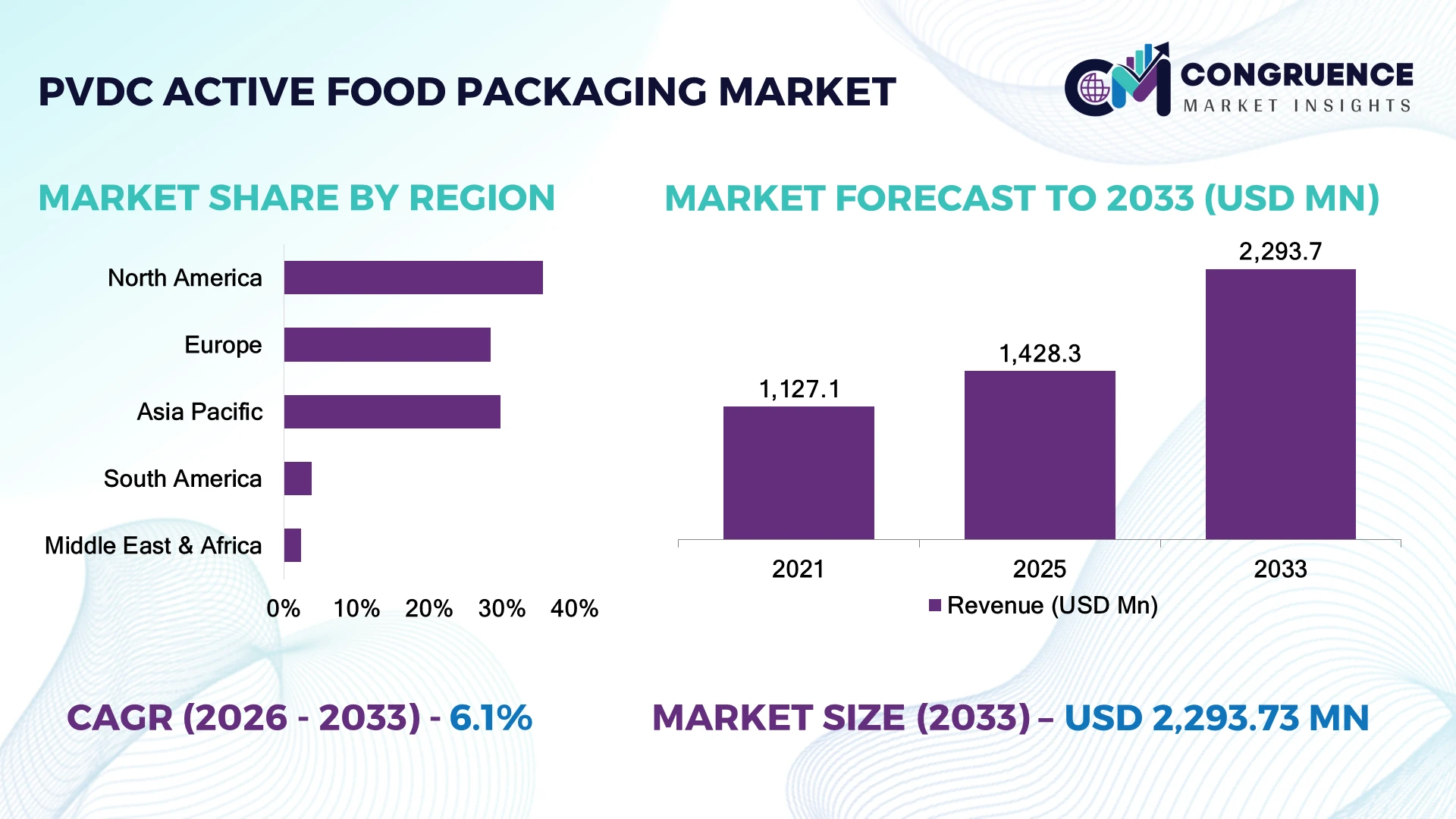
The Global PVDC Active Food Packaging Market was valued at USD 1,428.3 Million in 2025 and is anticipated to reach a value of USD 2,293.7 Million by 2033 expanding at a CAGR of 6.1% between 2026 and 2033. Growth is driven by expanding demand for high-barrier active packaging that extends shelf life, reduces food waste, and protects moisture- and oxygen-sensitive products across processed food, meat, dairy, and pharmaceutical packaging.
The United States leads the market with approximately 29% global demand, supported by advanced food processing infrastructure, over USD 3 billion in packaging modernization investments, and widespread adoption of intelligent barrier packaging across meat and ready-to-eat foods. Japan maintains higher active-packaging deployment, exceeding 42% in premium packaged foods compared with nearly 31% in the United States. Ongoing supply-chain diversification following Red Sea shipping disruptions continues encouraging localized barrier-film production and inventory resilience.
Manufacturers securing advanced coating technologies and regional production capacity will strengthen long-term supply reliability while capturing premium packaging contracts.
Market Size & Growth: USD 1,428.3 million (2025) to USD 2,293.7 million (2033) at 6.1% CAGR, driven by high-barrier active packaging adoption.
Top Growth Drivers: Oxygen barrier demand +34%, packaged food consumption +28%, shelf-life optimization +22%.
Short-Term Forecast: By 2028, barrier efficiency improves 18% while packaging waste declines 12%.
Emerging Technologies: AI quality inspection, antimicrobial coatings, smart oxygen scavengers enhance packaging performance.
Regional Leaders: North America, Europe, and Asia-Pacific exceed USD 1.65 billion combined demand with localized manufacturing expansion.
Consumer/End-User Trends: Around 63% of premium food brands prioritize extended shelf-life packaging solutions.
Pilot/Case Example: 2025 smart-packaging deployment reduced spoilage by 17% across chilled food logistics.
Competitive Landscape: Top suppliers hold approximately 47% share, led by Amcor, Kureha, Berry Global, Sealed Air, and Winpak.
Regulatory & ESG Impact: Advanced downgauging lowers material usage by 14% while maintaining barrier performance.
Investment & Funding: More than USD 850 million supports coating lines, regional expansion, and automation amid supply-chain realignment.
Innovation & Future Outlook: High-performance recyclable barrier structures and digital production monitoring reshape premium food packaging.
PVDC Active Food Packaging continues gaining traction across processed foods, dairy, seafood, and pharmaceutical packaging where superior moisture and oxygen barriers remain essential. Advanced antimicrobial coatings and oxygen-scavenging technologies improve product protection, with active packaging deployment increasing nearly 19% among premium food manufacturers. Regional manufacturing expansion and regulatory emphasis on food waste reduction are accelerating innovation, setting the stage for broader strategic market transformation.
The PVDC Active Food Packaging Market has become strategically significant as food manufacturers prioritize shelf-life optimization, supply-chain resilience, and premium product protection. Regulatory pressure to reduce food waste, coupled with ongoing restructuring of global packaging supply chains, is accelerating investment in advanced barrier materials and intelligent packaging technologies. Companies increasingly compete through packaging performance rather than material volume, creating differentiation across high-value food and healthcare applications.
Modern multilayer PVDC active packaging delivers approximately 28% higher oxygen barrier performance than conventional mono-material barrier films while reducing product spoilage by nearly 18% under controlled distribution conditions. North America emphasizes automation and high-volume food packaging, whereas Asia-Pacific leads manufacturing expansion and production scalability. More than 60% of newly commissioned premium food packaging lines now integrate digital inspection and automated coating technologies to improve consistency and operational efficiency.
Leading packaging manufacturers are expanding regional coating facilities, strengthening resin sourcing partnerships, and integrating intelligent quality monitoring into production. For example, automated inline coating inspection reduces defect rates while improving production stability across high-speed packaging operations. Over the next two to three years, businesses combining advanced barrier performance, sustainable material optimization, and resilient manufacturing networks will establish stronger competitive positions in premium food packaging markets.
Demand for longer shelf life and lower food waste is accelerating adoption of PVDC active food packaging across meat, dairy, seafood, and ready-to-eat products. High-barrier PVDC structures reduce oxygen transmission by up to 95%, while active packaging technologies extend product freshness by approximately 20–30%. Japan and the United States continue tightening food safety and waste reduction initiatives, encouraging processors to adopt advanced barrier films. This shift directly improves inventory efficiency and lowers distribution losses, particularly in chilled food logistics. Packaging manufacturers are responding by expanding multilayer film production, integrating antimicrobial technologies, and investing in high-speed coating lines. A notable strategic trend is the combination of active barrier functionality with lightweight packaging, enabling premium performance without increasing material consumption.
PVDC-based packaging faces structural pressure from evolving recycling regulations and the complexity of multilayer material recovery. Recycling rates for flexible multilayer packaging remain below 18% in many developed markets, while specialized separation processes can increase recycling costs by nearly 25%. European packaging legislation continues encouraging recyclable mono-material alternatives, creating investment uncertainty for conventional PVDC structures. These factors affect product scalability, procurement strategies, and long-term profitability for packaging converters. Companies are reducing exposure by developing thinner PVDC coatings, diversifying barrier resin portfolios, and localizing raw material sourcing through long-term supply agreements. A key operational insight is that manufacturers combining barrier performance with improved recyclability are better positioned to retain contracts with multinational food brands.
Next-generation active packaging integrating oxygen scavengers, antimicrobial systems, and intelligent freshness monitoring creates substantial commercial opportunities. Digital quality monitoring can reduce packaging inspection time by approximately 30%, while advanced active barrier technologies improve packaged food stability by nearly 22%. South Korea and Singapore continue supporting smart packaging innovation through food technology programs and advanced manufacturing initiatives. Companies are accelerating research into recyclable high-barrier films, sensor-enabled packaging, and AI-assisted production optimization through collaborative development partnerships. An emerging opportunity lies in combining active packaging with digital traceability, enabling manufacturers to deliver both product protection and supply-chain transparency for premium retail and export markets.
Maintaining consistent coating quality across high-speed production lines remains a significant execution challenge. Variations of just 3–5% in coating thickness can substantially affect barrier performance, while automated inspection systems require specialized expertise and precision process control. Germany and the United States continue investing in digital manufacturing platforms, yet skilled workforce availability remains constrained for advanced coating operations. Production inconsistencies increase material waste, reduce operational efficiency, and complicate global qualification requirements. Companies must strengthen inline quality analytics, automation, predictive maintenance, and workforce training while expanding collaborative equipment development. Long-term competitiveness will depend on delivering uniform barrier performance at industrial scale without sacrificing sustainability or manufacturing flexibility.
Smart Barrier Film Integration Active oxygen scavengers and antimicrobial coatings are moving into mainstream food packaging, with adoption increasing nearly 26% across premium packaged foods. Digital inspection improves coating consistency by approximately 21%, reducing spoilage and enhancing production reliability. Companies are scaling automated coating technologies following stricter food safety and traceability requirements.
Ultra-Thin High-Barrier Structures Manufacturers are reducing PVDC coating thickness by approximately 15% while maintaining equivalent barrier performance through precision coating technologies. Lightweight structures lower material consumption and transportation costs without compromising shelf life. This shift is encouraging investment in advanced extrusion equipment and multilayer film optimization across large packaging facilities.
Regional Supply Chain Localization Food packaging producers are expanding regional coating and converting operations as supply-chain disruptions reshape procurement strategies. Local sourcing has shortened lead times by nearly 18% while reducing inventory requirements by around 12%. Companies are strengthening long-term resin partnerships and increasing domestic production to improve operational resilience.
Digital Manufacturing Expansion AI-assisted defect detection and inline process monitoring are improving production yield by approximately 14% while reducing quality inspection time by nearly 28%. Rather than relying solely on equipment upgrades, manufacturers are integrating predictive maintenance with automated quality analytics, creating a competitive advantage through higher throughput, consistent barrier performance, and faster customer qualification.
Oxygen Scavenger Packaging dominates the PVDC Active Food Packaging Market with an estimated 39% share, supported by its ability to significantly extend shelf life for meat, dairy, and ready-to-eat products. Its compatibility with multilayer PVDC structures, superior oxidation control, and ease of integration into existing packaging lines make it the preferred choice for large-scale food processors. Moisture Control Packaging remains widely deployed for bakery and dehydrated foods, while Antimicrobial Packaging continues gaining traction in premium fresh food applications. Companies are enhancing oxygen-scavenging formulations, improving active agent dispersion, and expanding production capacity to address growing demand for high-performance packaging.
Ethylene Scavenger Packaging is the fastest-growing segment as fresh produce exporters increasingly prioritize quality preservation during long-distance transportation. Active humidity-control solutions are also expanding as cold-chain distribution improves globally. Around 62% of premium fresh food packaging projects now incorporate at least one active packaging technology, encouraging manufacturers to invest in multifunctional barrier films. Product development increasingly focuses on combining oxygen management, antimicrobial functionality, and lightweight structures within a single packaging platform.
According to findings presented by the Institute of Food Technologists (IFT) during 2025 technical sessions, active packaging technologies capable of oxygen and moisture control are being adopted across commercial food packaging lines to improve shelf-life stability and reduce distribution losses.
Meat & Poultry represents the leading application with approximately 34% of total demand due to stringent freshness requirements, microbial control, and extended refrigerated distribution. PVDC active food packaging delivers superior oxygen and moisture barriers that help preserve product quality throughout complex supply chains. Dairy Products and Seafood also represent mature applications where barrier consistency directly influences shelf life and food safety. Packaging suppliers continue expanding customized active-film solutions while integrating automated quality inspection into food packaging operations.
Fruits & Vegetables is the fastest-growing application as exporters increasingly adopt ethylene-control and moisture-regulating packaging to minimize spoilage during international transportation. Ready-to-Eat Foods are also expanding rapidly due to changing consumer lifestyles and premium convenience food demand. Nearly 58% of newly introduced premium packaged food products incorporate advanced barrier packaging technologies. Manufacturers are investing in intelligent active packaging, production automation, and collaborative innovation with food processors to improve operational performance and product differentiation.
Industry observations shared through PMMI packaging technology programs during 2025 indicate increasing deployment of active barrier packaging across chilled food, fresh produce, and ready-to-eat manufacturing to improve product integrity throughout distribution.
Food Manufacturers account for approximately 56% of global demand, supported by large-scale packaging operations, extensive cold-chain requirements, and strict product quality standards. Their purchasing decisions prioritize barrier performance, packaging efficiency, and regulatory compliance across processed foods, dairy, meat, and frozen products. Packaging Converters remain critical partners by developing customized multilayer structures, while Beverage Manufacturers selectively deploy active packaging for specialty products requiring extended stability. Suppliers continue strengthening long-term contracts, technical collaboration, and customized product development to improve customer retention.
Retail & Private Label Companies represent the fastest-growing end-user group as retailers expand premium packaged food portfolios and seek longer shelf life to reduce inventory losses. Foodservice Providers are also increasing adoption through centralized distribution systems and prepared meal offerings. Approximately 46% of premium retail food launches now specify advanced active packaging features, encouraging suppliers to develop application-specific packaging platforms and integrated supply-chain partnerships.
A 2026 enterprise packaging survey presented through the Consumer Brands Association highlighted growing investment by food manufacturers and private-label retailers in advanced barrier packaging to improve shelf-life management, reduce waste, and strengthen supply-chain efficiency.
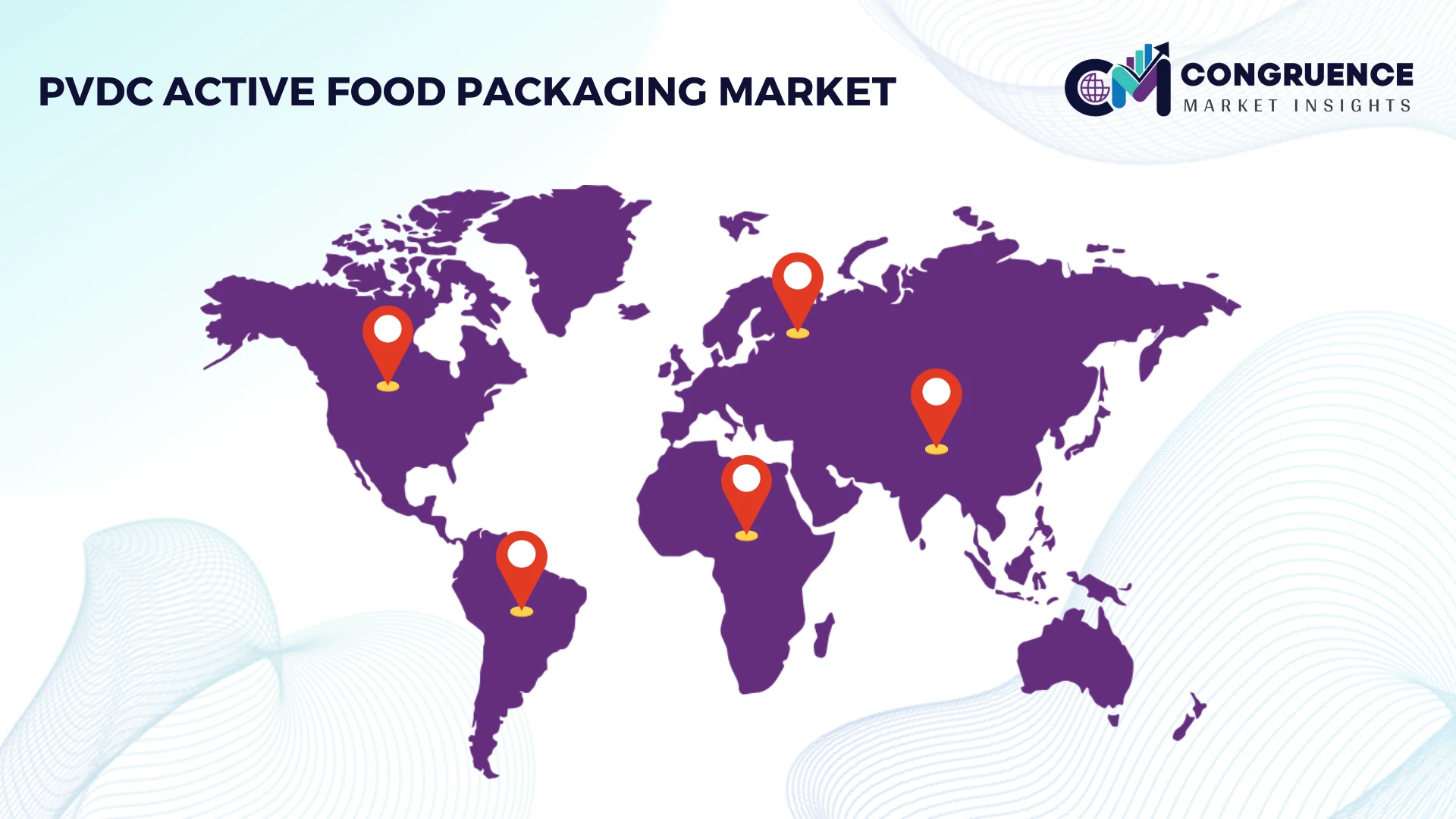
North America accounted for the largest market share at 35.6% in 2025 however, Asia-Pacific is expected to register the fastest growth, expanding at a CAGR of 7.3% between 2026 and 2033.
Strategic Automation Reinforces Premium Barrier Packaging Leadership
North America leads the PVDC active food packaging market through its highly integrated food processing industry, advanced multilayer film manufacturing, and widespread deployment of active packaging across meat, dairy, and ready-to-eat foods. The region contributes nearly 36% of global demand, supported by automated coating technologies, extensive cold-chain infrastructure, and strict food safety requirements. More than 65% of premium chilled food packaging utilizes high-barrier active packaging formats. Packaging manufacturers continue investing in digital quality inspection, localized resin procurement, and high-speed converting lines to strengthen production resilience. Strategic collaboration between food processors and packaging converters is accelerating adoption of customized active packaging solutions that improve shelf-life performance while reducing logistics losses.
United States Market Outlook: The United States dominates regional demand through its large packaged food industry, advanced flexible packaging manufacturing, and established innovation ecosystem. Nearly 72% of North American active food packaging production capacity is concentrated within the country. Manufacturers continue expanding intelligent packaging technologies, automated multilayer film production, and regional coating facilities to improve operational efficiency, regulatory compliance, and supply-chain responsiveness for premium food brands.
Sustainability Requirements Accelerate High-Performance Material Innovation
Europe remains a major market due to advanced food packaging standards, strong barrier-film manufacturing capabilities, and increasing emphasis on reducing food waste through active packaging technologies. The region accounts for approximately 28% of global consumption, while manufacturers focus on downgauged PVDC structures, recyclable multilayer solutions, and precision coating technologies. Continuous modernization of converting facilities and greater automation improve production consistency while supporting premium food packaging applications requiring extended shelf life.
Germany Market Outlook: Germany leads the European market with its advanced packaging machinery industry, high-value food manufacturing sector, and strong materials engineering expertise. More than 38% of regional flexible packaging equipment investments support high-barrier packaging applications. Companies continue integrating digital manufacturing systems and precision coating technologies to strengthen competitiveness across premium food packaging segments.
Manufacturing Scale Drives Regional Expansion
Asia-Pacific is the fastest-growing regional market, supported by expanding food processing capacity, rising packaged food consumption, and increasing investment in advanced packaging infrastructure. The region contributes approximately 31% of global manufacturing output for flexible food packaging materials. Automated multilayer film production has improved manufacturing productivity by nearly 20%, while export-oriented packaging facilities continue expanding across major industrial hubs. Companies are strengthening regional resin sourcing, production integration, and advanced coating capabilities to meet growing domestic and international demand.
China Market Outlook: China serves as the region's manufacturing center through extensive flexible packaging production, integrated petrochemical supply chains, and expanding food processing industries. More than 45% of Asia-Pacific barrier packaging exports originate from Chinese manufacturing facilities. Investments in automated coating lines, intelligent quality control, and high-performance packaging materials continue strengthening the country's leadership in active food packaging production.
Processed Food Demand Supports Packaging Modernization
South America is experiencing steady expansion as packaged food consumption, cold-chain investment, and food export activities continue increasing. Regional food manufacturers are adopting active barrier packaging to improve product stability during long-distance transportation and retail distribution. Around 17% of recent packaging equipment investments have focused on high-barrier flexible packaging technologies. While infrastructure development remains uneven, manufacturers continue modernizing converting operations and strengthening regional partnerships to improve packaging performance and supply reliability.
Brazil Market Outlook: Brazil represents the largest regional market due to its extensive food processing industry, agricultural exports, and expanding flexible packaging sector. Domestic converters are investing in multilayer film production, automated packaging systems, and quality inspection technologies. Growing exports of processed meat, poultry, and fresh produce continue increasing demand for advanced PVDC active food packaging solutions across domestic and international markets.
Food Security Investments Encourage Packaging Innovation
The Middle East & Africa market is gradually expanding through investment in food processing infrastructure, cold-chain logistics, and modern packaging facilities supporting national food security initiatives. Demand for high-barrier packaging is increasing across imported foods, dairy products, and processed meat applications. Approximately 15% of new food manufacturing investments incorporate advanced packaging technologies to improve product preservation and distribution efficiency. Regional companies continue expanding partnerships with international packaging suppliers while modernizing production capabilities.
Saudi Arabia Market Outlook: Saudi Arabia leads regional market development through significant investment in food manufacturing, logistics infrastructure, and industrial diversification programs. Modern food processing facilities increasingly utilize high-performance barrier packaging to improve shelf-life management and reduce import-related losses. Expansion of domestic packaging manufacturing and strategic investment in advanced converting technologies continue strengthening the country's long-term position within the regional active food packaging industry.
Global packaging leaders including Amcor, Sealed Air, Berry Global, Winpak, and Kureha compete directly with regional flexible packaging converters and specialized active-packaging innovators for high-value food contracts. The top five companies collectively account for approximately 49% of global market share. Competition is driven by barrier performance, active functionality, and manufacturing efficiency, where advanced multilayer technologies improve shelf life by nearly 28%, automated coating systems increase production yield by around 16%, and localized supply networks reduce lead times by approximately 18%. Market leaders are expanding regional converting facilities, investing in recyclable high-barrier structures, forming food manufacturer partnerships, and integrating upstream resin sourcing. The competitive landscape is shifting from conventional barrier films toward recyclable active packaging with intelligent quality monitoring. Entry barriers include proprietary coating technologies, food-contact regulatory compliance, and capital-intensive multilayer manufacturing. Winning requires scalable innovation, dependable supply chains, superior barrier performance, and customized packaging solutions for premium food brands.
Amcor plc
Sealed Air Corporation
Berry Global Group, Inc.
Winpak Ltd.
Kureha Corporation
Mondi plc
Huhtamaki Oyj
Coveris Holdings S.A.
Constantia Flexibles Group GmbH
Toppan Holdings Inc.
Cosmo First Limited
UFlex Limited
Advanced multilayer PVDC coating technologies remain the industry benchmark for oxygen and moisture protection, while active oxygen scavengers and antimicrobial systems are becoming standard in premium food applications. Precision coating equipment improves barrier consistency by approximately 19%, and next-generation scavenger formulations extend product freshness by nearly 24%. Around 61% of newly commissioned premium food packaging lines now incorporate automated coating inspection and active barrier integration, delivering stronger quality assurance and lower production variability.
Artificial intelligence-based visual inspection, inline thickness monitoring, and digital process analytics are transforming manufacturing efficiency. Compared with conventional quality control, AI-assisted inspection reduces coating defects by approximately 27% while shortening production validation time by nearly 20%. Companies integrating automated converting, predictive maintenance, and intelligent process control benefit from higher production stability, faster customer qualification, and improved operational flexibility. Global packaging leaders gain a competitive advantage by combining digital manufacturing with customized active packaging solutions for meat, dairy, and ready-to-eat products.
Between 2026 and 2028, recyclable high-barrier structures, bio-based active additives, and smart freshness indicators will accelerate commercial deployment. Automated multilayer production is expected to improve throughput by nearly 18% while reducing material waste by approximately 13%. Companies investing early in recyclable active packaging, intelligent quality monitoring, and scalable coating technologies will strengthen premium market positioning and secure long-term supply agreements with multinational food manufacturers.
December 2024 Berry Global and VOID Technologies commercialized a high-performance recyclable polyethylene film for pet food packaging, reducing plastic consumption while maintaining barrier performance through proprietary voiding technology. The solution enables store-drop recycling and strengthens sustainable flexible packaging innovation. Source: Amcor (Amcor)
April 2025 Amcor received unconditional European Commission approval for its combination with Berry Global, completing the final regulatory milestone before closing. The transaction strengthens global packaging scale, innovation capability, and food packaging supply resilience across major international markets. Source: Amcor (Amcor)
April 2025 Amcor completed its merger with Berry Global, creating a significantly larger global packaging organization with expanded material science capabilities and broader manufacturing reach, strengthening development of advanced food packaging solutions and integrated customer support. Source: Amcor Investor News (Amcor)
March 2025 Berry Global released its 2024 Sustainability Report, reporting an MSCI rating upgrade to AA while highlighting continued progress in circular packaging initiatives and climate performance, reinforcing long-term investment in sustainable food packaging innovation. Source: Berry Global Sustainability Report. (Amcor)
The report provides comprehensive assessment of the PVDC Active Food Packaging Market across oxygen scavenger, moisture control, antimicrobial, ethylene scavenger, and other active packaging technologies. It evaluates applications spanning meat and poultry, dairy products, seafood, fruits and vegetables, bakery products, ready-to-eat foods, and additional packaged food categories. Analysis covers food manufacturers, packaging converters, retail brands, and foodservice operators across North America, Europe, Asia-Pacific, South America, and the Middle East & Africa. More than 60% of the evaluation focuses on high-barrier active packaging deployment, automation, and sustainable material innovation.
The study examines multilayer coating technologies, intelligent packaging, digital quality inspection, recyclable barrier structures, and supply-chain modernization shaping industry competitiveness between 2026 and 2033. It compares regional manufacturing concentration, technology adoption, deployment intensity, innovation strategies, partnership activity, and company positioning, enabling stakeholders to identify investment priorities, expansion opportunities, competitive differentiation, procurement strategies, and future demand across established and emerging food packaging markets.
| Report Attribute/Metric | Report Details |
|---|---|
|
Market Revenue in 2025 |
USD 1,428.3 Million |
|
Market Revenue in 2033 |
USD 2,293.7 Million |
|
CAGR (2026 - 2033) |
6.1% |
|
Base Year |
2025 |
|
Forecast Period |
2026 - 2033 |
|
Historic Period |
2021 - 2025 |
|
Segments Covered |
By Type
By Application
By End-User
|
|
Key Report Deliverable |
Revenue Forecast, Growth Trends, Market Dynamics, Segmental Overview, Regional and Country-wise Analysis, Competition Landscape |
|
Region Covered |
North America, Europe, Asia-Pacific, South America, Middle East, Africa |
|
Key Players Analyzed |
Amcor plc, Sealed Air Corporation, Berry Global Group, Inc., Winpak Ltd., Kureha Corporation, Mondi plc, Huhtamaki Oyj, Coveris Holdings S.A., Constantia Flexibles Group GmbH, Toppan Holdings Inc., Cosmo First Limited, UFlex Limited |
|
Customization & Pricing |
Available on Request (10% Customization is Free) |




