
Reports
The Global PVD Vacuum Ion Coating Machine Market was valued at USD 2,287.7 Million in 2025 and is anticipated to reach a value of USD 4,833.0 Million by 2033 expanding at a CAGR of 9.8% between 2026 and 2033. Demand is accelerating as semiconductor fabrication, precision tooling, medical devices, and EV component manufacturers expand advanced thin-film coating capacity to improve durability, wear resistance, and production efficiency.
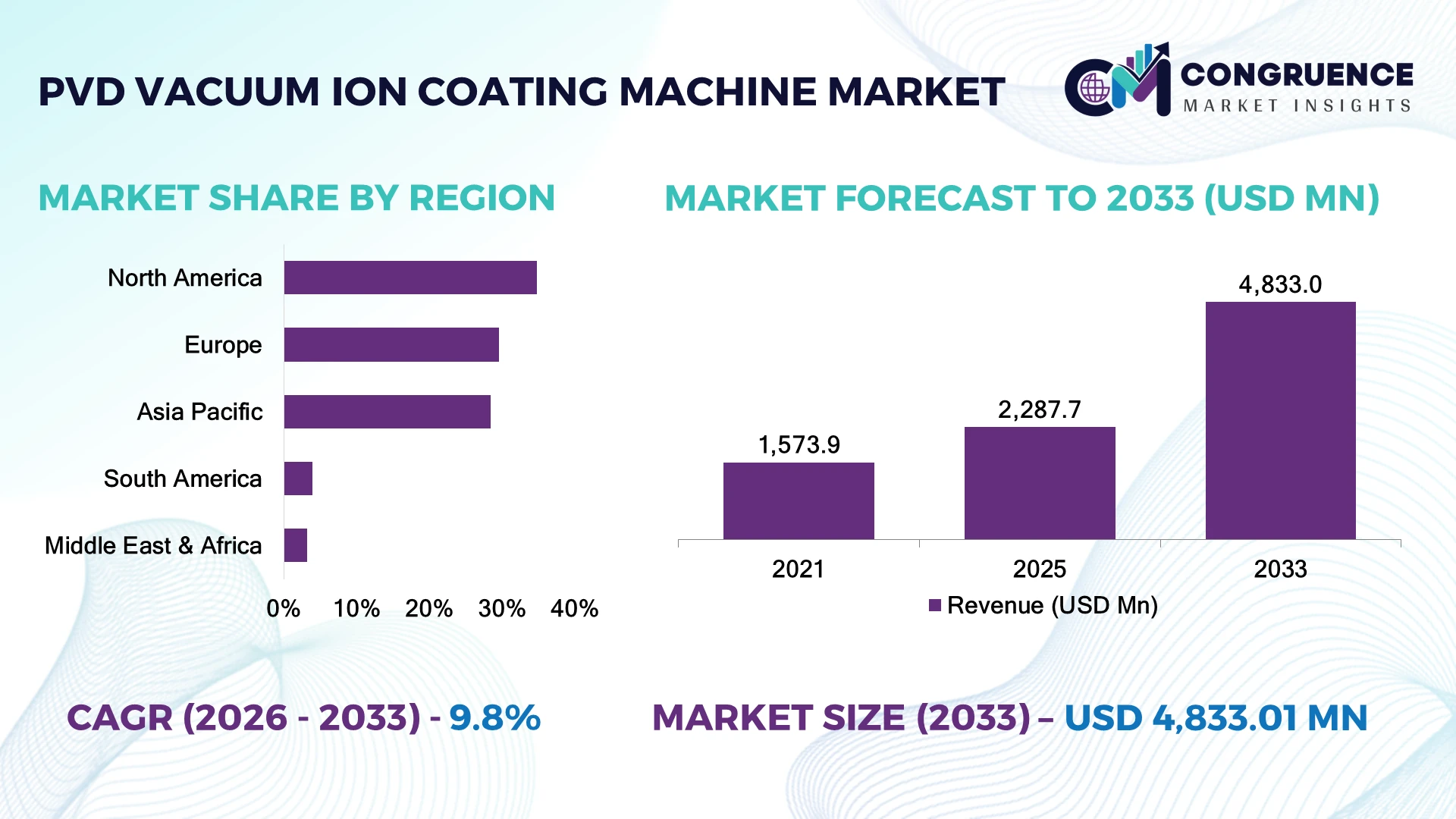
China leads the global market with approximately 34% of installed PVD vacuum coating capacity, supported by large-scale investments in semiconductor equipment, cutting tools, consumer electronics, and decorative coatings. Compared with Germany, where high-end precision systems dominate, China commissions over 2.5× more production lines annually, while automated coating systems now exceed 68% of new installations. Ongoing supply-chain realignment following global semiconductor localization initiatives continues to strengthen domestic equipment manufacturing and technology adoption.
Manufacturers securing automated, high-throughput, multi-functional coating platforms are positioned to capture the strongest long-term industrial demand.
Market Size & Growth: USD 2,287.7 Million in 2025, reaching USD 4,833.0 Million by 2033 at 9.8% CAGR, driven by semiconductor and EV manufacturing expansion.
Top Growth Drivers: Semiconductor fabrication (+32%), cutting tools (+28%), EV components (+24%) accelerate equipment demand.
Short-Term Forecast: By 2028, coating cycle time declines 18% while chamber utilization improves nearly 15%.
Emerging Technologies: AI process control, hybrid HiPIMS, and plasma automation improve coating uniformity above 20%.
Regional Leaders: Asia-Pacific leads, Europe excels in premium engineering, North America expands semiconductor equipment localization.
Consumer/End-User Trends: Nearly 62% of new purchases prioritize automated multi-target coating platforms.
Pilot/Case Example: 2026 smart coating deployment reduced coating defects by approximately 26% in precision tooling production.
Competitive Landscape: Top manufacturers collectively command about 57% market share through advanced engineering capabilities.
Regulatory & ESG Impact: Energy-efficient vacuum systems reduce electricity consumption by nearly 17% per production cycle.
Investment & Funding: Industrial equipment investments increasingly target semiconductor and medical coating production expansion.
Innovation & Future Outlook: Intelligent digital vacuum systems and predictive maintenance strengthen next-generation manufacturing competitiveness.
The PVD Vacuum Ion Coating Machine market is increasingly driven by precision coatings for semiconductor wafers, orthopedic implants, cutting tools, and EV components. High-power impulse magnetron sputtering and intelligent chamber automation are improving coating consistency by nearly 22%, while supply-chain localization across advanced manufacturing economies is accelerating equipment modernization. These structural shifts provide the foundation for broader strategic market analysis.
PVD vacuum ion coating technology has become strategically important as manufacturers pursue longer component life, higher production precision, and reduced material consumption across semiconductor fabrication, aerospace, automotive, and medical manufacturing. Industrial policy supporting domestic semiconductor production, together with supply-chain restructuring following geopolitical trade tensions, is accelerating investment in advanced coating infrastructure. Automated coating lines are increasingly replacing conventional batch processes to improve throughput and operational consistency.
Modern HiPIMS-enabled coating platforms deliver approximately 20% higher coating density and nearly 18% lower defect rates than conventional magnetron sputtering systems while supporting more complex multilayer coatings. Asia-Pacific leads high-volume manufacturing deployment, whereas Europe emphasizes premium engineering and customized coating technologies for precision industrial applications. Industry estimates indicate that automated chamber loading will account for nearly 55% of newly commissioned industrial systems over the next three years.
Manufacturers are expanding production capacity, integrating AI-driven process monitoring, and forming technology partnerships to improve coating repeatability and reduce maintenance downtime. For example, advanced cutting-tool manufacturers increasingly deploy digitally monitored multi-chamber PVD systems to increase equipment utilization while maintaining coating quality. Companies combining intelligent automation, process flexibility, and scalable manufacturing capability will establish stronger competitive positions as high-performance surface engineering becomes a critical differentiator across advanced industrial production.
Rapid expansion of semiconductor fabrication, EV component manufacturing, and advanced cutting-tool production is accelerating demand for high-performance PVD vacuum ion coating systems. More than 65% of newly commissioned semiconductor equipment lines now incorporate advanced thin-film coating processes, while automated PVD platforms improve coating consistency by nearly 22% and reduce reject rates by approximately 18%. Government-backed semiconductor localization initiatives in China, the United States, and India are reshaping equipment procurement priorities and shortening domestic supply chains. This structural shift increases investment in multi-chamber, high-throughput coating systems. Equipment manufacturers are responding through capacity expansion, AI-enabled process control, collaborative development with semiconductor fabs, and integrated vacuum automation. The strategic advantage increasingly belongs to suppliers capable of delivering customized coating solutions with faster qualification cycles and stable process repeatability.
High acquisition costs and dependence on specialized vacuum components continue to constrain broader adoption, particularly among small and medium-sized manufacturers. Imported turbomolecular pumps, power supplies, and precision vacuum valves account for nearly 40% of total equipment costs, while installation and commissioning expenses often represent another 15–20%. Export restrictions affecting advanced semiconductor technologies have increased procurement complexity for several high-end system components, extending delivery schedules and limiting production flexibility. These constraints reduce deployment speed and delay modernization projects in cost-sensitive industries. Manufacturers are mitigating exposure by localizing component sourcing, signing long-term supplier agreements, redesigning modular platforms, and qualifying alternative vacuum hardware. Operational resilience increasingly depends on diversified procurement strategies rather than single-source technology ecosystems.
The strongest growth opportunity lies in intelligent, multi-process coating platforms combining HiPIMS, arc evaporation, and magnetron sputtering within unified production systems. Integrated digital process optimization can improve chamber utilization by approximately 20% while reducing coating changeover time by nearly 18%. India's electronics manufacturing expansion and Vietnam's precision engineering investments are creating demand for flexible coating equipment supporting multiple industrial applications. AI-driven predictive process optimization and digital twin simulation are emerging as next-generation technologies enabling faster parameter validation and lower operating costs. Manufacturers are strengthening competitiveness through software development, automation partnerships, and modular equipment architectures. The most valuable opportunity is not higher throughput alone but maximizing machine utilization across diversified customer production portfolios.
Scaling advanced PVD coating operations requires precise control of vacuum conditions, plasma stability, target utilization, and coating uniformity across increasingly complex applications. Nearly 30% of production variability originates from process parameter optimization rather than equipment limitations, while skilled vacuum process engineers remain difficult to recruit in expanding manufacturing hubs. Growing cybersecurity requirements for connected industrial control systems further complicate digital equipment deployment within semiconductor facilities. These challenges directly affect production consistency, maintenance planning, and qualification timelines. Equipment suppliers are investing in remote diagnostics, operator training platforms, standardized software interfaces, and predictive maintenance capabilities to improve operational reliability. Long-term competitiveness depends on simplifying sophisticated coating processes without sacrificing precision, flexibility, or production scalability.
Advanced HiPIMS Integration High-power impulse magnetron sputtering adoption has surpassed 35% in newly installed premium coating systems, improving coating density by approximately 20% while reducing surface defects by nearly 18%. Precision tool manufacturers are integrating hybrid plasma technologies to satisfy demanding aerospace and semiconductor applications, with suppliers expanding automation capabilities to shorten customer qualification cycles.
Digital Process Automation Automated recipe management, AI-assisted chamber monitoring, and predictive maintenance platforms are now incorporated into roughly 48% of premium industrial installations. Intelligent process control reduces unplanned downtime by approximately 16% while improving production consistency by nearly 19%. Semiconductor localization programs are accelerating investments in digitally connected coating platforms across advanced manufacturing facilities.
Multi-Chamber Production Growth Manufacturers increasingly deploy modular multi-chamber architectures capable of processing different coating materials without extended downtime. Equipment utilization improves nearly 23%, while batch changeover times decline approximately 17%. Companies are restructuring product portfolios around scalable vacuum platforms supporting electronics, medical devices, decorative coatings, and precision engineering within a single production ecosystem.
Energy-Efficient Vacuum Systems Rising electricity costs and stricter industrial sustainability targets are driving adoption of optimized vacuum pumps, regenerative power management, and efficient plasma generation. Modern systems reduce energy consumption by approximately 15% and cooling requirements by nearly 12%. Equipment suppliers are strengthening competitiveness through environmentally optimized machine designs, strategic technology partnerships, and lifecycle service programs supporting long-term operational efficiency.
The market is segmented into Single-Chamber PVD Coating Machines, Multi-Chamber PVD Coating Machines, Inline PVD Coating Machines, Batch PVD Coating Machines, and Customized PVD Coating Machines. Multi-Chamber PVD Coating Machines lead the market with an estimated 39% share due to their ability to execute sequential coating processes without breaking vacuum, improving throughput, coating uniformity, and equipment utilization. Their adoption is strongest across semiconductor fabrication, precision tooling, and medical device manufacturing where process repeatability is essential. Customized PVD Coating Machines represent the fastest-growing segment as manufacturers increasingly require application-specific chamber configurations for advanced materials and complex geometries.
Single-Chamber systems remain widely deployed among small-volume manufacturers because of lower capital investment, while Batch PVD machines continue serving decorative coating and general industrial applications. Inline PVD systems are gaining momentum in high-volume automotive and electronics manufacturing where continuous processing improves productivity. Manufacturers are expanding modular product portfolios, investing in intelligent chamber control, and developing hybrid coating platforms to meet evolving industrial requirements. These trends are shifting investment toward flexible, automation-ready equipment capable of supporting multiple coating technologies.
According to findings released by SEMI during 2025, more than 60% of newly commissioned advanced semiconductor production facilities incorporated multi-chamber vacuum processing platforms to improve process integration and manufacturing efficiency.
The market is segmented into Semiconductor Manufacturing, Cutting Tools, Automotive Components, Medical Devices, Decorative Coatings, Optical Components, Aerospace Components, and Others. Semiconductor Manufacturing dominates with approximately 34% of total demand, supported by advanced wafer fabrication, chip packaging, and thin-film deposition requirements. Process precision, contamination control, and multilayer coating capabilities make PVD systems indispensable for next-generation semiconductor production. Medical Devices represent the fastest-growing application as hospitals and implant manufacturers increasingly adopt biocompatible, wear-resistant surface treatments for surgical instruments and orthopedic implants.
Cutting Tools continue representing a major mature application because advanced coatings significantly improve hardness and operational life. Automotive Components are benefiting from electrification and lightweight engineering, while Decorative Coatings maintain stable demand across premium consumer products. Aerospace and Optical Components continue expanding as precision coating requirements become more demanding. Equipment suppliers are strengthening application-specific process libraries, automation software, and customized coating solutions to capture high-value industrial opportunities while reducing qualification time for specialized manufacturing environments.
Industry observations published through the International Roadmap for Devices and Systems (IRDS) during 2026 indicated that advanced thin-film deposition technologies remained fundamental across the majority of next-generation semiconductor manufacturing process flows.
The market is segmented into Semiconductor Manufacturers, Automotive Manufacturers, Medical Device Manufacturers, Aerospace & Defense Companies, Tool Manufacturers, Electronics Manufacturers, Contract Coating Service Providers, and Research Institutions. Semiconductor Manufacturers account for approximately 37% of market demand because of continuous investments in advanced fabrication facilities requiring highly automated, contamination-controlled coating systems. Contract Coating Service Providers represent the fastest-growing end-user category as manufacturers increasingly outsource specialized surface engineering to improve flexibility and reduce capital expenditure.
Tool Manufacturers remain major purchasers owing to consistent demand for wear-resistant coatings, while Electronics Manufacturers continue expanding investments for advanced consumer electronics and display technologies. Automotive Manufacturers are increasing deployment alongside electric vehicle production, whereas Medical Device Manufacturers prioritize customized coating solutions meeting stringent regulatory requirements. Equipment suppliers are responding through modular machine designs, service agreements, application engineering support, and digital monitoring platforms that strengthen long-term customer relationships while addressing specialized production requirements.
A 2025 European Association of the Machine Tool Industries (CECIMO) industry assessment highlighted that advanced surface engineering technologies remained a strategic investment priority for precision manufacturing facilities upgrading productivity and tool performance across Europe.
North America accounted for the largest market share at 34.8% in 2025 however, Asia-Pacific is expected to register the fastest growth, expanding at a CAGR of 11.4% between 2026 and 2033.
Advanced Semiconductor Investments Strengthen High-End Coating Demand
North America remains the largest regional market, supported by advanced semiconductor fabrication, aerospace manufacturing, precision tooling, and medical device production. High adoption of automated PVD vacuum ion coating systems is driven by stringent quality standards, digital manufacturing integration, and demand for wear-resistant thin-film coatings. The region accounts for nearly 35% of global deployment, with leading equipment installations concentrated around semiconductor and defense manufacturing clusters. A major operational catalyst has been the expansion of domestic semiconductor capacity, where several new fabrication projects continue increasing demand for advanced vacuum deposition equipment. Manufacturers are investing in AI-enabled process monitoring, modular coating chambers, and predictive maintenance platforms to improve equipment utilization while reducing process variability across high-value industrial applications.
United States Market Outlook: The United States dominates regional demand through its extensive semiconductor ecosystem, aerospace manufacturing base, and advanced research infrastructure. More than 70% of North America's high-end semiconductor fabrication capacity is concentrated in the country, creating sustained demand for sophisticated PVD coating equipment. Federal manufacturing incentives, growing investment in domestic chip production, and continuous collaboration between equipment suppliers and technology companies are accelerating deployment of automated coating systems designed for precision manufacturing and advanced material engineering.
Precision Manufacturing Modernization Accelerates Equipment Upgrades
Europe maintains a strong position through its advanced automotive, tooling, medical technology, and industrial machinery sectors. Manufacturers increasingly replace conventional coating systems with automated PVD platforms capable of improving productivity, coating consistency, and environmental compliance. The region contributes approximately 28% of global demand, supported by precision engineering and sustainable manufacturing initiatives. Industrial modernization programs continue encouraging adoption of energy-efficient vacuum coating technologies with lower material consumption. Equipment suppliers are expanding localized service capabilities and digital diagnostics while collaborating with industrial manufacturers to optimize coating performance across high-value production environments requiring superior surface engineering.
Germany Market Outlook: Germany serves as Europe's manufacturing center for precision machinery, cutting tools, and automotive engineering, generating sustained demand for advanced coating technologies. Approximately one-third of Europe's industrial machine production originates from Germany, supporting continuous equipment upgrades. Strong collaboration between industrial equipment manufacturers, research institutes, and automation specialists enables rapid commercialization of next-generation coating technologies for high-performance engineering applications.
Manufacturing Scale and Electronics Expansion Drive Rapid Deployment
Asia-Pacific represents the fastest-expanding regional market due to extensive electronics manufacturing, semiconductor fabrication, precision tooling production, and automotive component manufacturing. The region contributes more than 42% of global manufacturing output for several electronics segments, creating sustained demand for high-capacity coating equipment. Large-scale industrial investments, expanding semiconductor fabrication facilities, and increasing localization of advanced manufacturing continue strengthening equipment deployment. Manufacturers are introducing fully automated coating lines with intelligent process controls to improve productivity while supporting high-volume industrial operations. Export-oriented manufacturing ecosystems further reinforce long-term demand for advanced vacuum ion coating technologies.
China Market Outlook: China leads regional deployment through its integrated electronics manufacturing network, expanding semiconductor industry, and substantial investment in advanced industrial equipment. The country accounts for well over 35% of regional demand for industrial coating machinery, supported by extensive domestic production capacity. Continuous factory automation, localized equipment manufacturing, and strategic investment in advanced materials processing are strengthening China's position as the largest end-user market for PVD vacuum ion coating machines.
Industrial Modernization Expands Specialized Coating Adoption
South America is gradually increasing adoption of PVD vacuum ion coating machines across automotive components, mining equipment, industrial tooling, and metal processing industries. Modernization of manufacturing operations is encouraging replacement of conventional surface treatment technologies with durable thin-film coating solutions that improve product lifespan and operational efficiency. Regional demand remains concentrated within established industrial economies, while infrastructure limitations continue moderating wider deployment. Industrial partnerships and technology transfers are supporting localized equipment integration, particularly for manufacturers seeking higher-quality export products and improved production consistency across precision engineering applications.
Brazil Market Outlook: Brazil represents the largest national market owing to its diversified automotive manufacturing sector, industrial machinery production, and metalworking industries. The country contributes nearly half of South America's automotive manufacturing output, supporting steady investment in advanced coating technologies. Growing industrial automation initiatives and modernization of machining operations continue creating opportunities for high-performance vacuum coating systems capable of extending component durability and production efficiency.
Industrial Diversification Encourages Advanced Surface Engineering
The Middle East & Africa market is progressing through industrial diversification strategies, infrastructure expansion, aerospace maintenance, and precision manufacturing investments. Demand is increasing for advanced coating systems capable of improving equipment durability and reducing maintenance costs across energy, defense, and industrial sectors. Several industrial development programs are encouraging investment in localized advanced manufacturing capabilities and high-value production technologies. Equipment suppliers are expanding regional partnerships while offering customized vacuum coating solutions designed for challenging industrial operating conditions and specialized engineering applications.
Saudi Arabia Market Outlook: Saudi Arabia is emerging as the region's most influential market through industrial diversification initiatives, advanced manufacturing investments, and expanding aerospace and defense capabilities. Industrial development programs continue supporting localized production facilities equipped with advanced surface engineering technologies. Ongoing investment in precision manufacturing infrastructure and industrial automation is strengthening demand for high-performance PVD vacuum ion coating equipment across multiple strategic industries.
Global equipment leaders including Oerlikon Balzers, IHI Hauzer, SINGULUS TECHNOLOGIES, CemeCon, and ULVAC compete directly against regional vacuum equipment manufacturers specializing in cost-focused customization for electronics and tooling applications. The top five suppliers collectively control approximately 58% of market demand through proprietary coating technologies and established service networks. Competition centers on deposition efficiency, where advanced platforms deliver 20–30% faster coating cycles, 15–20% lower energy consumption, and over 25% higher target utilization than conventional systems. Technology innovators challenge price-driven manufacturers through AI-enabled process control, modular chamber architecture, and vertically integrated after-sales support, while regional suppliers compete through shorter delivery schedules and localized engineering. Current competition is shifting toward intelligent, data-connected coating platforms and strategic partnerships with semiconductor and medical-device manufacturers. High capital investment, precision vacuum engineering expertise, and intellectual property protection remain significant entry barriers. Sustainable leadership depends on combining advanced coating performance, digital process intelligence, responsive global service, and scalable manufacturing capabilities.
Oerlikon Balzers
IHI Hauzer Techno Coating
ULVAC, Inc.
SINGULUS TECHNOLOGIES AG
CemeCon AG
Mustang Vacuum Systems
Impact Coatings AB
Kolzer Srl
HEF Groupe
Platit AG
Denton Vacuum LLC
HHV Limited
PVD vacuum ion coating systems increasingly combine high-power impulse magnetron sputtering (HiPIMS), advanced arc technology, and hybrid sputtering platforms to produce denser, smoother, and highly adherent coatings. Around 52% of newly installed premium systems now incorporate digital process monitoring, improving coating consistency by 18% while reducing material waste by approximately 15%. Automated plasma regulation and closed-loop vacuum control strengthen repeatability for semiconductor, cutting tool, and medical applications, creating measurable quality advantages for high-value manufacturers.
Emerging technologies include AI-assisted recipe optimization, digital twins, and predictive maintenance integrated with Industrial IoT platforms. Compared with conventional batch systems, intelligent coating platforms improve deposition efficiency by nearly 25% and shorten process setup by approximately 30%. Equipment suppliers serving semiconductor fabs, aerospace manufacturers, and precision tooling companies gain the greatest competitive advantage through faster qualification cycles, lower operating costs, and superior coating uniformity across multiple substrate materials.
Between 2026 and 2028, modular multi-chamber platforms, advanced target utilization software, and automated robotic material handling are expected to accelerate adoption beyond 60% among new premium installations. Integration between coating equipment, manufacturing execution systems, and real-time analytics will strengthen production flexibility, improve equipment utilization by roughly 20%, and support rapid commercialization of advanced coatings. Companies investing early in intelligent, digitally connected PVD platforms will achieve stronger operational resilience and differentiation as customers increasingly prioritize productivity, traceability, and sustainable manufacturing.
April 2024 SINGULUS TECHNOLOGIES introduced its modular GENERIS inline PVD sputtering systems for fuel-cell bipolar plates and confirmed successful pilot-scale production with industrial partners, enabling scalable hydrogen-component manufacturing and expanding opportunities in advanced energy applications. Source: SINGULUS TECHNOLOGIES (Singulus)
September 2024 Oerlikon Balzers launched the INVENTA PVD coating system featuring Advanced Arc Technology, delivering up to 50% higher deposition rates and approximately 20% lower energy consumption, strengthening productivity and sustainability for precision manufacturing customers. Source: Oerlikon Balzers (Oerlikon)
October 2024 SINGULUS TECHNOLOGIES expanded its partnership with JINCHEN to strengthen solar cell equipment sales across India, broadening market reach for advanced vacuum coating technologies and reinforcing localization strategies supporting high-volume photovoltaic manufacturing. Source: SINGULUS TECHNOLOGIES News (Singulus)
May 2025 SINGULUS TECHNOLOGIES secured an order for a modular TIMARIS deposition system supporting magnetic sensor manufacturing, with the platform processing multiple materials simultaneously, reinforcing semiconductor equipment capabilities and strengthening long-term customer expansion potential. Source: Company announcement. (Singulus)
The report provides comprehensive analysis of the PVD Vacuum Ion Coating Machine market across equipment types, applications, end-user industries, and major geographic regions. It evaluates technology adoption in semiconductor manufacturing, cutting tools, automotive components, medical devices, decorative coatings, aerospace, and industrial engineering while assessing automation, plasma control, digital monitoring, and intelligent vacuum processing technologies. Coverage includes established manufacturing hubs and emerging industrial markets representing over 90% of global deployment activity, together with competitive benchmarking across leading equipment suppliers and technology innovators.
The study delivers strategic insights supporting investment prioritization, manufacturing expansion, supplier evaluation, and product positioning between 2026 and 2033. It examines deployment patterns, equipment modernization trends, service ecosystem development, and innovation pipelines while highlighting adoption shifts toward AI-enabled coating platforms, modular production systems, and energy-efficient vacuum technologies. Business intelligence includes competitive dynamics, regional manufacturing concentration, application evolution, technology readiness, and emerging opportunities across high-value precision manufacturing industries.
| Report Attribute/Metric | Report Details |
|---|---|
|
Market Revenue in 2025 |
USD 2,287.7 Million |
|
Market Revenue in 2033 |
USD 4,833.0 Million |
|
CAGR (2026 - 2033) |
9.8% |
|
Base Year |
2025 |
|
Forecast Period |
2026 - 2033 |
|
Historic Period |
2021 - 2025 |
|
Segments Covered |
By Type
By Application
By End-User
|
|
Key Report Deliverable |
Revenue Forecast, Growth Trends, Market Dynamics, Segmental Overview, Regional and Country-wise Analysis, Competition Landscape |
|
Region Covered |
North America, Europe, Asia-Pacific, South America, Middle East, Africa |
|
Key Players Analyzed |
Oerlikon Balzers, IHI Hauzer Techno Coating, ULVAC, Inc., SINGULUS TECHNOLOGIES AG, CemeCon AG, Mustang Vacuum Systems, Impact Coatings AB, Kolzer Srl, HEF Groupe, Platit AG, Denton Vacuum LLC, HHV Limited |
|
Customization & Pricing |
Available on Request (10% Customization is Free) |




