
Reports
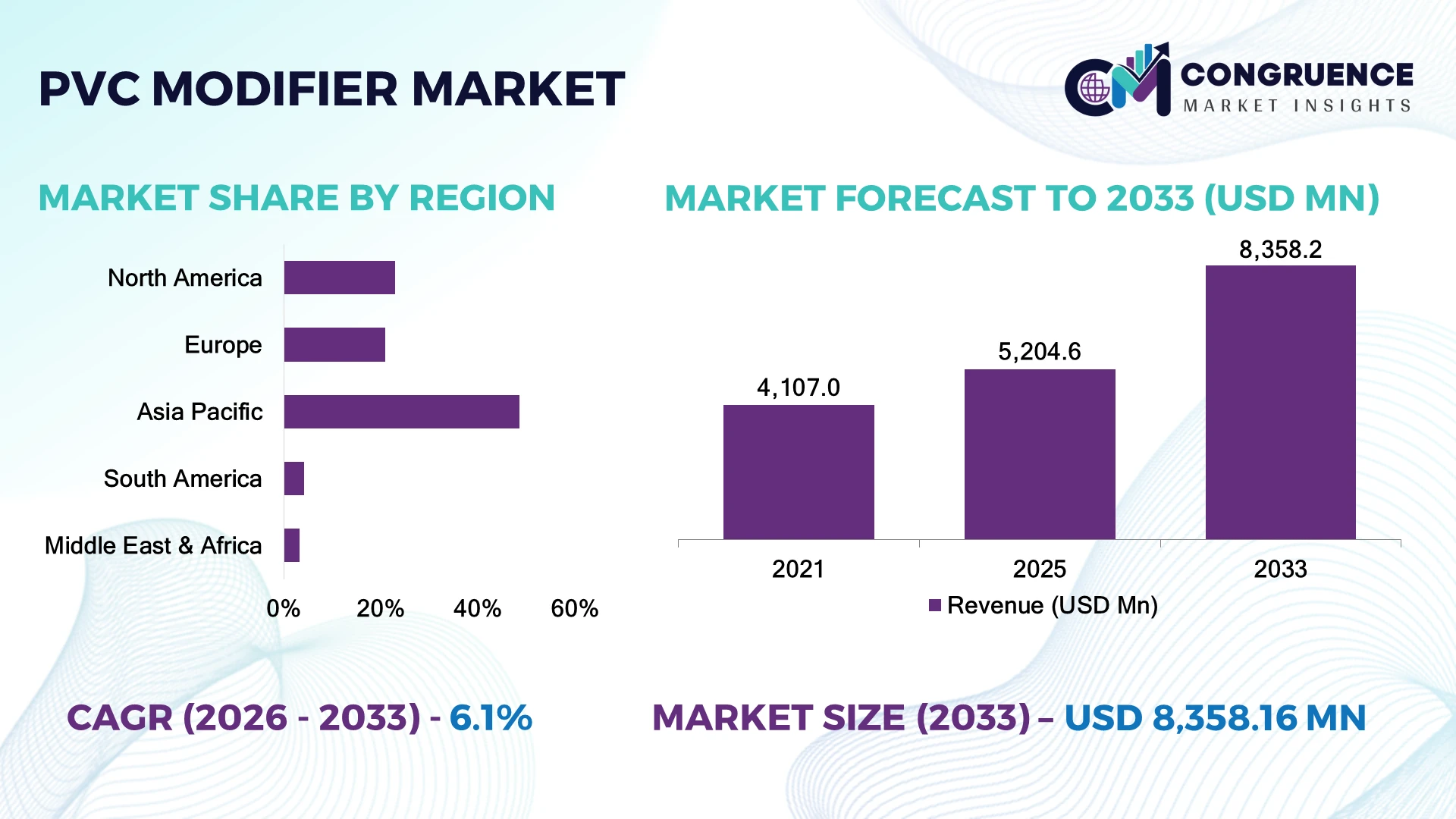
The Global PVC Modifier Market was valued at USD 5,204.6 Million in 2025 and is anticipated to reach a value of USD 8,358.2 Million by 2033 expanding at a CAGR of 6.1% between 2026 and 2033. Growth is driven by rising demand for high-impact PVC formulations in construction, pipe systems, window profiles, and sustainable infrastructure projects requiring enhanced durability and processing efficiency.
China dominates the PVC Modifier market with approximately 45% of global production capacity, supported by integrated chlor-alkali manufacturing, expanding construction materials industries, and continuous investment in polymer processing technologies. Production capacity is nearly 3.2 times higher than India, while automated compounding technologies improve manufacturing efficiency by approximately 18%. Ongoing supply-chain diversification following global trade realignments in 2026 is encouraging additional capacity expansion across Southeast Asia while preserving China's manufacturing leadership.
Manufacturers prioritizing advanced polymer formulations, localized production, and downstream PVC partnerships will secure stronger long-term competitive positioning.
Market Size & Growth: USD 5,204.6 million in 2025 reaching USD 8,358.2 million by 2033 at 6.1% CAGR, supported by advanced PVC processing and infrastructure demand.
Top Growth Drivers: Infrastructure construction (+24%), PVC pipe demand (+19%), window profile production (+16%).
Short-Term Forecast: By 2028, production efficiency improves 15% while material waste declines 11%.
Emerging Technologies: Advanced acrylic modifiers, automated compounding, and sustainable polymer formulations enhance product performance.
Regional Leaders: Asia-Pacific (~USD 4.2 billion), Europe (~USD 1.6 billion), North America (~USD 1.2 billion), supported by construction modernization.
Consumer/End-User Trends: Nearly 63% of rigid PVC formulations incorporate impact modifiers for enhanced durability.
Pilot/Case Example: A 2026 polymer processing upgrade improved extrusion throughput by approximately 14%.
Competitive Landscape: Top five producers control nearly 55% of global supply through integrated manufacturing.
Regulatory & ESG Impact: Low-emission modifier technologies reduce processing emissions by approximately 13%.
Investment & Funding: More than USD 2.1 billion supports polymer capacity expansion and specialty additive production.
Innovation & Future Outlook: Bio-based modifiers and high-performance formulations strengthen next-generation PVC applications.
The PVC Modifier market is advancing through high-performance polymer engineering, improved impact resistance technologies, and formulation optimization for infrastructure and industrial applications. Approximately 38% of newly developed modifier formulations emphasize enhanced weatherability and processing stability, while manufacturers increasingly localize production to strengthen supply resilience amid evolving trade policies. These developments establish a strong foundation for the market's strategic evolution.
The PVC Modifier market has become strategically important as manufacturers compete through material performance, formulation innovation, and integrated polymer supply chains rather than production scale alone. Infrastructure modernization, stricter product performance standards, and supply-chain restructuring are reshaping procurement strategies and investment priorities across construction, industrial, and utility applications. High-performance modifiers have become critical for improving durability and processing consistency in advanced PVC products.
Modern acrylic and impact modifier technologies improve impact strength by approximately 22% while reducing processing scrap by nearly 16% compared with conventional formulations. China leads large-scale manufacturing through integrated chlor-alkali and polymer production, while Germany focuses on specialty polymer innovation and premium construction-grade formulations. Over the next two to three years, demand for weather-resistant and recyclable PVC formulations is expected to accelerate as infrastructure projects adopt higher material performance standards.
Manufacturers are expanding compounding facilities, strengthening partnerships with PVC resin producers, and investing in specialty modifier development to improve application-specific performance. Companies are also increasing automation across formulation and quality control processes to deliver consistent product specifications. Suppliers combining advanced polymer science, localized manufacturing, and strong downstream customer integration will establish lasting competitive advantages as high-performance PVC applications continue expanding across global infrastructure and industrial markets.
Rapid expansion of infrastructure construction and utility network modernization is increasing demand for high-performance PVC modifiers that enhance impact strength, weatherability, and processing stability. Approximately 66% of rigid PVC pipe formulations now incorporate advanced impact modifiers, while optimized polymer blends improve extrusion efficiency by nearly 17% and reduce production scrap by approximately 14%. China's continued investment in municipal infrastructure and industrial manufacturing has accelerated demand for specialty PVC compounds following supply-chain localization initiatives in 2026. This shift is encouraging manufacturers to expand compounding capacity, strengthen partnerships with PVC resin producers, and invest in advanced acrylic modifier technologies. A key strategic advantage increasingly lies in delivering application-specific formulations that improve processing consistency while reducing lifecycle costs for downstream manufacturers.
Dependence on acrylic monomers, chlorinated polymers, and specialty chemical intermediates continues exposing PVC modifier manufacturers to input cost volatility. Raw materials account for nearly 58% of total production costs, while fluctuations in petrochemical feedstocks have increased procurement expenses by approximately 15% across specialty formulations. Germany's energy-intensive chemical industry continues facing elevated operating costs, creating additional pressure on premium modifier production. These structural constraints reduce pricing flexibility, compress operating margins, and complicate long-term supply agreements with processors. Companies are mitigating risks through multi-source procurement, localized raw material partnerships, long-term supply contracts, and formulation optimization that lowers dependence on high-cost specialty feedstocks without compromising product performance.
Growing investment in recyclable PVC systems and advanced polymer engineering is creating new opportunities for specialty modifier manufacturers. Approximately 33% of newly developed modifier formulations are designed to improve recycled PVC performance, while advanced processing technologies enhance material consistency by nearly 19%. Japan is advancing sustainable polymer technologies through collaborative research focused on high-performance recyclable construction materials. Manufacturers are expanding R&D programs, partnering with compounders, and developing modifiers compatible with recycled and bio-attributed feedstocks. A significant strategic opportunity lies in premium infrastructure applications, where specialized modifiers enable higher recycled content while maintaining mechanical strength and processing efficiency demanded by modern construction standards.
Achieving consistent modifier performance across diverse PVC formulations remains a major execution challenge as application requirements become increasingly specialized. Approximately 27% of product qualification cycles require application-specific reformulation, while performance validation extends development timelines by nearly 18%. India's expanding PVC processing industry is increasing demand for customized modifier solutions across pipes, profiles, fittings, and industrial products, placing pressure on suppliers to maintain uniform quality across varying production environments. Manufacturers must strengthen technical service capabilities, invest in digital formulation analytics, and expand collaborative product development with converters. Long-term competitiveness depends on delivering reproducible processing performance while minimizing formulation complexity across multiple end-use applications.
Advanced Acrylic Modifiers Expand: High-performance acrylic modifiers are replacing conventional formulations, improving impact resistance by approximately 21% while increasing extrusion productivity by nearly 15%. Growing infrastructure quality requirements are encouraging manufacturers to scale specialty polymer production and optimize compounding technologies for premium construction applications.
Automated Compounding Accelerates: Polymer manufacturers are deploying automated formulation and dosing systems that improve batch consistency by approximately 18% and reduce material waste by nearly 13%. Labor optimization and digital process control are strengthening production efficiency while enabling faster commercialization of customized PVC modifier grades.
Localized Supply Chains Strengthen: Supply-chain diversification has increased regional raw material sourcing by approximately 20%, reducing procurement lead times by nearly 16%. Chemical producers are expanding domestic partnerships and restructuring logistics networks to improve supply security amid evolving global trade policies and feedstock availability.
Recycled PVC Compatibility Grows: Modifier technologies designed for recycled PVC have expanded by approximately 24%, while enhanced formulations improve recycled material processability by nearly 17%. Manufacturers are collaborating with recyclers and downstream converters to develop circular polymer solutions that meet stricter sustainability expectations without sacrificing product performance.
Acrylic impact modifiers account for approximately 43% of the global PVC Modifier market, supported by superior weather resistance, excellent transparency retention, and compatibility with rigid PVC products used in window profiles, pipes, and construction materials. Their long-term durability and processing stability make them the preferred solution for premium infrastructure applications. Chlorinated polyethylene (CPE) modifiers continue serving cost-sensitive applications because of their balanced impact performance and affordability, while MBS modifiers remain strategically important for transparent PVC products requiring high optical clarity.
Acrylic processing aids represent the fastest-growing type as manufacturers increasingly prioritize higher extrusion efficiency and improved melt strength in automated production environments. Advanced processing aids improve throughput by approximately 16% while reducing processing defects by nearly 14%. Companies are expanding specialty polymer portfolios, investing in formulation research, and strengthening partnerships with PVC compounders to develop application-specific modifier systems. Investment priorities continue shifting toward high-value specialty additives that enhance production efficiency while supporting premium construction and industrial applications.
According to a 2026 assessment by the Vinyl Institute, manufacturers continue increasing the adoption of advanced impact modifiers and processing aids to improve long-term durability and production efficiency across rigid PVC construction products.
Pipes and fittings account for approximately 39% of global PVC Modifier consumption due to expanding investments in water infrastructure, sewage systems, irrigation networks, and industrial fluid transportation. These applications require superior impact resistance, pressure performance, and long-term weatherability, making advanced modifier formulations essential. Window profiles remain a mature segment supported by energy-efficient construction, while siding, sheets, films, and injection-molded products continue benefiting from application-specific modifier technologies.
Window profiles represent the fastest-growing application as energy-efficient buildings and modern construction standards increase demand for durable PVC products with improved dimensional stability and UV resistance. Advanced modifier systems improve impact performance by approximately 18% while enhancing extrusion productivity by nearly 15%. Manufacturers are expanding customized formulation capabilities, integrating automated compounding technologies, and collaborating with profile producers to optimize product performance. Demand is steadily shifting toward high-performance construction materials capable of meeting increasingly stringent durability and processing requirements.
A 2025 industry survey published by the European Council of Vinyl Manufacturers indicated continued growth in advanced modifier adoption across PVC pipes and building profiles as infrastructure modernization and energy-efficient construction projects accelerated globally.
The construction industry accounts for approximately 61% of global PVC Modifier demand because of extensive consumption across pipes, window profiles, siding, roofing components, and structural building products. Large-scale infrastructure projects and urban development continue driving demand for modifiers that improve durability, impact resistance, and weather performance. Industrial manufacturing remains a stable end-user segment through electrical conduits and fabricated products, while packaging applications maintain selective demand for specialized PVC formulations.
Infrastructure and utility developers represent the fastest-growing end-user group as governments increase investment in water distribution, sanitation, and resilient public infrastructure. Advanced modifier formulations improve service life by approximately 20%, while reducing installation-related product failures by nearly 13%. Manufacturers are strengthening relationships with construction material producers, expanding regional production capacity, and developing customized grades tailored to infrastructure specifications. Competitive positioning increasingly depends on technical support, formulation expertise, and consistent supply for large-scale public projects.
A 2026 construction materials assessment by the International Code Council highlighted increasing specification of high-performance PVC compounds for infrastructure and commercial building projects requiring enhanced durability and long-term structural reliability.
Asia-Pacific accounted for the largest market share at 48.6% in 2025 however, North America is expected to register the fastest growth, expanding at a CAGR of 6.6% between 2026 and 2033.
Infrastructure Modernization Accelerates High-Performance Polymer Adoption
North America represents a mature PVC Modifier market supported by large-scale infrastructure rehabilitation, advanced polymer processing, and increasing adoption of premium construction materials. The region contributes approximately 23% of global demand, driven by replacement of aging water distribution systems, commercial construction, and industrial manufacturing. More than 61% of rigid PVC pipe production incorporates advanced impact modifiers to improve durability and service life. Chemical producers are expanding specialty polymer capacity while increasing automated compounding, improving production efficiency by approximately 15%. Strategic partnerships between resin manufacturers and additive suppliers are strengthening localized supply chains, enabling faster product qualification and customized formulations for infrastructure-grade applications.
United States Market Outlook: The United States leads the regional market through its integrated petrochemical industry, advanced PVC processing capacity, and sustained investment in municipal infrastructure. Large construction material manufacturers increasingly specify high-performance acrylic modifiers for pressure pipes, window profiles, and industrial applications. Approximately 68% of domestic PVC pipe manufacturing utilizes advanced modifier formulations, encouraging suppliers to expand technical support, formulation development, and downstream partnerships with major construction product manufacturers.
Sustainability Standards Reshape Specialty Polymer Demand
Europe accounts for approximately 21% of global PVC Modifier consumption, supported by stringent construction standards, circular economy initiatives, and advanced specialty chemical manufacturing. Demand increasingly favors high-performance modifier systems that improve product durability while supporting recyclable PVC applications. Nearly 36% of newly developed modifier formulations are designed for recycled-content PVC products. Chemical producers continue modernizing production assets, investing in energy-efficient processing technologies, and expanding collaborations with construction material manufacturers to strengthen sustainable product portfolios and regulatory compliance.
Germany Market Outlook: Germany remains the technological center of the European PVC Modifier industry due to its strong specialty chemicals sector and advanced polymer research capabilities. Manufacturers focus on premium acrylic modifiers, processing aids, and sustainable formulations for high-value construction applications. Automated compounding technologies have improved batch consistency by approximately 17%, reinforcing Germany's leadership in specialty polymer innovation and industrial-grade PVC material development.
Manufacturing Scale Reinforces Global Supply Leadership
Asia-Pacific dominates the PVC Modifier market through integrated chemical manufacturing, expanding PVC resin production, and large-scale infrastructure development. The region accounts for approximately 48.6% of global demand, supported by strong construction activity, expanding pipe manufacturing, and competitive production economics. Automated compounding operations have improved manufacturing productivity by nearly 19%, while localized raw material integration continues reducing production costs. Major producers are expanding specialty additive capacity, strengthening downstream partnerships, and investing in advanced formulation technologies to support both domestic demand and export-oriented manufacturing.
China Market Outlook: China serves as the industry's largest production hub with approximately 45% of global PVC Modifier manufacturing capacity, supported by integrated chlor-alkali operations and extensive PVC processing industries. Continuous investment in automated polymer manufacturing and specialty additives strengthens production efficiency and product consistency. Manufacturers are increasingly developing customized modifier grades for infrastructure, industrial, and export applications while expanding collaborations with downstream PVC compounders.
Infrastructure Investment Expands Construction Material Demand
South America is experiencing steady PVC Modifier demand driven by water infrastructure upgrades, residential construction, and expanding industrial manufacturing. Brazil represents the largest share of regional consumption due to its established PVC processing industry and growing construction sector. Approximately 22% of new municipal pipeline projects specify higher-performance PVC materials requiring advanced impact modifiers. Manufacturers are strengthening regional distribution networks and localized compounding capabilities to improve product availability while addressing logistics costs and imported raw material dependency.
Brazil Market Outlook: Brazil leads the regional market through its diversified chemical industry, established PVC processing ecosystem, and increasing infrastructure investment. Domestic manufacturers continue expanding production of pipes, fittings, and construction materials utilizing advanced modifier technologies. Improved technical collaboration between polymer suppliers and construction product manufacturers has enhanced formulation performance, while localized production supports faster supply response and greater procurement stability.
Industrial Diversification Supports Polymer Manufacturing Expansion
The Middle East & Africa market is progressing through infrastructure development, industrial diversification, and investment in downstream petrochemical industries. Demand for PVC Modifiers is strengthening across construction materials, water management systems, and industrial piping applications. Approximately 18% of newly commissioned polymer processing facilities incorporate advanced compounding technologies for specialty PVC formulations. Manufacturers are expanding regional distribution partnerships, improving technical support capabilities, and investing in localized processing to strengthen supply reliability and reduce dependence on imported specialty additives.
Saudi Arabia Market Outlook: Saudi Arabia has emerged as the region's strategic market through its integrated petrochemical industry, expanding downstream manufacturing, and large-scale infrastructure investments. Strong feedstock availability supports competitive PVC resin production, creating favorable conditions for specialty modifier manufacturing. Industrial diversification initiatives continue attracting investment into polymer processing, while domestic manufacturers increasingly focus on higher-value construction materials and advanced PVC formulations for infrastructure applications.
Global specialty polymer suppliers including Kaneka Corporation, Arkema, Dow, Shandong Ruifeng Chemical, and LG Chem compete against regional compounders and cost-focused Chinese manufacturers for long-term PVC formulation programs. Premium technology providers challenge volume-driven suppliers through formulation performance, while integrated chemical companies compete with independent additive producers on supply reliability and customization. The top five players collectively account for approximately 55% of global market share. Competition centers on processing efficiency, impact performance, formulation flexibility, and localized supply. Advanced acrylic technologies improve extrusion productivity by nearly 16%, customized modifier systems reduce processing scrap by approximately 14%, and integrated raw-material sourcing lowers procurement costs by around 12%. Companies are expanding specialty additive capacity, strengthening downstream partnerships, investing in recyclable formulations, and increasing vertical integration. Competition is shifting toward sustainable, application-specific modifiers with stronger technical support. High qualification requirements and proprietary formulation expertise remain major entry barriers. Success demands differentiated polymer technology, resilient supply chains, rapid formulation development, and deep customer integration.
Kaneka Corporation
Arkema S.A.
Dow Inc.
LG Chem Ltd.
Shandong Ruifeng Chemical Co., Ltd.
Shandong Rike Chemical Co., Ltd.
Novista Group
Sundow Polymers Co., Ltd.
Shandong Hongfu Group
Shandong Donglin New Materials Co., Ltd.
Mitsubishi Chemical Corporation
Avient Corporation
PVC Modifier technology is advancing through high-performance acrylic impact modifiers, intelligent processing aids, and specialty polymer formulations engineered for modern extrusion systems. Advanced acrylic modifiers improve impact resistance by approximately 22%, while next-generation processing aids increase extrusion efficiency by nearly 16%. Around 64% of premium rigid PVC formulations now utilize advanced modifier technologies to enhance weatherability, dimensional stability, and long-term product durability. These technologies reduce manufacturing variability and improve production consistency, creating measurable operational advantages for pipe, profile, and construction material manufacturers.
Emerging innovations include recyclable-compatible modifier chemistries, bio-attributed polymer additives, AI-assisted formulation optimization, and automated compounding platforms. Compared with conventional chlorinated polyethylene systems, advanced acrylic modifier technologies improve processing stability by approximately 18% while reducing material consumption by nearly 11%. Integrated chemical producers and specialty additive manufacturers benefit most because digital formulation capabilities accelerate customer-specific product development and shorten qualification timelines for infrastructure-grade PVC applications.
Between 2026 and 2028, digital compounding, circular polymer technologies, and low-carbon additive manufacturing will redefine competitive positioning. Manufacturers investing in automated formulation control, advanced polymer engineering, and sustainable modifier portfolios will strengthen supply resilience, reduce production complexity, and accelerate commercialization of premium PVC products. Early technology adoption enables greater processing flexibility, faster product customization, and stronger participation in infrastructure, construction, and industrial modernization projects.
April 2025 – Shandong Repolyfine Chemical introduced advanced acrylic impact modifiers capable of maintaining PVC impact performance at temperatures as low as -60°C, strengthening demand for high-durability construction and industrial applications. Source: Shandong Repolyfine Chemical Co., Ltd.
December 2025 – Arkema announced the planned divestment of selected acrylic impact modifier and MBS businesses to sharpen its specialty materials strategy, strengthening portfolio focus across high-value polymer additives. Source: Arkema
2026 – Kaneka continued expanding its Kane Ace™ acrylic impact modifier portfolio, including next-generation grades that enable reduced additive dosage while maintaining outdoor PVC impact performance, improving formulation cost efficiency. Source: Kaneka
September 2025 – Arkema introduced new Durastrength® acrylic impact modifier technologies with a reduced carbon footprint for rigid PVC applications, supporting lower Scope 3 emissions while preserving processing performance. Source: Arkema Product Documentation. Arkema Plastic Additives
This report provides a comprehensive evaluation of the global PVC Modifier market across major product types, applications, end-user industries, and regional markets. The analysis covers acrylic impact modifiers, chlorinated polyethylene, MBS modifiers, processing aids, and emerging specialty formulations deployed across pipes and fittings, window profiles, siding, films, sheets, and industrial products. It further examines evolving technologies including recyclable-compatible modifiers, automated compounding, advanced polymer engineering, and sustainable additive solutions shaping next-generation PVC manufacturing.
The study delivers strategic intelligence supporting investment planning, product development, geographic expansion, and competitive benchmarking between 2026 and 2033. More than 60% of advanced rigid PVC formulations now utilize high-performance modifier technologies, while localized manufacturing and customized polymer solutions continue reshaping procurement strategies. Company benchmarking, technology assessment, regional demand analysis, supply-chain evaluation, and application-level adoption trends enable stakeholders to identify high-priority growth opportunities, optimize production strategies, strengthen competitive positioning, and respond effectively to changing infrastructure, construction, and industrial material requirements.
| Report Attribute/Metric | Report Details |
|---|---|
|
Market Revenue in 2025 |
USD 5,204.6 Million |
|
Market Revenue in 2033 |
USD 8,358.2 Million |
|
CAGR (2026 - 2033) |
6.1% |
|
Base Year |
2025 |
|
Forecast Period |
2026 - 2033 |
|
Historic Period |
2021 - 2025 |
|
Segments Covered |
By Type
By Application
By End-User
|
|
Key Report Deliverable |
Revenue Forecast, Growth Trends, Market Dynamics, Segmental Overview, Regional and Country-wise Analysis, Competition Landscape |
|
Region Covered |
North America, Europe, Asia-Pacific, South America, Middle East, Africa |
|
Key Players Analyzed |
Kaneka Corporation, Arkema S.A., Dow Inc., LG Chem Ltd., Shandong Ruifeng Chemical Co., Ltd., Shandong Rike Chemical Co., Ltd., Novista Group, Sundow Polymers Co., Ltd., Shandong Hongfu Group, Shandong Donglin New Materials Co., Ltd., Mitsubishi Chemical Corporation, Avient Corporation |
|
Customization & Pricing |
Available on Request (10% Customization is Free) |




