
Reports
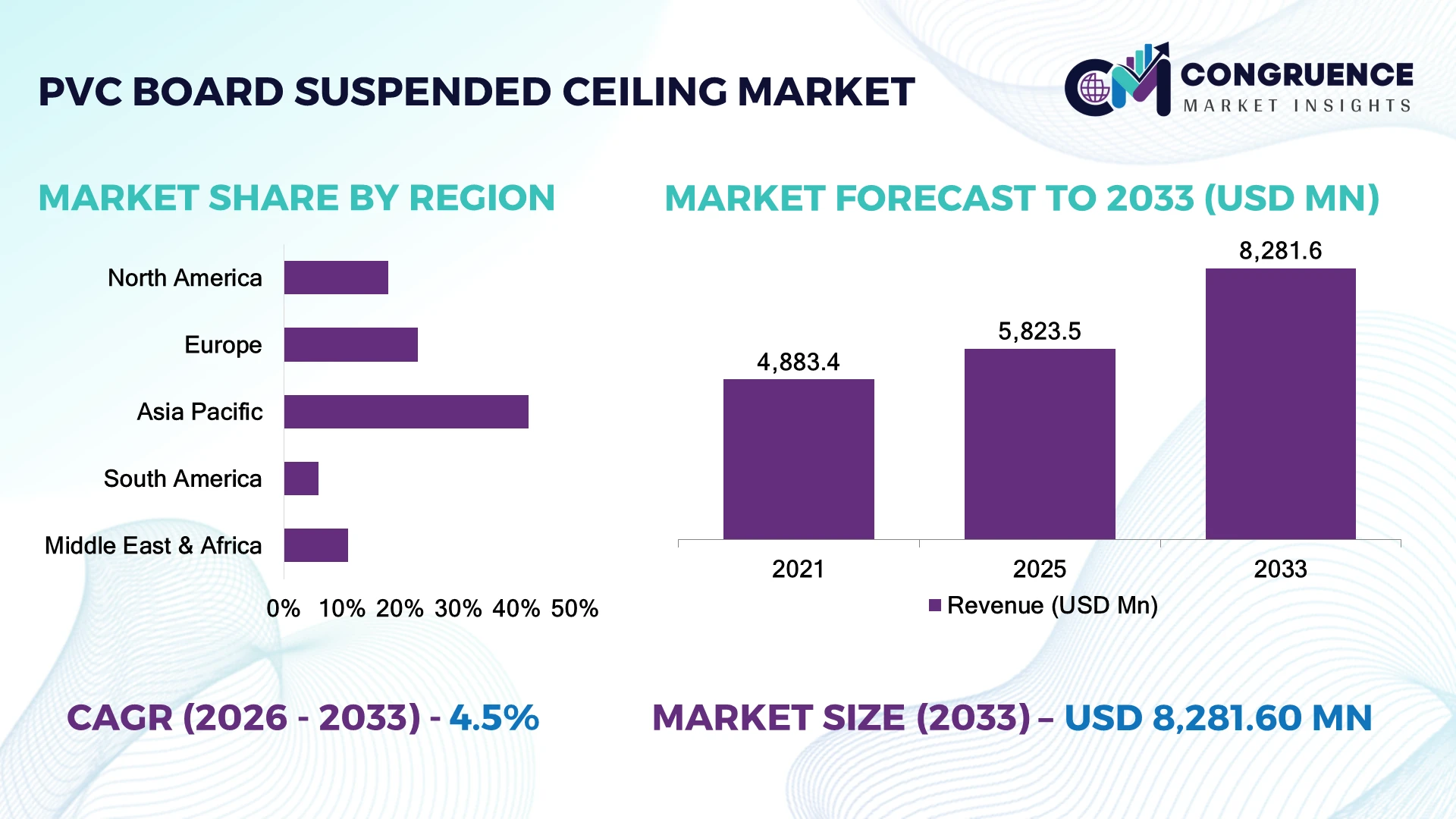
The Global PVC Board Suspended Ceiling Market was valued at USD 5,823.5 Million in 2025 and is anticipated to reach a value of USD 8,281.6 Million by 2033 expanding at a CAGR of 4.5% between 2026 and 2033. Growth is supported by moisture-resistant interior finishing, faster installation requirements, renovation of aging buildings, and demand for low-maintenance ceilings in kitchens, bathrooms, retail spaces, and institutional facilities.
China holds a strategic position in PVC building-material manufacturing, supported by large-scale polymer processing, established extrusion capacity, and extensive construction supply chains. India is strengthening its position through residential construction, commercial fit-outs, and expanding domestic building-material distribution. With more than 85% of existing European buildings expected to remain in use in 2050, renovation offers a distinct demand pathway alongside new construction. China's manufacturing scale favors cost-competitive supply, while European buyers place greater emphasis on product compliance, material traceability, and circularity. Companies should prioritize efficient local distribution, verified product performance, and differentiated designs rather than relying exclusively on low prices.
Manufacturers that combine competitive production costs with dependable quality, installation efficiency, and material-compliance capabilities are best positioned to capture demand across new-build and renovation projects.
Market Size & Growth: The market is valued at USD 5,823.5 million in 2025 and is projected to reach USD 8,281.6 million by 2033, supported by moisture-resistant interior finishing and cost-conscious building modernization.
Top Growth Drivers: Water-resistant interior applications, renovation demand, and faster installation requirements are key demand drivers; project specifications and local construction activity determine their relative impact.
Short-Term Forecast: By 2028, manufacturers targeting a 3–5% reduction in material waste through extrusion control, cutting optimization, and improved inventory planning can strengthen margins; this is an operational target, not an observed market average.
Emerging Technologies: Digital surface printing, automated dimensional inspection, and recycled-PVC formulation are improving design flexibility, production consistency, and material utilization.
Regional Leaders: Asia-Pacific leads through construction scale and manufacturing depth; North America emphasizes renovation and specification-led projects; Europe places stronger weight on circularity and material compliance.
Consumer & End-User Trends: Residential kitchens and bathrooms favor moisture-resistant panels, while commercial buyers prioritize cleanability, installation speed, replacement convenience, and predictable maintenance.
Pilot & Operational Example: A project-level installation trial targeting a 10% reduction in fitting time can improve contractor productivity; actual results depend on panel dimensions, ceiling layout, substrate condition, and installer experience.
Competitive Landscape: Competition spans ceiling-system specialists, diversified building-material companies, and regional PVC extruders. Product-specific global market shares are not consistently disclosed, making audited leadership claims unreliable.
Regulatory & ESG Impact: European PVC recycling reached 765,972 tonnes in 2025, up 5.7% year over year, reinforcing the importance of traceable materials and circularity across the wider PVC value chain.
Investment & Funding: Investment priorities include extrusion-line efficiency, digital printing, automated quality checks, and regional distribution. No reliable consolidated investment total is available specifically for PVC board suspended ceilings.
Innovation & Future Outlook: The next competitive shift centers on consistent surface finishes, better installation systems, recycled-content validation, and fit-for-purpose performance documentation rather than design novelty alone.
The PVC board suspended ceiling market serves residential renovation, hospitality, retail, healthcare, and other interior-fit-out projects where moisture resistance and manageable installation costs are important. Digital printing and improved extrusion controls support more consistent finishes and product customization. As material traceability and recycled-content expectations strengthen, manufacturers need to balance cost competitiveness with documented product quality and local compliance. This creates opportunities for suppliers that can provide dependable specifications, stable lead times, and installation-ready product ranges.
PVC board suspended ceilings are becoming strategically relevant as building owners seek interior systems that combine moisture resistance, predictable installation, and lower routine maintenance. Demand extends beyond new residential construction into hotel refurbishment, retail fit-outs, institutional buildings, and renovation of kitchens and bathrooms. The market is consequently influenced not only by construction volume but also by contractor productivity, replacement cycles, and the availability of standardized panel systems.
Manufacturing technology is shaping the next stage of competition. Automated extrusion monitoring, dimensional inspection, and digital printing improve process control and design consistency compared with manual checks and conventional surface decoration. A 3–5% reduction in avoidable production waste is a reasonable improvement target for a plant implementing process controls, although results depend on equipment condition and product mix. China benefits from manufacturing scale, while European suppliers face stronger incentives to document material sourcing and circularity. European PVC recycling increased 5.7% in 2025, reinforcing the commercial relevance of recycled-material infrastructure.
Between 2026 and 2028, manufacturers should prioritize measurable process improvements, installation-friendly profiles, verified performance claims, and distributor partnerships. For example, coordinating panel dimensions with contractor workflows can reduce cutting losses and simplify replacement. Businesses that invest in reliable quality systems and market-specific product portfolios can compete on delivered value rather than price alone. Long-term relevance will depend on balancing affordability, durability, compliance, and material recovery.
Demand is supported by the need for ceiling finishes that withstand humid environments and require limited routine maintenance. PVC boards are particularly relevant in bathrooms, kitchens, laundries, and selected commercial interiors where moisture exposure can damage conventional finishes. In project planning, a target of 10–15% lower installation time is possible when standardized panels and compatible accessories replace more labor-intensive finishing steps; this is a project-level target, not a universal performance benchmark. India's apartment construction and renovation activity creates a practical market for economical, easy-to-clean ceiling systems. Manufacturers are responding with consistent panel dimensions, interlocking profiles, ready-finished surfaces, and contractor-oriented distribution. The strongest advantage comes from reducing total installed effort, not simply offering a lower panel price.
PVC resin, additives, pigments, printing films, and packaging expose manufacturers to input-cost volatility. A 5–10% movement in resin and additive costs can materially affect margins in price-sensitive product lines when contracts do not permit prompt price revisions; this is a sensitivity scenario rather than a measured market-wide change. Low-cost suppliers also create pressure on thickness consistency, surface finish, and dimensional tolerance. In export markets, documentation and chemical-compliance requirements add testing and administrative costs. Manufacturers can limit exposure through multiple sourcing arrangements, longer-term procurement agreements, tighter material-yield control, and product specifications that prevent excessive overengineering. The key restraint is the difficulty of passing higher input costs through fragmented distribution channels without losing price-sensitive buyers.
Product differentiation offers an opportunity beyond commodity white ceiling panels. Digital printing, decorative laminates, wood-look finishes, and application-specific panel designs help suppliers address hospitality, retail, and residential refurbishment projects. A 3–5% improvement in usable output from reduced trimming and setup waste is a practical manufacturing target for plants upgrading process controls, although each facility must validate its own baseline. Recycled-PVC integration is another opportunity where material consistency, traceability, and end-use requirements permit it. European PVC recycling increased 5.7% in 2025, demonstrating continued activity across the broader recovery ecosystem. Manufacturers can develop qualified recycled-content grades, partner with recyclers, and introduce premium finishes while retaining a cost-focused core range. Commercial gains depend on verified performance and customer willingness to pay for differentiation.
Manufacturers must address application-specific fire requirements, dimensional stability, joint integrity, and the handling of PVC waste throughout a product's life cycle. A 2–3% installation rework allowance can serve as an internal planning threshold for pilot projects, but actual rates depend on installer training, substrate condition, and system design. Inadequate support spacing or incompatible accessories can cause uneven finishes and costly callbacks. Recycling also becomes more complex when panels contain mixed laminates, adhesives, coatings, or contaminants. Companies need validated product testing, clear installation instructions, trained contractor networks, and material identification that supports future recovery. Long-term competitiveness requires performance documentation and consistent installation outcomes, particularly where buyers compare PVC systems with mineral-fiber, metal, or gypsum alternatives.
Decorative Finishes Gain Specification Value. Digital printing and laminated surfaces are expanding the range of wood-look, stone-look, and custom designs available to residential and commercial buyers. Manufacturers can reduce dependence on standard white panels by developing application-specific collections. A 5–10% reduction in rejected printed panels is a reasonable internal quality-improvement target for suppliers upgrading color control and inspection, not an established industry average. The commercial opportunity lies in repeatable finish quality across production batches.
Production Controls Become More Data-Led. Extrusion monitoring, automated cutting, and dimensional inspection help manufacturers detect variation before products reach distributors. Plants targeting 3–5% lower material waste can use production data to improve die settings, cutting plans, and changeovers. These gains require equipment calibration and baseline measurement. Suppliers are increasingly evaluating automation through measurable yield and defect reduction rather than adopting technology for its own sake.
Circularity Influences Material Decisions. European PVC recycling reached 765,972 tonnes in 2025, a 5.7% increase over 2024. Although this figure covers the broader PVC value chain rather than ceiling boards alone, it highlights growing recovery infrastructure. Ceiling manufacturers are evaluating recycled-content sourcing, product identification, and design choices that simplify future material separation. The practical challenge is maintaining consistent color, mechanical properties, and surface quality when recycled inputs are introduced.
Installation Efficiency Shapes Product Design. Contractors and project managers increasingly value panels that are easy to cut, align, and replace without extensive finishing. Standardized dimensions, compatible trims, and well-designed joining profiles can reduce fitting complexity. A 10% reduction in installation time is a useful project-trial target when comparing optimized systems with existing workflows, but should be verified on-site. Manufacturers are responding with coordinated accessories and clearer installation guidance, particularly for renovation projects where disruption must be minimized.
Hollow-core PVC ceiling panels are estimated to represent approximately 48% of demand by panel construction, supported by low weight, interlocking installation, manageable material consumption, and suitability for residential renovations. Their installation simplicity helps contractors reduce handling requirements and ceiling dead load compared with heavier board systems. Solid PVC panels serve projects requiring a more substantial panel structure, while foamed PVC boards offer opportunities where weight and machinability influence specification. Co-extruded and other engineered panels remain more specialized, with selection driven by surface durability, dimensional consistency, and application-specific performance. These shares are directional estimates because manufacturers do not consistently disclose global sales by panel construction.
Engineered and co-extruded panels are a potential high-growth niche as buyers seek improved surface consistency and more differentiated finishes. A 3–5% reduction in cutting waste is a practical target for manufacturers optimizing panel dimensions and production settings, although results require plant-level validation. Suppliers are responding through improved extrusion control, decorative surface options, and coordinated trims and accessories. Investment priorities should favor reliable high-volume hollow-core production while selectively expanding engineered products where customers value finish quality and installation performance.
Bathrooms and kitchens are estimated to account for approximately 35% of PVC board suspended ceiling demand, reflecting exposure to humidity, routine cleaning requirements, and the appeal of finished panels that avoid repeated painting. Living areas and bedrooms provide a substantial established market, particularly in cost-sensitive residential construction, while commercial interiors—including retail units, offices, and hospitality spaces—support demand for coordinated finishes and faster fit-outs. Utility and institutional applications remain relevant where ease of cleaning and maintenance access influence material selection. These application shares are indicative estimates rather than audited sales data.
Commercial interiors are a potential faster-expanding application, with project demand supported by refurbishment, standardized fit-out schedules, and the need to minimize business disruption. Contractors targeting a 5–10% reduction in ceiling installation time can test coordinated panel-and-trim systems against existing workflows; actual savings depend on site conditions and installer experience. Manufacturers are adapting with consistent dimensions, decorative options, and installation-ready accessories. In the United States, 2025 private construction spending declined 2.9% from 2024, highlighting the importance of winning renovation and replacement projects rather than relying solely on new construction. Suppliers should prioritize applications where moisture performance, installation speed, and lifecycle maintenance create a clear purchasing advantage.
Residential builders, renovation contractors, and homeowners are estimated to represent approximately 45% of demand by end-user group, supported by bathroom and kitchen upgrades, affordable housing projects, and the replacement of aging interior finishes. Commercial developers and fit-out contractors form another important buyer group, prioritizing repeatable specifications, installation schedules, and predictable material availability across multiple sites. Hospitality and retail operators typically emphasize decorative consistency and rapid refurbishment, while institutional and industrial facility managers focus on maintenance requirements and suitability for the intended environment. These indicative shares reflect a proposed segmentation framework, not audited global purchasing data.
Commercial fit-out contractors are a potential faster-growing buyer group where multi-site refurbishment and standardized project delivery reward reliable panel dimensions and coordinated accessories. A 5–10% reduction in fitting time is a useful project-level target for evaluating optimized installation systems, but it should be verified through site trials rather than assumed across all projects. Manufacturers can serve this segment through contractor pricing, dependable delivery, specification support, and partnerships with distributors and installers. Residential buyers remain more price-sensitive, making pack availability and accessible product ranges important. Future positioning depends on matching product quality, pricing, and service to each buyer’s procurement model rather than using a single channel strategy.
Asia-Pacific accounted for the largest market share at approximately 42% in 2025; moreover, Asia-Pacific is also expected to register the fastest growth between 2026 and 2033. Asia-Pacific benefits from manufacturing scale and extensive construction supply chains, while European demand is more influenced by renovation requirements, product compliance, and material recovery. North American suppliers compete through renovation-oriented distribution, whereas Middle Eastern markets offer opportunities tied to hospitality, commercial interiors, and infrastructure development.
Renovation-Led Demand Rewards Reliable Distribution and Installation Efficiency
North America represented an estimated 18% of global demand in 2025, with the United States serving as the principal market. PVC board suspended ceilings are most relevant in moisture-prone residential interiors, selected retail and hospitality fit-outs, and projects where ease of cleaning and straightforward replacement are priorities. Buyers typically compare PVC panels with gypsum, mineral-fiber, and metal ceiling systems based on application suitability, installed cost, appearance, and fire-performance requirements. Contractors and distributors influence product selection because dependable stock and compatible trims help reduce installation delays. Manufacturers can strengthen their position through regional warehousing, consistent panel dimensions, and clearly documented performance specifications. The strongest commercial opportunities lie in renovation and specialized interiors rather than assuming PVC boards are suitable for every commercial ceiling application.
United States Market Outlook: The United States offers a mature distribution ecosystem, established building-product retailers, and a large base of renovation contractors. The U.S. Census Bureau publishes monthly construction-spending data across private, public, residential, and nonresidential categories, providing a useful indicator for tracking project conditions. For PVC ceiling suppliers, competitive success depends on accurate product specifications, consistent quality, and distributor relationships that support smaller renovation orders as well as larger fit-outs. Manufacturers should also verify applicable building-code and fire-performance requirements before positioning PVC panels for commercial or institutional use.
Renovation and Material Traceability Shape Product Selection
Europe accounted for an estimated 23% of the market in 2025. Demand reflects residential refurbishment, hospitality upgrades, and selected commercial interiors, but product choice is shaped by fire-safety requirements, building specifications, and scrutiny of material composition. PVC panels compete most effectively in applications where moisture resistance and cleaning convenience outweigh the acoustic or fire-performance advantages of alternative ceiling systems. The European Union's construction production increased by 0.5% in 2025, indicating modest activity across the wider construction sector. Suppliers are therefore incentivized to target clearly defined applications, maintain technical documentation, and improve material traceability. Recycling infrastructure also matters: European PVC recovery activity is creating stronger incentives to document recycled inputs and consider end-of-life handling.
Germany Market Outlook: Germany is an important market because of its established construction-product distribution, renovation activity, and technical specification culture. Suppliers must demonstrate that panel systems meet the requirements of their intended use, particularly for commercial interiors where fire classification and installation details influence acceptance. Germany's mature building-material ecosystem supports access to contractors, wholesalers, and specialist installers, but competition from established ceiling materials remains significant. Companies can improve positioning through reliable product documentation, coordinated accessories, consistent surface finishes, and targeted distribution partnerships rather than relying on price alone.
Manufacturing Scale Meets Uneven Construction Conditions
Asia-Pacific represented an estimated 42% of global demand in 2025, supported by large construction markets, extensive PVC processing capacity, and demand for affordable interior finishes. China is important to the regional supply base, while India contributes through residential construction, renovation, and a broad network of building-material distributors. However, manufacturing scale does not guarantee uniform demand: China's real-estate development investment declined 17.2% in 2025, underscoring pressure in its property sector. Suppliers therefore need to balance production efficiency with market diversification and careful inventory management. Moisture-resistant panels, decorative finishes, and standardized installation systems remain commercially relevant, especially where contractors prioritize affordability and fast interior completion.
India Market Outlook: India combines a large housing requirement with extensive domestic distribution of economical construction materials. By December 2025, approximately 2.92 crore houses had been completed under the rural Pradhan Mantri Awaas Yojana, illustrating the scale of housing delivery, although this does not directly measure demand for PVC ceilings. Suppliers can address residential renovation and new-build projects through accessible price points, localized stock, and panel formats suited to local construction practices. Manufacturers should emphasize dimensional consistency, surface durability, and installation guidance to reduce site-level wastage and strengthen contractor confidence.
Affordable Refurbishment and Distributor Reach Define Market Access
South America accounted for an estimated 6% of global demand in 2025, with Brazil representing the principal commercial opportunity. Residential refurbishment, retail fit-outs, hospitality projects, and moisture-prone interiors provide relevant use cases for PVC board suspended ceilings. However, currency movements, imported-input costs, and differences in purchasing power can constrain premium product adoption. Regional suppliers compete by offering practical designs, manageable order quantities, and reliable availability through local wholesalers. Companies entering the market should avoid relying exclusively on imported finished panels where freight and exchange-rate exposure undermine pricing. Local distributor partnerships and selective product localization can improve responsiveness, while application-specific performance documentation helps distinguish suitable products from lower-cost alternatives.
Brazil Market Outlook: Brazil offers the region's strongest route to scale through its broad construction-material distribution network and large residential market. Suppliers can target bathroom and kitchen renovations, budget-conscious housing, and selected commercial interiors where moisture resistance and easy maintenance matter. Market access depends on competitive landed costs, dependable wholesaler relationships, and clear product specifications in Portuguese. Companies should evaluate local sourcing and inventory arrangements to reduce exposure to currency fluctuations and shipping delays. A focused portfolio of standard panels, decorative finishes, and compatible accessories can serve different price points without creating excessive inventory complexity.
Infrastructure Programmes and Hospitality Fit-Outs Create Selective Opportunities
The Middle East & Africa region represented an estimated 11% of global demand in 2025, with opportunities concentrated in selected Gulf markets and South Africa. Hotels, retail developments, residential projects, and public facilities require interior finishes suited to local operating conditions and maintenance expectations. PVC panels can compete in suitable applications through moisture resistance, decorative flexibility, and straightforward replacement, but fire performance and project specifications remain essential selection criteria. South Africa's 2025 infrastructure programme included more than R940 billion in planned public infrastructure spending over three years, spanning transport, water, energy, and other sectors. This broad investment pipeline provides construction context, not a direct measure of ceiling-panel demand. Suppliers benefit from project-specific distribution and contractor engagement.
Saudi Arabia Market Outlook: Saudi Arabia is a strategically important market because of investment in hospitality, commercial developments, housing, and infrastructure under its economic diversification programme. Suppliers should target projects where PVC panels meet the specified fire, installation, and maintenance requirements rather than assuming suitability across all building types. Project procurement often rewards reliable delivery, documentation, and the ability to coordinate with contractors and local distributors. Companies can strengthen their position through partnerships with regional building-material suppliers, locally available accessories, and product ranges designed for clearly defined interior applications. Careful specification review is essential before committing inventory to large projects.
The market divides between global ceiling brands Armstrong, Saint-Gobain, Hunter Douglas, OWA, and ROCKWOOL, and regional PVC panel specialists competing on price, decorative flexibility, and local availability. Global suppliers target specification-led commercial projects; regional extruders serve residential renovations and cost-sensitive distributors. The top five players’ combined share is not reliably disclosed for this narrowly defined category; a 25–35% range is a directional assumption, not audited data. Buyers compare installed cost, moisture resistance, fire documentation, finish consistency, lead time, and accessory compatibility. A 5–10% installation-time reduction can be a project target for standardized panels, while 3–5% lower material waste is a process-improvement target, both requiring validation. Companies are adding wood-look finishes, widening distributor networks, and coordinating panels with trims and grids. Recycled-content traceability is emerging as a differentiator. Entry barriers include extrusion know-how, consistent quality, code compliance, and distribution reach. Winning requires dependable supply, verified performance, and cost discipline at scale.
PVC ceiling-panel production relies on extrusion, calibration, printing, and lamination. Servo-controlled lines and inline checks can reduce setup variation and scrap; a 3–5% waste reduction is a plant-level target, not an industry average. Adoption is uneven, with larger exporters better placed to justify sensors and digital batch records. Consistent thickness and finish reduce complaints and returns across distributor networks.
Digital printing, hot-stamping, and laminated films offer wood-look and stone-look surfaces without natural materials. Automated color inspection improves batch consistency, while optimized cutting may raise usable output by 2–4% in suitable operations. These are engineering targets requiring validation in factory trials. Regional brands compete through design flexibility, while established ceiling suppliers benefit from compatible grids, trims, and installation guidance. Product claims need testing for fire performance and durability.
During 2026–2028, investment priorities center on quality automation, recycled-PVC qualification, and traceable sourcing rather than radical product changes. European PVC recycling reached 765,972 tonnes in 2025, up 5.7%, signaling demand for recycled-content documentation. Adoption rates for these technologies are not consistently published for PVC ceiling boards. Companies should pilot upgrades against scrap, changeover time, defects, and returns before scaling. Suppliers combining efficient production, validated performance, and reliable delivery will gain durable competitive advantage.
February 2025 Spiro Panels launched PVC ceiling solutions in India with wood-look finishes and a 10-year product replacement warranty. The launch targets residential and commercial interiors, positioning decorative durability and reduced maintenance against conventional wood-effect ceiling options. Source: PR Newswire
June 2026 VinylPlus reported 765,972 tonnes of PVC waste recycled within its European framework in 2025, up 5.7% year over year. The result strengthens pressure on building-product converters to document recycled inputs and material traceability for building converters. Source: VinylPlus
2026 Whiterock PVC Panels reported strengthening distribution to more than 8 regional warehouses, following product-range diversification in 2025. The expansion improves domestic stock availability and signals competition shifting toward regional fulfilment as well as panel pricing across India. Source: Whiterock
January 2026 The EU Construction Products Regulation 2024/3110 began applying, introducing a revised framework for construction-product information and sustainability performance. PVC ceiling suppliers serving Europe must track applicable requirements and prepare product documentation carefully for evolving compliance expectations. Source: europa.eu
The report assesses PVC board suspended ceilings across standard and moisture-resistant panels, PVC-laminated gypsum tiles, decorative panels, and other board formats. Application coverage includes residential, commercial, and institutional or industrial interiors, while end-user analysis distinguishes new construction from renovation and replacement. Regional coverage spans Asia-Pacific, North America, Europe, South America, and the Middle East and Africa, with country-level focus on China, India, the United States, Germany, Brazil, and Saudi Arabia.
The analysis reviews extrusion and lamination, digital printing, dimensional inspection, installation systems, material sourcing, recycled-PVC traceability, and application-specific fire and moisture requirements. It compares global ceiling-system brands with regional panel manufacturers, assessing pricing, distribution, product differentiation, and compliance barriers. Findings support investment planning, distributor selection, manufacturing upgrades, market-entry prioritization, and competitive positioning between 2026 and 2033, including niche opportunities in decorative finishes and renovation-led demand.
| Report Attribute/Metric | Report Details |
|---|---|
|
Market Revenue in 2025 |
USD 5,823.5 Million |
|
Market Revenue in 2033 |
USD 8,281.6 Million |
|
CAGR (2026 - 2033) |
4.5% |
|
Base Year |
2025 |
|
Forecast Period |
2026 - 2033 |
|
Historic Period |
2021 - 2025 |
|
Segments Covered |
By Type
By Application
By End-User
|
|
Key Report Deliverable |
Revenue Forecast, Growth Trends, Market Dynamics, Segmental Overview, Regional and Country-wise Analysis, Competition Landscape |
|
Region Covered |
North America, Europe, Asia-Pacific, South America, Middle East, Africa |
|
Key Players Analyzed |
Armstrong World Industries, Inc., Saint-Gobain S.A., Hunter Douglas N.V., OWA Odenwald Faserplattenwerk GmbH, ROCKWOOL International A/S, SAS International, Hufcor, YOUPON Integrated Ceiling, Ouraohua, Spiro Panels, Dumaplast, Palram Industries Ltd., Aerotex, Merlin Gypsum |
|
Customization & Pricing |
Available on Request (10% Customization is Free) |




