
Reports
The Global PVB Interlayer Film Market was valued at USD 171.0 Million in 2025 and is anticipated to reach a value of USD 289.4 Million by 2033 expanding at a CAGR of 6.8% between 2026 and 2033. Growth is primarily driven by accelerating adoption of laminated safety glass in electric vehicles, energy-efficient architectural glazing, and stringent building safety standards across major manufacturing economies.
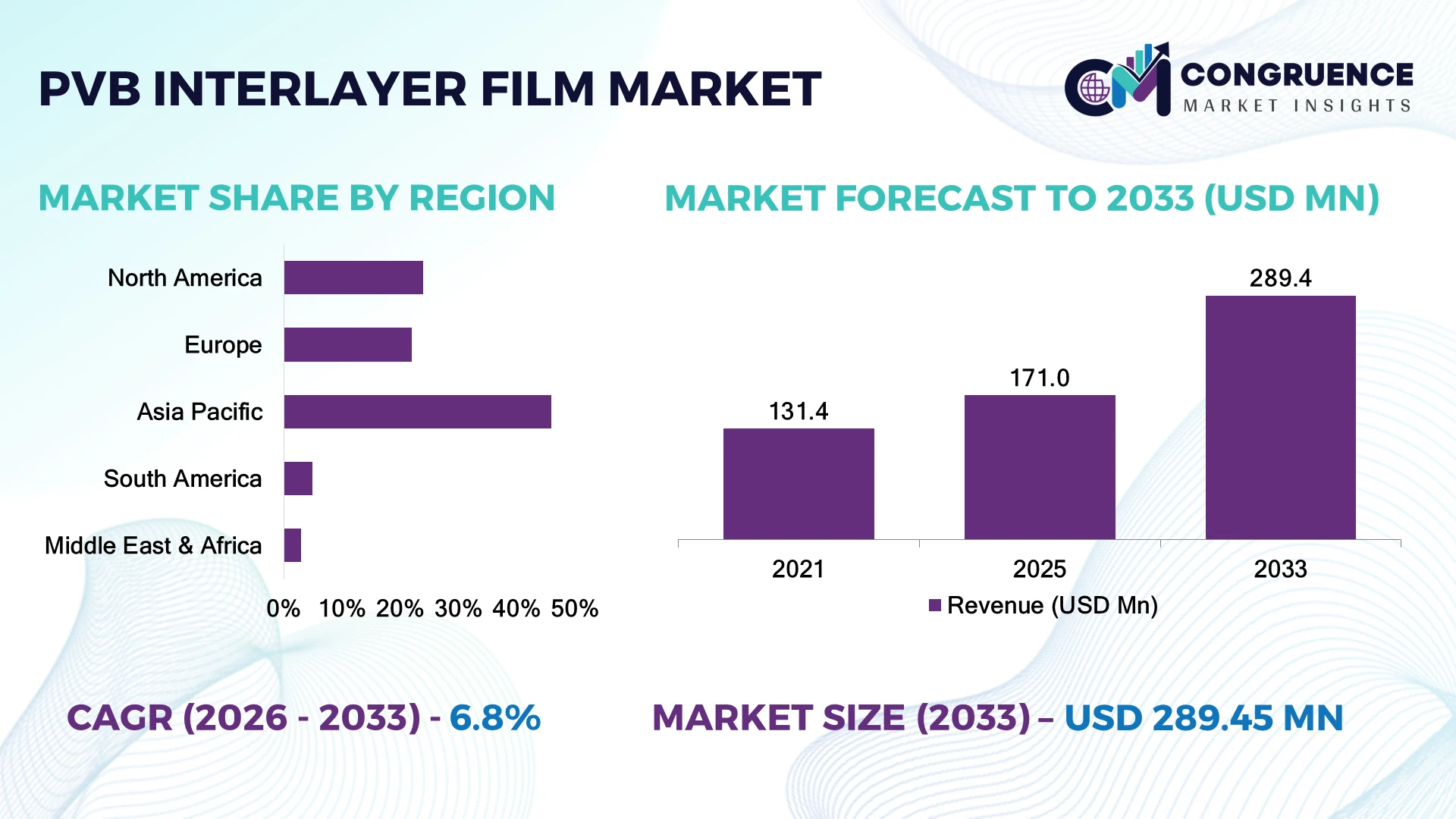
China dominates the market with an estimated 38% share of global PVB interlayer film production, supported by more than 45 million square meters of annual laminated glass capacity and continued investments in automotive and construction manufacturing. The country significantly outpaces Germany, which holds approximately 8% of production capacity but leads in advanced acoustic-glazing integration. Rapid deployment of high-performance glazing in EV platforms and large-scale infrastructure projects strengthens China's leadership, while trade diversification efforts following global supply-chain realignments continue to reshape procurement strategies.
Strategic implication companies with localized manufacturing, advanced acoustic-film portfolios, and automotive OEM partnerships are best positioned to capture long-term competitive advantage.
Market Size & Growth: USD 171.0 Million in 2025 reaching USD 289.4 Million by 2033, supported by advanced laminated glass adoption and EV production expansion.
Top Growth Drivers: Automotive laminated glass demand (+14%), energy-efficient building installations (+11%), and safety-regulation compliance adoption (+9%).
Short-Term Forecast: By 2028, manufacturing yield efficiency improves by 12% through automation and digital quality-control systems.
Emerging Technologies: AI-driven defect detection, multilayer acoustic interlayers, and advanced UV-resistant formulations improve performance and consistency.
Regional Leaders: Asia Pacific (~USD 118 Million), North America (~USD 56 Million), and Europe (~USD 49 Million) supported by EV, infrastructure, and sustainable-building adoption.
Consumer/End-User Trends: More than 65% of premium automotive windshields now utilize enhanced laminated safety-glass technologies.
Pilot/Case Example: In 2024, automated film-inspection deployment reduced production defects by approximately 18% in high-volume manufacturing facilities.
Competitive Landscape: Eastman holds roughly 22% share, alongside Kuraray, Sekisui Chemical, Everlam, and Chang Chun Group.
Regulatory & ESG Impact: Energy-efficient glazing solutions improve building thermal performance by up to 20% under evolving construction standards.
Investment & Funding: Over USD 450 Million in capacity expansion and technology investments supports regional manufacturing diversification.
Innovation & Future Outlook: High-performance acoustic films, smart-glass integration, and supply-chain regionalization are reshaping competitive positioning.
PVB interlayer films remain critical across automotive, architectural, and photovoltaic glass applications where impact resistance, sound insulation, and UV protection are essential. Recent innovation focuses on acoustic-performance optimization and enhanced optical clarity, while manufacturers integrate AI-enabled quality control systems. More than 30% of new premium building projects specify advanced laminated glazing solutions, supported by evolving safety regulations and regional supply-chain localization initiatives. This transition is creating new opportunities for differentiated product portfolios and strategic manufacturing investments.
The PVB interlayer film market is becoming strategically important as safety standards, infrastructure modernization programs, and electric vehicle production increasingly rely on high-performance laminated glass technologies. Industry participants are restructuring supply chains to reduce dependence on single-country sourcing while expanding localized production capabilities. This shift is strengthening resilience and improving procurement flexibility for automotive and architectural glass manufacturers.
Technology advancement is creating measurable operational benefits. Modern AI-enabled inspection systems improve defect detection accuracy by nearly 25% compared with conventional visual inspection methods while reducing material waste by approximately 15%. China leads in manufacturing scale and capacity deployment, whereas Germany and Japan maintain stronger positions in premium acoustic and specialty interlayer technologies. These differences are influencing partnership strategies and product differentiation across global markets.
Over the next two to three years, adoption of advanced acoustic and solar-control interlayers is expected to accelerate as vehicle manufacturers and commercial developers seek enhanced performance standards. Several producers are expanding regional manufacturing footprints and establishing technical partnerships with glass processors. Companies that combine localized production, advanced material innovation, and integrated customer support capabilities will strengthen competitive positioning and secure long-term relevance in increasingly performance-driven end-use markets.
The strongest growth catalyst is the rapid penetration of laminated safety glass across electric vehicles, commercial buildings, and transportation infrastructure. More than 70% of premium vehicle windshields now incorporate advanced laminated glazing systems, while energy-efficient building installations have increased by approximately 11% annually in key construction markets. Regulatory requirements for occupant protection and impact resistance continue to tighten in China, the United States, and the European Union. This creates direct demand for high-performance PVB interlayers capable of delivering acoustic insulation, UV protection, and structural integrity. In response, manufacturers are expanding production capacity, investing in multilayer formulations, and strengthening partnerships with automotive OEMs. A notable strategic insight is that suppliers offering integrated technical support and customized film specifications are securing higher-value contracts and improving long-term customer retention.
PVB interlayer film production remains vulnerable to feedstock volatility and energy-intensive manufacturing processes. Polyvinyl alcohol and plasticizer costs have experienced fluctuations exceeding 15% in recent years, while industrial electricity expenses increased by more than 10% across several manufacturing hubs. Supply-chain disruptions affecting specialty chemical inputs continue to create procurement uncertainty, particularly for producers with concentrated sourcing networks. These pressures directly impact operating margins and limit pricing flexibility for manufacturers serving highly competitive automotive and construction markets. To mitigate risks, companies are diversifying supplier bases, expanding regional sourcing arrangements, and negotiating long-term procurement contracts. A critical operational insight is that vertically integrated producers maintain stronger cost control and supply stability compared with manufacturers dependent on external raw-material suppliers.
Emerging opportunities are centered on next-generation glazing technologies that combine safety, acoustic performance, and energy efficiency. Smart-glass installations are expanding by approximately 12% annually, while demand for acoustic laminated glazing has increased by more than 18% within premium automotive segments. New interlayer formulations offering enhanced solar control and optical clarity are attracting interest from commercial building developers and mobility manufacturers. China and India are investing heavily in modern infrastructure projects where advanced glazing specifications are becoming standard. Companies are accelerating R&D programs, expanding specialty product portfolios, and forming ecosystem partnerships with glass processors and technology developers. A less obvious opportunity lies in photovoltaic glass applications, where advanced interlayers can improve durability and performance while supporting broader renewable-energy deployment objectives.
A major long-term challenge involves maintaining quality consistency while scaling advanced interlayer production for diverse end-use applications. Premium acoustic and optical-grade films often require defect rates below 1%, demanding sophisticated process control and skilled technical personnel. Manufacturing facilities implementing advanced automation report productivity gains exceeding 20%, yet workforce shortages and specialized engineering requirements continue to constrain expansion plans. Automotive customers also require rigorous qualification processes that can extend beyond 12 months before commercial deployment. These complexities affect production scalability, market responsiveness, and competitive differentiation. To overcome these barriers, companies are investing in digital manufacturing platforms, workforce development programs, and collaborative innovation partnerships. The most successful producers are building integrated quality-management ecosystems that support consistent performance across global manufacturing networks.
Acoustic Film Penetration Accelerates Premium vehicle manufacturers are increasing adoption of acoustic PVB interlayers as electric vehicle cabin-noise requirements become more stringent. Acoustic-film utilization has risen by nearly 18%, while premium windshield integration exceeds 65% in several vehicle platforms. Manufacturers in Germany and Japan are expanding specialty-film production lines and forming technical partnerships with automotive OEMs to improve passenger comfort and differentiate next-generation mobility offerings.
Localized Manufacturing Footprints Expand Supply-chain diversification remains a major operational shift following logistics disruptions and trade-policy uncertainty. More than 30% of large producers have increased regional sourcing initiatives, while localized procurement strategies have reduced lead times by approximately 12–15%. Companies are restructuring production networks, expanding facilities in India and Southeast Asia, and strengthening supplier ecosystems to improve resilience and reduce dependency on concentrated chemical feedstock sources.
Automated Quality Control Deployment AI-enabled inspection systems are becoming standard across high-volume lamination operations. Automated defect-detection accuracy has improved by roughly 25%, while material waste has declined by nearly 15% in digitally monitored production environments. Producers are integrating machine vision, predictive maintenance, and process analytics into manufacturing workflows, enabling faster qualification cycles and greater consistency for automotive and architectural-grade interlayer films.
High-Performance Glazing Specifications Rise Advanced solar-control, UV-resistant, and structural PVB formulations are gaining traction as building standards evolve. High-performance glazing specifications have increased by over 20% in commercial construction projects, while laminated façade adoption continues to expand across urban infrastructure developments. Companies are prioritizing specialty-product portfolios, investing in formulation innovation, and aligning with glass processors to support increasingly complex architectural and energy-efficiency requirements.
Standard PVB remains the leading segment, accounting for approximately 62% of global demand due to its extensive use in automotive windshields, building façades, and commercial laminated glass applications. Its dominance is supported by established processing infrastructure, cost efficiency, and compatibility with high-volume manufacturing operations. Large glass processors continue prioritizing standard-grade films because they offer reliable adhesion, optical clarity, and impact resistance while supporting scalable production. Acoustic PVB and colored PVB maintain strong relevance in premium automotive and architectural projects where performance differentiation increasingly influences purchasing decisions. Structural and high-performance PVB grades represent the fastest-growing segment, with adoption increasing by nearly 14% as electric vehicles and advanced building envelopes require enhanced safety, durability, and sound insulation. Specialty films now account for more than 22% of premium glazing installations. Manufacturers are expanding advanced formulation portfolios, increasing R&D spending, and collaborating with OEMs to develop customized solutions. Investment priorities are gradually shifting from volume-focused production toward performance-driven products that command higher margins and stronger customer retention.
Automotive applications hold the largest share of the PVB interlayer film market at approximately 55%, supported by widespread use in windshields, panoramic roofs, and side glazing systems. Vehicle manufacturers increasingly specify laminated glass to improve occupant safety, reduce cabin noise, and enhance UV protection. The transition toward electric vehicles is further strengthening demand, as quieter cabins make acoustic-glazing performance more important. Architectural glazing remains a mature and strategically important application, particularly in commercial towers, public infrastructure, and energy-efficient buildings where safety compliance and thermal performance are key procurement priorities. Architectural applications represent the fastest-growing segment, with adoption increasing by roughly 13% as governments and developers prioritize sustainable construction and advanced façade systems. Solar and specialty glazing applications are also expanding, particularly in large infrastructure projects. More than 35% of new commercial developments now include advanced laminated glass specifications. Companies are increasing production flexibility, automating lamination processes, and strengthening partnerships with glass fabricators to support evolving performance requirements. Demand is becoming increasingly operationally critical in projects where safety, energy efficiency, and durability are evaluated together.
The construction industry represents the largest end-user segment, accounting for approximately 48% of total demand. Large-scale deployment across commercial buildings, transportation terminals, public infrastructure, and high-rise developments continues to drive purchasing volumes. Safety regulations, urban redevelopment programs, and energy-efficiency standards are increasing reliance on laminated glazing systems. Building developers increasingly prioritize interlayer performance to improve impact resistance, occupant protection, and acoustic insulation. The automotive industry follows closely, supported by rising vehicle production and growing adoption of advanced glazing technologies. Automotive manufacturers constitute the fastest-growing end-user group, with demand expanding by nearly 15% as electric vehicle production accelerates and premium glazing features become standard across more vehicle categories. Infrastructure and transportation operators are also increasing procurement activity, particularly for rail systems, airports, and public facilities. More than 40% of recent automotive glazing investments have focused on enhanced acoustic and safety performance. Manufacturers are targeting these buyers through customized product portfolios, long-term supply agreements, and joint development programs. Future demand is increasingly shifting toward end users requiring multifunctional glazing solutions that combine safety, comfort, and energy-performance benefits.
Asia-Pacific accounted for the largest market share at 46% in 2025 however, Middle East & Africa is expected to register the fastest growth, expanding at a CAGR of 7.8% between 2026 and 2033.

North America accounted for approximately 24% of the global PVB interlayer film market in 2025, supported by strong automotive manufacturing activity, advanced building standards, and growing deployment of acoustic laminated glass. The United States and Mexico remain key production centers for automotive glazing systems, while commercial construction projects increasingly specify high-performance laminated glass for safety and energy-efficiency objectives. More than 65% of premium vehicle platforms in the region incorporate laminated glazing beyond standard windshield applications. Manufacturers are expanding automation across film-processing operations to improve quality consistency and reduce material losses. Strategic partnerships between glass processors and automotive OEMs continue to strengthen localized supply chains, while investments in advanced acoustic and solar-control interlayer technologies are supporting product differentiation across transportation and infrastructure applications.
United States Market Outlook: The United States remains the most influential market due to its extensive automotive production base, advanced commercial construction sector, and stringent safety standards. Large-scale investments in transportation modernization and energy-efficient building development continue to increase laminated glass deployment. More than 70% of newly constructed Class-A commercial buildings utilize advanced glazing systems incorporating safety interlayers. Domestic manufacturers are prioritizing automation, localized sourcing strategies, and next-generation acoustic film technologies to strengthen operational competitiveness and reduce supply-chain exposure.
Europe represented approximately 22% of global demand, supported by advanced automotive engineering, strict building-performance regulations, and widespread adoption of energy-efficient construction materials. Regulatory emphasis on occupant safety and sustainable infrastructure is accelerating deployment of laminated glazing systems across commercial and residential developments. Automotive manufacturers continue integrating acoustic and UV-resistant glazing technologies to improve passenger comfort and vehicle efficiency. Several manufacturers have expanded specialty-film production capabilities, while new investments in low-emission manufacturing processes support sustainability objectives. The region also benefits from strong collaboration between material suppliers, glass processors, and automotive OEMs, enabling rapid commercialization of advanced interlayer solutions tailored to evolving regulatory requirements and premium product segments.
Germany Market Outlook: Germany serves as the region’s strategic center for automotive glazing innovation and advanced materials engineering. The country maintains a strong concentration of premium vehicle manufacturers and specialty glass processors that drive demand for high-performance interlayer technologies. Nearly 60% of premium automotive glazing projects incorporate enhanced acoustic solutions. Manufacturers continue investing in research programs focused on lightweight glazing, improved sound insulation, and advanced safety applications, reinforcing Germany’s position as a technology leader within the European laminated glass ecosystem.
Asia-Pacific dominates the global market with approximately 46% share, supported by extensive glass manufacturing capacity, rapid urbanization, and large-scale automotive production. China, India, Japan, and South Korea collectively account for a significant portion of global laminated glass output. Infrastructure modernization programs and growing electric vehicle manufacturing continue to increase demand for advanced PVB interlayer solutions. More than 50% of new high-rise commercial developments in major metropolitan centers incorporate laminated safety glazing systems. Manufacturers are expanding production facilities, increasing vertical integration, and improving process automation to meet growing requirements from automotive and construction customers. The region also benefits from strong export activity and cost-efficient manufacturing ecosystems that support global supply-chain participation.
China Market Outlook: China remains the largest individual market due to its dominant laminated glass manufacturing base and extensive automotive production network. The country accounts for an estimated 38% of global PVB interlayer film production capacity and continues investing in advanced glazing technologies for electric vehicles and large-scale infrastructure projects. Rapid deployment of smart-city developments and transportation infrastructure further supports demand. Domestic manufacturers are expanding specialty-film portfolios and strengthening technology capabilities to move beyond volume leadership toward higher-value performance-focused applications.
South America accounts for approximately 5% of global market demand, with growth supported by transportation infrastructure projects, commercial construction activity, and gradual modernization of automotive manufacturing capabilities. Laminated safety glass adoption continues to increase as building codes evolve and developers prioritize occupant protection standards. Regional automotive assemblers are also incorporating higher-performance glazing technologies into newer vehicle platforms. Infrastructure investment programs in urban transportation systems and commercial developments are generating additional demand for advanced interlayer products. While supply-chain constraints and limited local specialty-material production remain challenges, manufacturers are strengthening regional distribution networks and increasing technical support capabilities to improve market penetration and customer engagement.
Brazil Market Outlook: Brazil is the largest market in South America due to its sizable automotive industry, construction sector, and industrial manufacturing base. The country accounts for more than 45% of regional vehicle production and remains a key destination for glazing-related investments. Demand is increasingly concentrated in commercial buildings and transportation infrastructure projects where laminated safety glass specifications are expanding. Local processors are improving production efficiency and establishing strategic partnerships with international material suppliers to enhance product availability and technical expertise.
Middle East & Africa represented approximately 3% of global demand in 2025 but is experiencing rapid transformation driven by infrastructure expansion, urban development projects, and modernization initiatives. Large-scale commercial complexes, airports, transportation corridors, and tourism-related developments are increasing demand for laminated safety glass systems. High-performance glazing is increasingly specified for premium architectural projects due to its durability, safety, and environmental performance benefits. Several regional projects have incorporated advanced façade systems featuring laminated glass technologies to improve energy management and structural resilience. Manufacturers are strengthening regional distribution networks, establishing strategic partnerships, and expanding technical service capabilities to support increasingly complex project requirements across emerging construction markets.
Saudi Arabia Market Outlook: Saudi Arabia leads the regional market through extensive infrastructure investment, large-scale urban development programs, and ambitious construction activity. Major economic diversification initiatives continue to drive deployment of advanced building materials across commercial, transportation, and tourism projects. More than 40% of newly announced large-scale construction developments include high-performance façade specifications emphasizing safety and energy efficiency. Market participants are expanding local partnerships, strengthening project support capabilities, and increasing product customization efforts to align with evolving infrastructure and architectural requirements.
The competitive landscape is led by global interlayer specialists including Kuraray, Eastman, Sekisui Chemical, Everlam, and Chang Chun Group, which collectively control approximately 72% of global market activity. Competition primarily occurs between technology-driven global leaders and cost-focused regional manufacturers, while automotive-grade suppliers compete directly for OEM qualification programs and long-term glazing contracts. Performance differentiation has become increasingly important, with acoustic and specialty interlayers growing more than 15% faster than standard-grade products. Automated inspection systems improve defect detection by nearly 25%, making manufacturing consistency a critical competitive factor. Companies are competing through capacity expansion, product innovation, vertical integration, and strategic partnerships with glass processors and automotive manufacturers. Supply-chain localization has emerged as a key battleground as firms seek to reduce lead times by 10–15% and strengthen regional responsiveness. Rising technical certification requirements and customer qualification cycles create significant entry barriers. Winning requires advanced formulation expertise, scalable manufacturing, reliable supply networks, and strong OEM relationships.
Eastman Chemical Company
Sekisui Chemical Co., Ltd.
Everlam NV
Chang Chun Group
Kingboard Holdings Limited
Zhejiang Decent Plastic Co., Ltd.
Huakai Plastic (Chongqing) Co., Ltd.
Jiangxi Rongxin New Materials Co., Ltd.
Rehone Plastic Co., Ltd.
Tiantai Kanglai Industrial Co., Ltd.
Weifang Liyang New Material Co., Ltd.
Advanced acoustic interlayer technology is becoming a primary differentiator across automotive and architectural applications. New-generation acoustic PVB films reduce cabin and environmental noise by up to 30% compared with conventional laminated-glass configurations. More than 65% of premium vehicle glazing programs now incorporate enhanced acoustic interlayers. Manufacturers benefit through stronger product differentiation, higher-value contracts, and improved compliance with evolving comfort and safety requirements.
Digital manufacturing technologies are transforming production efficiency. AI-enabled inspection systems improve defect-detection accuracy by approximately 25% while reducing material waste by nearly 15%. Compared with traditional manual inspection workflows, automated quality-control platforms shorten qualification cycles and improve consistency across high-volume manufacturing lines. Adoption levels continue to increase among large-scale producers seeking greater operational control and lower production variability. Companies with advanced automation capabilities gain a measurable competitive advantage in premium automotive and specialty architectural segments.
Disruptive innovation is increasingly centered on low-carbon, solar-control, and multifunctional interlayer technologies. New formulations reduce embodied carbon by up to 33% while maintaining safety performance and optical clarity. Smart-glass integration and advanced solar-management films are expected to see broader deployment between 2026 and 2028 as sustainability requirements strengthen. Technology leaders capable of combining acoustic performance, energy efficiency, and digital manufacturing capabilities will capture the strongest strategic positioning in next-generation glazing markets.
November 2024 – Eastman announced an expansion of its interlayer extrusion capabilities in Ghent, Belgium, to strengthen regional supply for Saflex™ PVB products. The project supports future automotive and architectural demand and is scheduled for completion by 2026, enhancing European production flexibility and customer responsiveness. Source: www.eastman.com
November 2024 – Eastman launched Saflex Evoca™ RSL, a rigid acoustic PVB interlayer designed for electric vehicle sidelites. The solution improves acoustic performance while supporting lightweight frameless door designs, helping OEMs optimize vehicle comfort and design flexibility in next-generation EV platforms. Source: www.saflex-vanceva.eastman.com
October 2024 – Eastman introduced Saflex LiteCarbon™ Clear, a lower-carbon PVB interlayer for architectural glazing. The product delivers a 33% reduction in carbon footprint versus conventional alternatives, supporting sustainable building targets while maintaining laminated-glass performance and processing compatibility. Source: www.saflex-vanceva.eastman.com
April 2026 – Kuraray implemented a global 10% price increase for Trosifol® PVB interlayers following sustained increases in raw materials, logistics, packaging, and energy costs. The move highlights ongoing supply-chain pressures and reinforces the industry's focus on maintaining reliable supply and technical service capabilities. Source: www.kuraray.eu
This report provides a comprehensive assessment of the global PVB interlayer film market across major product categories, applications, end-user industries, and regional markets. Coverage includes standard, acoustic, colored, and specialty interlayer technologies used in automotive glazing, architectural glass, infrastructure projects, transportation systems, and emerging high-performance applications. The analysis evaluates adoption patterns, manufacturing trends, deployment priorities, and competitive positioning across North America, Europe, Asia-Pacific, South America, and the Middle East & Africa.
The study examines operational developments influencing more than 90% of current market activity, including advanced glazing technologies, automation adoption, supply-chain localization, and sustainability-focused product innovation. It provides strategic insights into customer demand shifts, enterprise investment priorities, manufacturing expansion plans, and technology differentiation strategies. The report supports business decision-making related to market entry, capacity planning, partnership development, geographic expansion, competitive benchmarking, and long-term positioning across evolving automotive, construction, and specialty glazing ecosystems between 2026 and 2033.
| Report Attribute / Metric | Details |
|---|---|
| Market Revenue (2025) | USD 171.0 Million |
| Market Revenue (2033) | USD 289.4 Million |
| CAGR (2026–2033) | 6.8% |
| Base Year | 2025 |
| Forecast Period | 2026–2033 |
| Historic Period | 2021–2025 |
| Segments Covered |
By Type
By Application
By End-User
|
| Key Deliverables | Revenue Forecast; Market Trends; Growth Drivers & Restraints; Technology Insights; Segmentation Analysis; Regional Insights; Competitive Landscape; Regulatory & ESG Overview; Recent Developments |
| Regions Covered | North America; Europe; Asia-Pacific; South America; Middle East & Africa |
| Companies Profiled | Kuraray Co., Ltd.; Eastman Chemical Company; Sekisui Chemical Co., Ltd.; Everlam NV; Chang Chun Group; Kingboard Holdings Limited; Zhejiang Decent Plastic Co., Ltd.; Huakai Plastic (Chongqing) Co., Ltd.; Jiangxi Rongxin New Materials Co., Ltd.; Rehone Plastic Co., Ltd.; Tiantai Kanglai Industrial Co., Ltd.; Weifang Liyang New Material Co., Ltd. |
| Customization & Pricing | Available on Request (10% Customization Free) |




