
Reports
The Global PVB Dispersions Market was valued at USD 2,452.7 Million in 2025 and is anticipated to reach a value of USD 3,998.6 Million by 2033 expanding at a CAGR of 6.3% between 2026 and 2033. Growth is driven by rising adoption of high-performance PVB coatings in automotive glazing, architectural laminates, and advanced protective applications requiring improved adhesion, durability, and optical performance.
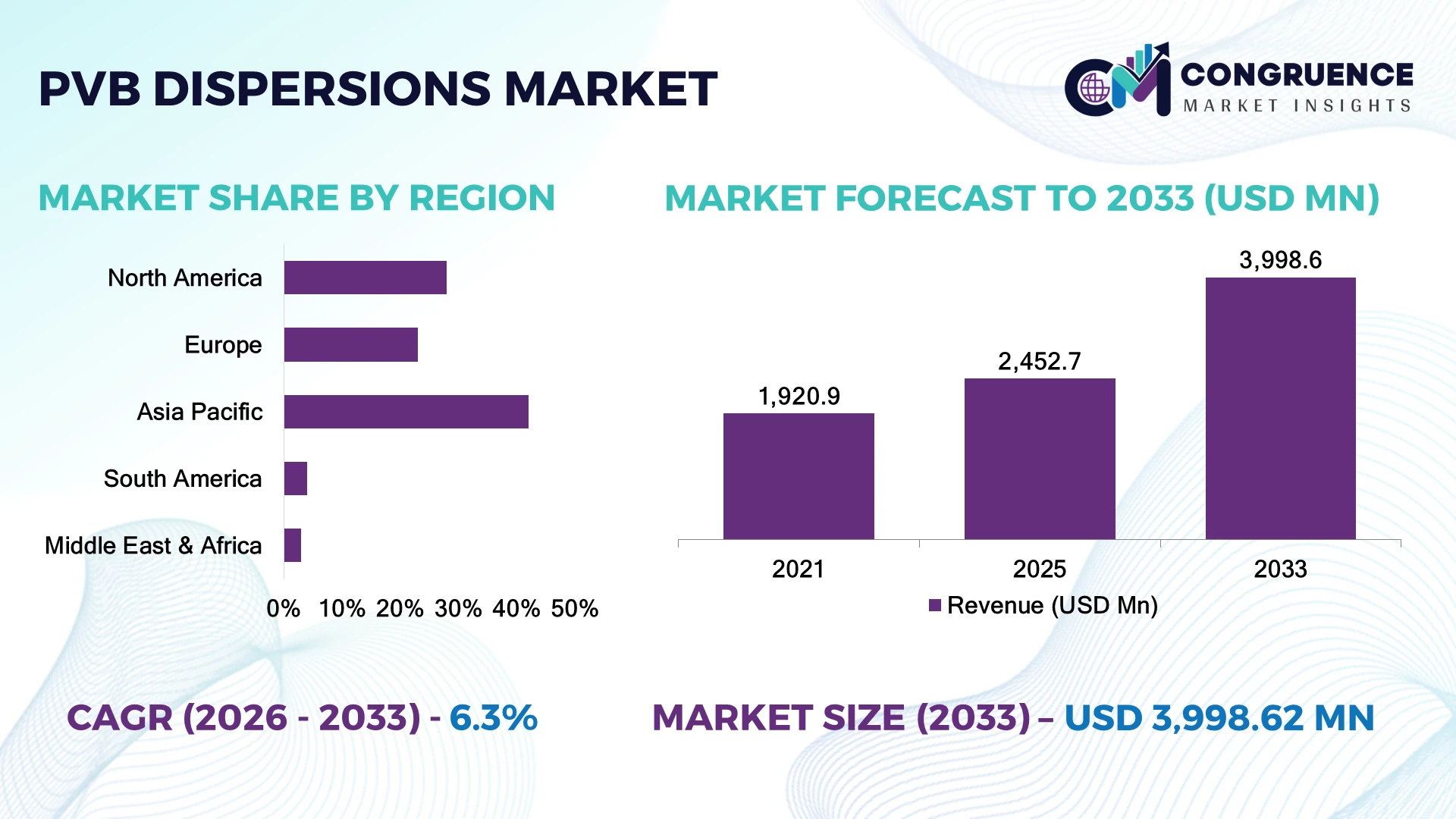
China dominates the PVB dispersions landscape with nearly 32% market share, supported by automotive glass production exceeding 30 million vehicles annually and expanding specialty chemical capacity. The United States follows with strong aerospace, construction, and safety-glass applications, while Germany maintains technology leadership through premium automotive manufacturing. China’s production scale is over 20% higher than Europe’s, creating competitive advantages in cost optimization and supply-chain resilience.
Strategic decisions increasingly focus on localized manufacturing, advanced formulation development, and partnerships across high-growth application sectors.
Market Size & Growth: USD 2,452.7 Million in 2025 to USD 3,998.6 Million by 2033 at 6.3% CAGR, supported by advanced coating adoption in automotive and construction industries.
Top Growth Drivers: Automotive glazing expansion (35%), architectural safety glass demand (28%), specialty coating innovation (22%).
Short-Term Forecast: By 2028, automated dispersion processing improves production efficiency by 15% and reduces material waste by 10%.
Emerging Technologies: AI-based formulation optimization, nano-enhanced PVB materials, and automated quality-control systems reshape production.
Regional Leaders: Asia-Pacific projected at USD 1,900 Million with automotive expansion; North America at USD 900 Million with aerospace adoption; Europe at USD 850 Million with sustainable materials focus.
Consumer/End-User Trends: Over 45% of premium vehicle manufacturers integrate advanced laminated glass solutions using PVB-based technologies.
Pilot/Case Example: 2024 automotive coating modernization projects achieved 18% reduction in production defects through digital process monitoring.
Competitive Landscape: Eastman leads with approximately 25% share, followed by Kuraray, Sekisui Chemical, Solutia, and Chang Chun Group.
Regulatory & ESG Impact: Green manufacturing initiatives reduce solvent emissions by nearly 20% across advanced polymer production facilities.
Investment & Funding: More than USD 500 Million invested in specialty polymer capacity expansion and regional chemical supply-chain localization.
Innovation & Future Outlook: Next-generation bio-based PVB formulations and recyclable laminated materials accelerate strategic industry transformation.
PVB dispersions are increasingly critical across automotive, construction, electronics, and specialty coating industries due to their superior bonding performance, transparency, and resistance characteristics. Demand is expanding as manufacturers prioritize lightweight materials, safety standards, and sustainable production methods. Approximately 40% of new product development initiatives focus on improving formulation efficiency, while supply-chain restructuring after global logistics disruptions has encouraged localized chemical production strategies. The market is transitioning toward advanced materials designed for energy-efficient buildings, electric vehicles, and high-performance industrial applications.
The PVB Dispersions Market is becoming strategically important as industries prioritize lightweight safety materials, advanced coatings, and localized chemical supply networks. Automotive manufacturers are accelerating adoption of laminated glass technologies as electric vehicle platforms demand improved acoustic insulation, impact resistance, and weight efficiency. Supply-chain restructuring following global disruptions has encouraged companies to establish regional production hubs and strengthen raw material partnerships.
Advanced automated dispersion systems deliver measurable advantages compared with conventional processing, improving formulation consistency by approximately 20% while reducing production losses by nearly 12%. Japan and Germany emphasize precision-driven applications in automotive and industrial sectors, whereas China focuses on high-volume manufacturing and capacity expansion. The next two to three years will see stronger adoption of digital quality monitoring, sustainable formulations, and integrated polymer solutions.
Companies are expanding through technology partnerships, specialty chemical investments, and regional manufacturing initiatives. For example, automotive glass suppliers are collaborating with polymer producers to develop enhanced PVB solutions for electric mobility applications. Competitive positioning will depend on formulation innovation, supply-chain reliability, and the ability to deliver sustainable, high-performance materials across evolving industrial ecosystems.
Rising demand for advanced laminated glass is the primary growth catalyst, with automotive applications accounting for nearly 45% of PVB dispersion consumption. Electric vehicle manufacturers increasingly require acoustic and impact-resistant glazing solutions, improving demand for specialized polymer formulations. China’s expanding electric vehicle production ecosystem and Europe’s stricter vehicle safety regulations are accelerating adoption. Companies are responding through expanded polymer research programs, manufacturing upgrades, and partnerships with automotive glass producers. The shift toward lightweight vehicle design creates a strategic opportunity for suppliers offering high-performance PVB dispersions with improved transparency, adhesion, and durability.
Dependence on petrochemical-derived inputs creates cost pressure, with raw material fluctuations impacting approximately 15–20% of production expenses. Global chemical supply disruptions and energy-price instability continue affecting manufacturers in Europe and Asia. Smaller producers face challenges maintaining margins due to limited procurement power and regional supply dependencies. Companies are reducing exposure through supplier diversification, long-term contracts, and localized sourcing strategies. The key operational challenge remains balancing cost control with consistent quality requirements demanded by automotive and architectural customers.
Growing demand for environmentally responsible materials creates opportunities for bio-based and recyclable PVB formulations, with sustainable product initiatives increasing by more than 25% among specialty chemical manufacturers. Green building regulations in Europe and energy-efficient construction programs in Asia are encouraging adoption of advanced laminated materials. Companies are investing in R&D collaborations, recycling technologies, and low-emission production processes. A significant opportunity lies in developing circular PVB solutions for automotive glass recovery systems, enabling manufacturers to reduce waste while improving environmental compliance.
Maintaining consistent dispersion quality at industrial scale remains a major challenge, with formulation variability affecting approximately 10–15% of production efficiency. Advanced applications require tighter particle-size control, improved compatibility, and automated monitoring systems. Manufacturers in the United States, Germany, and Japan face increasing pressure to integrate smart production technologies while controlling operational costs. Companies must invest in digital manufacturing platforms, workforce training, and process optimization partnerships. Long-term competitiveness depends on achieving scalable production without compromising performance standards or sustainability objectives.
Sustainable Formulation Shift Manufacturers are increasing development of low-emission and recyclable PVB dispersion formulations, with sustainability-focused product launches rising by around 25% since 2025. European regulatory pressure on chemical emissions and circular material targets is accelerating adoption of greener polymer systems. Companies are expanding bio-based research programs, improving solvent-reduction processes by nearly 15%, and forming partnerships to meet automotive and construction sustainability requirements.
Digital Production Optimization Advanced monitoring and automated formulation systems are transforming PVB dispersion manufacturing, with smart process adoption improving quality consistency by approximately 20% and reducing production errors by 10–12%. Chemical producers in Germany, Japan, and the United States are deploying AI-assisted analytics and automated inspection workflows. This operational shift enables faster product customization, lower waste generation, and improved scalability for specialty applications.
Localized Supply Networks Global supply-chain disruptions have pushed polymer producers to restructure sourcing strategies, with regional raw material localization initiatives increasing by more than 30% among major manufacturers. China, India, and Southeast Asian chemical hubs are expanding domestic production capabilities to reduce dependency risks. Companies are strengthening supplier agreements, adding regional inventory capacity, and improving logistics resilience for automotive and industrial customers.
High-Performance Material Development Demand is shifting toward advanced PVB dispersions with improved adhesion, optical clarity, and durability, with premium formulations representing nearly 35% of new product development activity. Electric vehicle growth and architectural safety requirements are driving this transition. Companies are investing in nanotechnology-enhanced polymers, application-specific coatings, and collaborative development programs with glass manufacturers to improve performance advantages.
Based on type, water-based PVB dispersions represent the leading segment, accounting for approximately 55% of market adoption due to easier processing, lower environmental impact, and compatibility with automotive and architectural coatings. Their scalability and reduced handling complexity make them preferred among large industrial users. Solvent-based PVB dispersions maintain relevance in specialized applications requiring stronger bonding performance, while modified PVB formulations are emerging rapidly with nearly 20% adoption growth due to demand for enhanced durability and customized performance characteristics. The fastest-growing segment is modified PVB dispersions, supported by rising demand for high-performance materials in electric vehicles, smart glass, and advanced protective coatings. Companies are increasing R&D investment, expanding specialty production lines, and developing application-specific solutions. Mature water-based systems continue receiving process optimization investments, while emerging formulations are attracting partnerships focused on sustainability and advanced material performance.
Automotive glazing is the leading application segment, representing approximately 50% of PVB dispersion demand due to increasing use of laminated safety glass, acoustic insulation systems, and lightweight vehicle designs. Construction glass applications follow with around 30% share, supported by infrastructure modernization and energy-efficient building standards. The fastest-growing application is smart and specialty glass, expanding by nearly 18% as manufacturers integrate advanced optical and functional materials. Industrial coatings and protective applications continue developing through specialized requirements for durability and chemical resistance. Automotive manufacturers are increasing collaboration with polymer suppliers to improve glass performance, while construction companies are adopting advanced laminated solutions for safety compliance. Demand is shifting from standard formulations toward customized dispersions capable of meeting stricter performance requirements across emerging applications.
Automotive manufacturers represent the dominant end-user group, accounting for approximately 45% of consumption due to large-scale demand for laminated windshields, acoustic glass, and electric vehicle glazing systems. Glass processors and construction companies collectively contribute nearly 40% of market utilization, supported by infrastructure upgrades and safety regulations. The fastest-growing end-user segment is electric vehicle manufacturers, with adoption expanding by around 22% as EV producers prioritize lightweight and high-performance glazing materials. Traditional automotive suppliers continue focusing on volume efficiency, while emerging EV manufacturers demand customized solutions with improved insulation and durability characteristics. Construction companies are increasing partnerships with material suppliers to support smart building projects. Companies are targeting end-users through technical collaborations, localized production, and application-specific product portfolios to strengthen long-term customer relationships.
Asia-Pacific accounted for the largest market share at 42% in 2025 however, North America is expected to register the fastest growth, expanding at a CAGR of 7.1% between 2026 and 2033.
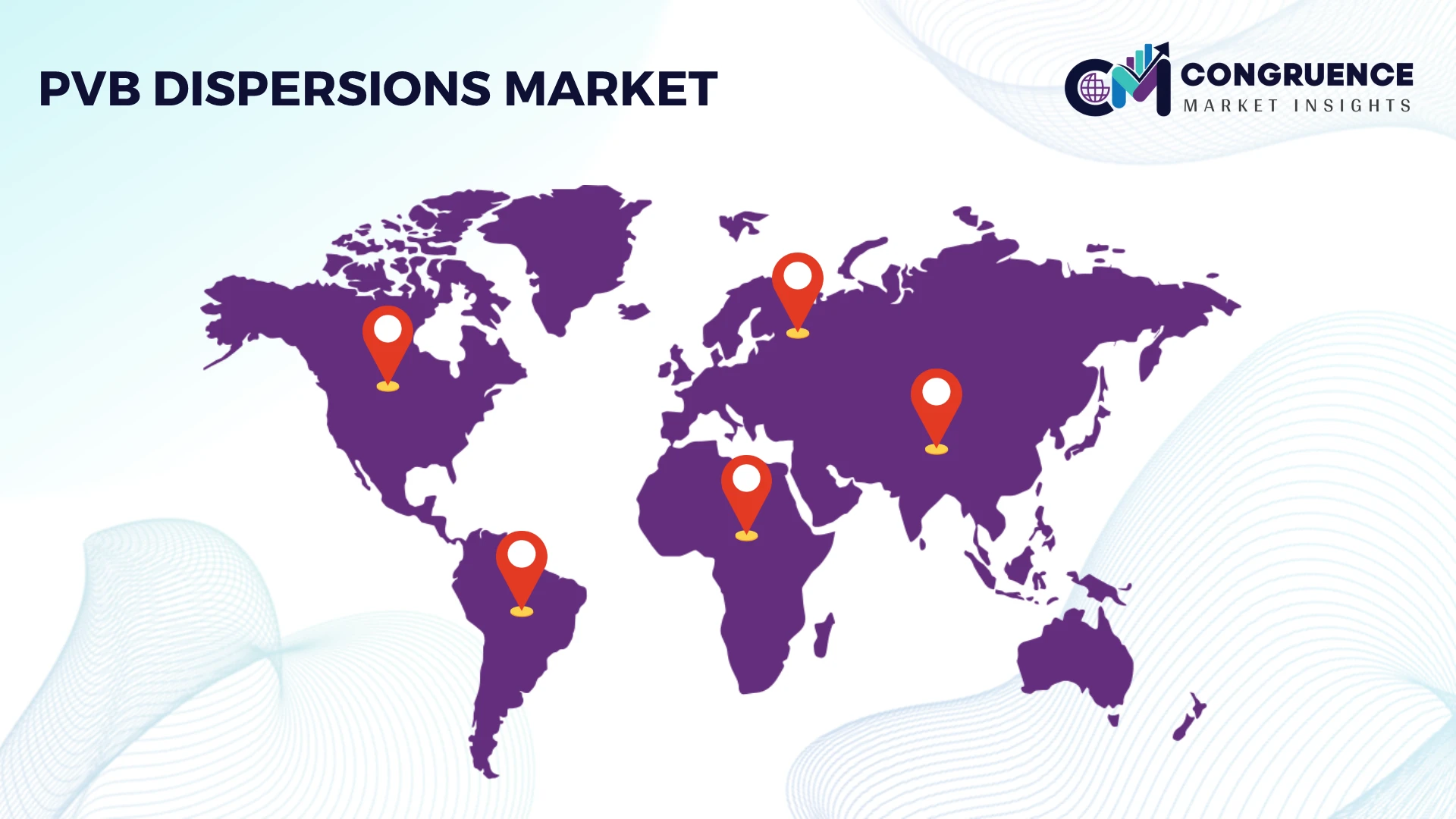
North America holds approximately 28% of the global PVB dispersions market, supported by strong automotive manufacturing, aerospace applications, and architectural safety glass demand. The United States contributes the majority of regional consumption through electric vehicle production, premium glazing solutions, and specialty coating applications. More than 35% of new vehicle glazing developments in advanced automotive segments incorporate enhanced laminated glass technologies. Manufacturers are expanding specialty polymer capacity, improving automated formulation processes, and developing partnerships with glass producers to strengthen supply reliability and application-specific solutions.
United States Market Outlook: The United States remains the dominant country within North America due to its advanced automotive ecosystem, construction activity, and specialty chemical production capabilities. Over 40% of premium vehicle platforms utilize advanced glazing systems, encouraging suppliers to increase localized production, invest in material innovation, and establish long-term partnerships with automotive and construction companies.
Europe accounts for nearly 23% of global PVB dispersions demand, driven by automotive manufacturing strength, sustainable construction practices, and strict material safety regulations. Germany, France, and Italy represent key consumption centers due to established glass-processing and polymer industries. More than 30% of new commercial building projects prioritize energy-efficient glazing solutions, increasing demand for high-performance laminated materials. Companies are focusing on recyclable formulations, lower-emission production methods, and regional manufacturing investments to align with European sustainability objectives and evolving construction standards.
Germany Market Outlook: Germany leads Europe through its automotive engineering capabilities, premium vehicle production, and advanced material research infrastructure. The country’s automotive sector generates strong demand for safety and acoustic glazing solutions, with more than 50% of premium vehicles integrating advanced glass technologies. Manufacturers are strengthening collaboration with polymer suppliers to improve durability and sustainability performance.
Asia-Pacific dominates the PVB dispersions market with approximately 42% share, supported by large-scale automotive production, expanding construction activity, and strong chemical manufacturing capacity. China, Japan, South Korea, and India are major contributors, with China producing more than 30 million vehicles annually and maintaining a significant glass-processing ecosystem. Rising electric vehicle adoption and smart infrastructure development are accelerating demand for advanced polymer materials. Companies are expanding production facilities, improving supply-chain integration, and introducing customized dispersion solutions to serve automotive, construction, and industrial applications.
China Market Outlook: China represents the largest country-level market due to its automotive manufacturing scale, domestic chemical production, and extensive industrial supply network. The country contributes over 30% of global vehicle output, supporting continuous demand for laminated safety glass materials. Producers are increasing capacity expansion and technology partnerships to improve cost efficiency and support next-generation mobility applications.
South America contributes approximately 4% of global PVB dispersions demand, with Brazil accounting for the majority of regional consumption. Market development is supported by automotive manufacturing, commercial infrastructure projects, and increasing adoption of safety glass applications. Brazil’s vehicle production exceeds 2 million units annually, creating steady demand for laminated glazing materials. However, reliance on imported specialty chemicals affects supply flexibility and cost management. Companies are strengthening distributor networks, improving inventory planning, and developing regional partnerships to enhance availability and reduce logistics-related challenges.
Brazil Market Outlook: Brazil remains the leading South American market due to its automotive assembly capabilities, construction sector activity, and industrial infrastructure. The country’s manufacturing base supports demand for advanced glazing materials, while suppliers are expanding partnerships with glass processors and distributors to improve regional access and support growing commercial projects.
Middle East & Africa represents approximately 3% of global PVB dispersions demand, supported by commercial construction, urban development, and infrastructure modernization projects. Saudi Arabia, the United Arab Emirates, and South Africa are key markets where premium buildings increasingly adopt advanced glazing technologies. More than 25% of new high-end commercial developments in major Gulf cities incorporate advanced glass systems for safety and energy efficiency. Companies are improving regional distribution capabilities, forming construction partnerships, and expanding technical support networks to capture demand from large-scale infrastructure initiatives.
Saudi Arabia Market Outlook: Saudi Arabia is emerging as the most strategically important market in the region due to large infrastructure programs, smart city development, and commercial construction expansion. Vision 2030 projects are accelerating adoption of modern building materials, including laminated glass technologies. Suppliers are strengthening local partnerships and distribution channels to support growing demand from urban development initiatives.
The PVB dispersions market features global leaders Eastman, Kuraray, and Sekisui competing with regional producers such as Chang Chun Group and Chinese specialty polymer manufacturers. Global suppliers compete through advanced formulations, while regional players focus on cost efficiency and localized supply. The top five companies collectively control approximately 65% of market influence. Competition centers on technology differentiation, with premium formulations improving durability by 15–20%, while optimized production systems reduce processing costs by nearly 10%. Players are expanding manufacturing capacity, forming automotive glass partnerships, and integrating upstream polymer supply chains to secure raw materials. The market is shifting toward sustainable formulations, customized solutions, and regional supply control following logistics disruptions. Entry barriers remain high due to formulation expertise, quality certifications, and automotive qualification requirements. Winning companies must combine innovation, reliable supply networks, and application-specific customization to outperform established global and regional competitors.
Kuraray Co., Ltd.
Sekisui Chemical Co., Ltd.
Chang Chun Group
Everlam
Kingboard Holdings Limited
Zhejiang Decent Plastic Co., Ltd.
Huakai Plastic
Tangshan Jichang New Material Co., Ltd.
Wuhan Honghui New Material Co., Ltd.
Weifang Liyang New Material Co., Ltd.
Zhejiang Pulijin Plastic Co., Ltd.
Advanced formulation technologies are reshaping PVB dispersions through improved molecular design, nano-enhanced additives, and automated quality monitoring. AI-assisted formulation analysis reduces development cycles by approximately 20%, while digital process control improves production consistency by nearly 15%. Leading suppliers are integrating predictive analytics with polymer processing to deliver customized solutions faster.
Sustainable technologies are gaining importance as manufacturers shift from conventional solvent-intensive processes toward lower-emission and recyclable material systems. New-generation formulations improve environmental performance by around 25% compared with older approaches. Water-based dispersion technologies are expanding adoption across automotive and architectural applications because they provide improved handling efficiency and reduced processing complexity.
Between 2026 and 2028, competitive advantage will increasingly depend on smart manufacturing, circular material development, and application-specific engineering. Companies investing in automated production platforms and advanced polymer research will benefit from faster customization, improved quality control, and stronger customer retention. Technology leaders serving electric vehicle manufacturers and premium construction projects are positioned to capture demand through higher-performance materials and integrated supply solutions.
June 2025 Kuraray expanded production facilities for optical-use Poval film at its Saijo Plant in Japan, adding 38 million square meters annually and increasing total capacity from 296 million to 334 million square meters. The expansion strengthens specialty polymer supply capabilities. Source: www.kuraray.com
October 2024 Sekisui Chemical revised S-LEC PVB interlayer film pricing globally, implementing a 6–15% adjustment due to rising production pressures. The move reflected supply-chain cost management and protected availability for laminated glass customers. Source: www.sekisuichemical.com
June 2025 Kuraray conducted a strategic management briefing focused on PVOH resin growth opportunities, highlighting expansion of high-performance vinyl acetate chain applications supporting PVB-related material development. The initiative strengthens specialty chemical innovation priorities. Source: www.kuraray.com
April 2025 Kuraray announced PVOH resin price revisions across global markets, including USD 220 per ton increases in several regions. The adjustment reflected input-cost pressures and reinforced supply-chain optimization strategies.
The PVB Dispersions Market Report covers comprehensive analysis across product types, applications, end-user industries, and major geographic markets including North America, Europe, Asia-Pacific, South America, and Middle East & Africa. The study evaluates water-based, solvent-based, and modified formulations across automotive glazing, construction materials, protective coatings, and specialty industrial applications.
The report examines technology trends, competitive positioning, supply-chain strategies, and emerging opportunities from 2026 to 2033. It includes analysis of leading manufacturers, adoption patterns, production developments, sustainability initiatives, and niche application areas. With coverage of more than 10 key market participants and multiple industrial segments, the report supports investment decisions, expansion planning, partnership evaluation, and long-term competitive strategy development.
| Report Attribute / Metric | Details |
|---|---|
| Market Revenue (2025) | USD 2,452.7 Million |
| Market Revenue (2033) | USD 3,998.6 Million |
| CAGR (2026–2033) | 6.3% |
| Base Year | 2025 |
| Forecast Period | 2026–2033 |
| Historic Period | 2021–2025 |
| Segments Covered |
By Type
By Application
By End-User
|
| Key Deliverables | Revenue Forecast; Market Trends; Growth Drivers & Restraints; Technology Insights; Segmentation Analysis; Regional Insights; Competitive Landscape; Regulatory & ESG Overview; Recent Developments |
| Regions Covered | North America; Europe; Asia-Pacific; South America; Middle East & Africa |
| Companies Profiled | Eastman Chemical Company; Kuraray Co., Ltd.; Sekisui Chemical Co., Ltd.; Chang Chun Group; Everlam; Kingboard Holdings Limited; Zhejiang Decent Plastic Co., Ltd.; Huakai Plastic; Tangshan Jichang New Material Co., Ltd.; Wuhan Honghui New Material Co., Ltd.; Weifang Liyang New Material Co., Ltd.; Zhejiang Pulijin Plastic Co., Ltd. |
| Customization & Pricing | Available on Request (10% Customization Free) |




