
Reports
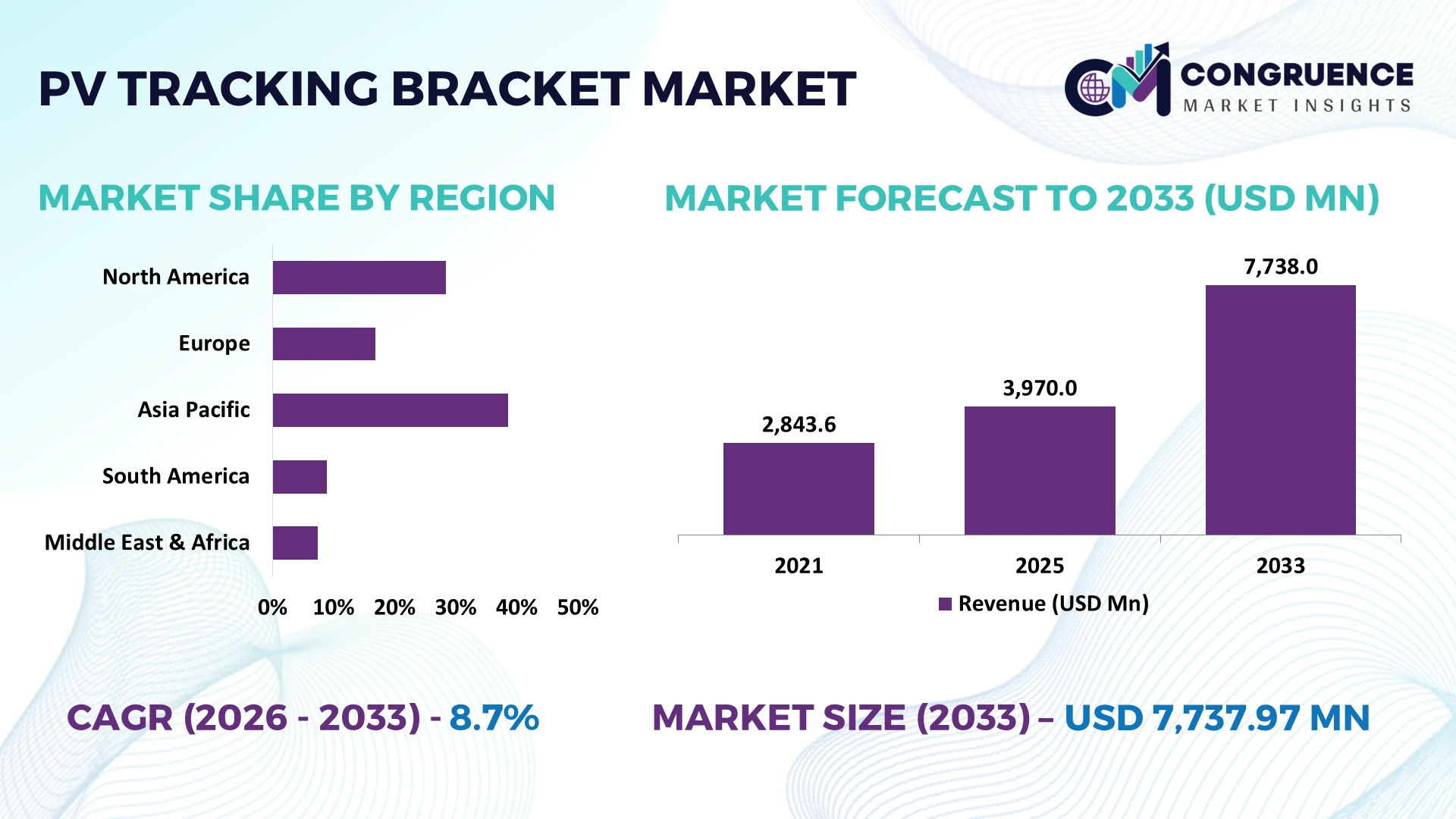
The Global PV Tracking Bracket Market was valued at USD 3,970.0 Million in 2025 and is anticipated to reach a value of USD 7,738.0 Million by 2033 expanding at a CAGR of 8.7% between 2026 and 2033. Expanding utility-scale solar installations, increasing adoption of bifacial photovoltaic modules, and higher electricity generation efficiency from single-axis tracking systems are driving demand for advanced PV tracking brackets.
China dominates the solar manufacturing ecosystem, accounting for over 80% of global photovoltaic manufacturing capacity and adding approximately 277 GW of solar capacity in 2024, compared with around 50 GW in the United States. Investments in automated steel fabrication, large-scale renewable energy bases, and intelligent tracking technologies strengthen domestic manufacturing capabilities, while international trade restrictions accelerate geographical supply-chain diversification.
Manufacturers prioritizing localized production, intelligent tracking mechanisms, and terrain-adaptive mounting structures are positioned to secure long-term utility-scale solar procurement contracts.
Market Size & Growth: USD 3,970.0 million in 2025, reaching USD 7,738.0 million by 2033 at 8.7% CAGR, driven by utility-scale solar expansion.
Top Growth Drivers: Tracking-based energy yield gains (15–25%), bifacial generation gains (5–15%), and solar capacity expansion (29% globally in 2024).
Short-Term Forecast: By 2028, advanced terrain-following systems target 10–15% lower site preparation costs.
Emerging Technologies: AI-enabled tracking, automated stow mechanisms, and corrosion-resistant materials support 1–3% incremental energy yield targets.
Regional Leaders: Illustrative 2033 projections include Asia Pacific (USD 3,095.2 million; solar parks), North America (USD 2,166.6 million; intelligent tracking), and Europe (USD 1,315.5 million; sustainable infrastructure).
Consumer/End-User Trends: Tracking systems serve over 70% of recent U.S. utility-scale solar installations, reflecting developer preferences for higher generation efficiency.
Pilot/Case Example: Australia's 2024 operational 400 MW Western Downs Solar Farm incorporates single-axis tracking technology, typically delivering 15–25% higher generation than fixed structures.
Competitive Landscape: Nextracker leads the broader solar tracker industry with approximately 25–30% share, competing with Array Technologies, GameChange Solar, PV Hardware, and Arctech.
Regulatory & ESG Impact: U.S. domestic-content incentives offer an additional 10-percentage-point investment tax credit for qualifying projects.
Investment & Funding: Global solar investments exceeded USD 500 billion in 2024, supporting manufacturing expansion and infrastructure development.
Innovation & Future Outlook: Terrain-adaptive brackets and bifacial-compatible architectures target 10–15% lower installation costs.
The PV Tracking Bracket Market increasingly serves utility-scale solar parks, independent power producers, and renewable infrastructure developers. Innovations in modular mounting assemblies, self-powered actuators, and intelligent backtracking algorithms improve structural reliability and electricity generation. With tracking systems delivering up to 25% higher energy output under suitable conditions, localized component manufacturing and performance-oriented procurement are reshaping competitive investment priorities.
The PV Tracking Bracket Market is becoming strategically important as renewable energy developers prioritize electricity generation efficiency, land utilization, and lifecycle project economics. Solar infrastructure procurement is shifting from conventional mounting structures toward integrated tracking platforms combining mechanical durability, automated controls, and predictive maintenance. Domestic manufacturing incentives and international trade restrictions are simultaneously restructuring steel sourcing and component production, strengthening the importance of regional supply networks.
Single-axis tracking systems deliver approximately 15–25% higher electricity generation than conventional fixed-tilt installations under favorable conditions. China leverages extensive manufacturing infrastructure and large-scale solar developments, while the United States emphasizes intelligent tracking, domestic sourcing, and bifacial module integration. Between 2026 and 2028, advanced terrain-following designs are expected to target 10–15% reductions in site preparation expenditure, improving project viability across uneven landscapes.
Australia's 400 MW Western Downs Solar Farm demonstrates the practical integration of tracking technology within large-scale renewable infrastructure. Manufacturers are expanding automated fabrication facilities, collaborating with engineering and construction contractors, and developing standardized mounting architectures. Competitive leadership increasingly depends on combining structural engineering expertise, localized manufacturing capabilities, and measurable lifetime generation advantages rather than competing exclusively on component pricing.
Accelerating utility-scale photovoltaic deployment is strengthening demand for tracking brackets that maximize electricity generation without proportionately increasing land requirements. Single-axis tracking systems deliver approximately 15–25% higher energy output than fixed-tilt installations, while bifacial modules provide additional generation gains of 5–15% under suitable conditions. Tracking technologies account for over 70% of recent U.S. utility-scale solar installations, reflecting their established commercial relevance. China's large renewable energy bases and expanding American solar infrastructure are encouraging manufacturers to increase automated steel fabrication capacity and develop high-load mounting assemblies. Higher generation per installed megawatt improves project economics, making tracker compatibility and structural reliability increasingly important procurement criteria for independent power producers.
PV tracking bracket manufacturing remains exposed to fluctuations in steel prices, galvanization expenses, and specialized mechanical component availability. China accounts for approximately 53% of global crude steel production, creating substantial geographical concentration within upstream material supply. The United States increased Section 232 steel tariffs to 50% for most affected trading partners in June 2025, intensifying procurement pressures for import-dependent manufacturers. Furthermore, tracking installations typically require 5–15% higher upfront investment than comparable fixed-tilt configurations, depending on project conditions. Manufacturers are addressing these limitations through regional fabrication partnerships, long-term steel procurement contracts, and material-efficient structural designs. Securing predictable input costs is essential for maintaining margins under fixed-price solar infrastructure contracts.
Next-generation terrain-adaptive tracking brackets are opening commercial opportunities across uneven landscapes previously considered expensive for utility-scale photovoltaic development. Advanced mounting architectures target 10–20% reductions in grading-related expenditure, while intelligent tracking algorithms offer potential incremental generation improvements of 1–3%. Bifacial-compatible bracket configurations further support rear-side energy gains of 5–15%, depending on ground reflectivity and module positioning. India's expanding solar infrastructure and Saudi Arabia's large desert-based renewable energy projects create opportunities for customized structural solutions. Manufacturers are investing in independent-row tracking, automated installation technologies, and engineering partnerships. Reducing dependence on extensive land preparation expands the economically viable project pipeline while improving construction schedules and capital utilization.
Maintaining tracking accuracy and mechanical reliability across decades of operation presents a significant execution challenge for PV tracking bracket manufacturers. Utility-scale photovoltaic projects commonly operate over 25–30 years, requiring tracking assemblies to withstand repetitive movement, wind loading, corrosion, and temperature fluctuations. Even a 1–2% reduction in annual energy generation through mechanical downtime undermines long-term project economics, while soiling-related losses commonly range between 3–5% globally. Harsh desert conditions in Saudi Arabia and extreme weather exposure in the United States increase engineering complexity. Manufacturers must strengthen wind-tunnel validation, predictive maintenance integration, and automated stow capabilities. Delivering consistent field performance across diverse climatic conditions is essential for securing bankable warranties and repeat infrastructure contracts.
Automated Bracket Assembly and Installation: Solar tracker manufacturers are replacing manual fastening processes with preassembled mounting components, standardized connectors, and automated installation equipment. Advanced assembly workflows target 15–25% reductions in installation labor and 10–20% shorter construction schedules. Companies including Nextracker and GameChange Solar are developing installation-friendly architectures to address skilled workforce shortages and accelerate project commissioning.
Regional Manufacturing and Procurement Localization: Domestic-content incentives and the United States' 50% steel tariffs introduced in June 2025 are restructuring tracker component procurement. Qualifying American solar projects receive an additional 10-percentage-point investment tax credit under applicable domestic-content provisions. Manufacturers are expanding regional fabrication partnerships, shortening procurement routes, and integrating local steel suppliers to strengthen delivery reliability.
Digital Monitoring and Predictive Maintenance: Solar asset operators are integrating sensor-based monitoring, remote diagnostics, and automated fault detection into tracking infrastructure. Predictive maintenance programs target 10–20% lower maintenance expenditure and operational availability exceeding 99%. Tracker manufacturers are expanding digital service capabilities, enabling operators to identify mechanical misalignment before individual component failures affect entire tracking rows.
High-Capacity Module Structural Compatibility: Commercial photovoltaic module capacities increasingly exceed 600 W, with advanced formats reaching 700 W and above. Larger modules require redesigned torque tubes, reinforced mounting interfaces, and optimized load distribution. Manufacturers are collaborating with module producers to standardize mechanical compatibility, reduce component requirements, and minimize engineering modifications across utility-scale installations.
Single-Axis Tracking Brackets represent the leading segment, accounting for an estimated 90.0% of the PV tracking bracket market in 2025. Their dominance reflects mechanical simplicity, scalable installation, lower maintenance requirements, and compatibility with large photovoltaic arrays. Single-axis systems increase electricity generation by approximately 15–25% compared with conventional fixed-tilt structures under favorable conditions. Utility-scale developers in the United States, India, and Saudi Arabia prioritize these configurations because standardized mounting assemblies simplify procurement, construction, and long-term asset management.
Dual-Axis Tracking Brackets represent the anticipated fastest-growing niche segment, supported by specialized applications requiring precise solar orientation and maximum generation per installed module. Dual-axis systems deliver approximately 30–40% higher energy generation than fixed-tilt installations under suitable conditions, although additional mechanical components increase installation and maintenance complexity. While single-axis brackets retain their cost advantage across large solar parks, dual-axis configurations attract investment in land-constrained and specialized photovoltaic installations. Manufacturers are refining actuator mechanisms, lightweight structural components, and modular mounting designs to improve commercial feasibility and application-specific performance.
Utility-Scale Solar Power Plants dominate the application segment, accounting for an estimated 85.0% market share in 2025. Large photovoltaic installations require extensive tracking infrastructure capable of supporting thousands of modules while maintaining consistent mechanical performance. Tracking brackets improve electricity generation by approximately 15–25% compared with fixed mounting structures, strengthening their commercial relevance across competitive power purchase agreements. Large solar parks in India, Saudi Arabia, and the United States increasingly prioritize standardized mounting assemblies to streamline construction schedules and maintenance operations.
Commercial & Industrial Solar Projects represent the anticipated fastest-growing application segment, supported by corporate decarbonization strategies, ground-mounted captive power installations, and industrial energy procurement modernization. Advanced tracking systems target 10–15% reductions in installation-related expenditure through modular assembly and optimized foundation designs. Residential Solar Installations remain a specialized application because rooftop constraints, mechanical complexity, and limited installation space favor conventional mounting structures. Manufacturers are expanding compact tracking architectures, developing customized structural configurations, and collaborating with commercial solar developers to address smaller installations without sacrificing operational reliability.
Independent Power Producers (IPPs) represent the leading end-user segment, accounting for an estimated 45.0% market share in 2025. Their dominance reflects extensive utility-scale project portfolios, competitive electricity pricing requirements, and dependence on long-term generation performance. Single-axis tracking installations support approximately 15–25% higher electricity output under favorable operating conditions, improving asset productivity across contracted power generation projects. Independent developers increasingly negotiate framework agreements with tracker manufacturers to standardize procurement, reduce engineering duplication, and improve component availability across multiple developments.
Commercial & Industrial Enterprises represent the anticipated fastest-growing end-user segment, driven by captive solar generation, corporate renewable energy commitments, and electricity cost optimization. Automated bracket installation workflows target 10–20% shorter construction schedules, improving deployment economics for industrial facilities. Electric Utilities maintain substantial demand through centralized renewable infrastructure investments, while Government & Public Sector Organizations support tracker deployment through public solar parks and infrastructure modernization initiatives. Manufacturers are targeting these buyers through customized engineering, volume-based procurement agreements, extended warranties, and partnerships with engineering, procurement, and construction contractors.
Asia Pacific accounted for the largest market share at 38.5% in 2025 however, Middle East & Africa is expected to register the fastest growth, expanding at a CAGR of 11.2% between 2026 and 2033.

North America accounted for 28.4% of the global PV tracking bracket market in 2025, supported by extensive utility-scale photovoltaic installations, advanced tracking technologies, and established renewable energy procurement networks. Single-axis tracking systems dominate large solar developments across the United States, while Canada and Mexico are expanding ground-mounted photovoltaic infrastructure. The United States installed approximately 50 GWdc of solar capacity in 2024, strengthening demand for high-performance mounting structures and automated tracking assemblies. Domestic-content incentives are encouraging manufacturers to establish regional steel fabrication facilities and diversify component sourcing. Companies including Nextracker, Array Technologies, and GameChange Solar are expanding manufacturing partnerships and developing installation-efficient bracket designs. Growing integration of bifacial modules and intelligent tracking controls is shifting procurement priorities toward structural durability, operational reliability, and predictable lifetime electricity generation.
U.S. Market Outlook: The United States leads regional demand through extensive solar development across Texas, California, and Arizona. Tracking systems support more than 70% of recent utility-scale solar installations, reflecting their commercial maturity. Domestic manufacturing incentives and steel import restrictions are encouraging localized bracket production, while independent power producers increasingly prioritize standardized mounting platforms, extended warranties, and reliable component delivery schedules.
Europe accounted for 16.8% of the global PV tracking bracket market in 2025, supported by renewable energy expansion, corporate decarbonization commitments, and modernization of electricity generation infrastructure. Spain, Italy, Portugal, and Greece represent important deployment markets because favorable solar irradiation strengthens the economic advantages of tracking systems. The European Union installed approximately 65.5 GW of solar capacity in 2024, expanding procurement opportunities for photovoltaic mounting infrastructure. However, land availability restrictions and environmental permitting requirements are encouraging manufacturers to develop compact, terrain-compatible structural designs. European suppliers are prioritizing recyclable materials, corrosion-resistant components, and lower-carbon steel procurement to align with sustainability requirements. Partnerships between tracker manufacturers, engineering contractors, and renewable energy developers are strengthening regional supply networks, while automated installation technologies improve construction efficiency and reduce dependence on specialized labor.
Spain Market Outlook: Spain represents a strategically important European market for PV tracking brackets due to its extensive ground-mounted photovoltaic infrastructure and favorable climatic conditions. The country surpassed 30 GW of installed solar photovoltaic capacity in 2024. Large renewable energy developers increasingly adopt single-axis tracking systems, creating opportunities for domestic manufacturers specializing in structural engineering, automated tracking mechanisms, and high-durability mounting components.
Asia Pacific accounted for 38.5% of the global PV tracking bracket market in 2025, supported by extensive photovoltaic manufacturing capabilities, competitive steel fabrication infrastructure, and large renewable energy development programs. China, India, and Australia are strengthening demand through utility-scale solar parks and centralized renewable electricity generation. India added approximately 24.5 GW of solar capacity in 2024, expanding opportunities for tracking bracket manufacturers and engineering contractors. Regional suppliers benefit from integrated manufacturing ecosystems encompassing structural steel, mechanical actuators, control systems, and photovoltaic components. Companies including Arctech and TrinaTracker are expanding automated production facilities, international distribution networks, and customized engineering capabilities. Increasing deployment across desert environments and uneven landscapes is encouraging investment in terrain-adaptive mounting systems, while competitive manufacturing costs strengthen the region's positioning within international solar infrastructure supply chains.
China Market Outlook: China dominates the regional manufacturing ecosystem through extensive steel processing infrastructure, integrated photovoltaic supply chains, and large-scale renewable energy development. The country added approximately 277 GW of solar capacity in 2024, significantly expanding domestic mounting infrastructure requirements. Chinese manufacturers are strengthening automated fabrication capabilities, intelligent tracking technologies, and overseas manufacturing partnerships to maintain export competitiveness and address international procurement localization requirements.
South America accounted for 8.9% of the global PV tracking bracket market in 2025, driven by expanding renewable electricity generation, favorable solar irradiation, and increasing private-sector investment in photovoltaic infrastructure. Brazil, Chile, and Argentina represent important deployment markets, particularly for ground-mounted solar installations serving industrial facilities and national electricity networks. Chile surpassed 10 GW of cumulative solar photovoltaic capacity in 2024, strengthening demand for tracking structures designed for high-irradiation environments. Mining companies and independent power producers increasingly prioritize tracking systems to improve generation efficiency and reduce electricity procurement costs. However, transmission constraints, currency fluctuations, and project financing limitations influence deployment schedules. Manufacturers are addressing these pressures through regional distribution partnerships, standardized structural components, and localized engineering support, improving procurement flexibility and reducing installation complexity across geographically diverse solar development sites.
Brazil Market Outlook: Brazil leads regional demand through its expanding renewable energy infrastructure, established industrial base, and competitive photovoltaic development environment. The country's cumulative solar capacity exceeded 50 GW in early 2025. Utility-scale developers increasingly prioritize durable tracking brackets capable of operating under varied climatic conditions, while domestic fabrication partnerships improve component availability, transportation efficiency, and compliance with local financing requirements.
Middle East & Africa accounted for 7.4% of the global PV tracking bracket market in 2025, supported by ambitious renewable energy diversification programs, large desert-based solar developments, and increasing electricity infrastructure investments. Saudi Arabia, the United Arab Emirates, Egypt, and South Africa are expanding utility-scale photovoltaic installations to diversify electricity generation and strengthen energy security. The UAE's 2 GW Al Dhafra Solar PV project demonstrates the scale of mounting infrastructure required for centralized renewable electricity generation. Extreme temperatures, abrasive dust, and high wind loads are encouraging demand for reinforced tracking brackets, corrosion-resistant materials, and automated protective mechanisms. Manufacturers are establishing regional engineering partnerships and localized fabrication capabilities to support large procurement contracts. Standardized mounting architectures and climate-specific structural designs are becoming critical for reducing maintenance requirements and ensuring consistent operational performance.
Saudi Arabia Market Outlook: Saudi Arabia represents a strategically significant growth market through its Vision 2030 economic diversification strategy and large renewable energy procurement programs. The 2.06 GW Al Shuaibah 2 solar project illustrates the country's expanding utility-scale photovoltaic infrastructure. Manufacturers are targeting domestic production partnerships, desert-compatible tracking assemblies, and automated installation solutions to strengthen competitiveness across government-backed renewable energy developments.
Nextracker, Array Technologies, GameChange Solar, Arctech, and PV Hardware compete through manufacturing scale, structural engineering, intelligent tracking capabilities, and regional supply networks. The market exhibits a moderately consolidated structure, with the five leading suppliers estimated to collectively account for 65% of the broader solar tracker market. Global technology leaders emphasize reliability and generation optimization, while cost-focused manufacturers leverage integrated steel fabrication and competitive component sourcing. Single-axis tracking systems deliver 15–25% higher electricity generation than fixed structures, while modular installation architectures target 10–20% reductions in construction time. Nextracker and Array Technologies strengthen differentiation through engineering innovation, whereas Arctech and GameChange Solar pursue manufacturing expansion and localized procurement partnerships. Competition is shifting toward integrated mechanical and digital tracking platforms, reducing differentiation through standalone bracket pricing. Bankability requirements, structural certification, and long-term performance warranties create substantial entry barriers. Winning requires localized manufacturing, competitive lifecycle economics, proven structural reliability, and scalable project execution capabilities across markets.
Nextpower Inc. (Formerly Nextracker Inc.)
Array Technologies Inc.
GameChange Solar
Arctech Solar Holding Co., Ltd.
PV Hardware (PVH)
TrinaTracker
Soltec Power Holdings
Gonvarri Solar Steel
Axial Structural Solutions
Antaisolar
Ideematec Inc.
FTC Solar Inc.
Convert Italia
Versolsolar Hangzhou Co., Ltd.
Single-axis tracking technology dominates utility-scale photovoltaic infrastructure, delivering 15–25% higher electricity generation than conventional fixed-tilt mounting systems. Advanced torque tube designs, synchronized drive mechanisms, and reinforced structural brackets improve mechanical stability and compatibility with high-capacity photovoltaic modules. Tracking systems support over 70% of recent American utility-scale solar installations, demonstrating commercial maturity. Manufacturers are standardizing mounting interfaces to simplify engineering workflows, accelerate construction, and improve component interchangeability.
Emerging terrain-following tracking systems reduce dependence on extensive land grading, targeting 10–20% lower site preparation costs. AI-enabled backtracking algorithms and intelligent irradiation monitoring support incremental energy generation improvements of 1–3% under suitable conditions. Nextpower and Arctech are integrating adaptive structural engineering with intelligent control platforms, strengthening competitive differentiation across challenging project locations. Automated weather-responsive stow mechanisms further protect photovoltaic assemblies against extreme environmental conditions.
Between 2026 and 2028, robotic installation, predictive maintenance, and digitally integrated tracking architectures will increasingly influence procurement decisions. Automated assembly workflows target 15–25% reductions in installation labor requirements, while sensor-based monitoring supports operational availability exceeding 99%. Manufacturers integrating structural components, control software, and engineering services gain advantages over standalone bracket suppliers. Technology investment priorities increasingly emphasize lifecycle performance, installation scalability, material efficiency, and measurable operational reliability across diverse utility-scale solar development environments worldwide.
January 2026, Nextpower announced the completion of its joint venture with Abunayyan Holding, establishing Saudi Arabian manufacturing operations targeting 12 GW of annual capacity. The initiative strengthens regional supply chains, supports industrial localization, and expands tracker availability across Middle Eastern markets. Source: investors.nextracker.com
August 2025, Array Technologies announced a supply agreement for ENGIE's 200 MW Emerald Green Solar project in Indiana, featuring fully domestic-content OmniTrack systems. The deployment strengthens American component sourcing and supports developers pursuing federal tax incentives through qualifying domestic manufacturing arrangements. Source: arraytechinc.com
August 2025, GameChange Solar announced its improved global competitive ranking after shipping 13.7 GWdc of solar tracking systems during 2024. The milestone reflects stronger international market penetration, particularly across India and Africa, alongside expanded manufacturing capabilities supporting reliable utility-scale project delivery.
September 2022, Arctech celebrated the opening of its Indian solar tracker manufacturing facility through Jash Energy alongside achieving 3.5 GW in regional shipments. The facility strengthens localized structural component production, supporting faster deliveries, competitive procurement costs, and improved engineering assistance for developers. Source: arctechsolar.com
The PV Tracking Bracket Market Report provides comprehensive analysis across Single-Axis Tracking Brackets and Dual-Axis Tracking Brackets, covering Utility-Scale Solar Power Plants, Commercial & Industrial Solar Projects, and Residential Solar Installations. End-user coverage includes Independent Power Producers, Commercial & Industrial Enterprises, Electric Utilities, and Government & Public Sector Organizations. The report evaluates deployment patterns, structural engineering requirements, manufacturing capabilities, and procurement dynamics across North America, Europe, Asia Pacific, South America, and Middle East & Africa.
The study examines intelligent tracking algorithms, terrain-adaptive mounting structures, automated installation technologies, corrosion-resistant materials, and emerging bifacial-compatible architectures. With tracking systems offering approximately 15–25% higher generation than fixed-tilt configurations under suitable conditions, the analysis evaluates operational advantages, competitive differentiation, supply-chain localization, and investment opportunities. Strategic insights support manufacturing expansion, product development, geographical diversification, and competitive positioning between 2026 and 2033.
| Report Attribute / Metric | Details |
|---|---|
| Market Revenue (2025) | USD 3,970.0 Million |
| Market Revenue (2033) | USD 7,738.0 Million |
| CAGR (2026–2033) | 8.7% |
| Base Year | 2025 |
| Forecast Period | 2026–2033 |
| Historic Period | 2021–2025 |
| Segments Covered |
By Type
By Application
By End-User
|
| Key Report Deliverables | Revenue Forecast; Market Trends; Growth Drivers & Restraints; Technology Insights; Segmentation Analysis; Regional Insights; Competitive Landscape; Regulatory & ESG Overview; Recent Developments |
| Regions Covered | North America; Europe; Asia-Pacific; South America; Middle East & Africa |
| Key Players Analyzed | Nextpower Inc. (Formerly Nextracker Inc.); Array Technologies Inc.; GameChange Solar; Arctech Solar Holding Co., Ltd.; PV Hardware (PVH); TrinaTracker; Soltec Power Holdings; Gonvarri Solar Steel; Axial Structural Solutions; Antaisolar; Ideematec Inc.; FTC Solar Inc.; Convert Italia; Versolsolar Hangzhou Co., Ltd. |
| Customization & Pricing | Available on Request (10% Customization Free) |




