
Reports
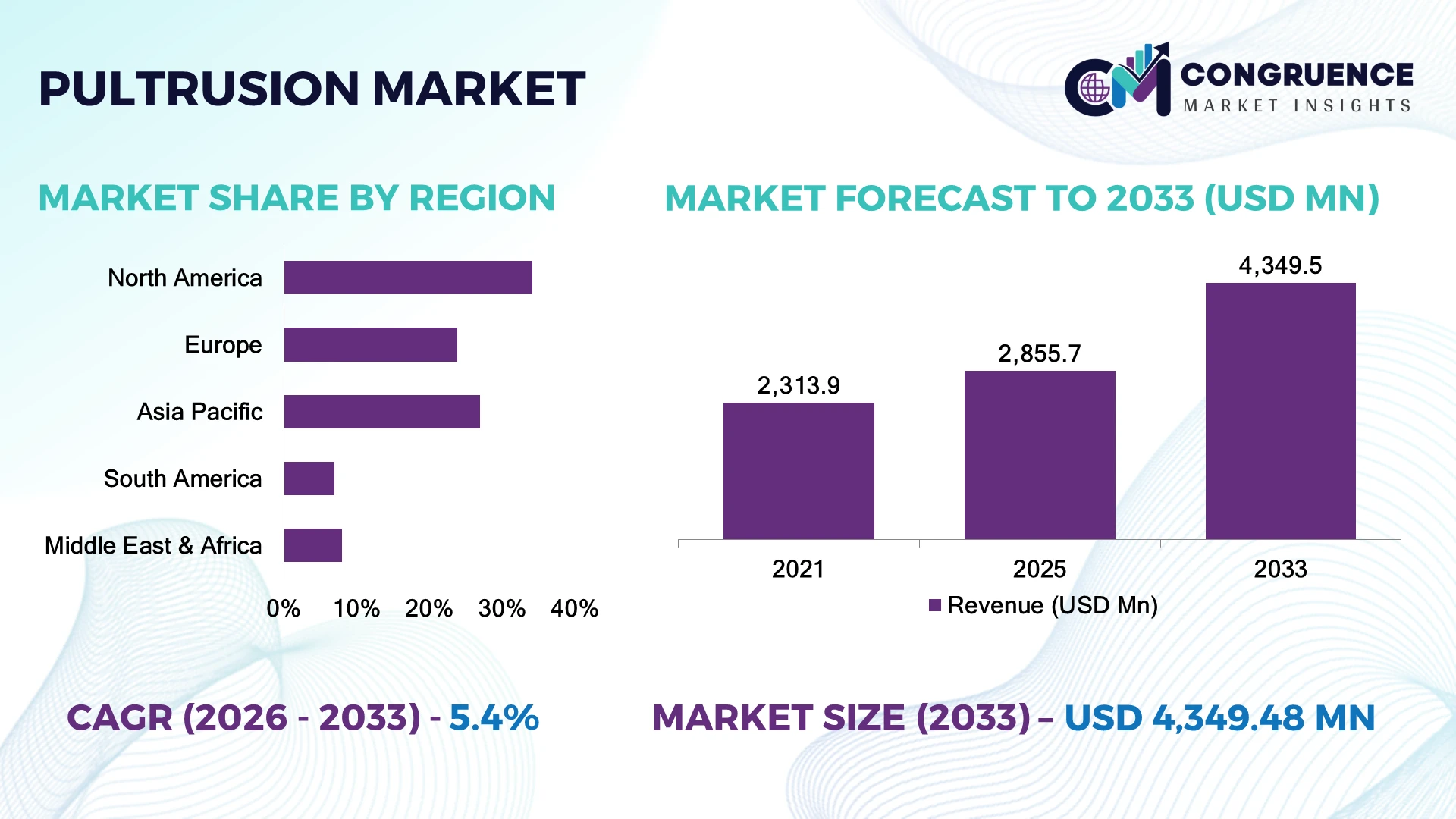
The Global Pultrusion Market was valued at USD 2,855.7 Million in 2025 and is anticipated to reach a value of USD 4,349.5 Million by 2033 expanding at a CAGR of 5.4% between 2026 and 2033. Growth is being driven by rising deployment of lightweight FRP profiles in wind-energy structures, electrical infrastructure, corrosion-resistant construction, transportation components, and utility applications, where continuous production lowers fabrication intensity.
China remains the dominant manufacturing and consumption hub, supported by extensive construction, electrical, transportation, and wind-energy activity. Chinese pultrusion demand is expanding around 6% annually, while India is accelerating capacity through infrastructure and renewable-energy investments. The U.S. remains technology-intensive, particularly in structural composites and utility applications, with automated lines increasingly replacing labor-intensive fabrication. Geopolitical supply-chain diversification is encouraging manufacturers to establish regional production and reduce dependence on concentrated composite-material supply routes.
Strategically, manufacturers with localized capacity, automated production, and differentiated FRP formulations are best positioned to capture high-volume infrastructure demand.
Market Size & Growth: USD 2,855.7 million in 2025 to USD 4,349.5 million by 2033 at 5.4% CAGR, driven by lightweight FRP infrastructure and wind-energy applications.
Top Growth Drivers: Infrastructure modernization 31%, renewable-energy structures 24%, corrosion-resistant industrial applications 19%.
Short-Term Forecast: By 2028, automated pultrusion lines are positioned to reduce process labor requirements by 10–15% while improving production consistency by approximately 8%.
Emerging Technologies: Thermoplastic pultrusion, automated resin injection, adaptive die-temperature control, and digital process monitoring are accelerating high-volume composite production.
Regional Leaders: Asia-Pacific is projected at approximately USD 1.8 billion by 2033, North America at USD 1.3 billion, and Europe at USD 0.9 billion, with automation adoption strongest in advanced manufacturing hubs.
Consumer/End-User Trends: Construction and electrical applications collectively represent more than 50% of pultruded-profile consumption, while wind-energy buyers increasingly specify lightweight carbon-fiber components.
Pilot/Case Example: 2025 thermoplastic pultruded window reinforcement demonstrated approximately 12% lower thermal transmittance than steel reinforcement, strengthening demand for energy-efficient building components.
Competitive Landscape: Exel Composites, Fiberline Composites, Strongwell, Bedford Reinforced Plastics, and Creative Pultrusions lead through profile engineering, production scale, customized formulations, and application-specific solutions.
Regulatory & ESG Impact: Corrosion-resistant FRP systems can extend component service life by 20% or more in demanding environments, supporting lower replacement frequency and lifecycle material consumption.
Investment & Funding: Composite manufacturers are directing multimillion-dollar capacity investments toward India, China, Europe, and North America, with wind-energy and infrastructure applications receiving priority.
Innovation & Future Outlook: Thermoplastic matrices, recycled reinforcement, curved pultrusion, intelligent process control, and digitally optimized resin impregnation will shift competition toward material efficiency and application-specific engineering.
The Pultrusion Market is gaining strategic traction across wind turbine components, structural profiles, cable trays, utility systems, transportation parts, and corrosion-resistant industrial structures. Approximately 50% of incremental application demand is concentrated in infrastructure-linked uses, where lightweight FRP reduces maintenance requirements and installation weight. In 2026, supply-chain localization and renewable-energy manufacturing expansion are encouraging producers to establish regional production capabilities, while automated resin impregnation and precision thermal control improve throughput and dimensional consistency.
Pultrusion is becoming strategically important because it combines continuous production, lightweight structural performance, corrosion resistance, and comparatively low process energy requirements. The technology is particularly relevant as infrastructure owners seek materials that reduce maintenance and installation burdens. A major shift is occurring from conventional glass-fiber thermoset profiles toward thermoplastic and carbon-fiber solutions for applications requiring recyclability, higher performance, or improved joining capability.
The technology economics are increasingly compelling. Modern pultrusion operates at roughly 3.1 MJ/kg of process energy, compared with about 21.9 MJ/kg for autoclave molding, giving manufacturers a substantial energy-efficiency advantage. Advanced process monitoring, automated tension control, and optimized die heating can further reduce energy consumption by approximately 10% while improving dimensional consistency. China emphasizes production scale and cost competitiveness, whereas Germany, the United States, and Japan prioritize engineered profiles and advanced composite formulations.
Over the next two to three years, investment will increasingly target automated lines, thermoplastic pultrusion, recycled-fiber compatibility, and application-specific tooling. Wind-energy suppliers are already increasing localized production for structural components, while construction manufacturers are integrating pultruded profiles into energy-efficient building systems. The strongest competitive position will belong to producers that combine high-volume manufacturing with material engineering, regional supply resilience, and application-specific customization.
Demand for corrosion-resistant, lightweight composite profiles is accelerating as infrastructure owners replace steel and aluminum in bridges, utility structures, cable management, and wind-energy components. Renewable-energy applications contribute roughly 20% of incremental pultrusion demand, while infrastructure projects account for approximately 30%. In China and India, expanding transmission networks and wind installations are increasing requirements for continuous FRP profiles. At the same time, automated pulling, resin impregnation, and die-temperature control are improving production consistency by 8–12%. Manufacturers are responding by expanding automated capacity, developing application-specific glass and carbon-fiber formulations, and forming partnerships with engineering contractors. The non-obvious advantage is lifecycle economics: corrosion resistance reduces replacement frequency, allowing suppliers to compete on total installed cost rather than profile price alone.
Pultrusion profitability remains exposed to fluctuations in epoxy, polyester, vinyl ester, glass fiber, and carbon-fiber input costs. Resin and reinforcement together can represent 45–65% of finished profile costs, making a 10% material-price increase capable of compressing producer margins by several percentage points. European manufacturers also face comparatively high industrial energy costs, while Asian producers retain stronger cost advantages. Supply disruptions affecting specialty resins or continuous fiber can extend procurement cycles by 15–20%. Companies are reducing exposure through multi-country sourcing, longer-term supplier contracts, localized resin formulations, and greater use of glass fiber where carbon fiber is unnecessary. The strategic pressure point is material substitution: producers that cannot redesign formulations quickly lose competitiveness when premium reinforcement prices rise.
Thermoplastic pultrusion is creating opportunities in transportation, electrical equipment, modular construction, and recyclable structural components. Thermoplastic matrices can shorten consolidation and joining cycles by approximately 20–30% compared with conventional thermoset processing, while automated production can reduce downstream labor requirements by 10–15%. Germany and the United States are advancing high-performance composite applications, while India and China provide scalable manufacturing opportunities. The emerging opportunity is not simply replacing thermoset profiles; it is enabling welding, reshaping, and automated assembly of continuous-fiber components. Manufacturers are investing in hybrid reinforcement architectures, thermoplastic resin systems, and digitally controlled impregnation. Companies that combine pultrusion with automated cutting and robotic assembly can capture additional value beyond profile manufacturing and enter integrated component supply chains.
Scaling advanced pultrusion requires precise control of fiber tension, resin impregnation, die temperature, pulling speed, and dimensional tolerances. Variations of only 2–3% in fiber alignment can affect mechanical performance sufficiently to disrupt qualification for demanding structural applications. Carbon-fiber profiles are particularly sensitive because reinforcement costs can exceed 50% of material input value. In the United States and Germany, skilled composite-process technicians remain critical for commissioning and troubleshooting sophisticated lines. Companies are addressing this through inline vision inspection, automated tension control, digital process monitoring, and operator training. The long-term challenge is integrating these systems without reducing line availability. Manufacturers that achieve stable quality at higher pulling speeds will gain a decisive advantage in aerospace, transportation, and high-performance infrastructure applications.
Thermoplastic Processing Gains Momentum Thermoplastic pultrusion is moving from specialized trials toward commercial applications requiring recyclability and rapid assembly. Processing cycles can be 20–30% shorter than comparable thermoset routes, while automated joining can reduce downstream labor by 10–15%. Automotive and electrical-component manufacturers are increasing pilot programs, pushing pultruders toward hybrid reinforcement and higher-temperature resin capabilities.
Automation Raises Line Productivity Manufacturers are upgrading pulling systems with automated tension control, machine vision, resin metering, and closed-loop die-temperature management. These technologies are improving dimensional consistency by approximately 8–12% and reducing manual intervention by 15–20%. Labor shortages in European composite manufacturing are accelerating investment, with producers prioritizing connected production cells and predictive maintenance rather than simply adding conventional lines.
Recycled Reinforcement Enters Profiles Sustainability requirements are shifting attention toward recycled glass fiber, recovered carbon fiber, and lower-impact resin systems. Recycled reinforcement can reduce virgin-material requirements by approximately 10–20% in selected non-critical profiles. Construction and utility suppliers are testing these materials for cable trays, structural channels, and architectural components, while manufacturers are redesigning formulations to maintain mechanical performance without sacrificing production speed.
Regional Supply Chains Rebalance Trade friction, freight volatility, and resin-supply disruptions are encouraging pultrusion producers to localize reinforcement and resin procurement. Manufacturers are targeting 10–15% reductions in logistics exposure through regional sourcing and dual-supplier contracts. China and India are expanding production capacity, while European and North American producers are emphasizing engineered profiles, shorter lead times, and vertically integrated material preparation to protect customer delivery schedules.
Glass-fiber pultrusion remains the volume anchor
Glass-fiber pultrusion is estimated to account for approximately 72% of global demand, supported by its lower material cost, strong corrosion resistance, and suitability for continuous profiles. Carbon-fiber pultrusion represents roughly 16%, but is the fastest-growing type as aerospace, mobility, wind-energy, and lightweight structural applications prioritize higher specific strength. Basalt fiber and other reinforcement systems together hold about 12%, serving specialized thermal, fire-resistant, and infrastructure requirements. The strategic divide is clear: glass fiber wins on cost and scalable production, while carbon fiber wins where weight reduction justifies premium pricing. Manufacturers are expanding hybrid reinforcement capabilities and optimizing resin systems to capture both volume and high-performance applications.
Carbon-fiber adoption is shifting investment toward automated impregnation, precision die design, and hybrid profiles. Companies with established glass-fiber capacity retain a cost advantage, while technology-focused producers are targeting premium applications where performance offsets higher reinforcement costs. The resulting investment priority is moving from simple capacity expansion toward differentiated, application-specific composite profiles.
The American Composites Manufacturers Association reported in 2026 that glass-reinforced polyester/vinyl-ester composites accounted for more than 1.9 billion pounds of sales in the U.S. and Canada during the first half of 2025, reinforcing the commercial scale of glass-fiber-based systems.
Construction leads while energy applications accelerate
Construction is estimated to represent approximately 38% of pultrusion demand, making it the leading application through structural profiles, gratings, reinforcement systems, platforms, ladders, and building components. Infrastructure follows at roughly 24%, supported by corrosion-resistant bridges, utility structures, rebar, and water-treatment applications. Energy-related applications are the fastest-growing, accounting for about 14% and gaining traction in wind-energy components, electrical structures, and emerging hydrogen infrastructure. Transportation, industrial equipment, and other applications collectively contribute the balance, with demand increasingly determined by weight reduction and lifecycle performance rather than material substitution alone.
The construction segment remains mature and specification-driven, whereas energy applications are moving toward engineered, higher-value profiles. Approximately 30% of new application-development activity is increasingly concentrated around energy, mobility, and infrastructure-related composite solutions. Producers are responding through application engineering, co-development with OEMs, and profile customization rather than relying solely on standard catalog products. This shift strengthens margins where pultrusion replaces heavier steel or corrosion-sensitive materials.
The American Composites Manufacturers Association reported in 2026 that construction represented 34% and infrastructure 26% of U.S. and Canadian glass-reinforced thermoset composite sales during the first half of 2025, confirming the continued concentration of composite demand in built-environment applications.
Infrastructure buyers anchor procurement, OEM adoption expands
Infrastructure and construction companies are estimated to represent approximately 42% of pultrusion purchases, reflecting extensive use of FRP structural shapes, gratings, reinforcing bars, utility components, and access systems. Industrial manufacturers account for about 24%, while transportation and energy OEMs together represent roughly 21%. Infrastructure buyers prioritize corrosion resistance, service life, and installation efficiency, whereas OEMs increasingly evaluate weight, dimensional consistency, and integration into automated production. This creates distinct purchasing models: project-led procurement dominates established construction markets, while design-in partnerships increasingly determine OEM demand.
Energy and advanced manufacturing users are the fastest-growing buyer groups, with adoption estimated to expand from a smaller base as wind, electrification, and lightweight equipment applications mature. Companies are therefore increasing engineering support, prototyping, and long-term supply agreements rather than competing exclusively on profile price. The non-obvious advantage is specification lock-in: once a pultruded profile is embedded into an engineered system, switching suppliers can require redesign, validation, and tooling changes, creating durable customer relationships for technically capable producers.
The American Composites Manufacturers Association reported in 2026 that 77% of surveyed composites companies considered employee retention, turnover, and replacement of retiring talent extremely or very important, increasing the strategic value of suppliers that can provide standardized engineering support, process consistency, and application expertise.
North America accounted for the largest market share at 34.2% in 2025 however, Asia-Pacific is expected to register the fastest growth, expanding at a CAGR of 6.4% between 2026 and 2033.
North America accounted for the largest market share at 34.2% in 2025 however, Asia-Pacific is expected to register the fastest growth, expanding at a CAGR of 6.4% between 2026 and 2033.

Infrastructure modernization accelerates engineered FRP adoption
North America remains the largest Pultrusion market, supported by established composite manufacturing, utility infrastructure, bridge rehabilitation, water-treatment projects, and industrial corrosion-control applications. The region represented approximately 34.2% of global demand in 2025, with the United States accounting for the dominant share through mature FRP profile production and specification-driven construction procurement. Demand is increasingly shifting from standard profiles toward customized structural shapes, reinforcing bars, gratings, and electrically non-conductive components. More than 30% of regional application development is concentrated in infrastructure, utilities, and energy-related projects, strengthening demand for high-performance pultruded composites. Producers are responding by expanding automated lines, improving resin impregnation, and developing hybrid glass-carbon reinforcement systems. The strategic advantage increasingly rests on engineering support and specification integration rather than production volume alone.
United States Market Outlook: The United States leads regional deployment through its large construction, utilities, transportation, and industrial maintenance base. FRP infrastructure applications increasingly prioritize corrosion resistance and lower lifecycle intervention requirements. Approximately 40% of North American pultrusion consumption is linked to construction and infrastructure-related applications, creating strong opportunities for producers with domestic manufacturing, engineering capabilities, and established contractor relationships.
Decarbonization and lifecycle performance reshape material selection
Europe maintains a strong position in pultruded composites as infrastructure refurbishment, renewable-energy installations, electrical applications, and corrosion-resistant construction increasingly favor lightweight engineered materials. Germany, Italy, France, and the United Kingdom form major industrial demand centers, while sustainability requirements are pushing manufacturers toward lower-emission resin systems and longer-life composite designs. Approximately 28% of European pultrusion demand is linked to infrastructure and construction applications, while energy and electrical uses continue gaining specification share. Manufacturers are investing in automated profile production, recycled reinforcement research, and resin optimization to improve material efficiency. The strategic shift is toward lifecycle economics: longer service intervals and reduced maintenance increasingly offset higher initial composite costs.
Germany Market Outlook: Germany combines advanced manufacturing infrastructure with strong automotive, electrical, construction, and industrial-equipment capabilities. Its engineering-intensive procurement environment supports customized pultruded profiles and precision composite components. Approximately 25% of European industrial composite production is concentrated in Germany, Italy, and France combined, creating a dense supplier ecosystem that supports tooling, resin development, automation, and application engineering.
Manufacturing scale is shifting toward high-volume composite production
Asia-Pacific is the fastest-expanding Pultrusion market, driven by infrastructure construction, electrical equipment, wind-energy deployment, transportation modernization, and expanding composite manufacturing capacity. China, Japan, South Korea, and India account for the largest industrial demand, with China providing the region's strongest production base. The region represented approximately 27% of global demand in 2025 and is increasingly moving from commodity FRP profiles toward engineered structural components. More than 35% of new capacity investment is directed toward construction, energy, electrical, and infrastructure applications. Manufacturers are scaling continuous production lines, improving automated resin systems, and localizing reinforcement and tooling supply chains. This production concentration is strengthening cost competitiveness while enabling faster customization for domestic infrastructure programs.
China Market Outlook: China holds the strongest manufacturing position in Asia-Pacific through extensive composite processing capacity, infrastructure spending, wind-energy production, and electrical-equipment manufacturing. Its large domestic construction base supports high-volume pultruded profile production, while increasing automation is improving consistency and throughput. Approximately 45% of regional pultrusion production capacity is concentrated in China, giving domestic manufacturers a substantial scale and supply-chain advantage.
Infrastructure renewal is opening targeted composite applications
South America remains a developing pultrusion market, with Brazil representing the principal demand and manufacturing center. Infrastructure rehabilitation, electrical utilities, wastewater facilities, mining operations, and industrial corrosion control are creating targeted opportunities for FRP profiles and structural components. Brazil accounts for more than 50% of regional pultrusion demand, supported by its larger construction and industrial base. Mining and chemical-processing facilities increasingly favor corrosion-resistant composites where steel replacement reduces maintenance exposure. However, limited local tooling capabilities and dependence on specialized reinforcement and resin inputs constrain production flexibility. Manufacturers are responding through localized distribution, regional fabrication partnerships, and application-specific inventory. The strongest opportunity lies in replacing maintenance-intensive metallic structures rather than competing directly across all construction applications.
Brazil Market Outlook: Brazil provides the strongest commercial platform through its construction, mining, utilities, energy, and industrial-processing sectors. Local demand increasingly favors FRP gratings, ladders, structural profiles, and electrical components in corrosion-intensive environments. Industrial buyers can reduce maintenance intervention requirements by approximately 20%–30% when suitable composite structures replace vulnerable metallic components, supporting wider specification adoption.
Industrial diversification is expanding engineered composite deployment
The Middle East & Africa market is being shaped by infrastructure expansion, water-treatment investment, industrial diversification, energy projects, and corrosion-intensive operating environments. Saudi Arabia, the United Arab Emirates, and South Africa represent the principal demand centers, with Gulf countries particularly attractive for FRP applications in utilities, desalination, petrochemical facilities, and large construction projects. Approximately 30% of regional demand is concentrated in infrastructure and water-related applications, where corrosion resistance directly supports lifecycle economics. Producers are increasing local distribution networks and forming project partnerships with engineering contractors to secure specifications before procurement. The market remains import-dependent for selected reinforcement and processing technologies, making regional warehousing and localized fabrication increasingly important competitive levers.
Saudi Arabia Market Outlook: Saudi Arabia offers the strongest regional opportunity because large infrastructure, desalination, industrial-processing, and construction programs require materials capable of operating under corrosive and high-temperature conditions. Water and industrial projects represent a significant share of composite application potential, while localization initiatives are encouraging suppliers to establish regional processing, distribution, and technical-support capabilities.
Strongwell, Exel Composites, Creative Composites Group, Fiberline Composites, and Jiangsu Jiuding compete directly across engineered FRP profiles, with North American and European specialists confronting cost-focused Asian producers. The top five players collectively command approximately 40% of global sales, leaving substantial room for regional specialists. Price influences roughly 30% of purchasing decisions, while product performance and customization each account for about 25%, making resin formulation, fiber alignment, tooling precision, and application engineering decisive. Exel is strengthening wind-energy capacity and long-term OEM relationships, while Strongwell emphasizes domestic infrastructure profiles and integrated manufacturing. Asian producers increasingly compete through scale, localized supply, and shorter delivery cycles. The competitive shift is moving from standard-profile pricing toward specification control, carbon-fiber capability, and vertically integrated reinforcement supply. Entry barriers remain high because qualification, tooling expertise, process consistency, and established contractor relationships require substantial investment. Winning requires cost discipline, engineered differentiation, dependable capacity, and early customer specification influence.
Strongwell Corporation
Exel Composites Oyj
Creative Composites Group
Fiberline Composites A/S
Bedford Reinforced Plastics
Jiangsu Jiuding New Material Co., Ltd.
Pultron Composites Ltd.
Tencom Ltd.
Fibergrate Composite Structures Inc.
Röchling Group
Epsilon Composite
Enduro Composites Inc.
Pultrall Inc.
Top Glass Industries S.p.A.
Pultrusion technology is shifting from conventional manual process control toward automated fiber tensioning, closed-loop resin metering, digital die monitoring, and precision temperature management. Automated line control can improve dimensional consistency by 10–15% and reduce material waste by 5–8%. AI-assisted process monitoring remains at an emerging deployment stage, but approximately 20% of advanced composite manufacturers are integrating machine-vision or predictive-quality functions. These systems improve throughput stability and reduce scrap-intensive production interruptions.
Carbon-fiber pultrusion, hybrid reinforcement, polyurethane resin systems, and recyclable thermoplastic matrices represent the strongest technology transitions. Thermoplastic pultrusion can shorten consolidation and processing cycles by approximately 15–25% versus conventional thermoset routes in suitable applications. Digital twins and inline inspection are also improving process traceability by roughly 10–12%. Technology leaders with high-volume wind, transportation, and industrial contracts benefit most because consistent high-speed production converts process improvements directly into lower unit costs and tighter delivery schedules.
Between 2026 and 2028, automated impregnation, robotic handling, AI-based defect detection, and hybrid fiber architectures will increasingly differentiate suppliers. Companies combining advanced process control with application engineering can secure specification-led contracts while reducing production variability. The decisive advantage will shift toward manufacturers capable of integrating materials, tooling, sensors, and analytics into a single repeatable production platform.
February 2025 Exel Composites received a EUR 10 million order for pultruded carbon-fiber wind-turbine spar-cap planks from a South Asian manufacturer, with production beginning in Q1 and deliveries extending into 2026. The agreement strengthens Exel’s wind-energy capacity and validates its India-based production platform. Source: Exel Composites
December 2024 Kineco Exel Composites’ Indian manufacturing site became operational, commissioning dedicated pultrusion lines for wind-energy components. The facility supports deliveries from early 2025 and expands localized production capability, improving regional supply responsiveness for large composite blade structures. Source: Fortune Business Insights
May 2024 Fiberline Building Profiles and KRAFTON announced a strategic merger to strengthen pultruded structural-profile and plank offerings across Europe. The combination targeted broader product coverage and improved delivery performance, increasing scale and commercial reach in construction-focused composite applications. Source: CompositesWorld
2026 Pultrusion manufacturers are accelerating automated production, resin-system optimization, and high-performance profile development as industrial and renewable-energy applications expand. Carbon-fiber and hybrid systems are receiving increasing attention, while production localization strengthens supply reliability for wind, infrastructure, and transportation customers. Source: American Composites Manufacturers Association
The Pultrusion Market Report covers the industry across fiber types, resin systems, applications, end-users, manufacturing technologies, and major geographic markets. Segmentation evaluates glass fiber, carbon fiber, and other reinforcement formats alongside polyester, vinyl ester, polyurethane, and emerging resin systems. Application coverage spans industrial, housing, civil engineering, consumer, electrical, infrastructure, transportation, and renewable-energy uses, with country-level analysis across North America, Europe, Asia-Pacific, South America, and the Middle East & Africa.
The report evaluates production capacity, deployment patterns, automation adoption, material substitution, supplier positioning, and application-specific demand. More than 10 major manufacturers are assessed for competitive positioning, product specialization, expansion priorities, and technology capabilities. The analysis supports investment planning, manufacturing-location decisions, partnership development, product portfolio optimization, regional expansion, and competitive strategy while assessing technology and application shifts shaping the market through 2026–2033.
| Report Attribute/Metric | Report Details |
|---|---|
|
Market Revenue in 2025 |
USD 2,855.7 Million |
|
Market Revenue in 2033 |
USD 4,349.5 Million |
|
CAGR (2026 - 2033) |
5.4% |
|
Base Year |
2025 |
|
Forecast Period |
2026 - 2033 |
|
Historic Period |
2021 - 2025 |
|
Segments Covered |
By Type
By Application
By End-User
|
|
Key Report Deliverable |
Revenue Forecast, Growth Trends, Market Dynamics, Segmental Overview, Regional and Country-wise Analysis, Competition Landscape |
|
Region Covered |
North America, Europe, Asia-Pacific, South America, Middle East, Africa |
|
Key Players Analyzed |
Strongwell Corporation, Exel Composites Oyj, Creative Composites Group, Fiberline Composites A/S, Bedford Reinforced Plastics, Jiangsu Jiuding New Material Co., Ltd., Pultron Composites Ltd., Tencom Ltd., Fibergrate Composite Structures Inc., Röchling Group, Epsilon Composite, Enduro Composites Inc., Pultrall Inc., Top Glass Industries S.p.A. |
|
Customization & Pricing |
Available on Request (10% Customization is Free) |




