
Reports
The Global Pulp and Paper Market was valued at USD 372,186.1 Million in 2025 and is anticipated to reach a value of USD 478,848.1 Million by 2033 expanding at a CAGR of 3.2% between 2026 and 2033. Growth is being driven by packaging substitution, e-commerce logistics, tissue consumption, recycled-fiber integration, and mill automation that improves energy and material productivity.
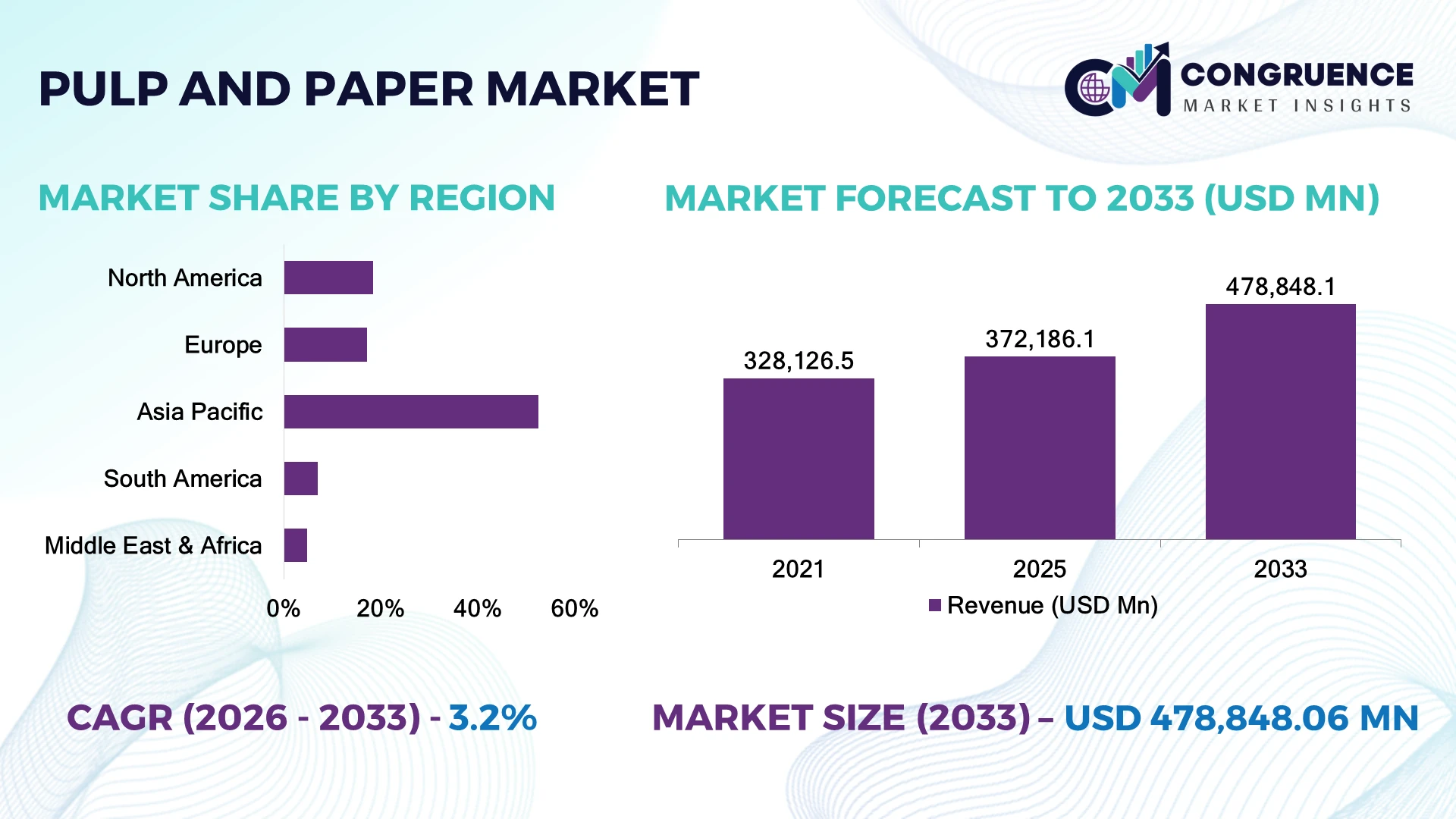
China remains the dominant production hub, accounting for more than 35% of global paper output, supported by integrated pulp, paper, packaging, and converting capacity. Its production scale exceeds the United States by more than 2 times, while India is expanding faster through packaging and tissue investments. Digital process optimization can reduce selected mill energy consumption by 10–20%. Supply-chain restructuring linked to geopolitical tensions and freight volatility is reinforcing regional sourcing and integrated production strategies.
Strategically, producers with fiber security, energy-efficient mills, and packaging exposure are best positioned to capture value through 2033.
Market Size & Growth: USD 372.2 billion in 2025 to USD 478.8 billion by 2033 at 3.2% CAGR, driven by packaging conversion and tissue demand.
Top Growth Drivers: Packaging substitution 42%, e-commerce logistics 31%, tissue consumption 18%.
Short-Term Forecast: By 2028, digital mill optimization can improve throughput 5–10% while reducing selected energy inputs 10–15%.
Emerging Technologies: AI process control, predictive maintenance, machine vision, and digital twins are improving yield, quality, and mill uptime.
Regional Leaders: Asia-Pacific leads with China above 35% of paper output; Europe emphasizes recycled fiber; North America prioritizes automation and high-performance packaging.
Consumer/End-User Trends: Packaging grades represent more than 50% of global paper demand, reflecting substitution away from rigid materials.
Pilot/Case Example: 2025 AI optimization applications demonstrated potential energy savings of up to 15% in mechanical refining and 10–20% in drying processes.
Competitive Landscape: Major producers including International Paper, Stora Enso, UPM, Smurfit Westrock, and Nine Dragons compete through scale, fiber access, packaging integration, and mill efficiency.
Regulatory & ESG Impact: Recycled-fiber adoption, water-efficiency programs, and decarbonization investments are pushing mills toward 10–20% lower energy intensity in targeted processes.
Investment & Funding: Multi-billion-dollar mill modernization programs are concentrating capital on packaging capacity, recycled fiber, automation, and renewable-energy integration.
Innovation & Future Outlook: Advanced barrier papers, fiber-based packaging, AI-controlled production, and low-carbon pulping will shift competition toward integrated, resource-efficient manufacturing.
The Pulp and Paper Market is being reshaped by packaging conversion, recycled-fiber processing, tissue production, and premium specialty papers. Packaging grades increasingly account for more than half of global paper demand, while mill operators are integrating AI, machine vision, and predictive maintenance to improve yield and reduce energy intensity. In 2026, geopolitical disruptions and freight volatility are strengthening interest in regional fiber sourcing and vertically integrated production. These shifts are moving investment toward high-efficiency mills and value-added packaging applications.
The Pulp and Paper Market is becoming strategically important because packaging conversion, fiber security, energy costs, and decarbonization now directly determine mill competitiveness. Producers are restructuring portfolios toward containerboard, cartonboard, tissue, and specialty grades while reducing exposure to structurally weaker graphic-paper categories. The shift is particularly pronounced as geopolitical disruptions and freight volatility increase the value of localized fiber supply and integrated manufacturing.
Technology is becoming a measurable cost lever rather than an optional modernization layer. AI-assisted process optimization can deliver up to 15% energy savings in mechanical refining, while optimization across dewatering and drying can reduce energy consumption by approximately 10–20%. European producers emphasize recycled fiber and energy efficiency, whereas Chinese and Indian manufacturers are concentrating on capacity scale, packaging integration, and domestic supply-chain control.
Through 2026–2028, mills with predictive maintenance, automated quality control, and real-time energy management should target 5–10% throughput improvement and lower unplanned downtime. Companies are prioritizing brownfield modernization, renewable-energy integration, strategic fiber contracts, and packaging partnerships. Competitive advantage will increasingly depend on combining secure raw materials with digitally optimized, low-cost production.
Packaging substitution is accelerating pulp and paper demand as e-commerce, food delivery, and consumer-goods producers replace rigid plastics with fiber-based formats. Packaging grades already represent more than 50% of global paper consumption, while recycled-fiber utilization in major converting markets continues to expand. China, India, and Indonesia are adding containerboard and cartonboard capacity to localize supply and reduce imported packaging exposure. At mill level, AI process control and predictive maintenance can improve production efficiency by 5–10% and reduce selected energy consumption by 10–15%. Companies are responding through brownfield expansion, automated quality systems, and integrated pulp-to-packaging assets. The strategic advantage is shifting toward producers that control fiber inputs while rapidly converting capacity toward higher-value packaging grades.
Pulp and paper producers remain exposed to volatile wood fiber, recovered paper, chemicals, and electricity costs, creating direct pressure on mill margins. Energy can represent approximately 10–20% of manufacturing costs at energy-intensive facilities, while recovered-paper quality variations can increase rejects and processing losses by 3–8%. European mills face additional pressure from carbon-related compliance and elevated energy costs, whereas Asian producers remain sensitive to imported pulp and recovered-fiber availability. Freight disruption can further increase delivered input costs by double-digit percentages on exposed trade lanes. Companies are responding through long-term fiber contracts, supplier diversification, mill-level energy optimization, and greater recycled-fiber sourcing. The operational priority is securing predictable feedstock and power economics before adding capacity.
Advanced barrier papers create a high-value opportunity as converters seek recyclable alternatives to multilayer plastic packaging. Water-, grease-, and oxygen-resistant fiber structures can expand paper applications across foodservice, pharmaceutical, personal-care, and industrial packaging, with targeted performance improvements of 10–20% versus conventional grades. India and Southeast Asian manufacturing hubs offer additional opportunity as packaged-food and organized retail penetration increases. Digital mill controls can simultaneously improve yield by 3–7%, making specialty-grade production more commercially attractive without proportional capacity additions. Producers are investing in coating technologies, fiber chemistry, pilot lines, and converter partnerships to accelerate qualification cycles. The less-obvious opportunity lies in combining recycled fiber with functional coatings, allowing mills to compete on sustainability credentials without sacrificing barrier performance.
Long-term competitiveness increasingly depends on modernizing aging mills without disrupting continuous production. Older facilities can face energy-intensity gaps of 10–25% against optimized operations, while water-intensive processes require substantial reductions in freshwater use and effluent loading. Workforce shortages further complicate modernization because advanced automation requires operators capable of managing distributed-control systems, analytics, and predictive maintenance. In Finland, Sweden, Canada, and the United States, established mills are therefore combining electrification, biomass energy, heat recovery, and automated process control rather than relying solely on new capacity. Companies must allocate capital to phased retrofits, workforce reskilling, cybersecurity, and digital infrastructure. The strategic challenge is achieving measurable carbon and productivity improvements while maintaining uptime, product consistency, and asset utilization during transformation.
Packaging Grades Reshape Mill Portfolios Packaging and containerboard increasingly absorb capacity previously directed toward graphic paper, with packaging applications representing more than 50% of global paper consumption. Producers are reallocating 10–20% of selected mill capacity toward higher-value grades, responding to e-commerce logistics and plastic-reduction initiatives. Integrated mills are accelerating conversion projects and strengthening converter partnerships.
AI Moves Into Mill Operations AI-based process optimization, machine vision, and predictive maintenance are moving from isolated pilots into production environments. Automated monitoring can improve selected process efficiencies by 5–10% while reducing unplanned downtime by approximately 10–15%. Finnish, Swedish, and North American mills are prioritizing real-time analytics, digital twins, and automated quality inspection to offset skilled-labor constraints.
Recovered Fiber Quality Becomes Strategic Recycled-fiber utilization is expanding, but contamination and inconsistent furnish quality are increasing sorting and processing requirements. Advanced optical sorting and automated bale inspection can improve usable-fiber recovery by roughly 5–10%. Producers are investing in collection partnerships, pulping optimization, and higher-precision screening because fiber quality increasingly determines both production yield and sustainability performance.
Low-Carbon Mill Retrofits Accelerate Energy-intensive mills are combining heat recovery, electrification, biomass fuels, and closed-loop water systems as carbon requirements tighten. Targeted modernization programs can reduce energy intensity by 10–20% and freshwater consumption by 15–30%. Companies are favoring phased retrofits over complete rebuilds, protecting production continuity while improving environmental performance and lowering long-term operating exposure.
Packaging Grades Lead as Graphic Paper Contracts
Packaging paper and paperboard represent the leading type, accounting for approximately 64% of European paper and board production in 2025, reflecting the structural shift toward containerboard, wrapping, and retail packaging. Containerboard alone increased 1.7%, while graphic paper production declined 7.3%, reinforcing investment migration toward packaging assets. Tissue remains a resilient mature category, supported by hygiene consumption, while specialty paper is gaining strategic relevance through barrier, functional, and high-performance applications. Companies are converting underutilized graphic-paper machines toward packaging grades and upgrading coating and converting capabilities.
The fastest-growing type is specialty paper, supported by demand for recyclable barrier formats, technical substrates, and high-value industrial applications. Its strategic advantage is higher value density rather than production scale, with specialty grades representing roughly 10% of European paper and board output when enhanced-property grades are included. Producers are prioritizing R&D, coating technologies, and converter partnerships, while maintaining tissue capacity for stable recurring demand. This portfolio shift is directing capital away from declining print grades toward differentiated packaging and specialty products.
The Confederation of European Paper Industries reported that packaging grades represented 63.9% of European paper and board production in 2025, while graphic grades accounted for 20.8%, confirming a decisive capacity shift toward packaging applications.
Packaging Applications Command Industrial Demand
Packaging is the leading application, representing approximately 64% of European paper and board production and concentrating demand around containerboard, cartonboard, wrapping, and transport packaging. Its scale is reinforced by e-commerce fulfillment, food distribution, and consumer-goods logistics, making packaging capacity more operationally critical than print-oriented applications. Containerboard production increased 1.7% in 2025, while wrapping paper rose 1.0%, demonstrating stronger resilience than traditional graphic applications. Producers are converting machines, expanding corrugated-board integration, and optimizing fiber utilization to protect margins.
The fastest-growing application is fiber-based sustainable packaging, where recyclable barrier papers and lightweight structures are replacing selected plastic formats. Adoption is being accelerated by packaging redesign, retailer sustainability targets, and regulatory pressure on difficult-to-recycle materials. Tissue and hygiene applications remain mature but dependable, while printing and publishing continue contracting; European graphic-paper production fell 7.3% in 2025. Companies are therefore shifting investment toward high-speed converting, barrier coatings, digital quality control, and integrated packaging ecosystems. The strongest demand concentration is moving toward applications where fiber performance directly affects logistics efficiency and regulatory compliance.
The American Forest & Paper Association reported that U.S. packaging paper production increased 1.7% in 2025, while containerboard continued to represent more than half of total U.S. paper and paperboard capacity, demonstrating packaging's operational importance.
Consumer Goods and Logistics Drive Purchasing
Consumer goods manufacturers and retailers form the leading end-user group, accounting for an estimated 40% of global paper and paperboard demand through packaging, cartons, labels, and transport materials. Their purchasing intensity reflects high-volume replenishment and strict requirements for strength, printability, barrier performance, and delivery reliability. Food and beverage producers represent a particularly important subsegment because packaging directly supports shelf life and distribution efficiency. Companies are responding with customized grades, lightweighting programs, recycled-fiber formulations, and long-term supply agreements.
E-commerce and logistics is the fastest-growing end-user group, supported by increasing parcel volumes and pressure to reduce packaging weight and fossil-based materials. Its share of incremental packaging demand is estimated at more than 25%, compared with slower growth across traditional publishing and office-paper users. Healthcare, pharmaceuticals, and industrial manufacturers remain strategically important because they require specialized grades with traceability, hygiene, or technical performance. Producers are targeting these buyers through application-specific R&D, converter partnerships, and localized inventory. The competitive priority is shifting from commodity tonnage toward reliable, specification-driven supply.
The American Forest & Paper Association reported a 91.9% operating rate for U.S. containerboard mills in 2025, indicating sustained industrial utilization and strong operational dependence on packaging-grade supply.
Asia-Pacific accounted for the largest market share at 52.4% in 2025 however, South America is expected to register the fastest growth, expanding at a CAGR of 4.1% between 2026 and 2033.

Packaging conversion and mill modernization reshape capacity
North America remains a high-value pulp and paper market anchored by containerboard, tissue, folding carton, and specialty grades. The United States accounts for the majority of regional production, with packaging and tissue increasingly absorbing investment previously directed toward declining printing papers. Containerboard operating rates remain above 90%, supporting disciplined capacity utilization, while mill operators are deploying AI process controls, automated quality inspection, and predictive maintenance to improve throughput. Canada retains a strategic advantage in softwood fiber availability and integrated pulp production, strengthening cross-border supply. Producers are also investing in biomass energy, heat recovery, and recycled-fiber processing to reduce energy exposure and improve asset productivity. The regional competitive shift favors integrated producers that combine fiber security, converting capacity, and efficient logistics rather than relying solely on commodity paper volumes.
United States Market Outlook: The United States remains the region's principal production and consumption hub, supported by extensive containerboard, tissue, corrugated packaging, and pulp infrastructure. Packaging grades dominate mill utilization, while automated inspection and predictive maintenance are expanding across large facilities. Investments increasingly prioritize machine conversions, recycled-fiber capability, and energy-efficient drying systems, strengthening domestic supply resilience.
Circular fiber economics drive structural portfolio change
Europe is shifting capital toward packaging, tissue, specialty grades, and recycled-fiber infrastructure while graphic-paper capacity continues contracting. Packaging accounted for approximately 64% of European paper and board production in 2025, making it the dominant industrial grade category. Finland, Sweden, and Germany remain important production and technology hubs, combining established mills with advanced automation, biomass energy, and closed-loop water systems. European producers are also responding to tighter environmental requirements by improving fiber recovery, reducing freshwater intensity, and replacing fossil-based process energy. Mill modernization increasingly targets 10–20% energy-efficiency improvements through heat recovery, electrification, and digital process control. The strategic priority is converting legacy assets toward higher-value grades without compromising production continuity or environmental performance.
Germany Market Outlook: Germany remains a major European paper-processing and converting center, supported by sophisticated packaging, printing, recycling, and industrial manufacturing ecosystems. Recovered fiber plays a central role in domestic production, while automated sorting and quality-control systems improve furnish consistency. Producers are prioritizing lightweight packaging, energy-efficient machinery, and closed-loop material flows to protect margins under elevated energy and compliance costs.
Scale, packaging integration, and domestic supply control
Asia-Pacific holds the largest global production position, led by China, Japan, India, Indonesia, and South Korea. China alone contributes more than one-third of worldwide paper output, supported by integrated pulp, paper, packaging, and converting capacity. India is expanding containerboard, tissue, and cartonboard production as organized retail, food processing, and e-commerce logistics deepen. Indonesian and Southeast Asian producers retain advantages in plantation-based fiber and export-oriented pulp manufacturing. Mill investments increasingly combine high-speed machines with AI-based process control, automated inspection, and energy management, enabling productivity improvements of roughly 5–10% in targeted operations. Companies are also localizing fiber and packaging supply chains to reduce exposure to freight volatility and imported furnish. Competitive advantage increasingly rests on scale plus vertical integration rather than standalone paper capacity.
China Market Outlook: China is the dominant country in the global pulp and paper industry, contributing more than 35% of worldwide paper production and maintaining extensive integrated manufacturing capacity. Its large domestic packaging market supports high machine utilization and rapid conversion toward containerboard and cartonboard. Producers are investing heavily in automation, recycled-fiber processing, energy efficiency, and integrated converting, reinforcing China's cost and supply-chain advantage.
Plantation fiber economics strengthen export-oriented pulp
South America is emerging as a strategically important pulp production base, with Brazil dominating regional capacity through large-scale eucalyptus plantations, integrated mills, and export infrastructure. Chile also maintains a strong forestry and pulp ecosystem. Brazil's plantation-based fiber model provides short rotation cycles and competitive wood costs, supporting large mill projects and global pulp supply. New capacity and modernization programs are increasingly concentrated around high-efficiency kraft pulping, biomass energy, and automated material handling. Producers are targeting energy savings of roughly 10–15% through recovery systems and process optimization while improving logistics from inland forests to export terminals. The region's opportunity is strongest in market pulp and integrated forestry assets, although transport infrastructure and long-distance logistics remain critical cost variables. Companies are responding with vertically integrated plantations, dedicated logistics, and long-term export contracts.
Brazil Market Outlook: Brazil is the region's dominant pulp producer because of its extensive eucalyptus plantation base, competitive fiber economics, and integrated forestry-to-port infrastructure. Large-scale mills operate with advanced kraft pulping, biomass recovery, and automated material handling. Plantation productivity can exceed 35 cubic meters of wood per hectare annually in leading commercial systems, supporting reliable feedstock availability. Continued investment in mill efficiency and logistics strengthens Brazil's position as a low-cost global pulp supplier.
Import substitution and packaging infrastructure accelerate
Middle East and Africa demand is increasingly concentrated in tissue, corrugated packaging, cartonboard, and hygiene products, supported by urbanization, food processing, retail modernization, and logistics development. Saudi Arabia, the United Arab Emirates, Egypt, and South Africa are important manufacturing and converting hubs, while several markets remain dependent on imported pulp or finished paper. Packaging conversion capacity is expanding as regional manufacturers seek shorter supply chains and greater control over product availability. Tissue and hygiene production is particularly attractive because localized converting reduces dependence on imported finished products. New facilities increasingly incorporate automated converting, energy-efficient drying, and recycled-fiber processing, targeting 5–10% productivity improvements. Companies are responding through domestic capacity additions, regional partnerships, and integrated converting operations. The strategic opportunity lies in replacing imports with efficient local production while overcoming fiber availability and logistics constraints.
Saudi Arabia Market Outlook: Saudi Arabia is strategically positioned as a regional paper and packaging hub because of its large consumer market, industrial diversification agenda, and expanding logistics infrastructure. Investment is concentrated on tissue, packaging conversion, and downstream paper products rather than plantation-based pulp production. Modern facilities increasingly emphasize automated converting and energy-efficient operations, improving production consistency while reducing reliance on imported finished paper products.
International Paper and DS Smith compete with Stora Enso, UPM, Suzano, Mondi, and integrated regional producers across packaging, pulp, and specialty grades. Global scale leaders compete against cost-focused Latin American pulp producers and Asian capacity operators. The top five players collectively hold approximately 16% of global pulp and paper sales, leaving meaningful fragmentation. Fiber security influences roughly 35% of purchasing decisions, while energy efficiency affects 20–25% of mill competitiveness and packaging conversion increasingly determines 30% or more of strategic capacity allocation. Players compete through mill conversions, acquisitions, forestry integration, long-term fiber contracts, automation, and specialty-grade innovation. International Paper’s DS Smith combination illustrates consolidation toward integrated packaging platforms, while Stora Enso’s Oulu investment reinforces high-value board capacity. The shift is moving from commodity volume toward supply control, recyclable packaging, and digitally optimized mills. Entry barriers remain high because of capital intensity, forest assets, logistics, and environmental compliance. Winning requires secure fiber, efficient assets, differentiated grades, and dependable customer integration.
International Paper
Stora Enso
UPM-Kymmene Corporation
Suzano S.A.
Nine Dragons Paper Holdings
Oji Holdings Corporation
Nippon Paper Industries Co., Ltd.
Sappi Limited
Mondi plc
Smurfit Westrock plc
Lee & Man Paper Manufacturing Limited
The Navigator Company
AI process control, digital twins, machine vision, and predictive maintenance are moving from pilots into core mill operations. Advanced analytics can improve targeted throughput by 5–10% and reduce selected energy consumption by 10–15%, while automated inspection cuts quality-related waste by approximately 2–5%. Adoption is strongest at large integrated mills with sensor infrastructure across high-volume continuous production environments globally. AI-assisted optimization can outperform operator-only control by roughly 5–8% on targeted efficiency measures, giving producers with modern automation a clear cost advantage.
Next-generation fiber processing combines advanced refining, enzyme-assisted pulping, lightweighting, and functional coatings. Lightweight packaging boards can reduce material consumption by up to 20–30% for selected applications while maintaining strength. Digital fiber characterization and automated sorting can improve recovered-fiber yield by approximately 5–10%, strengthening recycled-content economics. Producers with integrated forestry, pulp, board, and converting assets benefit most because technology gains compound across the value chain.
From 2026 to 2028, mills will increasingly integrate AI with ERP, maintenance, energy-management, and supply-planning systems. Automated decisions on furnish, steam, chemicals, and machine speed should improve operating consistency while reducing downtime by 10–15%. The strongest competitive advantage will go to producers combining secure fiber supply with digitally optimized, low-carbon assets rather than isolated automation tools.
January 2025 International Paper completed its DS Smith acquisition for approximately $9.9 billion, combining packaging assets across North America and Europe. The transaction strengthened integrated packaging scale and supply-chain control, accelerating portfolio concentration toward sustainable fiber-based packaging. Source: International Paper
March 2025 Stora Enso began production ramp-up at its Oulu packaging board line, backed by approximately €1 billion investment and 750,000 tonnes annual capacity. The conversion redirects legacy paper capacity toward higher-value board, strengthening European packaging supply. Source: Stora Enso
April 2025 Mondi started its Duino recycled containerboard machine in Italy following a €200 million investment. The converted machine will produce 420,000 tonnes annually using recovered fiber, strengthening backward integration, supply security, and recycled packaging capacity for customers. Source: Mondi
December 2025 Suzano started a fluff pulp production line in Brazil after investing R$490 million. The project increased fluff pulp capacity from 100,000 to 440,000 tonnes annually, strengthening supply for absorbent hygiene products and expanding flexible pulp operations. Source: Suzano
The Pulp and Paper Market Report evaluates the industry across pulp grades, paper, paperboard, packaging materials, tissue, specialty papers, and emerging fiber-based products. Application coverage spans packaging, printing and publishing, hygiene, foodservice, industrial, healthcare, and consumer uses, with end-user analysis covering manufacturers, converters, retailers, institutions, and commercial enterprises. The assessment identifies mature grades alongside higher-growth packaging and specialty niches.
Regional analysis covers North America, Europe, Asia-Pacific, South America, and the Middle East & Africa, emphasizing production concentration, fiber availability, mill capacity, recycling infrastructure, trade exposure, and modernization activity. Technology coverage includes AI process control, predictive maintenance, machine vision, digital twins, advanced fiber processing, automated sorting, and low-carbon mill systems. The report supports investment planning, capacity conversion, sourcing strategy, partnership evaluation, competitive positioning, and technology prioritization through 2033.
| Report Attribute/Metric | Report Details |
|---|---|
|
Market Revenue in 2025 |
USD 372,186.1 Million |
|
Market Revenue in 2033 |
USD 478,848.1 Million |
|
CAGR (2026 - 2033) |
3.2% |
|
Base Year |
2025 |
|
Forecast Period |
2026 - 2033 |
|
Historic Period |
2021 - 2025 |
|
Segments Covered |
By Type
By Application
By End-User
|
|
Key Report Deliverable |
Revenue Forecast, Growth Trends, Market Dynamics, Segmental Overview, Regional and Country-wise Analysis, Competition Landscape |
|
Region Covered |
North America, Europe, Asia-Pacific, South America, Middle East, Africa |
|
Key Players Analyzed |
International Paper, Stora Enso, UPM-Kymmene Corporation, Suzano S.A., Nine Dragons Paper Holdings, Oji Holdings Corporation, Nippon Paper Industries Co., Ltd., Sappi Limited, Mondi plc, Smurfit Westrock plc, Lee & Man Paper Manufacturing Limited, The Navigator Company |
|
Customization & Pricing |
Available on Request (10% Customization is Free) |




