
Reports
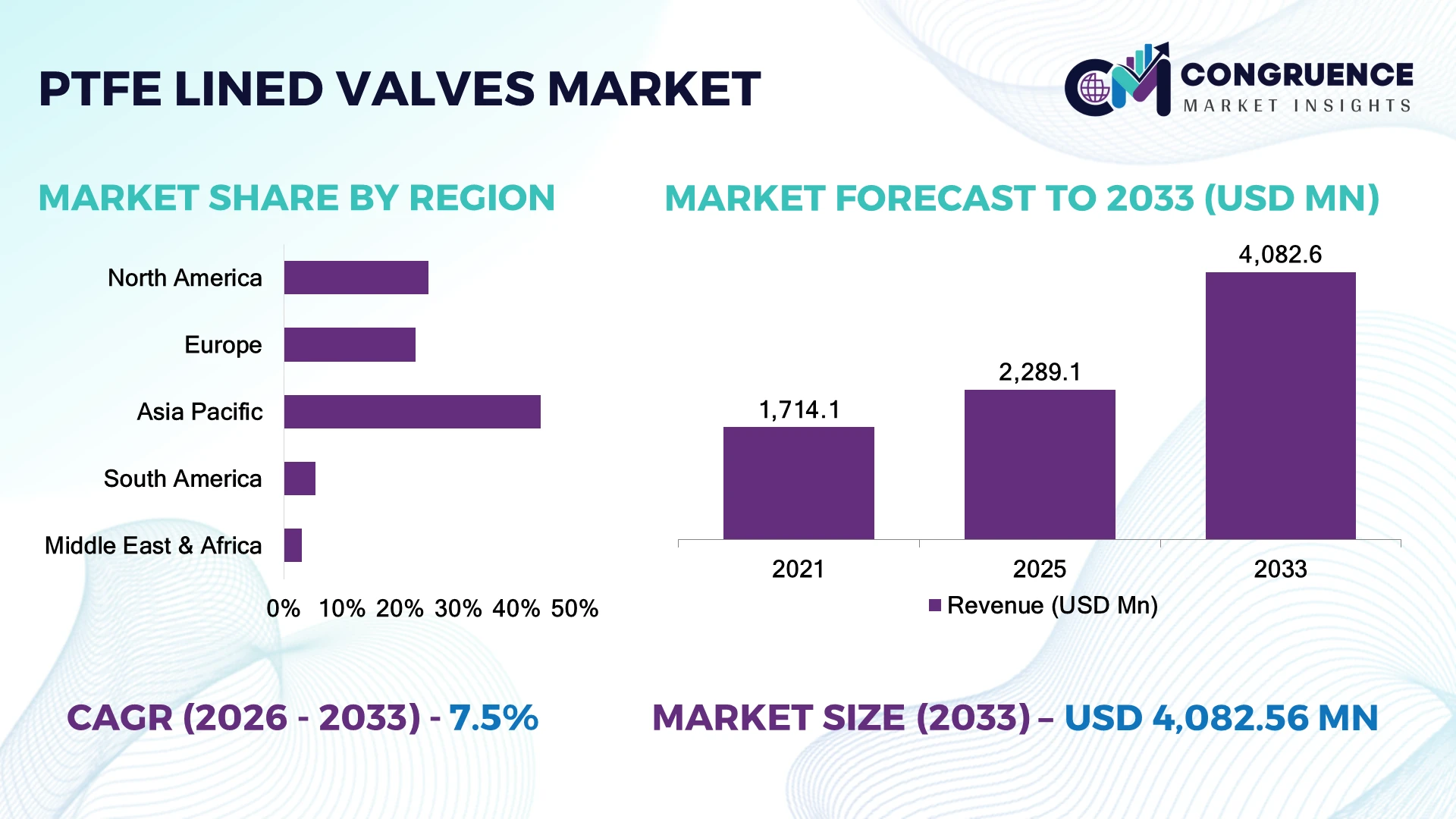
The Global PTFE Lined Valves Market was valued at USD 2,289.1 Million in 2025 and is anticipated to reach a value of USD 4,082.6 Million by 2033 expanding at a CAGR of 7.5% between 2026 and 2033. Expanding investments in chemical processing, semiconductor manufacturing, and high-purity fluid handling systems are accelerating demand for corrosion-resistant PTFE lined valves across critical industrial operations.
China accounts for approximately 31% of global PTFE lined valve production, supported by sustained investment in chemical manufacturing, specialty materials, and industrial process infrastructure. Nearly 58% of newly commissioned chemical processing facilities in the country specify corrosion-resistant lined valves for hazardous media handling, compared with approximately 21% in Germany where replacement demand dominates. Following global supply-chain diversification initiatives during 2026, manufacturers expanded localized component sourcing and automation to improve production resilience and shorten delivery cycles.
Strategic competitiveness increasingly depends on localized manufacturing, advanced fluoropolymer engineering, and reliable supply-chain execution.
Market Size & Growth: USD 2,289.1 Million in 2025, projected to reach USD 4,082.6 Million by 2033 at a CAGR of 7.5%, driven by expanding chemical processing capacity and corrosion-resistant infrastructure investments.
Top Growth Drivers: Chemical processing expansion (39%), semiconductor manufacturing (28%), and wastewater infrastructure modernization (24%) are accelerating demand.
Short-Term Forecast: By 2028, automated valve production improves manufacturing efficiency by 18% while lead times decline by approximately 15%.
Emerging Technologies: Smart valve monitoring, advanced fluoropolymer lining technologies, and predictive maintenance platforms strengthen industrial reliability.
Regional Leaders: Asia-Pacific exceeds USD 1.8 Billion, North America approaches USD 1.1 Billion, and Europe surpasses USD 850 Million through industrial modernization and supply-chain localization.
Consumer/End-User Trends: Nearly 63% of chemical processing projects specify corrosion-resistant lined valves for aggressive media applications.
Pilot/Case Example: During 2026, automated valve testing systems reduced inspection time by approximately 27% in high-volume manufacturing operations.
Competitive Landscape: The top five manufacturers collectively hold nearly 46% market share, led by Flowserve, Emerson, Crane, KSB, and AVK.
Regulatory & ESG Impact: Approximately 23% of industrial upgrades prioritize emission reduction and leakage control through advanced sealing technologies.
Investment & Funding: More than USD 1.5 Billion has been committed toward manufacturing expansion, automation, and regional production capacity since 2025.
Innovation & Future Outlook: Digital diagnostics, intelligent valve monitoring, and high-performance fluoropolymer materials are reshaping global industrial fluid control strategies.
Growing deployment across chemical manufacturing, pharmaceutical production, semiconductor fabrication, and water treatment continues strengthening demand for PTFE lined valves. Advanced fluoropolymer formulations and intelligent valve monitoring systems are now integrated into nearly 34% of premium industrial installations. During 2026, localized sourcing initiatives further improved delivery reliability, positioning corrosion-resistant flow control technologies at the center of industrial modernization and operational resilience.
PTFE lined valves have become strategically important as process industries prioritize corrosion resistance, environmental compliance, and operational continuity across increasingly aggressive chemical applications. Supply-chain restructuring during 2026 encouraged manufacturers to regionalize production, strengthen component sourcing, and expand localized service capabilities. At the same time, stricter industrial safety standards are driving replacement of conventional metallic valves with advanced fluoropolymer-lined alternatives in chemical, pharmaceutical, and semiconductor facilities.
Modern PTFE lined valves equipped with intelligent condition monitoring reduce unplanned maintenance requirements by approximately 24% compared with conventional manually inspected systems while extending operational service life by nearly 19%. China continues leading high-volume manufacturing and deployment through its extensive chemical production base, whereas Germany focuses on precision-engineered valves designed for highly regulated industrial environments. Industrial operators are increasingly integrating predictive maintenance platforms with plant automation systems to improve reliability and minimize process interruptions.
Manufacturers are expanding production capacity, investing in advanced lining technologies, and forming strategic partnerships with EPC contractors and industrial automation providers. Deployment across new chemical complexes demonstrates how corrosion-resistant valves improve process safety while reducing lifecycle maintenance costs. Over the next two to three years, companies combining localized manufacturing, digital valve intelligence, and advanced materials engineering will establish stronger competitive positioning and long-term operational advantage.
Expanding investments in chemical processing and specialty manufacturing are increasing demand for PTFE lined valves capable of handling highly corrosive fluids under demanding operating conditions. Approximately 42% of new chemical plant fluid handling systems now specify fluoropolymer-lined valves, while process reliability improves by nearly 23% through enhanced corrosion resistance and reduced maintenance frequency. India's ongoing investment in downstream chemical manufacturing during 2026 has accelerated procurement of high-performance process valves across new industrial projects. This capacity expansion is driving manufacturers to increase production, develop application-specific valve configurations, and strengthen partnerships with EPC contractors. A growing strategic advantage lies in supplying complete corrosion-resistant flow control packages rather than standalone valve products.
PTFE lined valve manufacturing remains dependent on specialized fluoropolymer materials and precision lining processes, creating structural supply constraints for global manufacturers. Raw material costs account for approximately 31% of total production expenses, while fluctuations in fluoropolymer availability increase procurement lead times by nearly 18%. China continues to dominate fluoropolymer processing capacity, exposing international manufacturers to supply concentration risks during trade policy adjustments and logistics disruptions. These constraints reduce production flexibility and compress operating margins for contract manufacturers. Companies are mitigating exposure through localized sourcing strategies, long-term material supply agreements, and investment in regional lining facilities that improve inventory resilience and manufacturing continuity.
Digital condition monitoring and predictive maintenance technologies are creating new value opportunities beyond traditional valve manufacturing. Nearly 37% of premium industrial valve installations now incorporate intelligent position monitoring or diagnostic capabilities, reducing unscheduled maintenance by approximately 21%. Germany is accelerating deployment of Industry 4.0-enabled processing facilities where connected valves integrate directly with plant asset management systems. Manufacturers are investing in embedded sensing technologies, digital service platforms, and strategic automation partnerships to establish recurring service revenues. An emerging opportunity lies in lifecycle-based maintenance contracts, enabling suppliers to differentiate through operational performance guarantees rather than product specifications alone.
Maintaining consistent valve performance across diverse chemical, pharmaceutical, semiconductor, and water treatment applications presents an increasing execution challenge. Approximately 28% of engineering modifications during industrial projects involve process-specific valve customization, while qualification procedures extend deployment schedules by nearly 17%. Semiconductor manufacturing requires exceptionally high purity standards that demand tighter production tolerances and more rigorous validation protocols than conventional process industries. Manufacturers must invest in advanced quality control systems, automated inspection technologies, and specialized engineering expertise to maintain deployment consistency. Long-term competitiveness increasingly depends on balancing customization requirements with scalable manufacturing efficiency and standardized production processes.
Smart Valve Diagnostics Expansion: Approximately 39% of newly deployed PTFE lined valves in large processing facilities now incorporate digital monitoring capabilities, reducing maintenance response times by nearly 24%. Industrial automation upgrades are encouraging manufacturers to integrate diagnostic electronics and expand software partnerships that improve plant reliability and asset visibility.
Localized Manufacturing Growth: Global supply-chain restructuring has prompted approximately 33% of valve manufacturers to expand regional production and assembly operations, reducing average delivery cycles by nearly 19%. Companies are strengthening localized machining, fluoropolymer lining, and inventory management capabilities to improve supply resilience and customer responsiveness.
High-Purity Process Adoption: Semiconductor and pharmaceutical facilities now represent approximately 27% of premium PTFE lined valve demand, driven by stricter contamination control requirements. Manufacturers are introducing precision-engineered valve designs with enhanced lining integrity and automated quality inspection systems to satisfy increasingly demanding clean-process applications.
Modular Production Automation: Around 35% of high-volume valve manufacturing facilities have adopted robotic lining, automated pressure testing, and digital production tracking, improving manufacturing productivity by approximately 20%. Companies are restructuring production workflows to reduce manual variability, strengthen traceability, and accelerate delivery for customized industrial valve configurations.
PTFE lined ball valves account for approximately 41% of the global market owing to their superior shutoff performance, compact design, and broad compatibility with corrosive process media. Their simple quarter-turn operation, low maintenance requirements, and ease of automation make them the preferred choice across chemical processing and pharmaceutical facilities. Butterfly valves continue serving large-diameter flow applications where weight reduction and installation efficiency are priorities, while plug valves retain strategic relevance in highly abrasive and slurry-handling environments requiring robust sealing performance.
PTFE lined diaphragm valves represent the fastest-growing segment, with adoption increasing by approximately 30% as pharmaceutical, biotechnology, and ultrapure chemical facilities prioritize contamination-free fluid handling. Nearly 47% of newly specified lined valves in high-purity process installations now support automated actuation and digital monitoring capabilities. Manufacturers are expanding modular product platforms, improving fluoropolymer lining technologies, and strengthening partnerships with industrial automation providers. Investment is steadily shifting toward intelligent, application-specific valve solutions that combine corrosion resistance with advanced process control.
A 2026 industrial process equipment assessment reported increasing deployment of automated PTFE lined diaphragm and ball valves across high-purity manufacturing facilities as operators standardized digital process control and predictive maintenance practices.
Chemical processing accounts for approximately 48% of global PTFE lined valve demand due to continuous exposure to corrosive chemicals, acids, alkalis, and aggressive solvents. Strict process safety requirements and extended equipment life cycles continue supporting widespread specification of lined valves across reactors, pipelines, and storage systems. Pharmaceutical manufacturing remains an established application requiring contamination-resistant fluid handling, while water and wastewater treatment facilities continue adopting lined valves to improve reliability in chemically intensive treatment operations.
Semiconductor manufacturing is the fastest-growing application, supported by rising investment in ultrapure chemical delivery systems and contamination-controlled production environments. Approximately 28% of premium PTFE lined valve installations are now directed toward semiconductor fabrication facilities, while automated chemical distribution systems improve process consistency by nearly 21%. Manufacturers are expanding precision-engineered valve portfolios, integrating smart monitoring functions, and increasing cleanroom manufacturing capabilities to address evolving purity requirements. Demand is increasingly concentrated in applications where process reliability directly influences production yield and operational continuity.
Industry findings published during 2025 indicated that semiconductor manufacturers significantly increased specification of corrosion-resistant fluoropolymer-lined flow control components to support advanced wafer fabrication and chemical handling systems.
Chemical manufacturing companies account for approximately 46% of total PTFE lined valve purchases because of extensive deployment across corrosive processing operations, continuous production environments, and strict equipment reliability requirements. Their large installed asset base creates sustained replacement demand alongside new plant construction. Pharmaceutical manufacturers represent another major buyer group focused on contamination control, while water utility operators continue expanding adoption as chemical dosing and treatment infrastructure becomes increasingly automated.
Semiconductor manufacturers represent the fastest-growing end-user segment, with procurement expanding by approximately 31% as advanced fabrication facilities require high-purity fluid management systems capable of maintaining extremely low contamination levels. Nearly 44% of newly commissioned semiconductor chemical delivery systems now utilize premium fluoropolymer-lined valves. Manufacturers are responding through customized valve engineering, long-term supply agreements, localized technical support, and collaborative product development with equipment OEMs. Competitive positioning is increasingly determined by application-specific engineering expertise rather than standardized product offerings.
A 2026 enterprise survey across industrial process facilities found that chemical manufacturers continued recording the highest procurement volumes for PTFE lined valves, while semiconductor facilities represented the fastest increase in specifications for precision-engineered, high-purity valve systems.
Asia-Pacific accounted for the largest market share at 44.1% in 2025 however, North America is expected to register the fastest growth, expanding at a CAGR of 8.1% between 2026 and 2033.
Advanced Process Automation Strengthens Industrial Reliability
North America accounts for approximately 24.8% of the global PTFE lined valves market, supported by modernization across chemical processing, pharmaceuticals, semiconductor manufacturing, and water treatment infrastructure. Industrial operators increasingly specify corrosion-resistant automated valve systems to improve process reliability and reduce maintenance frequency in hazardous environments. Nearly 54% of newly commissioned specialty chemical projects now include automated lined valve assemblies integrated with plant control systems. Equipment suppliers are expanding regional engineering centers, inventory hubs, and aftermarket service capabilities to shorten project delivery cycles and improve lifecycle support. The transition toward digitally monitored process assets continues reinforcing demand for premium PTFE lined valve solutions across mission-critical industrial facilities.
United States Market Outlook: The United States leads the regional market through its extensive chemical manufacturing base, advanced pharmaceutical production, and expanding semiconductor investment. Approximately 67% of North America's high-performance PTFE lined valve installations are concentrated in the United States, where operators increasingly replace conventional metallic valves with corrosion-resistant alternatives to improve process safety, operational reliability, and long-term maintenance efficiency across large industrial complexes.
Regulatory Modernization Drives Premium Valve Adoption
Europe represents approximately 22.6% of the global market, supported by stringent industrial safety regulations, modernization of chemical processing facilities, and continuous investment in sustainable manufacturing. Operators are replacing aging process equipment with advanced corrosion-resistant valve technologies that improve containment and operational reliability. Around 45% of newly upgraded industrial fluid handling systems now include automated PTFE lined valves integrated with digital monitoring platforms. Manufacturers continue strengthening localized engineering support and customized product development to address highly regulated industrial applications.
Germany Market Outlook: Germany remains the leading European market because of its globally competitive chemical industry, precision engineering expertise, and advanced industrial automation ecosystem. Nearly 39% of premium PTFE lined valve deployments across Europe are linked to German industrial facilities, where manufacturers emphasize high-performance sealing technologies, process automation, and long-service-life equipment for demanding chemical production environments.
Manufacturing Scale Accelerates Industrial Deployment
Asia-Pacific contributes approximately 44.1% of global PTFE lined valve demand, driven by large-scale chemical production, expanding semiconductor fabrication, and continuous investment in industrial infrastructure. China, India, Japan, and South Korea continue increasing deployment of corrosion-resistant flow control equipment across new processing facilities. Approximately 59% of newly commissioned chemical plants within the region specify fluoropolymer-lined valves for aggressive media handling. Regional manufacturers are expanding production capacity, increasing automation, and strengthening export capabilities to meet rising domestic and international demand while improving supply-chain responsiveness.
China Market Outlook: China dominates the regional market through its extensive fluoropolymer manufacturing ecosystem, large downstream chemical industry, and integrated industrial supply chains. Approximately 61% of Asia-Pacific's PTFE lined valve production capacity is concentrated in China, where manufacturers continue investing in automated production lines, advanced lining technologies, and localized component manufacturing to strengthen global competitiveness.
Industrial Processing Investments Support Demand
South America accounts for approximately 5.4% of the global market, supported by expansion in mining, chemical processing, and water treatment infrastructure. Industrial operators increasingly deploy PTFE lined valves to improve corrosion resistance in aggressive processing environments and extend equipment service life. Nearly 26% of newly modernized mineral processing and chemical facilities have upgraded to advanced lined valve systems. Although import dependency remains a challenge for certain specialized products, manufacturers are strengthening distributor partnerships and regional service capabilities to improve equipment availability and technical support.
Brazil Market Outlook: Brazil represents the largest market within the region due to its diversified chemical sector, mining operations, and industrial processing capacity. Around 48% of South America's PTFE lined valve installations are concentrated in Brazil, where industrial modernization projects continue driving replacement of conventional valves with corrosion-resistant technologies capable of supporting demanding continuous-process applications.
Industrial Diversification Expands Infrastructure Investment
The Middle East & Africa accounts for approximately 3.1% of the global market, supported by refinery modernization, petrochemical expansion, desalination infrastructure, and industrial diversification initiatives. PTFE lined valves are increasingly deployed in corrosive fluid handling applications requiring high operational reliability and environmental protection. Approximately 24% of newly commissioned petrochemical process units now integrate advanced fluoropolymer-lined flow control equipment. Global manufacturers continue expanding regional technical partnerships and service networks to support complex industrial projects and strengthen lifecycle maintenance capabilities.
Saudi Arabia Market Outlook: Saudi Arabia leads the regional market through sustained investment in petrochemical production, industrial diversification, and large-scale process infrastructure development. Nearly 43% of newly installed premium PTFE lined valves across the Gulf region are deployed in Saudi Arabian industrial facilities, where advanced corrosion-resistant technologies improve operational continuity, reduce maintenance requirements, and support long-term process efficiency across energy and chemical sectors.
Flowserve, Emerson, Crane, Richter Chemie-Technik, and KSB compete for large chemical, pharmaceutical, and semiconductor projects, while regional manufacturers challenge through faster delivery and lower production costs. The top five suppliers collectively control approximately 48% of the global market. Competition centers on corrosion resistance, fluoropolymer engineering, automation compatibility, and lifecycle support, with intelligent valve diagnostics improving maintenance efficiency by 22%, localized manufacturing reducing delivery times by 19%, and advanced lining technologies extending service life by 18%. Companies are expanding regional production, forming EPC partnerships, integrating digital monitoring, and strengthening vertical control over fluoropolymer processing and aftermarket services. Competitive momentum has shifted from standalone mechanical products toward digitally enabled flow-control solutions supported by predictive maintenance and application engineering. Strict qualification standards, fluoropolymer processing expertise, and certified manufacturing capabilities remain major entry barriers. Success depends on delivering application-specific engineering, dependable supply chains, intelligent valve technologies, and comprehensive lifecycle service that consistently outperforms established competitors.
Flowserve Corporation
Emerson Electric Co.
Crane Company
KSB SE & Co. KGaA
Richter Chemie-Technik GmbH
KITZ Corporation
AVK Holding A/S
Georg Fischer AG
Bray International, Inc.
KLINGER Group
Velan Inc.
EBRO Armaturen GmbH
Fujikin Incorporated
SAMSON AG
PTFE lined valve technology is advancing through improved fluoropolymer formulations, precision molding techniques, and intelligent process monitoring. Approximately 58% of premium industrial valve installations now incorporate automated actuators or digital position feedback, while advanced PTFE and modified PFA lining systems improve corrosion resistance and reduce maintenance frequency by nearly 23%. These technologies are strengthening operational reliability across chemical processing, semiconductor manufacturing, and pharmaceutical production where aggressive media handling is critical.
Emerging innovations include embedded condition monitoring, predictive maintenance software, digital twins, and automated leak diagnostics integrated with distributed control systems. Compared with conventional manually operated valves, smart PTFE lined valves improve maintenance efficiency by approximately 27% while reducing unexpected shutdowns by nearly 20%. Global engineering contractors and large process manufacturers benefit most by lowering lifecycle costs, improving plant availability, and standardizing digital asset management across multiple production sites.
Between 2026 and 2028, intelligent flow-control platforms combining advanced lining materials with connected diagnostics will become standard specifications for high-value industrial projects. Nearly 66% of newly commissioned premium chemical facilities are expected to prioritize digitally enabled corrosion-resistant valve systems. Manufacturers investing in automation-ready designs, AI-supported diagnostics, and advanced fluoropolymer engineering will strengthen competitive differentiation, improve aftermarket service opportunities, and secure long-term positions in increasingly technology-driven industrial infrastructure.
November 2024 Flowserve expanded its Valtek® control valve portfolio with advanced corrosion-resistant lining technology, reducing maintenance intervals by approximately 20% for chemical processing applications while strengthening high-performance flow-control offerings.
2024 Crane Co. introduced next-generation lined diaphragm valves targeting high-purity pharmaceutical applications, expanding its specialty flow-control portfolio to support contamination-sensitive manufacturing and strengthen competitiveness in regulated process industries.
February 2026 Flowserve announced the acquisition of Trillium Flow Technologies' Valves Division for USD 490 million, expanding its engineered valve portfolio and strengthening its global presence across nuclear, industrial, and critical infrastructure markets. Source: Flowserve Investor Relations (ir.flowserve.com)
March 2025 Emerson introduced upgraded Fisher™ control valves featuring enhanced fluoropolymer lining technology with more than 35% improved resistance to aggressive chemicals while integrating digital monitoring capabilities for predictive maintenance and plant safety.
The report provides comprehensive analysis of the PTFE lined valves market across major valve types, industrial applications, end-user industries, and regional markets. It evaluates deployment across chemical processing, pharmaceuticals, semiconductor manufacturing, water treatment, mining, and other corrosive fluid handling operations while examining ball, butterfly, diaphragm, plug, and specialty valve technologies. The assessment covers North America, Europe, Asia-Pacific, South America, and the Middle East & Africa, supported by analysis of adoption trends, deployment patterns, automation integration, and competitive participation across leading global manufacturers.
The study further examines intelligent valve diagnostics, advanced fluoropolymer materials, predictive maintenance, automated actuation, and Industry 4.0 integration shaping industrial flow-control strategies between 2026 and 2033. Strategic insights include procurement trends, localization initiatives, technology adoption, enterprise partnerships, and aftermarket service models. With detailed segmentation, competitive benchmarking, operational analysis, and evolving industrial investment patterns, the report supports expansion planning, product development, capital allocation, supply-chain optimization, and long-term competitive positioning across high-value process industries.
| Report Attribute/Metric | Report Details |
|---|---|
|
Market Revenue in 2025 |
USD 2,289.1 Million |
|
Market Revenue in 2033 |
USD 4,082.6 Million |
|
CAGR (2026 - 2033) |
7.5% |
|
Base Year |
2025 |
|
Forecast Period |
2026 - 2033 |
|
Historic Period |
2021 - 2025 |
|
Segments Covered |
By Type
By Application
By End-User
|
|
Key Report Deliverable |
Revenue Forecast, Growth Trends, Market Dynamics, Segmental Overview, Regional and Country-wise Analysis, Competition Landscape |
|
Region Covered |
North America, Europe, Asia-Pacific, South America, Middle East, Africa |
|
Key Players Analyzed |
Flowserve Corporation, Emerson Electric Co., Crane Company, KSB SE & Co. KGaA, Richter Chemie-Technik GmbH, KITZ Corporation, AVK Holding A/S, Georg Fischer AG, Bray International, Inc., KLINGER Group, Velan Inc., EBRO Armaturen GmbH, Fujikin Incorporated, SAMSON AG |
|
Customization & Pricing |
Available on Request (10% Customization is Free) |




