
Reports
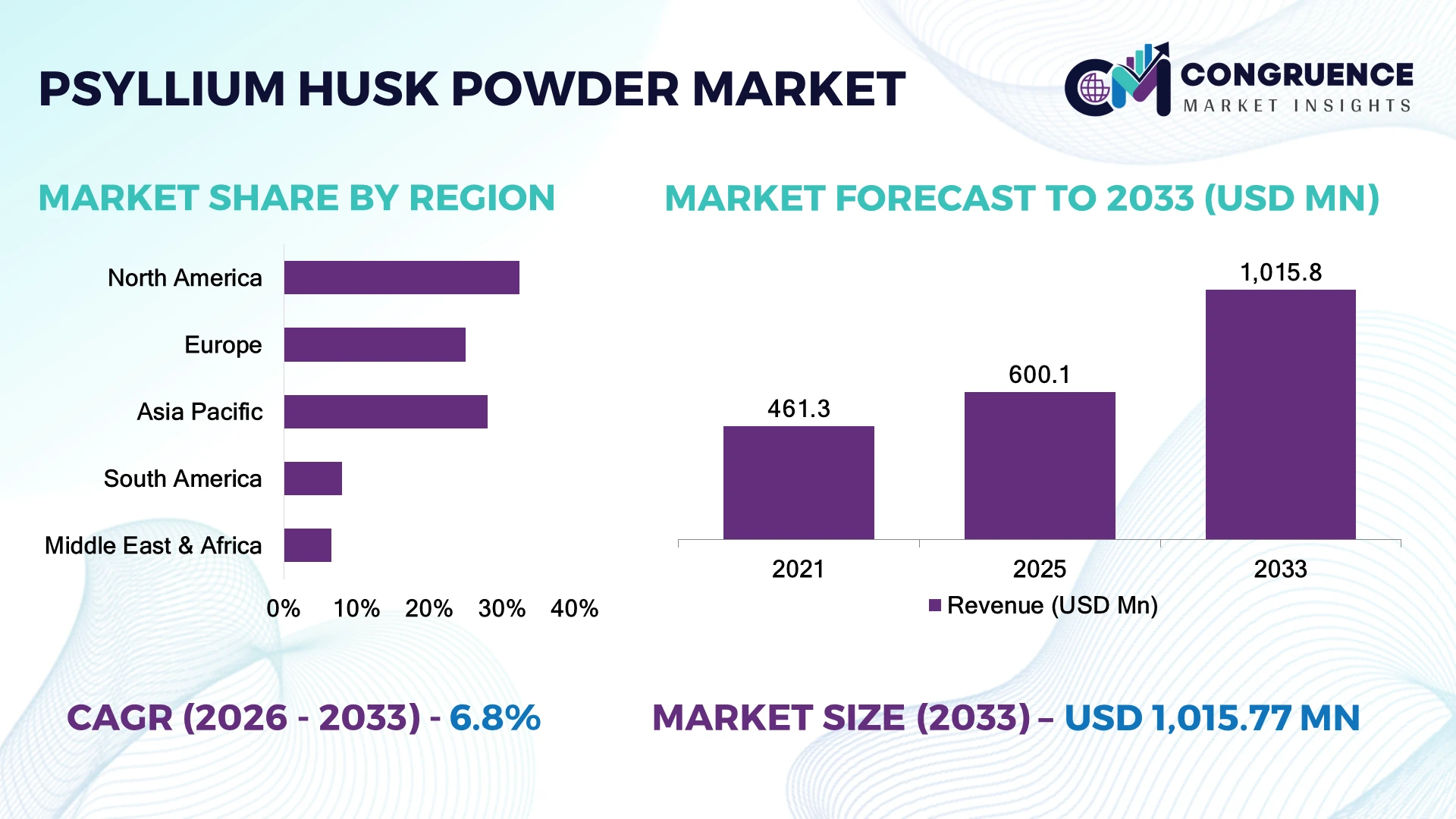
The Global Psyllium Husk Powder Market was valued at USD 600.1 Million in 2025 and is anticipated to reach a value of USD 1,015.8 Million by 2033 expanding at a CAGR of 6.8% between 2026 and 2033. Growth is driven by rising use of soluble fiber in digestive-health supplements, pharmaceutical formulations, functional foods, and gluten-free products, alongside tighter demand for standardized high-purity powder.
India dominates global psyllium supply, with Rajasthan contributing more than 70% of national production and Gujarat about 27%; approximately 72–85% of Indian production is exported. The U.S. remains the largest import market, while Europe relies more heavily on pharmaceutical and nutraceutical-grade supply. In 2026, Indian psyllium exports reached 22,658 tonnes during April–July, up 6.1% year-on-year.
Procurement resilience, purity standardization, and processing capacity in India are becoming decisive for global psyllium husk powder buyers.
Market Size & Growth: USD 600.1 million in 2025 to USD 1,015.8 million by 2033 at 6.8% CAGR, driven by soluble-fiber applications.
Top Growth Drivers: Digestive-health supplements, pharmaceutical formulations, and functional foods collectively represent the strongest demand catalysts.
Short-Term Forecast: Indian exports rose 6.1% year-on-year in April–July 2026, strengthening near-term supply-chain momentum.
Emerging Technologies: Automated cleaning, optical sorting, micronization, and AI-assisted quality control are improving purity and batch consistency.
Regional Leaders: North America leads consumption, Europe emphasizes pharmaceutical-grade material, while Asia-Pacific anchors production and processing.
Consumer/End-User Trends: Powder represents about 50% of India's isabgol market, reflecting convenience across supplements, foods, and household formats.
Pilot/Case Example: 2026 export performance reached 22,658 tonnes during April–July, demonstrating stronger shipment throughput despite crop-cycle uncertainty.
Competitive Landscape: India controls more than 85% of global commercial supply, with processors competing on purity, particle size, certifications, and delivery reliability.
Regulatory & ESG Impact: U.S. regulations recognize psyllium as dietary fiber; qualifying psyllium products require at least 95% purity for specified health claims.
Investment & Funding: Processing investment is shifting toward automated sorting, pharmaceutical-grade milling, contamination control, and export-compliance infrastructure.
Innovation & Future Outlook: High-purity powders, organic grades, customized particle sizes, and functional-food formulations are moving competition beyond commodity pricing.
Psyllium husk powder demand is strengthening across dietary supplements, OTC fiber products, pharmaceutical excipients, bakery formulations, and high-fiber functional foods. Powder commands roughly 50% of India's isabgol market, supported by convenient formulation and dosing. In 2026, stronger Indian export flows and crop-supply monitoring are making inventory planning and supplier diversification increasingly important for international buyers, creating a natural transition toward strategic market pathways.
Psyllium husk powder is becoming strategically important because global buyers depend heavily on Indian cultivation and processing while downstream demand is diversifying beyond traditional laxative applications. Rajasthan contributes more than 70% of Indian production and Gujarat adds roughly 27%, concentrating agricultural risk within two major producing regions. This structure makes procurement continuity, inventory planning, and supplier qualification central competitive issues for pharmaceutical, nutraceutical, and food manufacturers.
Processing modernization is shifting competitive advantage from basic milling toward automated cleaning, optical sorting, micronization, and tighter purity control. Optical sorting and automated inspection can reduce manual quality-screening requirements by an estimated 10–15% in high-throughput operations, while micronization enables more consistent incorporation into beverages, bakery mixes, and supplement formulations. North America prioritizes finished-product consumption and pharmaceutical applications, whereas Asia-Pacific retains the strongest production and processing concentration.
Over the next 2–3 years, buyers are expected to prioritize dual sourcing, certified processing, tighter contaminant controls, and customized particle-size specifications. Indian processors are consequently investing in export-grade infrastructure and higher-value powder formats. Companies that secure reliable raw-material access while delivering standardized, traceable powder will hold the strongest operational position as psyllium moves from commodity fiber toward specification-driven functional ingredients.
Rising incorporation of soluble fiber into nutraceuticals, pharmaceutical formulations, and functional foods is increasing demand for standardized psyllium husk powder. India supplies more than 85% of global psyllium, concentrating procurement around Gujarat and Rajasthan while encouraging processors to upgrade cleaning, grading, and milling capabilities. U.S. regulatory recognition of psyllium as dietary fiber and a minimum 95% purity specification for qualifying health claims strengthen demand for consistent pharmaceutical-grade material. Automated optical sorting and multi-stage cleaning are increasingly used to improve batch uniformity. Companies are responding through processing expansion, certification upgrades, and direct contracts with manufacturers, shifting competition from raw-material availability toward documented purity, swelling performance, and traceability.
Heavy dependence on Indian cultivation creates a structural supply constraint because more than 85% of global psyllium production is concentrated in one country, leaving international buyers exposed to weather, crop cycles, and logistics disruptions. Gujarat and Rajasthan account for the majority of cultivation and processing, concentrating sourcing risk within a limited agricultural corridor. Psyllium husk used for qualifying U.S. health claims requires at least 95% purity, increasing rejection exposure when contamination or inconsistent separation affects batches. Processing yields also depend on mechanical dehusking and rigorous cleaning. Companies are reducing exposure through multi-season procurement contracts, strategic inventories, supplier qualification, and investment in automated sorting. The key operational pressure is balancing raw-material security with tighter quality specifications without transferring excessive cost into finished products.
Premium pharmaceutical, nutraceutical, and functional-food formulations create an opportunity to move psyllium beyond commodity fiber toward specification-driven ingredients. Psyllium already qualifies as dietary fiber under U.S. regulations, while 95% minimum purity requirements for qualifying health claims reinforce demand for controlled-grade material. Newer milling and purification approaches can improve particle-size consistency and processing efficiency by roughly 10–15% compared with less automated workflows. India’s processing hubs are positioned to capture this value through micronized powders, organic grades, customized mesh sizes, and pharmaceutical-grade batches. Emerging applications in high-fiber bakery products, ready-to-mix beverages, and metabolic-health formulations provide additional outlets. Companies investing in cleanroom processing, digital batch traceability, and formulation partnerships can capture higher margins while reducing dependence on bulk ingredient pricing.
Maintaining consistent swelling capacity, color, moisture, microbial quality, and particle size remains a significant execution challenge because psyllium is an agricultural raw material with natural batch variability. Commercial processors must maintain purity above demanding specifications while handling thousands of kilograms through cleaning and dehusking operations. Automated facilities can process around 1,000 kg of seed per hour, but downstream husk cleaning and separation can operate at substantially lower throughput, creating bottlenecks. India’s concentration of cultivation intensifies the need for robust quality-control infrastructure rather than simply additional processing capacity. Companies must invest in inline inspection, laboratory testing, supplier audits, and controlled storage. The competitive pressure is increasingly operational: processors unable to synchronize agricultural variability with pharmaceutical-grade consistency risk losing high-value export contracts.
Automated Sorting Reshapes Processing: Indian processors are increasing use of optical sorting and multi-stage cleaning, with some facilities processing approximately 1,000 kg of seed per hour. Automated grading improves color consistency and contaminant removal while reducing manual inspection dependence. Companies are pairing sorting equipment with controlled blending and laboratory testing to deliver more uniform export-grade psyllium powder.
Purity Becomes Commercial Differentiator: Pharmaceutical and health-claim applications increasingly favor tightly specified material, with 95% purity representing an established regulatory benchmark for qualifying psyllium husk claims in the U.S. This is shifting procurement toward certified batches, documented contaminant controls, and traceability. Indian processors are responding by upgrading quality systems rather than competing solely on bulk pricing.
Micronized Formats Expand Applications: Powder manufacturers are moving toward controlled particle sizes for beverages, bakery mixes, supplements, and pharmaceutical formulations. Specialized milling can improve incorporation consistency by roughly 10–15% versus less controlled conventional grinding. The non-obvious shift is that particle engineering is becoming a formulation-service capability, encouraging processors to collaborate directly with finished-product manufacturers on customized grades.
Supply Concentration Drives Contracting: India supplies more than 85% of global psyllium, making procurement unusually sensitive to agricultural conditions and export logistics. Buyers are responding with longer-term contracts, strategic inventories, and supplier diversification within Gujarat and Rajasthan. Processing companies are simultaneously increasing storage and quality-control capacity, turning supply reliability into a commercial differentiator alongside purity and price.
Conventional psyllium remains the leading type, accounting for approximately 58% of India’s psyllium market in 2025, reflecting its established cultivation base, lower certification burden, and compatibility with large-volume pharmaceutical, food, and supplement manufacturing. At the global level, conventional material remains structurally dominant because more than 90% of psyllium production is concentrated in India, supporting mature procurement and processing networks. Organic psyllium is the fastest-growing type as clean-label positioning and certified sourcing gain traction, particularly among premium nutraceutical and functional-food brands. Organic products command a smaller base but increasingly attract higher-value formulations.
Companies are responding by maintaining conventional capacity for volume-sensitive customers while expanding certified organic sourcing and segregated processing. Organic demand is increasingly linked to North American and European premium-product channels, whereas conventional supply remains strongest in India-led export chains. The strategic shift is therefore toward portfolio segmentation rather than replacement: processors are investing in dual sourcing, certification, and dedicated handling to capture premium margins without disrupting high-volume conventional contracts.
India’s conventional psyllium segment accounted for 58% of the domestic market in 2025, while powder represented approximately 50%, highlighting the commercial importance of standardized, cost-efficient processing.
Pharmaceutical and dietary supplement applications represent the leading demand pool, accounting for approximately 51.5% of the global psyllium market in 2025 when combined. The segment benefits from psyllium’s established use in fiber supplements, laxative formulations, cholesterol-management products, and medical nutrition. Food and beverage applications form the next major outlet, with demand expanding through gluten-free bakery, functional beverages, and fiber-enriched formulations. Pharmaceuticals and dietary supplements remain mature, while functional foods are the fastest-changing application as manufacturers seek plant-based texturizers and soluble-fiber ingredients.
Companies are increasingly supplying application-specific powder grades rather than undifferentiated bulk material. Pharmaceutical customers prioritize purity and batch documentation, while food manufacturers focus more heavily on hydration rate, particle size, sensory performance, and processing compatibility. This differentiation is increasing the value of technical support and formulation partnerships. The business implication is clear: processors capable of supplying customized specifications can move toward higher-value contracts while reducing exposure to commodity price competition.
In 2025, pharmaceuticals and dietary supplements together represented approximately 51.5% of psyllium husk powder applications, reinforcing their role as the principal demand base for standardized grades.
Pharmaceutical companies represent the leading end-user group, accounting for approximately 30% of global demand, supported by psyllium’s established use in gastrointestinal and fiber-based formulations. Food manufacturers and nutraceutical companies form substantial secondary buyer groups, with nutraceutical demand expanding faster as brands introduce fiber supplements, weight-management products, and functional nutrition formats. Individual consumers remain important through retail and online channels, but their purchasing patterns are increasingly influenced by packaged supplement brands rather than bulk ingredient suppliers.
The fastest-changing end-user group is nutraceutical manufacturers, where formulation flexibility and clean-label positioning are driving greater use of powder formats. Food processors typically prioritize consistent hydration and functional performance, while pharmaceutical buyers demand tighter quality documentation and contaminant controls. Companies are therefore segmenting commercial strategies by specification: long-term supply agreements for pharmaceutical accounts, customized grades for food manufacturers, and smaller certified batches for premium nutraceutical brands. The competitive implication is that supplier differentiation increasingly depends on technical service, certification, and reliable batch-to-batch performance rather than raw-material availability alone.
India’s psyllium powder format represented approximately 50% of the domestic isabgol market in 2025, indicating strong acceptance of powder-based formats across consumer and industrial end-use channels.
North America accounted for the largest market share at 32.4% in 2025 however, Asia-Pacific is expected to register the fastest growth, expanding at a CAGR of 8.1% between 2026 and 2033.
Functional nutrition is shifting psyllium toward higher-value formulations
North America represents the largest consumption center for psyllium husk powder, supported by established dietary-supplement manufacturing, OTC fiber products, functional foods, and pharmaceutical formulations. The United States accounts for the majority of regional demand, with supplement manufacturers increasingly incorporating soluble fiber into capsules, powders, gummies, and ready-to-mix products. More than 70% of U.S. adults use dietary supplements in some form, creating a substantial distribution base for fiber-focused products. Regulatory recognition of psyllium as dietary fiber also supports standardized health-positioning strategies. Manufacturers are increasingly demanding consistent swelling capacity, particle size, microbiological quality, and contaminant specifications from Indian suppliers. Contract manufacturing and private-label supplement production are strengthening demand for customized grades, while e-commerce is broadening access to consumer psyllium products. This is shifting competition toward quality documentation and formulation support rather than commodity procurement alone.
United States Market Outlook: The United States is the region's principal consumption and formulation hub, supported by a large dietary-supplement industry and established pharmaceutical distribution channels. Psyllium is recognized as a source of soluble dietary fiber, while qualifying health-claim products require at least 95% psyllium husk purity. Manufacturers are therefore prioritizing certified suppliers, standardized particle sizes, and reliable import inventories to maintain formulation consistency.
Clean-label formulation is increasing demand for certified fiber ingredients
Europe is characterized by strong demand from nutraceutical, pharmaceutical, functional-food, and clean-label ingredient manufacturers. Germany, the United Kingdom, France, and Italy represent important consumption markets, with buyers placing greater emphasis on organic certification, traceability, contaminant control, and sustainable sourcing. Psyllium's compatibility with gluten-free and plant-based formulations is supporting broader use in bakery mixes, cereals, beverages, and digestive-health products. Pharmaceutical and nutraceutical applications remain particularly important because European manufacturers generally require tighter batch documentation than conventional food processors. Organic and specialty-grade products are gaining commercial relevance, while imported Indian material continues to dominate upstream supply. Companies are responding through certified sourcing programs, supplier audits, customized particle-size specifications, and longer-term procurement arrangements designed to reduce quality variability.
Germany Market Outlook: Germany represents a major European processing and consumption center because of its advanced nutraceutical, pharmaceutical, and functional-food industries. Manufacturers emphasize standardized raw materials and extensive quality documentation, creating demand for pharmaceutical-grade psyllium with controlled microbial and contaminant profiles. The country's mature organic-food market also provides a commercially attractive channel for certified organic psyllium products and premium fiber formulations.
India's supply dominance is strengthening processing sophistication
Asia-Pacific is the global production center for psyllium, with India supplying more than 85% of worldwide commercial requirements. Gujarat and Rajasthan anchor cultivation, cleaning, dehusking, and powder-processing activity, creating an unusually concentrated supply ecosystem. India's export infrastructure connects processors with pharmaceutical, nutraceutical, and food manufacturers across North America and Europe. During April–July 2026, Indian psyllium exports reached approximately 22,658 tonnes, demonstrating continued international shipment intensity. Processors are increasingly investing in optical sorting, automated cleaning, micronization, laboratory testing, and segregated organic processing to capture higher-value contracts. Domestic demand is also expanding through fiber supplements, digestive-health products, and functional foods. The strategic shift is from agricultural volume leadership toward specification-driven ingredient manufacturing.
India Market Outlook: India is the dominant global production and processing base, with Rajasthan contributing more than 70% of domestic cultivation and Gujarat approximately 27%. Export-oriented processors are increasingly adding automated sorting, controlled milling, and laboratory quality systems to meet pharmaceutical and nutraceutical specifications. The country's integrated agricultural-processing-export ecosystem gives Indian suppliers a substantial advantage in cost, availability, and customer responsiveness.
Nutraceutical distribution is broadening beyond traditional fiber products
South America remains primarily a consumption market, with Brazil representing the largest commercial opportunity because of its population scale, established pharmaceutical sector, and expanding nutraceutical distribution network. Psyllium is increasingly incorporated into dietary-fiber supplements, digestive-health products, functional foods, and weight-management formulations. Brazil's growing packaged-health-product segment supports demand for convenient powder and capsule formats, while Argentina and Chile provide smaller but established nutraceutical channels. Imported material remains important because local psyllium cultivation is limited compared with India's production base. Distributors and supplement manufacturers therefore place greater emphasis on inventory continuity, documentation, and reliable import logistics. Companies entering the region are increasingly using local distributors and contract manufacturers rather than establishing primary processing facilities, limiting capital intensity while improving market access.
Brazil Market Outlook: Brazil provides the strongest commercial platform in South America through its large consumer base, pharmaceutical manufacturing infrastructure, and developed supplement distribution channels. The country also has a substantial functional-food industry, supporting wider use of soluble fiber in packaged products. Import-dependent manufacturers increasingly favor suppliers offering standardized purity, consistent particle size, and dependable shipment schedules.
Digestive-health positioning is driving premium imported ingredients
Middle East & Africa remains predominantly import-dependent, with demand concentrated in the Gulf states, South Africa, Egypt, and selected North African markets. Saudi Arabia and the United Arab Emirates provide particularly attractive channels through modern pharmacy networks, nutraceutical distributors, and premium health-product retailers. Psyllium is increasingly marketed through digestive-health, weight-management, and dietary-fiber applications, while pharmaceutical-grade material supports specialized formulations. The region's hot climate and long import routes increase the importance of moisture-controlled storage and sealed packaging. UAE-based distributors are strengthening regional re-export capabilities, connecting Indian suppliers with Gulf and African buyers. Companies are responding through distributor partnerships, smaller retail-ready formats, halal-compliant certification, and localized packaging. The strategic opportunity centers on reliable imported supply combined with premium formulation and distribution capabilities.
Saudi Arabia Market Outlook: Saudi Arabia represents a major regional demand center because of its large pharmaceutical and nutraceutical distribution infrastructure and expanding health-oriented consumer market. Imported psyllium is increasingly positioned in digestive-health and fiber supplements, while pharmacy-led distribution provides broad consumer access. Suppliers with halal certification, documented purity, moisture-controlled packaging, and dependable Gulf-region logistics have a clear operational advantage.
Unjha Formulations and Indian processors compete with global ingredient suppliers and branded nutraceutical manufacturers, while U.S. and European supplement companies compete through formulation, certification, and distribution. The top five branded and processing groups collectively account for an estimated 18% share, leaving India’s fragmented supplier base structurally influential. Competition centers on purity, particle size, price, traceability, and delivery reliability: certified grades command roughly 5–15% premiums, while automated sorting can reduce manual inspection requirements by 10–15%. Leading processors are adding optical sorting, micronization, laboratory controls, and export certifications, while downstream brands are using contract manufacturing and direct sourcing agreements. The competitive shift is from bulk commodity trading toward specification-driven ingredients and application-specific grades. Entry barriers remain strongest in agricultural sourcing, quality certification, export compliance, and reliable processing capacity. Winning suppliers need secure Indian raw-material access, consistent specifications, rapid customization, and documented traceability; buyers increasingly reward dependable quality and formulation support over the lowest nominal price.
Unjha Formulations Limited
Jyotindra International
Shreeji Pharma International
Satnam Psyllium Industries
Gayatri Psyllium
Sidhpur Sat-Isabgol Factory
Vraj Psyllium
NOW Foods
Yerba Prima
Konsyl Pharmaceuticals
Procter & Gamble
Organic India
The Vitamin Shoppe
Dabur India Limited
Automated optical sorting is becoming the key current technology, separating discolored seed and foreign material before milling. High-throughput systems can reduce manual inspection requirements by 10–15% and improve batch consistency by 1–2%. Adoption is strongest among export-oriented Indian processors handling pharmaceutical and nutraceutical grades. Micronization and controlled particle engineering are emerging next, improving dispersion and formulation consistency by roughly 1–2% while enabling customized mesh specifications. Compared with conventional grinding, controlled milling can improve particle-size uniformity by 10–15%, benefiting suppliers serving beverages, bakery mixes, and supplement manufacturers.
Digital batch records, laboratory information systems, and barcode traceability are also integrating procurement, processing, testing, and shipment documentation, reducing release delays by approximately 1–2%. By 2026–2028, automated contaminant detection and inline quality monitoring will become more important as buyers demand tighter specifications and documented provenance. Large Indian processors benefit first because they can amortize automation across export volumes, while smaller firms face equipment and certification pressure. Integration of sorting, milling, testing, and traceability into one controlled workflow will increasingly determine supplier qualification, production consistency, and competitive access to pharmaceutical and premium nutraceutical contracts worldwide.
August 2026 Unjha’s psyllium market faced a fortnight-long trading halt after GST disputes disrupted seed auctions, starving processors of raw material. The disruption exposed concentrated procurement risk and threatened export continuity for processors dependent on Unjha. Source: The Times of India
August 2025 The Vitamin Shoppe launched Solaray high-potency psyllium fiber as U.S. fiber-combination products increased 10% year-on-year. Early sales exceeded launch expectations, strengthening demand for convenient psyllium formats and accelerating premium supplement positioning. Source: NutraIngredients.com
July 2025 VRL’s pipeline disclosed VRP-1016, a psyllium-husk tablet combining psyllium and Triphala extracts, at the preclinical stage. The formulation expands psyllium into standardized combination therapeutics, creating a differentiated pathway beyond conventional powder products. Source: Business Standard
March 2026 FDA cited Nupack over disease-treatment claims for Pure Psyllium Husk after a 2025 inspection. The action reinforces compliance pressure around labeling and health claims, increasing the commercial importance of regulatory review and evidence-based positioning. Source: fda.gov U.S. Food and Drug Administration
The Psyllium Husk Powder Market Report covers conventional and organic types across pharmaceutical, dietary supplement, food and beverage, functional-food, and other applications. End-user analysis includes pharmaceutical manufacturers, nutraceutical companies, food processors, retailers, and direct consumers. Geographic coverage spans North America, Europe, Asia-Pacific, South America, and Middle East & Africa, with detailed assessment of India, the United States, Germany, Brazil, and Saudi Arabia as important commercial markets.
The report evaluates processing technologies including automated sorting, micronization, particle-size engineering, laboratory quality control, and digital traceability. Quantitative analysis incorporates segment shares, export volumes, processing concentration, adoption patterns, and supplier participation. The resulting intelligence supports procurement planning, processing investments, geographic expansion, supplier qualification, product customization, competitive positioning, and partnership decisions through 2026–2033, including opportunities in pharmaceutical-grade, organic, premium nutraceutical, and customized psyllium powder formats.
| Report Attribute/Metric | Report Details |
|---|---|
|
Market Revenue in 2025 |
USD 600.1 Million |
|
Market Revenue in 2033 |
USD 1,015.8 Million |
|
CAGR (2026 - 2033) |
6.8% |
|
Base Year |
2025 |
|
Forecast Period |
2026 - 2033 |
|
Historic Period |
2021 - 2025 |
|
Segments Covered |
By Type
By Application
By End-User
|
|
Key Report Deliverable |
Revenue Forecast, Growth Trends, Market Dynamics, Segmental Overview, Regional and Country-wise Analysis, Competition Landscape |
|
Region Covered |
North America, Europe, Asia-Pacific, South America, Middle East, Africa |
|
Key Players Analyzed |
Unjha Formulations Limited, Jyotindra International, Shreeji Pharma International, Satnam Psyllium Industries, Gayatri Psyllium, Sidhpur Sat-Isabgol Factory, Vraj Psyllium, NOW Foods, Yerba Prima, Konsyl Pharmaceuticals, Procter & Gamble, Organic India, The Vitamin Shoppe, Dabur India Limited |
|
Customization & Pricing |
Available on Request (10% Customization is Free) |




