
Reports
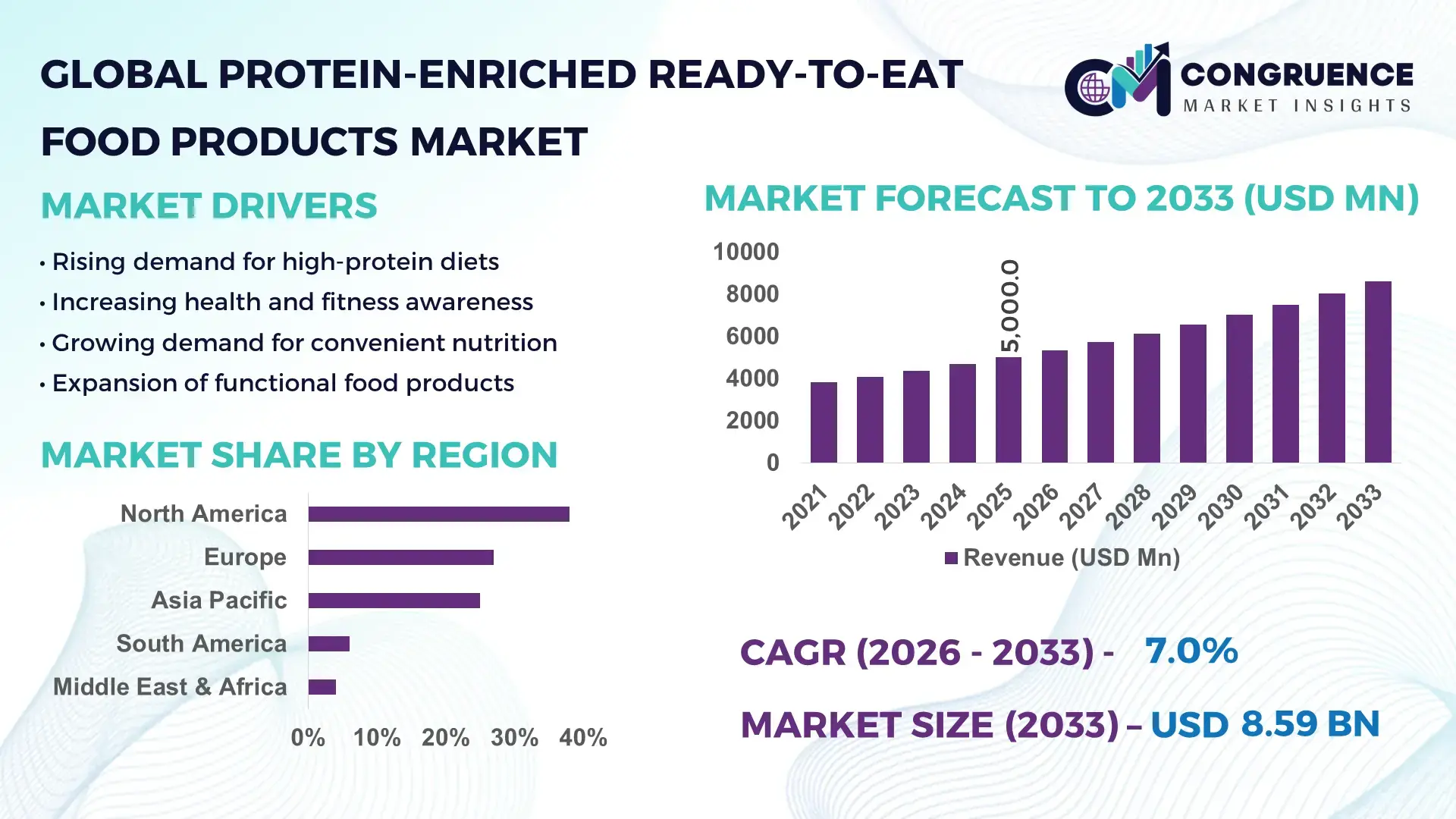
The Global Protein-Enriched Ready-to-Eat Food Products Market was valued at USD 5,000.0 Million in 2025 and is anticipated to reach a value of USD 8,590.9 Million by 2033 expanding at a CAGR of 7% between 2026 and 2033, according to an analysis by Congruence Market Insights. The growth is primarily driven by increasing consumer demand for convenient, high-protein dietary solutions aligned with active and health-conscious lifestyles.
The United States dominates the Protein-Enriched Ready-to-Eat Food Products Market with a highly developed food processing ecosystem and strong investment inflows exceeding USD 12 billion annually in functional and fortified foods manufacturing. Over 68% of packaged food manufacturers in the country have introduced protein-enriched SKUs, particularly in snacks and meal kits. Consumer adoption remains robust, with nearly 72% of adults actively seeking high-protein foods in daily diets. Advanced production facilities utilizing automated processing and high-pressure pasteurization technologies have improved shelf-life efficiency by 35%. Additionally, over 40% of new product launches in the ready-to-eat category incorporate plant-based or hybrid protein formulations, highlighting innovation depth and diversified product portfolios.
Market Size & Growth: USD 5000.0 Million in 2025, projected to reach USD 8,590.9 Million by 2033, expanding at 7% CAGR, driven by rising health-focused consumption patterns.
Top Growth Drivers: 72% consumer preference for protein diets, 45% increase in fitness-driven food purchases, 38% rise in plant-based protein adoption.
Short-Term Forecast: By 2028, manufacturing efficiency is expected to improve by 28% due to automation and ingredient optimization.
Emerging Technologies: High-pressure processing (HPP), AI-driven nutrition profiling, precision fermentation technologies.
Regional Leaders: North America (USD 3,100 Million by 2033) driven by innovation; Europe (USD 2,200 Million) with clean-label focus; Asia-Pacific (USD 2,900 Million) led by urban consumption growth.
Consumer/End-User Trends: Over 65% of urban consumers prefer ready-to-eat protein meals for convenience and nutritional balance.
Pilot or Case Example: In 2024, a US-based manufacturer improved production yield by 30% through AI-driven formulation optimization.
Competitive Landscape: Market leader holds ~18% share, followed by 5–10% shares among major global players.
Regulatory & ESG Impact: 50% of companies have adopted clean-label standards and reduced additives by 25%.
Investment & Funding Patterns: Over USD 6 billion invested in protein innovation and food-tech startups globally in the last 2 years.
Innovation & Future Outlook: Hybrid protein products and sustainable packaging solutions are shaping future growth.
Protein-enriched ready-to-eat food products are increasingly integrated across retail (45%), foodservice (30%), and sports nutrition (25%) sectors, supported by rising innovation in plant-based protein blends and clean-label formulations. Regulatory emphasis on nutritional transparency and sustainability has led to a 22% increase in eco-friendly packaging adoption. Regional consumption trends highlight strong urban demand, while emerging economies are witnessing over 35% growth in protein snack penetration, signaling robust future expansion.
The Protein-Enriched Ready-to-Eat Food Products Market holds significant strategic relevance as global dietary preferences shift toward functional nutrition and time-efficient consumption patterns. Organizations are increasingly aligning their product portfolios with high-protein formulations to cater to evolving consumer expectations, particularly among urban professionals and fitness-conscious demographics. Advanced food processing technologies such as high-pressure processing deliver up to 40% longer shelf life compared to traditional thermal preservation methods, improving product quality and reducing waste.
From a regional perspective, North America dominates in volume, while Asia-Pacific leads in adoption with over 60% of new consumers incorporating protein-rich ready-to-eat products into daily diets. Strategic investments in automation and AI-driven product development are enhancing production efficiency by over 30%. By 2028, precision fermentation is expected to improve protein yield efficiency by 25%, enabling cost-effective and scalable production.
Firms are committing to ESG metrics, targeting up to 35% reduction in packaging waste and adopting recyclable materials. In 2025, a leading US-based food company achieved a 28% reduction in energy consumption through smart manufacturing systems and sustainable sourcing practices. The market continues to evolve as a cornerstone of health-driven consumption trends, positioning the Protein-Enriched Ready-to-Eat Food Products Market as a resilient, innovation-led sector supporting sustainable growth and regulatory compliance.
The Protein-Enriched Ready-to-Eat Food Products Market is characterized by rapid evolution driven by changing dietary patterns, increased health awareness, and advancements in food processing technologies. Consumers are increasingly shifting toward high-protein diets, with more than 65% of urban populations actively incorporating protein-rich foods into daily meals. This has led to a surge in demand for ready-to-eat formats such as snacks, meals, and beverages that combine convenience with nutritional value. Additionally, innovations in plant-based and alternative protein sources are reshaping product portfolios, with over 40% of new product launches incorporating plant or hybrid protein blends. The market is also influenced by regulatory frameworks emphasizing clean-label ingredients and sustainability, with nearly 50% of manufacturers reformulating products to reduce artificial additives. Supply chain optimization and automation are further enhancing production efficiency, reducing processing time by up to 30%. However, fluctuating raw material costs and consumer price sensitivity remain key influencing factors in market expansion.
The increasing demand for health-oriented convenience foods is a primary driver of the Protein-Enriched Ready-to-Eat Food Products Market. Over 70% of consumers globally are prioritizing nutritional value alongside convenience, leading to higher adoption of protein-enriched ready meals and snacks. The growing fitness culture, with approximately 45% of adults engaging in regular physical activity, has further accelerated demand for protein-rich diets. Additionally, busy lifestyles and urbanization have resulted in nearly 60% of consumers opting for ready-to-eat products over traditional cooking. Food manufacturers are responding by expanding product lines, with over 50% of new product launches in the ready-to-eat category featuring added protein content. Technological advancements such as high-pressure processing and vacuum packaging have improved product shelf life by up to 35%, making these products more accessible and appealing to consumers. Retail expansion and e-commerce platforms have also increased product availability, contributing to wider market penetration.
The Protein-Enriched Ready-to-Eat Food Products Market faces significant restraints due to high production costs and complexities in sourcing quality protein ingredients. Protein isolates, especially plant-based and alternative proteins, can account for up to 35% of total production costs, creating pricing challenges for manufacturers. Additionally, supply chain disruptions and fluctuating raw material availability have led to price volatility exceeding 20% in certain protein categories. Maintaining product stability and taste while incorporating high protein levels also requires advanced processing techniques, increasing operational expenses by nearly 25%. Regulatory compliance regarding labeling and nutritional claims further adds to the cost burden, with manufacturers needing to invest in quality assurance and certification processes. Consumer price sensitivity remains a critical issue, as nearly 40% of buyers consider price as a deciding factor, limiting the adoption of premium protein-enriched products in cost-sensitive markets.
Innovation in plant-based and alternative protein sources presents significant growth opportunities in the Protein-Enriched Ready-to-Eat Food Products Market. The demand for plant-based protein products has increased by over 35% in recent years, driven by environmental concerns and dietary preferences. Technologies such as precision fermentation and cellular agriculture are enabling the development of novel protein ingredients with improved nutritional profiles and reduced environmental impact. Additionally, over 50% of consumers are now open to trying alternative protein sources, creating a strong foundation for product innovation. Food manufacturers are leveraging these trends to introduce new ready-to-eat products, with plant-based variants accounting for nearly 40% of recent launches. Expansion into emerging markets, where urban populations are growing at over 4% annually, further enhances opportunities for market penetration. Partnerships between food-tech startups and established manufacturers are accelerating innovation cycles and product commercialization.
Maintaining optimal taste, texture, and nutritional balance remains a key challenge in the Protein-Enriched Ready-to-Eat Food Products Market. High protein content often affects the sensory properties of food, with nearly 30% of consumers reporting dissatisfaction with taste or texture in certain products. Achieving the right formulation requires advanced R&D, increasing development timelines by up to 20%. Additionally, balancing macronutrients while ensuring product stability during storage poses technical challenges, particularly in ready-to-eat formats with extended shelf life requirements. The use of alternative proteins, such as plant-based sources, can introduce flavor inconsistencies, requiring additional processing and flavor masking techniques. Furthermore, maintaining nutritional integrity during processing is critical, as heat treatment can reduce protein bioavailability by up to 15%. These challenges necessitate continuous innovation and investment in food science and technology to meet consumer expectations.
Rising Demand for Plant-Based Protein Alternatives: The market is witnessing a significant shift toward plant-based protein formulations, with over 42% of new product launches incorporating plant-derived ingredients such as pea, soy, and lentil proteins. Consumer preference for sustainable food options has increased by 37%, driving manufacturers to develop innovative plant-based ready-to-eat meals. Additionally, nearly 48% of millennials prefer plant-based protein snacks, reflecting a generational shift in consumption behavior.
Integration of Smart Packaging Technologies: Smart and active packaging solutions are gaining traction, with approximately 33% of manufacturers adopting technologies such as oxygen scavengers and freshness indicators. These innovations have extended product shelf life by up to 30% while improving safety and quality monitoring. Around 28% of new packaging solutions now include recyclable or biodegradable materials, aligning with sustainability goals.
Growth in Personalized Nutrition Solutions: Personalized nutrition is emerging as a key trend, with over 25% of companies offering customized protein-enriched meal plans based on individual dietary needs. AI-driven nutritional analysis tools have improved product personalization accuracy by 35%, enabling brands to cater to diverse consumer requirements. Approximately 40% of fitness-focused consumers are actively seeking personalized ready-to-eat protein products.
Expansion of Online Distribution Channels: E-commerce platforms are driving market accessibility, with online sales accounting for nearly 38% of total product distribution. Digital platforms have increased product reach by over 45%, particularly in urban areas. Subscription-based meal services have grown by 32%, offering consumers convenient access to protein-enriched ready-to-eat products with consistent quality and variety.
The Protein-Enriched Ready-to-Eat Food Products Market is segmented based on type, application, and end-user, reflecting diverse consumption patterns and product innovations. Product types range from protein snacks and meals to beverages and functional foods, catering to varying dietary preferences. Applications span retail, foodservice, and specialized nutrition sectors, each contributing distinct demand dynamics. End-user segmentation highlights consumer groups such as fitness enthusiasts, working professionals, and elderly populations seeking convenient nutrition. Over 55% of demand originates from urban consumers, while specialized nutrition segments such as sports and clinical nutrition are expanding rapidly. Technological advancements and ingredient innovation continue to shape segmentation trends, with plant-based and hybrid protein products gaining traction across all categories.
Protein snacks dominate the market with approximately 38% share, driven by high consumer demand for convenient, on-the-go nutrition solutions. Protein meals account for around 27%, offering balanced nutrition in ready-to-eat formats, while protein beverages hold nearly 20% share due to their ease of consumption and rapid absorption. However, protein meals are the fastest-growing segment, expanding at an estimated growth rate exceeding 8% annually, supported by increasing demand for complete meal replacements among busy professionals. Functional and fortified foods, including protein bars and fortified cereals, collectively contribute around 15% share, catering to niche dietary requirements. Product innovation in this segment focuses on improving taste, texture, and nutritional value, with manufacturers investing heavily in R&D.
• In 2025, a major food research initiative reported that protein snack adoption increased by over 30% among urban consumers, driven by demand for convenient and healthy options.
Retail remains the leading application segment, accounting for approximately 52% of market demand, supported by widespread availability of protein-enriched products in supermarkets and online platforms. Foodservice contributes around 28%, driven by quick-service restaurants and meal delivery services incorporating protein-rich menu options. However, the sports and clinical nutrition segment is growing fastest, with adoption rates exceeding 9% annually, fueled by increasing health awareness and medical dietary requirements. Other applications, including institutional catering and specialty nutrition, collectively represent around 20% share. Consumer adoption trends indicate that over 60% of fitness enthusiasts prefer ready-to-eat protein products for post-workout nutrition, while nearly 45% of working professionals rely on such products for daily meals.
• In 2025, a global nutrition study highlighted that over 50 million consumers adopted protein-enriched ready meals as part of structured dietary plans, improving nutritional intake consistency.
Fitness enthusiasts represent the leading end-user segment, accounting for approximately 36% of market demand, driven by increasing focus on muscle recovery and performance nutrition. Working professionals follow with around 30% share, leveraging ready-to-eat products for convenience and time efficiency. The elderly population is the fastest-growing segment, with adoption rates rising above 8% annually due to increased awareness of protein intake for healthy aging. Other end-users, including students and general consumers, contribute a combined share of approximately 34%. Adoption trends show that over 65% of urban consumers regularly purchase protein-enriched ready-to-eat products, while nearly 48% of households include such products in weekly grocery purchases.
• In 2025, a healthcare-focused survey indicated that protein-enriched diets improved nutritional outcomes for over 20 million elderly individuals globally.
North America accounted for the largest market share at 38% in 2025 however, Asia-Pacific is expected to register the fastest growth, expanding at a CAGR of 8.5% between 2026 and 2033.
North America’s dominance is supported by high consumer adoption, with over 70% of adults incorporating protein-rich foods into daily diets. Europe follows with a 27% share, driven by clean-label and sustainable product demand. Asia-Pacific holds approximately 25% share, with rapid urbanization and rising disposable incomes contributing to increased consumption. South America and the Middle East & Africa collectively account for around 10%, with emerging demand in urban centers. Technological advancements, expanding retail networks, and increasing health awareness are key factors influencing regional market dynamics.
North America holds approximately 38% of the global market share, driven by strong demand from fitness, healthcare, and retail sectors. The region benefits from advanced food processing technologies, including high-pressure processing and AI-driven formulation systems. Regulatory frameworks emphasize clean-label products, with over 50% of manufacturers reformulating products to reduce artificial additives. Leading companies are investing in plant-based protein innovations and sustainable packaging solutions. Consumer behavior indicates that over 70% of urban populations prefer ready-to-eat protein products, with high adoption among millennials and fitness enthusiasts. A major regional player has introduced hybrid protein meal kits, improving consumer engagement by over 25%.
Europe accounts for approximately 27% of the global market share, with key markets including Germany, the UK, and France. Regulatory initiatives promoting sustainability and clean-label products have led to a 30% increase in eco-friendly packaging adoption. The region is witnessing strong demand for plant-based protein products, with over 45% of consumers preferring sustainable food options. Technological advancements in food processing and packaging are enhancing product quality and shelf life. Local players are focusing on premium and organic product lines to cater to health-conscious consumers.
Asia-Pacific ranks among the fastest-growing regions, with significant consumption in China, India, and Japan. The region’s rapid urbanization and rising disposable incomes have increased demand for ready-to-eat protein products by over 35%. Manufacturing expansion and infrastructure development are supporting market growth, with over 40% of new production facilities located in this region. E-commerce platforms are driving accessibility, with online sales accounting for nearly 45% of distribution. A leading regional company has introduced affordable protein meal solutions, increasing market penetration by over 20%.
South America holds approximately 6% of the global market share, with Brazil and Argentina as key markets. The region is experiencing growing demand for protein-enriched foods, driven by increasing health awareness and urbanization. Government initiatives supporting food manufacturing and trade policies have improved market accessibility. Local players are focusing on affordable product offerings to cater to cost-sensitive consumers. Consumer behavior indicates rising adoption of ready-to-eat protein snacks, particularly among younger populations.
The Middle East & Africa region accounts for approximately 4% of the global market share, with growth driven by urbanization and increasing disposable incomes. Key markets include the UAE and South Africa, where demand for convenient nutrition solutions is rising. Technological modernization in food processing and packaging is improving product quality and shelf life. Trade partnerships and regulatory frameworks are supporting market expansion. Consumer trends indicate growing preference for protein-enriched ready-to-eat products among urban populations.
United States – 34% Market share: strong production capacity and high consumer demand for protein-rich diets.
China – 18% Market share: expanding manufacturing base and rapid urban consumption growth.
The Protein-Enriched Ready-to-Eat Food Products Market is moderately fragmented, with over 150 active global and regional players competing across multiple product categories. The top five companies collectively account for approximately 35% of the market share, indicating a competitive yet innovation-driven landscape. Companies are focusing on product differentiation through advanced formulations, including plant-based and hybrid protein solutions. Strategic initiatives such as mergers, acquisitions, and partnerships are increasing, with over 20 major collaborations recorded in the past two years. Innovation remains a key competitive factor, with more than 40% of companies investing in R&D to improve product quality and nutritional value. Additionally, sustainability initiatives, including eco-friendly packaging and clean-label products, are becoming critical differentiators. Digital transformation and e-commerce integration are also reshaping competitive dynamics, enabling companies to expand their market reach and improve customer engagement.
Danone S.A.
General Mills Inc.
PepsiCo Inc.
Kellogg Company
Unilever PLC
The Kraft Heinz Company
Tyson Foods Inc.
Hormel Foods Corporation
Conagra Brands Inc.
Beyond Meat Inc.
Impossible Foods Inc.
Oatly Group AB
Glanbia plc
Technological advancements are playing a pivotal role in shaping the Protein-Enriched Ready-to-Eat Food Products Market, enabling manufacturers to enhance product quality, efficiency, and sustainability. High-pressure processing (HPP) technology has gained widespread adoption, improving product shelf life by up to 40% while preserving nutritional integrity. Automation in food processing has reduced production time by approximately 30%, allowing manufacturers to scale operations efficiently. Precision fermentation and cellular agriculture are emerging as key innovations, enabling the production of alternative proteins with improved amino acid profiles and reduced environmental impact.
AI-driven formulation tools are transforming product development, improving ingredient optimization accuracy by over 35% and reducing development timelines by nearly 25%. Smart packaging technologies, including oxygen scavengers and freshness indicators, are extending product shelf life and ensuring quality control. Additionally, sustainable packaging solutions have increased by over 28%, aligning with regulatory requirements and consumer preferences. Digital supply chain management systems are enhancing traceability and reducing waste by approximately 20%. These technological advancements are driving innovation and competitiveness in the market, enabling companies to meet evolving consumer demands while maintaining operational efficiency.
• In February 2026, Nestlé reported continued expansion of its nutrition and health science portfolio, with its Nutrition & Health Science division generating CHF 14.3 billion in sales in 2025 and ongoing investments in high-protein and functional food innovations to strengthen ready-to-eat and fortified product offerings. Source: www.nestle.com
• In March 2026, Danone announced a definitive agreement to acquire Huel, a producer of plant-based ready-to-eat meals and high-protein snacks, to expand its footprint in complete nutrition products and strengthen its global distribution of protein-rich convenience foods.
• In January 2026, Beyond Meat (rebranded as Beyond) introduced a new product line including a sparkling protein beverage “Beyond Immerse” and announced plans to launch protein bars, marking its strategic expansion into ready-to-eat protein nutrition categories beyond meat alternatives.
• In 2025, Nestlé implemented a CHF 1.1 billion cost optimization and investment program to accelerate innovation across categories including prepared dishes and nutrition products, supporting the development of protein-enriched ready-to-eat offerings and improving production efficiency across global markets.
The Protein-Enriched Ready-to-Eat Food Products Market Report provides a comprehensive analysis of key market segments, including product types, applications, and end-user categories. The report covers a wide range of product formats such as protein snacks, meals, beverages, and functional foods, offering detailed insights into their adoption patterns and consumption trends. Application areas analyzed include retail, foodservice, sports nutrition, and clinical nutrition, highlighting their respective contributions to market demand.
Geographically, the report examines major regions including North America, Europe, Asia-Pacific, South America, and the Middle East & Africa, providing in-depth insights into regional market dynamics, consumer behavior, and industry developments. The report also explores technological advancements such as high-pressure processing, precision fermentation, and AI-driven product development, emphasizing their impact on market growth and innovation.
Additionally, the report includes analysis of competitive landscape, key industry players, and strategic initiatives shaping the market. Emerging trends such as plant-based protein adoption, sustainable packaging, and digital distribution channels are also covered. The scope extends to regulatory frameworks, ESG initiatives, and investment patterns influencing market expansion. Overall, the report offers valuable insights for stakeholders, enabling informed decision-making and strategic planning in the evolving Protein-Enriched Ready-to-Eat Food Products Market.
| Report Attribute / Metric | Details |
|---|---|
| Market Revenue (2025) | USD 5,000.0 Million |
| Market Revenue (2033) | USD 8,590.9 Million |
| CAGR (2026–2033) | 7.0% |
| Base Year | 2025 |
| Forecast Period | 2026–2033 |
| Historic Period | 2021–2025 |
| Segments Covered |
By Type
By Application
By End-User Insights
|
| Key Report Deliverables | Revenue Forecast; Market Trends; Growth Drivers & Restraints; Technology Insights; Segmentation Analysis; Regional Insights; Competitive Landscape; Regulatory & ESG Overview; Recent Developments |
| Regions Covered | North America; Europe; Asia-Pacific; South America; Middle East & Africa |
| Key Players Analyzed | Nestlé S.A.; Danone S.A.; General Mills Inc.; PepsiCo Inc.; Kellogg Company; Unilever PLC; The Kraft Heinz Company; Tyson Foods Inc.; Hormel Foods Corporation; Conagra Brands Inc.; Beyond Meat Inc.; Impossible Foods Inc.; Oatly Group AB; Glanbia plc |
| Customization & Pricing | Available on Request (10% Customization Free) |




