
Reports
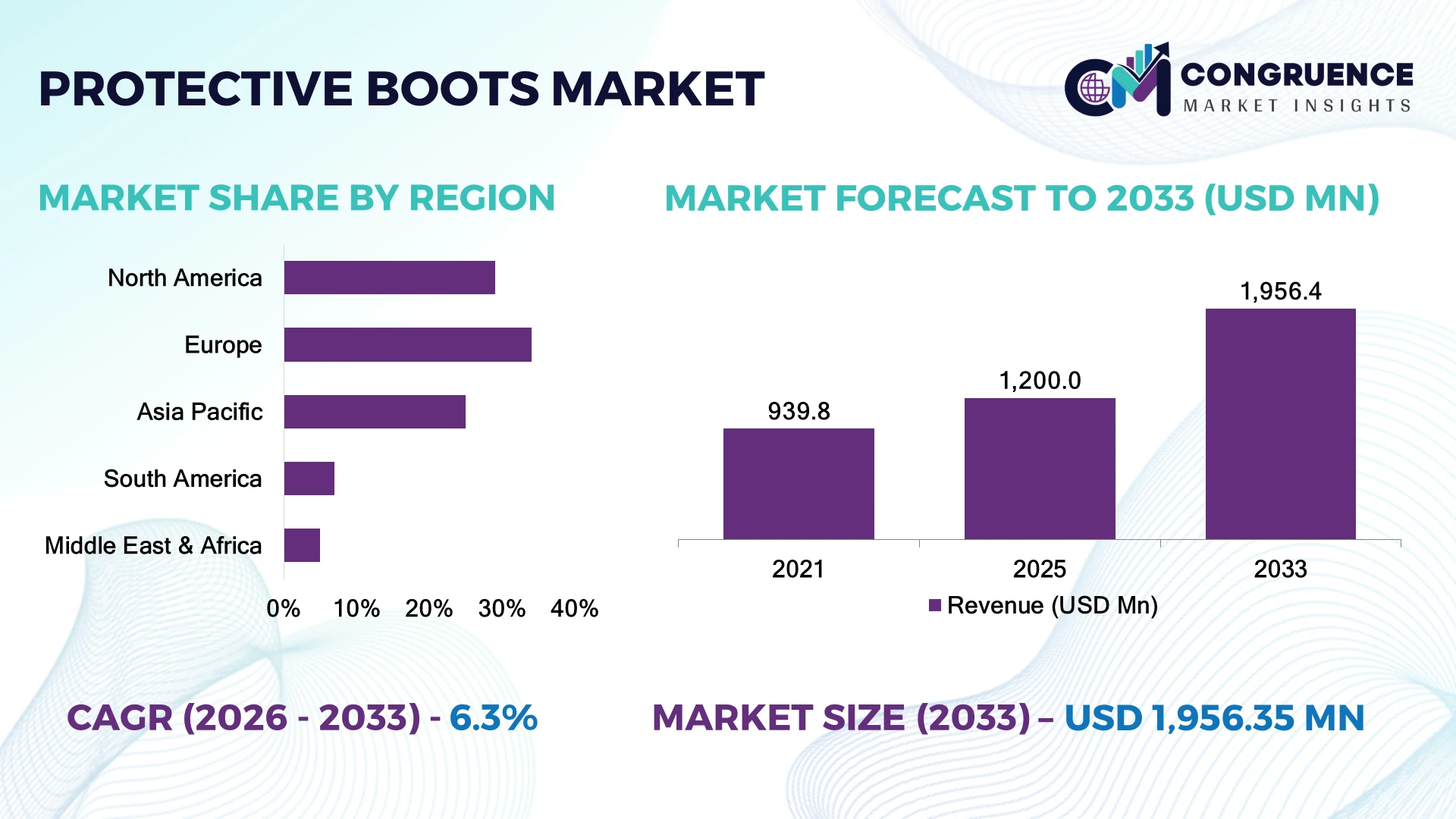
The Global Protective Boots Market was valued at USD 1,200.0 Million in 2025 and is anticipated to reach a value of USD 1,956.4 Million by 2033 expanding at a CAGR of 6.3% between 2026 and 2033. Growth is being accelerated by stricter workplace safety mandates across construction, mining, oil & gas, and manufacturing sectors, alongside rapid adoption of lightweight composite-toe and slip-resistant protective footwear technologies.
Germany remains a dominant country in the global protective boots landscape, accounting for approximately 18% of European industrial safety footwear consumption, supported by over EUR 60 billion in annual industrial investments and strong automotive, engineering, and chemical manufacturing activity. Compared with Italy, Germany deploys nearly 25% more automated industrial equipment, driving higher demand for advanced protective footwear. The country's industrial workforce safety compliance exceeds 90%, reinforcing premium boot adoption across regulated workplaces.
Strategic implication suppliers should prioritize technologically advanced, compliance-focused product portfolios aligned with industrial modernization programs.
Market Size & Growth: USD 1,200.0 million in 2025 reaching USD 1,956.4 million by 2033, driven by industrial safety modernization and advanced protective materials.
Top Growth Drivers: Workplace safety compliance (+18%), infrastructure activity (+15%), industrial automation deployment (+22%).
Short-Term Forecast: By 2028, lightweight protective boot designs are expected to reduce worker fatigue by nearly 20%.
Emerging Technologies: Smart sensors, composite toe caps, and advanced anti-slip sole technologies improve workplace protection and durability.
Regional Leaders: North America (~USD 620 million), Europe (~USD 540 million), Asia-Pacific (~USD 480 million); adoption fueled by industrial digitization and worker safety upgrades.
Consumer/End-User Trends: More than 65% of industrial buyers now prioritize lightweight and ergonomic safety footwear.
Pilot/Case Example: In 2024, a European manufacturing safety program reduced workplace slip incidents by approximately 28% through upgraded protective footwear deployment.
Competitive Landscape: Honeywell leads with an estimated 12% market share alongside Dunlop Protective Footwear, Bata Industrials, UVEX, and Wolverine Worldwide.
Regulatory & ESG Impact: Safety compliance initiatives improved certified footwear adoption by over 30% across regulated industrial facilities.
Investment & Funding: More than USD 450 million has been directed toward manufacturing expansion, material innovation, and regional supply-chain strengthening.
Innovation & Future Outlook: Smart-connected footwear and sustainable material integration are reshaping competitive differentiation across high-growth industrial sectors.
Protective boots have become an essential component of industrial risk management strategies across manufacturing, energy, logistics, and construction environments. Demand is increasingly shifting toward lightweight composite materials, enhanced slip resistance, and ergonomic designs that improve worker productivity. More than 40% of new product launches now incorporate advanced protective materials. Growing supply-chain localization efforts and stricter occupational safety requirements are accelerating product innovation, creating a foundation for deeper strategic market analysis.
Protective boots are becoming strategically important as industrial employers increasingly link worker safety performance with operational productivity, regulatory compliance, and workforce retention. Infrastructure modernization, manufacturing expansion, and stricter occupational safety frameworks are elevating protective footwear from a procurement necessity to a competitive operational asset. Companies operating in mining, energy, logistics, and heavy manufacturing are integrating advanced protective equipment standards into long-term workforce strategies.
Technology differentiation is reshaping market positioning. Composite-toe protective boots typically weigh 25–35% less than traditional steel-toe alternatives while maintaining equivalent impact protection, improving worker mobility and reducing fatigue-related incidents. North American buyers prioritize premium performance and compliance features, while India and Southeast Asia emphasize scalable deployment across expanding industrial workforces. Adoption of anti-slip technologies and advanced cushioning systems has increased by over 30% among industrial footwear procurement programs.
A practical example can be seen in large logistics operators upgrading footwear fleets to reduce workplace injury rates and improve operational continuity. Manufacturers are responding through localized production, material innovation partnerships, and expanded distribution networks. Over the next two to three years, adoption of ergonomic and smart-enabled protective footwear is expected to rise steadily across industrial sectors. Organizations that align product innovation with regulatory compliance, workforce safety outcomes, and supply-chain resilience will strengthen long-term competitive positioning.
Industrial safety regulations are becoming increasingly stringent across construction, mining, manufacturing, and energy sectors, directly increasing demand for certified protective boots. More than 70% of industrial employers globally have strengthened workplace safety procurement standards, while slip-and-fall incidents continue to account for nearly 15% of workplace injuries in heavy industries. The European Union's ongoing workplace safety enforcement measures and expanding infrastructure projects in India are accelerating certified footwear adoption. This regulatory push improves worker protection, reduces downtime, and strengthens operational efficiency. In response, manufacturers are expanding production capacity, introducing lightweight composite-toe designs, and forming partnerships with industrial distributors. A key strategic insight is that protective footwear is increasingly evaluated as a productivity-enhancing asset rather than a simple personal protective equipment purchase.
Protective boot manufacturers face significant cost pressure from fluctuating prices of rubber, leather, polyurethane, and specialty composite materials. Raw material costs account for approximately 45–55% of total production expenses, while global logistics disruptions have increased transportation costs by more than 20% in certain trade corridors. Dependence on imported specialty materials remains particularly challenging for manufacturers in emerging economies. These cost pressures reduce pricing flexibility, compress margins, and complicate large-volume procurement contracts. Companies are mitigating exposure through supplier diversification, regional sourcing strategies, and long-term procurement agreements. An important operational insight is that manufacturers with localized supply chains are achieving faster inventory replenishment cycles and greater resilience against global sourcing disruptions than competitors dependent on concentrated supplier networks.
The emergence of smart personal protective equipment presents substantial opportunities for protective boot manufacturers. Adoption of lightweight composite materials has increased by nearly 35% among premium industrial footwear products, while demand for ergonomic safety footwear has risen by more than 25% across logistics and warehouse operations. Smart sensors capable of monitoring worker movement, impact exposure, and environmental conditions are gaining attention in high-risk industries. Germany and Japan are leading early industrial trials involving connected worker safety technologies. Companies are increasing R&D investments, collaborating with industrial technology providers, and developing integrated safety ecosystems. A non-obvious opportunity lies in data-driven workplace safety programs, where connected footwear can support injury prevention initiatives and improve workforce productivity metrics beyond traditional protection functions.
Long-term market expansion depends on balancing protection performance, worker comfort, and compliance across diverse industrial environments. Approximately 30% of workers report discomfort from poorly fitted safety footwear, while replacement cycles vary by more than 40% between industries. Rapidly evolving safety standards across the United States, Germany, and Australia create ongoing certification and product adaptation requirements. Maintaining consistent performance across different climates, terrains, and industrial applications increases development complexity. Companies must invest in advanced testing facilities, ergonomic design innovation, and workforce education programs to improve adoption consistency. A critical strategic challenge is ensuring that protective boots deliver measurable safety benefits without compromising mobility, comfort, or productivity, factors that increasingly influence enterprise-wide procurement decisions.
• Lightweight Composite Materials Expansion Industrial buyers are rapidly replacing traditional steel-toe designs with composite and hybrid protective boots. Composite-toe product penetration has exceeded 35% in premium industrial footwear portfolios, while average boot weight has declined by nearly 20%. Large manufacturing employers are standardizing lighter footwear to improve worker mobility and reduce fatigue-related productivity losses. Companies are expanding advanced materials sourcing networks and increasing investment in ergonomic product engineering to differentiate performance in high-volume industrial contracts.
• Digital Procurement and Fleet Standardization Enterprise procurement teams are consolidating footwear purchasing across multiple facilities, with centralized procurement programs increasing by approximately 30% over the past two years. Digital inventory tracking has reduced replacement cycle delays by nearly 25% in logistics and warehousing operations. Labor shortages and workforce mobility pressures are driving standardized safety equipment deployment. Manufacturers are responding through integrated procurement platforms, automated replenishment systems, and strategic distributor partnerships that improve delivery speed and inventory visibility.
• Localized Manufacturing Footprint Growth Supply-chain disruptions have accelerated regional production strategies, with localized sourcing increasing by roughly 28% among industrial footwear manufacturers. Lead times have fallen by nearly 15% where regional production hubs support domestic industrial demand. India, Mexico, and Poland are attracting new manufacturing investments due to workforce availability and industrial expansion. Companies are restructuring supplier networks, diversifying material procurement, and establishing regional assembly facilities to improve operational resilience and fulfillment consistency.
• Performance-Certified Footwear Demand Compliance-focused purchasing is becoming a major operational trend as certified protective footwear adoption exceeds 60% across highly regulated industrial workplaces. Slip-resistant technologies have reduced workplace incident rates by approximately 20% in selected industrial deployments, while waterproof performance requirements have increased by nearly 18% in outdoor infrastructure projects. Employers are prioritizing measurable safety outcomes, prompting manufacturers to expand testing capabilities, introduce application-specific product lines, and strengthen certification-driven product development strategies.
Protective boots are commonly segmented into Steel-Toe Boots, Composite-Toe Boots, Alloy-Toe Boots, Metatarsal Boots, and Waterproof Protective Boots. Steel-Toe Boots remain the leading segment with an estimated market share of approximately 42%, supported by proven impact resistance, broad regulatory acceptance, and cost-efficient deployment across construction, mining, and heavy manufacturing operations. Their established safety record and extensive distribution infrastructure continue to support large-scale procurement programs. Waterproof Protective Boots maintain strong relevance in utilities, oil & gas, and outdoor infrastructure environments, while Metatarsal Boots serve specialized high-impact industrial applications. Composite-Toe Boots represent the fastest-growing segment as employers prioritize worker comfort, mobility, and fatigue reduction. Adoption of composite designs has increased by more than 30% among premium industrial footwear categories, while lightweight product demand has risen by approximately 25% in logistics and warehouse operations. Alloy-Toe Boots are gaining traction where weight optimization is critical without sacrificing protection. Manufacturers are expanding composite-material innovation programs, introducing application-specific designs, and strengthening premium product portfolios. Investment priorities increasingly favor lightweight, multi-hazard protection platforms that improve both safety performance and workforce productivity.
Protective boots are widely used across Construction, Manufacturing, Mining, Oil & Gas, and Logistics & Warehousing applications. Construction remains the dominant application segment with an estimated share of approximately 34%, supported by large workforce deployment, strict jobsite safety requirements, and ongoing infrastructure modernization programs. Manufacturing follows closely due to continuous production operations and growing emphasis on workplace safety compliance. Mining and Oil & Gas maintain strong demand for specialized impact-resistant and waterproof protective footwear designed for hazardous operating environments. Logistics & Warehousing is emerging as the fastest-growing application segment. Expansion of distribution centers and e-commerce fulfillment operations has increased ergonomic protective footwear adoption by nearly 28% over recent years. Warehouse operators report growing preference for lightweight, anti-slip footwear capable of supporting long-duration shifts. Companies are scaling product customization, improving inventory availability, and introducing application-specific footwear platforms. Demand is increasingly shifting toward operational performance features that enhance worker mobility, reduce fatigue, and support productivity-focused workplace safety programs.
Protective boots are primarily purchased by Construction Companies, Manufacturing Enterprises, Mining Operators, Oil & Gas Companies, and Logistics Providers. Manufacturing Enterprises represent the largest end-user segment with an estimated market share of approximately 31%, driven by large employee bases, continuous operating schedules, and extensive safety compliance requirements. Construction Companies remain major purchasers due to workforce intensity and project-based safety mandates. Mining Operators and Oil & Gas Companies continue to invest in specialized footwear capable of withstanding extreme operational conditions and environmental exposure. Logistics Providers are the fastest-growing end-user group as warehouse automation, fulfillment expansion, and workforce retention initiatives reshape procurement priorities. Demand for ergonomic protective footwear has increased by nearly 26% among logistics operators, while centralized procurement adoption has grown by approximately 30%. Companies are responding through customized product offerings, strategic distribution agreements, and workforce-focused safety programs. Competitive positioning is increasingly determined by the ability to balance safety certification, comfort performance, and operational efficiency across large employee populations.
Europe accounted for the largest market share at 34% in 2025 however, Asia-Pacific is expected to register the fastest growth, expanding at a CAGR of 7.4% between 2026 and 2033.
North America accounted for approximately 29% of the global protective boots market in 2025, supported by strong demand from construction, oil & gas, logistics, and manufacturing sectors. Industrial employers increasingly prioritize ergonomic footwear solutions that reduce workplace injuries and improve operational efficiency. More than 65% of large industrial facilities have incorporated enhanced slip-resistant and lightweight safety footwear into workforce protection programs. Expansion of warehouse automation and infrastructure modernization projects continues to strengthen demand for application-specific protective footwear. Procurement strategies are also shifting toward centralized purchasing models that improve inventory control and compliance consistency across multiple sites. Manufacturers are responding through localized distribution networks, product customization, and advanced materials integration that enhance durability and worker comfort while supporting enterprise-wide safety objectives.
United States Market Outlook: The United States represents the largest market within North America due to its extensive industrial workforce, large-scale infrastructure investments, and stringent workplace safety standards. Construction, energy, transportation, and manufacturing industries collectively employ millions of workers requiring certified protective footwear. More than 70% of Fortune 500 industrial companies have strengthened workplace safety procurement standards in recent years. Domestic manufacturers are expanding premium product offerings, while enterprise buyers increasingly prioritize ergonomic features, advanced traction technologies, and compliance-driven footwear programs to improve workforce productivity and reduce operational risk.
Europe remains the largest regional market, contributing approximately 34% of global demand. Strong occupational safety regulations, advanced manufacturing infrastructure, and widespread industrial automation support high adoption of premium protective footwear. Automotive manufacturing, engineering, chemical processing, and logistics operations drive substantial demand for certified safety footwear solutions. More than 60% of industrial footwear procurement contracts now include ergonomic performance requirements alongside safety certifications. Sustainability initiatives are also encouraging adoption of recyclable materials and lower-impact manufacturing processes. Regional manufacturers continue investing in advanced production technologies and specialized footwear designs tailored to evolving workplace safety standards, reinforcing Europe’s position as a leading innovation and deployment hub.
Germany Market Outlook: Germany serves as the strategic center of the European protective boots market, supported by its large industrial base and extensive manufacturing ecosystem. The country accounts for an estimated 18% of European industrial safety footwear consumption, driven by automotive, machinery, and chemical industries. High levels of industrial automation and workforce safety compliance create sustained demand for advanced protective footwear. German enterprises increasingly favor lightweight composite-toe and application-specific footwear solutions that improve operational efficiency while maintaining rigorous safety performance standards across industrial environments.
Asia-Pacific represents approximately 25% of the global market and is emerging as the fastest-expanding regional segment. Rapid industrialization, infrastructure development, manufacturing growth, and workforce expansion are driving substantial demand for protective footwear. Large-scale construction projects, logistics network expansion, and growing factory employment are increasing deployment volumes across multiple industries. Regional manufacturing capacity continues to expand, with several countries strengthening domestic production capabilities to improve supply-chain resilience. Industrial employers are increasingly adopting certified protective footwear as workplace safety regulations become more stringent. Companies are scaling regional manufacturing operations and distribution partnerships to capture growing demand while improving delivery efficiency and product accessibility.
China Market Outlook: China remains the most influential market within Asia-Pacific due to its dominant manufacturing sector and extensive industrial workforce. The country accounts for a significant share of regional protective footwear production and consumption. Expansion of advanced manufacturing facilities, logistics infrastructure, and industrial safety initiatives continues to strengthen market demand. Industrial employers are increasingly transitioning toward higher-performance protective footwear solutions, while domestic manufacturers are investing in automation, advanced materials, and export-focused production capabilities to support both local and international demand requirements.
South America accounted for approximately 7% of global market demand in 2025, with mining, construction, agriculture, and energy sectors serving as key consumption drivers. Protective footwear adoption is increasing as employers focus on workforce safety and operational continuity in physically demanding environments. Infrastructure development programs and resource extraction activities continue to generate stable procurement demand. However, supply-chain inefficiencies and import dependency remain operational constraints in several markets. Manufacturers are addressing these challenges through regional partnerships, expanded distribution networks, and localized inventory strategies that improve product availability and procurement efficiency. Demand is increasingly concentrated in sectors where regulatory compliance and workforce protection directly influence operational performance.
Brazil Market Outlook: Brazil leads the South American market through its extensive mining operations, construction activity, and industrial production capacity. The country maintains one of the region’s largest industrial workforces requiring certified protective equipment. Mining and infrastructure projects continue to support long-term procurement requirements, while industrial employers increasingly emphasize workforce safety compliance. Domestic distributors are expanding product portfolios and strengthening regional supply networks to improve access to advanced protective footwear solutions across major industrial centers and resource-rich regions.
The Middle East & Africa region accounted for approximately 5% of global demand in 2025, supported by infrastructure development, energy sector expansion, and industrial diversification initiatives. Large construction programs, transportation projects, and energy investments continue to increase demand for specialized protective footwear. Industrial safety standards are becoming more structured across major economic hubs, encouraging wider adoption of certified products. Companies are strengthening regional distribution networks and expanding partnerships to improve product accessibility and service coverage. Investment in industrial zones, logistics infrastructure, and workforce development programs is creating additional opportunities for premium protective footwear suppliers seeking long-term market penetration.
Saudi Arabia Market Outlook: Saudi Arabia represents the most strategically significant market within the region due to extensive infrastructure development, industrial diversification programs, and energy-sector activity. Major construction and industrial projects continue to create sustained demand for workforce protection equipment. The country is increasing investment in manufacturing, logistics, and industrial cities, generating broader deployment opportunities for protective footwear suppliers. Employers are placing greater emphasis on compliance-driven safety programs, while distributors and manufacturers are expanding local partnerships and inventory capabilities to support rising industrial workforce requirements.
The Protective Boots Market is led by global safety specialists including Honeywell, UVEX, Dunlop Protective Footwear, Bata Industrials, and Wolverine Worldwide, competing directly against regional manufacturers focused on cost-efficient industrial footwear. The top five players collectively account for approximately 38% of market share, creating a moderately consolidated structure. Global leaders compete through advanced materials, compliance certifications, and distribution scale, while regional players focus on pricing advantages and localized supply networks. Composite-toe product adoption has increased by over 30%, ergonomic footwear demand has risen nearly 25%, and enterprise procurement standardization exceeds 40% among large industrial employers. Competition increasingly centers on product performance, delivery speed, and application-specific customization rather than price alone. Companies are expanding manufacturing footprints, forming industrial distribution partnerships, investing in lightweight protective technologies, and strengthening vertical integration across sourcing and production. The competitive shift is moving toward premium safety innovation and supply-chain control. Certification requirements and distribution access remain key barriers. Winning requires technological differentiation, operational reliability, and enterprise-grade compliance capabilities.
UVEX Safety Group
Dunlop Protective Footwear
Bata Industrials
Wolverine Worldwide
Rock Fall Ltd.
COFRA S.r.l.
ELTEN GmbH
JAL Group
HAIX Group
Rocky Brands
KEEN Utility
Timberland PRO
MASCOT International
Protective footwear technology is rapidly shifting from traditional protection-focused designs toward performance-driven solutions. Composite toe technology is replacing conventional steel-toe systems in many industrial environments, reducing boot weight by 25–35% while maintaining equivalent impact resistance. More than 35% of premium industrial boot deployments now incorporate composite protection systems. Advanced anti-slip outsoles and energy-return midsoles are improving worker mobility and reducing fatigue-related productivity losses. These technologies are providing measurable operational advantages in logistics, manufacturing, and infrastructure-intensive sectors.
Emerging innovations focus on material engineering and smart functionality. High-performance polyurethane compounds improve sole durability by approximately 20%, while advanced moisture-management systems enhance comfort during extended shifts. Adoption of ergonomic protective footwear has increased by nearly 30% among large industrial employers. Manufacturers benefit through premium product positioning, while enterprise buyers gain lower replacement rates and improved workforce acceptance. Integration of digital fit analysis and automated manufacturing systems is further improving product consistency and deployment efficiency.
Between 2026 and 2028, connected safety footwear and sensor-enabled monitoring platforms are expected to move from pilot deployments into targeted industrial applications. Smart footwear solutions capable of tracking movement patterns and environmental exposure can improve workplace safety response times by more than 15%. Companies investing early in intelligent safety ecosystems, advanced materials, and automated production capabilities will gain stronger competitive differentiation as industrial safety programs become increasingly data-driven.
May 2025 – Honeywell completed the sale of its Personal Protective Equipment business to Protective Industrial Products (PIP) in a transaction valued at USD 1.325 billion, transferring operations spanning 20 manufacturing sites and 17 distribution facilities. The move reshaped competitive positioning across industrial safety equipment markets. Source: www.investor.honeywell.com
June 2025 – UVEX Safety Group's uvex 1 x-cite safety footwear range received the Red Dot Award: Product Design 2025. The collection integrates lightweight carbon toe protection, slip-resistant outsoles, and recycled material components, strengthening UVEX's premium positioning in safety footwear innovation. Source: www.uvex-safety.com
July 2025 – UVEX introduced the uvex Ultimate Line performance collection featuring the new uvex 3 MACSOLE BOA safety footwear platform. The design incorporates a MACSOLE outsole and energy-return midsole technology, while extending field-of-view performance by 52% across associated PPE innovations. Source: www.uvex-safety.com
April 2026 – UVEX expanded its occupational footwear portfolio with new uvex 3 quatro high-leg and winter boot variants alongside the Heckel MacCrossroad 3.0 High launch. The expanded range targets rugged industrial environments, strengthening specialized footwear coverage across multiple hazardous workplace applications.
This report provides comprehensive analysis of the Protective Boots Market across key product categories, applications, end-user industries, and regional markets. Coverage includes Steel-Toe Boots, Composite-Toe Boots, Alloy-Toe Boots, Metatarsal Boots, and Waterproof Protective Boots, alongside demand assessment across construction, manufacturing, mining, oil & gas, and logistics operations. The study evaluates adoption patterns, procurement trends, material innovations, certification developments, and deployment dynamics shaping industrial footwear purchasing decisions.
The report further examines competitive positioning, manufacturing strategies, supply-chain developments, and emerging technology integration across North America, Europe, Asia-Pacific, South America, and the Middle East & Africa. More than 60% of industrial buyers now prioritize comfort and performance alongside safety compliance, highlighting evolving purchasing priorities. Strategic insights support expansion planning, product development, investment evaluation, partnership assessment, and competitive benchmarking between 2026 and 2033. Special attention is given to lightweight materials, ergonomic designs, smart safety technologies, and application-specific footwear innovations influencing long-term market direction.
| Report Attribute / Metric | Details |
|---|---|
| Market Revenue (2025) | USD 1,200.0 Million |
| Market Revenue (2033) | USD 1,956.4 Million |
| CAGR (2026–2033) | 6.3% |
| Base Year | 2025 |
| Forecast Period | 2026–2033 |
| Historic Period | 2021–2025 |
| Segments Covered |
By Type
By Application
By End-User
|
| Key Deliverables | Revenue Forecast; Market Trends; Growth Drivers & Restraints; Technology Insights; Segmentation Analysis; Regional Insights; Competitive Landscape; Regulatory & ESG Overview; Recent Developments |
| Regions Covered | North America; Europe; Asia-Pacific; South America; Middle East & Africa |
| Companies Profiled | Honeywell; UVEX Safety Group; Dunlop Protective Footwear; Bata Industrials; Wolverine Worldwide; Rock Fall Ltd.; COFRA S.r.l.; ELTEN GmbH; JAL Group; HAIX Group; Rocky Brands; KEEN Utility; Timberland PRO; MASCOT International |
| Customization & Pricing | Available on Request (10% Customization Free) |




