
Reports
The Global Project Portfolio Management (PPM) Market was valued at USD 539.0 Million in 2025 and is anticipated to reach a value of USD 961.3 Million by 2033 expanding at a CAGR of 7.50% between 2026 and 2033. Growth is driven by enterprise-wide AI-enabled portfolio governance, hybrid work program management, and cloud-based resource optimization across regulated and complex project environments.
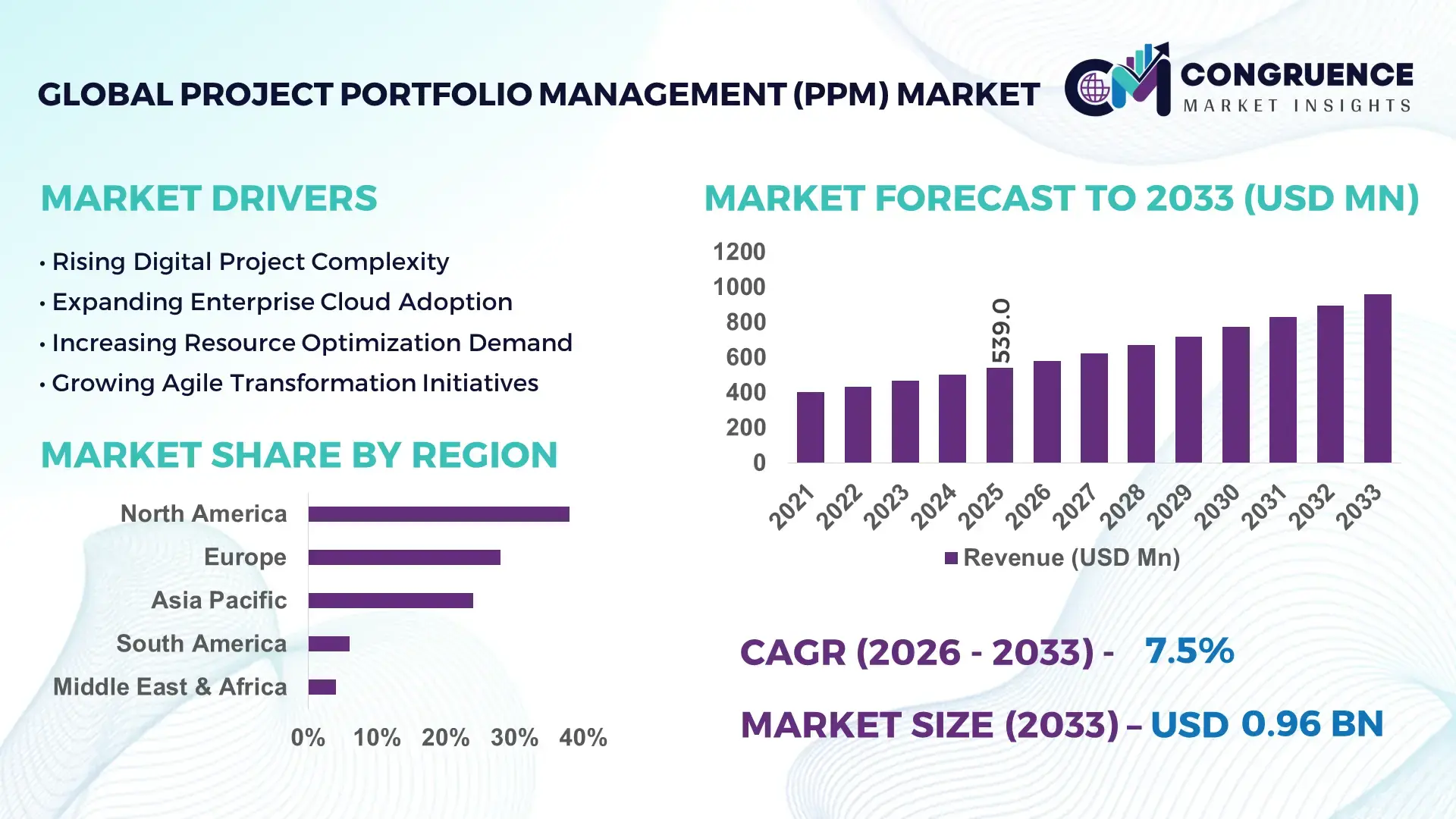
The United States dominates the global Project Portfolio Management (PPM) Market with an estimated 38% share, supported by extensive digital transformation investments across IT, healthcare, financial services, aerospace, and government sectors. More than 72% of large enterprises have integrated cloud-based project governance platforms, while enterprise AI adoption continues to accelerate portfolio automation. Compared with Germany, where manufacturing-led PPM deployment remains strong, the U.S. demonstrates broader cross-industry implementation, reinforced by ongoing infrastructure modernization following the Infrastructure Investment and Jobs Act.
This leadership reinforces North America as the strategic benchmark for vendors prioritizing AI-driven portfolio visibility, enterprise scalability, and long-term digital execution.
Market Size & Growth: USD 539.0 Million in 2025, projected to reach USD 961.3 Million by 2033 at 7.50%, supported by enterprise AI integration and cloud-first portfolio management.
Top Growth Drivers: AI-enabled planning (58%), cloud migration (64%), and hybrid workforce adoption (52%) continue accelerating enterprise deployments.
Short-Term Forecast: By 2028, organizations are expected to reduce project planning cycles by nearly 30% through intelligent workflow automation.
Emerging Technologies: Generative AI, predictive analytics, and low-code automation improve portfolio prioritization, resource allocation, and risk forecasting.
Regional Leaders: North America (~USD 365 Million), Europe (~USD 255 Million), and Asia-Pacific (~USD 215 Million) lead through cloud adoption, infrastructure modernization, and enterprise digitization.
Consumer/End-User Trends: Nearly 68% of large enterprises now prefer SaaS-based PPM platforms for centralized governance and remote collaboration.
Pilot/Case Example: In 2024, enterprise AI-powered portfolio implementations improved project delivery accuracy by approximately 25% while reducing scheduling conflicts.
Competitive Landscape: Microsoft leads with approximately 18% market share, alongside Planview, Broadcom, ServiceNow, and Oracle competing through AI-driven platform expansion.
Regulatory & ESG Impact: Compliance automation reduces reporting effort by nearly 35%, supporting governance initiatives across regulated industries amid evolving global regulations.
Investment & Funding: More than USD 2 Billion has been invested in enterprise work management, AI partnerships, and cloud platform expansion amid ongoing digital transformation.
Innovation & Future Outlook: Autonomous portfolio optimization, digital twins, and AI copilots are reshaping strategic decision-making as global enterprises modernize project governance.
The Project Portfolio Management (PPM) Market is witnessing strong demand across IT services, construction, manufacturing, healthcare, and financial institutions seeking unified project governance and real-time decision support. AI-powered predictive scheduling, intelligent resource allocation, and embedded analytics are transforming enterprise portfolio execution, with over 60% of large organizations expanding cloud-native deployment strategies. Growing regulatory oversight and increasingly complex global delivery networks continue accelerating investment in integrated portfolio intelligence, setting the stage for broader strategic transformation.
Project Portfolio Management (PPM) has become a strategic enterprise capability as organizations seek greater visibility across increasingly complex project ecosystems. Digital transformation, distributed workforces, and infrastructure modernization have elevated portfolio governance from an operational function to a board-level priority. Enterprises are consolidating fragmented project management tools into unified cloud platforms that improve capital allocation, execution discipline, and business alignment while supporting compliance across global operations.
AI-enabled PPM platforms outperform traditional spreadsheet-based planning by reducing portfolio planning time by approximately 35% and improving resource utilization by nearly 20% through predictive analytics and automated prioritization. North America remains the largest deployment hub because of advanced enterprise software adoption, while Asia-Pacific records faster implementation across manufacturing, technology, and public infrastructure initiatives. Over the next two to three years, enterprise AI integration is expected to become a standard capability, with automated decision support expanding across strategic portfolio governance.
Large enterprises are increasingly deploying integrated PPM solutions to synchronize finance, operations, engineering, and procurement within a single governance framework. Vendors are strengthening competitive positions through AI partnerships, cloud-native platform expansion, and industry-specific capabilities tailored for regulated sectors. Organizations that invest early in intelligent portfolio orchestration, predictive resource optimization, and enterprise-wide visibility will secure stronger operational resilience, faster strategic execution, and sustained competitive differentiation.
The accelerating adoption of AI-enabled enterprise portfolio governance is fundamentally reshaping Project Portfolio Management (PPM) deployment across complex organizations. More than 72% of large enterprises have adopted cloud-based project management platforms, while approximately 58% now incorporate AI-driven forecasting and resource optimization into strategic planning. The United States Infrastructure Investment and Jobs Act has further intensified demand for centralized portfolio oversight across public infrastructure and engineering programs. This convergence improves project prioritization, resource allocation, and compliance while reducing scheduling conflicts. In response, leading vendors are expanding AI capabilities through acquisitions, cloud-native innovation, and ecosystem partnerships integrating ERP and collaboration platforms. Organizations increasingly view intelligent portfolio orchestration as a competitive operational capability rather than standalone project management software.
Integration complexity across legacy enterprise environments continues to constrain large-scale PPM implementation despite growing digital investment. Nearly 47% of enterprises still operate multiple disconnected project management environments, while about 39% report interoperability challenges between ERP, finance, and portfolio systems. Germany's manufacturing sector illustrates this limitation, where deeply embedded legacy production platforms increase migration costs and deployment timelines. Fragmented enterprise data reduces reporting accuracy, slows executive decision-making, and increases implementation overhead. To mitigate these structural constraints, software providers are expanding API-first architectures, modular deployment models, and preconfigured industry connectors. Strategic localization of implementation services and stronger system integration partnerships are becoming essential to accelerate enterprise-wide adoption while minimizing operational disruption.
Next-generation predictive analytics and generative AI are creating significant opportunities beyond conventional project tracking by transforming enterprise decision intelligence. Around 65% of global organizations are prioritizing AI-enabled workflow automation, while intelligent resource optimization can improve project utilization by approximately 25%. In Japan, manufacturing leaders increasingly deploy digital twins alongside portfolio management to synchronize engineering, production planning, and capital investments. The growing convergence of AI copilots, low-code automation, and enterprise knowledge graphs enables continuous portfolio optimization with reduced manual intervention. Software vendors are strengthening this opportunity through R&D investment, hyperscaler partnerships, and industry-specific cloud platforms. Organizations capable of combining operational data with predictive portfolio intelligence will unlock faster strategic execution and measurable productivity gains.
Protecting enterprise portfolio data while maintaining seamless cross-platform collaboration remains a critical long-term execution challenge. Approximately 61% of enterprises identify cybersecurity as a primary concern during cloud migration, while nearly 43% report difficulties maintaining consistent governance across multi-cloud environments. The rapid expansion of AI-assisted project planning further increases requirements for secure access controls, auditability, and regulatory compliance. Weak governance frameworks can undermine executive confidence, delay deployment, and reduce platform scalability across multinational operations. Companies are responding through zero-trust security architectures, confidential computing, and advanced identity management integrated into PPM ecosystems. Long-term market leadership will increasingly depend on delivering highly secure, interoperable platforms without compromising operational agility or user productivity.
AI-Driven Portfolio Automation AI-enabled project prioritization and predictive scheduling have become mainstream, with nearly 58% of large enterprises integrating AI into portfolio governance and over 42% deploying generative AI assistants for project planning. Organizations are automating risk assessment and resource balancing to shorten approval cycles and improve delivery consistency. Technology transitions toward enterprise AI platforms are prompting software vendors to expand strategic partnerships and embed intelligent decision support into core PPM workflows.
Cloud Migration Accelerates Deployment Cloud-based PPM platforms now account for approximately 70% of new enterprise implementations, while organizations report infrastructure cost reductions of nearly 30% after replacing legacy on-premises environments. Hybrid workforce expansion and rising demand for real-time collaboration continue reshaping deployment models. Companies are strengthening cloud ecosystems through hyperscaler alliances, SaaS platform enhancements, and continuous feature releases that improve scalability, governance, and multi-location project visibility.
ERP And Workflow Integration Expands More than 65% of enterprises now integrate PPM platforms with ERP, CRM, and financial management systems, reducing duplicate data entry by almost 35%. In Germany, manufacturing organizations increasingly connect engineering, procurement, and production planning into unified project governance frameworks to improve operational synchronization. Vendors are investing in API-first architectures, low-code integration, and automation technologies to accelerate enterprise-wide deployment while enhancing decision accuracy and execution speed.
Compliance-Centric Governance Strengthens Evolving cybersecurity regulations and stricter enterprise governance requirements are increasing demand for audit-ready portfolio management platforms. Around 61% of organizations prioritize advanced security controls, while automated compliance workflows reduce reporting effort by nearly 33%. A growing non-obvious trend is the integration of ESG tracking into portfolio dashboards for capital allocation decisions. Software providers are responding through zero-trust security frameworks, compliance automation, and industry-specific governance capabilities that improve operational resilience.
Cloud-Based solutions represent the leading segment of the Project Portfolio Management (PPM) Market, accounting for approximately 69% of enterprise deployments due to superior scalability, subscription-based pricing, rapid implementation, and seamless integration with collaboration, ERP, and analytics platforms. Large organizations increasingly standardize cloud-native portfolio environments to improve global project visibility and centralized governance. Meanwhile, On-Premises solutions remain relevant across government, defense, and highly regulated industries requiring stringent data residency and security controls. Although adoption is comparatively mature, these deployments continue supporting mission-critical operations where infrastructure ownership remains essential. Cloud-Based platforms are also the fastest-growing type as hybrid work models, AI-enabled planning, and continuous software updates reshape enterprise project governance. More than 72% of newly deployed PPM environments are cloud-native, while organizations report approximately 30% lower infrastructure maintenance requirements following migration. Vendors are expanding multi-cloud capabilities, strengthening cybersecurity frameworks, and integrating AI-powered portfolio intelligence to accelerate customer adoption. Investment priorities increasingly favor flexible SaaS architectures capable of supporting enterprise-wide digital transformation and global operational scalability.
IT & Telecommunications represents the leading application segment, supported by continuous software development, digital infrastructure expansion, and enterprise transformation initiatives. Nearly 34% of enterprise PPM deployments originate from technology organizations managing complex application portfolios, cloud migration, and product development lifecycles. BFSI follows with strong demand driven by digital banking modernization and regulatory governance, while Healthcare and Government increasingly deploy integrated portfolio management to improve resource utilization and strategic program execution. Construction & Engineering is emerging as the fastest-growing application due to large-scale infrastructure modernization and capital-intensive project management requirements. Manufacturing and Energy & Utilities continue expanding adoption as organizations integrate operational technology with enterprise planning platforms. Approximately 55% of industrial enterprises now connect project execution with financial planning systems to improve investment prioritization and operational efficiency. Vendors are responding through industry-specific workflows, AI-enabled scheduling, and vertical-focused platform enhancements that strengthen deployment flexibility and operational performance across multiple sectors.
Large Enterprises account for the dominant share of the Project Portfolio Management (PPM) Market because of extensive project portfolios, complex governance structures, and higher digital transformation spending. Nearly 76% of enterprise-scale organizations deploy integrated PPM platforms to coordinate finance, procurement, engineering, and operations through centralized decision-making. Their adoption is reinforced by increasing investments in AI-driven planning, enterprise analytics, and cloud infrastructure capable of supporting multinational project execution across diverse business units. Small & Medium Enterprises (SMEs) represent the fastest-growing end-user segment as affordable SaaS subscriptions, low-code deployment, and simplified implementation lower technology barriers. More than 48% of SMEs now prioritize cloud-native portfolio management solutions to improve project visibility and operational efficiency without significant infrastructure investment. Software providers are introducing modular pricing, industry-specific templates, and partner-led implementation services to strengthen SME adoption. Competitive differentiation increasingly depends on delivering scalable platforms that support organizations throughout every stage of business expansion.
North America accounted for the largest market share at 38% in 2025 however, Asia-Pacific is expected to register the fastest growth, expanding at a CAGR of 9.6% between 2026 and 2033.
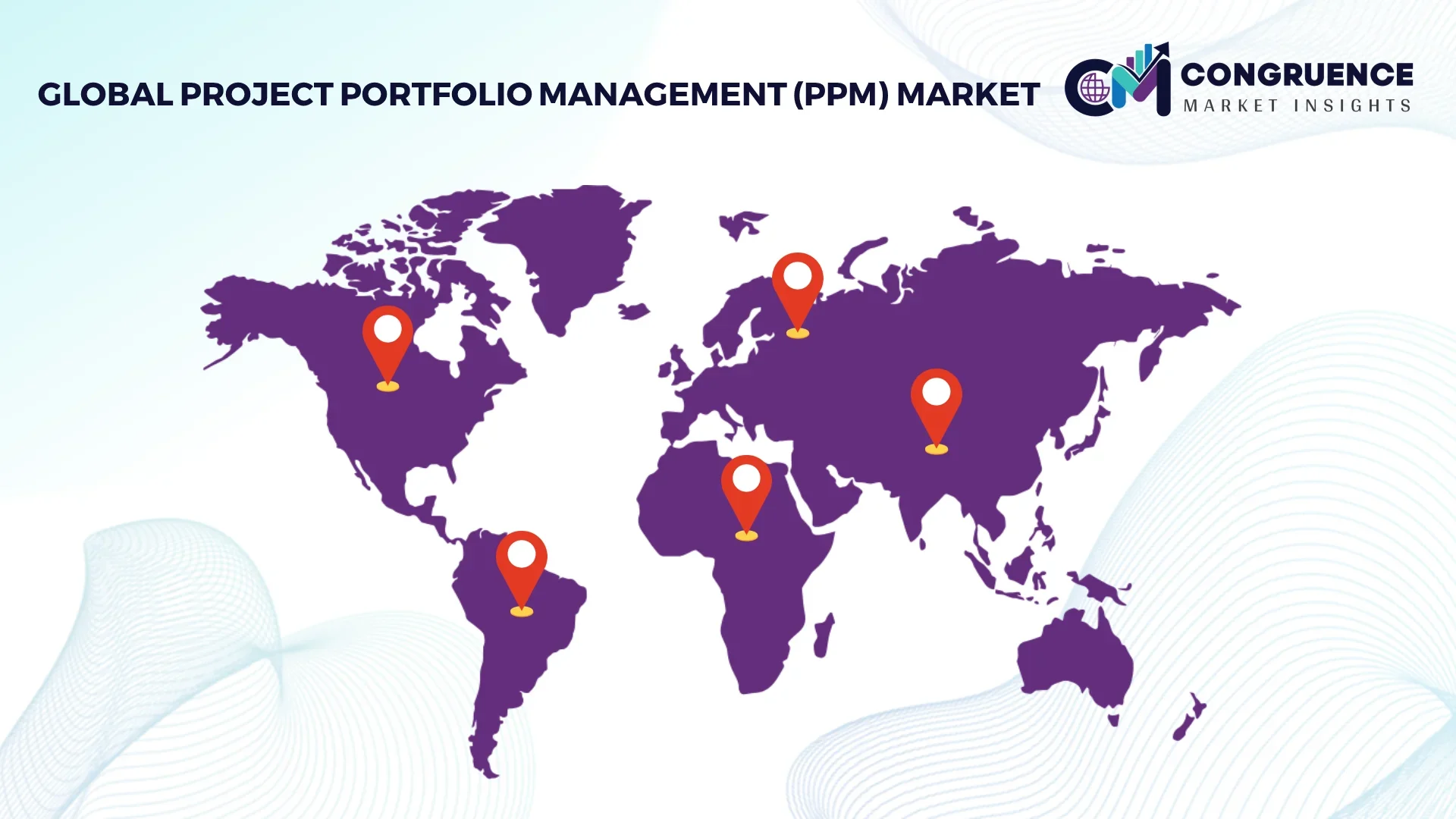
North America remains the largest Project Portfolio Management (PPM) Market, contributing approximately 38% of global demand through widespread enterprise software adoption, mature cloud infrastructure, and advanced digital transformation initiatives. More than 72% of large organizations have integrated cloud-based portfolio management platforms to improve governance, resource planning, and project visibility. The region benefits from strong investment in AI-enabled business applications and increasing modernization across healthcare, financial services, aerospace, and government sectors. Enterprise software vendors continue strengthening strategic partnerships with hyperscale cloud providers while expanding AI-powered workflow automation. Continuous platform innovation and enterprise-wide digital governance reinforce the region's leadership in high-value portfolio management deployments.
United States Market Outlook: The United States represents the largest national market due to its concentration of Fortune 1000 enterprises, global software providers, and large-scale digital transformation programs. Approximately 75% of major enterprises utilize enterprise portfolio governance solutions to coordinate multi-business operations. Continued investment in artificial intelligence, cloud computing, and infrastructure modernization is encouraging vendors to expand integrated project intelligence, predictive analytics, and enterprise automation capabilities across regulated and technology-intensive industries.
Europe maintains a strong position through enterprise modernization, industrial digitalization, and strict governance requirements across manufacturing, financial services, and public administration. The region accounts for nearly 28% of global market activity, while over 63% of large enterprises have standardized centralized project governance platforms. Digital compliance initiatives and increasing cybersecurity requirements continue driving enterprise platform upgrades. Organizations increasingly integrate PPM with ERP and operational technology environments to strengthen investment planning and project execution. Software vendors are expanding localized cloud infrastructure and compliance-focused capabilities to support evolving enterprise governance frameworks.
Germany Market Outlook: Germany leads the European market through its advanced manufacturing ecosystem, Industry 4.0 initiatives, and strong enterprise software adoption. Approximately 61% of large industrial companies deploy integrated portfolio management solutions to coordinate engineering, production, and capital investment programs. Domestic enterprises increasingly prioritize AI-enabled scheduling, predictive resource planning, and digital governance platforms to improve operational efficiency while maintaining compliance across multinational manufacturing operations.
Asia-Pacific is emerging as the fastest-growing regional market, supported by rapid enterprise digitalization, expanding IT services, and large-scale infrastructure investment. The region represents approximately 24% of global adoption, while cloud-based enterprise software implementation has increased by nearly 32% during recent transformation initiatives. Large organizations increasingly deploy integrated portfolio platforms to manage construction, manufacturing, telecommunications, and government modernization projects. Software providers continue expanding regional cloud infrastructure, implementation partnerships, and AI-enabled project governance capabilities to meet rising enterprise demand for scalable digital operations.
China Market Outlook: China dominates the regional market through extensive enterprise digitization, expanding cloud infrastructure, and large industrial modernization programs. More than 68% of major technology and manufacturing enterprises have accelerated digital project governance initiatives supporting complex infrastructure and production investments. Domestic software providers continue enhancing AI integration, intelligent workflow automation, and enterprise collaboration capabilities to strengthen operational visibility across rapidly expanding industrial ecosystems.
South America is steadily strengthening its position as organizations modernize project governance across infrastructure, financial services, energy, and telecommunications. The region contributes approximately 6% of global market activity, while cloud-based enterprise software adoption has increased by nearly 27% across large organizations. Digital transformation initiatives continue encouraging migration from manual project tracking toward integrated portfolio management platforms. Vendors are expanding regional implementation partnerships and managed services to improve deployment efficiency despite uneven digital infrastructure and enterprise technology maturity across several markets.
Brazil Market Outlook: Brazil leads the South American market through its large enterprise base, expanding financial services sector, and increasing public infrastructure investments. Around 54% of large organizations have accelerated enterprise cloud transformation strategies supporting centralized project governance. Technology providers continue investing in local partnerships, SaaS delivery models, and implementation services that improve enterprise scalability while addressing growing operational complexity across diversified industries.
The Middle East & Africa market is expanding as governments and enterprises increase investments in digital infrastructure, smart cities, and economic diversification programs. The region contributes approximately 4% of global demand, while enterprise cloud adoption has improved by nearly 29% across strategic industries. Large infrastructure developments require integrated portfolio governance to coordinate capital-intensive programs and improve execution transparency. Software vendors are strengthening regional cloud availability, implementation ecosystems, and cybersecurity capabilities to support modernization initiatives and enterprise-wide digital governance.
Saudi Arabia Market Outlook: Saudi Arabia represents the leading market within the region due to Vision 2030 transformation projects, large-scale infrastructure development, and accelerated enterprise digitization. More than 60% of major public sector digital initiatives now incorporate centralized project governance platforms to improve oversight and investment efficiency. Technology providers continue expanding cloud partnerships, AI-enabled project management capabilities, and local implementation resources to support long-term national modernization priorities.
The Project Portfolio Management (PPM) market is led by Microsoft, Planview, ServiceNow, Oracle, and Broadcom, with these global platform providers competing against specialist vendors such as Planisware and Celoxis through enterprise-scale capabilities rather than price alone. The top five players collectively account for approximately 58% of the market, reflecting moderate consolidation. Competition centers on AI-enabled portfolio intelligence, cloud-native deployment, and deep ERP integration, with nearly 70% of new implementations favoring SaaS platforms and 65% requiring multi-system integration. Vendors delivering AI-assisted planning report workflow efficiency gains approaching 25–30%, strengthening customer retention. Market leaders continue expanding through acquisitions, hyperscaler partnerships, embedded generative AI, and industry-specific solutions, while regional vendors compete through customization and implementation agility. The competitive shift is moving from standalone project management toward enterprise strategic portfolio ecosystems. High implementation complexity, ecosystem integration, and long enterprise sales cycles remain significant entry barriers. Winning requires scalable AI capabilities, trusted enterprise integration, rapid deployment, and measurable business outcomes.
Planview
ServiceNow
Oracle
Broadcom
Planisware
Celoxis Technologies
Upland Software
Adobe Workfront
Atlassian
Hexagon AB
Changepoint
SAP
OnePlan
Artificial intelligence, predictive analytics, and cloud-native portfolio management platforms are redefining enterprise project execution. More than 58% of large organizations now deploy AI-enabled planning capabilities, while approximately 70% of new PPM implementations are cloud-based. Generative AI is increasingly automating portfolio prioritization, demand assessment, and executive reporting, reducing manual planning effort by nearly 30%. Organizations integrating AI with ERP, CRM, and financial systems achieve stronger visibility across complex investment portfolios and improve strategic decision quality.
Modern cloud-native PPM platforms outperform legacy on-premises environments by reducing deployment time by approximately 40% while improving cross-functional collaboration by nearly 25% through real-time analytics and workflow automation. Low-code integration, API-first architecture, digital dashboards, and AI copilots are becoming standard enterprise requirements. Global software leaders including Microsoft, ServiceNow, and Planview benefit from broad cloud ecosystems and enterprise integration capabilities, creating a competitive advantage over standalone project management solutions.
Between 2026 and 2028, autonomous portfolio optimization, digital twins for capital planning, and intelligent resource orchestration will become mainstream enterprise capabilities. Organizations investing early in explainable AI, integrated governance, and predictive portfolio intelligence will strengthen operational resilience, accelerate strategic execution, and improve investment prioritization while responding faster to changing business conditions.
September 2024 – Planview announced the acquisition of Plutora, strengthening its Value Stream Management and enterprise software delivery portfolio. The acquisition expanded Planview's connected work platform by integrating release management and software delivery orchestration capabilities for enterprise customers. Business Impact: Enhanced end-to-end strategic portfolio execution and DevOps integration for large organizations.
November 2024 – Microsoft expanded Microsoft Planner by unifying Microsoft Project for the web, Planner, Microsoft To Do, and Copilot experiences into a single work management platform. The update introduced AI-assisted planning and portfolio visibility across Microsoft 365, enabling organizations to manage enterprise-scale initiatives more efficiently. Business Impact: Improved cross-functional portfolio coordination and AI-powered project planning.
August 2024 – ServiceNow released the Xanadu platform update, adding enhanced Project Portfolio Management dashboards, improved project workspace capabilities, and expanded portfolio reporting functionality. These enhancements improved project visibility and operational decision-making while strengthening integration across enterprise workflows. Business Impact: Faster executive reporting and improved portfolio governance.
March 2026 – ServiceNow introduced new Project Portfolio Management capabilities in the Australia Release, including AI-powered demand summarization, AI-linked demand management, and new AI Platform licensing tiers supporting autonomous workflows. Business Impact: Accelerated project intake, improved portfolio prioritization, and reduced manual planning effort through embedded AI. Source: www.servicenow.com
The report provides comprehensive analysis of the global Project Portfolio Management (PPM) market across Cloud-Based and On-Premises deployment models, covering applications including IT & Telecommunications, BFSI, Healthcare, Government, Manufacturing, Construction & Engineering, Energy & Utilities, and Others. It evaluates demand across Large Enterprises and Small & Medium Enterprises (SMEs) while assessing deployment trends, enterprise adoption patterns, competitive positioning, and technology integration across North America, Europe, Asia-Pacific, South America, and the Middle East & Africa.
The study examines AI-driven portfolio management, predictive analytics, cloud-native platforms, automation, API-based integration, and enterprise governance technologies shaping industry transformation. With coverage of leading vendors, evolving deployment strategies, and key operational trends, the report supports investment planning, product development, market expansion, competitive benchmarking, and strategic decision-making. It also highlights emerging adoption opportunities, enterprise digital transformation priorities, and technology roadmaps expected to influence market direction between 2026 and 2033.
| Report Attribute / Metric | Details |
|---|---|
| Market Revenue (2025) | USD 539.0 Million |
| Market Revenue (2033) | USD 961.3 Million |
| CAGR (2026–2033) | 7.50% |
| Base Year | 2025 |
| Forecast Period | 2026–2033 |
| Historic Period | 2021–2025 |
| Segments Covered |
By Type
By Application
By End-User
|
| Key Report Deliverables | Revenue Forecast; Market Trends; Growth Drivers & Restraints; Technology Insights; Segmentation Analysis; Regional Insights; Competitive Landscape; Regulatory & ESG Overview; Recent Developments |
| Regions Covered | North America; Europe; Asia-Pacific; South America; Middle East & Africa |
| Key Players Analyzed | Microsoft; Planview; ServiceNow; Oracle; Broadcom; Planisware; Celoxis Technologies; Upland Software; Adobe Workfront; Atlassian; Hexagon AB; Changepoint; SAP; OnePlan |
| Customization & Pricing | Available on Request (10% Customization Free) |




