
Reports
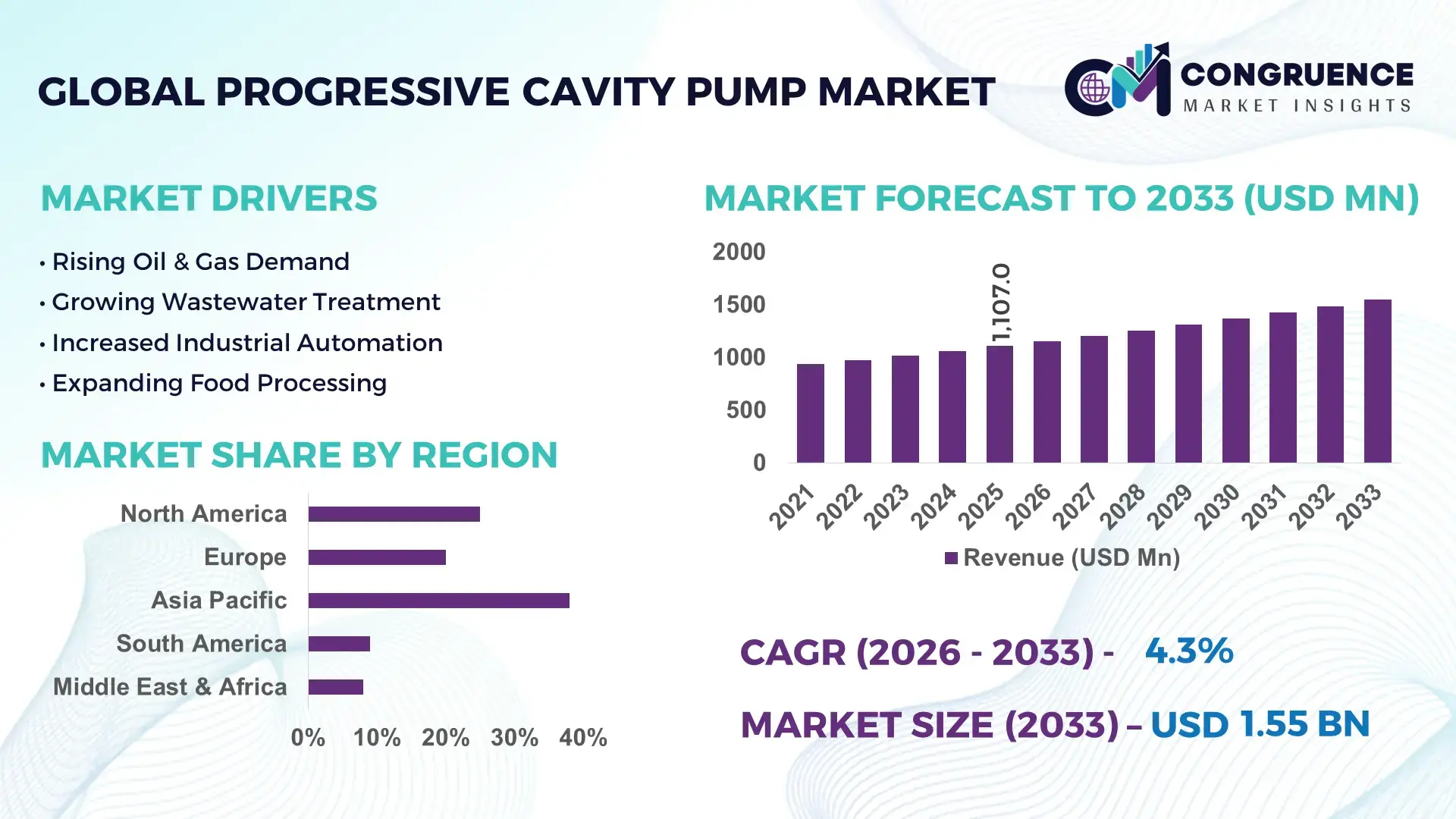
The Global Progressive Cavity Pump Market was valued at USD 1107 Million in 2025 and is anticipated to reach a value of USD 1550.32 Million by 2033 expanding at a CAGR of 4.3% between 2026 and 2033. Rising upstream oil recovery activity, wastewater infrastructure modernization, and high-viscosity fluid handling demand across food processing and chemical manufacturing are accelerating advanced progressive cavity pump deployment with energy-efficiency gains exceeding 18% in continuous-flow operations.
China remains the dominant country in the global progressive cavity pump market, accounting for nearly 29% of Asia-Pacific manufacturing capacity in 2026, supported by large-scale wastewater treatment expansion and industrial processing investments exceeding USD 8 billion across municipal and petrochemical sectors. Germany maintains stronger automation integration, with over 46% of industrial pump installations linked to predictive maintenance systems compared with China’s 31%, while North American shale recovery projects continue to increase demand for abrasion-resistant pumping systems amid Red Sea shipping disruptions impacting component lead times by nearly 12%.
Manufacturers prioritizing localized component sourcing, smart monitoring integration, and corrosion-resistant elastomer innovation are positioned to secure stronger industrial contracts and long-cycle operational partnerships through 2033.
Market Size & Growth: USD 1107 million in 2025 rising to USD 1550.32 million by 2033 at 4.3% growth, driven by automated fluid-handling expansion in wastewater and oilfield operations.
Top Growth Drivers: Wastewater infrastructure upgrades contribute 34% demand growth, oil recovery projects 27%, and food-grade processing automation 19%.
Short-Term Forecast: By 2027, smart progressive cavity pump systems reduce unplanned downtime by 21% and lower maintenance costs by 16%.
Emerging Technologies: AI-based predictive diagnostics, wear-resistant elastomers, and IIoT-enabled monitoring improve operational efficiency by nearly 24% in continuous-flow applications.
Regional Leaders: Asia-Pacific exceeds USD 620 million with municipal adoption growth, Europe reaches USD 410 million through energy-efficient retrofits, and North America surpasses USD 330 million from shale and chemical processing demand.
Consumer/End-User Trends: More than 48% of industrial operators prioritize low-shear pumping systems for viscous and sensitive fluid transfer applications.
Pilot/Case Example: In 2026, a large wastewater modernization project in Southeast Asia improved sludge transfer efficiency by 28% using advanced cavity pump automation.
Competitive Landscape: Top manufacturers control nearly 41% global share, with leading participation from Netzsch, Seepex, CIRCOR, Sulzer, and Xylem.
Regulatory & ESG Impact: Industrial energy-efficiency mandates cut power consumption by 14% across upgraded pumping installations in regulated European facilities.
Investment & Funding: Global industrial fluid-handling investments surpassed USD 2.4 billion in 2026, supported by regional manufacturing expansion and supply-chain localization.
Innovation & Future Outlook: Magnetic drive integration, digital twin monitoring, and modular pump designs are accelerating high-growth replacement demand across process industries.
Progressive cavity pump demand is strengthening across wastewater treatment, crude oil transfer, mining slurry handling, and hygienic food-processing applications as operators prioritize low-pulsation fluid movement and extended equipment lifespan. Advanced elastomer materials and IoT-enabled condition monitoring systems now improve maintenance efficiency by nearly 22%, while regional supply-chain diversification in Asia and Europe is accelerating localized manufacturing strategies amid tightening industrial energy regulations and operational resilience planning, setting the stage for broader strategic market expansion.
The progressive cavity pump market is gaining strategic importance as industrial operators prioritize continuous-flow efficiency, sludge handling optimization, and low-shear fluid transfer across wastewater, mining, chemicals, and upstream energy applications. Infrastructure modernization programs in China, India, and the United States are accelerating replacement cycles for aging rotary equipment, while stricter industrial discharge regulations are increasing deployment of precision metering and abrasion-resistant pumping systems. More than 44% of newly commissioned wastewater facilities in 2026 incorporated digitally monitored positive displacement pumps to improve operational visibility and reduce maintenance disruptions.
Advanced smart cavity pumps equipped with predictive diagnostics now deliver nearly 19% lower maintenance expenditure compared with legacy centrifugal systems in high-viscosity environments, while reducing energy losses by approximately 14% during continuous-duty operations. Germany leads in automation-linked pump integration, with over 48% of industrial installations connected to centralized monitoring systems, whereas India is expanding deployment scale through municipal treatment upgrades and food-processing capacity additions. Over the next two years, industrial users are expected to increase elastomer-upgrade adoption by nearly 21% to extend pump life in corrosive operating conditions.
In 2026, a large petrochemical processing facility in Texas implemented IoT-enabled progressive cavity pumps and reduced unplanned shutdown frequency by 17% within twelve months. Manufacturers are responding through localized assembly expansion, digital service partnerships, and modular pump platform development to secure long-term industrial contracts. Companies capable of combining predictive maintenance capability, material durability, and supply-chain resilience will strengthen competitive positioning across critical process industries.
Rapid modernization of industrial fluid-handling infrastructure is accelerating progressive cavity pump deployment across wastewater processing, oil recovery, and food-grade manufacturing. China increased municipal sludge-treatment investments by nearly 24% in 2026, while United States shale operators expanded high-viscosity transfer applications by approximately 18% to improve extraction continuity. Advanced elastomer rotor-stator systems are also extending equipment operating life by 15% in abrasive environments. Tightening discharge regulations and rising energy-efficiency targets are forcing industrial facilities to replace aging centrifugal systems with precision positive displacement technologies. In response, manufacturers are expanding localized production facilities, strengthening aftermarket maintenance networks, and investing in IoT-enabled diagnostics. A notable operational shift involves integrating predictive monitoring into pump fleets, reducing unplanned maintenance intervals and improving lifecycle cost control for continuous-process industries.
Volatility in stainless steel, specialty elastomer, and precision-machined rotor pricing continues to pressure profitability and deployment planning across the progressive cavity pump market. In 2026, elastomer procurement costs in Europe increased by nearly 13%, while global lead times for industrial-grade mechanical seals extended by approximately 16% due to shipping bottlenecks and supplier concentration in East Asia. These pressures are increasing procurement risk for wastewater and chemical processing projects operating under fixed-budget contracts. Smaller manufacturers face additional interoperability limitations when integrating smart monitoring modules into legacy pumping systems. Companies are responding through dual-sourcing agreements, regionalized assembly operations, and long-term supplier contracts to stabilize component access. Strategic localization in India and Mexico is emerging as a critical hedge against import dependency and freight-related operational disruption.
Digitalization of industrial process systems is creating strong opportunities for advanced progressive cavity pump platforms integrated with predictive analytics and remote asset management. More than 39% of large industrial operators in Germany and Japan are prioritizing smart pumping infrastructure to improve uptime visibility and reduce manual inspection frequency. AI-assisted diagnostics are lowering maintenance intervention rates by nearly 22%, while modular pump architectures reduce replacement downtime by approximately 17% in continuous-flow facilities. Hydrogen processing, lithium refining, and biofuel production are emerging as high-value deployment areas requiring precision low-pulsation fluid transfer. Manufacturers are increasing R&D spending on corrosion-resistant elastomers and cloud-connected monitoring systems while forming automation partnerships with industrial software providers. A non-obvious strategic advantage is the growing demand for service-based maintenance contracts that generate recurring operational revenue beyond equipment sales.
Long-term deployment scalability is increasingly constrained by technical workforce shortages and integration complexity across digitally connected industrial environments. Nearly 31% of processing facilities in Southeast Asia reported delays in commissioning advanced pumping systems due to shortages of trained automation technicians and fluid-system specialists. Integration of IoT-enabled pumps into older SCADA architectures also raises cybersecurity exposure and compatibility concerns, particularly in chemical and energy infrastructure. In Germany and the United States, retrofitting older industrial facilities can increase project engineering costs by approximately 14% because of customized control-system modifications and compliance testing requirements. Companies must strengthen technical training ecosystems, cybersecurity frameworks, and interoperability standards to maintain deployment consistency. Strategic partnerships with automation integrators and industrial software firms are becoming essential to ensure scalable implementation and long-term operational reliability.
Smart Monitoring Deployment Expands Industrial operators are accelerating integration of IoT-enabled progressive cavity pumps to improve uptime visibility and reduce maintenance dependency. In 2026, nearly 42% of newly installed pumps in Germany’s chemical processing sector included predictive diagnostics, while remote condition monitoring reduced emergency service interventions by 18%. Labor shortages across European industrial facilities are pushing companies toward automated maintenance workflows. Manufacturers are responding through cloud-based monitoring partnerships, digital aftermarket platforms, and sensor-integrated rotor-stator systems that improve operational continuity in high-viscosity processing environments.
Localized Manufacturing Networks Strengthen Supply-chain restructuring following Red Sea shipping disruptions and Asian component concentration has accelerated regional manufacturing expansion. Industrial pump producers in India and Mexico increased localized assembly operations by approximately 21% during 2025–2026 to reduce lead-time volatility and import dependency. Companies adopting dual-sourcing strategies lowered procurement delays by nearly 14%, improving project delivery consistency for wastewater and mining contracts. A non-obvious shift involves manufacturers relocating elastomer finishing operations closer to municipal infrastructure clusters to stabilize maintenance service timelines and strengthen aftermarket responsiveness.
Energy-Efficient Retrofits Accelerate Industrial retrofitting programs are driving replacement of aging centrifugal systems with energy-optimized progressive cavity pumps in sludge transfer and chemical dosing applications. In Japan, retrofitted wastewater facilities achieved nearly 16% lower energy consumption and 12% improved flow consistency during continuous-duty operations. Regulatory pressure tied to industrial efficiency standards is accelerating adoption of variable-speed drive integration and wear-resistant stator materials. Companies are restructuring product portfolios around modular retrofit kits and low-maintenance pump architectures to secure long-term service contracts across process industries.
Hygienic Processing Demand Rises Food-processing operators are increasing deployment of sanitary progressive cavity pumps to support low-shear transfer of viscous products and automated cleaning systems. More than 37% of dairy and beverage facilities in the United States upgraded to CIP-compatible pump systems in 2026 to improve contamination control and reduce cleaning downtime by approximately 15%. Manufacturers are scaling stainless-steel production lines, expanding hygienic certification capabilities, and partnering with automation integrators to address rising compliance requirements and high-throughput production workflows across packaged food operations.
Single Screw Pumps remain the dominant segment due to their strong suitability for high-viscosity fluid transfer, continuous-flow stability, and lower operational pulsation across wastewater, chemical, and sludge-processing applications. In 2026, nearly 46% of industrial progressive cavity pump installations used single screw configurations because of their lower maintenance frequency and approximately 18% better handling efficiency for abrasive media compared with traditional rotary alternatives. Horizontal Pumps continue to hold strong adoption in large-scale municipal and oil transfer infrastructure because of easier integration into continuous pipeline systems. Companies are prioritizing advanced elastomer innovation and modular assembly expansion to improve lifecycle durability and reduce service downtime in heavy-duty industrial environments.
Multi Screw Pumps are emerging as the fastest-growing segment, supported by increasing deployment in precision fluid transfer and high-pressure industrial processing. Adoption across petrochemical facilities in the United States increased by nearly 17% during 2025–2026 due to improved flow stability and reduced vibration performance. Hopper Pumps are gaining traction in sludge-intensive operations, while Vertical Pumps are expanding within compact processing facilities where installation footprint optimization is critical. Manufacturers are diversifying product portfolios through customized pressure configurations, automation-compatible designs, and sector-specific engineering partnerships to capture specialized industrial demand.
Wastewater Treatment remains the leading application segment as governments and industrial operators expand sludge management, chemical dosing, and effluent-processing capacity. In 2026, nearly 43% of progressive cavity pump deployments were linked to municipal and industrial wastewater infrastructure upgrades, particularly across China and India where stricter discharge compliance standards accelerated modernization programs. Progressive cavity systems improved sludge transfer efficiency by approximately 21% in continuous-flow treatment operations while lowering maintenance interruptions. Sludge Processing also continues to expand steadily due to rising demand for abrasion-resistant pumping systems capable of handling high-solid-content materials. Companies are increasing localized manufacturing and aftermarket servicing capabilities near major treatment infrastructure hubs to secure long-term municipal contracts.
Oil and Gas Transfer is the fastest-growing application segment, supported by rising heavy crude movement and enhanced oil recovery operations in the United States and the Middle East. Advanced cavity pumps reduced fluid handling losses by nearly 16% in high-viscosity transfer systems during 2025–2026. Food Processing and Chemical Handling applications are also expanding through hygienic automation upgrades and precision metering requirements. Manufacturers are responding with corrosion-resistant materials, sanitary-grade configurations, and digital monitoring integration to strengthen operational reliability across sensitive industrial processing environments.
The Oil and Gas Industry remains the dominant end-user segment due to extensive deployment in heavy crude transfer, drilling fluid circulation, and enhanced oil recovery operations. In 2026, approximately 38% of industrial progressive cavity pump demand originated from upstream and midstream hydrocarbon processing facilities, particularly in the United States and Saudi Arabia. Advanced rotor-stator systems improved viscous fluid transfer efficiency by nearly 17% while reducing downtime linked to abrasive fluid handling. Water Treatment Plants continue to represent a strong secondary demand base as municipalities modernize sludge management infrastructure and automate dosing operations. Manufacturers are strengthening partnerships with energy operators and industrial EPC firms to secure long-cycle infrastructure contracts and customized pumping solutions.
Water Treatment Plants are emerging as the fastest-growing end-user group because of tightening industrial discharge regulations and expanding urban infrastructure investments. Deployment of digitally monitored cavity pumps in municipal treatment facilities increased by nearly 22% during 2025–2026. The Food and Beverage Industry is increasing adoption of hygienic low-shear pumping systems, while Chemical Industry and Mining Industry operators are prioritizing corrosion-resistant and solids-handling capabilities. Pulp and Paper Industry demand is also stabilizing through modernization of slurry transfer systems. Companies are differentiating through application-specific engineering, predictive maintenance services, and modular product customization strategies targeting operational efficiency and lifecycle optimization.
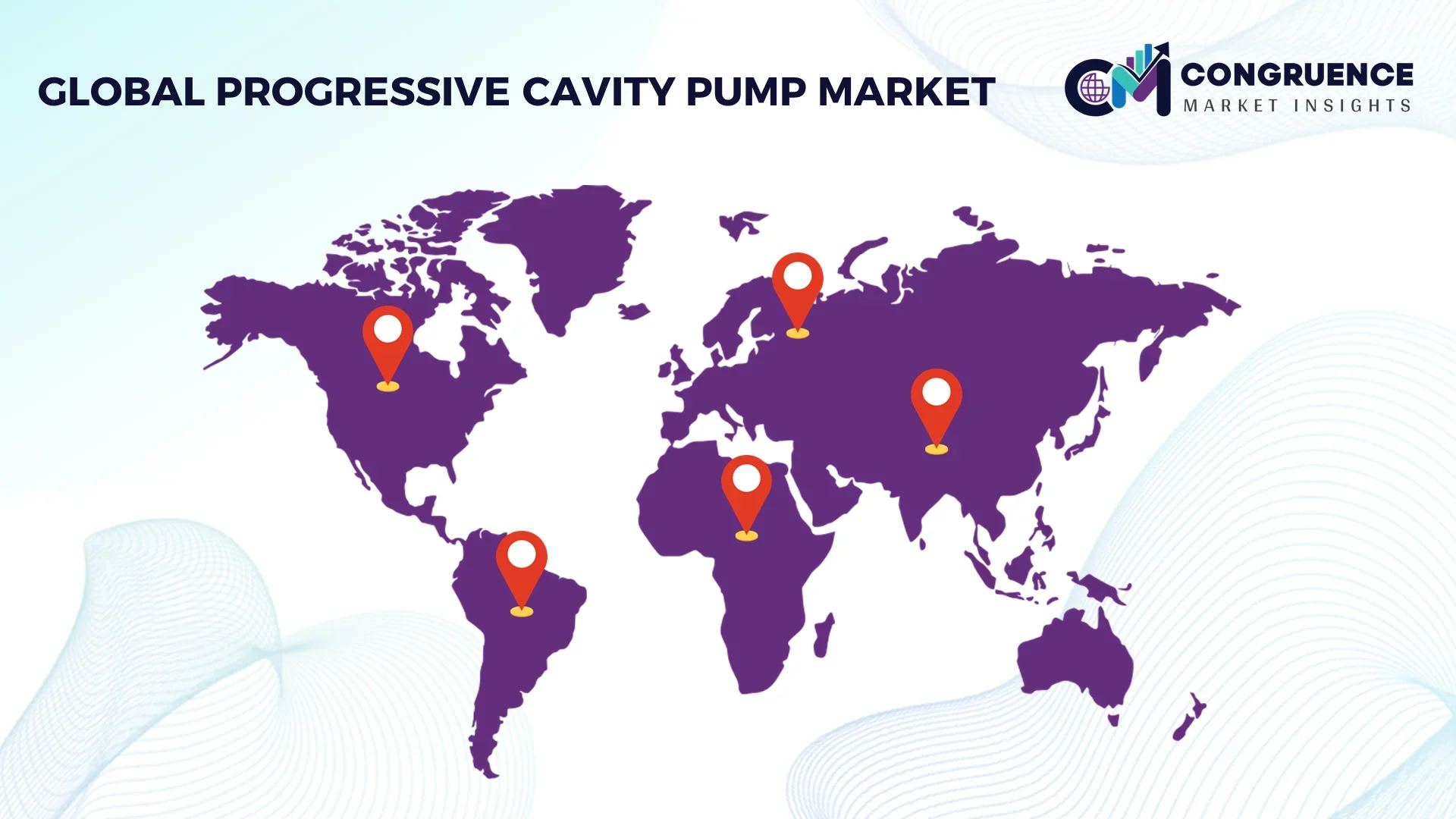
Asia-Pacific accounted for the largest market share at 38% in 2025 however, Middle East & Africa is expected to register the fastest growth, expanding at a CAGR of 5.8% between 2026 and 2033.
Automation-Led Infrastructure Replacement Accelerates Deployment
North America remains a high-value operational hub for progressive cavity pump deployment, supported by shale extraction activity, wastewater modernization, and advanced food-processing automation. The region contributed nearly 27% of global industrial installations in 2025, with strong concentration across the United States and Canada. Oil transfer and sludge-processing applications continue to dominate deployment intensity due to rising demand for continuous-flow handling systems and lower maintenance equipment. In 2026, multiple municipal infrastructure projects in Texas and California integrated digitally monitored cavity pumps, improving sludge transfer efficiency by approximately 18%. Industrial operators are increasingly adopting predictive maintenance integration to reduce service downtime and stabilize operating costs across high-throughput processing environments.
United States Market Outlook: The United States leads the regional market through strong upstream oil production, wastewater infrastructure investments, and rapid industrial automation adoption. More than 41% of newly deployed progressive cavity systems in 2026 were connected to remote monitoring platforms across municipal and energy operations. Domestic manufacturers are expanding localized component production and aftermarket service partnerships to address supply-chain reliability concerns and strengthen long-term industrial maintenance contracts.
Energy-Efficient Industrial Retrofits Reshape Operations
Europe is advancing progressive cavity pump adoption through industrial energy-efficiency mandates, wastewater treatment modernization, and stricter process automation standards. The region represented nearly 24% of global deployment activity in 2025, with Germany, France, and Italy driving industrial replacement demand. Retrofitting projects across chemical and municipal facilities improved process energy efficiency by nearly 15% through variable-speed drive integration and wear-resistant rotor systems. Food-processing enterprises are also increasing demand for hygienic low-shear pumping technologies to comply with evolving contamination-control requirements. Companies are strengthening engineering partnerships and modular product development strategies to support customized retrofit deployment across aging industrial infrastructure.
Germany Market Outlook: Germany maintains strong market leadership through advanced manufacturing integration, industrial automation expertise, and highly digitized wastewater infrastructure. Approximately 48% of newly installed industrial cavity pumps in 2026 incorporated predictive diagnostics and centralized monitoring compatibility. German enterprises are prioritizing corrosion-resistant materials, smart maintenance systems, and precision-engineered pump assemblies to improve lifecycle efficiency across chemical processing and municipal treatment operations.
Large-Scale Infrastructure Expansion Drives Volume Leadership
Asia-Pacific dominates the progressive cavity pump market through extensive wastewater infrastructure expansion, industrial processing growth, and localized manufacturing scale. The region accounted for approximately 38% of global demand in 2025, supported by strong deployment activity across China, India, Japan, and Southeast Asia. Municipal sludge-processing capacity additions and chemical production investments increased industrial pump installations by nearly 22% during 2025–2026. Regional manufacturers are expanding rotor-stator production facilities and automation-compatible product lines to strengthen export competitiveness and reduce procurement lead times. A major operational shift involves integrating digital monitoring systems into municipal treatment projects to improve maintenance planning and process reliability.
China Market Outlook: China leads the regional market through large-scale wastewater infrastructure development, petrochemical processing expansion, and domestic industrial equipment manufacturing strength. In 2026, more than 29% of Asia-Pacific progressive cavity pump production capacity was concentrated in China, supported by state-backed industrial modernization initiatives. Chinese manufacturers are increasing smart pump integration, localized elastomer production, and automated assembly investments to strengthen supply-chain control and support rising domestic and export demand.
Mining and Wastewater Projects Sustain Demand
South America is experiencing steady progressive cavity pump adoption through mining operations, municipal wastewater upgrades, and expanding food-processing infrastructure. Brazil, Chile, and Argentina remain key deployment centers due to rising slurry-handling and sludge-transfer requirements across industrial facilities. The region contributed nearly 7% of global installations in 2025, while mining-sector demand for abrasion-resistant pumping systems increased by approximately 16% during 2025–2026. Infrastructure limitations and imported component dependency continue to affect project execution speed in several countries. Companies are responding through regional distribution partnerships, localized maintenance hubs, and application-specific engineering services targeting mining and municipal processing operations.
Brazil Market Outlook: Brazil remains the strategic core of the South American market due to strong mining output, wastewater treatment investments, and food-processing expansion. Industrial operators increased deployment of solids-handling progressive cavity pumps by nearly 19% in 2026 across mining slurry and municipal sludge-processing applications. Domestic distributors are strengthening service networks and spare-parts localization to improve maintenance responsiveness and reduce operational disruption linked to import lead times.
Energy and Water Infrastructure Investments Accelerate Adoption
Middle East & Africa is emerging as the fastest-expanding regional market due to rising investment in water desalination, oilfield infrastructure, and industrial wastewater management. The region accounted for nearly 9% of global deployment activity in 2025, with Saudi Arabia, the UAE, and South Africa driving infrastructure-linked demand. Enhanced oil recovery operations and desalination facilities increased adoption of corrosion-resistant progressive cavity systems by approximately 20% during 2025–2026. Governments are prioritizing industrial water reuse and energy-sector modernization programs, encouraging long-cycle procurement of digitally monitored pumping equipment. Manufacturers are expanding regional service partnerships and technical support operations to strengthen project execution capability.
Saudi Arabia Market Outlook: Saudi Arabia leads regional deployment through large-scale desalination projects, upstream oilfield activity, and industrial diversification investments linked to infrastructure modernization programs. In 2026, major energy and water operators expanded deployment of advanced cavity pump systems across high-viscosity transfer and sludge-handling operations, improving process reliability by nearly 17%. Industrial suppliers are increasing localized technical servicing and automation integration partnerships to support long-term infrastructure and energy-sector operational requirements.
The progressive cavity pump market is controlled by global engineering leaders including Netzsch, Seepex, CIRCOR, Sulzer, Xylem, and PCM Group competing directly against regional cost-focused manufacturers in China and India. The top five players collectively account for nearly 41% of global market positioning, with competition centered on durability, customization speed, digital monitoring capability, and aftermarket servicing strength. European manufacturers maintain an advantage in predictive maintenance integration and precision elastomer engineering, while Asian suppliers compete aggressively through 12%–18% lower production costs and faster delivery cycles. Companies are expanding through localized assembly facilities, wastewater infrastructure partnerships, and modular pump platform development targeting oil transfer and sludge-processing applications. Vertical integration into rotor-stator manufacturing and service-network expansion has become a major competitive shift following recent supply-chain disruptions. High-performance material engineering, certified industrial reliability, and established maintenance ecosystems remain critical entry barriers. Winning requires operational responsiveness, application-specific engineering, and strong lifecycle service capability.
Netzsch Pumps & Systems
Seepex
CIRCOR International
Sulzer
Xylem
PCM Group
ITT Bornemann
LEWA
Liberty Process Equipment
Wangen Pumpen
Moyno
Roto Pumps
Pumpenfabrik Wangen
Nova Rotors
Advanced elastomer engineering, variable-frequency drives, and IoT-enabled condition monitoring currently define the core technology landscape in the progressive cavity pump market. In 2026, nearly 44% of newly deployed industrial cavity pumps incorporated predictive monitoring systems that reduced unplanned maintenance events by approximately 18%. Smart stator materials are also extending wear resistance by nearly 15% in abrasive sludge and mining applications. Compared with legacy centrifugal systems, modern progressive cavity pumps deliver nearly 21% better handling efficiency for high-viscosity fluids while reducing flow pulsation in continuous-duty operations. Industrial operators benefit through lower downtime, improved dosing precision, and reduced maintenance labor requirements.
Emerging technologies are centered on modular drive systems, digital twin diagnostics, and hygienic low-shear transfer architectures. Germany and Japan are accelerating deployment of AI-assisted maintenance platforms, with automated fault detection adoption rising by nearly 24% during 2025–2026. Food-processing enterprises are increasingly integrating CIP-compatible pump systems that lower cleaning downtime by approximately 14%. Manufacturers are responding through software partnerships, smart retrofit kits, and cloud-connected monitoring ecosystems to strengthen aftermarket service revenue and improve operational lifecycle management.
Between 2026 and 2028, disruptive technologies including magnetically coupled sealing systems, additive-manufactured rotor components, and autonomous process-control integration will reshape industrial fluid handling. Companies investing early in digitally integrated and energy-optimized pumping systems will secure stronger positioning across wastewater modernization, biofuel production, and high-solids industrial processing operations.
June 2026 – NETZSCH Pumps & Systems expanded its NEMO® progressing cavity pump portfolio with advanced application-focused configurations supporting nearly 500 m³/h flow handling across industrial processing sectors. The launch strengthened operational flexibility for wastewater, food-processing, and petrochemical customers seeking lower pulsation and higher solids-handling capability.
March 2026 – SEEPEX introduced its Smart Joint Access system for BN series progressive cavity pumps, enabling faster inspection access without full disassembly. The design reduced maintenance intervention time by approximately 30%, improving operational continuity for continuous-process industries handling high-viscosity and abrasive media.
March 2026 – NETZSCH Pumps & Systems launched a next-generation progressing cavity pump platform for oil and gas applications featuring insertable maintenance architecture and compact drive-head integration. The system reduced installation complexity and improved servicing speed for remote well-site operations requiring high-viscosity multiphase fluid transfer.
June 2025 – SEEPEX showcased its BF progressive cavity pump range at The Battery Show Europe, aligning fluid-handling technology with growing battery manufacturing demand. The expansion strengthened the company’s positioning in precision chemical transfer applications requiring stable low-shear pumping performance and contamination-controlled process integration.
The report delivers detailed analysis of the global progressive cavity pump market across major types including Single Screw Pumps, Multi Screw Pumps, Hopper Pumps, Vertical Pumps, and Horizontal Pumps, with application-level assessment spanning wastewater treatment, oil and gas transfer, food processing, chemical handling, and sludge processing. It evaluates operational deployment patterns across North America, Europe, Asia-Pacific, South America, and Middle East & Africa, covering industrial modernization trends, infrastructure investments, automation integration, and evolving maintenance strategies. More than 40% of recent industrial deployments analyzed involve digitally monitored or energy-optimized pumping systems.
The study further examines end-user demand across oil and gas, municipal water treatment, mining, food and beverage, pulp and paper, and chemical processing industries. It includes strategic benchmarking of leading manufacturers, technology adoption analysis, supply-chain restructuring trends, and competitive positioning insights between 2026 and 2033. The report supports investment prioritization, product expansion planning, localization strategies, and lifecycle service optimization through detailed operational and enterprise-level intelligence.
| Report Attribute/Metric | Report Details |
|---|---|
|
Market Revenue in 2025 |
USD 1107 Million |
|
Market Revenue in 2033 |
USD 1550.32 Million |
|
CAGR (2026 - 2033) |
4.3% |
|
Base Year |
2025 |
|
Forecast Period |
2026 - 2033 |
|
Historic Period |
2021 - 2025 |
|
Segments Covered |
By Type
By Application
By End-User
|
|
Key Report Deliverable |
Revenue Forecast, Growth Trends, Market Dynamics, Segmental Overview, Regional and Country-wise Analysis, Competition Landscape |
|
Region Covered |
North America, Europe, Asia-Pacific, South America, Middle East, Africa |
|
Key Players Analyzed |
Netzsch Pumps & Systems, Seepex, CIRCOR International, Sulzer, Xylem, PCM Group, ITT Bornemann, LEWA, Liberty Process Equipment, Wangen Pumpen, Moyno, Roto Pumps, Pumpenfabrik Wangen, Nova Rotors |
|
Customization & Pricing |
Available on Request (10% Customization is Free) |




