
Reports
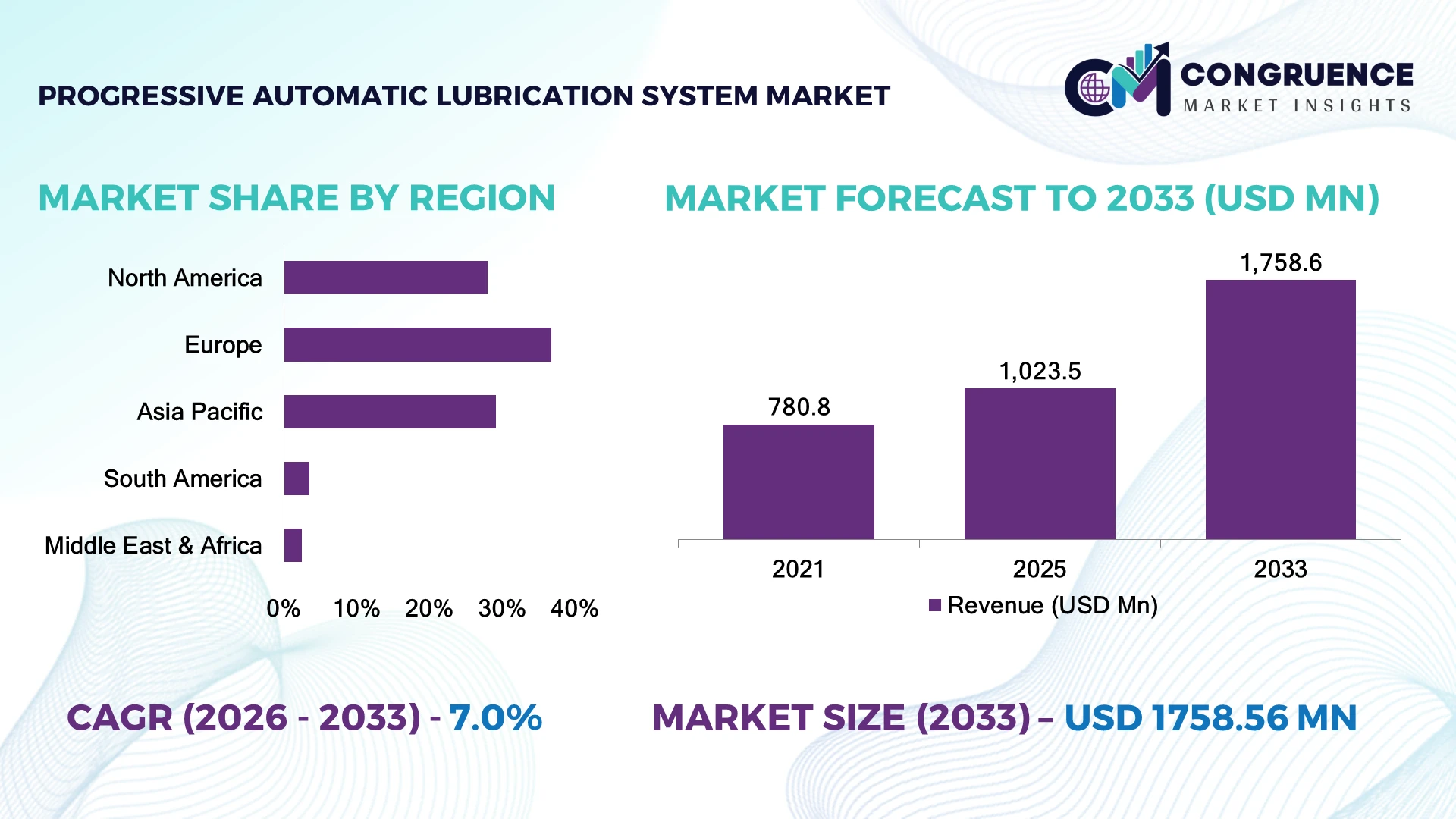
The Global Progressive Automatic Lubrication System Market was valued at USD 1,023.5 Million in 2025 and is anticipated to reach a value of USD 1,758.6 Million by 2033 expanding at a CAGR of 7.0% between 2026 and 2033. Growth is driven by rising predictive maintenance adoption, automated heavy equipment fleets, and increasing investment in mining, construction, steel, and industrial automation requiring continuous lubrication reliability.
Germany leads the market with approximately 19% global manufacturing concentration for industrial lubrication systems, supported by advanced machinery, automotive, and process industries investing heavily in Industry 4.0 upgrades. More than 62% of newly commissioned automated production lines integrate centralized lubrication, compared with nearly 47% in China, while Europe's industrial modernization has accelerated following energy security initiatives triggered by the Russia-Ukraine conflict.
Strategic investments increasingly favor intelligent lubrication platforms that minimize downtime, extend asset life, and reduce maintenance intervention across mission-critical industrial operations.
Market Size & Growth: USD 1,023.5 million (2025) reaching USD 1,758.6 million by 2033 at 7.0% CAGR, supported by industrial automation.
Top Growth Drivers: Predictive maintenance (+44%), automated manufacturing (+38%), mining modernization (+31%).
Short-Term Forecast: By 2028, unplanned equipment downtime declines nearly 22% through automated lubrication deployment.
Emerging Technologies: IoT sensors, AI diagnostics, and smart controllers improve lubrication accuracy by over 28%.
Regional Leaders: Europe, Asia-Pacific, and North America lead, driven by factory automation and infrastructure expansion.
Consumer/End-User Trends: Around 58% of new heavy equipment installations include centralized lubrication systems.
Pilot/Case Example: 2026 mining deployment reduced grease consumption by 18% while extending bearing life by 24%.
Competitive Landscape: Top suppliers control approximately 48% market share through integrated automation portfolios.
Regulatory & ESG Impact: Lubricant waste falls nearly 25% using precision metering technologies.
Investment & Funding: Industrial automation investments exceed USD 3.5 billion supporting maintenance modernization initiatives.
Innovation & Future Outlook: Digital lubrication monitoring and cloud diagnostics accelerate global equipment reliability strategies.
The Progressive Automatic Lubrication System Market is expanding across mining, construction equipment, manufacturing, ports, and wind energy where predictive maintenance is becoming operationally essential. Intelligent lubricant metering, remote diagnostics, and sensor-enabled controllers improve maintenance efficiency by nearly 30%. Growing industrial resilience initiatives following supply-chain disruptions are accelerating adoption, setting the stage for broader strategic market transformation.
Progressive automatic lubrication systems have become a strategic investment for asset-intensive industries seeking higher equipment availability, lower maintenance costs, and improved operational consistency. Industrial automation, digital maintenance platforms, and infrastructure modernization are driving deployment across mining, steel production, manufacturing, agriculture, and heavy construction. The increasing shift toward predictive maintenance is transforming lubrication from a scheduled maintenance activity into a continuous operational function.
Modern sensor-enabled lubrication systems reduce lubricant consumption by approximately 20% while improving bearing life by nearly 30% compared with conventional manual lubrication practices. Germany and the Nordic countries lead adoption through advanced industrial automation, while China expands installations rapidly across manufacturing and heavy equipment production. Over the next two to three years, integrated condition monitoring is expected to become standard across more than half of newly automated industrial facilities.
Mining operators increasingly deploy centralized lubrication systems connected to machine health monitoring platforms, allowing maintenance teams to identify lubrication anomalies before equipment failure occurs. Manufacturers are expanding digital product portfolios, strengthening OEM partnerships, and integrating remote diagnostics into lubrication controllers. Companies capable of combining intelligent automation, predictive analytics, and high-reliability lubrication hardware will establish stronger competitive positions as industrial operators prioritize equipment uptime, maintenance efficiency, and lifecycle optimization.
Industrial automation and predictive maintenance programs are driving widespread deployment of progressive automatic lubrication systems across mining, manufacturing, steel, and heavy construction. Nearly 61% of new automated production assets now integrate centralized lubrication, while predictive maintenance programs reduce bearing failures by approximately 35% and maintenance labor by 28%. Germany continues expanding Industry 4.0 manufacturing, encouraging OEMs to incorporate intelligent lubrication modules into factory equipment. This shift improves equipment availability, extends component life, and lowers lubricant waste. Manufacturers are responding through smart controller development, sensor-enabled lubrication monitoring, strategic OEM collaborations, and expanded production capacity. A key operational advantage lies in replacing reactive maintenance with continuous lubrication management, enabling higher machine utilization and predictable lifecycle performance across critical industrial assets.
Retrofitting progressive automatic lubrication systems into aging industrial equipment remains a major structural constraint. Installation and commissioning can account for nearly 25% of total project expenditure, while over 40% of older production assets require customized piping or controller modifications. In India and several Southeast Asian manufacturing clusters, legacy machinery lacks standardized interfaces, delaying deployment and increasing engineering costs. These limitations reduce scalability for small and medium-sized industrial operators and lengthen investment payback periods. Equipment suppliers are mitigating these risks through modular lubrication kits, localized component sourcing, long-term service contracts, and standardized installation platforms. Developing retrofit-friendly architectures has become a strategic priority for expanding addressable markets without requiring complete equipment replacement.
Digital maintenance ecosystems are creating significant opportunities for intelligent progressive lubrication platforms. IoT-enabled lubrication controllers improve maintenance planning accuracy by approximately 33%, while cloud-connected diagnostics reduce unexpected lubrication faults by nearly 26%. Australia and Canada are expanding autonomous mining operations where remotely monitored lubrication systems improve fleet reliability across isolated worksites. Manufacturers are investing in AI-assisted fault prediction, wireless sensors, and digital twin integration to strengthen asset performance. Partnerships between lubrication specialists and industrial automation providers are accelerating interoperable solutions. A distinctive opportunity lies in combining lubrication analytics with enterprise asset management software, transforming lubrication data into actionable maintenance intelligence that supports productivity improvements beyond traditional lubrication functions.
Long-term competitiveness depends on overcoming integration complexity across increasingly digital industrial environments. More than 36% of industrial operators manage mixed-equipment fleets from multiple OEMs, while nearly 29% report software compatibility challenges between lubrication controllers and plant monitoring systems. Japan's advanced manufacturing facilities increasingly require seamless communication between lubrication equipment, PLCs, and predictive maintenance platforms, raising engineering requirements. Inconsistent communication protocols and cybersecurity expectations complicate deployment consistency across multinational facilities. Companies are investing in open communication standards, secure industrial connectivity, advanced software engineering, and strategic automation partnerships. The strongest competitive advantage will belong to suppliers delivering interoperable, cyber-secure lubrication ecosystems that integrate reliably into diverse industrial automation infrastructures.
Smart Sensor Integration Expands IoT-enabled lubrication systems now represent nearly 46% of newly commissioned industrial installations, while remote condition monitoring reduces inspection frequency by approximately 32%. Industrial labor shortages and increasing automation are accelerating deployment. Manufacturers are integrating wireless sensors, cloud dashboards, and predictive alerts into centralized lubrication platforms to improve equipment availability and maintenance precision.
OEM Equipment Integration Increases Around 54% of heavy equipment manufacturers now offer factory-installed progressive lubrication systems on premium models, reducing installation time by nearly 30%. Construction and mining operators increasingly prefer integrated solutions over aftermarket installations. Equipment suppliers are strengthening OEM partnerships and standardizing lubrication architectures to simplify commissioning and lifecycle support.
Digital Maintenance Platforms Mature Progressive lubrication controllers are increasingly connected with enterprise asset management software, improving maintenance scheduling accuracy by approximately 35% while reducing lubricant consumption by 18%. Digital transformation initiatives across Germany and Japan are driving this operational shift. Suppliers continue expanding software capabilities and automated reporting to strengthen predictive maintenance ecosystems.
Precision Lubrication Enhances Sustainability Automated metering technologies lower lubricant waste by nearly 24% while extending bearing service intervals by approximately 27%. Tightening environmental compliance requirements and higher lubricant costs encourage industrial operators to optimize consumption rather than increase maintenance frequency. Manufacturers are responding with electronically controlled pumps, precision metering valves, and intelligent diagnostics that simultaneously improve sustainability and operational efficiency.
Progressive metering systems account for approximately 72% of the global Progressive Automatic Lubrication System market, supported by their precise lubricant distribution, continuous line monitoring, and ability to maintain lubrication across multiple lubrication points using a single pumping source. Their compact design, lower maintenance requirements, and compatibility with mining, construction, and manufacturing equipment make them the preferred solution for heavy-duty industrial applications. Electrically monitored progressive systems represent the fastest-growing segment, expanding as manufacturers integrate sensors and digital diagnostics into maintenance platforms. These intelligent systems improve fault detection by nearly 35% and reduce manual inspection frequency by around 30%, strengthening equipment reliability.
Mechanically monitored progressive systems continue serving cost-sensitive industries where operational simplicity and rugged performance remain priorities. Manufacturers are expanding smart controller portfolios, partnering with industrial automation providers, and introducing modular metering blocks that simplify installation across diverse equipment platforms. Investment priorities increasingly favor digitally connected lubrication architectures capable of supporting predictive maintenance while maintaining compatibility with existing industrial assets.
Industry findings published by the National Fluid Power Association during 2025 indicate that centralized lubrication technologies are increasingly being specified alongside automated hydraulic equipment to improve machine reliability and reduce unplanned maintenance interventions.
Mining equipment represents the largest application segment with approximately 31% market share, reflecting continuous operation, harsh environments, and extensive lubrication requirements across haul trucks, crushers, conveyors, and excavators. Automatic lubrication minimizes bearing failures, extends component life, and reduces maintenance shutdowns where equipment accessibility is limited. Construction equipment is emerging as the fastest-growing application as infrastructure expansion and fleet automation increase demand for intelligent lubrication systems. Automated lubrication solutions improve equipment availability by approximately 28% while reducing lubricant consumption by nearly 20%, making them increasingly attractive for contractors managing large mobile equipment fleets.
Manufacturing machinery, agricultural equipment, material handling systems, marine equipment, and wind turbines continue expanding adoption as industries modernize maintenance strategies. Suppliers are developing application-specific lubrication packages, integrating remote monitoring capabilities, and strengthening OEM partnerships to improve deployment efficiency across multiple industrial sectors. Investment continues shifting toward high-utilization assets where automated lubrication delivers measurable lifecycle savings and improved operational continuity.
According to operational assessments released by the Association of Equipment Manufacturers during 2025, predictive maintenance technologies including centralized lubrication are becoming increasingly integrated into modern off-highway equipment to maximize fleet utilization and equipment uptime.
Manufacturing accounts for approximately 34% of total market demand, driven by automated production lines, continuous-process operations, and increasing emphasis on predictive maintenance. Steel plants, cement facilities, pulp and paper mills, and automotive manufacturing rely extensively on progressive lubrication systems to maintain production continuity while reducing equipment wear. Mining is projected to be the fastest-growing end-user segment as autonomous operations, larger equipment fleets, and remote asset monitoring accelerate investment. Automated lubrication reduces maintenance labor by approximately 30% while improving bearing service life by nearly 25%, strengthening productivity across heavy industrial operations.
Construction, agriculture, transportation, energy, and marine industries continue expanding adoption as fleet operators seek lower maintenance costs and improved equipment availability. Manufacturers are introducing industry-specific lubrication packages, flexible service contracts, and integrated monitoring platforms while strengthening OEM collaborations to meet diverse operational requirements. Competitive positioning increasingly depends on delivering customized lubrication solutions aligned with sector-specific maintenance challenges and digital asset management strategies.
According to 2026 industrial equipment surveys conducted by the International Society of Automation (ISA), automated maintenance technologies, including centralized lubrication systems, are being adopted across critical industrial assets to improve reliability, operational efficiency, and maintenance planning accuracy.
Europe accounted for the largest market share at 36.8% in 2025 however, Asia-Pacific is expected to register the fastest growth, expanding at a CAGR of 8.2% between 2026 and 2033.
Advanced Fleet Automation Strengthens Lubrication System Deployment
North America represents a mature market driven by mining, construction, agriculture, and heavy manufacturing sectors increasingly adopting predictive maintenance technologies. Centralized lubrication systems are widely integrated into off-highway equipment, automated production lines, and logistics infrastructure to maximize equipment uptime. The region contributes approximately 28% of global demand, supported by high replacement rates and OEM-standard lubrication integration. More than 60% of newly deployed large mining equipment incorporates automatic lubrication systems. Equipment manufacturers continue expanding digital monitoring capabilities while strengthening partnerships with industrial automation providers, enabling real-time maintenance optimization and reducing lifecycle operating costs across critical industrial assets.
United States Market Outlook: The United States leads regional demand through large mining operations, advanced manufacturing, extensive construction activity, and highly mechanized agricultural equipment fleets. More than 65% of newly commissioned heavy industrial machinery includes centralized lubrication capabilities as asset owners prioritize predictive maintenance and operational reliability. Continued investment in industrial automation and infrastructure modernization supports strong adoption across manufacturing, quarrying, and material handling industries.
Industrial Modernization Drives Precision Lubrication Leadership
Europe remains the largest regional market, supported by advanced machinery manufacturing, automotive production, mining equipment, and stringent industrial maintenance standards. Germany, Sweden, and Italy continue investing in Industry 4.0 technologies that integrate intelligent lubrication with predictive maintenance platforms. Nearly 62% of newly automated manufacturing systems include centralized lubrication functions, improving operational reliability and reducing lubricant waste. OEMs are expanding modular lubrication platforms, digital controllers, and condition-monitoring capabilities to meet increasing demand for efficient industrial asset management while supporting sustainability objectives across heavy industries.
Germany Market Outlook: Germany serves as Europe's technology hub for automatic lubrication systems through its globally competitive machinery, automotive, and industrial automation sectors. Smart manufacturing initiatives continue driving intelligent lubrication integration across production facilities. Approximately 68% of advanced industrial equipment manufacturers offer digitally monitored lubrication solutions as standard or optional configurations, strengthening equipment reliability and lifecycle efficiency.
Manufacturing Expansion Accelerates Smart Lubrication Adoption
Asia-Pacific is the fastest-growing regional market, supported by expanding manufacturing capacity, mining investments, infrastructure development, and industrial automation across China, India, Japan, and Southeast Asia. The region accounts for nearly 30% of global installations while rapidly increasing deployment across heavy equipment fleets. Automated production facilities increasingly integrate centralized lubrication to improve equipment utilization and reduce maintenance costs. Suppliers continue expanding manufacturing capacity, localized engineering support, and OEM collaborations to serve rapidly growing industrial sectors.
China Market Outlook: China dominates regional deployment through large-scale manufacturing, mining equipment production, construction machinery, and expanding automated factories. More than 55% of newly manufactured heavy industrial equipment incorporates centralized lubrication systems to improve operational efficiency. Domestic equipment manufacturers continue investing in intelligent controllers, sensor-enabled lubrication technology, and localized component production to strengthen competitiveness in industrial automation markets.
Mining Investments Sustain Equipment Modernization
South America continues expanding demand through mining, agriculture, cement production, and heavy construction projects where equipment reliability remains operationally critical. The region contributes approximately 6% of global market demand, with lubrication automation reducing maintenance interruptions across remote operating environments. Growing mining investments encourage deployment of centralized lubrication systems that improve equipment availability while lowering maintenance labor requirements. Suppliers increasingly strengthen regional distribution networks, technical support capabilities, and aftermarket service partnerships to improve deployment efficiency despite infrastructure and logistics challenges.
Brazil Market Outlook: Brazil leads regional demand through extensive mining operations, agricultural mechanization, and infrastructure development projects. Large off-highway equipment fleets increasingly adopt automatic lubrication to improve machine utilization under demanding operating conditions. Mining operators continue investing in predictive maintenance technologies, creating favorable conditions for intelligent lubrication systems integrated with fleet management and remote equipment monitoring platforms.
Infrastructure Expansion Supports Industrial Reliability
The Middle East & Africa market is driven by mining, oil and gas, cement production, ports, and large-scale infrastructure development requiring continuous equipment operation. Industrial operators increasingly adopt centralized lubrication to minimize maintenance downtime in harsh operating environments. Equipment modernization initiatives across mining and energy facilities are accelerating deployment of automated lubrication technologies capable of improving asset reliability. Suppliers are strengthening regional partnerships, technical service networks, and localized engineering capabilities to support expanding industrial investment across strategic sectors.
Saudi Arabia Market Outlook: Saudi Arabia represents the region's most significant market through mining expansion, industrial diversification, petrochemical operations, and infrastructure modernization initiatives. Heavy equipment operators increasingly implement automated lubrication systems to maximize equipment availability under high-temperature operating conditions. Ongoing investment in industrial automation and advanced maintenance technologies continues strengthening long-term demand for intelligent lubrication solutions across large industrial facilities.
The Progressive Automatic Lubrication System market is led by SKF, Timken (Groeneveld-BEKA), Graco, Bijur Delimon, and DropsA, with the top five suppliers collectively accounting for approximately 49% of global market share. Global lubrication specialists compete against regional system integrators, while OEM-aligned manufacturers challenge aftermarket suppliers through factory-installed solutions. Competition is driven by intelligent monitoring, metering precision, installation speed, and lifecycle service, with IoT-enabled systems reducing maintenance inspections by nearly 30% and precision metering lowering lubricant consumption by approximately 20%. Companies are expanding OEM partnerships, strengthening regional service networks, integrating cloud diagnostics, and introducing modular progressive systems compatible with automated equipment. Competitive momentum is shifting from standalone lubrication hardware toward digitally connected maintenance ecosystems supporting predictive asset management. High engineering expertise, established OEM relationships, and global service capability remain the primary entry barriers. Winning requires combining reliable hardware, intelligent monitoring, rapid technical support, and seamless industrial automation integration.
SKF Group
The Timken Company (Groeneveld-BEKA)
Graco Inc.
Bijur Delimon International
DropsA S.p.A.
LUBE Corporation
ILC S.r.l.
Cenlub Systems
Lubecore International
Alemite LLC
Trico Corporation
Perma-Tec GmbH & Co. KG
Pricol Limited
WOERNER GmbH
Progressive automatic lubrication systems are rapidly evolving through IoT connectivity, intelligent controllers, electronic metering devices, and predictive maintenance software. Smart lubrication controllers improve fault detection by approximately 35%, while sensor-enabled monitoring reduces unnecessary maintenance inspections by nearly 30%. Around 58% of newly deployed industrial lubrication systems now include digital monitoring capabilities, enabling continuous asset supervision. These technologies improve equipment reliability while reducing lubricant waste and extending bearing service life across mining, manufacturing, and construction operations.
Wireless diagnostics, cloud-connected lubrication platforms, AI-assisted maintenance analytics, and digitally controlled pumps are replacing conventional timer-based lubrication systems. Compared with legacy manual lubrication, intelligent progressive systems improve equipment availability by nearly 28% while lowering lubricant consumption by approximately 20%. Industrial operators integrating lubrication data with enterprise asset management platforms achieve stronger maintenance planning and reduced unexpected equipment failures. Large mining companies, automated factories, and construction fleet operators benefit most from these integrated digital lubrication ecosystems.
Between 2026 and 2028, autonomous lubrication optimization, digital twins, edge computing, and machine-learning diagnostics will accelerate adoption across heavy industries. Suppliers investing in predictive lubrication intelligence, modular electronics, and open industrial communication protocols will strengthen competitive positioning. Organizations adopting connected lubrication infrastructure today will gain measurable operational resilience, lower maintenance costs, and superior equipment lifecycle performance as industrial automation continues expanding globally.
February 2024 SKF Lincoln introduced the CLP Smart Series compact lubrication pumps featuring wireless control through the eLube app for progressive lubrication systems, simplifying configuration and improving maintenance efficiency across mobile and industrial equipment. Source: prnewswire.com
September 2024 SKF Lincoln launched the SL-6 metering device engineered for single-line automatic lubrication systems handling extreme-pressure greases, delivering enhanced leakage protection and long-term performance for construction and mining equipment. Source: prnewswire.com
January 2025 SKF expanded its connected lubrication portfolio with wireless monitoring for SYSTEM 24 lubricators through the Lubrication Cloud platform, enabling remote status monitoring and centralized lubrication management across industrial facilities. Source: vogel-zentralschmierung.de
October 2024 SKF showcased updated Lincoln Quicklub automatic lubrication technologies during FABTECH 2024, emphasizing faster servicing, modular product architecture, and improved system integration to strengthen industrial maintenance efficiency. Source: SKF Group.
This report provides comprehensive analysis of the Progressive Automatic Lubrication System market across system types, applications, end-user industries, and major geographic regions. It evaluates progressive metering technologies, intelligent lubrication controllers, monitoring platforms, pumps, and digital maintenance solutions used across mining, manufacturing, construction, agriculture, transportation, marine, and energy sectors. More than 55% of newly installed heavy industrial equipment now incorporates centralized lubrication, highlighting the growing importance of automated maintenance technologies.
The report assesses competitive positioning, deployment trends, OEM integration strategies, aftermarket opportunities, and technology innovation between 2026 and 2033. It delivers actionable insights into industrial automation, predictive maintenance adoption, regional investment priorities, product differentiation, and emerging digital lubrication ecosystems, supporting strategic expansion, competitive benchmarking, technology selection, operational optimization, and long-term investment planning across mature and high-growth industrial markets.
| Report Attribute/Metric | Report Details |
|---|---|
|
Market Revenue in 2025 |
USD 1,023.5 Million |
|
Market Revenue in 2033 |
USD 1,758.6 Million |
|
CAGR (2026 - 2033) |
7% |
|
Base Year |
2025 |
|
Forecast Period |
2026 - 2033 |
|
Historic Period |
2021 - 2025 |
|
Segments Covered |
By Type
By Application
By End-User
|
|
Key Report Deliverable |
Revenue Forecast, Growth Trends, Market Dynamics, Segmental Overview, Regional and Country-wise Analysis, Competition Landscape |
|
Region Covered |
North America, Europe, Asia-Pacific, South America, Middle East, Africa |
|
Key Players Analyzed |
SKF Group, The Timken Company (Groeneveld-BEKA), Graco Inc., Bijur Delimon International, DropsA S.p.A., LUBE Corporation, ILC S.r.l., Cenlub Systems, Lubecore International, Alemite LLC, Trico Corporation, Perma-Tec GmbH & Co. KG, Pricol Limited, WOERNER GmbH |
|
Customization & Pricing |
Available on Request (10% Customization is Free) |




