
Reports
The Global Programmable Logic Controller PLC Market was valued at USD 14854.18 Million in 2025 and is anticipated to reach a value of USD 25713.69 Million by 2033 expanding at a CAGR of 7.1% between 2026 and 2033. Growth is driven by industrial robotics, automotive electrification, high-speed machine automation, and migration from legacy control systems toward Ethernet-connected and cybersecurity-enabled PLC architectures.
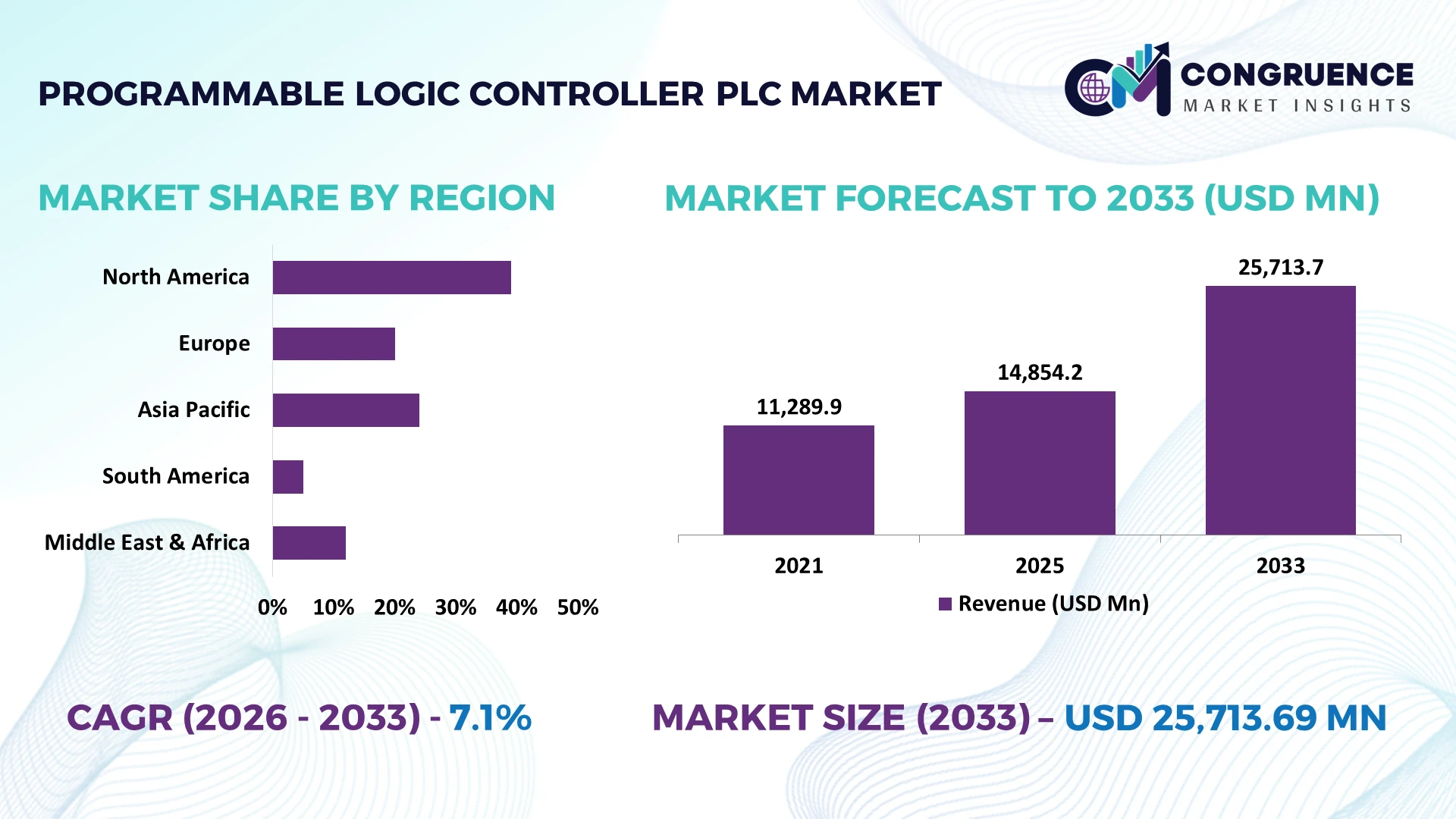
China remains the dominant PLC deployment hub, supported by its large electronics, automotive, machinery, and semiconductor manufacturing base. China accounted for approximately 54% of global industrial robot installations in 2024, creating sustained demand for high-speed PLC control and machine integration. India is expanding manufacturing automation through electronics and automotive investments, while Japan maintains advanced adoption across precision manufacturing. China’s industrial automation scale remains substantially higher, reinforcing its position as the primary regional demand center. Geopolitical supply-chain diversification is simultaneously accelerating automation investment across India and Southeast Asia.
Strategically, PLC suppliers should prioritize high-volume Asian manufacturing corridors while developing scalable, cybersecurity-ready platforms for rapidly modernizing factories.
Market Size & Growth: USD 14.85 billion in 2025 to USD 25.71 billion by 2033 at 7.1% CAGR, supported by robotics, connected manufacturing, and PLC modernization.
Top Growth Drivers: Industrial robotics 54%, modular PLC adoption 42%, and digital I/O deployment 65% are accelerating automation investment.
Short-Term Forecast: By 2030, Ethernet-enabled PLC architectures are expected to reduce control-system integration costs by 10–15% while improving commissioning efficiency by 8–12%.
Emerging Technologies: AI-assisted programming, edge computing, soft PLCs, industrial Ethernet, and cybersecurity-enabled controllers are reshaping next-generation automation.
Regional Leaders: Asia Pacific is projected to exceed USD 5 billion in annual PLC demand, North America is approaching USD 4 billion, and Europe is moving toward USD 3 billion, with smart-factory adoption strengthening across all three regions.
Consumer/End-User Trends: Automotive and electronics manufacturers increasingly deploy PLCs across robotic assembly, inspection, packaging, and material-handling operations, with digital I/O representing about 65% of configurations.
Pilot/Case Example: In 2024, China installed approximately 295,000 industrial robots, a 7% increase, expanding the addressable requirement for PLC-controlled robotic cells and automated production systems.
Competitive Landscape: Siemens leads with approximately 20% share, while Rockwell Automation, Schneider Electric, Mitsubishi Electric, and ABB maintain strong positions across industrial automation applications.
Regulatory & ESG Impact: Energy-monitoring and industrial cybersecurity requirements are increasing demand for connected PLCs, with predictive control architectures targeting 5–10% reductions in avoidable equipment downtime.
Investment & Funding: More than USD 30 billion equivalent in manufacturing investments under India’s production-linked incentive programs is strengthening demand for automation, PLCs, robotics, and digitally controlled production equipment.
Innovation & Future Outlook: AI-enabled engineering, virtual PLCs, edge analytics, modular architectures, and secure industrial networking are shifting purchasing decisions toward integrated, software-driven automation ecosystems.
The Programmable Logic Controller PLC Market is experiencing concentrated demand across automotive, electronics, semiconductor, pharmaceuticals, food processing, energy, and water infrastructure, where automated sequencing and real-time control directly affect production throughput. Modular architectures account for approximately 42% of PLC configurations, reflecting manufacturers’ preference for scalable systems that can expand with production capacity. Recent innovations include AI-assisted programming, edge-based diagnostics, industrial Ethernet, virtualized PLCs, and integrated cybersecurity functions. Manufacturers are also increasing multi-source procurement as geopolitical tensions and supply-chain restructuring encourage regional automation capabilities. The transition from standalone controllers toward connected, software-defined automation is strengthening demand for flexible PLC platforms and creating new opportunities across factory modernization and industrial digitalization.
Programmable Logic Controllers are becoming strategically important as manufacturers compete on automation intensity, production flexibility, and control-system resilience. Automotive, semiconductor, electronics, and machinery plants are replacing fragmented legacy controls with networked PLC architectures that integrate robotics, motion control, safety, and real-time analytics. Supply-chain restructuring is also encouraging manufacturers in India, Vietnam, and Mexico to establish automated production capacity closer to end markets.
Modern Ethernet-enabled PLC systems can reduce control-panel wiring and commissioning requirements by approximately 10–15% compared with conventional architectures, while centralized diagnostics can improve fault-identification efficiency by 8–12%. China remains the largest deployment center because of its extensive electronics and automotive automation base, whereas Germany and Japan emphasize high-precision, energy-efficient control systems. India is increasingly focused on scalable automation for new manufacturing facilities.
Over the next 2–3 years, adoption of edge-connected PLCs, remote diagnostics, and software-configurable control is expected to accelerate, with manufacturers targeting 5–10% lower unplanned downtime. A practical deployment involves PLC-controlled robotic assembly cells where real-time diagnostics shorten troubleshooting cycles and protect throughput. Companies are responding through localized engineering, automation partnerships, and modular product portfolios, making integrated control capability increasingly central to competitive positioning.
Industrial automation is strengthening PLC demand as manufacturers expand robotic production, high-speed material handling, and machine-vision systems. China accounted for approximately 54% of global industrial robot installations in 2024, while automotive applications represent about 28% of Asia Pacific PLC demand. Digital I/O configurations also account for roughly 65% of deployments, reflecting increasingly complex machine-control requirements. The shift toward connected factories is pushing manufacturers to replace isolated controllers with Ethernet-enabled architectures supporting centralized diagnostics. Companies are responding by expanding modular PLC portfolios, integrating motion and safety control, and forming automation partnerships. The non-obvious advantage is faster production-line reconfiguration, allowing factories to accommodate shorter product cycles without replacing complete control infrastructures.
Legacy equipment remains a structural constraint because many factories operate mixed generations of PLCs, proprietary protocols, and aging field devices. Integration projects can increase engineering and commissioning costs by 10–20% when legacy interfaces require customized gateways, while skilled automation engineering shortages can extend deployment schedules by 15% or more. Manufacturing facilities in mature industrial hubs such as Germany and Japan frequently require compatibility between decades-old machinery and new Ethernet-based controls. Supply-chain disruptions involving semiconductors and specialized automation components further complicate replacement planning. Companies are mitigating these pressures through phased modernization, multi-year component contracts, protocol converters, and localized inventories. The key operational issue is not controller availability alone, but maintaining production continuity during migration.
Soft PLCs, edge computing, AI-assisted programming, and virtualized control are creating opportunities beyond conventional hardware replacement. Software-defined architectures can reduce selected control-system hardware requirements by approximately 15–20%, while edge analytics can improve response and diagnostic efficiency by 8–12%. India’s expanding electronics and automotive manufacturing base provides an important deployment opportunity as new facilities can implement modern architectures without extensive legacy constraints. AI-assisted engineering is also reducing repetitive programming and configuration work. Companies are positioning through R&D partnerships, industrial-PC integration, and open communication ecosystems. A distinctive opportunity lies in brownfield factories where hybrid PLC-edge architectures can modernize analytics and diagnostics without replacing every installed controller.
Connected PLC environments increase execution complexity as factories integrate controllers with enterprise networks, cloud platforms, robotics, and remote-access systems. Cybersecurity requirements can add approximately 5–10% to automation-system engineering and protection costs, while workforce shortages can increase commissioning and maintenance workloads by 10–15%. Manufacturers in China, the United States, and Germany are therefore strengthening secure industrial networking, role-based access, and controller-level monitoring. Another pressure is interoperability across PLC, SCADA, MES, robotics, and safety platforms, which can create inconsistent data structures and maintenance procedures. Companies must invest in cybersecurity-by-design, standardized architectures, workforce training, and vendor-neutral integration capabilities to sustain reliable deployment as PLC systems become increasingly software-driven.
Ethernet Control Expands: Ethernet-enabled PLC deployment is approaching 46% of new industrial control installations as manufacturers replace serial communication with faster connected architectures. China’s electronics and automotive plants are accelerating adoption, while suppliers integrate real-time networking and OPC UA to reduce commissioning time by approximately 10%.
Compact PLC Adoption Accelerates: Compact PLCs are expanding at approximately 12.25% as machine builders prioritize smaller control footprints and integrated I/O. Packaging, assembly, and material-handling applications are driving deployment, while manufacturers are expanding compact portfolios to lower installation complexity and support space-constrained production environments.
Robotic Control Density Rises: Global industrial robot installations reached approximately 542,000 units in 2024, increasing demand for PLCs capable of synchronized motion, safety interlocks, and high-speed sequencing. China represented about 54% of installations, prompting suppliers to combine PLC, motion-control, and robotics functionality within unified platforms.
Localized Procurement Gains Momentum: Chinese automation manufacturers increased their domestic industrial-robot market presence to approximately 57% in 2024, reflecting stronger localization of industrial technology. Manufacturers are responding by qualifying regional suppliers, increasing dual sourcing, and expanding local engineering capabilities to reduce component lead times and improve replacement resilience.
Modular PLCs lead the provided type segments with approximately 43% market share, supported by expandable I/O, communication, safety, and motion modules suited to complex production environments. Their scalability enables manufacturers to add machinery without replacing the core controller, strengthening lifecycle economics. Rack-mounted PLCs remain important for high-capacity industrial installations, while Safety PLCs address machine protection requirements and Motion Control PLCs support synchronized positioning. High-End PLCs retain relevance in demanding plants requiring greater processing capacity and multi-system integration.
Compact PLCs represent the fastest-growing type, expanding at approximately 12.25%, as machine builders prioritize smaller footprints, integrated functionality, and lower installation complexity. Mature rack-mounted systems continue to serve established facilities with long replacement cycles. Companies are therefore expanding compact product portfolios while maintaining modular architectures, directing investment toward flexible controller families that support both machine-level automation and plant-level expansion.
Factory Automation represents the leading application, accounting for approximately 33% of deployment across the specified applications. High-volume production lines require PLCs for sequencing, machine coordination, material handling, packaging, and safety control. Machine Control remains foundational for deterministic operations, while Process Control maintains strong relevance in chemicals, pharmaceuticals, Oil & Gas, and water treatment. Motion Control and Robotics are gaining importance as manufacturers increase high-speed positioning and automated handling.
Robotics is emerging as the fastest-growing application as manufacturers shift toward flexible production cells and higher automation density. Building Automation and Energy Management are expanding through connected HVAC, electrical monitoring, and facility-control systems. Companies are integrating PLCs with SCADA, robotics, industrial Ethernet, and energy-monitoring platforms, increasing controller functionality while reducing isolated control layers. This shift is strengthening demand for PLC architectures capable of coordinating multiple operational systems from a unified control environment.
Automotive represents the leading end-user, accounting for approximately 18% of PLC demand, supported by extensive automation across welding, assembly, inspection, material handling, and battery manufacturing. Electronics is another PLC-intensive segment because semiconductor and electronic-component production requires precise sequencing and high equipment uptime. Pharmaceuticals prioritize validated control and traceability, while Chemicals and Oil & Gas depend heavily on continuous process control and safety systems.
Electronics and automotive are driving the strongest shift toward integrated PLC, robotics, motion, and machine-vision environments. Food & Beverage emphasizes hygienic processing and rapid changeovers, while Power Generation and Water & Wastewater increasingly prioritize remote monitoring and energy optimization. Companies are responding with sector-specific controller configurations, application partnerships, localized engineering, and bundled automation solutions. The strategic shift is toward customer-specific PLC ecosystems rather than standardized controller sales, particularly across expanding manufacturing hubs in China, India, Japan, and the United States.
Asia Pacific accounted for the largest market share at approximately 35% in 2025 however, Asia Pacific is expected to register the fastest growth, expanding at a CAGR of 8.2% between 2026 and 2033.

Connected factory modernization accelerates PLC replacement
North America maintains strong PLC demand across automotive, aerospace, semiconductor, pharmaceuticals, food processing, and advanced machinery. The United States accounts for the majority of regional deployment, supported by factory reshoring, robotics integration, and modernization of aging control infrastructure. Approximately 40% of new manufacturing automation projects increasingly incorporate connected control architectures, strengthening demand for Ethernet-enabled PLCs, remote diagnostics, and integrated safety systems. Companies are expanding local engineering capabilities and partnering with robotics and industrial software providers to shorten commissioning cycles and improve lifecycle support.
United States Market Outlook: The United States remains the region’s principal PLC deployment center because of its extensive manufacturing base and accelerating investment in semiconductor, automotive, aerospace, and battery facilities. New plants increasingly combine PLCs with robotics, machine vision, industrial Ethernet, and centralized diagnostics. This is encouraging suppliers to expand application engineering, cybersecurity capabilities, and localized technical support to capture long-term automation spending.
Energy-efficient automation reshapes industrial modernization
Europe’s PLC market is anchored by automotive, machinery, pharmaceuticals, chemicals, and energy-intensive manufacturing. Germany represents the strongest industrial deployment base, while Italy and France maintain substantial machine-building and process-automation activity. Approximately 35% of modernization projects increasingly prioritize connected monitoring and predictive maintenance capabilities. Energy-efficiency requirements are also encouraging manufacturers to connect PLCs with energy-monitoring systems and intelligent facility controls. Companies are upgrading legacy production lines through modular controller replacements, secure networking, functional-safety integration, and motion-control partnerships rather than undertaking complete automation redesigns.
Germany Market Outlook: Germany remains strategically significant because of its advanced machinery, automotive, chemical, and industrial automation ecosystem. More than 25,000 industrial robots were installed in German factories in 2024, supporting demand for PLCs coordinating robotic cells, motion systems, safety functions, and high-speed production equipment. Manufacturers are increasingly combining PLC modernization with energy monitoring and predictive maintenance to improve asset utilization.
Manufacturing scale drives high-density automation
Asia Pacific represents the largest PLC deployment base, supported by China, Japan, South Korea, India, and Southeast Asian manufacturing hubs. China’s electronics, automotive, machinery, and semiconductor industries create substantial controller demand, while Japan emphasizes precision automation and high-performance control. Approximately 54% of global industrial robot installations occurred in China in 2024, reinforcing the region’s exceptionally high automation density. India and Southeast Asia are attracting manufacturing diversification projects, increasing demand for scalable PLC architectures, robotics integration, and localized technical support. Suppliers are expanding regional production, application partnerships, and distributor networks to address increasingly diversified manufacturing investment.
China Market Outlook: China remains the most strategically significant country because of its manufacturing scale, extensive robotics deployment, and rapidly expanding domestic automation ecosystem. Electronics, automotive, battery, machinery, and semiconductor plants increasingly use PLCs for synchronized production, robotic handling, safety control, and machine monitoring. With approximately 295,000 industrial robots installed in 2024, China’s automation intensity continues to create substantial demand for both compact machine-level controllers and modular plant-level PLC systems.
Industrial modernization concentrates around resource-intensive production
South America’s PLC demand is concentrated in Brazil, where mining, food processing, automotive manufacturing, chemicals, pulp and paper, and energy infrastructure create recurring automation requirements. Brazil accounts for the largest industrial automation base in the region, while Argentina and Chile provide additional demand through food production, mining, and process industries. Approximately 30% of regional industrial automation investment is concentrated in resource and processing-intensive operations, increasing requirements for reliable machine and process control. Companies are prioritizing retrofit projects, remote monitoring, and modular PLC upgrades where full production-line replacement is economically difficult. Local system integrators and international automation suppliers are strengthening partnerships to improve technical support and reduce deployment delays.
Brazil Market Outlook: Brazil offers the strongest PLC opportunity because of its diversified industrial base spanning automotive, food processing, mining, chemicals, pulp and paper, and power generation. Large processing facilities increasingly require PLC-based monitoring and automated sequencing to improve throughput and equipment reliability. Suppliers are expanding through local integrators, application-specific solutions, and retrofit programs targeting established production assets.
Infrastructure investment accelerates industrial control modernization
Middle East and Africa PLC demand is increasingly linked to energy infrastructure, water treatment, mining, petrochemicals, logistics, and large-scale industrial development. Saudi Arabia and the United Arab Emirates are leading adoption through industrial diversification and smart-infrastructure projects, while South Africa maintains substantial demand from mining, utilities, and manufacturing. Approximately 25% of regional automation projects increasingly incorporate remote monitoring or centralized control capabilities, supporting demand for connected PLC architectures. Companies are combining PLC deployment with SCADA, industrial networking, cybersecurity, and energy-management systems. Suppliers are strengthening regional partnerships and local service capabilities to address project-based procurement, harsh operating environments, and specialized engineering requirements.
Saudi Arabia Market Outlook: Saudi Arabia represents a strategically significant PLC market because industrial diversification is expanding automation requirements beyond conventional oil and gas operations. Manufacturing, water infrastructure, mining, logistics, and new industrial facilities increasingly require PLC-based control and monitoring. Companies are positioning through local partnerships, project-specific engineering, and integrated automation packages that combine PLCs with SCADA, safety systems, and industrial communications.
The Programmable Logic Controller PLC market is led by Siemens, Rockwell Automation, Schneider Electric, Mitsubishi Electric, and ABB, competing globally with regional automation specialists and cost-focused Chinese suppliers. The top five players collectively control approximately 70–75% of the market, creating a concentrated structure where technology depth and installed-base strength shape purchasing decisions. Competition increasingly centers on cybersecurity, industrial Ethernet, software integration, customization, and lifecycle support, with advanced platforms commanding roughly 10–15% higher system value where high-performance control is required. Siemens and Rockwell emphasize integrated automation ecosystems, while Mitsubishi Electric and Schneider Electric strengthen motion, machine control, and energy-management integration. Regional suppliers compete through shorter lead times and localized pricing, particularly in China and India. Current competition is shifting toward software-enabled controllers, edge connectivity, and interoperability rather than standalone hardware. High engineering requirements and established customer ecosystems remain major entry barriers. Winning requires reliable hardware, open connectivity, rapid engineering support, and strong lifecycle service.
Siemens AG
Rockwell Automation, Inc.
Schneider Electric SE
Mitsubishi Electric Corporation
ABB Ltd.
Omron Corporation
Keyence Corporation
Panasonic Holdings Corporation
Emerson Electric Co.
Honeywell International Inc.
Fuji Electric Co., Ltd.
Bosch Rexroth AG
Delta Electronics, Inc.
WAGO GmbH & Co. KG
Modern PLC technology is shifting from standalone hardware toward Ethernet-connected, edge-enabled control. Industrial Ethernet, OPC UA, integrated safety, and real-time diagnostics can improve communication efficiency by 8–12% and reduce commissioning effort by 5–10%. Adoption is strongest in newly automated automotive, electronics, semiconductor, and machinery facilities, where connected controllers support centralized monitoring and faster fault resolution across multi-line manufacturing environments.
Emerging virtual PLCs, edge computing, AI-assisted engineering, and software-defined automation are changing controller economics. Virtual PLC architectures can reduce dedicated hardware requirements by approximately 10–15%, while AI-assisted code generation can improve engineering productivity by 15–20% in selected engineering workflows, particularly standardized machine configurations. Siemens and Audi are deploying virtual PLC technology in production, giving early technology adopters an advantage at scale through 2028.
From 2026–2028, distributed I/O, digital twins, industrial cybersecurity, and AI-enabled predictive control will become increasingly integrated with PLC platforms. Compared with legacy relay-based and isolated PLC architectures, connected systems can improve operational response by 10–15% and reduce diagnostic time by 8–12%. Companies investing now gain faster modernization cycles, lower integration friction, stronger cybersecurity readiness, lower maintenance exposure, and stronger competitive positioning as factories prioritize flexible, data-driven production.
May 2025 Siemens certified the SIMATIC S7-1500V F as the first failsafe virtual PLC, with TÜV approval, and confirmed productive Audi deployment. The move advances software-defined automation, enabling centralized control and flexible scaling across IT-based factory infrastructure systems.
March 2025 Mitsubishi Electric established an autonomous factory-automation headquarters in Suzhou, China, covering product planning, development, manufacturing, and sales. The structure strengthens local responsiveness and expands competitive capacity in one of the world’s largest automation markets.
April 2024 Rockwell Automation announced a 98,000-square-foot manufacturing facility in Chennai, India, designed for potential expansion and approximately 230 employees. The investment strengthens regional production capacity, supply-chain resilience, and localized automation support for Asia-Pacific customers globally.
September 2025 OMRON announced the global launch of its Sysmac-Edge DX1 Data Flow Controller, enabling factory data collection, analysis, and visualization without specialized programming. The edge architecture improves shop-floor data accessibility and supports digital transformation across manufacturing operations.
The Programmable Logic Controller PLC Market Report provides a structured assessment of controller demand across Compact, Modular, Rack-Mounted, Safety, Motion Control, and High-End PLC architectures. Coverage spans Machine Control, Process Control, Factory Automation, Motion Control, Robotics, Building Automation, and Energy Management, with detailed evaluation of Automotive, Food & Beverage, Pharmaceuticals, Chemicals, Oil & Gas, Power Generation, Electronics, and Water & Wastewater applications. The analysis also examines connected PLCs, virtual controllers, edge computing, industrial Ethernet, cybersecurity, AI-assisted engineering, and software-defined automation.
Regional coverage includes North America, Europe, Asia Pacific, South America, and Middle East & Africa, with country-level emphasis on major manufacturing and automation hubs. The report tracks deployment intensity, modernization patterns, technology adoption, supplier positioning, and niche opportunities such as brownfield migration and distributed control. These insights support investment planning, market expansion, product prioritization, partnership decisions, competitive positioning, and technology roadmaps through 2026–2033.
| Report Attribute/Metric | Report Details |
|---|---|
Market Revenue in 2025 | USD 14854.18 Million |
Market Revenue in 2033 | USD 25713.69 Million |
CAGR (2026 - 2033) | 7.1% |
Base Year | 2025 |
Forecast Period | 2026 - 2033 |
Historic Period | 2021 - 2025 |
Segments Covered | By Type
By Application
By End-User
|
Key Report Deliverable | Revenue Forecast, Growth Trends, Market Dynamics, Segmental Overview, Regional and Country-wise Analysis, Competition Landscape |
Region Covered | North America, Europe, Asia-Pacific, South America, Middle East, Africa |
Key Players Analyzed | Siemens AG, Rockwell Automation, Inc., Schneider Electric SE, Mitsubishi Electric Corporation, ABB Ltd., Omron Corporation, Keyence Corporation, Panasonic Holdings Corporation, Emerson Electric Co., Honeywell International Inc., Fuji Electric Co., Ltd., Bosch Rexroth AG, Delta Electronics, Inc., WAGO GmbH & Co. KG |
Customization & Pricing | Available on Request (10% Customization is Free) |




