
Reports
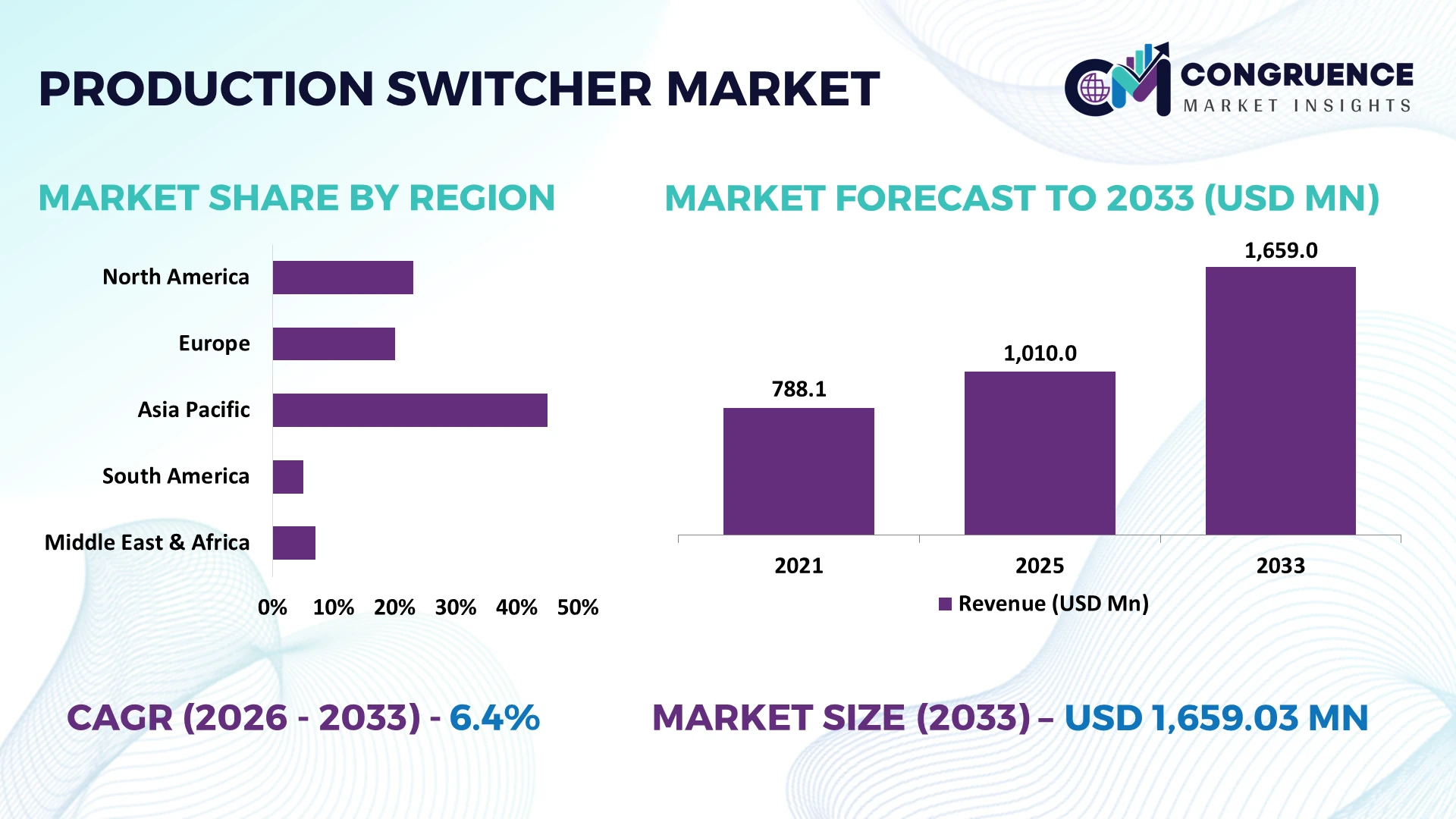
The Global Production Switcher Market was valued at USD 1010 Million in 2025 and is anticipated to reach a value of USD 1659.03 Million by 2033 expanding at a CAGR of 6.4% between 2026 and 2033. Growth is driven by SMPTE ST 2110 migration, UHD/HDR live sports production, software-defined switching, remote production and multi-platform OTT workflows requiring simultaneous broadcast and digital outputs.
The United States remains the dominant country market, supported by an estimated 30%+ global share, extensive sports-production infrastructure, major television networks and rapid deployment of IP-connected control rooms. Advanced switchers increasingly support 40–80 inputs, 4K processing and cloud-connected production. France demonstrated the technology transition during the Paris 2024 Olympics, where France Télévisions deployed ST 2110 infrastructure for 54 native UHD-HDR feeds. Compared with India, U.S. adoption remains materially stronger in high-capacity IP and UHD production environments.
Strategically, vendors should prioritize IP-native, software-scalable switchers that protect existing SDI investments while enabling broadcasters to migrate production capacity incrementally.
Market Size & Growth: USD 1.01 billion in 2025 advances to USD 1.66 billion by 2033 at 6.4%, driven by IP-native live-production modernization.
Top Growth Drivers: ST 2110 adoption reached 30%; AI broadcast usage reached 27%; production switchers represent approximately 45% of broader broadcast-switcher demand.
Short-Term Forecast: By 2028, software-defined workflows should reduce dedicated hardware requirements by approximately 15–20% across scalable remote-production environments.
Emerging Technologies: AI-assisted switching, cloud-native production and 100G Ethernet ST 2110 connectivity are moving advanced switchers beyond conventional SDI architectures.
Regional Leaders: By 2033, North America approaches USD 630 million, Asia-Pacific USD 520 million and Europe USD 360 million, led by IP, UHD and remote-production upgrades.
End-User Trends: 82% of broadcasters still use SDI infrastructure, while 30% now operate ST 2110, reinforcing demand for hybrid switchers.
Pilot/Case Example: Paris 2024 infrastructure enabled France Télévisions to receive 54 uncompressed UHD-HDR feeds through an ST 2110 production environment.
Competitive Landscape: Grass Valley, Sony, Blackmagic Design and Ross Video collectively represent approximately 40% of the broader competitive market.
Regulatory & ESG Impact: IP production can consolidate multiple signal paths onto 100G Ethernet, reducing dedicated cabling and supporting infrastructure-efficiency targets.
Investment & Funding: USD 100 million+ scale broadcast-modernization programs increasingly concentrate spending on IP routing, cloud production, UHD processing and remotely controlled infrastructure.
Innovation & Future Outlook: 64% of surveyed broadcasters identify AI as the technology expected to have the greatest five-year production impact, accelerating automated switching.
The Production Switcher Market is increasingly shaped by live sports, television news, entertainment production, houses of worship, corporate streaming and multi-camera digital broadcasting. IP-native architectures, software-defined switchers, automated camera selection and integrated 4K/HDR processing are reducing dependence on fixed-purpose production hardware. ST 2110 usage reached 30% among surveyed broadcasters in 2026, although substantial SDI infrastructure remains operational. The resulting hybrid transition creates sustained demand for interoperable switchers capable of bridging legacy and IP workflows, establishing the technology and procurement priorities that define the market’s strategic direction.
Production switchers are becoming strategic control points as broadcasters consolidate linear television, OTT, live sports, and social feeds into unified production environments. The structural shift from baseband SDI toward SMPTE ST 2110 and software-defined architectures is redirecting capital toward flexible processing rather than fixed hardware chains. With roughly 30% of surveyed broadcast organizations operating ST 2110 workflows, interoperability and infrastructure modernization increasingly influence vendor selection, production scalability, and competitive differentiation.
IP-based production can transport multiple uncompressed video, audio, and ancillary streams over 25–100GbE networks, replacing numerous dedicated SDI connections and reducing physical cabling requirements by more than 50% in large installations. The United States leads high-capacity IP and remote-production deployment, while India retains a larger installed base of cost-sensitive SDI and hybrid systems. France demonstrated operational scale during Paris 2024, where France Télévisions handled 54 native UHD-HDR feeds through ST 2110 infrastructure.
Through 2026–2028, hybrid SDI/IP migration, cloud control, automated switching, and distributed production will dominate investment priorities. Vendors are expanding interoperable platforms, orchestration software, and technology partnerships rather than competing solely on switcher hardware. Competitive advantage will increasingly depend on enabling customers to add production capacity without repeatedly rebuilding core infrastructure.
Broadcast infrastructure modernization is the primary structural driver as networks replace fixed SDI signal chains with IP-connected production environments. Approximately 30% of surveyed broadcasters now use SMPTE ST 2110, while around 82% still retain SDI somewhere in their operations, creating substantial demand for hybrid production switchers. Modern 100GbE networks can aggregate multiple UHD signals while materially reducing point-to-point cabling and routing complexity. Paris 2024 accelerated this transition, with France Télévisions implementing an ST 2110 environment capable of receiving 54 native UHD-HDR feeds. This shift expands demand for switchers supporting simultaneous SDI, IP, HDR, and remote-control workflows. Grass Valley, Sony, Ross Video, and other suppliers are consequently investing in software-defined processing, interoperable control layers, and scalable IP production ecosystems. The strategic advantage lies in migration flexibility: broadcasters can modernize workflows without immediately replacing every legacy asset.
The installed SDI base remains the largest structural restraint because replacing functional broadcast infrastructure rarely produces an immediate operational return. Around 82% of surveyed broadcasters continue using SDI in some capacity, compared with roughly 30% operating ST 2110, highlighting the migration gap. Moving to IP also requires 25–100GbE switching, precision timing, gateway equipment, monitoring tools, and workforce retraining, making conversion considerably broader than purchasing a new production switcher. Smaller Indian television stations and local production facilities remain particularly sensitive to this infrastructure burden, favoring incremental upgrades over complete control-room replacement. Vendors are reducing adoption friction through hybrid SDI/IP interfaces, modular I/O, software licensing, and phased migration architectures. Strategically, backward compatibility has become a commercial advantage: suppliers forcing full infrastructure replacement face longer procurement cycles and narrower addressable customer pools.
Software-defined switching creates an opportunity to separate production capacity from dedicated control-room hardware. Cloud and data-center architectures allow processing resources to be allocated across simultaneous productions, while remote operators can control geographically distributed cameras and feeds from centralized interfaces. With AI identified by approximately 64% of surveyed broadcasters as a major five-year production technology and ST 2110 adoption already near 30%, automated scene selection, metadata-driven routing, and virtualized switching are moving toward operational deployment. Japan, the United States, and major European sports broadcasters provide attractive environments for advanced distributed-production systems, while India offers scalable opportunities for lower-cost software-defined platforms. Vendors are investing in containerized processing, subscription licensing, API-based orchestration, and cloud partnerships. A non-obvious opportunity is capacity monetization: broadcasters can dynamically reuse processing resources between productions instead of maintaining dedicated switcher hardware for peak workloads.
Long-term deployment depends on solving operational complexity as broadcast engineering converges with enterprise networking, cloud infrastructure, and cybersecurity. A 100GbE production backbone carries substantially more operational consequence than isolated SDI links because configuration errors, synchronization failures, or network congestion can affect numerous media streams simultaneously. ST 2110 adoption near 30%, versus SDI presence around 82%, also means engineering teams must support two technology environments during a prolonged transition. In the United States and United Kingdom, broadcasters increasingly require expertise spanning PTP timing, multicast networking, NMOS control, UHD processing, and IT security rather than conventional video engineering alone. Suppliers must respond with automated network discovery, telemetry, redundancy, certification programs, and systems-integration partnerships. The critical competitive challenge is therefore deployment consistency: advanced switcher functionality creates limited advantage unless customers can operate complex IP production environments reliably at broadcast-grade availability.
Hybrid Architectures Become Operational Standard: Broadcasters are standardizing mixed SDI/IP environments rather than executing wholesale infrastructure replacement. In 2026, 82% still used SDI while SMPTE ST 2110 deployment increased from 26% to 30%. Switcher manufacturers are responding with gateway-compatible I/O, modular processing and unified control, allowing operators to modernize production rooms without disrupting established signal chains.
AI Moves Into Production Control: AI adoption among broadcast professionals increased from 25% in 2025 to 27% in 2026, while 64% identify AI as the technology with the greatest five-year production impact. Vendors are embedding automated camera selection, clipping and workflow assistance into production ecosystems, reducing repetitive operator tasks while enabling smaller crews to manage increasingly complex multi-output productions.
Remote Contribution Reshapes Switching Workflows: SRT usage reached 77% in 2025, up from 68%, while 76% of broadcasters using cellular contribution employed 5G. Sports and news operators increasingly route remote feeds directly into centralized production facilities, reducing dependence on large outside-broadcast deployments. Technology suppliers are integrating low-latency contribution, distributed control and switcher orchestration to accelerate live-event setup and deployment flexibility.
Cloud Remains Selectively Deployed: Cloud technology reached 86% of broadcasters in 2025, yet 49% used it for less than 25% of workflows. Budget constraints affected 48%, while network reliability concerned 37%, keeping latency-critical switching predominantly hybrid. Vendors are consequently separating control, processing and orchestration layers, enabling customers to cloud-enable selected functions without relocating every production workload.
Hybrid Switchers lead the Production Switcher Market with an estimated 32% share, reflecting broadcasters’ need to operate SDI and IP infrastructure simultaneously. Their advantage lies in protecting existing baseband investments while supporting ST 2110, UHD/HDR and networked production expansion. SDI Switchers retain approximately 27% because established television facilities continue prioritizing deterministic operation and familiar engineering workflows. Digital Switchers remain relevant across mainstream studios requiring multi-format processing, while Manual Switchers serve smaller installations where straightforward operation and lower system complexity outweigh automation requirements.
IP-Based Switchers represent the fastest-growing type as broadcasters restructure production around networked signal routing, remote control and scalable processing. ST 2110 usage increased from 26% in 2025 to 30% in 2026, providing a measurable deployment signal, although SDI remains present across 82% of surveyed broadcast environments. Manufacturers are therefore concentrating engineering resources on hybrid I/O, NMOS-compatible orchestration, distributed processing and software-defined control. Investment is shifting toward platforms that extend through firmware or software rather than requiring repeated chassis replacement.
Live Broadcasting leads application demand with an estimated 35% market share because television channels and streaming operators require continuous, frame-accurate switching across cameras, graphics, replay systems and external feeds. Sports Production follows with approximately 27% and represents the fastest-growing application, driven by UHD coverage, centralized production and expanding multi-platform distribution. Large sports workflows increasingly require switchers capable of processing dozens of synchronized feeds while simultaneously generating television, streaming, venue and social-media outputs.
News Production remains operationally intensive because breaking coverage requires rapid integration of studio, field and cellular feeds. Studio Production maintains steady demand around entertainment, talk-show and scheduled programming environments, while Event Production increasingly adopts compact systems supporting remote operators and IP contribution. In 2025, 76% of broadcasters using cellular networks employed 5G, with 55% citing bandwidth and 50% lower latency as benefits. Manufacturers are responding with automated switching, integrated replay, remote panels and scalable processing engines, concentrating product development where production complexity and output multiplication are highest.
Television Networks constitute the leading end-user group with an estimated 34% share, supported by large control-room footprints, continuous programming schedules and requirements for redundant production infrastructure. Broadcast Stations account for roughly 25%, retaining substantial demand for SDI and hybrid switchers as local facilities modernize incrementally. Production Houses increasingly prioritize configurable systems that can accommodate entertainment, corporate and streaming projects without dedicating hardware to individual formats.
Sports Broadcasters represent the fastest-growing buyer group because centralized production, remote contribution and simultaneous digital feeds are increasing switching intensity per event. Event Production Companies are following a similar transition toward portable, software-controlled systems that reduce equipment movement and crew requirements. AI usage among broadcasters increased from 25% in 2025 to 27% in 2026, while 64% expect AI to exert the strongest five-year production impact. Suppliers are targeting buyer groups through modular configurations, automation, remote-control ecosystems and interoperable partnerships, shifting competition from standalone switcher specifications toward complete production-workflow flexibility.
North America accounted for the largest market share at 38% in 2025 however, Asia-Pacific is expected to register the fastest growth, expanding at a CAGR of 8.1% between 2026 and 2033.
IP Production Reshapes Broadcast Infrastructure
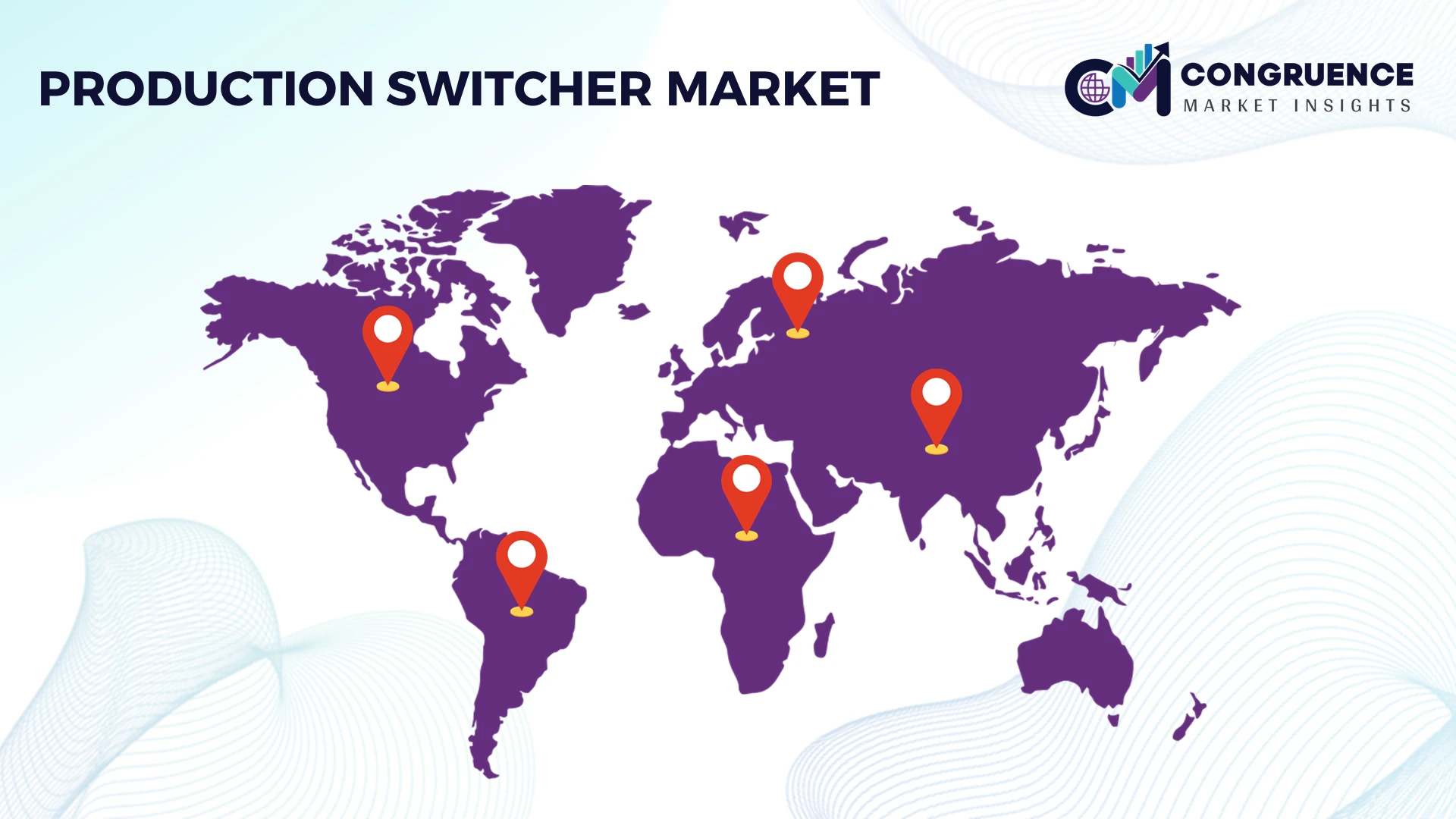
North America accounts for approximately 38% of global production switcher demand, anchored by extensive television, sports, streaming, and studio infrastructure in the United States. Large broadcasters are shifting capital toward hybrid SDI/IP control rooms, UHD/HDR processing, remote production, and software-defined switching. ST 2110 deployment has reached roughly 30% across surveyed broadcast environments, while continued SDI usage above 80% sustains demand for interoperable switchers rather than immediate infrastructure replacement. Major U.S. sports networks increasingly centralize switching, replay, graphics, and monitoring to reduce equipment duplication at venues. 25–100GbE production networks also enable higher signal density than conventional point-to-point architectures. Grass Valley, Ross Video, Sony, and Blackmagic Design are consequently strengthening IP orchestration, scalable processing, automation, and remote-control capabilities, making migration flexibility a decisive procurement criterion.
United States Market Outlook: The United States commands the region through its concentration of national networks, professional sports properties, streaming platforms, production studios, and broadcast technology investment. NFL, NBA, collegiate sports, and major news operations routinely require dozens of synchronized feeds per production. Increasing 4K/HDR output and centralized production favor high-capacity switchers supporting multi-format processing, redundancy, automation, and remote operators.
Broadcast Modernization Accelerates IP Migration
Europe represents approximately 25% of production switcher demand, with the United Kingdom, Germany, France, Italy, and Spain maintaining substantial public-service and commercial broadcasting infrastructure. Modernization increasingly centers on SMPTE ST 2110, UHD/HDR production, centralized control, and interoperability between legacy SDI and IP environments. Major sporting events have become practical technology accelerators: Paris 2024 required France Télévisions to manage 54 native UHD-HDR feeds within an IP-oriented production environment. European broadcasters are also consolidating processing and routing infrastructure to reduce equipment duplication, cabling, and control-room footprints. Public broadcasters face particularly strong requirements for resilient architectures because migration cannot interrupt continuous national programming. Suppliers are responding through NMOS-compatible control, modular I/O, software licensing, and partnerships with systems integrators, shifting purchasing decisions from standalone switcher capacity toward lifecycle interoperability.
United Kingdom Market Outlook: The United Kingdom combines extensive broadcast engineering expertise with globally significant sports, news, and entertainment production. BBC, ITV, Sky, and independent production ecosystems support sustained demand for advanced switching. Growing centralized and remote production allows production teams to reuse control-room resources across events, increasing the strategic value of software-defined control and IP-compatible switcher platforms.
Scale and Digital Video Converge
Asia-Pacific holds approximately 27% of the market and presents the strongest deployment momentum as television infrastructure modernization intersects with enormous digital-video audiences. Japan, China, South Korea, India, and Australia are expanding UHD, IP, streaming, and multi-platform production capabilities at different speeds. Japan and South Korea emphasize high-resolution broadcast engineering, while India combines hundreds of television channels with rapidly expanding sports and digital production requirements. China’s large electronics manufacturing ecosystem additionally supports cost-efficient broadcast hardware supply and component availability. Broadcasters increasingly require switchers that can generate linear television, OTT, venue, and social outputs from the same production workflow. Vendors are responding with scalable product families spanning compact switchers through enterprise IP systems, while local integration partnerships reduce deployment complexity. Cost-performance differentiation remains especially important outside premium metropolitan broadcast facilities.
Japan Market Outlook: Japan remains strategically important because of its advanced UHD broadcasting ecosystem and established professional video equipment base. NHK’s 8K broadcasting infrastructure demonstrates unusually high processing requirements compared with conventional HD workflows. Domestic expertise in imaging, signal processing, and broadcast engineering supports adoption of switchers optimized for UHD/HDR, precise synchronization, high-bandwidth routing, and technically demanding live productions.
Live Sports Drives Upgrade Cycles
South America represents approximately 6% of global production switcher demand, with Brazil concentrating the largest installed base through television networks, football broadcasting, studios, and event-production infrastructure. Broadcasters are moving selectively from HD-SDI toward hybrid IP production, prioritizing technologies that extend existing equipment rather than require complete facility replacement. Football remains a critical operational catalyst because premium matches require multi-camera switching, replay integration, graphics, and simultaneous broadcast and streaming outputs. Brazil’s nationwide 5G expansion also strengthens remote contribution possibilities, allowing production teams to transport selected feeds without deploying equivalent fixed connectivity at every location. Argentina, Colombia, and Chile provide secondary demand through television and event-production modernization. Vendors are emphasizing compact switchers, modular I/O, remote operation, and competitive system pricing because capital constraints make phased deployment more commercially viable than wholesale IP conversion.
Brazil Market Outlook: Brazil dominates regional deployment through its large free-to-air television ecosystem, professional football industry, entertainment production, and expanding digital distribution. Major sporting broadcasts can require 20–30+ camera feeds, creating substantial switching and replay complexity. Broadcasters increasingly favor hybrid architectures that support existing SDI equipment while introducing IP contribution, UHD processing, and remotely managed production functions.
Media Infrastructure Investment Intensifies
Middle East & Africa accounts for approximately 4% of global production switcher demand, but deployment is increasingly concentrated around Gulf media infrastructure, sports broadcasting, entertainment production, and new studio capacity. Saudi Arabia, the UAE, Qatar, and South Africa represent important technology centers, although infrastructure maturity varies considerably across African markets. Gulf investment in international sports, esports, entertainment, and locally produced media is raising requirements for UHD/HDR switching, centralized control, IP connectivity, and high-capacity live production. Saudi Arabia’s Vision 2030 transformation is particularly significant because expanding entertainment infrastructure creates production demand beyond traditional television broadcasting. Suppliers and systems integrators are targeting these projects through turnkey control rooms, training, local partnerships, and hybrid architectures. Across less-developed markets, compact switchers and IP contribution provide a lower-infrastructure route to professional multi-camera production.
Saudi Arabia Market Outlook: Saudi Arabia is emerging as the region’s most strategically significant deployment market as investment expands across sports, entertainment, esports, studios, and live events. Vision 2030 initiatives have helped create a substantially larger domestic events ecosystem, increasing requirements for portable and facility-based switching. Vendors positioned around UHD, remote production, scalable IP workflows, and local integration partnerships gain a clear procurement advantage.
Grass Valley, Sony, Ross Video, Blackmagic Design, Panasonic Connect, and FOR-A compete across professional production switching, with established broadcast OEMs challenged increasingly by software-led and cost-efficient platforms. The top five players collectively control approximately 55% of market demand, reflecting strong customer dependence on proven broadcast ecosystems. Premium vendors compete through IP orchestration, redundancy, UHD/HDR processing, and service integration, while value-focused suppliers can price comparable channel capacity roughly 20–35% lower. Software-defined architectures can reduce dedicated hardware requirements by 15–20%, shifting competition from chassis specifications toward scalable processing and licensing. Grass Valley and Ross Video emphasize integrated production ecosystems; Sony leverages cameras and professional video infrastructure; Blackmagic Design pressures established pricing through vertically integrated hardware-software development. Partnerships with systems integrators accelerate ST 2110 deployment and enterprise migrations. Certification complexity, installed workflow dependencies, and broadcast-grade reliability remain substantial entry barriers. Winning requires interoperability, scalable software, dependable support, competitive lifecycle cost, and seamless SDI-to-IP migration capabilities.
Grass Valley
Sony Corporation
Ross Video
Blackmagic Design
Panasonic Connect
FOR-A Company Limited
NewTek
Broadcast Pix
Roland Corporation
Evertz Microsystems
EVS Broadcast Equipment
Ikegami Tsushinki
RGBlink
DataVideo
Current production-switcher technology is converging around hybrid SDI/IP processing, UHD/HDR engines and software-defined control. SMPTE ST 2110 deployment has reached roughly 30% of surveyed broadcast environments, while SDI remains present in about 82%, making dual-domain interoperability critical. Native 25–100GbE switching can consolidate dozens of point-to-point video connections onto network fabrics, cutting physical cabling requirements by approximately 50% in large facilities and accelerating reconfiguration between productions.
Emerging platforms combine cloud-native switching, NDI transport, JPEG-XS compression, automated orchestration and GPU/CPU processing. Software switchers eliminate dedicated processing chassis for selected workflows, reducing hardware footprint by roughly 20–40% versus comparable legacy architectures. Compared with fixed SDI systems, dynamically licensed production engines can improve resource utilization by approximately 25% because M/Es and processing capacity can be reassigned between studios. Broadcasters, sports producers and multi-site networks gain operational advantage.
Disruptive development through 2026–2028 will center on AI-assisted production, distributed microservices and native ST 2110 switching with redundant 100GbE connectivity. AI automation can reduce repetitive switching and monitoring workload by 15–25%, enabling smaller crews to manage multi-output productions. Vendors combining familiar control surfaces with scalable software processing will outperform hardware-only competitors. Investment matters now because interoperability decisions determine future expansion cost, workflow flexibility and production resilience.
August 2024 Sony began shipping M2L-X, a software-based live production switcher supporting 24 inputs, hybrid cloud/on-premises processing, HDR and remote orchestration. The launch expanded flexible distributed production without requiring operators to remain inside traditional control rooms facilities. Source: (AVNetwork)
April 2025 Ross Video launched Carbonite HyperMax at NAB, delivering over 200 I/Os with four M/Es or eight M/Es with 144×144 I/O. Dynamic software licensing lets broadcasters reallocate processing resources, reducing dependence on fixed-purpose infrastructure during productions. Source:(Ross Video)
September 2025 Grass Valley showcased K-Frame VXP at IBC, combining four M/Es, UHD processing and integrated 48×24 routing in a 5RU frame. The hybrid hardware/software workflow enables production teams to retain tactile control while accessing cloud-native scalability. Source (International Broadcasting Convention)
April 2026 Blackmagic Design introduced ATEM 4 M/E Constellation IP, adding native SMPTE-2110 over 100G Ethernet; the Plus configuration provides 64 inputs and 64 outputs. Redundant IP connectivity moves ATEM into broadcast facilities requiring resilient UHD production. Source:(Blackmagic Design)
The Production Switcher Market Report evaluates Manual Switchers, Digital Switchers, Hybrid Switchers, SDI Switchers and IP-Based Switchers across Live Broadcasting, Studio Production, Sports Production, News Production and Event Production. End-user coverage includes Television Networks, Broadcast Stations, Production Houses, Sports Broadcasters and Event Production Companies. Analysis spans North America, Europe, Asia-Pacific, South America and Middle East & Africa, incorporating deployment patterns and infrastructure maturity.
Technology coverage examines SMPTE ST 2110, NDI, 12G-SDI, UHD/HDR processing, 25–100GbE connectivity, software-defined switching, cloud production and automation. With ST 2110 deployment around 30% while SDI remains embedded across approximately 82% of surveyed environments, hybrid migration receives particular attention. The report assesses competitive positioning, investment priorities, regional expansion, interoperability strategies and emerging distributed-production models, supporting technology procurement and market-entry decisions through 2026–2033.
| Report Attribute/Metric | Report Details |
|---|---|
Market Revenue in 2025 | USD 1010 Million |
Market Revenue in 2033 | USD 1659.03 Million |
CAGR (2026 - 2033) | 6.4% |
Base Year | 2025 |
Forecast Period | 2026 - 2033 |
Historic Period | 2021 - 2025 |
Segments Covered | By Type
By Application
By End-User
|
Key Report Deliverable | Revenue Forecast, Growth Trends, Market Dynamics, Segmental Overview, Regional and Country-wise Analysis, Competition Landscape |
Region Covered | North America, Europe, Asia-Pacific, South America, Middle East, Africa |
Key Players Analyzed | Grass Valley, Sony Corporation, Ross Video, Blackmagic Design, Panasonic Connect, FOR-A Company Limited, NewTek, Broadcast Pix, Roland Corporation, Evertz Microsystems, EVS Broadcast Equipment, Ikegami Tsushinki, RGBlink, DataVideo |
Customization & Pricing | Available on Request (10% Customization is Free) |




