
Reports
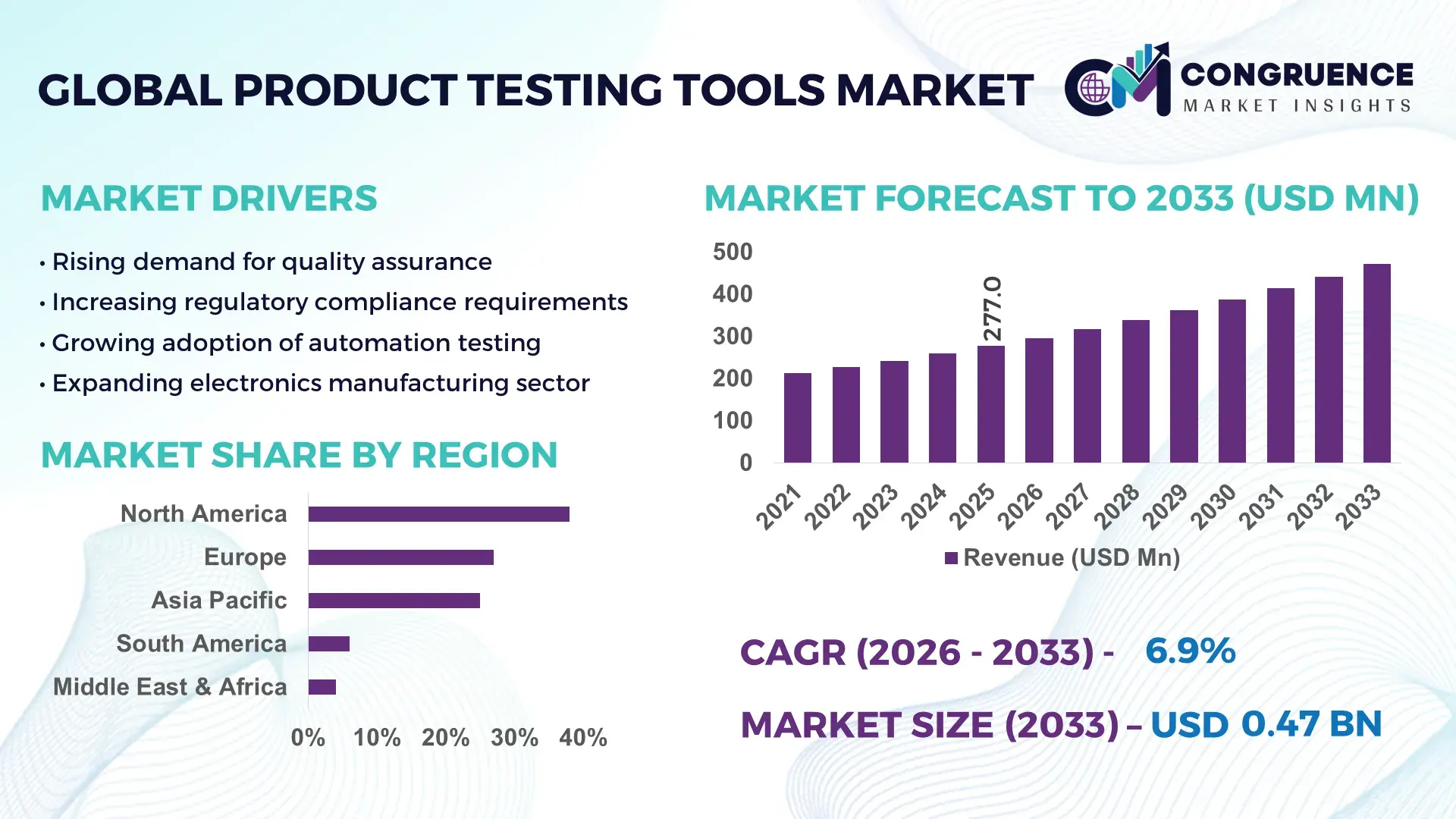
The Global Product Testing Tools Market was valued at USD 277.0 Million in 2025 and is anticipated to reach a value of USD 472.4 Million by 2033 expanding at a CAGR of 6.9% between 2026 and 2033, according to an analysis by Congruence Market Insights. This growth is primarily driven by increasing demand for quality assurance across manufacturing and digital product ecosystems.
The United States dominates the Product Testing Tools Market with over 38% adoption across advanced manufacturing sectors, supported by more than 12,000 testing laboratories and certification facilities nationwide. The country invests over USD 15 billion annually in R&D activities linked to testing technologies, particularly in aerospace, automotive, and semiconductor industries. Around 62% of enterprises in the U.S. deploy automated testing tools within product development cycles. Industrial IoT integration in testing environments has grown by 28%, enhancing real-time quality validation. Additionally, over 45% of consumer electronics firms in the U.S. utilize AI-driven testing frameworks, improving defect detection rates by nearly 35%.
Market Size & Growth: USD 277.0 Million in 2025, projected to reach USD 472.4 Million by 2033, growing at 6.9% driven by increasing automation in quality assurance processes.
Top Growth Drivers: Automation adoption at 58%, AI-based testing efficiency improvement at 42%, regulatory compliance requirements impacting 36% of enterprises.
Short-Term Forecast: By 2028, automated testing is expected to reduce product validation costs by 25% and improve release cycle efficiency by 30%.
Emerging Technologies: AI-driven defect detection, IoT-enabled testing environments, cloud-based testing platforms.
Regional Leaders: North America (USD 180M by 2033, strong industrial QA adoption), Asia-Pacific (USD 140M, manufacturing-driven testing demand), Europe (USD 110M, regulatory-focused testing expansion).
Consumer/End-User Trends: Over 65% of enterprises prioritize continuous testing integration in DevOps pipelines.
Pilot or Case Example: In 2024, a semiconductor firm achieved 32% defect reduction using AI-based testing tools.
Competitive Landscape: Market leader holds ~18% share, followed by major players like Keysight Technologies, Teradyne, National Instruments, Rohde & Schwarz.
Regulatory & ESG Impact: Over 40% of firms align testing with environmental compliance standards such as RoHS and ISO certifications.
Investment & Funding Patterns: Over USD 2 billion invested globally in testing automation startups and digital QA solutions.
Innovation & Future Outlook: Integration of AI and predictive analytics expected to enhance testing accuracy by over 35% in next-generation tools.
Product Testing Tools Market is increasingly influenced by automotive (28%), electronics (25%), and healthcare (18%) sectors, with rapid adoption of AI-driven testing solutions improving efficiency by 30%. Regulatory frameworks enforcing safety standards across 60% of industries are accelerating demand. Asia-Pacific consumption exceeds 35%, driven by manufacturing expansion, while cloud-based testing and predictive analytics continue shaping future innovation and operational efficiency.
The Product Testing Tools Market plays a critical strategic role in ensuring product quality, regulatory compliance, and accelerated innovation cycles across industries such as automotive, electronics, healthcare, and aerospace. With increasing product complexity, organizations are shifting from traditional manual testing to automated and AI-driven testing environments. AI-based testing tools deliver up to 40% improvement in defect detection compared to conventional manual testing methods, significantly reducing product failure rates and time-to-market.
North America dominates in volume due to its established industrial base, while Asia-Pacific leads in adoption with over 55% of manufacturing enterprises integrating automated testing tools into production workflows. This shift is supported by rapid industrialization and digital transformation initiatives across China, India, and Southeast Asia. By 2028, AI-enabled predictive testing is expected to reduce product downtime by 30% and improve operational efficiency by 25%, especially in high-precision industries like semiconductors and automotive manufacturing.
From an ESG and compliance perspective, firms are committing to sustainability improvements such as 20% reduction in testing-related energy consumption by 2030 through energy-efficient testing equipment and digital simulation tools. In 2025, a leading electronics manufacturer in Japan achieved a 28% reduction in product defects by implementing AI-powered automated testing systems, demonstrating measurable efficiency gains.
The future pathways of the Product Testing Tools Market are centered around integration with IoT, cloud computing, and advanced analytics, enabling real-time monitoring and predictive quality assurance. As regulatory frameworks tighten globally and consumer expectations for high-quality products rise, the Product Testing Tools Market is set to emerge as a pillar of resilience, compliance, and sustainable industrial growth.
The Product Testing Tools Market is evolving rapidly due to increasing product complexity, stringent regulatory requirements, and rising demand for high-quality outputs across industries. The integration of automation, artificial intelligence, and IoT technologies is transforming testing processes, enabling faster and more accurate validation of products. Approximately 60% of enterprises are shifting toward automated testing frameworks to reduce human error and enhance productivity.
Industries such as automotive and electronics are witnessing a surge in demand for advanced testing tools due to growing adoption of electric vehicles and smart devices. Additionally, over 50% of manufacturing firms are investing in digital twin technologies to simulate testing environments, improving efficiency and reducing physical testing costs. Regulatory compliance related to safety and environmental standards is influencing over 45% of procurement decisions.
Furthermore, cloud-based testing solutions are gaining traction, with nearly 35% of organizations adopting remote testing platforms to enhance scalability and flexibility. These evolving dynamics are reshaping the competitive landscape and driving continuous innovation within the Product Testing Tools Market.
Automation is a primary driver in the Product Testing Tools Market, as organizations aim to improve efficiency and reduce manual errors. Around 58% of enterprises have implemented automated testing systems, leading to a 35% improvement in testing accuracy and a 30% reduction in operational costs. Automation enables continuous testing in DevOps environments, ensuring faster product releases and improved quality assurance. The adoption of robotic testing solutions has increased by 25% in manufacturing sectors, enabling real-time defect detection and minimizing downtime. Additionally, automated testing tools can execute repetitive test cases up to 70% faster than manual methods, significantly enhancing productivity. Industries such as automotive and electronics rely heavily on automated testing to meet stringent quality standards and reduce recall risks. Moreover, integration of AI with automation allows predictive analytics, enabling companies to identify potential defects before production. This combination of speed, accuracy, and cost-efficiency is accelerating the adoption of automated testing tools across global markets.
High initial investment and implementation costs pose a significant restraint to the Product Testing Tools Market, particularly for small and medium enterprises. Advanced testing tools, especially those integrated with AI and IoT, require substantial capital expenditure, often exceeding 20–30% of a company’s annual IT budget. Additionally, the cost of skilled personnel required to operate these tools is increasing, with demand for specialized testing engineers rising by over 40%. Maintenance and software upgrade costs further add to the financial burden, making it difficult for smaller organizations to adopt these technologies. Integration challenges with existing legacy systems also contribute to increased costs and delays, affecting nearly 35% of enterprises. Furthermore, the need for continuous updates to comply with evolving regulatory standards adds to operational expenses. These financial and technical barriers limit widespread adoption, particularly in developing economies.
The integration of AI and cloud technologies presents significant opportunities in the Product Testing Tools Market. Cloud-based testing platforms are being adopted by over 35% of organizations, enabling scalable and cost-effective testing solutions. AI-driven analytics can improve defect detection rates by up to 40%, enhancing product reliability. Emerging markets in Asia-Pacific are witnessing a 45% increase in demand for digital testing tools due to rapid industrialization and technological advancements. Additionally, the rise of IoT devices is creating new testing requirements, with over 25 billion connected devices expected globally, driving demand for advanced testing solutions. Cloud-based platforms also allow remote testing and collaboration, reducing infrastructure costs by approximately 20%. These advancements are opening new avenues for innovation and expansion, particularly in industries such as healthcare, automotive, and consumer electronics.
Regulatory complexities present a major challenge in the Product Testing Tools Market, as companies must comply with diverse and evolving standards across regions. Over 50% of organizations report difficulties in aligning testing processes with multiple regulatory frameworks such as ISO, IEC, and industry-specific certifications. Compliance requirements often necessitate frequent updates to testing protocols, increasing operational complexity and costs. In sectors like healthcare and automotive, failure to meet regulatory standards can result in product recalls and financial penalties, impacting nearly 20% of companies annually. Additionally, cross-border trade introduces further challenges, as products must meet varying standards in different markets. The need for comprehensive documentation and validation processes increases workload and delays product launches. These regulatory hurdles require continuous adaptation and investment, posing significant challenges for market participants.
• Rising Adoption of AI-Powered Testing: Over 48% of enterprises have integrated AI into testing tools, improving defect detection accuracy by 35% and reducing testing cycles by 28%, especially in electronics and automotive sectors.
• Expansion of Cloud-Based Testing Platforms: Around 37% of companies are using cloud-based testing solutions, achieving up to 22% cost reduction and enabling real-time collaboration across distributed teams.
• Growth in IoT-Enabled Testing Environments: IoT-based testing adoption has increased by 30%, allowing real-time monitoring and reducing equipment downtime by 26% in industrial applications.
• Increased Focus on Regulatory Compliance Tools: Approximately 42% of organizations are investing in compliance-focused testing tools, enhancing audit readiness by 33% and reducing compliance-related delays by 20%.
The Product Testing Tools Market is segmented based on type, application, and end-user, reflecting diverse industry requirements and technological adoption levels. Testing tools range from hardware-based systems to advanced software-driven platforms, catering to industries such as automotive, electronics, healthcare, and manufacturing. Approximately 55% of demand is concentrated in software-based testing solutions due to increasing digitalization and automation trends.
Applications vary widely, with quality assurance and compliance testing accounting for over 40% of usage, followed by performance and safety testing. End-users include large enterprises, SMEs, and specialized testing laboratories, each with distinct requirements and adoption rates.
Technological advancements such as AI and IoT integration are influencing all segments, enabling faster, more accurate, and scalable testing solutions. Regional differences also impact segmentation, with Asia-Pacific leading in manufacturing-driven demand, while North America focuses on advanced digital testing solutions.
Product Testing Tools Market by type includes hardware testing tools, software testing tools, and hybrid testing solutions. Software testing tools dominate the segment, accounting for approximately 48% of adoption due to their flexibility and integration with DevOps environments. Hardware testing tools hold around 32% share, driven by demand in manufacturing and industrial applications. However, hybrid testing solutions are the fastest-growing segment, expected to grow at a CAGR of 8.5%, as they combine hardware precision with software analytics capabilities. These solutions enable real-time monitoring and predictive maintenance, enhancing efficiency by up to 30%. Other niche segments, including manual testing tools and specialized equipment, collectively contribute around 20% of the market, primarily used in traditional industries and small-scale operations.
• In 2025, a leading semiconductor company implemented hybrid testing tools to improve chip validation processes, reducing defect rates by 27% and enhancing production efficiency across multiple fabrication units.
Applications of Product Testing Tools include quality assurance, performance testing, safety testing, and compliance testing. Quality assurance leads the segment with approximately 42% share due to increasing focus on product reliability. Performance testing accounts for 26%, while safety testing contributes 18%.Compliance testing is the fastest-growing segment, expected to expand at a CAGR of 7.8%, driven by stringent regulatory requirements across industries. Other applications collectively account for 14% of usage. In 2025, more than 38% of enterprises globally reported piloting advanced testing tools for customer experience platforms. Additionally, over 60% of consumers prefer products that undergo rigorous quality testing, increasing demand for advanced testing solutions.
• In 2024, over 150 manufacturing facilities implemented AI-based compliance testing systems, improving regulatory adherence rates by 31% and reducing audit-related delays significantly.
End-users of the Product Testing Tools Market include automotive, electronics, healthcare, and industrial manufacturing sectors. The automotive sector leads with approximately 34% share due to increasing demand for electric vehicles and safety compliance. Electronics accounts for 28%, while healthcare contributes 16%. Industrial manufacturing is the fastest-growing segment, expected to expand at a CAGR of 7.5%, driven by automation and smart factory initiatives. Other sectors collectively contribute around 22% of the market. In 2025, more than 45% of manufacturing firms adopted automated testing solutions to enhance productivity. Additionally, around 52% of enterprises in the electronics sector use AI-based testing tools to improve product quality.
• In 2025, a major automotive manufacturer deployed advanced testing tools across its EV production lines, achieving a 29% improvement in quality control and reducing product defects significantly.
North America accounted for the largest market share at 38% in 2025 however, Asia-Pacific is expected to register the fastest growth, expanding at a CAGR of 7.8% between 2026 and 2033.
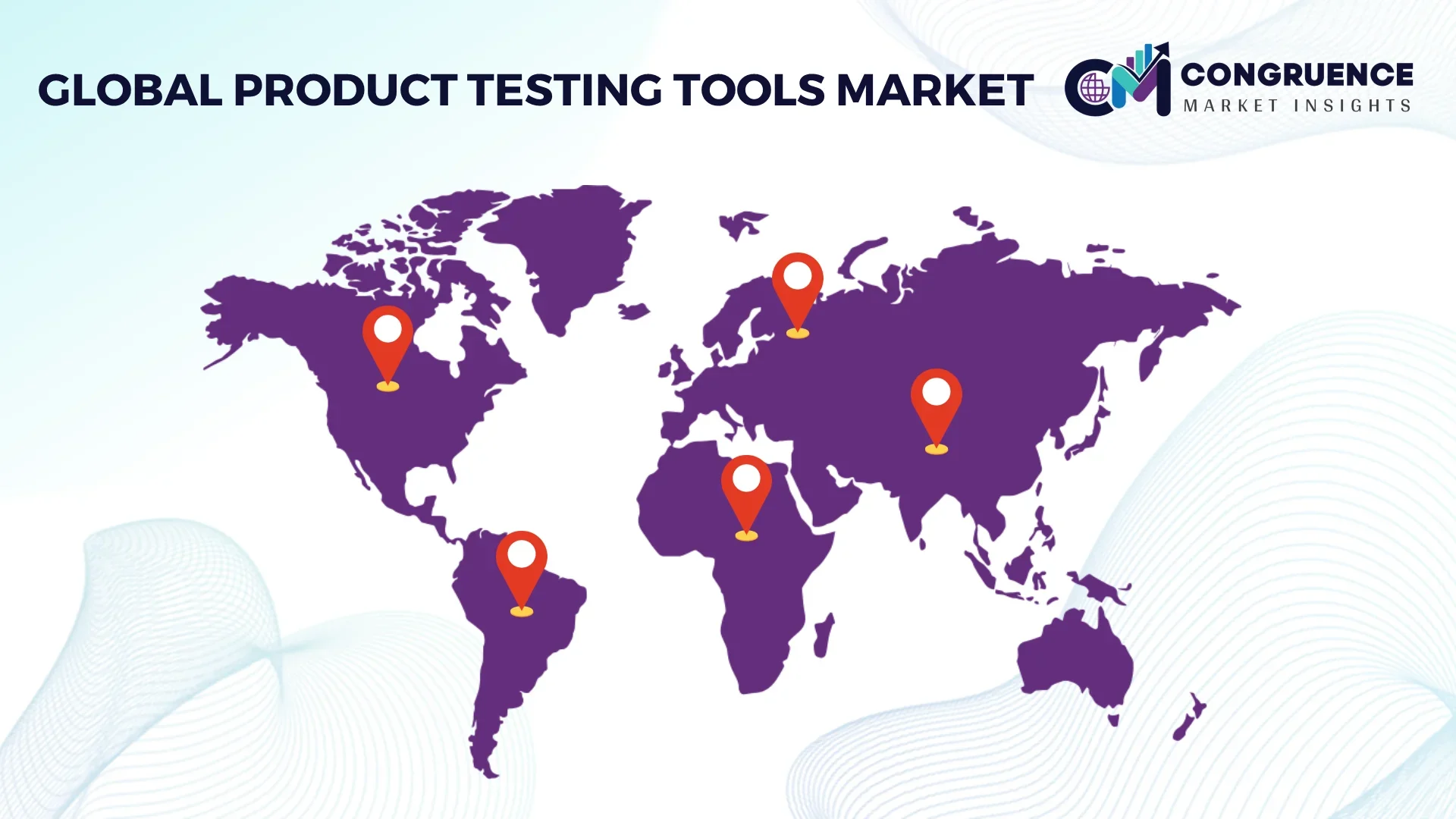
North America’s dominance is supported by over 60% enterprise adoption of automated testing tools and strong presence of advanced manufacturing industries. Europe holds around 27% share, driven by regulatory compliance requirements across automotive and industrial sectors. Asia-Pacific accounts for approximately 25% of the market, with countries like China, India, and Japan leading adoption due to rapid industrialization and manufacturing expansion. South America contributes around 6%, while the Middle East & Africa region holds about 4%, supported by infrastructure development and industrial modernization initiatives. Increasing investments in digital transformation and smart manufacturing are driving regional growth across all markets.
North America holds approximately 38% of the global Product Testing Tools Market, driven by strong adoption in automotive, aerospace, and electronics sectors. Over 65% of enterprises use automated testing tools, supported by regulatory frameworks such as ISO and industry-specific compliance standards. Technological advancements including AI-driven analytics and IoT-enabled testing platforms are widely adopted, improving testing efficiency by over 30%. Companies like Keysight Technologies are investing in advanced testing solutions to enhance product validation capabilities. Consumer behavior in this region reflects high adoption in healthcare and financial sectors, where quality assurance is critical.
Europe accounts for around 27% of the Product Testing Tools Market, with key markets including Germany, the UK, and France. Strict regulatory standards drive demand for compliance testing tools, with over 55% of enterprises focusing on sustainability and safety compliance. Adoption of AI and automation technologies is increasing, improving efficiency by approximately 28%. Companies such as Rohde & Schwarz are advancing testing technologies to meet evolving industry standards. Consumer behavior shows strong preference for compliant and sustainable products, influencing market demand.
Asia-Pacific represents about 25% of the global market, with China, India, and Japan leading consumption. Manufacturing growth and infrastructure development are key drivers, with over 50% of factories adopting automated testing systems. Innovation hubs in the region are focusing on AI and IoT integration, enhancing testing efficiency by 32%. Companies like Advantest are expanding their testing capabilities to support semiconductor industries. Consumer trends indicate strong demand driven by e-commerce and mobile applications.
South America holds approximately 6% of the Product Testing Tools Market, with Brazil and Argentina as key contributors. Infrastructure and energy sector developments are driving demand for testing tools. Government incentives and trade policies are supporting industrial growth, while adoption of digital testing solutions is increasing by 20%. Regional players are focusing on cost-effective testing solutions to meet local demand. Consumer behavior is influenced by localization and language-specific requirements.
The Middle East & Africa region accounts for around 4% of the market, with UAE and South Africa leading growth. Demand is driven by oil & gas, construction, and infrastructure sectors. Technological modernization initiatives are increasing adoption of advanced testing tools by 18%. Trade partnerships and regulatory frameworks are supporting market expansion. Consumer behavior reflects growing demand for quality assurance in industrial applications.
United States – 38% Market share: Strong industrial base and high adoption of automated testing technologies.
China – 21% Market share: Rapid manufacturing expansion and increasing investment in digital testing solutions.
The Product Testing Tools Market is moderately fragmented, with over 150 active competitors operating globally. The top five companies collectively hold approximately 45% of the market share, indicating a competitive yet concentrated landscape. Key players focus on innovation, strategic partnerships, and product launches to strengthen their market position.
Companies are increasingly investing in AI-driven testing solutions and cloud-based platforms to enhance efficiency and scalability. Around 60% of leading firms have introduced new products in the last two years, focusing on automation and predictive analytics.
Mergers and acquisitions are also prominent, with over 25 strategic deals recorded between 2023 and 2025, aimed at expanding technological capabilities and geographic reach. Additionally, collaboration with research institutions and technology providers is accelerating innovation.
The competitive environment is shaped by rapid technological advancements, regulatory compliance requirements, and increasing demand for high-quality products, making continuous innovation a key success factor.
Teradyne Inc.
National Instruments Corporation
Rohde & Schwarz GmbH & Co KG
Advantest Corporation
Anritsu Corporation
Fortive Corporation
EXFO Inc.
Teledyne Technologies Incorporated
Spectris plc
Viavi Solutions Inc.
Chroma ATE Inc.
Cobham Limited
Yokogawa Electric Corporation
Technological advancements are transforming the Product Testing Tools Market, with AI, IoT, and cloud computing playing a central role in innovation. Approximately 48% of enterprises have adopted AI-driven testing tools, improving defect detection accuracy by 35%. These tools enable predictive analytics, allowing companies to identify potential issues before they occur.
IoT-enabled testing systems are gaining traction, with adoption increasing by 30%, enabling real-time monitoring and data collection across testing environments. Cloud-based testing platforms are also expanding, with around 37% of organizations utilizing them for scalable and cost-efficient operations.
Digital twin technology is emerging as a key innovation, with over 25% of manufacturing firms implementing virtual testing environments to simulate real-world conditions. This reduces physical testing requirements and improves efficiency by 20%.
Automation remains a critical component, with robotic testing systems improving productivity by up to 40%. Integration of machine learning algorithms further enhances testing accuracy and reduces manual intervention. These technologies are collectively shaping the future of the Product Testing Tools Market, enabling faster, more reliable, and cost-effective testing solutions.
• In November 2025, Keysight Technologies was recognized as a Leader in the Gartner® Magic Quadrant™ for AI-augmented software testing tools, with projections indicating enterprise adoption of AI-driven testing tools will rise from 20% in 2025 to 70% by 2028, significantly enhancing automation and test coverage. Source: www.keysight.com
• In November 2025, Keysight Technologies introduced a scalable, modular all-in-one testing solution designed to accelerate high-volume PCBA manufacturing, improving production testing efficiency and enabling faster validation cycles for electronics manufacturers.
• In November 2025, Keysight Technologies launched high-power automated test equipment (ATE) solutions targeting advanced power validation challenges, supporting next-generation semiconductor and energy applications with enhanced precision and throughput capabilities.
• In October 2025, Keysight Technologies collaborated with industry partners to validate next-generation eCall systems through interoperability testing, enabling improved emergency communication reliability and compliance with evolving automotive safety standards.
The Product Testing Tools Market Report provides a comprehensive analysis of testing technologies, industry applications, and regional dynamics shaping the global market. It covers a wide range of product types including hardware testing tools, software testing platforms, and hybrid solutions that integrate advanced analytics and automation.
The report examines key application areas such as quality assurance, performance testing, safety validation, and compliance testing across industries including automotive, electronics, healthcare, aerospace, and industrial manufacturing. Approximately 55% of the market demand is driven by software-based testing solutions, reflecting increasing digital transformation across industries.
Geographically, the report spans North America, Europe, Asia-Pacific, South America, and the Middle East & Africa, highlighting regional adoption trends and industry-specific growth drivers. Asia-Pacific accounts for over 25% of global consumption, driven by manufacturing expansion, while North America leads in technological innovation and adoption.
The report also explores emerging technologies such as AI-driven testing, IoT-enabled systems, cloud-based platforms, and digital twin simulations, which are reshaping testing processes and improving efficiency. Additionally, it includes insights into competitive landscape, investment trends, regulatory frameworks, and evolving industry standards, providing decision-makers with actionable intelligence for strategic planning and investment decisions.
| Report Attribute / Metric | Details |
|---|---|
| Market Revenue (2025) | USD 277.0 Million |
| Market Revenue (2033) | USD 472.4 Million |
| CAGR (2026–2033) | 6.9% |
| Base Year | 2025 |
| Forecast Period | 2026–2033 |
| Historic Period | 2021–2025 |
| Segments Covered |
By Type
By Application
By End-User Insights
|
| Key Report Deliverables | Revenue Forecast; Market Trends; Growth Drivers & Restraints; Technology Insights; Segmentation Analysis; Regional Insights; Competitive Landscape; Regulatory & ESG Overview; Recent Developments |
| Regions Covered | North America; Europe; Asia-Pacific; South America; Middle East & Africa |
| Key Players Analyzed | Keysight Technologies; Teradyne Inc.; National Instruments Corporation; Rohde & Schwarz GmbH & Co KG; Advantest Corporation; Anritsu Corporation; Fortive Corporation; EXFO Inc.; Teledyne Technologies Incorporated; Spectris plc; Viavi Solutions Inc.; Chroma ATE Inc.; Cobham Limited; Yokogawa Electric Corporation |
| Customization & Pricing | Available on Request (10% Customization Free) |




