
Reports
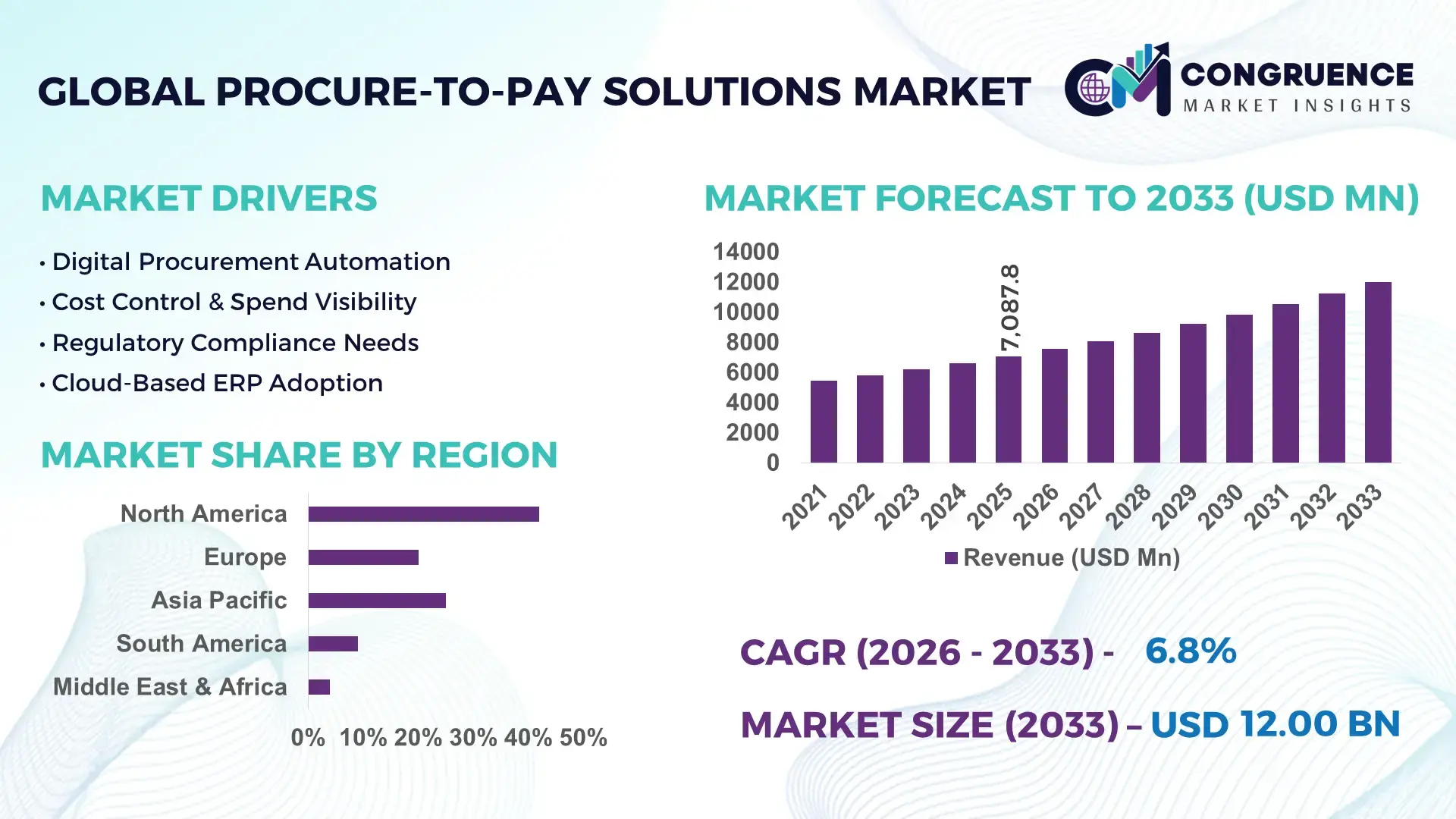
The Global Procure-To-Pay Solutions Market was valued at USD 7087.83 Million in 2025 and is anticipated to reach a value of USD 11997.3 Million by 2033 expanding at a CAGR of 6.8% between 2026 and 2033. Growth is driven by enterprise-wide digitization of procurement operations and finance process automation.
The United States remains the central hub for Procure-To-Pay solution development and deployment, supported by the world’s largest enterprise software ecosystem. More than 78% of large U.S. enterprises actively use integrated P2P or source-to-pay platforms across procurement and accounts payable. Annual enterprise software expenditure in the U.S. exceeds USD 250 billion, with finance and procurement systems forming a significant segment. Over 60% of leading global P2P vendors operate major R&D and innovation centers in the country, advancing AI-based invoice processing, predictive spend analytics, and cloud-native procurement orchestration across BFSI, healthcare, manufacturing, and government sectors.
Market Size & Growth: USD 7.09 billion in 2025, projected to reach USD 12.00 billion by 2033 at a CAGR of 6.8%, driven by rapid finance and procurement automation.
Top Growth Drivers: Cloud P2P adoption 64%, invoice automation efficiency improvement 45%, compliance digitization uptake 38%.
Short-Term Forecast: By 2028, average procurement cycle times are expected to decline by 22% across large enterprises.
Emerging Technologies: AI-driven invoice matching, blockchain-enabled audit trails, predictive spend analytics platforms.
Regional Leaders: North America USD 4.8 billion, Europe USD 3.5 billion, Asia-Pacific USD 2.9 billion by 2033, each driven by cloud-first enterprise strategies.
Consumer/End-User Trends: Large enterprises dominate deployments, while mid-sized firms are rapidly shifting to SaaS-based P2P platforms.
Pilot or Case Example: In 2024, a global manufacturing enterprise reduced invoice processing costs by 30% through AI-powered P2P automation.
Competitive Landscape: SAP leads with approximately 23% share, followed by Oracle, Coupa, Basware, and Workday.
Regulatory & ESG Impact: E-invoicing mandates and digital audit compliance requirements are accelerating enterprise platform upgrades.
Investment & Funding Patterns: More than USD 2.1 billion recently invested in cloud procurement platforms and AI-driven finance solutions.
Innovation & Future Outlook: Autonomous procurement workflows and deep ERP integration are defining next-generation P2P platforms.
The Procure-To-Pay Solutions Market is primarily driven by BFSI, manufacturing, healthcare, retail, and government organizations, with large enterprises contributing nearly 60% of total platform spending. AI-based invoice processing, cloud-native procurement orchestration, and real-time spend intelligence are reshaping financial governance. Regulatory pressure for digital tax compliance and e-invoicing is accelerating adoption globally. North America leads in system maturity, while Asia-Pacific is the fastest-growing region. Future expansion will be driven by autonomous procurement engines, embedded compliance analytics, and tighter ERP and treasury system integration.
The Procure-To-Pay Solutions Market has become strategically central to enterprise resilience as organizations modernize financial operations to gain real-time visibility, compliance control, and working capital efficiency. AI-driven invoice automation delivers 45% improvement compared to traditional rule-based OCR systems by reducing exception handling and manual touchpoints. Asia-Pacific dominates in transaction volume due to expanding manufacturing and shared service centers, while North America leads in adoption with over 72% of large enterprises actively using cloud-based P2P platforms. By 2028, autonomous procurement orchestration powered by generative AI is expected to cut invoice cycle times by 30% across global enterprises. Compliance and ESG priorities are reshaping platform roadmaps, with firms committing to paperless procurement programs targeting 40% reduction in paper-based transactions by 2027 to support digital sustainability reporting. In 2024, a U.S.-based multinational achieved a 32% reduction in invoice processing errors through AI-enabled three-way matching and predictive exception management. As supply chains grow more complex and regulatory oversight intensifies, the Procure-To-Pay Solutions Market is positioned as a core pillar of enterprise resilience, compliance assurance, and sustainable digital growth.
Enterprises are prioritizing end-to-end finance automation to improve visibility, control, and operational efficiency, directly boosting the Procure-To-Pay Solutions Market. Automated invoice matching reduces manual processing rates by over 50%, while straight-through processing levels now exceed 70% in digitally mature organizations. Global shared service centers increasingly rely on P2P platforms to standardize procurement across regions, lowering maverick spend by nearly 25%. Integration of procurement and accounts payable also strengthens working capital management, enabling early-payment discount capture improvements of 15–20%. As finance leaders pursue real-time spend intelligence and audit-ready reporting, Procure-To-Pay Solutions are becoming foundational digital infrastructure rather than discretionary IT investments.
Despite strong demand, legacy ERP fragmentation and complex IT landscapes continue to restrain the Procure-To-Pay Solutions Market. Many large enterprises operate multiple procurement and finance systems across regions, significantly increasing integration time and cost. Digital transformation projects in finance functions experience implementation overruns in nearly 30% of cases due to data harmonization and workflow reengineering challenges. Supplier onboarding complexity also slows platform utilization, particularly in regions with low digital readiness among SMEs. Concerns over data security and cross-border compliance further delay cloud migration decisions, especially in highly regulated industries such as banking and government procurement.
Supplier digitization represents a major growth avenue for the Procure-To-Pay Solutions Market as enterprises seek end-to-end transaction visibility beyond internal operations. Over 65% of global enterprises are prioritizing supplier portal expansion to enable e-invoicing, digital contracts, and real-time order tracking. Digitally connected supplier networks reduce invoice discrepancies by nearly 40% and improve on-time payment performance by more than 20%. Emerging markets, where supplier digital penetration remains below 50%, offer significant white space for cloud-based onboarding platforms. As supply chain risk management becomes a board-level priority, integrated supplier analytics within P2P platforms are gaining strategic importance.
Data governance complexity and regulatory fragmentation pose persistent challenges for the Procure-To-Pay Solutions Market. Multinational enterprises must comply with varying tax reporting, e-invoicing, and data residency rules across jurisdictions, increasing platform configuration complexity. Inconsistent master data across procurement, finance, and supplier systems remains a leading cause of transaction errors, accounting for over 25% of invoice exceptions in large organizations. Cybersecurity risks are also rising as financial workflows migrate to cloud environments. Vendors and enterprises must continuously invest in compliance engines, encryption, and audit automation to maintain trust, operational continuity, and regulatory alignment.
AI-Driven Invoice Automation Replacing Manual Processing Models
Enterprises are rapidly shifting toward AI-powered invoice processing engines to reduce manual workloads and error rates. Over 65% of large organizations now use AI-based three-way matching, cutting manual invoice touchpoints by nearly 50% and reducing exception rates by 35%. Automated classification models process up to 90% of invoices without human intervention, improving straight-through processing rates beyond 70% in digitally mature finance teams. This shift is also enabling faster financial close cycles, with average accounts payable processing times falling from 12 days to under 7 days.
Rapid Expansion of Cloud-Native, API-First P2P Platforms
Cloud-based P2P deployments have overtaken on-premise systems, with more than 72% of new enterprise implementations now SaaS-based. API-first architectures enable real-time ERP integration, reducing system integration timelines by 40% and lowering IT maintenance costs by nearly 30%. Multi-entity organizations benefit from centralized procurement control, achieving 25% reductions in maverick spend through standardized workflows. This architectural shift is also supporting continuous feature upgrades without system downtime, improving platform utilization rates above 80%.
Growth of Supplier Network Digitization and E-Invoicing Adoption
Supplier digitization is becoming a core P2P strategy, with over 60% of enterprises expanding digital supplier portals for onboarding, e-invoicing, and contract visibility. Digitally connected supplier networks reduce invoice discrepancies by approximately 38% and improve on-time payment performance by more than 20%. Organizations with integrated supplier networks report 28% faster dispute resolution cycles and improved cash flow forecasting accuracy. Adoption is accelerating across manufacturing and retail sectors where supplier volumes exceed 10,000 active vendors per enterprise.
Embedded Compliance and Real-Time Spend Intelligence Becoming Standard
Modern P2P platforms are embedding regulatory compliance and analytics directly into procurement workflows. More than 58% of enterprises now rely on real-time spend dashboards to enforce policy compliance, reducing non-compliant purchases by 30%. Automated audit trails cut internal audit preparation time by 45%, while real-time budget controls lower unplanned procurement overruns by 22%. These capabilities are transforming P2P systems into strategic financial governance platforms rather than back-office tools.
The Procure-To-Pay Solutions Market is segmented by type, application, and end-user, reflecting how enterprises adopt automation across procurement and finance workflows. By type, cloud-based and AI-enabled platforms dominate due to scalability and real-time analytics. By application, accounts payable automation leads as organizations prioritize faster invoice cycles and cost control. By end-user, large enterprises remain the primary adopters, while mid-sized firms are rapidly transitioning to SaaS models. Adoption patterns are shaped by regulatory digitization, multi-entity operations, and the need for integrated spend visibility. Sector-specific usage is strongest in BFSI, manufacturing, healthcare, retail, and government, where transaction volumes and compliance demands are highest. This multi-layered segmentation highlights a market shifting from transactional automation toward intelligent financial orchestration.
Cloud-based Procure-To-Pay platforms currently account for approximately 46% of total adoption, while on-premise systems hold 28%. However, AI-enabled autonomous P2P suites are rising fastest, supported by a projected 18.4% CAGR as enterprises seek predictive spend control and exception-free invoice processing. Cloud platforms lead due to faster deployment cycles, 40% lower infrastructure costs, and continuous feature upgrades, making them the preferred choice for multi-region enterprises. On-premise systems retain relevance in highly regulated industries requiring localized data control. Hybrid deployment models and mobile-first P2P applications together represent a combined 26% share, serving organizations balancing flexibility with compliance.
Accounts payable automation leads the Procure-To-Pay Solutions Market with nearly 41% adoption, followed by procurement workflow automation at 29%. However, integrated spend analytics and compliance monitoring is the fastest-growing application, expanding at an estimated 17.9% CAGR as CFOs prioritize real-time financial governance. AP automation dominates because invoice volumes are rising annually by over 20% in global shared service centers, making straight-through processing a strategic priority. Procurement workflow tools remain essential for supplier onboarding and contract compliance. Supplier management, catalog management, and expense integration together contribute a combined 30% share, supporting end-to-end transaction visibility.
Large enterprises account for approximately 57% of Procure-To-Pay platform adoption, while mid-sized enterprises represent 26%. However, SMEs are the fastest-growing end-user group, supported by an estimated 19.2% CAGR as affordable SaaS platforms lower entry barriers. Large enterprises lead due to complex multi-entity procurement environments and annual transaction volumes exceeding millions of invoices, making automation mission-critical. Mid-sized firms are expanding rapidly as they scale international operations. Government agencies, healthcare providers, and educational institutions collectively hold a combined 17% share, driven by transparency and compliance mandates. Adoption rates exceed 70% in BFSI and manufacturing enterprises due to strict audit and supplier governance requirements.
North America accounted for the largest market share at 42% in 2025; however, Asia-Pacific is expected to register the fastest growth, expanding at a CAGR of 7.2% between 2026 and 2033.
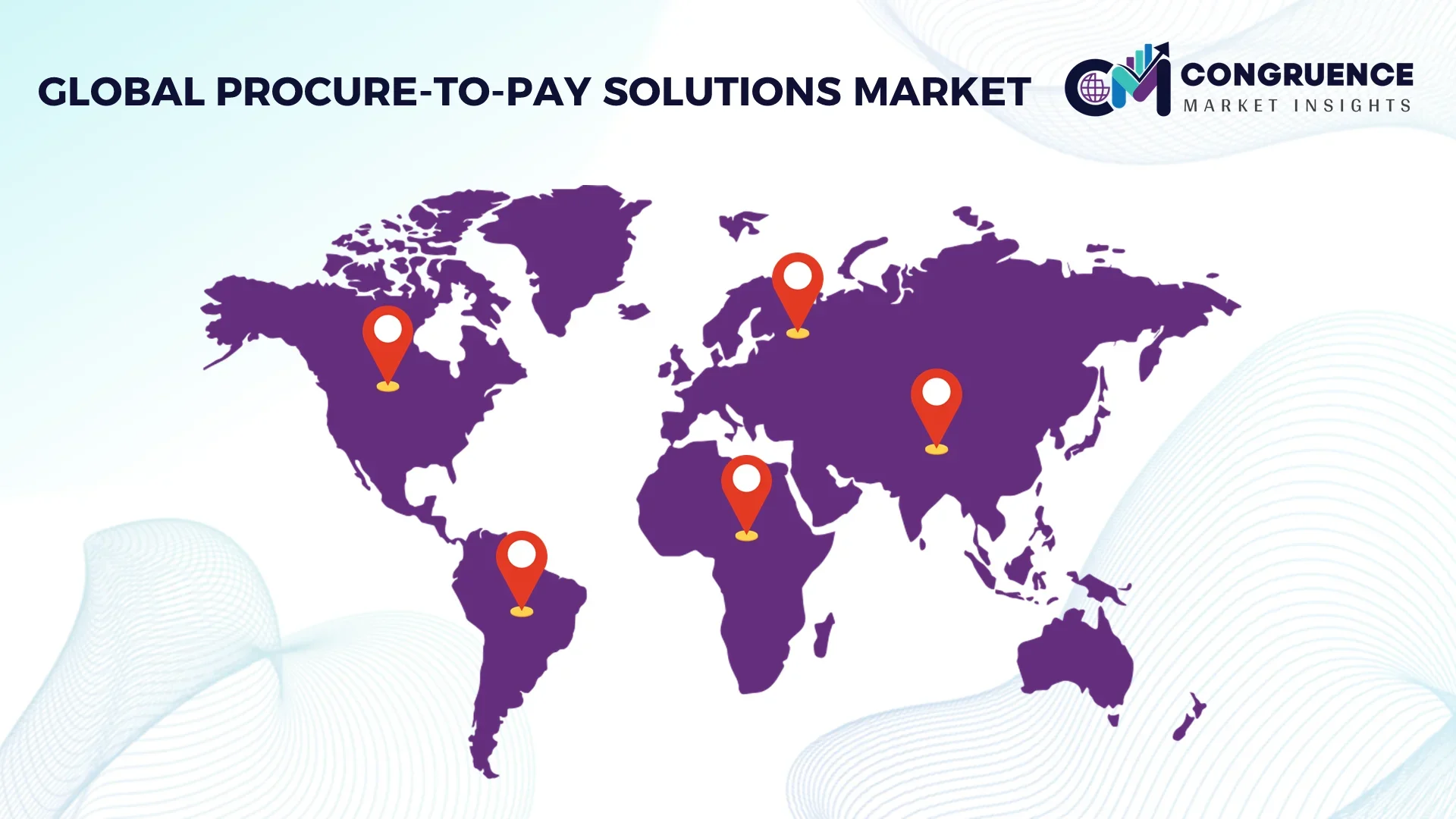
In 2025, North America processed over 1.2 billion invoices annually through cloud-based Procure-To-Pay platforms, with 78% of large enterprises leveraging AI-enabled automation. Europe followed with 28% adoption, while Asia-Pacific, led by China and India, accounted for 18% of volume. Adoption in Asia-Pacific is accelerating due to digital infrastructure upgrades, mobile-first P2P solutions, and e-commerce-driven supplier digitization. Global enterprise survey data indicates that 63% of organizations are actively expanding AI and spend analytics integration across regions. Multi-entity corporations, especially in BFSI, manufacturing, and healthcare, are standardizing P2P processes to reduce maverick spend, improve compliance, and gain real-time financial visibility.
How is automation transforming invoice and procurement operations in large enterprises?
North America holds approximately 42% of the global Procure-To-Pay Solutions Market, with BFSI, healthcare, and manufacturing driving demand. Regulatory initiatives for e-invoicing and digital financial reporting have accelerated cloud adoption, with over 70% of enterprises integrating AI-based invoice automation. Technological trends include predictive spend analytics, autonomous workflow engines, and deep ERP integration. U.S.-based vendors such as Coupa and Basware are expanding platform capabilities with embedded compliance and supplier collaboration tools. Enterprise adoption patterns show healthcare and finance sectors leading at over 75% implementation rates, while manufacturing firms focus on automating high-volume procurement cycles. Regional consumer behavior reflects a preference for scalable, cloud-native solutions that reduce manual touchpoints and optimize working capital efficiency.
How are regulatory frameworks driving procurement digitization and compliance efficiency?
Europe accounts for roughly 28% of the global Procure-To-Pay Solutions Market, with Germany, the UK, and France as leading contributors. Stringent e-invoicing mandates, VAT reporting requirements, and ESG-driven compliance initiatives are shaping platform adoption. Enterprises are increasingly implementing AI-powered spend analytics and automated exception management to meet audit requirements. Local players such as SAP and Basware provide cloud-first solutions integrated with regional compliance engines. European organizations show high adoption in finance and government sectors, driven by regulatory transparency, with approximately 68% of mid- to large-sized enterprises using automated P2P workflows. Consumer behavior favors explainable and compliant platforms capable of meeting multi-country regulatory demands efficiently.
What is driving the rapid adoption of digital procurement platforms across Asia-Pacific enterprises?
Asia-Pacific contributed 18% of global Procure-To-Pay Solutions volume in 2025, with China, India, and Japan as the largest consuming countries. Infrastructure modernization, manufacturing digitization, and mobile-first e-commerce platforms are key adoption drivers. AI-enabled invoice processing, cloud-native P2P platforms, and supplier portal expansions are increasingly deployed in high-volume industrial and retail enterprises. Local players, such as Zycus and Tradeshift, are actively partnering with regional conglomerates to implement predictive spend and compliance analytics. Consumer behavior shows accelerated uptake among mid-sized firms, with 62% implementing P2P solutions to streamline supplier networks and enhance cash flow forecasting.
How are digital procurement solutions enhancing efficiency in emerging South American markets?
South America represents 6% of the global Procure-To-Pay Solutions Market, with Brazil and Argentina as the primary contributors. The region’s growth is supported by modernization in infrastructure, energy, and retail sectors. Government incentives for digital finance transformation and trade facilitation are accelerating adoption. Local players are developing cloud-based P2P platforms to handle multi-currency transactions and regional tax compliance. Enterprises in Brazil report a 28% reduction in invoice processing delays after automation, while Argentina focuses on mobile-enabled supplier onboarding. Regional behavior indicates strong demand in media, retail, and logistics, with a preference for scalable, compliance-ready platforms.
How is technology adoption transforming procurement and financial governance in resource-driven economies?
Middle East & Africa hold around 6% of the global Procure-To-Pay Solutions Market, driven primarily by oil & gas, construction, and public sector procurement. UAE, Saudi Arabia, and South Africa are the major markets, investing in cloud P2P and AI-enabled invoice automation. Modernization initiatives focus on integrating ERP, treasury, and supplier risk management systems. Regional players are implementing centralized supplier portals and real-time spend analytics to enhance operational efficiency. Enterprises show strong adoption for compliance and ESG reporting, with 60% of large firms digitizing procurement workflows to improve transparency and reduce manual touchpoints. Regional consumer behavior favors centralized, high-security solutions capable of multi-jurisdictional compliance.
United States: 42% market share – High enterprise adoption, advanced digital finance infrastructure, and AI-driven platform development.
Germany: 12% market share – Strong regulatory push, mature ERP integration, and early adoption of cloud-based P2P systems.
The Procure-To-Pay Solutions Market is moderately consolidated, with over 120 active global competitors, of which the top five companies—SAP, Oracle, Coupa, Basware, and Workday—collectively hold approximately 62% of market influence. Market positioning is primarily driven by cloud-native offerings, AI-enabled automation, and integrated supplier networks. Strategic initiatives include AI-driven platform upgrades, partnerships with ERP providers, expansion of global service networks, and targeted acquisitions to enhance spend analytics and compliance capabilities. For instance, SAP and Oracle have both invested in predictive spend management modules, while Coupa has formed strategic alliances with finance consulting firms to accelerate adoption. Innovation trends include autonomous procurement workflows, blockchain-based audit trails, and embedded ESG reporting, which are redefining competitive differentiation. The fragmented remainder of the market, comprising over 115 smaller vendors, focuses on niche solutions, regional specialization, or industry-specific customizations, contributing to a highly dynamic environment where agility and technological sophistication determine market leadership.
Basware
Workday
Zycus
Tradeshift
Ivalua
GEP
Yooz
Tipalti
Jaggaer
Tungsten Network
Perfect Commerce
OpenText
Ariba
The Procure-To-Pay Solutions Market is experiencing a technological transformation driven by AI, cloud computing, and advanced analytics. AI-powered invoice processing now handles up to 90% of routine invoice approvals in digitally mature organizations, reducing manual touchpoints by 50% and cutting exception rates by 35%. Machine learning algorithms are increasingly deployed for predictive spend analysis, enabling enterprises to forecast procurement needs across multi-entity operations, with over 68% of large organizations integrating AI-based forecasting tools into their P2P platforms. Cloud-native P2P solutions dominate adoption, accounting for 46% of active deployments, offering scalability, real-time ERP integration, and multi-region compliance management. API-first architectures are enhancing interoperability, reducing integration timelines by nearly 40%, and allowing seamless connections with supplier portals, ERP systems, and treasury management platforms.
Emerging technologies such as blockchain-enabled audit trails are being piloted by 22% of global enterprises to ensure secure, tamper-proof transaction records, improving transparency and reducing audit preparation time by 45%. Robotic Process Automation (RPA) is used for repetitive approval workflows and supplier onboarding, accelerating invoice cycle times by an average of 28%. Additionally, mobile-first P2P applications are driving adoption in mid-sized enterprises, enabling 62% of procurement teams to process approvals remotely and maintain workflow continuity. Embedded compliance engines and ESG reporting modules are also transforming P2P solutions into strategic governance platforms, allowing firms to monitor supplier sustainability performance and reduce manual compliance interventions by 33%. Overall, these technologies are repositioning Procure-To-Pay Solutions from back-office tools to enterprise-wide financial orchestration platforms.
• In March 2025, SAP was named a Leader in the 2025 Gartner Magic Quadrant for Source‑to‑Pay Suites, emphasizing expanded AI coaching, spend visibility, and supplier collaboration within SAP Ariba and SAP Business Network deployments across 190 countries, supporting higher purchase order and invoice compliance. (SAP News Center)
• In March 2025, Coupa Software launched Coupa AI Spend, a strategic product expansion embedding generative AI across procurement, invoicing, and supplier risk workflows to enhance automated spend insights, improve compliance precision, and accelerate approval processes for enterprise customers worldwide.
• In June 2025, Oracle announced a strategic partnership with Ivalua to integrate Oracle Fusion Cloud Procurement with Ivalua’s source‑to‑pay capabilities, combining ERP ecosystem strengths with advanced procurement and sourcing tools to strengthen automation and supplier collaboration.
• In October 2024, SAP unveiled SAP Ariba Procurement 2.0, featuring enhanced AI‑powered supplier discovery and risk assessment tools integrated with a global supplier base of more than 5 million entities, delivering predictive analytics for demand forecasting and spend optimization.
The Procure‑To‑Pay Solutions Market Report encompasses a broad assessment of procurement automation technologies, end‑to‑end operational segments, and strategic application landscapes that define enterprise financial operations. Coverage includes segmentation by deployment type (cloud, on‑premise, hybrid), application categories (accounts payable automation, procurement workflow automation, spend analytics, compliance tracking), and end‑user industries such as BFSI, manufacturing, healthcare, retail, and government procurement functions. Geographic regions analyzed comprise North America, Europe, Asia‑Pacific, South America, and Middle East & Africa, with insights on regional adoption patterns, regulatory influences, and digital maturity variations.
The report also examines technological trends including AI‑driven invoice processing, predictive spend analytics, robotic process automation (RPA) for supplier onboarding and exception handling, API‑first architectures enabling rapid integration with ERP and treasury platforms, and blockchain‑anchored audit trails for secure transaction records. It evaluates competitive dynamics across over 100 vendors, profiling platform capabilities, strategic partnerships, and innovation velocity that shape vendor positioning. In addition, the scope includes niche and emerging sub‑segments such as mobile‑first P2P applications, ESG‑integrated procurement modules, and supplier network digitization tools that support enterprise risk management and sustainability reporting.
Decision‑maker insights address operational challenges, compliance drivers, digital transformation readiness, and functional benchmarking, providing a comprehensive perspective on how Procure‑To‑Pay solutions are executed, optimized, and monetized across diverse organizational contexts. The report is designed to support procurement, finance leadership, and IT strategists in prioritizing investments, defining migration roadmaps, and aligning technology roadmaps with broader corporate performance objectives.
| Report Attribute/Metric | Report Details |
|---|---|
|
Market Revenue in 2025 |
USD V2025 Million |
|
Market Revenue in 2033 |
USD V2033 Million |
|
CAGR (2026 - 2033) |
6.8% |
|
Base Year |
2025 |
|
Forecast Period |
2026 - 2033 |
|
Historic Period |
2021 - 2025 |
|
Segments Covered |
By Types
By Application
By End-User
|
|
Key Report Deliverable |
Revenue Forecast, Growth Trends, Market Dynamics, Segmental Overview, Regional and Country-wise Analysis, Competition Landscape |
|
Region Covered |
North America, Europe, Asia-Pacific, South America, Middle East, Africa |
|
Key Players Analyzed |
SAP, Oracle, Coupa, Basware, Workday, Zycus, Tradeshift, Ivalua, GEP, Yooz, Tipalti, Jaggaer, Tungsten Network, Perfect Commerce, OpenText, Ariba |
|
Customization & Pricing |
Available on Request (10% Customization is Free) |




