
Reports
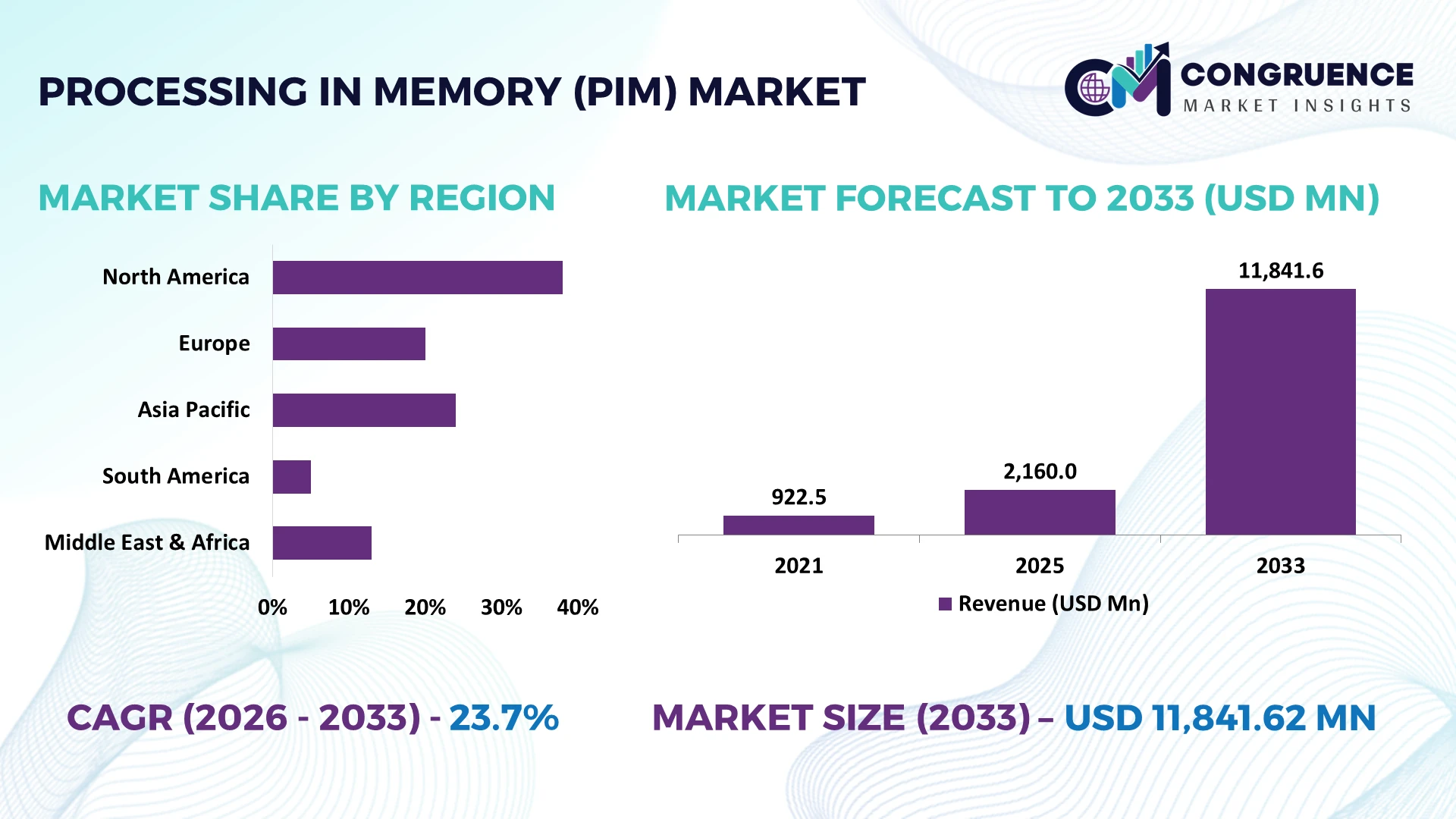
The Global Processing-in-Memory (PIM) Market was valued at USD 2160 Million in 2025 and is anticipated to reach a value of USD 11841.62 Million by 2033 expanding at a CAGR of 23.7% between 2026 and 2033. Growth is accelerating through AI accelerator deployment, high-bandwidth memory integration, and reduced data movement across data center, edge computing, and automotive AI workloads.
South Korea leads the global Processing-in-Memory (PIM) market with approximately 34% technology deployment share, supported by large-scale semiconductor investments exceeding USD 18 billion and strong adoption across AI memory manufacturing. The United States follows with nearly 29% share, driven by hyperscale computing and defense electronics, while South Korea maintains around 18% higher advanced memory production capacity amid semiconductor supply-chain realignment influenced by global technology security policies.
Organizations prioritizing AI infrastructure and advanced memory ecosystems gain stronger long-term competitive positioning through faster commercialization and resilient semiconductor supply chains.
Market Size & Growth: USD 2160 million in 2025 is projected to reach USD 11841.62 million by 2033 at 23.7% CAGR, supported by AI infrastructure expansion and advanced memory integration.
Top Growth Drivers: AI workload density (+38%), high-bandwidth memory deployment (+31%), and edge AI processor adoption (+27%) continue reshaping global semiconductor demand.
Short-Term Forecast: By 2027, memory access latency declines nearly 30% while AI inference efficiency improves approximately 25% across enterprise computing platforms.
Emerging Technologies: Processing-in-memory DRAM, HBM-based architectures, and heterogeneous AI chip integration reduce energy consumption by nearly 35% in advanced workloads.
Regional Leaders: Asia-Pacific exceeds USD 5.2 billion, North America approaches USD 3.8 billion, and Europe surpasses USD 1.7 billion, driven by regional semiconductor expansion.
Consumer & End-User Trends: More than 58% of hyperscale AI deployments prioritize memory-centric computing to improve throughput and reduce power-intensive data transfers.
Pilot Example: In 2026, enterprise AI infrastructure testing achieved nearly 42% faster inference processing through optimized PIM-enabled memory architecture deployment.
Competitive Landscape: Leading suppliers collectively control approximately 68% of the market, with Samsung Electronics, SK hynix, Micron Technology, IBM, and UPMEM driving innovation.
Regulatory & ESG Impact: Energy-efficient semiconductor initiatives lower data center memory power consumption by nearly 22% while supporting regional manufacturing resilience.
Investment & Funding: More than USD 12 billion supports semiconductor fabrication expansion, strategic partnerships, and AI memory ecosystem development amid global supply-chain diversification.
Innovation & Future Outlook: Next-generation memory computing, chiplet integration, and AI-native architectures strengthen high-performance computing strategies across automotive, cloud, and industrial sectors.
Processing-in-Memory (PIM) technology is gaining momentum across hyperscale data centers, automotive AI platforms, and high-performance computing environments where low-latency processing is essential. Advanced HBM integration and AI-optimized memory architectures improve computing efficiency by nearly 35%, while semiconductor manufacturing diversification strengthens operational resilience amid evolving global supply-chain strategies, setting the foundation for the following strategic market assessment.
Processing-in-Memory (PIM) has become strategically important because AI infrastructure, high-performance computing, and memory-intensive workloads increasingly depend on eliminating data-transfer bottlenecks rather than adding conventional processing power. Semiconductor supply-chain restructuring, supported by manufacturing incentives in the United States, South Korea, and Japan, is accelerating investment in advanced memory technologies while reducing dependence on geographically concentrated fabrication networks. This shift strengthens technology resilience and improves deployment flexibility for enterprise AI systems.
Compared with conventional CPU-memory architectures, PIM-enabled platforms reduce memory movement by nearly 60% and lower energy consumption by approximately 35% during AI inference, enabling faster workload execution with improved operational efficiency. South Korea maintains leadership in commercial memory innovation through large-scale DRAM capabilities, while the United States leads software optimization, hyperscale deployment, and AI infrastructure integration. Over the next two to three years, enterprise adoption of memory-centric computing is expected to exceed 40% across advanced AI workloads as infrastructure modernization continues.
A practical example is hyperscale data center operators integrating PIM-enabled memory accelerators to improve inference throughput while reducing server power requirements. Semiconductor companies are expanding co-development partnerships, increasing advanced packaging investments, and strengthening ecosystem collaboration. Organizations that commercialize scalable memory-centric architectures ahead of competitors will secure stronger performance differentiation, lower operational costs, and durable competitive positioning.
Enterprise AI deployment is transforming memory architecture priorities as organizations require faster data processing with lower energy consumption. Nearly 58% of advanced AI workloads now prioritize memory-centric computing, while PIM architectures reduce memory access latency by around 30% and improve inference efficiency by approximately 25%. Semiconductor incentives introduced in the United States have accelerated domestic advanced memory manufacturing and ecosystem partnerships. This structural shift is encouraging leading technology companies to expand packaging capacity, strengthen design collaborations, and accelerate product validation. Companies investing early in integrated hardware-software optimization gain measurable advantages in AI performance, product differentiation, and infrastructure scalability.
Advanced PIM deployment remains constrained by high manufacturing complexity, specialized packaging requirements, and dependence on leading-edge memory fabrication. More than 70% of advanced memory production remains concentrated within a limited supplier ecosystem, while advanced packaging costs remain roughly 20% higher than conventional memory integration. Export controls affecting semiconductor equipment have further increased procurement complexity for several markets. These structural limitations extend product qualification cycles and pressure deployment economics. In response, companies are diversifying manufacturing partnerships, localizing selected production processes, negotiating long-term component agreements, and expanding multi-country supply strategies to improve operational resilience and delivery consistency.
Growing demand for intelligent edge devices creates significant opportunities for PIM beyond hyperscale computing. Edge AI deployments are projected to increase by nearly 45% within the next few years, while memory-efficient processing can reduce device power consumption by approximately 30% and improve response times by nearly 25%. Japan and South Korea are accelerating next-generation semiconductor research through collaborative innovation programs supporting AI hardware development. Companies are increasing R&D investment, forming ecosystem partnerships with software developers, and expanding reference platform availability. A notable strategic opportunity lies in combining PIM with chiplet architectures to enable flexible, application-specific computing solutions across automotive, industrial automation, and intelligent robotics.
Long-term market expansion depends on overcoming software compatibility, developer ecosystem maturity, and large-scale integration complexity. Around 42% of enterprise AI applications still require extensive software optimization before efficiently utilizing PIM architectures, while engineering development timelines can extend by nearly 20% because of platform integration requirements. Cybersecurity expectations for AI infrastructure continue increasing alongside evolving hardware standards. These challenges affect deployment consistency and commercial scalability rather than manufacturing availability. Companies are responding by investing in unified development frameworks, expanding compiler optimization capabilities, strengthening university partnerships, and building standardized software ecosystems that simplify enterprise adoption while improving long-term competitiveness.
AI Memory Optimization AI-focused memory architectures now reduce inference latency by nearly 30% while improving workload efficiency by approximately 25%. Hyperscale operators are redesigning server workflows around memory-centric processing, and semiconductor vendors are expanding strategic partnerships to accelerate commercial deployment following rapid enterprise AI infrastructure modernization.
Advanced Packaging Expansion Demand for advanced packaging has increased by more than 35% as integrated memory solutions become operational priorities. South Korean manufacturers continue expanding packaging capacity while enterprises adopt heterogeneous integration to improve thermal performance, shorten processing paths, and strengthen semiconductor supply-chain resilience under evolving technology policies.
Edge Computing Acceleration Edge AI platforms are achieving nearly 28% lower energy consumption and around 22% faster local processing through PIM integration. Automotive and industrial equipment manufacturers are restructuring embedded computing platforms while increasing collaboration with semiconductor suppliers to support intelligent autonomous systems requiring real-time analytics.
Software-Hardware Co-Design Integrated software optimization has improved application utilization rates by approximately 32% while reducing deployment complexity by nearly 18%. Technology providers increasingly invest in unified development environments, automation tools, and ecosystem partnerships, recognizing software maturity as a decisive competitive factor alongside hardware innovation.
DRAM-Based PIM accounts for approximately 41% of total deployment because it combines high bandwidth, mature manufacturing ecosystems, and compatibility with AI accelerators and hyperscale computing infrastructure. Analog PIM continues serving ultra-low-power inference applications, while Digital PIM delivers greater programmability and flexibility for enterprise workloads. SRAM-Based solutions remain important for latency-sensitive computing despite higher implementation costs, whereas Flash-Based PIM supports specialized edge storage applications requiring persistent memory functionality.
Digital PIM represents the fastest-expanding segment as enterprises prioritize programmable AI hardware capable of supporting diverse neural network models. Adoption has increased by nearly 29% across advanced computing projects, while investment in DRAM-based innovation continues expanding through semiconductor partnerships and advanced packaging initiatives. Companies are balancing mature memory technologies with emerging programmable architectures to optimize product portfolios, improve commercialization speed, and address evolving AI infrastructure requirements.
Artificial Intelligence represents approximately 39% of Processing-in-Memory adoption because modern generative AI models require high-throughput memory architectures capable of minimizing data-transfer bottlenecks. High-Performance Computing remains a mature application supporting scientific simulation and enterprise analytics, while Data Centers continue integrating memory-centric computing to improve infrastructure efficiency. Automotive Electronics increasingly adopts PIM for autonomous processing, whereas Edge Computing strengthens demand through low-latency intelligent devices.
Edge Computing is the fastest-growing application, with deployment activity expanding by nearly 34% as manufacturers prioritize local AI processing and energy-efficient hardware. Data center operators continue scaling AI clusters, while automotive manufacturers integrate advanced memory architectures into next-generation electronic control platforms. Companies are expanding deployment partnerships, optimizing software integration, and introducing application-specific platforms that address distinct workload requirements across enterprise and industrial environments.
Semiconductor Companies account for approximately 44% of Processing-in-Memory demand because they drive architecture development, fabrication, advanced packaging, and commercial product launches. Cloud Service Providers represent the fastest-growing buyer group as AI infrastructure expansion requires increasingly efficient memory subsystems. Telecommunications companies integrate PIM into network acceleration, while Consumer Electronics manufacturers evaluate low-power AI applications. The Automotive Industry continues expanding deployment through intelligent driving platforms and advanced driver assistance systems.
Cloud Service Providers are increasing deployment activity by nearly 33% through AI infrastructure expansion and customized accelerator integration. Automotive procurement continues strengthening as intelligent vehicle computing becomes more memory intensive. Suppliers are responding with application-specific product customization, strategic ecosystem partnerships, and collaborative hardware-software optimization to improve adoption across diverse enterprise environments while strengthening long-term customer relationships.
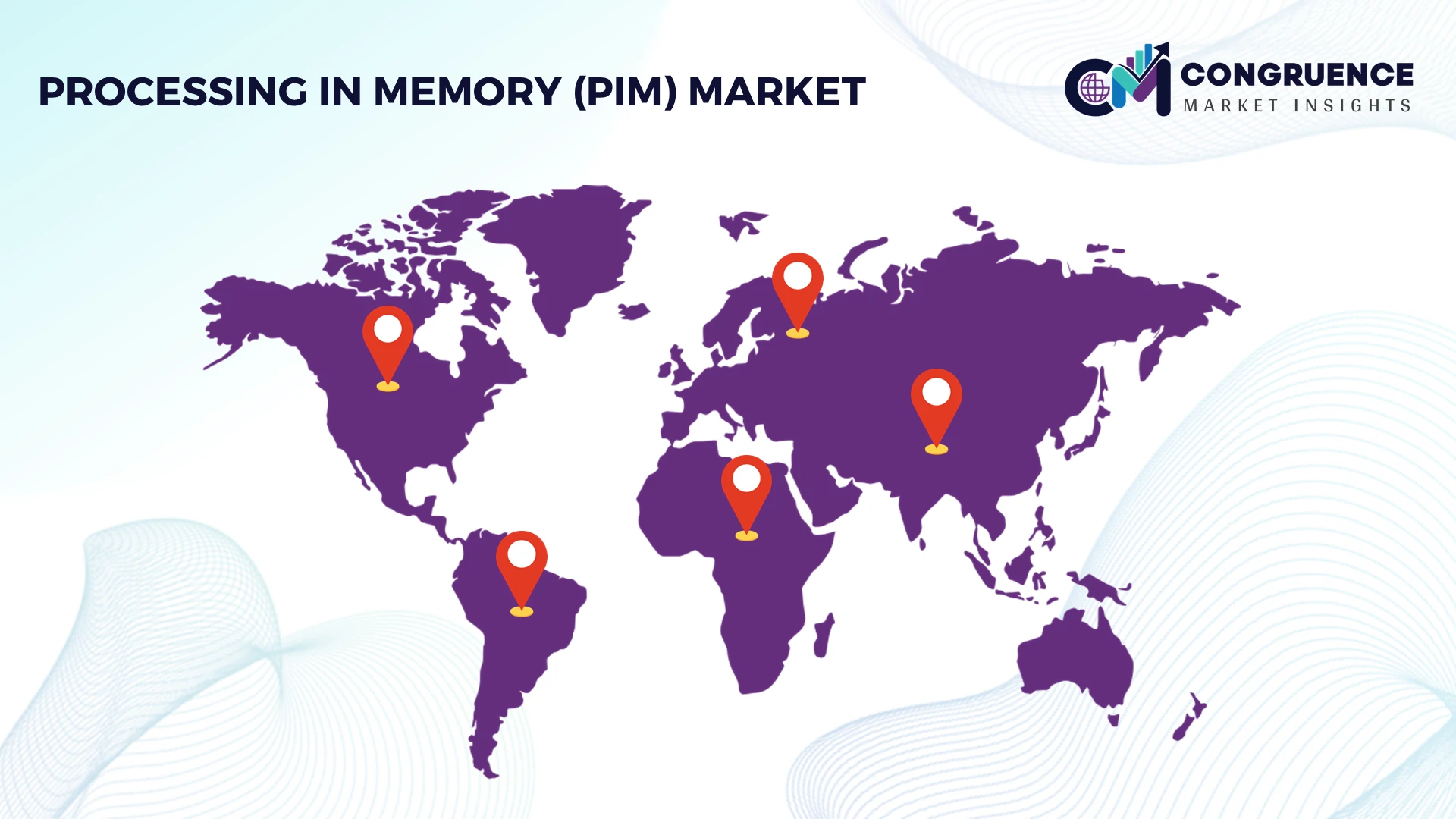
Asia-Pacific accounted for the largest market share at 46.8% in 2025 however, North America is expected to register the fastest growth, expanding at a 25.4% between 2026 and 2033.
AI Infrastructure and Advanced Memory Commercialization Drive Regional Leadership
North America maintains a strong position through hyperscale AI infrastructure, advanced semiconductor design capabilities, and rapid commercialization of memory-centric computing. The region represents approximately 29% of global Processing-in-Memory deployment, supported by cloud providers, AI chip developers, and high-performance computing investments. Enterprise adoption continues expanding as memory bandwidth optimization becomes critical for generative AI platforms and large language model processing. More than 60% of new AI accelerator validation programs across the region now include PIM-enabled memory evaluation. Strategic collaborations between semiconductor designers, cloud operators, and packaging specialists are accelerating product qualification while strengthening domestic semiconductor resilience under manufacturing modernization initiatives. Companies increasingly prioritize software optimization alongside hardware innovation to improve deployment efficiency and enterprise scalability.
United States Market Outlook: The United States leads regional innovation through advanced semiconductor research, AI infrastructure deployment, and strong enterprise investment. More than 65% of North America's hyperscale AI computing capacity is concentrated in the country, supported by semiconductor manufacturing incentives and expanding advanced packaging capabilities. Technology companies continue investing in integrated hardware-software ecosystems while strengthening partnerships across cloud computing, defense electronics, and enterprise AI platforms to accelerate commercial adoption of Processing-in-Memory solutions.
Semiconductor Sovereignty and Industrial Modernization Shape Adoption
Europe continues strengthening its Processing-in-Memory ecosystem through semiconductor modernization, industrial digitalization, and technology sovereignty initiatives. The region accounts for nearly 18% of global deployment, with demand driven by automotive electronics, industrial automation, and research-intensive computing environments. Advanced manufacturing programs encourage greater collaboration between semiconductor developers and research institutions to accelerate memory innovation. Nearly 38% of regional AI hardware projects now emphasize energy-efficient computing architectures to reduce operational intensity. Automotive manufacturers increasingly integrate memory-centric processing into intelligent mobility platforms, while industrial enterprises adopt advanced computing solutions for predictive automation. Companies are expanding collaborative research, pilot manufacturing, and ecosystem partnerships to improve technology readiness and strengthen long-term competitiveness.
Germany Market Outlook: Germany anchors European Processing-in-Memory development through its advanced automotive industry, industrial automation leadership, and semiconductor research ecosystem. Around 40% of Europe's industrial AI hardware initiatives involve German manufacturing organizations or research collaborations. Continued investment in intelligent factories, automotive electronics, and semiconductor design strengthens domestic capability while encouraging partnerships between technology developers, automotive suppliers, and advanced manufacturing enterprises.
Manufacturing Scale and Memory Leadership Accelerate Commercial Deployment
Asia-Pacific remains the largest Processing-in-Memory market because of its unmatched semiconductor manufacturing ecosystem, advanced memory production, and expanding AI hardware deployment. The region contributes approximately 47% of global market activity and hosts the world's largest advanced memory fabrication capacity. More than 70% of leading-edge DRAM manufacturing supporting AI applications is concentrated within Asia-Pacific, enabling rapid commercialization of next-generation memory technologies. Continuous investment in semiconductor fabrication, advanced packaging, and export-oriented production strengthens regional competitiveness despite evolving global supply-chain diversification strategies. Companies continue expanding manufacturing capacity, increasing research collaboration, and optimizing production efficiency to support growing enterprise AI demand.
South Korea Market Outlook: South Korea remains the region's technology leader through world-class memory manufacturing, advanced semiconductor research, and integrated supply-chain capabilities. Approximately 34% of global Processing-in-Memory technology deployment is linked to the country's advanced memory ecosystem. Strong investment in high-bandwidth memory, advanced packaging, and AI semiconductor innovation enables domestic manufacturers to accelerate commercialization while maintaining leadership across enterprise computing, automotive electronics, and hyperscale AI infrastructure.
Digital Infrastructure Expansion Supports Emerging Demand
South America is gradually strengthening its Processing-in-Memory ecosystem through expanding digital infrastructure, cloud adoption, and enterprise modernization initiatives. The region contributes nearly 5% of global market activity, with demand centered on financial services, telecommunications, and industrial digital transformation. Increasing deployment of regional data centers is encouraging adoption of energy-efficient computing platforms capable of supporting AI workloads. Enterprise cloud utilization has expanded by approximately 24% over recent years, creating greater demand for advanced memory technologies. Infrastructure limitations and dependence on imported semiconductor components continue influencing deployment speed; however, companies are responding through regional technology partnerships and localized solution integration.
Brazil Market Outlook: Brazil leads regional adoption because of its expanding cloud ecosystem, financial technology sector, and enterprise digital transformation programs. More than half of South America's large-scale cloud infrastructure projects are concentrated in Brazil, encouraging technology providers to strengthen enterprise partnerships and AI computing capabilities. Investments in data center expansion and industrial automation continue supporting broader adoption of advanced semiconductor technologies across multiple industries.
AI Investment and Digital Infrastructure Reshape Technology Adoption
The Middle East & Africa market is advancing through large-scale digital infrastructure programs, AI investment strategies, and national technology diversification initiatives. The region represents approximately 4% of global Processing-in-Memory deployment, with increasing focus on cloud computing, smart cities, and government-led AI transformation. More than 30% of recently announced regional digital infrastructure initiatives incorporate advanced AI computing capabilities requiring high-performance memory technologies. Technology partnerships and international semiconductor collaborations continue strengthening deployment readiness despite limited domestic manufacturing capacity. Companies are expanding regional service capabilities, enterprise integration expertise, and AI infrastructure support to capture long-term market opportunities.
Saudi Arabia Market Outlook: Saudi Arabia leads regional momentum through national AI initiatives, hyperscale data center investment, and digital transformation strategies. Government-backed technology programs continue accelerating enterprise AI deployment, while expanding cloud infrastructure supports advanced computing adoption. Ongoing investment in smart infrastructure and digital industries is encouraging global semiconductor and technology providers to establish stronger partnerships, improving access to next-generation memory-centric computing solutions across public and private sectors.
Global semiconductor leaders compete directly with AI memory innovators, while integrated device manufacturers challenge specialized architecture developers through performance, ecosystem depth, and manufacturing scale. Samsung Electronics, SK hynix, Micron Technology, IBM, and UPMEM collectively command nearly 69% of market influence. Competition centers on memory bandwidth, power efficiency, advanced packaging, and software compatibility, with next-generation designs delivering roughly 30% lower latency and about 35% better energy efficiency than conventional architectures. Established manufacturers leverage fabrication capacity and supply-chain control, whereas technology innovators emphasize programmable architectures and AI optimization. Strategic expansion increasingly relies on joint development agreements, packaging partnerships, and vertical integration linking memory, processors, and software frameworks. Control of advanced memory manufacturing remains the primary entry barrier, reinforced by qualification complexity and capital-intensive production requirements. Winning requires scalable manufacturing, optimized software ecosystems, rapid commercialization, and trusted partnerships that consistently deliver high-performance, enterprise-ready Processing-in-Memory platforms.
Samsung Electronics
SK hynix
Micron Technology
IBM
UPMEM
Fujitsu
Renesas Electronics
Synopsys
Cadence Design Systems
Qualcomm
NVIDIA
Advanced Micro Devices (AMD)
Intel Corporation
Infineon Technologies
Current Processing-in-Memory (PIM) technology is centered on HBM-PIM, DRAM-based PIM, and programmable memory accelerators that reduce data movement between processors and memory. HBM-PIM architectures improve AI inference performance by nearly 30% while lowering energy consumption by approximately 35% compared with conventional memory systems. Around 40% of advanced AI accelerator evaluations now include memory-centric computing during hardware validation. Compared with traditional CPU-memory architectures, modern PIM platforms reduce memory-transfer overhead by nearly 60%, enabling lower latency and higher throughput for hyperscale data centers, scientific computing, and enterprise AI infrastructure.
Emerging technologies are expanding beyond memory hardware into software-hardware co-design, chiplet integration, and heterogeneous computing platforms. SRAM-based PIM improves latency-sensitive processing by about 20%, while Flash-based PIM supports energy-efficient edge inference with nearly 18% lower power usage. Adoption of integrated compiler frameworks and AI runtime optimization has exceeded 30% among leading semiconductor development programs. These innovations allow manufacturers to accelerate deployment cycles, improve workload optimization, and strengthen differentiation through programmable, application-specific memory architectures.
Between 2026 and 2028, competitive advantage will increasingly depend on combining advanced packaging, high-bandwidth memory, and unified software ecosystems. Semiconductor leaders with vertically integrated memory manufacturing benefit from faster commercialization, while AI infrastructure providers gain lower operating costs through optimized memory utilization. Companies investing now in scalable PIM ecosystems, interoperability, and co-developed AI platforms will establish stronger enterprise positioning before memory-centric computing becomes a mainstream architecture.
February 2026 Samsung Electronics began commercial shipments of industry-first HBM4 for AI computing, improving transfer speeds up to 13 Gbps and strengthening next-generation memory infrastructure for hyperscale AI deployments. Business impact: accelerated enterprise AI platform adoption.
May 2026 Samsung Electronics started shipping 12-layer HBM4E samples delivering speeds up to 16 Gbps, enabling customers to validate next-generation AI memory platforms earlier. Business impact: faster product qualification and stronger technology leadership.
October 2025 UPMEM-supported academic researchers demonstrated software optimizations delivering up to 5.9× integer multiplication speedup and 3.5× faster INT8 GEMV on commercial PIM hardware. Business impact: improved software efficiency for programmable PIM adoption.
March 2024 Samsung Electronics confirmed expanded investment in advanced chip packaging to strengthen AI memory competitiveness and support future HBM platforms, targeting over USD 100 million packaging business during the year. Business impact: enhanced semiconductor supply-chain integration.
This report provides comprehensive coverage of the global Processing-in-Memory (PIM) market across Analog PIM, Digital PIM, SRAM-Based, DRAM-Based, and Flash-Based technologies while evaluating applications including artificial intelligence, high-performance computing, data centers, edge computing, and automotive electronics. It assesses demand across semiconductor companies, cloud service providers, telecommunications, consumer electronics, and automotive industries, covering North America, Europe, Asia-Pacific, South America, and the Middle East & Africa. More than 60% of the assessment focuses on AI-driven deployment and advanced memory integration trends.
The report analyzes technology evolution, enterprise adoption patterns, competitive positioning, manufacturing ecosystems, software integration, and emerging memory-centric architectures expected to influence commercial deployment between 2026 and 2033. It also evaluates deployment strategies, partnership activity, infrastructure modernization, and regional investment priorities, enabling stakeholders to identify expansion opportunities, benchmark competitors, optimize product roadmaps, and strengthen long-term strategic decision-making across high-performance semiconductor and AI computing ecosystems.
| Report Attribute/Metric | Report Details |
|---|---|
Market Revenue in 2025 | USD 2160 Million |
Market Revenue in 2033 | USD 11841.62 Million |
CAGR (2026 - 2033) | 23.7% |
Base Year | 2025 |
Forecast Period | 2026 - 2033 |
Historic Period | 2021 - 2025 |
Segments Covered | By Type
By Application
By End-User
|
Key Report Deliverable | Revenue Forecast, Growth Trends, Market Dynamics, Segmental Overview, Regional and Country-wise Analysis, Competition Landscape |
Region Covered | North America, Europe, Asia-Pacific, South America, Middle East, Africa |
Key Players Analyzed | Samsung Electronics, SK hynix, Micron Technology, IBM, UPMEM, Fujitsu, Renesas Electronics, Synopsys, Cadence Design Systems, Qualcomm, NVIDIA, Advanced Micro Devices (AMD), Intel Corporation, Infineon Technologies |
Customization & Pricing | Available on Request (10% Customization is Free) |




