
Reports
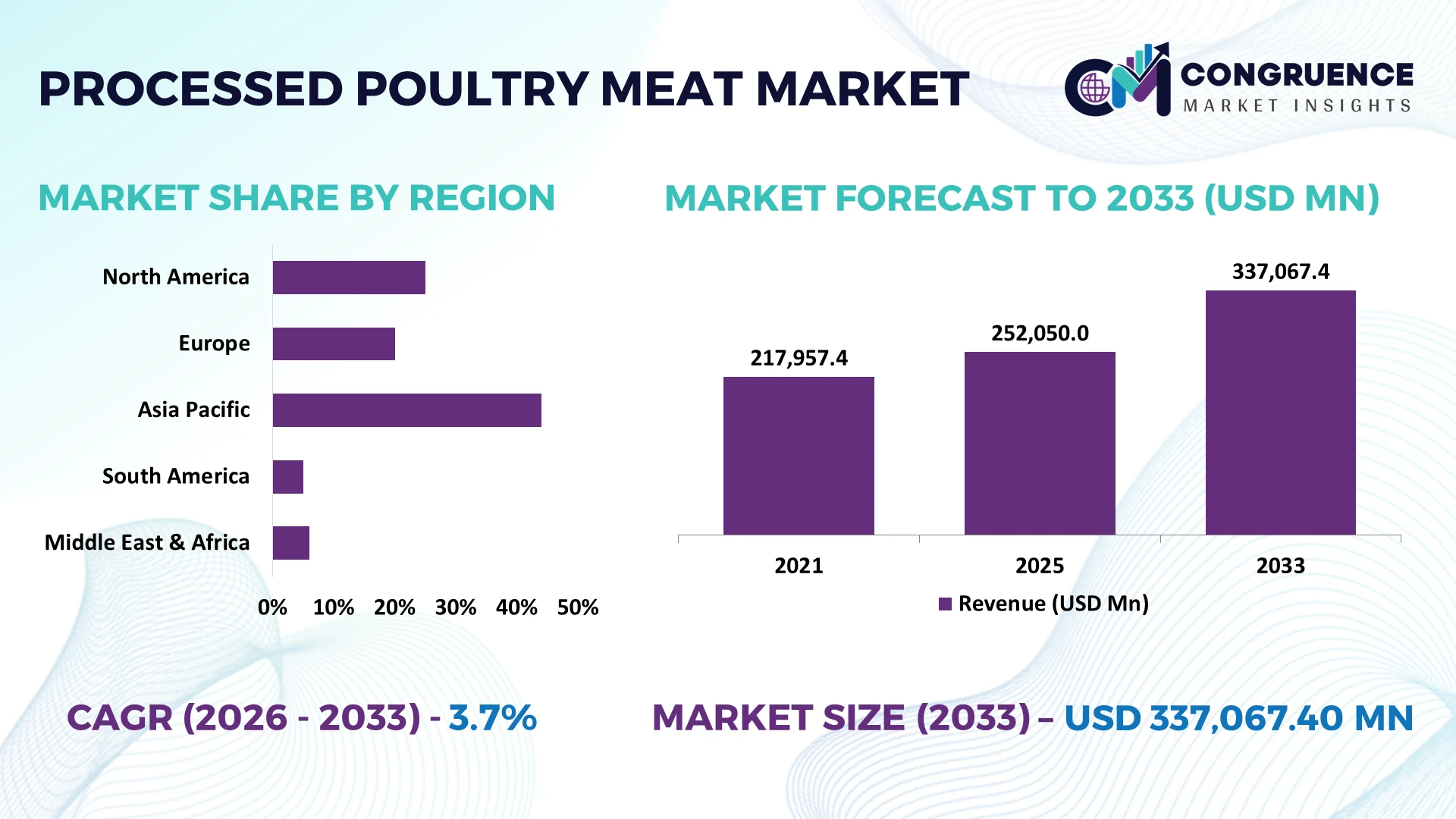
The Global Processed Poultry Meat Market was valued at USD 252050 Million in 2025 and is anticipated to reach a value of USD 337067.4 Million by 2033 expanding at a CAGR of 3.7% between 2026 and 2033. Growth is driven by automated poultry deboning, expansion of chilled and frozen food distribution, increasing foodservice utilization of portioned chicken products, and industrial adoption of ready to cook processing technologies.
The United States maintains a leading position in industrial poultry processing, supported by integrated broiler production, automated slaughtering, and extensive refrigerated distribution infrastructure. American broiler production exceeds 21 million metric tons annually, compared with approximately 15 million metric tons in Brazil. Tyson Foods, Pilgrim's Pride, and Perdue Farms operate integrated processing networks supplying retail, foodservice, and institutional buyers. Brazil's position as a major poultry exporter intensifies international competition, while US processors invest in automated deboning, portion control, and food safety technologies.
Strategically, processors should prioritize automated production lines and refrigerated distribution networks, leveraging the United States' production scale and Brazil's export competitiveness to strengthen processing efficiency and supply chain resilience.
Market Size & Growth: USD 252,050 million in 2025, reaching USD 337,067.4 million by 2033 at 3.7% CAGR, supported by automated processing and convenience food production.
Top Growth Drivers: US broiler production increased 2.1%, slaughter volumes rose 1.3%, and average live weight advanced 0.9% in 2025.
Short-Term Forecast: By 2027, projected market expansion reaches approximately 7.5% against 2025, supporting processing capacity planning.
Emerging Technologies: Three technologies reshape processing: AI vision inspection, robotic deboning, and high pressure processing for packaged poultry.
Regional Leaders: Illustrative 2033 allocations place North America at USD 114,602.92 million, Asia Pacific at USD 104,490.89 million, and Europe at USD 77,525.50 million, assuming 34%, 31%, and 23% shares respectively.
Consumer/End-User Trends: US processors handled approximately 9.40 billion broilers in 2025, supporting large scale retail and foodservice supply.
Pilot/Case Example: US poultry production in 2025 reached 62.2 billion pounds of live broiler weight, a 2% increase, demonstrating industrial throughput expansion.
Competitive Landscape: Tyson Foods, JBS, Pilgrim's Pride, BRF, and WH Group compete through integrated processing; verified global leader share remains unavailable.
Regulatory & ESG Impact: USDA inspection covers federally regulated poultry slaughter operations, with 100% inspection coverage required for applicable slaughter establishments.
Investment & Funding: A verified global investment total is unavailable; processing investment targets automated deboning, cold storage, and packaging infrastructure across 3 operational areas.
Innovation & Future Outlook: Three priorities shape advanced processing: precision portioning, digital traceability, and energy efficient refrigeration.
The Global Processed Poultry Meat Market encompasses chilled, frozen, marinated, breaded, and fully cooked poultry products supplied through supermarkets, restaurants, institutional kitchens, and industrial food manufacturers. Automated deboning and precision portioning improve carcass utilization, while modified atmosphere packaging and rapid freezing extend distribution flexibility. US broiler output increased approximately 2.1% during 2025, reinforcing the importance of high capacity processing infrastructure. Brazil's export oriented poultry industry adds competitive pressure through international supply contracts and sanitary compliance requirements. These developments make processing automation, product differentiation, and refrigerated logistics central to strategic investment decisions.
The Processed Poultry Meat Market is becoming strategically important as integrated processors compete for foodservice contracts, refrigerated retail distribution, and value added product manufacturing. The United States processes approximately 9.4 billion broilers annually, creating substantial opportunities for automated deboning, precision portioning, and industrial cooking systems. Avian influenza outbreaks and international sanitary restrictions are accelerating supply chain diversification, while major processors strengthen biosecurity, traceability, and domestic processing capabilities to protect production continuity.
Automated cutting and deboning systems offer measurable advantages over conventional manual processing. A 2% improvement in recoverable meat yield translates into approximately 20 additional kilograms per metric ton of processed material, strengthening raw material utilization. Brazil emphasizes export oriented processing and competitive production costs, while the United States prioritizes automation, food safety compliance, and high volume distribution. Between 2026 and 2028, processors are expected to expand machine vision inspection, robotic handling, and digital production monitoring.
Tyson Foods and JBS are integrating automated processing equipment with established refrigerated logistics networks. Practical deployment priorities include automated portioning, continuous temperature monitoring, and standardized packaging operations. Companies achieving consistent yield recovery, sanitary compliance, and dependable delivery performance will secure stronger positions in retail and institutional procurement.
Foodservice standardization and convenience product manufacturing are strengthening demand for processed poultry meat, particularly boneless cuts, breaded products, and fully cooked chicken. US broiler production increased approximately 2.1% during 2025, while slaughter volumes advanced around 1.3%, supporting additional processing throughput. Average live broiler weight increased approximately 0.9%, creating opportunities for improved portioning and meat recovery. Restaurant chains increasingly require standardized product dimensions, cooking performance, and reliable refrigerated deliveries. Tyson Foods, Pilgrim's Pride, and Perdue Farms are strengthening automated cutting, marination, and cooking operations to meet these specifications. The strategic advantage increasingly lies in converting production scale into consistent, contract ready products rather than simply increasing slaughter capacity.
Poultry processors remain exposed to feed ingredient volatility, refrigeration expenses, and interruptions in international sanitary trade. Feed commonly represents approximately 60% to 70% of live poultry production costs, making corn and soybean meal pricing critical to processing margins. A 10% increase in feed expenditure can materially affect integrated production economics when purchasing contracts limit immediate price adjustments. Refrigerated distribution also requires strict temperature management, with chilled poultry commonly maintained at or below 4°C. Brazil's export oriented processors face additional exposure to destination country sanitary restrictions and transportation disruptions. JBS, BRF, and other integrated operators are strengthening feed procurement contracts, refrigerated logistics partnerships, and geographic customer diversification to protect processing continuity and operating margins.
Advanced deboning, automated portioning, and digital quality monitoring create opportunities to improve poultry processing yields and expand premium product portfolios. A 1% improvement in meat recovery delivers approximately 10 additional kilograms of usable material per metric ton processed. Automated portion control targeting weight variation within 5% can improve foodservice specification compliance and reduce product giveaway. High pressure processing and rapid freezing technologies also support differentiated refrigerated and frozen poultry products. India's expanding organized foodservice infrastructure creates opportunities for standardized ready to cook poultry formats. Tyson Foods, BRF, and regional processors are investing in processing automation, specialized packaging, and product development. Competitive advantage increasingly depends on extracting greater value from existing raw material throughput.
Maintaining consistent poultry processing operations requires coordination between farm biosecurity, slaughter scheduling, automated equipment, and refrigerated distribution. High capacity facilities operating at 90% utilization have limited flexibility to absorb unexpected equipment downtime or livestock supply interruptions. A 2% reduction in available operating time translates into approximately 14.4 lost production hours during a 30 day continuous operating schedule. Avian influenza outbreaks intensify operational pressure by disrupting flock availability and requiring extensive sanitation and movement controls. US processors must also maintain compliance with USDA food safety requirements across slaughter and further processing operations. Tyson Foods, Pilgrim's Pride, and integrated competitors are strengthening predictive maintenance, digital traceability, workforce training, and emergency sourcing arrangements. Long term competitiveness requires dependable production continuity alongside rigorous sanitary performance.
Antibiotic Stewardship Reshapes Poultry Procurement: Poultry processors are strengthening veterinary oversight and antibiotic monitoring across integrated supply chains. The European Union prohibits routine preventive antimicrobial use under Regulation 2019/6, while United States veterinary feed directives require professional authorization for medically important antibiotics. Producers are expanding flock monitoring, supplier audits, and documented treatment protocols. These changes improve procurement transparency and strengthen access to regulated retail markets.
Packaging Formats Prioritize Shelf Life: Manufacturers are expanding vacuum packaging, modified atmosphere systems, and portion specific retail formats. Chilled poultry storage commonly requires temperatures at or below 4°C, while frozen distribution generally operates at minus 18°C or colder. Tyson Foods and BRF are optimizing packaging specifications and temperature monitoring systems. Better packaging integrity reduces product deterioration, strengthens inventory management, and supports longer distribution routes.
Export Certification Restructures Trade Flows: Brazil's poultry exporters are adapting shipment planning to changing sanitary certification and destination market requirements. Brazil exported approximately 5.29 million metric tons of chicken meat in 2024, highlighting its dependence on international distribution networks. Processors are strengthening establishment level traceability, export documentation, and market diversification. These measures improve shipment flexibility when importing countries impose disease related restrictions.
Protein Formulation Targets Product Consistency: Industrial manufacturers are refining marination, coating, and thermal processing parameters to improve finished product consistency. Fully cooked poultry products commonly require a minimum internal temperature of 74°C under United States consumer food safety guidance. Automated cooking systems continuously monitor temperature and residence time. Processors are standardizing recipes and equipment settings to reduce batch variation, improve food safety assurance, and maintain predictable product quality.
Fresh Processed Poultry represents the leading product category, accounting for an estimated 34% of the global Processed Poultry Meat Market. Its dominance reflects extensive utilization in supermarkets, butcher distribution networks, and commercial kitchens requiring refrigerated poultry cuts. Frozen Processed Poultry accounts for approximately 28%, supported by longer storage flexibility and international trade compatibility. Industrial processors maintain established chilling, cutting, and packaging infrastructure, enabling consistent production throughput. Tyson Foods, Pilgrim's Pride, and JBS are strengthening refrigerated distribution networks and standardized packaging operations to support retail and institutional procurement. Fresh products maintain advantages in established local supply chains, while frozen formats provide greater flexibility for export distribution and inventory management.
Ready-to-Eat Poultry represents the fastest growing category, supported by demand for fully cooked chicken portions, packaged meals, and convenient protein products. Ready-to-Cook Poultry maintains significant relevance through marinated cuts, coated chicken products, and prepared cooking formats. Canned Poultry serves shelf stable distribution requirements and institutional food inventories. Manufacturers are investing in automated cooking, packaging integrity, and specialized product development. Competitive positioning increasingly depends on convenience, consistent product specifications, and efficient refrigerated or frozen distribution.
Retail Consumption represents the leading application, accounting for an estimated 38% of the global Processed Poultry Meat Market. Its dominance reflects established supermarket distribution, household protein purchasing, and extensive chilled and frozen product assortments. Foodservice accounts for approximately 32%, supported by restaurant chains, takeaway outlets, and commercial kitchens requiring standardized poultry portions. Retail buyers prioritize packaging integrity, product availability, and predictable shelf life, while foodservice operators emphasize portion consistency and preparation efficiency. Tyson Foods, BRF, and Pilgrim's Pride are strengthening retail packaging capabilities and differentiated product portfolios to address these requirements. Manufacturers increasingly coordinate production schedules with retailer inventory systems to reduce stock imbalances and improve distribution efficiency.
Foodservice represents the fastest growing application, supported by restaurant expansion, standardized menu development, and increased procurement of prepared poultry products. Food Processing remains important for industrial meal production, coated products, and formulated protein ingredients. Institutional Catering supports hospitals, educational facilities, and workplace food operations requiring consistent food safety standards. Suppliers are expanding customized product specifications, refrigerated logistics partnerships, and dedicated processing capabilities. Investment priorities increasingly favor dependable delivery, standardized preparation performance, and flexible product formats.
Households represent the leading end user category, accounting for an estimated 41% of the global Processed Poultry Meat Market. Their dominance reflects widespread consumption of refrigerated chicken cuts, frozen poultry products, and convenient packaged protein formats. Restaurants and QSRs account for approximately 30%, supported by standardized menus and extensive procurement networks. Household purchasing emphasizes affordability, food safety, packaging convenience, and consistent product availability. Tyson Foods, Perdue Farms, and BRF are expanding consumer oriented product assortments and differentiated packaging formats. Supermarket distribution remains critical for established household demand, while specialized retail formats support premium and convenience focused poultry products.
Restaurants and QSRs represent the fastest growing end user category, driven by standardized chicken menus, delivery platforms, and operational requirements for portion controlled products. Hotels and Catering operators prioritize reliable refrigerated deliveries, predictable preparation yields, and food safety compliance. Food Processing Companies purchase poultry ingredients for prepared meals, coated products, and industrial protein formulations. Suppliers are strengthening long term procurement agreements, customized portioning, and dedicated distribution partnerships. Competitive advantage increasingly depends on consistent specifications, efficient fulfillment, and the ability to support both consumer retail and commercial food operations.
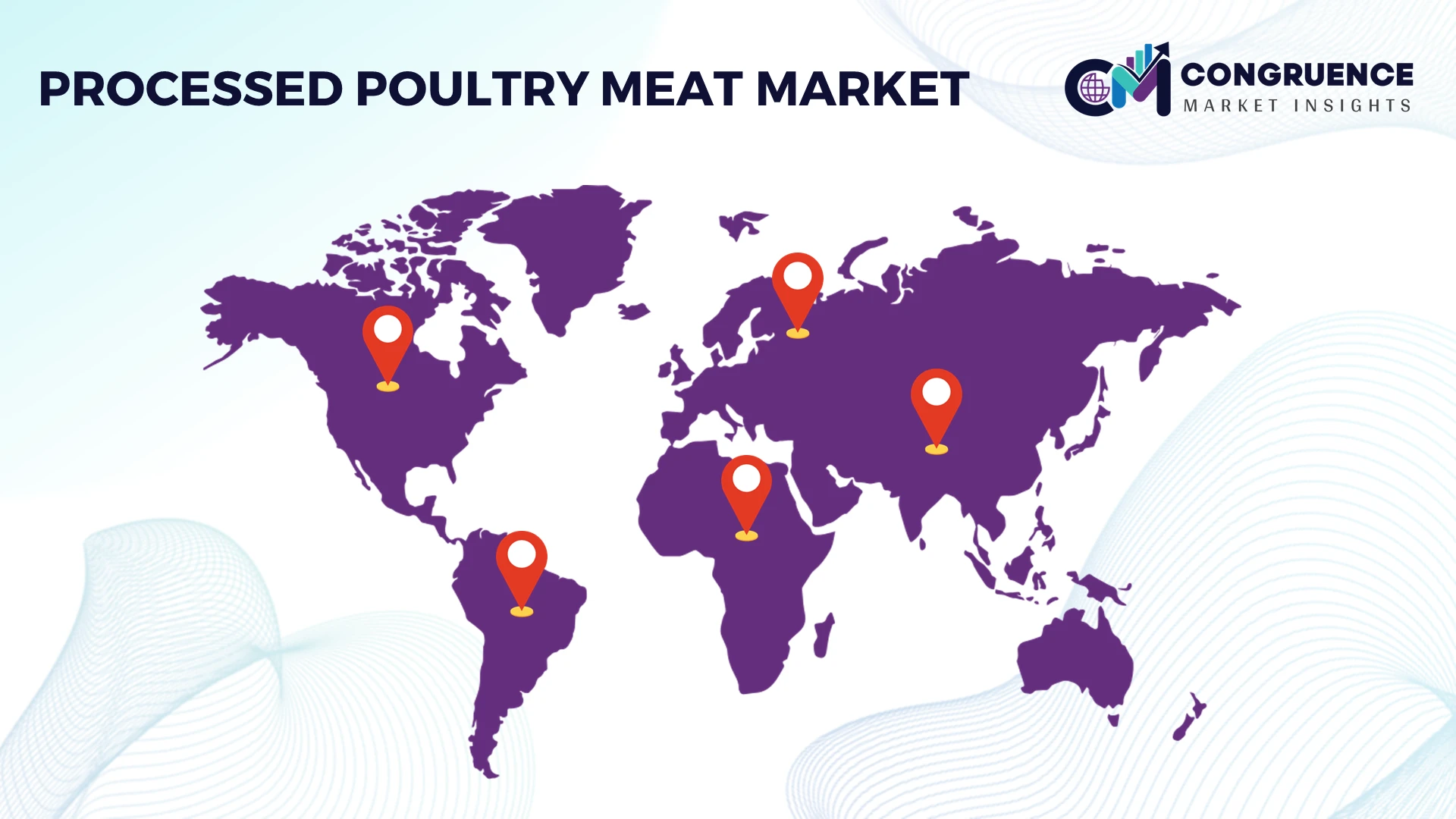
North America accounted for the largest market share at an estimated 34% in 2025 however, Asia-Pacific is expected to register the fastest growth, expanding at an estimated CAGR of 4.8% between 2026 and 2033.
Integrated Processing Infrastructure Strengthens Production Efficiency
North America represents an estimated 34% of the global Processed Poultry Meat Market, supported by extensive broiler production, integrated slaughtering operations, and advanced refrigerated distribution infrastructure. The United States dominates regional processing through Tyson Foods, Pilgrim's Pride, and Perdue Farms, which operate large scale poultry production and processing networks. American processors slaughtered approximately 9.4 billion broilers during 2025, demonstrating substantial industrial throughput. Automated deboning, precision portioning, and continuous food safety inspection support consistent product specifications across retail and foodservice channels. Canada contributes through regulated poultry production and established processing facilities, while Mexico strengthens regional supply through expanding commercial poultry operations. USDA inspection requirements encourage investment in sanitation monitoring, traceability, and standardized processing systems. Manufacturers increasingly prioritize processing yield optimization, refrigerated logistics reliability, and differentiated prepared poultry products to maintain competitiveness.
United States Market Outlook: The United States benefits from integrated poultry production clusters across Georgia, Arkansas, Alabama, and North Carolina. Tyson Foods and Perdue Farms maintain substantial processing infrastructure, supporting retail distribution and commercial foodservice procurement. American broiler production exceeds 21 million metric tons annually, reinforcing domestic processing capacity. USDA food safety regulations require comprehensive slaughter inspection and preventive controls, encouraging investment in automated monitoring, sanitary equipment, and refrigerated product handling.
Food Safety Compliance Accelerates Processing Modernization
Europe accounts for an estimated 23% of global Processed Poultry Meat Market demand, supported by established poultry manufacturing infrastructure, advanced food safety regulation, and extensive chilled product distribution. Poland, France, Germany, and the Netherlands maintain significant poultry processing capabilities, supplying retail, foodservice, and industrial food manufacturing channels. European Union hygiene regulations require documented food safety controls, encouraging investment in automated inspection, traceability, and temperature management. Poland produced approximately 3 million metric tons of poultry meat in 2024, reinforcing its position as a major European production center. Manufacturers including LDC Group, Plukon Food Group, and PHW Group are expanding specialized processing capabilities and prepared poultry product portfolios. Regional priorities include antibiotic stewardship, efficient refrigeration, and packaging modernization. Producers increasingly integrate automated cutting equipment and standardized quality systems to strengthen operational performance and cross border distribution.
Poland Market Outlook: Poland maintains extensive poultry production and processing infrastructure, supported by integrated farming operations and established European export networks. Domestic processors benefit from access to European Union distribution channels and substantial agricultural feed production. Poland's poultry industry supplies both chilled and frozen products across neighboring markets. European food safety regulations strengthen requirements for sanitary processing, traceability, and veterinary oversight, encouraging investment in automated equipment and modern refrigerated logistics.
Industrial Food Processing Expands Regional Production Scale
Asia-Pacific represents an estimated 31% of global Processed Poultry Meat Market demand, supported by substantial poultry production, expanding industrial food manufacturing, and increasing refrigerated distribution capacity. China dominates regional processing volume, while Thailand, India, Indonesia, and Japan contribute specialized production and prepared poultry manufacturing capabilities. China produces more than 15 million metric tons of chicken meat annually, supporting extensive domestic retail and foodservice supply. Thailand maintains established export oriented processing operations, particularly for cooked and prepared chicken products supplied to international markets. Companies including CP Foods, New Hope Liuhe, and Japfa are strengthening integrated processing, automated packaging, and product standardization. Expanding organized foodservice networks encourage investment in portion controlled and ready to cook poultry formats. Regional manufacturers increasingly prioritize refrigerated logistics, production traceability, and efficient conversion of poultry into higher value processed products.
China Market Outlook: China maintains extensive poultry processing infrastructure across Shandong, Guangdong, and other major agricultural manufacturing regions. New Hope Liuhe and other integrated producers operate feed production, poultry farming, and processing networks that support industrial supply coordination. China's substantial domestic foodservice sector encourages standardized poultry ingredients and packaged prepared products. Manufacturers are strengthening automated slaughtering, refrigerated distribution, and digital quality monitoring to improve processing efficiency and product safety.
Export Processing Capacity Strengthens Global Supply Position
South America represents an estimated 8% of global Processed Poultry Meat Market demand, supported by extensive poultry production, integrated processing infrastructure, and international export networks. Brazil dominates regional production through established poultry manufacturing clusters in Paraná, Santa Catarina, and Rio Grande do Sul. Brazil exported approximately 5.29 million metric tons of chicken meat in 2024, demonstrating substantial international distribution capacity. JBS, BRF, and other processors maintain integrated production networks combining feed procurement, poultry farming, processing, and refrigerated logistics. Argentina contributes through domestic poultry processing and regional trade. Export oriented operations require strict sanitary certification, product traceability, and dependable refrigerated transportation. Disease related trade restrictions and logistics disruptions remain important operational constraints. Manufacturers are strengthening market diversification, processing automation, and cold storage infrastructure to maintain shipment reliability and international competitiveness.
Brazil Market Outlook: Brazil benefits from established agricultural feed supply, integrated poultry production, and extensive export processing infrastructure. Paraná remains a major poultry producing state, supported by processing facilities and refrigerated transportation networks. JBS and BRF maintain significant domestic manufacturing operations and international distribution relationships. Brazil's federal inspection system supports sanitary certification for export markets, while producers invest in automated deboning, packaging, and traceability to maintain international market access.
Food Security Investment Accelerates Processing Localization
The Middle East and Africa account for an estimated 4% of global Processed Poultry Meat Market demand, supported by expanding domestic poultry production, refrigerated food distribution, and government initiatives promoting food security. Saudi Arabia represents a significant processing investment center, while South Africa and Egypt maintain established commercial poultry industries. Saudi Arabia's domestic poultry self sufficiency rate reached approximately 72% in 2024, demonstrating progress in local production capacity. Companies including Almarai and Tanmiah Food Company are strengthening integrated poultry farming, processing, and refrigerated distribution infrastructure. South African processors serve extensive retail and foodservice networks, although feed costs and electricity supply constraints influence operating efficiency. Regional investment increasingly targets automated processing facilities, cold storage development, and reliable domestic supply networks. Manufacturers prioritize production localization, sanitary compliance, and reduced dependence on imported processed poultry products.
Saudi Arabia Market Outlook: Saudi Arabia benefits from government supported food security initiatives and increasing investment in domestic poultry production. Tanmiah Food Company and Almarai maintain integrated poultry operations supplying chilled and processed products. The Saudi Food and Drug Authority establishes food safety requirements governing poultry processing and distribution. Manufacturers are expanding automated production facilities, refrigerated logistics, and domestic sourcing arrangements to strengthen supply continuity and reduce exposure to international trade disruptions.
The global Processed Poultry Meat Market features competition between integrated multinational processors and specialized regional manufacturers. JBS, Tyson Foods, BRF, CP Foods, and WH Group compete through processing capacity, distribution infrastructure, product specialization, and procurement efficiency. Their combined global processed poultry market share remains unverified; a defensible percentage requires comparable company level category disclosures. North America represents an estimated 34% of market demand, while Asia Pacific accounts for approximately 31%, influencing production investment and distribution strategies. Feed expenditure commonly represents 60% to 70% of live poultry production costs, making integrated feed procurement a significant competitive advantage. JBS and BRF emphasize export diversification, while Tyson Foods and CP Foods strengthen prepared poultry manufacturing and integrated processing. Companies are investing in automated deboning, refrigerated logistics, and food safety monitoring. Sanitary certification, capital intensive infrastructure, and dependable livestock sourcing create entry barriers. Winning requires efficient processing, reliable distribution, and differentiated product specifications.
JBS S.A.
Tyson Foods, Inc.
BRF S.A.
Charoen Pokphand Foods Public Company Limited
WH Group Limited
Perdue Farms Inc.
Koch Foods Incorporated
Wayne-Sanderson Farms
LDC Group
Plukon Food Group
PHW Group
New Hope Liuhe Co., Ltd.
Japfa Ltd.
Tanmiah Food Company
Current poultry processing technologies combine automated evisceration, precision weighing, machine vision inspection, and continuous refrigeration monitoring. Integrated processors deploy these systems across slaughtering, deboning, packaging, and distribution operations. A 2% improvement in recoverable meat yield produces 20 additional kilograms per metric ton processed. Compared with conventional manual cutting, automated portioning targets 15% higher throughput, although actual improvements depend on carcass characteristics and equipment configuration.
Emerging technologies include robotic deboning, hyperspectral contamination detection, and predictive equipment maintenance. Digital production monitoring connects processing lines with quality assurance and inventory systems. Facilities targeting 10% lower unplanned downtime can improve scheduling reliability without expanding slaughter capacity. High pressure processing offers additional preservation options for selected packaged products. Integrated manufacturers such as Tyson Foods and JBS benefit from combining equipment investment with established refrigerated distribution networks.
Disruptive innovation centers on artificial intelligence guided cutting, automated microbial screening, and integrated product traceability. Between 2026 and 2028, processors will prioritize adaptive robotics, sensor driven sanitation verification, and predictive refrigeration controls. A targeted 5% reduction in energy consumption would improve operating efficiency across intensive cooling operations. Competitive advantage increasingly depends on validated food safety performance, dependable equipment utilization, and consistent processing yields across high capacity production facilities.
July 2025: Tyson Foods introduced Simple Ingredient Nuggets containing 23 grams of protein per serving, using all natural white meat chicken. The product launch strengthens its convenient poultry portfolio and targets consumers seeking simplified ingredients and higher protein content. Source: tysonfoods.com
August 2025: CP Foods UK partnered with OMRON and Gripple Automation to deploy robotic poultry packaging capable of handling 120 trays per minute. The installation improves packing consistency, reduces manual handling requirements, and strengthens production responsiveness for retail customers. Source: omron.com
January 2026: JBS announced plans to double output at its Jeddah chicken processing facility by year end, following its 2025 opening. The expansion strengthens Saudi domestic poultry manufacturing and supports regional distribution under the Seara brand. Source: reuters.com
April 2025: BRF approved approximately USD 160 million for a processed food factory in Jeddah, Saudi Arabia, with annual capacity of 40,000 tons. The investment expands localized manufacturing through a joint venture and strengthens regional supply capabilities. Source: sec.gov
The Processed Poultry Meat Market Report evaluates manufacturing infrastructure, product differentiation, distribution networks, and competitive positioning between 2026 and 2033. Product segmentation covers Fresh Processed Poultry, Frozen Processed Poultry, Canned Poultry, Ready-to-Cook Poultry, and Ready-to-Eat Poultry. Application analysis examines Foodservice, Retail Consumption, Food Processing, and Institutional Catering, while end user coverage includes Households, Restaurants and QSRs, Hotels and Catering, and Food Processing Companies.
Regional assessment spans North America, Europe, Asia Pacific, South America, and the Middle East and Africa. North America's estimated 34% market contribution provides a benchmark for processing concentration. Technology coverage includes robotic deboning, machine vision inspection, precision portioning, and refrigerated logistics monitoring. Strategic analysis supports processing investment, supplier diversification, export market selection, food safety compliance, and competitive positioning across established and emerging poultry manufacturing markets.
| Report Attribute/Metric | Report Details |
|---|---|
Market Revenue in 2025 | USD 252050 Million |
Market Revenue in 2033 | USD 337067.4 Million |
CAGR (2026 - 2033) | 3.7% |
Base Year | 2025 |
Forecast Period | 2026 - 2033 |
Historic Period | 2021 - 2025 |
Segments Covered | By Type
By Application
By End-User
|
Key Report Deliverable | Revenue Forecast, Growth Trends, Market Dynamics, Segmental Overview, Regional and Country-wise Analysis, Competition Landscape |
Region Covered | North America, Europe, Asia-Pacific, South America, Middle East, Africa |
Key Players Analyzed | JBS S.A., Tyson Foods, Inc., BRF S.A., Charoen Pokphand Foods Public Company Limited, WH Group Limited, Perdue Farms Inc., Koch Foods Incorporated, Wayne-Sanderson Farms, LDC Group, Plukon Food Group, PHW Group, New Hope Liuhe Co., Ltd., Japfa Ltd., Tanmiah Food Company |
Customization & Pricing | Available on Request (10% Customization is Free) |




