
Reports
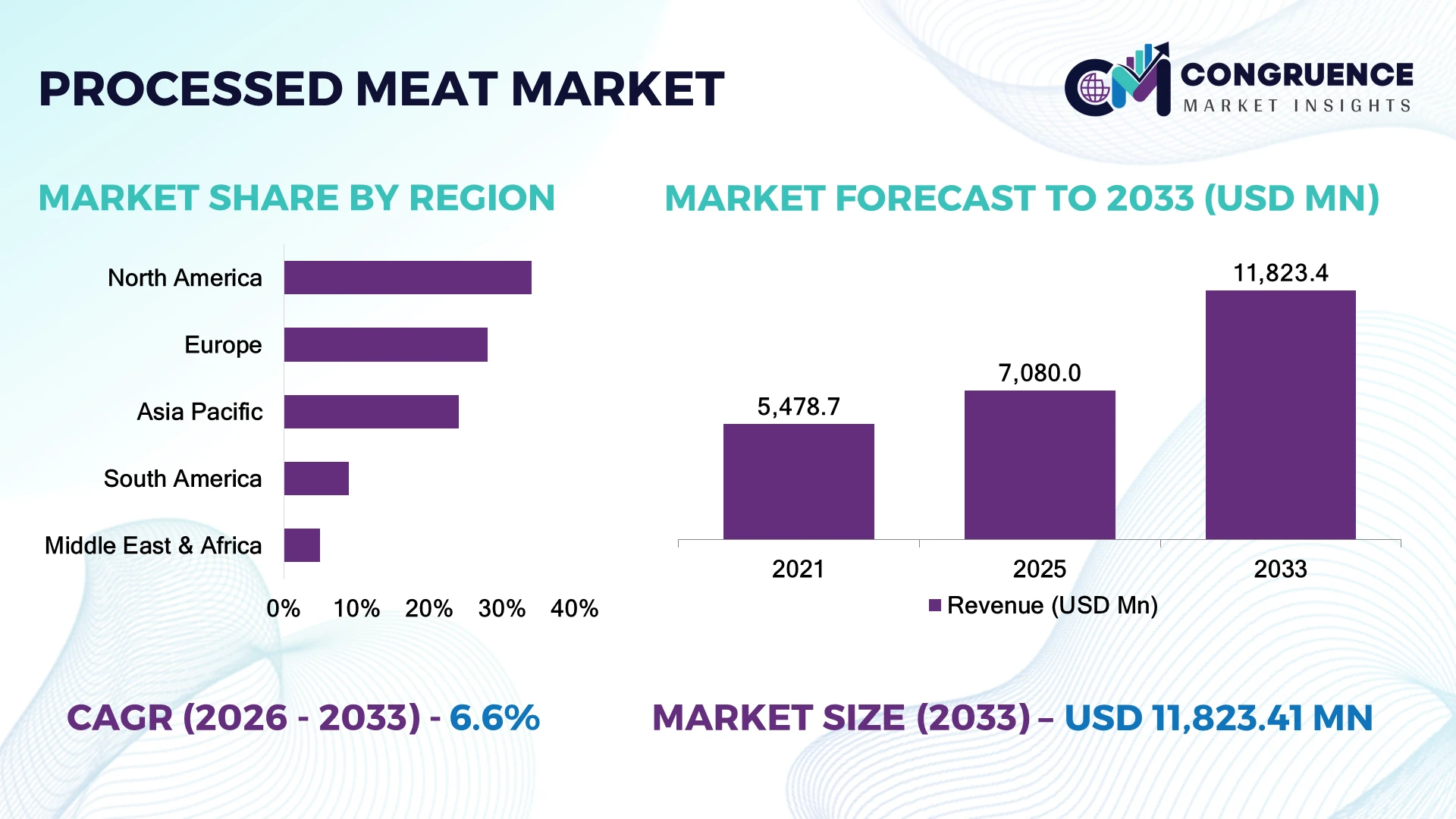
The Global Processed Meat Market was valued at USD 7,080.0 Million in 2025 and is anticipated to reach a value of USD 11,823.4 Million by 2033 expanding at a CAGR of 6.62% between 2026 and 2033. Growth is being accelerated by rapid expansion of cold-chain logistics, advanced meat preservation technologies, and increasing penetration of value-added protein products across retail and foodservice channels.
The United States remains the dominant country in the global processed meat landscape, accounting for approximately 19% of worldwide production value, supported by over USD 4 billion in annual meat processing investments and a highly automated manufacturing base where automation adoption exceeds 60% in large facilities. Compared with Germany, where automation penetration is near 45%, U.S. processors benefit from larger integrated supply networks and stronger foodservice demand. The country also strengthened domestic protein supply resilience following global trade and logistics disruptions linked to geopolitical tensions affecting agricultural commodity flows.
Strategically, market leaders are prioritizing automation, premium product portfolios, and supply-chain resilience to secure long-term competitive advantage.
Market Size & Growth: USD 7,080.0 million in 2025 is projected to reach USD 11,823.4 million by 2033, supported by 6.62% CAGR and expanding automated meat-processing capacity.
Top Growth Drivers: Convenience food consumption (+18%), cold-chain infrastructure expansion (+14%), and premium protein product adoption (+12%) continue to reshape demand.
Short-Term Forecast: By 2028, processing efficiency is expected to improve by nearly 15% through automation and digital quality-control deployment.
Emerging Technologies: AI-driven quality inspection, robotic slicing systems, and smart packaging technologies are reducing operational losses by up to 20%.
Regional Leaders: North America (~USD 3.4 billion), Europe (~USD 2.6 billion), and Asia Pacific (~USD 2.2 billion) lead expansion, supported by retail modernization and advanced distribution networks.
Consumer/End-User Trends: More than 55% of urban consumers regularly purchase ready-to-eat or ready-to-cook processed meat products for convenience.
Pilot/Case Example: In 2024, automated packaging upgrades at major European processing facilities improved throughput by approximately 17% while reducing labor dependency.
Competitive Landscape: The leading player controls roughly 8% market share, while Tyson Foods, WH Group, JBS, Hormel Foods, and Smithfield Foods remain influential global competitors.
Regulatory & ESG Impact: Sustainable packaging adoption increased by over 22%, while stricter food-safety compliance programs improved traceability rates by nearly 30%.
Investment & Funding: More than USD 5 billion has been allocated globally toward facility modernization, processing automation, and regional expansion initiatives.
Innovation & Future Outlook: High-protein formulations, clean-label processing, and digital traceability platforms are redefining competitive differentiation across global supply chains.
Processed meat products continue gaining traction across retail, foodservice, and convenience channels due to evolving consumer lifestyles and demand for extended shelf-life protein solutions. Manufacturers are introducing clean-label formulations, advanced packaging technologies, and sodium-reduction innovations. Nearly 35% of new product launches now emphasize premium or health-focused positioning. At the same time, tighter food-safety regulations and supply-chain optimization initiatives are encouraging investments in traceability and operational modernization, setting the stage for broader strategic transformation.
The processed meat market has become strategically important as food manufacturers, retailers, and foodservice operators seek reliable, scalable protein supply systems capable of supporting changing consumption patterns. Competition is increasingly influenced by supply-chain resilience, production efficiency, and the ability to deliver differentiated value-added products. Recent restructuring of sourcing networks and investments in domestic processing capacity have strengthened industry focus on operational security and production continuity.
Technology adoption is reshaping competitiveness across the value chain. AI-enabled quality inspection systems can improve defect detection accuracy by more than 25% compared with traditional manual inspection methods while reducing waste and rework costs. In the United States and Germany, automation adoption in large-scale facilities exceeds 50%, whereas several Southeast Asian markets remain focused on capacity expansion and infrastructure modernization to support growing consumption and exports.
Companies are expanding strategic partnerships with packaging providers, logistics operators, and digital traceability vendors to improve efficiency and compliance. For example, integrated smart-packaging deployment enables real-time product monitoring and inventory optimization. Over the next two to three years, adoption of digital monitoring platforms and automated processing systems is expected to accelerate, strengthening competitive positioning for manufacturers capable of combining operational efficiency, product innovation, and supply-chain agility.
The most influential growth driver is the rapid modernization of meat processing operations through automation, digital monitoring, and advanced preservation technologies. Automation adoption in large processing facilities has surpassed 60% in the United States, while robotic packaging utilization increased by nearly 20% over the past three years. Enhanced cold-chain networks have reduced spoilage rates by approximately 15%, improving supply reliability and product availability. Rising demand for premium ready-to-eat protein products has encouraged processors to expand production capacity and introduce value-added offerings. In response, leading companies are investing in automated slicing, packaging, and quality-control systems while pursuing partnerships with technology providers. A notable strategic insight is that operational efficiency now functions as a market differentiator rather than solely a cost-management tool, directly influencing retailer partnerships and procurement decisions.
Persistent volatility in livestock, feed, and energy markets continues to pressure industry margins. Feed costs have experienced fluctuations exceeding 25% in key agricultural markets, while energy expenses for cold-storage operations remain elevated compared with pre-disruption levels. In Germany and several European processing hubs, stricter environmental and animal welfare compliance requirements have increased operational expenditures by more than 10% for some facilities. These factors affect profitability, pricing flexibility, and expansion planning. Companies are mitigating exposure through long-term procurement agreements, supplier diversification strategies, and localized sourcing initiatives. A significant operational insight is that processors with vertically integrated supply networks demonstrate stronger resilience to commodity price swings, allowing them to maintain production consistency while protecting margins during periods of market instability.
A major opportunity lies in combining premium product development with digital traceability technologies. Consumer preference for premium and health-oriented meat products has increased by approximately 30% in several developed markets, while digital food traceability investments have grown by more than 20%. Smart labeling, blockchain-enabled verification, and AI-driven inventory management are emerging as important competitive tools. In China, investments in modern food-safety infrastructure continue to accelerate adoption of advanced tracking systems across protein supply chains. Companies are strengthening R&D capabilities, expanding premium product portfolios, and collaborating with technology vendors to enhance transparency. A less obvious strategic advantage is that traceability platforms not only improve compliance but also create measurable brand differentiation, enabling processors to command stronger retailer relationships and improve customer trust.
Long-term execution challenges increasingly stem from workforce shortages, integration complexity, and the need for continuous operational modernization. Labor shortages in food manufacturing have exceeded 12% across several developed economies, while implementation timelines for advanced processing systems can extend beyond 18 months. Facilities integrating robotics, AI inspection tools, and digital monitoring platforms often face training requirements that increase onboarding costs by nearly 15%. These challenges affect deployment consistency, productivity optimization, and long-term scalability. Companies are responding through workforce development programs, technology partnerships, and phased modernization strategies. A critical strategic insight is that future competitiveness will depend not only on technology acquisition but also on an organization's ability to integrate systems, develop skilled operators, and maintain consistent operational performance across increasingly complex production environments.
Advanced Traceability Platform Integration Food processors are accelerating deployment of digital traceability systems, with implementation rates rising by nearly 28% across large facilities and batch-level tracking accuracy improving by over 35%. New food-safety compliance requirements and export certification standards are driving adoption. Companies in the United States and China are integrating cloud-based monitoring tools with production workflows, reducing recall response times by approximately 20% while improving inventory visibility across complex distribution networks.
Premium Protein Portfolio Expansion Premium and clean-label processed meat launches increased by roughly 32%, while reduced-sodium product introductions expanded by 18% during the past two years. Health-conscious purchasing behavior and stricter labeling scrutiny are reshaping product development priorities. Manufacturers are restructuring portfolios, investing in ingredient innovation, and partnering with specialty suppliers to improve nutritional profiles without sacrificing shelf life, creating stronger differentiation in mature retail channels.
Labor-Saving Production Modernization Automated slicing, packaging, and inspection deployments have increased by nearly 25%, helping processors reduce manual handling requirements by 15% and improve line productivity by 12%. Labor shortages across Germany, the United Kingdom, and the United States continue to pressure operational efficiency. Companies are scaling robotics investments and redesigning plant workflows to maintain throughput consistency while lowering dependence on highly specialized labor pools.
Supply Network Localization Strategies Domestic sourcing programs expanded by approximately 22%, while long-distance procurement exposure declined by nearly 14% among major processors. Ongoing geopolitical trade uncertainties and transportation disruptions are encouraging localized supplier ecosystems. A notable emerging insight is that regional sourcing not only improves resilience but also shortens replenishment cycles, enabling faster product customization and more responsive retail inventory management.
Frozen processed meat products remain the leading segment, accounting for approximately 42% of market demand due to extended shelf life, lower spoilage risk, and efficient distribution across large retail networks. Their scalability and suitability for international trade continue to support dominance, particularly in the United States, China, and Brazil. Chilled processed meat products represent the fastest-growing segment as retailers expand fresh-food offerings and consumers increasingly prioritize perceived quality and convenience. Chilled product penetration has increased by nearly 18% in premium retail channels over the last few years.
Canned processed meat maintains strategic relevance in military, emergency food, and export applications where storage stability is critical. Other processed meat formats, including cured and specialty products, continue benefiting from premiumization trends and product diversification strategies. Manufacturers are allocating greater investment toward chilled logistics infrastructure, product innovation, and premium packaging solutions. More than 30% of major processors have expanded temperature-controlled distribution capacity to support changing consumption patterns and strengthen competitive positioning.
Retail distribution holds the largest share at approximately 48% of total market demand, supported by supermarket expansion, private-label growth, and increasing availability of value-added protein products. Strong consumer preference for convenient meal solutions continues to concentrate demand within modern retail channels. Product assortment expansion and digital grocery fulfillment capabilities have further strengthened retail dominance. Manufacturers increasingly prioritize retailer partnerships and category-specific product development to secure shelf space and improve brand visibility.
Foodservice is the fastest-growing application segment, driven by rapid expansion of quick-service restaurants, delivery-focused dining models, and institutional catering networks. Processed meat utilization within restaurant menus has increased by nearly 20% in several developed markets. Industrial applications, including food manufacturing and ingredient processing, remain strategically important for ready-meal production and large-scale food preparation. Companies are expanding production flexibility, integrating automated packaging systems, and strengthening distribution partnerships to meet evolving application requirements and improve supply responsiveness.
Households remain the dominant end-user group, representing approximately 55% of overall consumption due to widespread retail accessibility, convenience-driven purchasing behavior, and increasing demand for ready-to-cook protein products. Urban consumers continue favoring packaged meat solutions that reduce preparation time and improve meal consistency. Household demand remains particularly strong in the United States, China, and Japan, where convenience-oriented food consumption patterns support stable purchasing volumes.
Quick-service restaurants and foodservice operators constitute the fastest-growing end-user segment, supported by menu diversification, delivery platform expansion, and standardized food preparation requirements. Processed meat usage within organized restaurant operations has risen by roughly 17% in recent years. Institutional buyers, including schools, healthcare facilities, and corporate cafeterias, continue contributing stable demand through large-volume procurement contracts. In response, companies are introducing customized product formats, strengthening supply agreements, and developing segment-specific pricing strategies to improve customer retention and long-term market penetration.
North America accounted for the largest market share at 34% in 2025 however, Asia-Pacific is expected to register the fastest growth, expanding at a CAGR of 7.4% between 2026 and 2033.
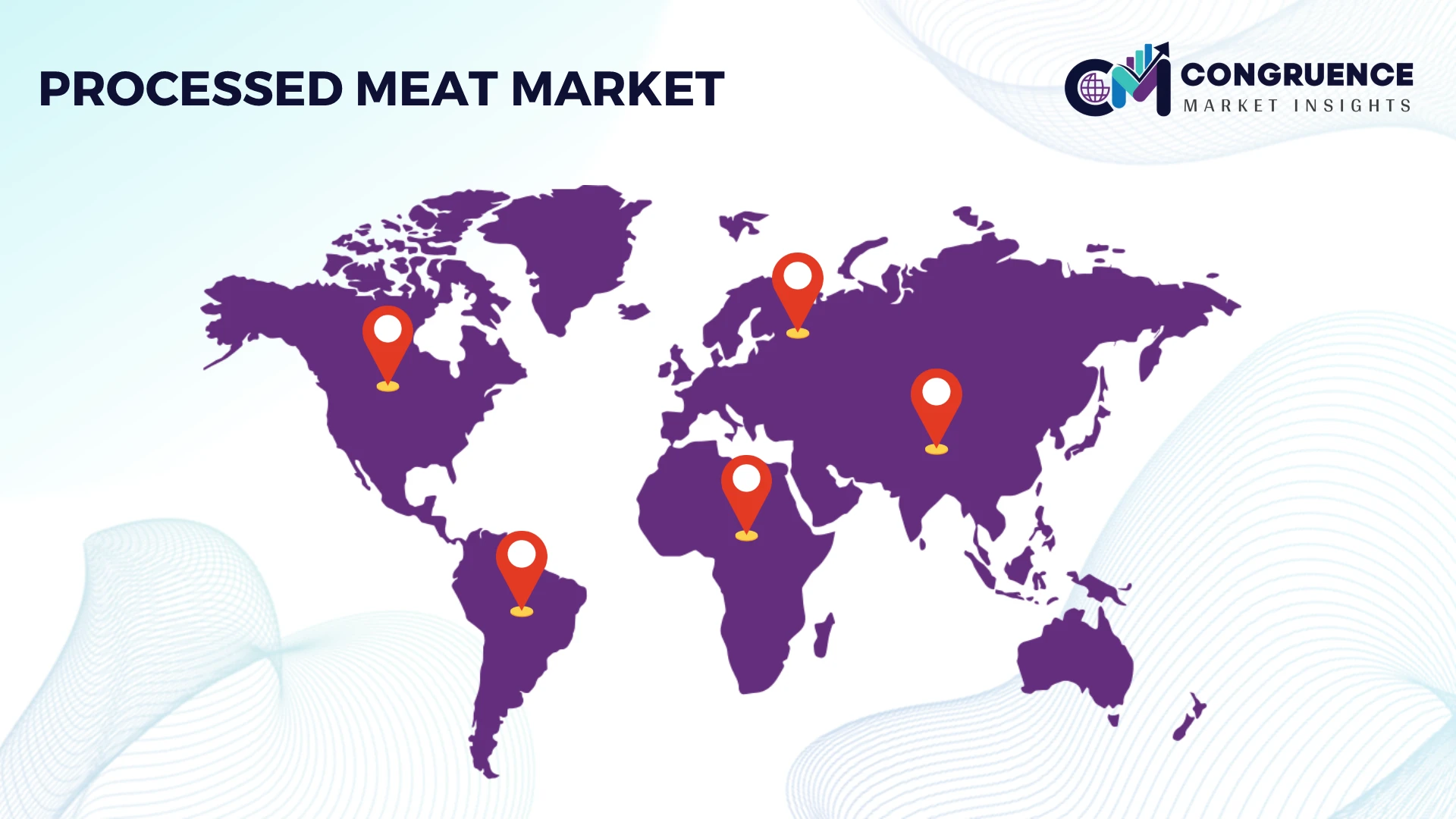
North America represents approximately 34% of global processed meat consumption and production, supported by highly integrated protein supply chains, advanced cold-storage infrastructure, and extensive retail distribution networks. The region maintains a strong position through large-scale processing facilities, sophisticated logistics systems, and widespread adoption of automation technologies. More than 60% of large processing plants utilize automated packaging and inspection systems to improve throughput and consistency. Rising demand for premium, clean-label, and ready-to-cook products is encouraging manufacturers to modernize facilities and optimize product portfolios. Companies continue investing in traceability platforms and production efficiency initiatives, while strategic partnerships between processors and retailers are strengthening category expansion. Ongoing investments in cold-chain capacity and digital inventory management are further improving operational responsiveness and reducing distribution inefficiencies.
United States Market Outlook: The United States remains the region’s most influential market due to its extensive meat-processing ecosystem, advanced manufacturing capabilities, and strong foodservice sector. The country accounts for more than 70% of North America's processed meat production capacity and benefits from a highly developed refrigerated logistics network. Large processors continue expanding automation programs, with robotic processing deployment increasing by nearly 20% in major facilities over recent years. Strong retail penetration, advanced food-safety systems, and ongoing investments in digital traceability infrastructure position the United States as a global benchmark for operational efficiency and protein supply-chain management.
Europe accounts for approximately 28% of the global market and remains a major center for premium processed meat production, food safety innovation, and sustainable manufacturing practices. Regulatory compliance, nutritional reformulation, and advanced packaging technologies are driving operational transformation across the industry. Processors are increasingly investing in energy-efficient production systems and enhanced traceability capabilities to comply with evolving food regulations. More than 40% of new product introductions emphasize reduced-sodium, clean-label, or premium positioning. Established retail networks and strong export capabilities continue supporting production stability, while investments in sustainable packaging and resource-efficient operations strengthen long-term competitiveness. Enterprise-level modernization initiatives are accelerating across major processing hubs to improve production flexibility and compliance performance.
Germany Market Outlook: Germany serves as Europe's strategic processing hub due to its advanced food manufacturing infrastructure, engineering expertise, and export-oriented meat industry. The country operates one of the continent’s largest meat-processing networks and maintains strong integration between production, packaging, and distribution functions. Automation adoption exceeds 50% among large-scale facilities, supporting productivity and quality consistency. Germany’s emphasis on food safety compliance, operational efficiency, and sustainable processing technologies continues attracting investment in modernization projects, strengthening its role as a key supplier for both domestic and international markets.
Asia-Pacific represents approximately 24% of the global market and is the fastest-evolving regional landscape for processed meat consumption and production. Expanding urban populations, growing cold-chain infrastructure, and rapid modernization of retail channels are reshaping demand patterns. Organized retail penetration has increased significantly across China, India, and Southeast Asia, supporting broader availability of packaged protein products. Processing capacity expansion and investment in refrigerated logistics continue strengthening regional supply chains. Several major processors are scaling manufacturing footprints to improve domestic supply security and reduce import dependence. Enhanced distribution infrastructure and increasing adoption of modern packaging technologies are improving product quality, shelf life, and market accessibility throughout the region.
China Market Outlook: China remains the dominant market within Asia-Pacific due to its massive consumer base, expanding protein-processing industry, and ongoing food-safety modernization efforts. The country accounts for a substantial share of regional processed meat consumption and continues investing heavily in cold-chain logistics and production infrastructure. Refrigerated warehouse capacity has expanded by more than 25% in recent years, supporting efficient distribution and inventory management. Strong government emphasis on food traceability and supply-chain resilience is encouraging processors to deploy advanced monitoring technologies and modern production systems across the value chain.
South America holds approximately 9% of the global market and plays a significant role in international processed meat supply. The region benefits from abundant livestock resources, competitive production economics, and expanding export capabilities. Large-scale processing facilities continue investing in modernization initiatives to improve product quality and meet international compliance standards. Export-oriented production remains a defining characteristic, with processors strengthening cold-storage infrastructure and logistics capabilities to support cross-border distribution. However, transportation bottlenecks and infrastructure variability continue creating operational challenges in some markets. Companies are responding through targeted investments in processing efficiency, supply-chain integration, and distribution network enhancement to improve reliability and market reach.
Brazil Market Outlook: Brazil is the region’s undisputed leader due to its extensive livestock base, globally competitive meat industry, and strong export infrastructure. The country operates some of the world's largest meat-processing enterprises and serves major international markets across Asia, Europe, and the Middle East. Export-focused processors continue investing in advanced production technologies and compliance systems. More than half of Brazil's processed meat output is linked directly or indirectly to international trade channels, reinforcing the country's strategic importance in global protein supply chains and supporting continued infrastructure development.
Middle East & Africa account for approximately 5% of the global market and are increasingly shaped by investments in food security, refrigerated logistics, and domestic food-processing capabilities. Governments and private enterprises are prioritizing modernization of food supply systems to reduce import vulnerabilities and improve product availability. Expansion of temperature-controlled warehousing and distribution networks is strengthening market accessibility across urban centers. Processors are investing in packaging modernization and production upgrades to improve quality standards and shelf-life performance. Rising demand for convenience foods and organized retail expansion continue supporting market development. Strategic partnerships between local distributors and international food companies are also improving technology transfer and operational capabilities.
Saudi Arabia Market Outlook: Saudi Arabia represents the region’s most strategically important market due to its food-security initiatives, advanced retail sector, and sustained investment in food manufacturing infrastructure. The country continues expanding cold-chain capacity and processing facilities to strengthen domestic production capabilities. Refrigerated logistics investments have increased substantially as part of broader economic diversification efforts. Strong regulatory oversight, growing consumer demand for packaged protein products, and ongoing modernization of food distribution systems position Saudi Arabia as a key regional hub for processed meat production, storage, and distribution activities.
The competitive landscape is led by JBS, Tyson Foods, WH Group, Hormel Foods, and BRF, which collectively control approximately 38%–42% of global market activity. Competition is primarily between multinational integrated protein processors and regional processors focused on cost efficiency and local distribution strength. Global leaders compete through supply-chain control, brand portfolios, and processing scale, while regional players challenge through pricing flexibility and market proximity. Automation adoption among leading processors exceeds 60%, reducing processing costs by nearly 15%, while digital traceability programs improve inventory visibility by approximately 25%. Companies are expanding through facility modernization, cold-chain investments, strategic partnerships, and vertical integration across livestock sourcing, processing, and distribution. The current competitive shift favors operators with stronger supply security and value-added product capabilities as clean-label and premium offerings gain share. Regulatory compliance, food-safety requirements, and capital-intensive cold-chain infrastructure remain significant entry barriers. Winning requires operational scale, resilient sourcing networks, advanced processing technologies, differentiated product portfolios, and rapid adaptation to changing consumer preferences.
JBS S.A.
WH Group Limited
Hormel Foods Corporation
BRF S.A.
Danish Crown A/S
NH Foods Ltd.
Smithfield Foods, Inc.
Maple Leaf Foods Inc.
Tönnies Holding ApS & Co. KG
OSI Group LLC
Vion Food Group
Seaboard Corporation
Pilgrim’s Pride Corporation
Advanced automation technologies are becoming central to processed meat operations. Robotic cutting, automated slicing, and intelligent packaging systems now operate in more than 55% of large-scale facilities across developed markets. Automated production lines improve throughput efficiency by approximately 15% while reducing labor dependency by nearly 20%. AI-powered quality inspection platforms identify defects and contamination risks faster than manual inspection processes, improving quality consistency and reducing waste. Companies with large integrated processing networks benefit most from these deployments because they can scale productivity improvements across multiple facilities.
Emerging technologies increasingly focus on traceability, predictive analytics, and smart packaging. Digital traceability systems improve inventory visibility by roughly 25% and shorten recall response times by more than 20%. Compared with traditional batch-record management, blockchain-enabled monitoring can improve traceability accuracy by nearly 30%. Smart packaging solutions equipped with freshness indicators are gaining adoption among premium product manufacturers seeking stronger retail differentiation and supply-chain transparency.
Between 2026 and 2028, predictive maintenance platforms, AI-driven demand forecasting, and digital twin production environments are expected to reshape operational decision-making. Early deployments indicate maintenance-related downtime reductions of approximately 12%. Companies investing now gain stronger supply-chain control, faster production adjustments, and greater resilience against labor shortages and compliance pressures, creating a measurable competitive advantage.
May 2025 – Hormel Foods began operations at its new Memphis-area distribution center, strengthening logistics efficiency and improving delivery responsiveness across key markets. The facility supports faster order fulfillment and network optimization as demand for value-added protein products expands. Business impact: improved supply-chain agility and service performance. Source: (Hormel Foods)
February 2025 – Tyson Foods announced leadership restructuring, expanding oversight of its Prepared Foods business and supply-chain operations under a broader growth strategy. The move aligns major protein segments under integrated management. Business impact: stronger operational coordination and portfolio execution. Source: (Tyson Foods SEC Release)
September 2025 – Tyson Foods confirmed removal of high-fructose corn syrup and selected additives across major brands including Jimmy Dean and Hillshire Farm. The initiative affects a significant portion of its packaged product portfolio. Business impact: stronger clean-label positioning and improved consumer trust. Source: (People.com Coverage)
October 2025 – JBS announced a USD 70 million investment program in Paraguay, including acquisition and expansion of a poultry processing facility targeting 100,000 birds per day processing capacity. Business impact: enhanced production diversification and stronger export competitiveness. Source: (Reuters Report)
This report provides comprehensive analysis of the global processed meat industry across major product categories, applications, end-user groups, and geographic markets. Coverage includes frozen, chilled, canned, cured, and specialty processed meat products, alongside retail, foodservice, industrial, and institutional demand channels. The study evaluates market positioning across North America, Europe, Asia-Pacific, South America, and the Middle East & Africa, with country-level assessment of key production and consumption hubs. More than 55% of industry activity remains concentrated within large-scale integrated processing networks, making operational efficiency and supply-chain capability central evaluation metrics.
The report further examines automation adoption, digital traceability deployment, smart packaging technologies, cold-chain modernization, and premium product innovation trends shaping competitive dynamics between 2026 and 2033. Strategic insights cover procurement structures, manufacturing optimization, distribution models, regulatory developments, investment priorities, partnership activity, and competitive positioning. The analysis supports expansion planning, portfolio development, risk assessment, and long-term decision-making for processors, suppliers, distributors, investors, and industry stakeholders.
| Report Attribute / Metric | Details |
|---|---|
| Market Revenue (2025) | USD 7,080.0 Million |
| Market Revenue (2033) | USD 11,823.4 Million |
| CAGR (2026–2033) | 6.62% |
| Base Year | 2025 |
| Forecast Period | 2026–2033 |
| Historic Period | 2021–2025 |
| Segments Covered |
By Type
By Application
By End-User
|
| Key Deliverables | Revenue Forecast; Market Trends; Growth Drivers & Restraints; Technology Insights; Segmentation Analysis; Regional Insights; Competitive Landscape; Regulatory & ESG Overview; Recent Developments |
| Regions Covered | North America; Europe; Asia-Pacific; South America; Middle East & Africa |
| Companies Profiled | Tyson Foods, Inc.; JBS S.A.; WH Group Limited; Hormel Foods Corporation; BRF S.A.; Danish Crown A/S; NH Foods Ltd.; Smithfield Foods, Inc.; Maple Leaf Foods Inc.; Tönnies Holding ApS & Co. KG; OSI Group LLC; Vion Food Group; Seaboard Corporation; Pilgrim’s Pride Corporation |
| Customization & Pricing | Available on Request (10% Customization Free) |




